break NISSAN PATROL 2000 Electronic Repair Manual
[x] Cancel search | Manufacturer: NISSAN, Model Year: 2000, Model line: PATROL, Model: NISSAN PATROL 2000Pages: 1033, PDF Size: 30.71 MB
Page 241 of 1033
Precautions
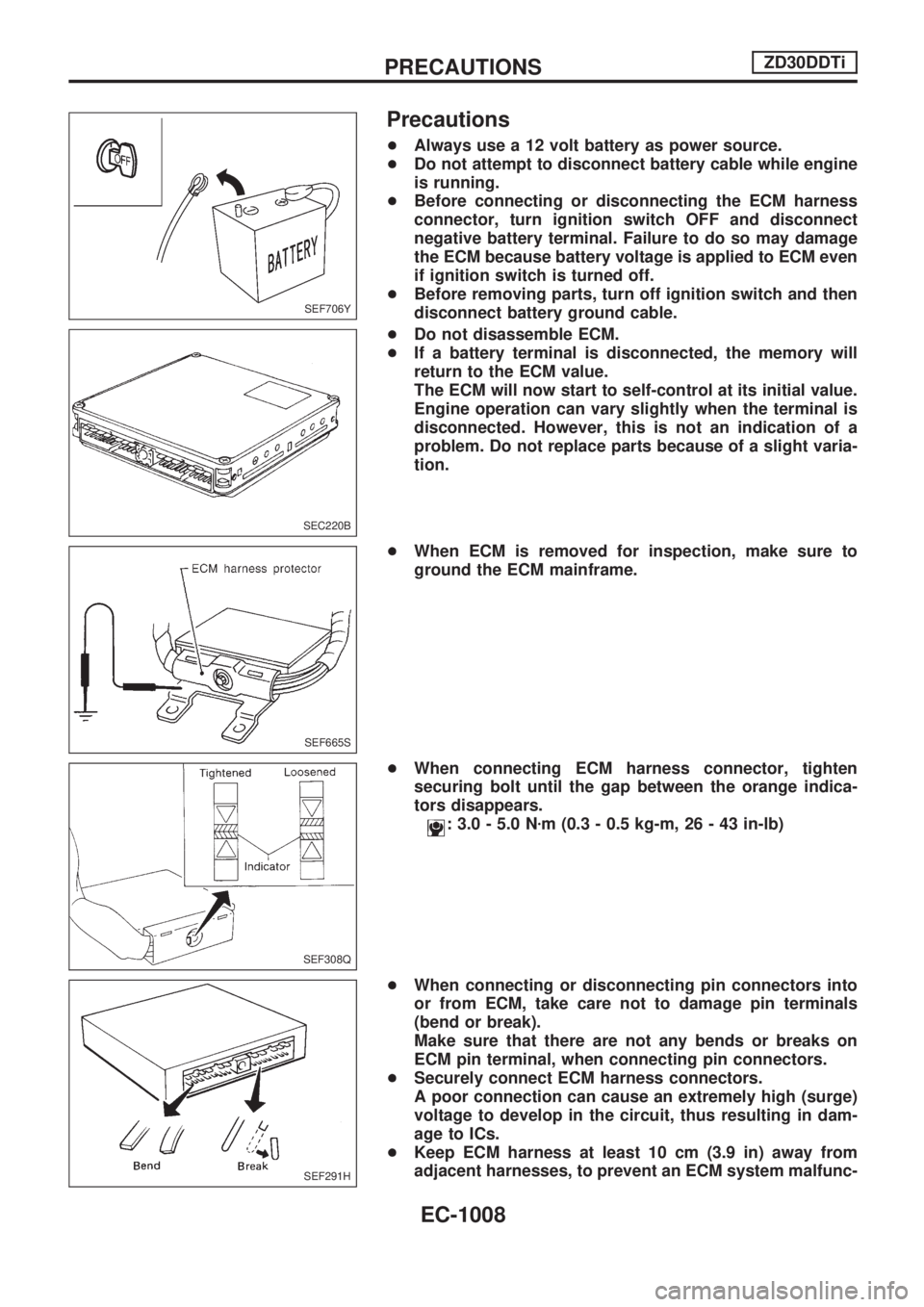
+Always use a 12 volt battery as power source.
+Do not attempt to disconnect battery cable while engine
is running.
+Before connecting or disconnecting the ECM harness
connector, turn ignition switch OFF and disconnect
negative battery terminal. Failure to do so may damage
the ECM because battery voltage is applied to ECM even
if ignition switch is turned off.
+Before removing parts, turn off ignition switch and then
disconnect battery ground cable.
+Do not disassemble ECM.
+If a battery terminal is disconnected, the memory will
return to the ECM value.
The ECM will now start to self-control at its initial value.
Engine operation can vary slightly when the terminal is
disconnected. However, this is not an indication of a
problem. Do not replace parts because of a slight varia-
tion.
+When ECM is removed for inspection, make sure to
ground the ECM mainframe.
+When connecting ECM harness connector, tighten
securing bolt until the gap between the orange indica-
tors disappears.
: 3.0 - 5.0 Nzm (0.3 - 0.5 kg-m, 26 - 43 in-lb)
+When connecting or disconnecting pin connectors into
or from ECM, take care not to damage pin terminals
(bend or break).
Make sure that there are not any bends or breaks on
ECM pin terminal, when connecting pin connectors.
+Securely connect ECM harness connectors.
A poor connection can cause an extremely high (surge)
voltage to develop in the circuit, thus resulting in dam-
age to ICs.
+Keep ECM harness at least 10 cm (3.9 in) away from
adjacent harnesses, to prevent an ECM system malfunc-
SEF706Y
SEC220B
SEF665S
SEF308Q
SEF291H
PRECAUTIONSZD30DDTi
EC-1008
Page 286 of 1033
9 CHECK AIR CLEANER FILTER
Check air cleaner filter for clogging or breaks.
OK or NG
OKcGO TO 10.
NGcReplace air cleaner filter.
10 CHECK FUEL INJECTION NOZZLE
Check fuel injection nozzle opening pressure. Refer to ªInjection pressure testº, EC-1025.
OK or NG
OKcGO TO 11.
NGcReplace fuel injection nozzle assembly.
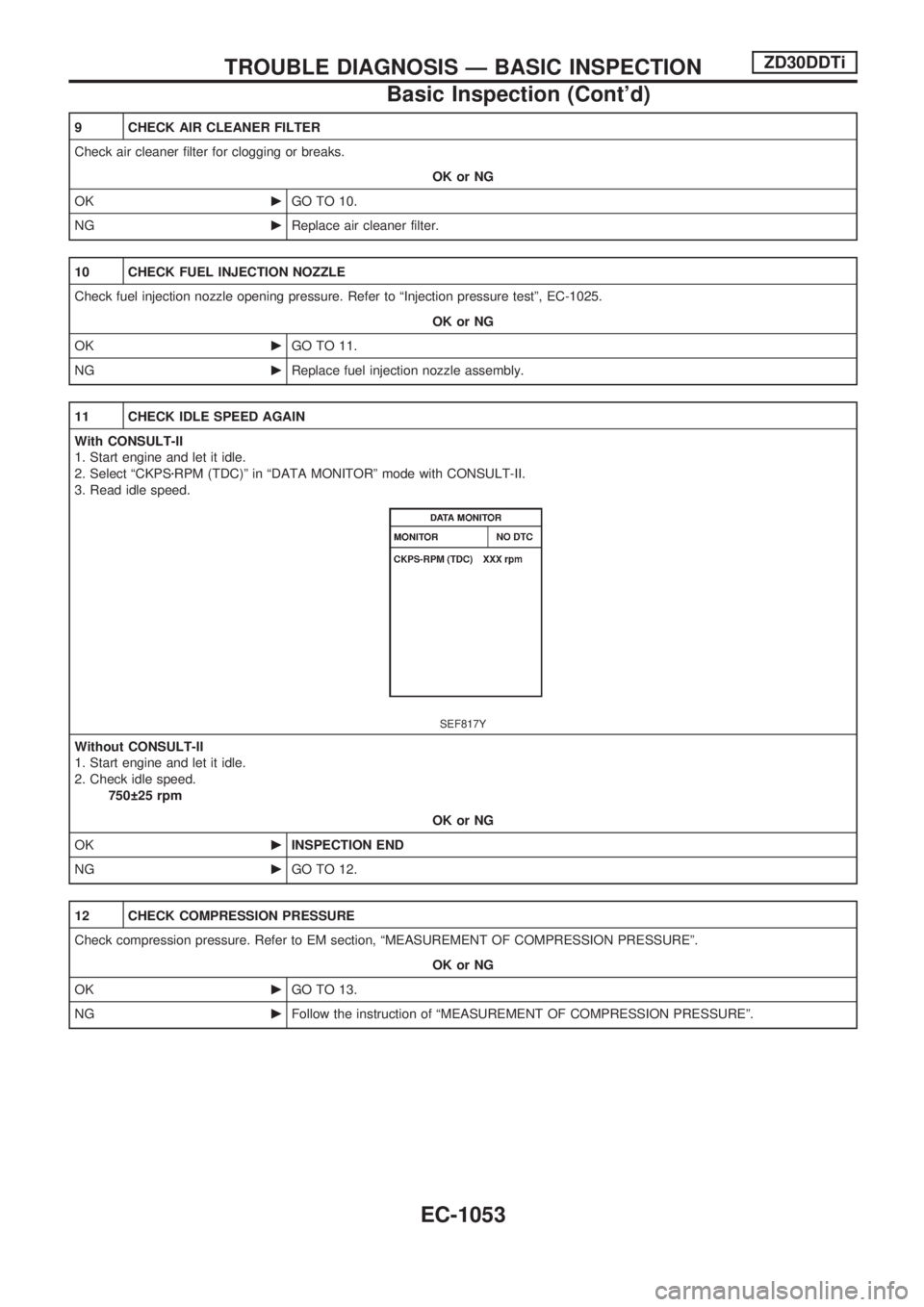
11 CHECK IDLE SPEED AGAIN
With CONSULT-II
1. Start engine and let it idle.
2. Select ªCKPSzRPM (TDC)º in ªDATA MONITORº mode with CONSULT-II.
3. Read idle speed.
SEF817Y
Without CONSULT-II
1. Start engine and let it idle.
2. Check idle speed.
750 25 rpm
OK or NG
OKcINSPECTION END
NGcGO TO 12.
12 CHECK COMPRESSION PRESSURE
Check compression pressure. Refer to EM section, ªMEASUREMENT OF COMPRESSION PRESSUREº.
OK or NG
OKcGO TO 13.
NGcFollow the instruction of ªMEASUREMENT OF COMPRESSION PRESSUREº.
TROUBLE DIAGNOSIS Ð BASIC INSPECTIONZD30DDTi
Basic Inspection (Cont'd)
EC-1053
Page 632 of 1033
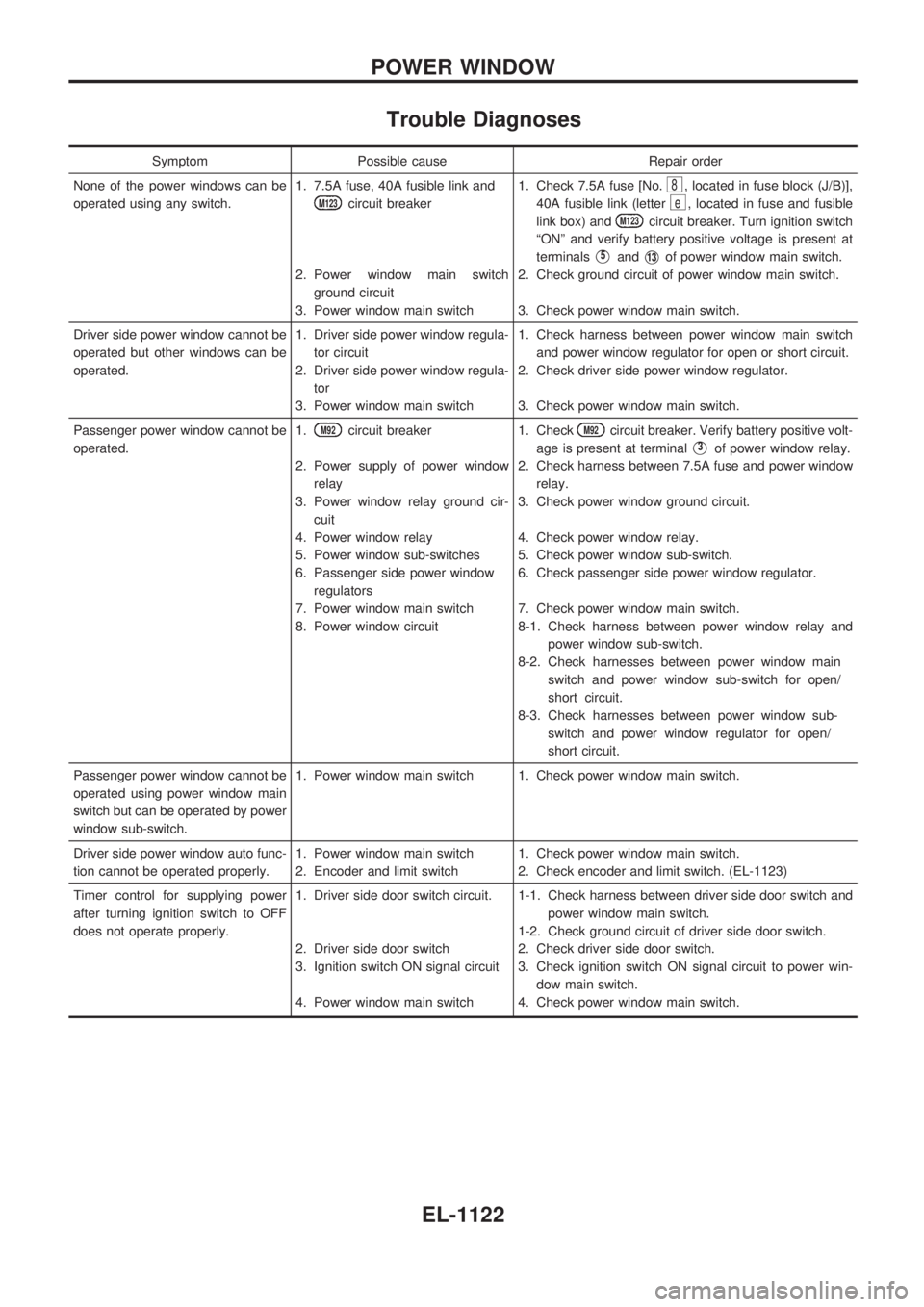
Trouble Diagnoses
Symptom Possible cause Repair order
None of the power windows can be
operated using any switch.1. 7.5A fuse, 40A fusible link and
M123circuit breaker
2. Power window main switch
ground circuit
3. Power window main switch1. Check 7.5A fuse [No.
8, located in fuse block (J/B)],
40A fusible link (letter
e, located in fuse and fusible
link box) and
M123circuit breaker. Turn ignition switch
ªONº and verify battery positive voltage is present at
terminals
V5andV13of power window main switch.
2. Check ground circuit of power window main switch.
3. Check power window main switch.
Driver side power window cannot be
operated but other windows can be
operated.1. Driver side power window regula-
tor circuit
2. Driver side power window regula-
tor
3. Power window main switch1. Check harness between power window main switch
and power window regulator for open or short circuit.
2. Check driver side power window regulator.
3. Check power window main switch.
Passenger power window cannot be
operated.1.
M92circuit breaker
2. Power supply of power window
relay
3. Power window relay ground cir-
cuit
4. Power window relay
5. Power window sub-switches
6. Passenger side power window
regulators
7. Power window main switch
8. Power window circuit1. CheckM92circuit breaker. Verify battery positive volt-
age is present at terminal
V3of power window relay.
2. Check harness between 7.5A fuse and power window
relay.
3. Check power window ground circuit.
4. Check power window relay.
5. Check power window sub-switch.
6. Check passenger side power window regulator.
7. Check power window main switch.
8-1. Check harness between power window relay and
power window sub-switch.
8-2. Check harnesses between power window main
switch and power window sub-switch for open/
short circuit.
8-3. Check harnesses between power window sub-
switch and power window regulator for open/
short circuit.
Passenger power window cannot be
operated using power window main
switch but can be operated by power
window sub-switch.1. Power window main switch 1. Check power window main switch.
Driver side power window auto func-
tion cannot be operated properly.1. Power window main switch
2. Encoder and limit switch1. Check power window main switch.
2. Check encoder and limit switch. (EL-1123)
Timer control for supplying power
after turning ignition switch to OFF
does not operate properly.1. Driver side door switch circuit.
2. Driver side door switch
3. Ignition switch ON signal circuit
4. Power window main switch1-1. Check harness between driver side door switch and
power window main switch.
1-2. Check ground circuit of driver side door switch.
2. Check driver side door switch.
3. Check ignition switch ON signal circuit to power win-
dow main switch.
4. Check power window main switch.
POWER WINDOW
EL-1122
Page 748 of 1033
1. Warm up engine.
2. Turn ignition switch OFF.
3.
Using CONSULT-II, make sure no error codes are indicated for
self-diagnosis items. Refer to EC section, ªFuel Pressure
Releaseº.
+Do not disconnect CONSULT-II until the end of this opera-
tion; it will be used to check engine rpm and for error detec-
tion at the end of this operation.
4. Disconnect the negative battery terminal.
5. Remove the following parts.
+Intercooler cover
+Intercooler
+Throttle body
+Rocker cover
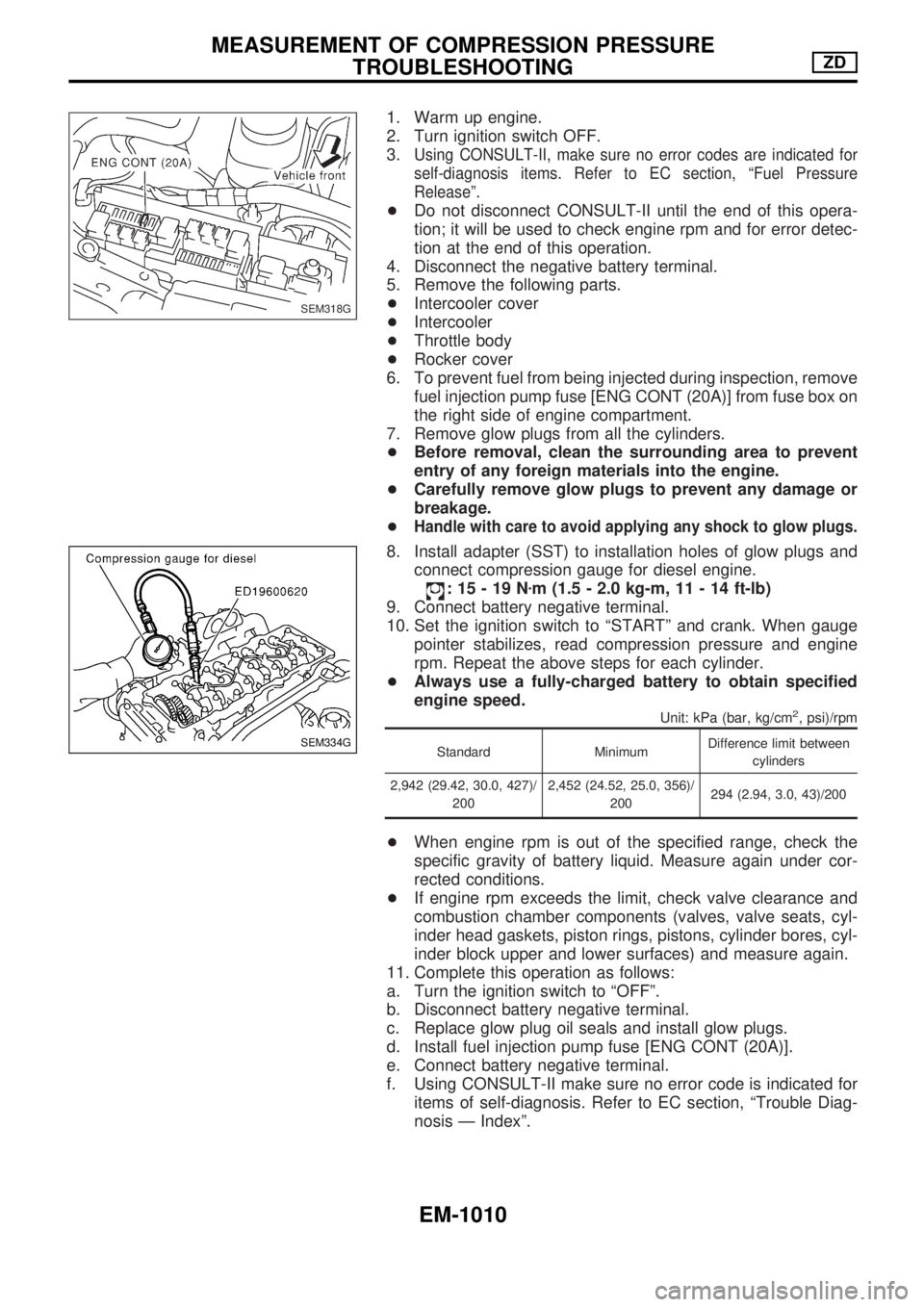
6. To prevent fuel from being injected during inspection, remove
fuel injection pump fuse [ENG CONT (20A)] from fuse box on
the right side of engine compartment.
7. Remove glow plugs from all the cylinders.
+Before removal, clean the surrounding area to prevent
entry of any foreign materials into the engine.
+Carefully remove glow plugs to prevent any damage or
breakage.
+
Handle with care to avoid applying any shock to glow plugs.
8. Install adapter (SST) to installation holes of glow plugs and
connect compression gauge for diesel engine.
:15-19Nzm (1.5 - 2.0 kg-m, 11 - 14 ft-lb)
9. Connect battery negative terminal.
10. Set the ignition switch to ªSTARTº and crank. When gauge
pointer stabilizes, read compression pressure and engine
rpm. Repeat the above steps for each cylinder.
+Always use a fully-charged battery to obtain specified
engine speed.
Unit: kPa (bar, kg/cm2, psi)/rpm
Standard MinimumDifference limit between
cylinders
2,942 (29.42, 30.0, 427)/
2002,452 (24.52, 25.0, 356)/
200294 (2.94, 3.0, 43)/200
+When engine rpm is out of the specified range, check the
specific gravity of battery liquid. Measure again under cor-
rected conditions.
+If engine rpm exceeds the limit, check valve clearance and
combustion chamber components (valves, valve seats, cyl-
inder head gaskets, piston rings, pistons, cylinder bores, cyl-
inder block upper and lower surfaces) and measure again.
11. Complete this operation as follows:
a. Turn the ignition switch to ªOFFº.
b. Disconnect battery negative terminal.
c. Replace glow plug oil seals and install glow plugs.
d. Install fuel injection pump fuse [ENG CONT (20A)].
e. Connect battery negative terminal.
f. Using CONSULT-II make sure no error code is indicated for
items of self-diagnosis. Refer to EC section, ªTrouble Diag-
nosis Ð Indexº.
SEM318G
SEM334G
MEASUREMENT OF COMPRESSION PRESSURE
TROUBLESHOOTINGZD
EM-1010
Page 792 of 1033
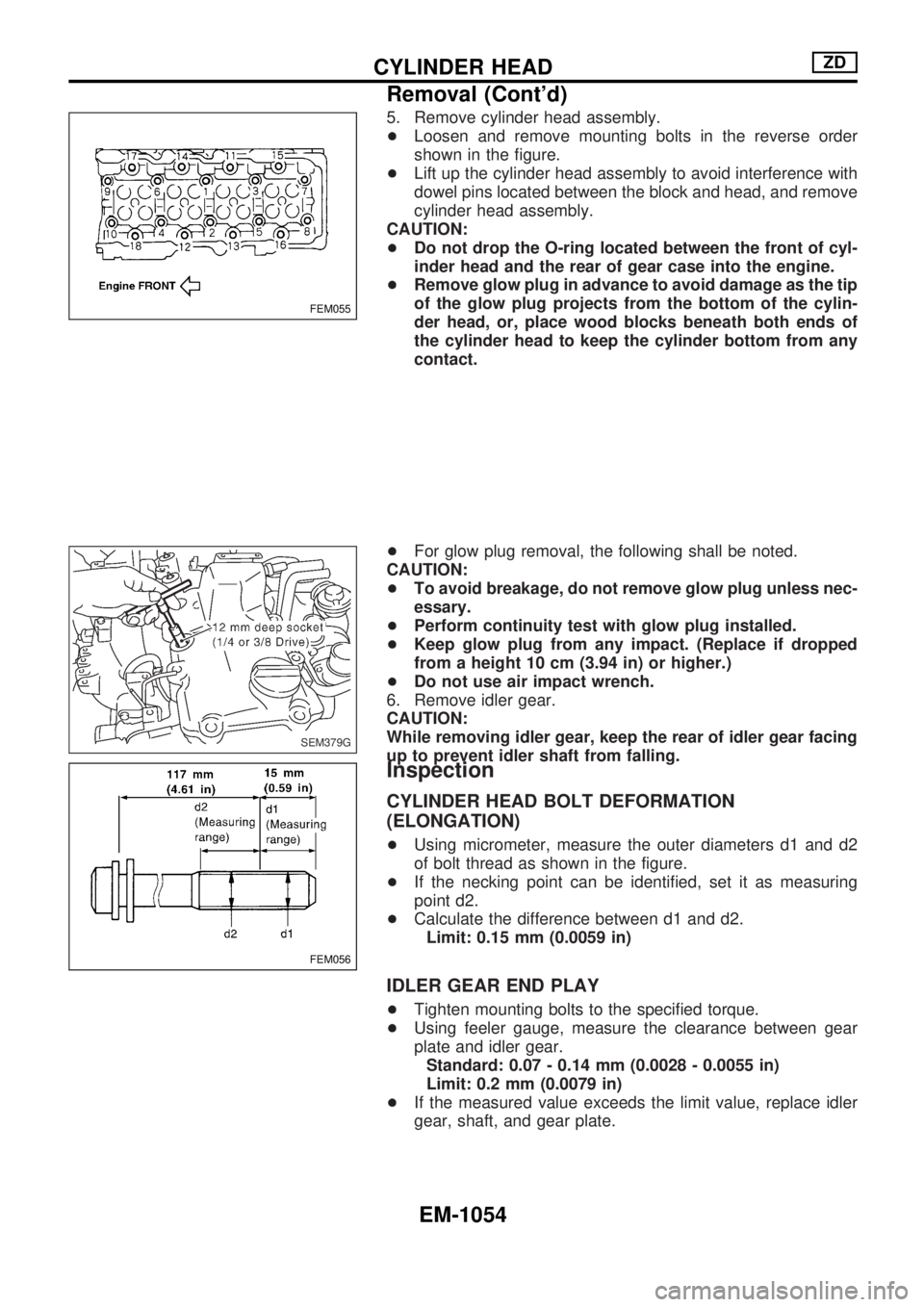
5. Remove cylinder head assembly.
+Loosen and remove mounting bolts in the reverse order
shown in the figure.
+Lift up the cylinder head assembly to avoid interference with
dowel pins located between the block and head, and remove
cylinder head assembly.
CAUTION:
+Do not drop the O-ring located between the front of cyl-
inder head and the rear of gear case into the engine.
+Remove glow plug in advance to avoid damage as the tip
of the glow plug projects from the bottom of the cylin-
der head, or, place wood blocks beneath both ends of
the cylinder head to keep the cylinder bottom from any
contact.
+For glow plug removal, the following shall be noted.
CAUTION:
+To avoid breakage, do not remove glow plug unless nec-
essary.
+Perform continuity test with glow plug installed.
+Keep glow plug from any impact. (Replace if dropped
from a height 10 cm (3.94 in) or higher.)
+Do not use air impact wrench.
6. Remove idler gear.
CAUTION:
While removing idler gear, keep the rear of idler gear facing
up to prevent idler shaft from falling.
Inspection
CYLINDER HEAD BOLT DEFORMATION
(ELONGATION)
+Using micrometer, measure the outer diameters d1 and d2
of bolt thread as shown in the figure.
+If the necking point can be identified, set it as measuring
point d2.
+Calculate the difference between d1 and d2.
Limit: 0.15 mm (0.0059 in)
IDLER GEAR END PLAY
+Tighten mounting bolts to the specified torque.
+Using feeler gauge, measure the clearance between gear
plate and idler gear.
Standard: 0.07 - 0.14 mm (0.0028 - 0.0055 in)
Limit: 0.2 mm (0.0079 in)
+If the measured value exceeds the limit value, replace idler
gear, shaft, and gear plate.
FEM055
SEM379G
FEM056
CYLINDER HEADZD
Removal (Cont'd)
EM-1054
Page 889 of 1033
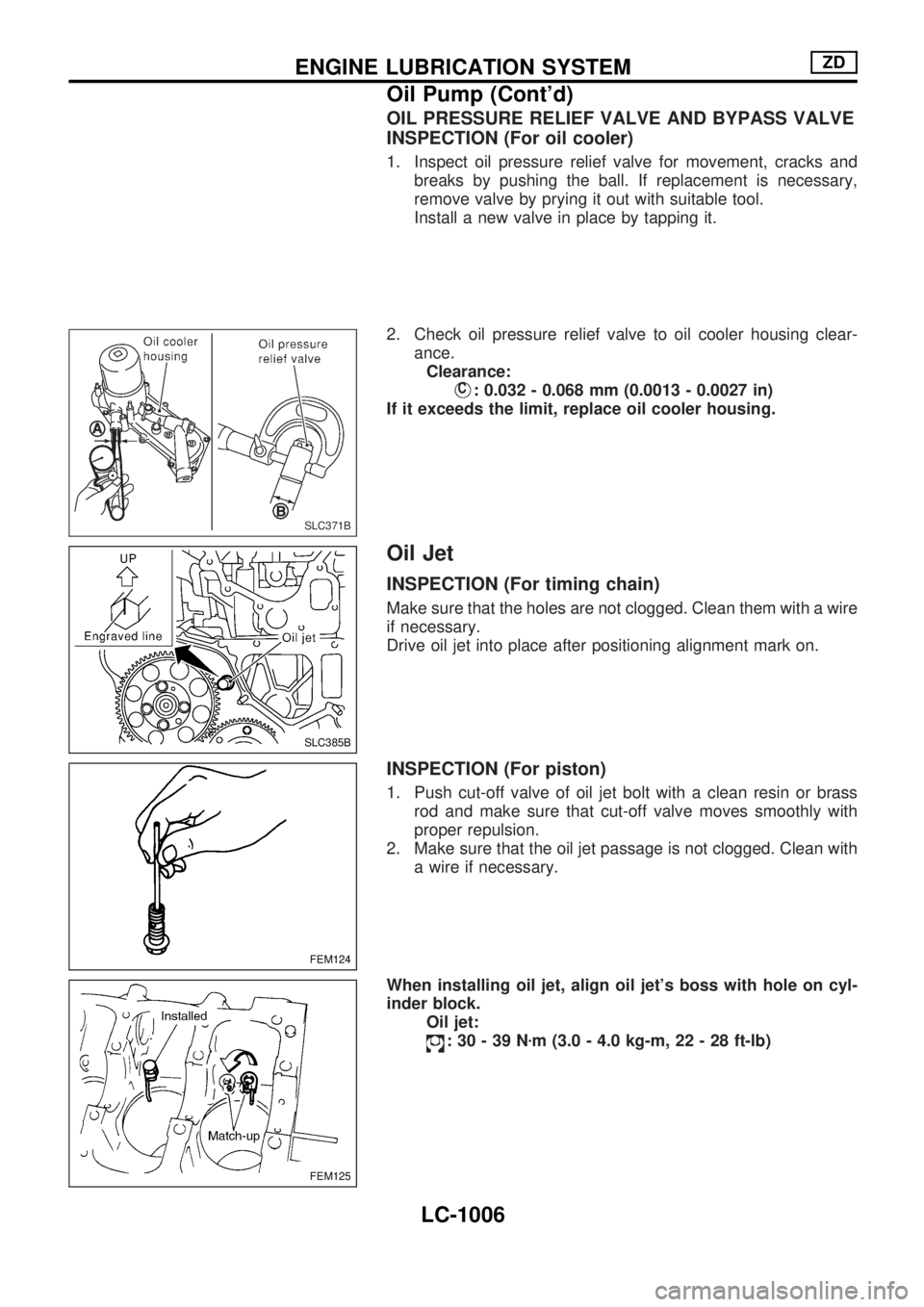
OIL PRESSURE RELIEF VALVE AND BYPASS VALVE
INSPECTION (For oil cooler)
1. Inspect oil pressure relief valve for movement, cracks and
breaks by pushing the ball. If replacement is necessary,
remove valve by prying it out with suitable tool.
Install a new valve in place by tapping it.
2. Check oil pressure relief valve to oil cooler housing clear-
ance.
Clearance:
VC: 0.032 - 0.068 mm (0.0013 - 0.0027 in)
If it exceeds the limit, replace oil cooler housing.
Oil Jet
INSPECTION (For timing chain)
Make sure that the holes are not clogged. Clean them with a wire
if necessary.
Drive oil jet into place after positioning alignment mark on.
INSPECTION (For piston)
1. Push cut-off valve of oil jet bolt with a clean resin or brass
rod and make sure that cut-off valve moves smoothly with
proper repulsion.
2. Make sure that the oil jet passage is not clogged. Clean with
a wire if necessary.
When installing oil jet, align oil jet's boss with hole on cyl-
inder block.
Oil jet:
:30-39Nzm (3.0 - 4.0 kg-m, 22 - 28 ft-lb)
SLC371B
SLC385B
FEM124
FEM125
ENGINE LUBRICATION SYSTEMZD
Oil Pump (Cont'd)
LC-1006
Page 977 of 1033
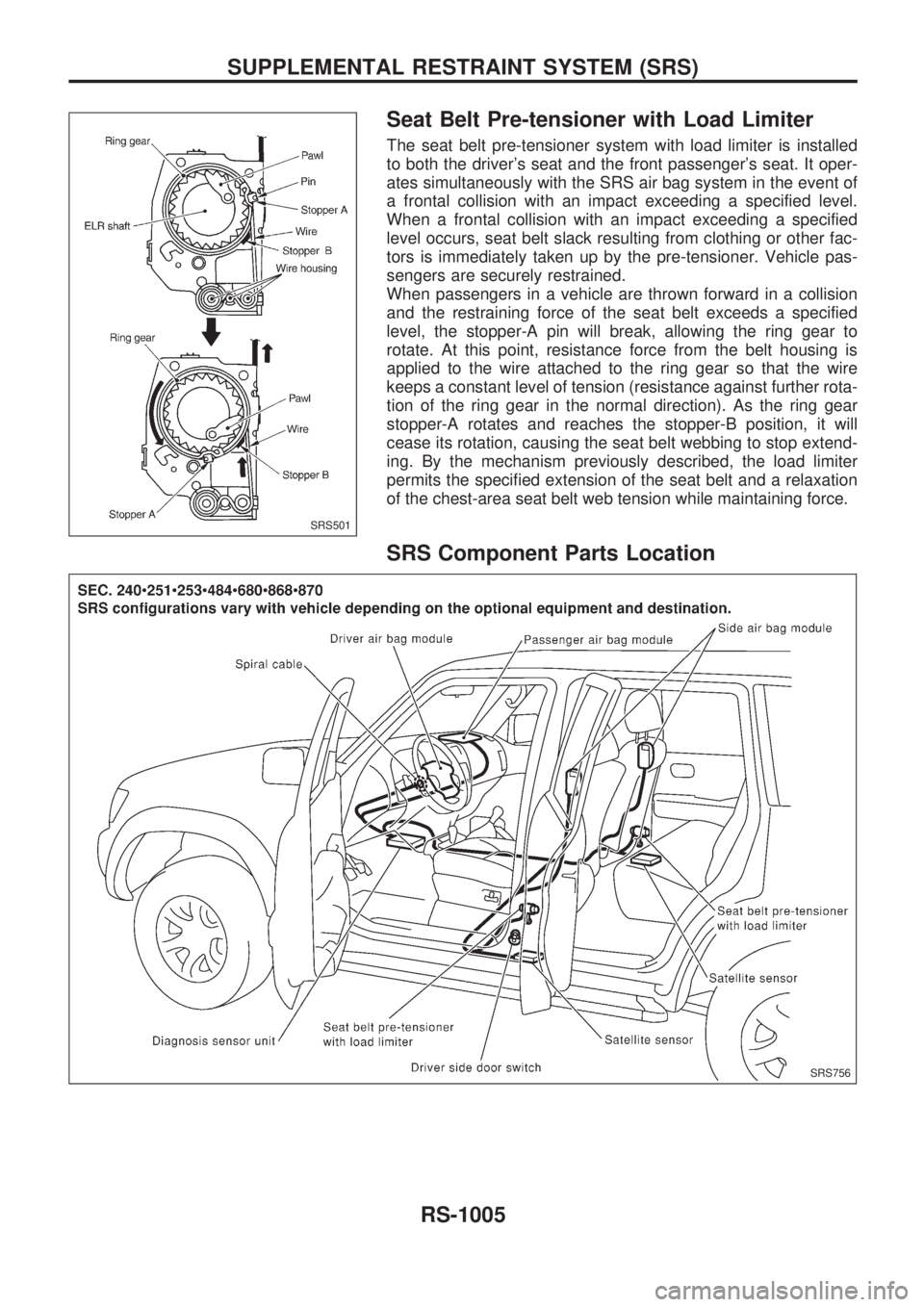
Seat Belt Pre-tensioner with Load Limiter
The seat belt pre-tensioner system with load limiter is installed
to both the driver's seat and the front passenger's seat. It oper-
ates simultaneously with the SRS air bag system in the event of
a frontal collision with an impact exceeding a specified level.
When a frontal collision with an impact exceeding a specified
level occurs, seat belt slack resulting from clothing or other fac-
tors is immediately taken up by the pre-tensioner. Vehicle pas-
sengers are securely restrained.
When passengers in a vehicle are thrown forward in a collision
and the restraining force of the seat belt exceeds a specified
level, the stopper-A pin will break, allowing the ring gear to
rotate. At this point, resistance force from the belt housing is
applied to the wire attached to the ring gear so that the wire
keeps a constant level of tension (resistance against further rota-
tion of the ring gear in the normal direction). As the ring gear
stopper-A rotates and reaches the stopper-B position, it will
cease its rotation, causing the seat belt webbing to stop extend-
ing. By the mechanism previously described, the load limiter
permits the specified extension of the seat belt and a relaxation
of the chest-area seat belt web tension while maintaining force.
SRS Component Parts Location
SRS501
SRS756
SUPPLEMENTAL RESTRAINT SYSTEM (SRS)
RS-1005