engine control NISSAN PATROL 2004 Electronic Owner's Guide
[x] Cancel search | Manufacturer: NISSAN, Model Year: 2004, Model line: PATROL, Model: NISSAN PATROL 2004Pages: 579, PDF Size: 26.61 MB
Page 442 of 579

Wiring Diagram Codes (Cell Codes)
Use the chart below to ®nd out what each wiring diagram code
stands for.
Refer to the wiring diagram code in the alphabetical index to ®nd
the location (Page number) of each wiring diagram.
Code Section Wiring Diagram Name
A/C, A HA Auto Air Conditioner
A/C, M HA Manual Air Conditioner
A/CCUT EC Air Conditioner Control
A/T AT A/T
ASCD EL Automatic Speed Control Device
AUDIO EL Audio
BACK/L EL Back-up Lamp
CD/CHG EL CD Auto Changer
CHIME EL Warning Chime
COMPAS EL Compass and Thermometer
COOL/B HA Cool Box
D/LOCK EL Power Door Lock
DEF EL Rear Window Defogger
DEICER EL Wiper Deicer
DTRL EL Headlamp Ð Daytime Light System
F/FOG EL Front Fog Lamp
FICD EC IACV-FICD Solenoid Valve
GLOW EC Quick Glow System
H/AIM EL Headlamp Aiming Control System
H/LAMP EL Headlamp
HEATUP EC Heat Up Switch
HLC EL Headlamp Washer
HORN EL Horn
HSEAT EL Heated Seat
ILL EL Illumination
LOAD EC Electrical Load Signal
MAFS EC Mass Air Flow Sensor
METER EL Meter and Gauges
MIRROR EL Door Mirror
MULTI EL Multi-remote Control System
NATS EL Nissan Anti-Theft System
NAVI EL Navigation System
NONDTC AT Non-detective Items
P/ANT EL Power Antenna
PHONE EL Telephone
POWER EL Power Supply Routing
R/COOL HA Rear Cooler System
R/FOG EL Rear Fog LampCode Section Wiring Diagram Name
R/HEAT HA Rear Heater System
REMOTE EL Audio (Remote Control Switch)
ROOM/L EL Interior Room Lamp
S/LOCK EL Power Door Lock Ð Super Lock
S/TANK FE Sub Fuel Tank Control System
SRS RS Supplemental Restraint System
STAB RA Stabilizer Release Device
STOP/L EL Stop Lamp
TAIL/L EL Parking, License and Tail Lamps
THEFT EL Theft Warning System
TRQ/SG EC Engine Torque Control Signal
TURN EL Turn Signal and Hazard Warning
Lamps
VSS EC Vehicle Speed Sensor
WARN EL Warning Lamps
WINDOW EL Power Window
WIP/R EL Rear Wiper and Washer
WIPER EL Front Wiper and Washer
WIRING DIAGRAM CODES (CELL CODES)
EL-4347
Page 451 of 579
Removal
1. Remove the following parts.
+Undercover
+Engine oil (Drain)
+Engine coolant (Drain)
+Engine cover
+Intercooler
+Air inlet pipe
+Air cleaner case
+Throttle body
+Swirl and intake air control valve control solenoid valve and
bracket
+Vacuum tank
+Glow plate
+Rocker cover
+Spill tube
+Radiator shrouds (Rear and Lower)
+Cooling fan
+Radiator hose (Upper and Lower)
+Auxiliary belt and auto tensioner.
2. Remove the alternator.
3. Remove the A/C compressor and bracket with piping con-
nected. Move and support it at the LH side of engine bay with
a rope to avoid putting load on piping.
Refer to HA section in NISSAN Service Manual (Publication No.
SM9E-Y61CG2 or SM9E-Y61CG3).
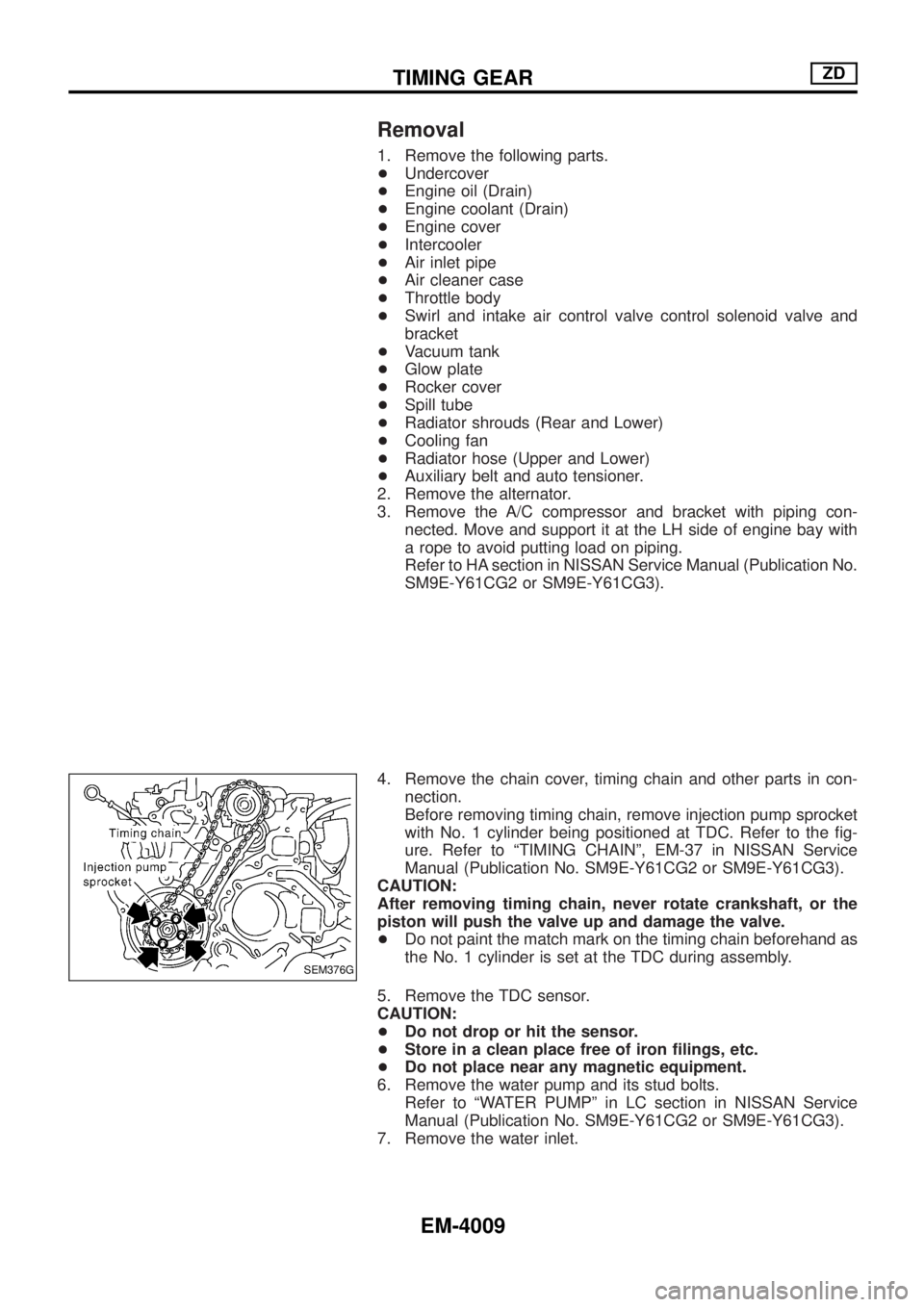
4. Remove the chain cover, timing chain and other parts in con-
nection.
Before removing timing chain, remove injection pump sprocket
with No. 1 cylinder being positioned at TDC. Refer to the ®g-
ure. Refer to ªTIMING CHAINº, EM-37 in NISSAN Service
Manual (Publication No. SM9E-Y61CG2 or SM9E-Y61CG3).
CAUTION:
After removing timing chain, never rotate crankshaft, or the
piston will push the valve up and damage the valve.
+Do not paint the match mark on the timing chain beforehand as
the No. 1 cylinder is set at the TDC during assembly.
5. Remove the TDC sensor.
CAUTION:
+Do not drop or hit the sensor.
+Store in a clean place free of iron ®lings, etc.
+Do not place near any magnetic equipment.
6. Remove the water pump and its stud bolts.
Refer to ªWATER PUMPº in LC section in NISSAN Service
Manual (Publication No. SM9E-Y61CG2 or SM9E-Y61CG3).
7. Remove the water inlet.
SEM376G
TIMING GEARZD
EM-4009
Page 461 of 579
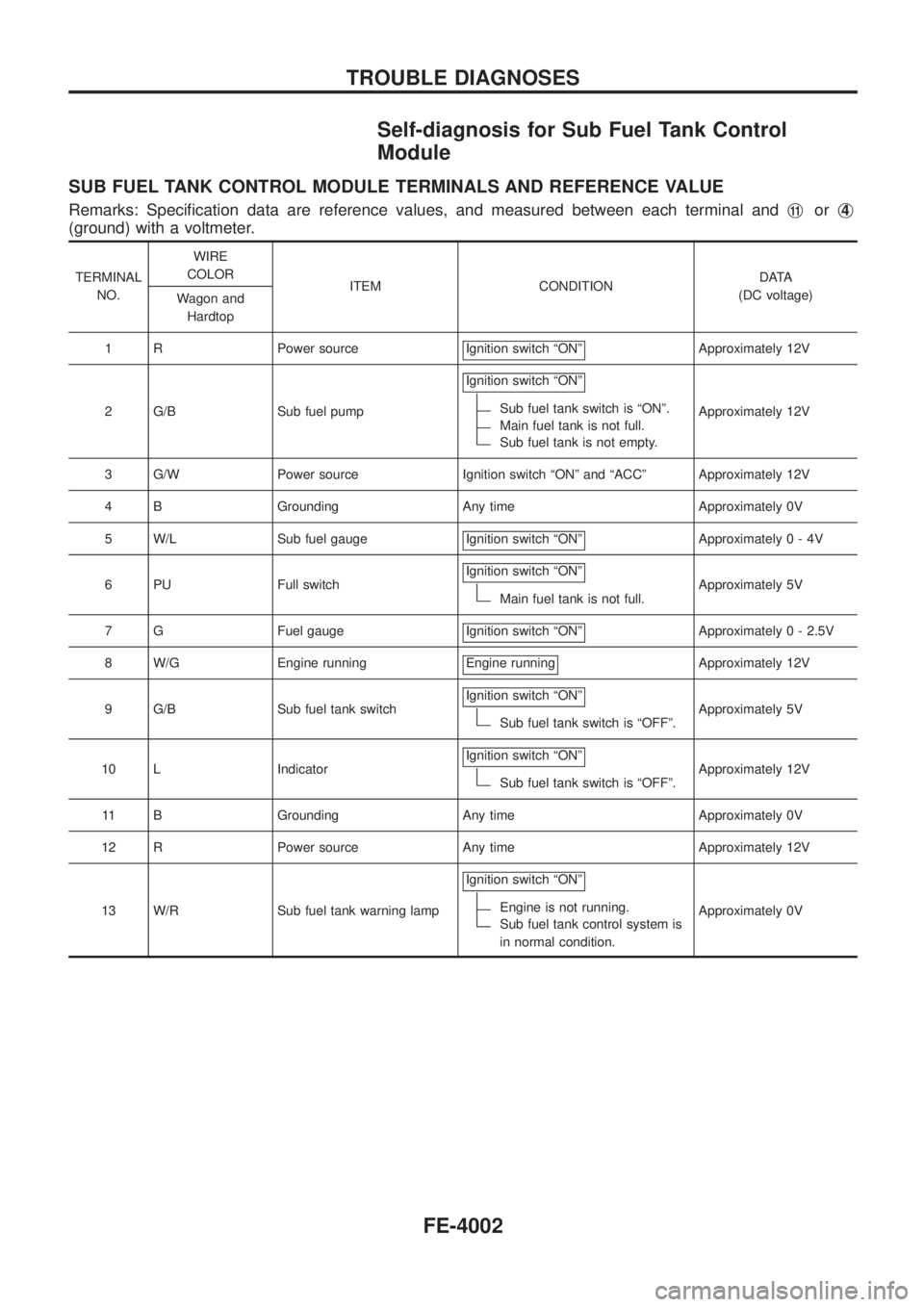
Self-diagnosis for Sub Fuel Tank Control
Module
SUB FUEL TANK CONTROL MODULE TERMINALS AND REFERENCE VALUE
Remarks: Speci®cation data are reference values, and measured between each terminal andj11orj4
(ground) with a voltmeter.
TERMINAL
NO.WIRE
COLOR
ITEM CONDITIONDATA
(DC voltage)
Wagon and
Hardtop
1 R Power source Ignition switch ªONº
Approximately 12V
2 G/B Sub fuel pumpIgnition switch ªONº
Sub fuel tank switch is ªONº.
Main fuel tank is not full.
Sub fuel tank is not empty.Approximately 12V
3 G/W Power source Ignition switch ªONº and ªACCº Approximately 12V
4 B Grounding Any time Approximately 0V
5 W/L Sub fuel gauge Ignition switch ªONº
Approximately0-4V
6 PU Full switchIgnition switch ªONº
Main fuel tank is not full.Approximately 5V
7 G Fuel gauge Ignition switch ªONº
Approximately 0 - 2.5V
8 W/G Engine running Engine running
Approximately 12V
9 G/B Sub fuel tank switchIgnition switch ªONº
Sub fuel tank switch is ªOFFº.Approximately 5V
10 L IndicatorIgnition switch ªONº
Sub fuel tank switch is ªOFFº.Approximately 12V
11 B Grounding Any time Approximately 0V
12 R Power source Any time Approximately 12V
13 W/R Sub fuel tank warning lampIgnition switch ªONº
Engine is not running.
Sub fuel tank control system is
in normal condition.Approximately 0V
TROUBLE DIAGNOSES
FE-4002
Page 472 of 579
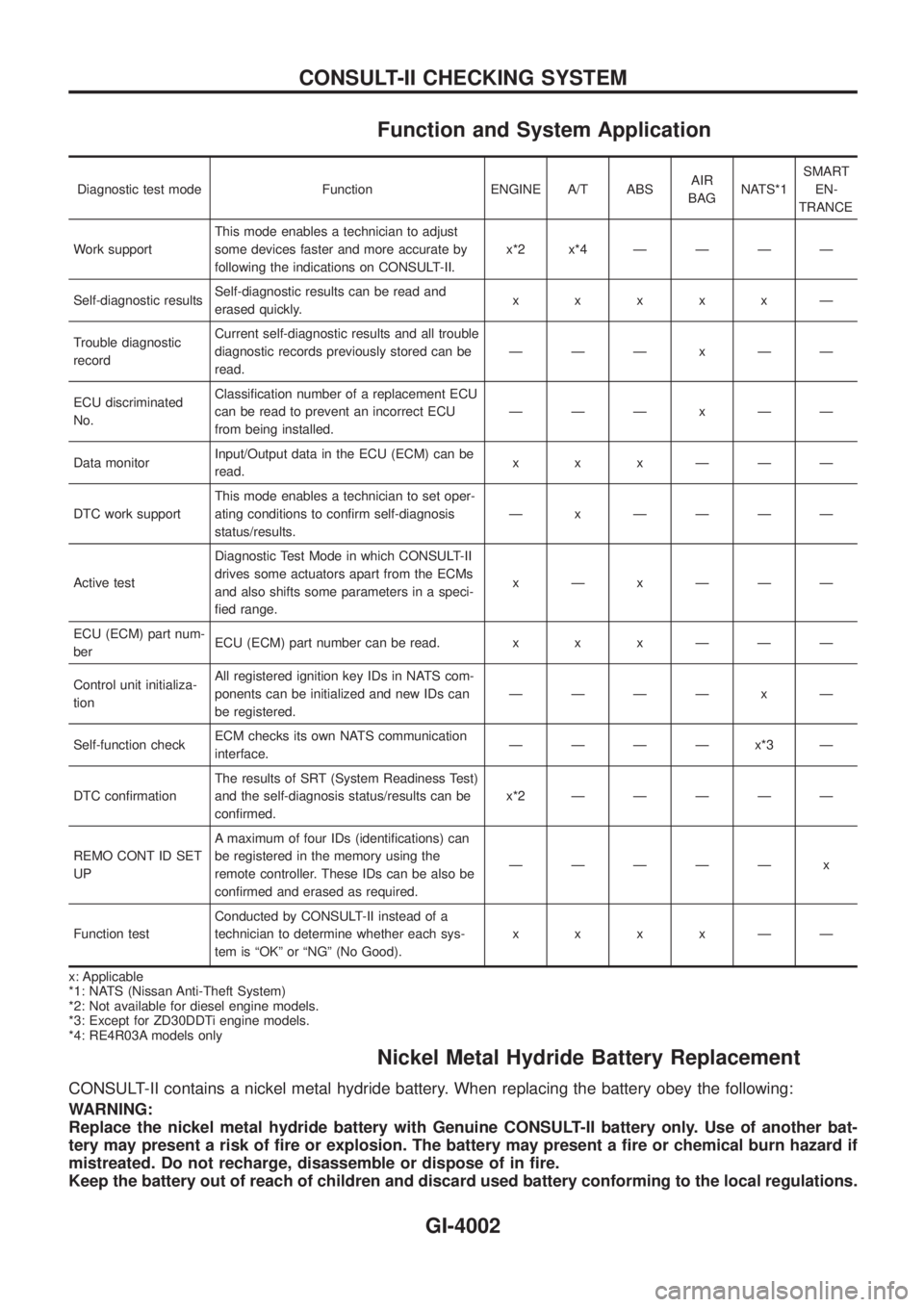
Function and System Application
Diagnostic test mode Function ENGINE A/T ABSAIR
BAGNATS*1SMART
EN-
TRANCE
Work supportThis mode enables a technician to adjust
some devices faster and more accurate by
following the indications on CONSULT-II.x*2x*4ÐÐÐÐ
Self-diagnostic resultsSelf-diagnostic results can be read and
erased quickly.xxxxxÐ
Trouble diagnostic
recordCurrent self-diagnostic results and all trouble
diagnostic records previously stored can be
read.ÐÐÐxÐÐ
ECU discriminated
No.Classi®cation number of a replacement ECU
can be read to prevent an incorrect ECU
from being installed.ÐÐÐxÐÐ
Data monitorInput/Output data in the ECU (ECM) can be
read.xxxÐÐÐ
DTC work supportThis mode enables a technician to set oper-
ating conditions to con®rm self-diagnosis
status/results.Ð x ÐÐÐÐ
Active testDiagnostic Test Mode in which CONSULT-II
drives some actuators apart from the ECMs
and also shifts some parameters in a speci-
®ed range.xÐxÐÐÐ
ECU (ECM) part num-
berECU (ECM) part number can be read. x x x Ð Ð Ð
Control unit initializa-
tionAll registered ignition key IDs in NATS com-
ponents can be initialized and new IDs can
be registered.ÐÐÐÐ x Ð
Self-function checkECM checks its own NATS communication
interface.ÐÐÐÐx*3Ð
DTC con®rmationThe results of SRT (System Readiness Test)
and the self-diagnosis status/results can be
con®rmed.x*2ÐÐÐÐÐ
REMO CONT ID SET
UPA maximum of four IDs (identi®cations) can
be registered in the memory using the
remote controller. These IDs can be also be
con®rmed and erased as required.ÐÐÐÐÐ x
Function testConducted by CONSULT-II instead of a
technician to determine whether each sys-
tem is ªOKº or ªNGº (No Good).xxxxÐÐ
x: Applicable
*1: NATS (Nissan Anti-Theft System)
*2: Not available for diesel engine models.
*3: Except for ZD30DDTi engine models.
*4: RE4R03A models only
Nickel Metal Hydride Battery Replacement
CONSULT-II contains a nickel metal hydride battery. When replacing the battery obey the following:
WARNING:
Replace the nickel metal hydride battery with Genuine CONSULT-II battery only. Use of another bat-
tery may present a risk of ®re or explosion. The battery may present a ®re or chemical burn hazard if
mistreated. Do not recharge, disassemble or dispose of in ®re.
Keep the battery out of reach of children and discard used battery conforming to the local regulations.
CONSULT-II CHECKING SYSTEM
GI-4002
Page 474 of 579
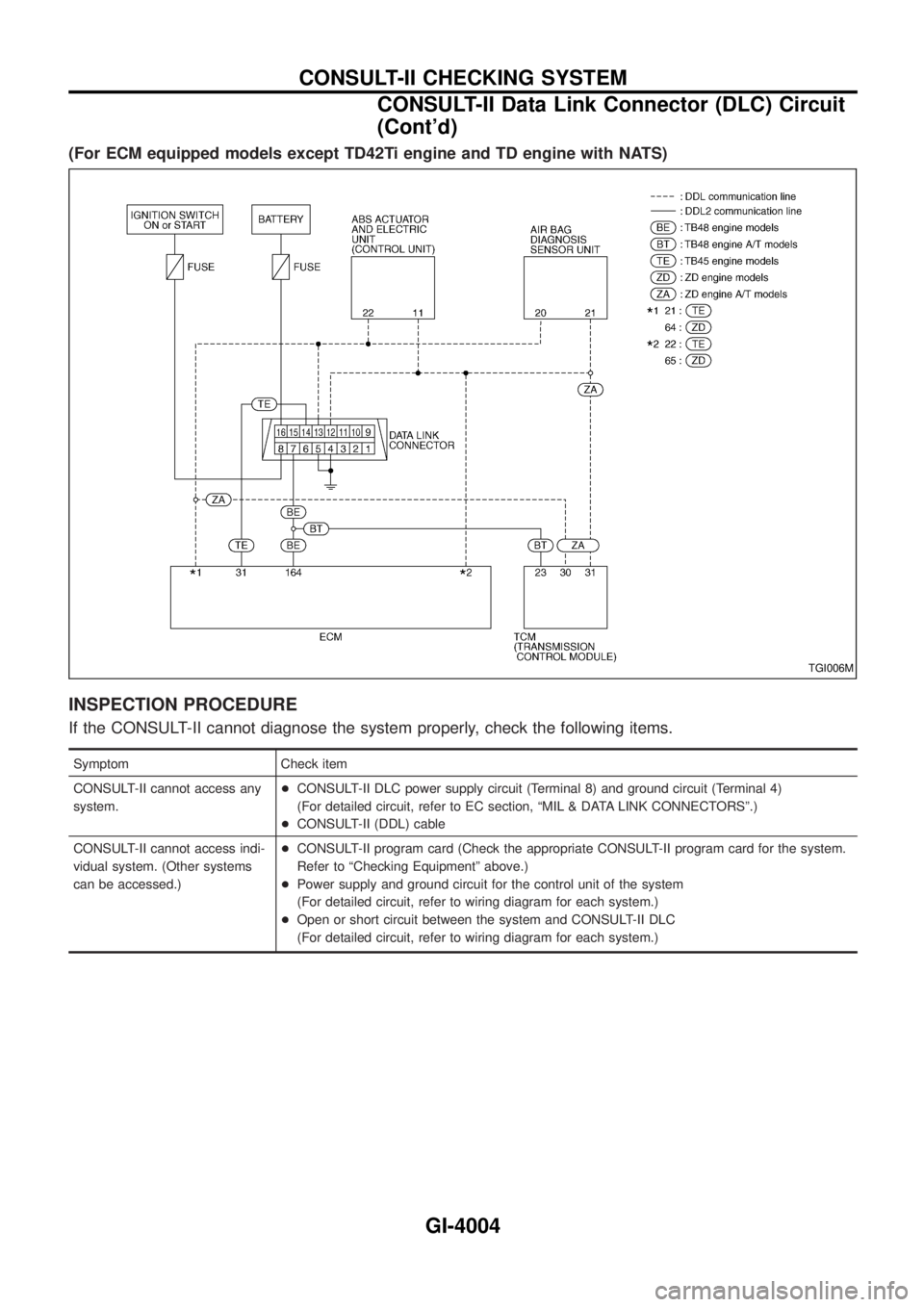
(For ECM equipped models except TD42Ti engine and TD engine with NATS)
INSPECTION PROCEDURE
If the CONSULT-II cannot diagnose the system properly, check the following items.
Symptom Check item
CONSULT-II cannot access any
system.+CONSULT-II DLC power supply circuit (Terminal 8) and ground circuit (Terminal 4)
(For detailed circuit, refer to EC section, ªMIL & DATA LINK CONNECTORSº.)
+CONSULT-II (DDL) cable
CONSULT-II cannot access indi-
vidual system. (Other systems
can be accessed.)+CONSULT-II program card (Check the appropriate CONSULT-II program card for the system.
Refer to ªChecking Equipmentº above.)
+Power supply and ground circuit for the control unit of the system
(For detailed circuit, refer to wiring diagram for each system.)
+Open or short circuit between the system and CONSULT-II DLC
(For detailed circuit, refer to wiring diagram for each system.)
TGI006M
CONSULT-II CHECKING SYSTEM
CONSULT-II Data Link Connector (DLC) Circuit
(Cont'd)
GI-4004
Page 480 of 579

HEATER&
AIR CONDITIONER
SECTION
HA
MODIFICATION NOTICE:
+ Wiring diagram has been changed.
+ Automatic A/C controller has been changed.
+ Front thermo amp. for auto A/C has been eliminated.
CONTENTS
AUTO
DESCRIPTION ...........................................................4002
Features (TB48 Engine Models) ...........................4002
REAR HEATER
TROUBLE DIAGNOSES ...........................................4003
Wiring Diagram Ð R/HEAT Ð/LHD Models .........4003
Wiring Diagram Ð R/HEAT Ð/RHD Models .........4004
MANUAL
TROUBLE DIAGNOSES ...........................................4005
Wiring Diagram Ð A/C, M Ð/Wagon and
Hardtop Models with ZD Engine ...........................4005
AUTO
DESCRIPTION...........................................................4007
Control Operation ..................................................4007
TROUBLE DIAGNOSES ...........................................4008
Circuit Diagram Ð A/C, A Ð/TB48 Engine ...........4008
Wiring Diagram Ð A/C, A Ð/TB48 Engine ...........4009
Circuit Diagram Ð A/C, A Ð/TB45 Engine ...........4013
Wiring Diagram Ð A/C, A Ð/TB45 Engine ...........4014
Circuit Diagram Ð A/C, A Ð/TD Engine ...............4017
Wiring Diagram Ð A/C, A Ð/TD Engine ...............4018
Circuit Diagram Ð A/C, A Ð/ZD Engine ...............4021
Wiring Diagram Ð A/C, A Ð/ZD Engine ...............4022
Self-diagnosis ........................................................4025
Operational Check .................................................4032
A/C System ............................................................4034 Mode Door Motor...................................................4035
Air Mix Door Motor ................................................4036
Intake Door Motor ..................................................4037
Blower Motor..........................................................4038
Magnet Clutch........................................................4039
Insufficient Cooling ................................................4052
Insufficient Heating ................................................4053
Self-diagnosis ........................................................4054
REAR COOLER
TROUBLE DIAGNOSES ...........................................4055
Wiring Diagram Ð R/COOL Ð/LHD Models with
Front Auto A/C .......................................................4055
Wiring Diagram Ð R/COOL Ð/LHD Models with
Front Manual A/C Except for TB45E Engine ........4057
Wiring Diagram Ð R/COOL Ð/LHD Models with
Front Manual A/C for TB45E Engine.....................4059
Wiring Diagram Ð R/COOL Ð/RHD Models with
Front Auto A/C .......................................................4061
Wiring Diagram Ð R/COOL Ð/RHD Models with
Front Manual A/C...................................................4063
COOL BOX
TROUBLE DIAGNOSES ...........................................4065
Wiring Diagram Ð COOL/B Ð/All Engines
Except TB48 and TB45E Wagon Models for the
Middle East ............................................................4065
Wiring Diagram Ð COOL/B Ð/TB48 and TB45E
Engine Wagon Models for the Middle East...........4066
HA-4001
Page 481 of 579
Features (TB48 Engine Models)
CAN COMMUNICATION SYSTEM DESCRIPTION
CAN (Controller Area Network) is a serial communication line for real time application. It is an on-vehicle mul-
tiplex communication line with high data communication speed and excellent error detection ability. Many
electronic control units are equipped onto a vehicle, and each control unit shares information and links with
other control units during operation (not independent). In CAN communication, control units are connected with
2 communication lines (CAN H line, CAN L line) allowing a high rate of information transmission with less wir-
ing. Each control unit transmits/receives data but selectively reads required data only.
SYSTEM CONSTRUCTION
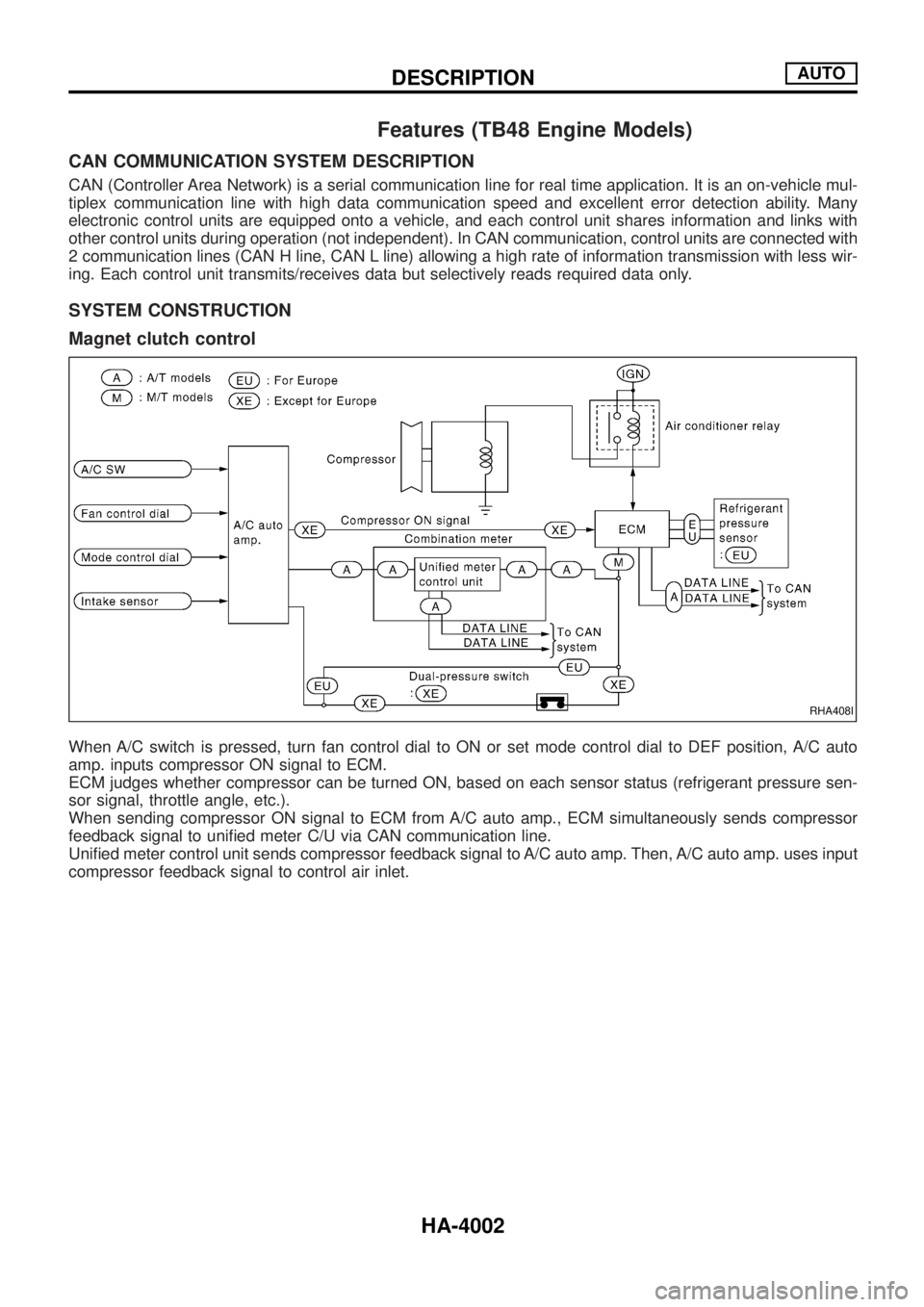
Magnet clutch control
When A/C switch is pressed, turn fan control dial to ON or set mode control dial to DEF position, A/C auto
amp. inputs compressor ON signal to ECM.
ECM judges whether compressor can be turned ON, based on each sensor status (refrigerant pressure sen-
sor signal, throttle angle, etc.).
When sending compressor ON signal to ECM from A/C auto amp., ECM simultaneously sends compressor
feedback signal to uni®ed meter C/U via CAN communication line.
Uni®ed meter control unit sends compressor feedback signal to A/C auto amp. Then, A/C auto amp. uses input
compressor feedback signal to control air inlet.
RHA408I
DESCRIPTIONAUTO
HA-4002
Page 504 of 579
Self-diagnosis
INTRODUCTION AND GENERAL DESCRIPTION
The self-diagnostic system diagnoses sensors, door motors, blower motor, etc. by system line.
Self-diagnosis is step-1 to 7. There are two ways of changing method during self-diagnosis.
+Switching to self-diagnosis step-1 to 4.
Shifting from usual control to the self-diagnostic system is accomplished by starting the engine (turning
the ignition switch from OFF to ON) and pressing A/C switch for at least 5 seconds. The A/C switch must
be pressed within 10 seconds after starting the engine (ignition switch is turned ON). This system will be
canceled by either pressing intake switch or turning the ignition switch OFF. Shifting from one step to
another is accomplished be means of turning fan control dial, as required.
+Switching to self-diagnosis step-5 to 7 (Auxiliary mechanism).
Shifting from usual control to the self-diagnostic system is accomplished by starting the engine (turning
the ignition switch from OFF to ON) and pressing intake switch for at least 5 seconds. The intake switch
must be pressed within 10 seconds after starting the engine (ignition switch is turned ON). This system
will be canceled by either pressing A/C switch or turning the ignition switch OFF. Shifting from one step
to another is accomplished by means of turning fan control dial, as required.
TROUBLE DIAGNOSESAUTO
HA-4025
Page 506 of 579
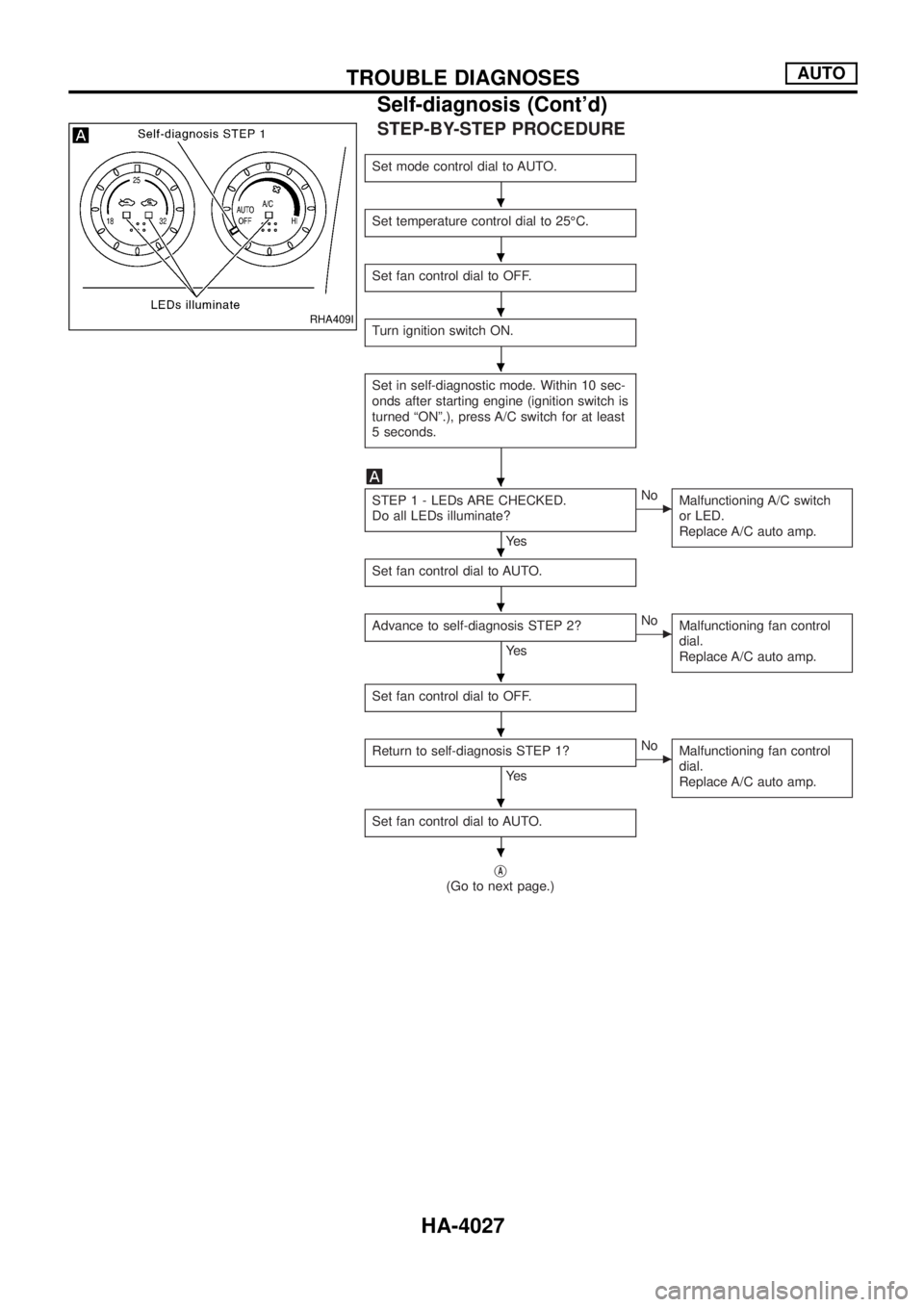
STEP-BY-STEP PROCEDURE
Set mode control dial to AUTO.
Set temperature control dial to 25ÉC.
Set fan control dial to OFF.
Turn ignition switch ON.
Set in self-diagnostic mode. Within 10 sec-
onds after starting engine (ignition switch is
turned ªONº.), press A/C switch for at least
5 seconds.
STEP 1 - LEDs ARE CHECKED.
Do all LEDs illuminate?
Ye s
cNo
Malfunctioning A/C switch
or LED.
Replace A/C auto amp.
Set fan control dial to AUTO.
Advance to self-diagnosis STEP 2?
Ye s
cNo
Malfunctioning fan control
dial.
Replace A/C auto amp.
Set fan control dial to OFF.
Return to self-diagnosis STEP 1?
Ye s
cNo
Malfunctioning fan control
dial.
Replace A/C auto amp.
Set fan control dial to AUTO.
jA
(Go to next page.)
RHA409I
.
.
.
.
.
.
.
.
.
.
.
TROUBLE DIAGNOSESAUTO
Self-diagnosis (Cont'd)
HA-4027
Page 509 of 579
jC
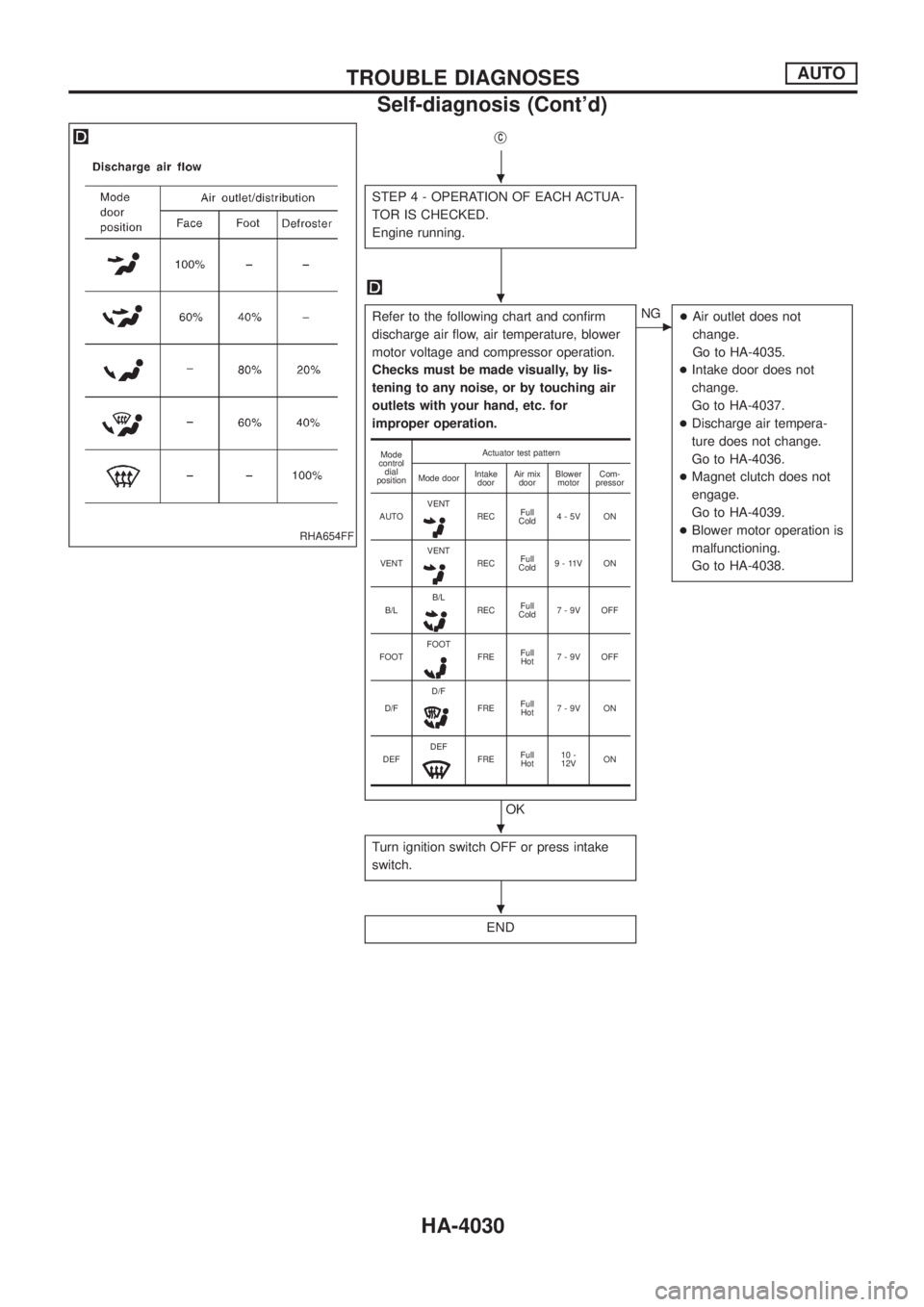
STEP 4 - OPERATION OF EACH ACTUA-
TOR IS CHECKED.
Engine running.
Refer to the following chart and con®rm
discharge air ¯ow, air temperature, blower
motor voltage and compressor operation.
Checks must be made visually, by lis-
tening to any noise, or by touching air
outlets with your hand, etc. for
improper operation.
OK
cNG
+Air outlet does not
change.
Go to HA-4035.
+Intake door does not
change.
Go to HA-4037.
+Discharge air tempera-
ture does not change.
Go to HA-4036.
+Magnet clutch does not
engage.
Go to HA-4039.
+Blower motor operation is
malfunctioning.
Go to HA-4038.
Turn ignition switch OFF or press intake
switch.
END
Mode
control
dial
positionActuator test pattern
Mode doorIntake
doorAir mix
doorBlower
motorCom-
pressor
AUTOVENT
RECFull
Cold4-5V ON
VENTVENT
RECFull
Cold9 - 11V ON
B/LB/L
RECFull
Cold7-9V OFF
FOOTFOOT
FREFull
Hot7-9V OFF
D/FD/F
FREFull
Hot7-9V ON
DEFDEF
FREFull
Hot10 -
12VON
RHA654FF
.
.
.
.
TROUBLE DIAGNOSESAUTO
Self-diagnosis (Cont'd)
HA-4030