cooling NISSAN PATROL 2006 Owner's Guide
[x] Cancel search | Manufacturer: NISSAN, Model Year: 2006, Model line: PATROL, Model: NISSAN PATROL 2006Pages: 1226, PDF Size: 37.18 MB
Page 856 of 1226
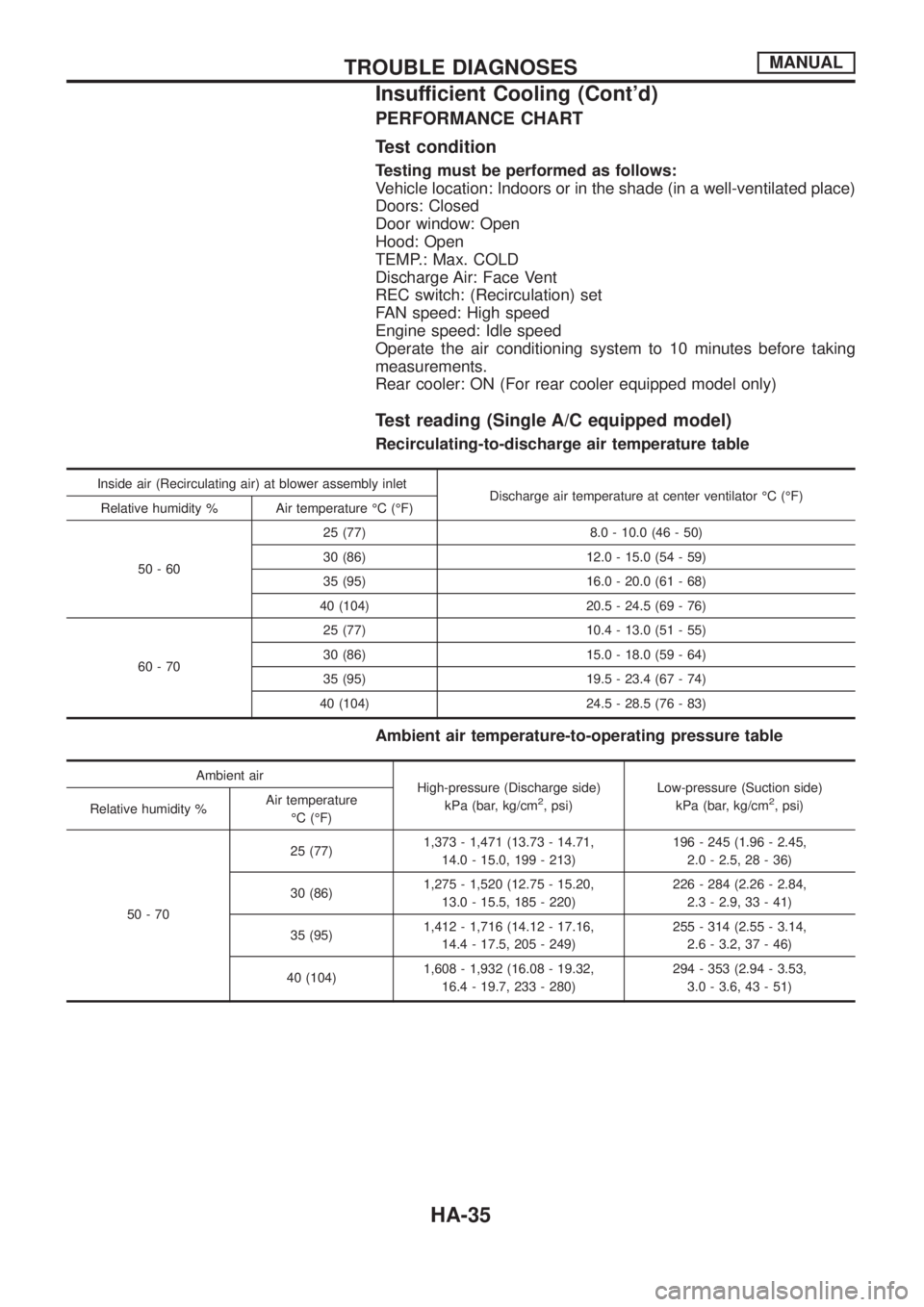
PERFORMANCE CHART
Test condition
Testing must be performed as follows:
Vehicle location: Indoors or in the shade (in a well-ventilated place)
Doors: Closed
Door window: Open
Hood: Open
TEMP.: Max. COLD
Discharge Air: Face Vent
REC switch: (Recirculation) set
FAN speed: High speed
Engine speed: Idle speed
Operate the air conditioning system to 10 minutes before taking
measurements.
Rear cooler: ON (For rear cooler equipped model only)
Test reading (Single A/C equipped model)
Recirculating-to-discharge air temperature table
Inside air (Recirculating air) at blower assembly inlet
Discharge air temperature at center ventilator ÉC (ÉF)
Relative humidity % Air temperature ÉC (ÉF)
50-6025 (77) 8.0 - 10.0 (46 - 50)
30 (86) 12.0 - 15.0 (54 - 59)
35 (95) 16.0 - 20.0 (61 - 68)
40 (104) 20.5 - 24.5 (69 - 76)
60-7025 (77) 10.4 - 13.0 (51 - 55)
30 (86) 15.0 - 18.0 (59 - 64)
35 (95) 19.5 - 23.4 (67 - 74)
40 (104) 24.5 - 28.5 (76 - 83)
Ambient air temperature-to-operating pressure table
Ambient air
High-pressure (Discharge side)
kPa (bar, kg/cm
2, psi)Low-pressure (Suction side)
kPa (bar, kg/cm2, psi)
Relative humidity %Air temperature
ÉC (ÉF)
50-7025 (77)1,373 - 1,471 (13.73 - 14.71,
14.0 - 15.0, 199 - 213)196 - 245 (1.96 - 2.45,
2.0 - 2.5, 28 - 36)
30 (86)1,275 - 1,520 (12.75 - 15.20,
13.0 - 15.5, 185 - 220)226 - 284 (2.26 - 2.84,
2.3 - 2.9, 33 - 41)
35 (95)1,412 - 1,716 (14.12 - 17.16,
14.4 - 17.5, 205 - 249)255 - 314 (2.55 - 3.14,
2.6 - 3.2, 37 - 46)
40 (104)1,608 - 1,932 (16.08 - 19.32,
16.4 - 19.7, 233 - 280)294 - 353 (2.94 - 3.53,
3.0 - 3.6, 43 - 51)
TROUBLE DIAGNOSESMANUAL
Insufficient Cooling (Cont'd)
HA-35
Page 857 of 1226
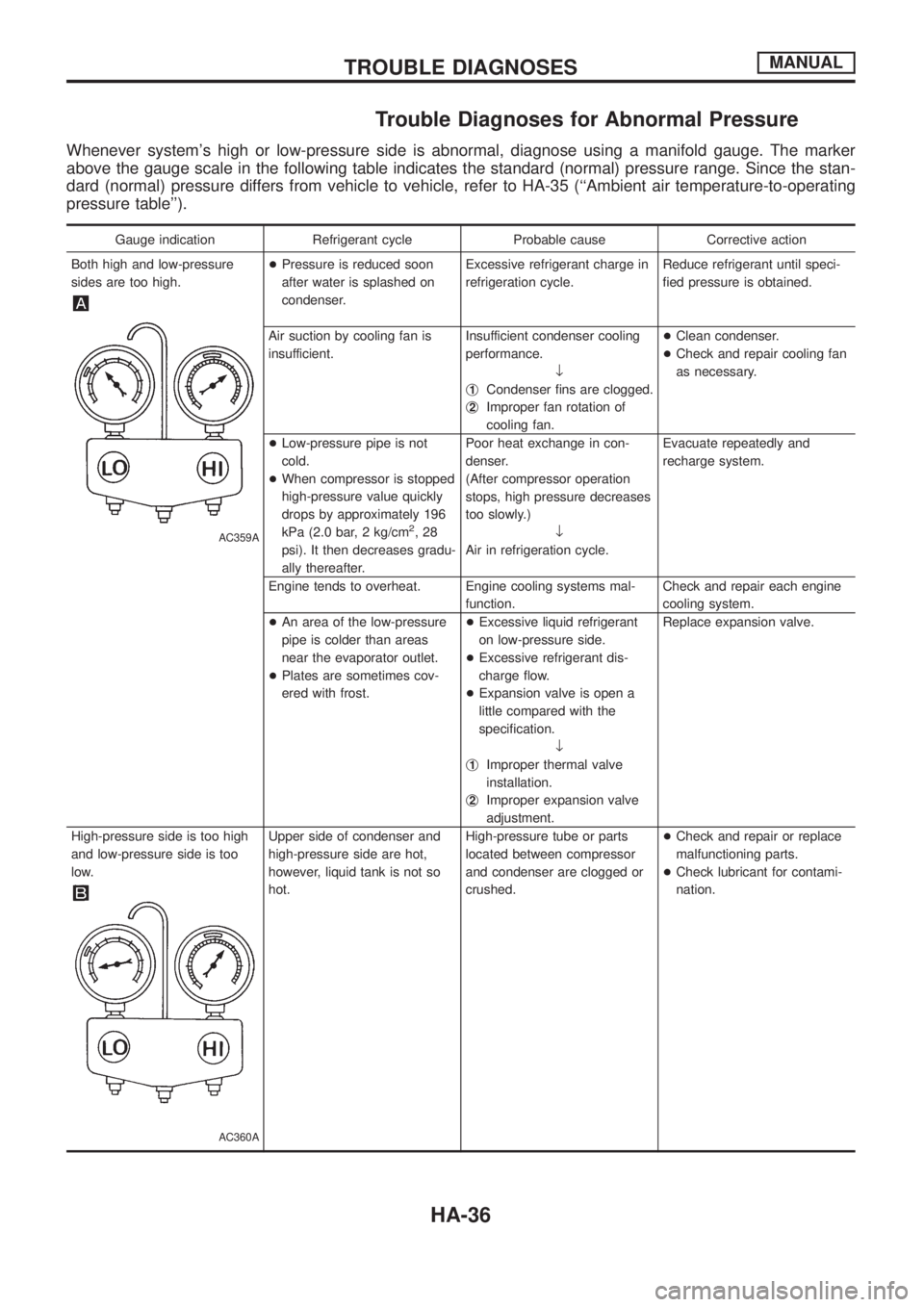
Trouble Diagnoses for Abnormal Pressure
Whenever system's high or low-pressure side is abnormal, diagnose using a manifold gauge. The marker
above the gauge scale in the following table indicates the standard (normal) pressure range. Since the stan-
dard (normal) pressure differs from vehicle to vehicle, refer to HA-35 (``Ambient air temperature-to-operating
pressure table'').
Gauge indication Refrigerant cycle Probable cause Corrective action
Both high and low-pressure
sides are too high.
AC359A
+Pressure is reduced soon
after water is splashed on
condenser.Excessive refrigerant charge in
refrigeration cycle.Reduce refrigerant until speci-
®ed pressure is obtained.
Air suction by cooling fan is
insufficient.Insufficient condenser cooling
performance.
¯
j
1Condenser ®ns are clogged.
j
2Improper fan rotation of
cooling fan.+Clean condenser.
+Check and repair cooling fan
as necessary.
+Low-pressure pipe is not
cold.
+When compressor is stopped
high-pressure value quickly
drops by approximately 196
kPa (2.0 bar, 2 kg/cm
2,28
psi). It then decreases gradu-
ally thereafter.Poor heat exchange in con-
denser.
(After compressor operation
stops, high pressure decreases
too slowly.)
¯
Air in refrigeration cycle.Evacuate repeatedly and
recharge system.
Engine tends to overheat. Engine cooling systems mal-
function.Check and repair each engine
cooling system.
+An area of the low-pressure
pipe is colder than areas
near the evaporator outlet.
+Plates are sometimes cov-
ered with frost.+Excessive liquid refrigerant
on low-pressure side.
+Excessive refrigerant dis-
charge ¯ow.
+Expansion valve is open a
little compared with the
speci®cation.
¯
j
1Improper thermal valve
installation.
j
2Improper expansion valve
adjustment.Replace expansion valve.
High-pressure side is too high
and low-pressure side is too
low.
AC360A
Upper side of condenser and
high-pressure side are hot,
however, liquid tank is not so
hot.High-pressure tube or parts
located between compressor
and condenser are clogged or
crushed.+Check and repair or replace
malfunctioning parts.
+Check lubricant for contami-
nation.
TROUBLE DIAGNOSESMANUAL
HA-36
Page 859 of 1226
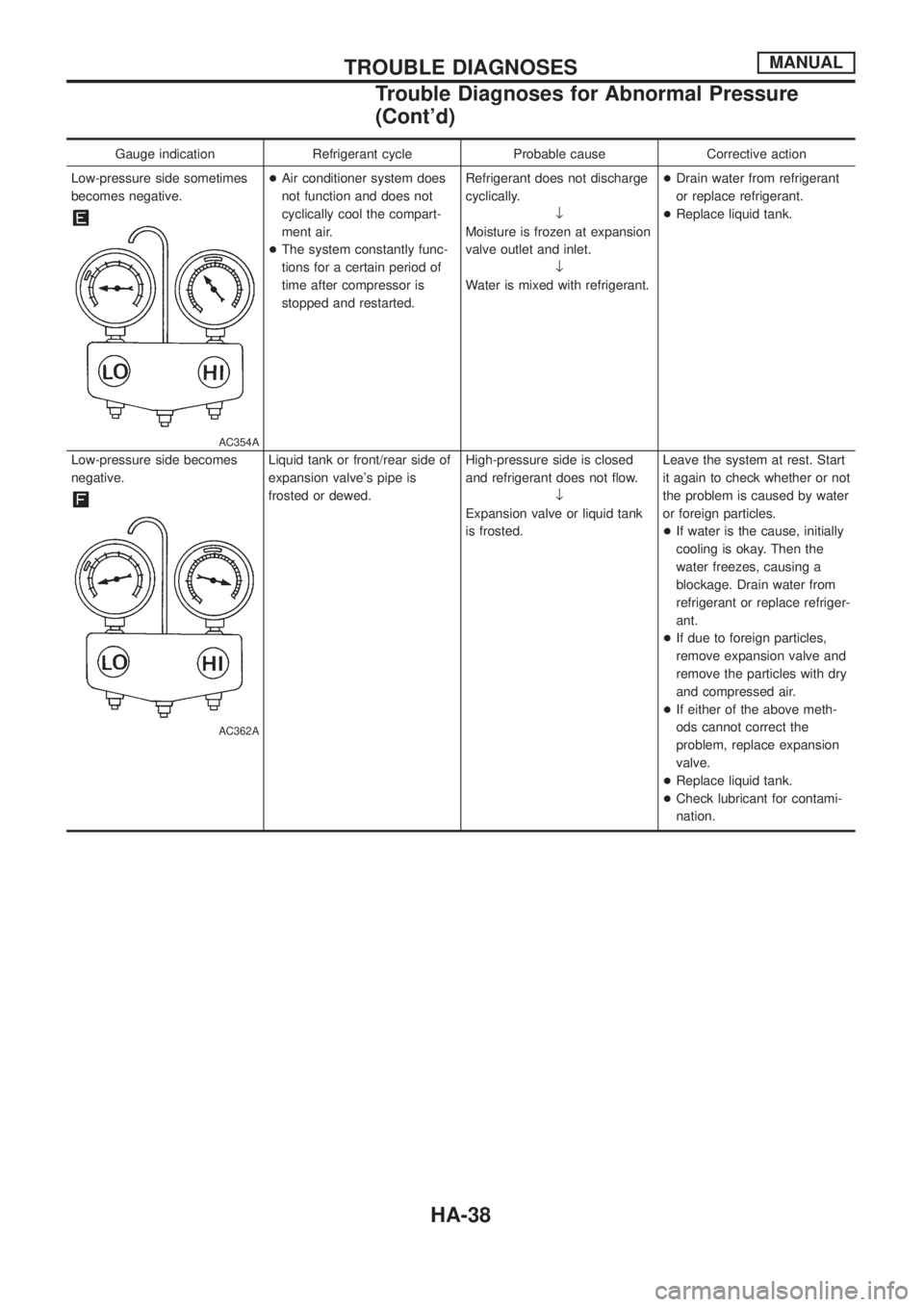
Gauge indication Refrigerant cycle Probable cause Corrective action
Low-pressure side sometimes
becomes negative.
AC354A
+Air conditioner system does
not function and does not
cyclically cool the compart-
ment air.
+The system constantly func-
tions for a certain period of
time after compressor is
stopped and restarted.Refrigerant does not discharge
cyclically.
¯
Moisture is frozen at expansion
valve outlet and inlet.
¯
Water is mixed with refrigerant.+Drain water from refrigerant
or replace refrigerant.
+Replace liquid tank.
Low-pressure side becomes
negative.
AC362A
Liquid tank or front/rear side of
expansion valve's pipe is
frosted or dewed.High-pressure side is closed
and refrigerant does not ¯ow.
¯
Expansion valve or liquid tank
is frosted.Leave the system at rest. Start
it again to check whether or not
the problem is caused by water
or foreign particles.
+If water is the cause, initially
cooling is okay. Then the
water freezes, causing a
blockage. Drain water from
refrigerant or replace refriger-
ant.
+If due to foreign particles,
remove expansion valve and
remove the particles with dry
and compressed air.
+If either of the above meth-
ods cannot correct the
problem, replace expansion
valve.
+Replace liquid tank.
+Check lubricant for contami-
nation.
TROUBLE DIAGNOSESMANUAL
Trouble Diagnoses for Abnormal Pressure
(Cont'd)
HA-38
Page 890 of 1226
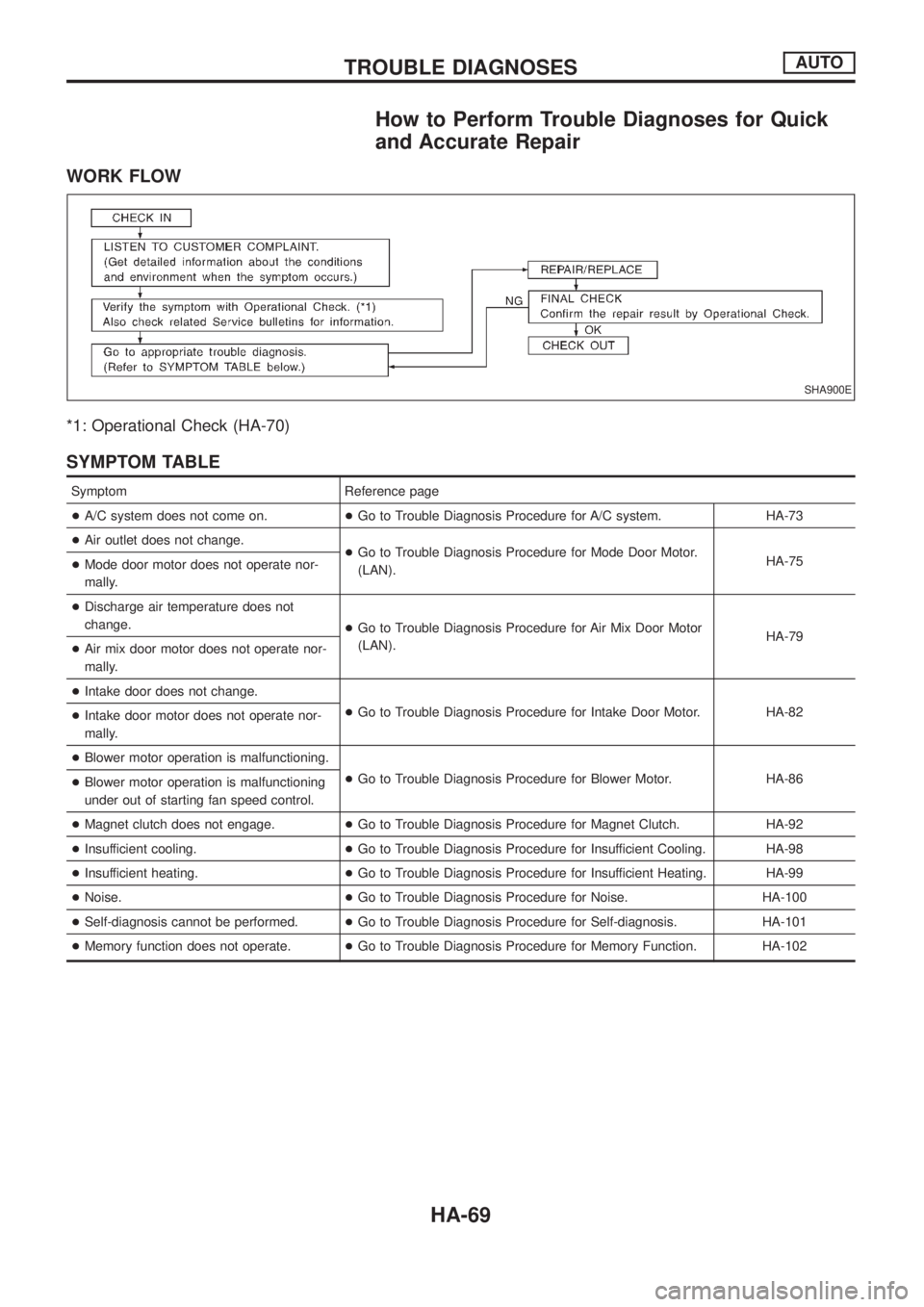
How to Perform Trouble Diagnoses for Quick
and Accurate Repair
WORK FLOW
*1: Operational Check (HA-70)
SYMPTOM TABLE
Symptom Reference page
+A/C system does not come on.+Go to Trouble Diagnosis Procedure for A/C system. HA-73
+Air outlet does not change.
+Go to Trouble Diagnosis Procedure for Mode Door Motor.
(LAN).HA-75
+Mode door motor does not operate nor-
mally.
+Discharge air temperature does not
change.
+Go to Trouble Diagnosis Procedure for Air Mix Door Motor
(LAN).HA-79
+Air mix door motor does not operate nor-
mally.
+Intake door does not change.
+Go to Trouble Diagnosis Procedure for Intake Door Motor. HA-82
+Intake door motor does not operate nor-
mally.
+Blower motor operation is malfunctioning.
+Go to Trouble Diagnosis Procedure for Blower Motor. HA-86
+Blower motor operation is malfunctioning
under out of starting fan speed control.
+Magnet clutch does not engage.+Go to Trouble Diagnosis Procedure for Magnet Clutch. HA-92
+Insufficient cooling.+Go to Trouble Diagnosis Procedure for Insufficient Cooling. HA-98
+Insufficient heating.+Go to Trouble Diagnosis Procedure for Insufficient Heating. HA-99
+Noise.+Go to Trouble Diagnosis Procedure for Noise. HA-100
+Self-diagnosis cannot be performed.+Go to Trouble Diagnosis Procedure for Self-diagnosis. HA-101
+Memory function does not operate.+Go to Trouble Diagnosis Procedure for Memory Function. HA-102
SHA900E
TROUBLE DIAGNOSESAUTO
HA-69
Page 909 of 1226
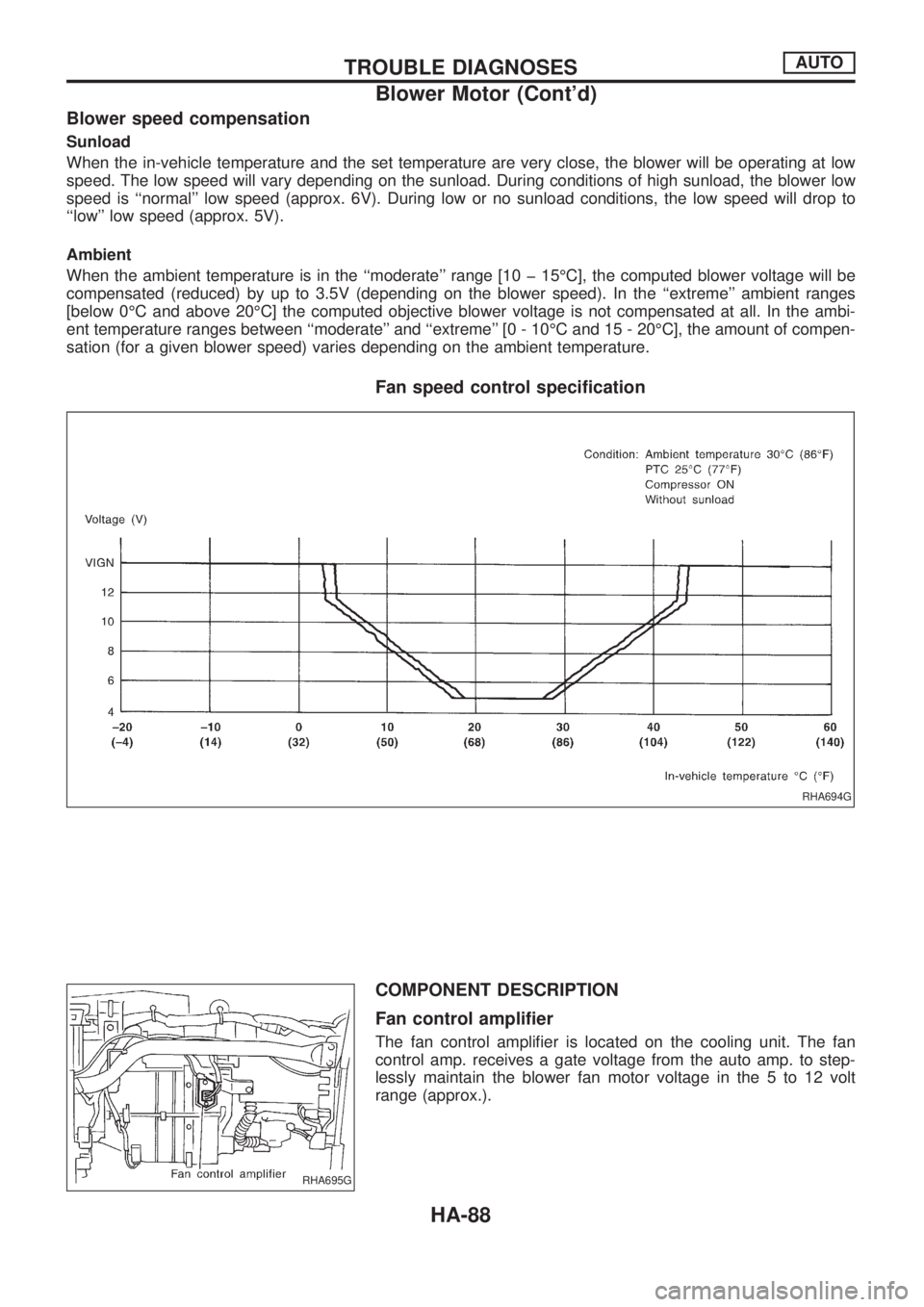
Blower speed compensation
Sunload
When the in-vehicle temperature and the set temperature are very close, the blower will be operating at low
speed. The low speed will vary depending on the sunload. During conditions of high sunload, the blower low
speed is ``normal'' low speed (approx. 6V). During low or no sunload conditions, the low speed will drop to
``low'' low speed (approx. 5V).
Ambient
When the ambient temperature is in the ``moderate'' range [10 þ 15ÉC], the computed blower voltage will be
compensated (reduced) by up to 3.5V (depending on the blower speed). In the ``extreme'' ambient ranges
[below 0ÉC and above 20ÉC] the computed objective blower voltage is not compensated at all. In the ambi-
ent temperature ranges between ``moderate'' and ``extreme'' [0 - 10ÉC and 15 - 20ÉC], the amount of compen-
sation (for a given blower speed) varies depending on the ambient temperature.
Fan speed control speci®cation
COMPONENT DESCRIPTION
Fan control ampli®er
The fan control ampli®er is located on the cooling unit. The fan
control amp. receives a gate voltage from the auto amp. to step-
lessly maintain the blower fan motor voltage in the 5 to 12 volt
range (approx.).
RHA694G
RHA695G
TROUBLE DIAGNOSESAUTO
Blower Motor (Cont'd)
HA-88
Page 919 of 1226
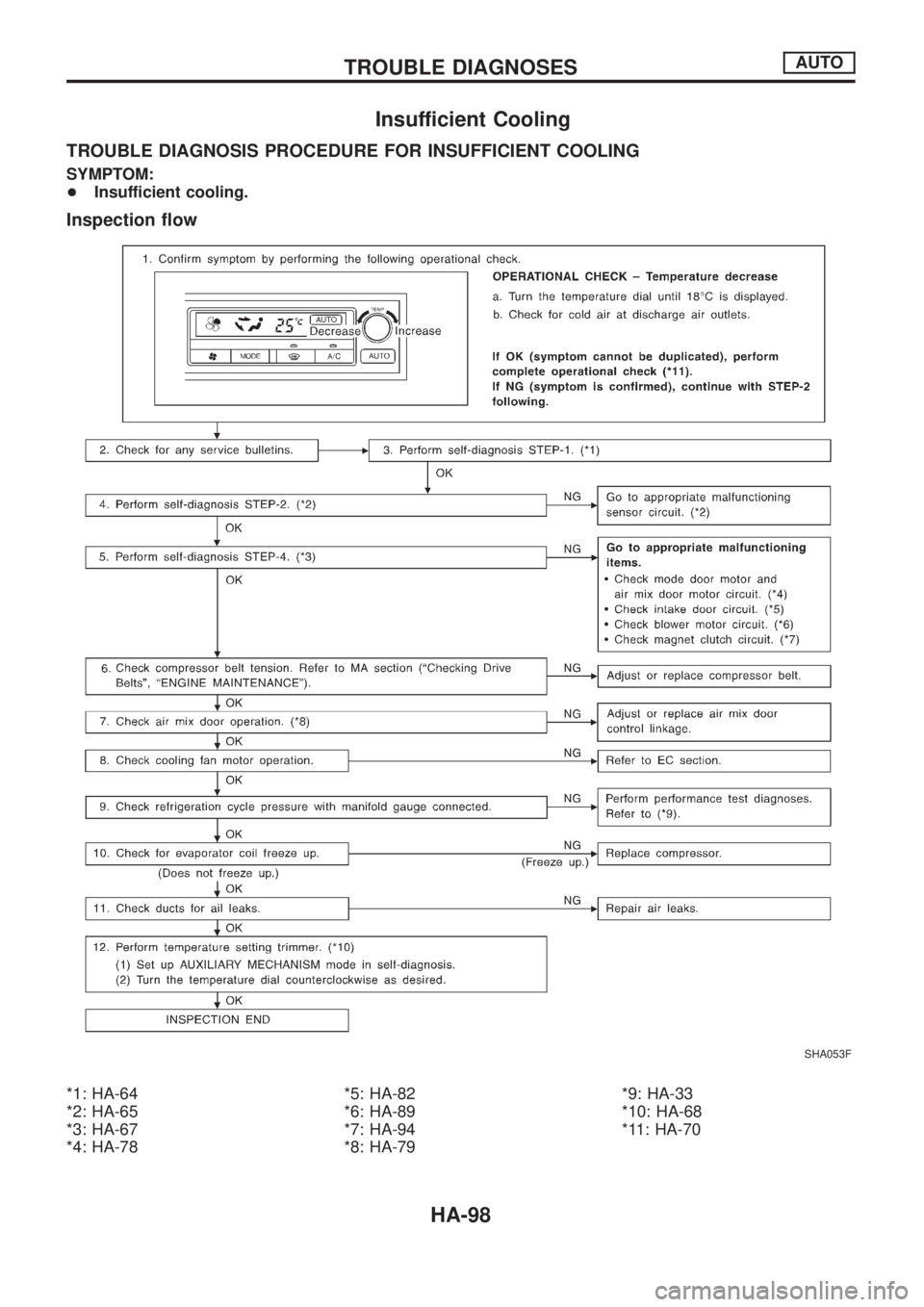
Insufficient Cooling
TROUBLE DIAGNOSIS PROCEDURE FOR INSUFFICIENT COOLING
SYMPTOM:
+Insufficient cooling.
Inspection ¯ow
*1: HA-64
*2: HA-65
*3: HA-67
*4: HA-78*5: HA-82
*6: HA-89
*7: HA-94
*8: HA-79*9: HA-33
*10: HA-68
*11: HA-70
SHA053F
TROUBLE DIAGNOSESAUTO
HA-98
Page 931 of 1226
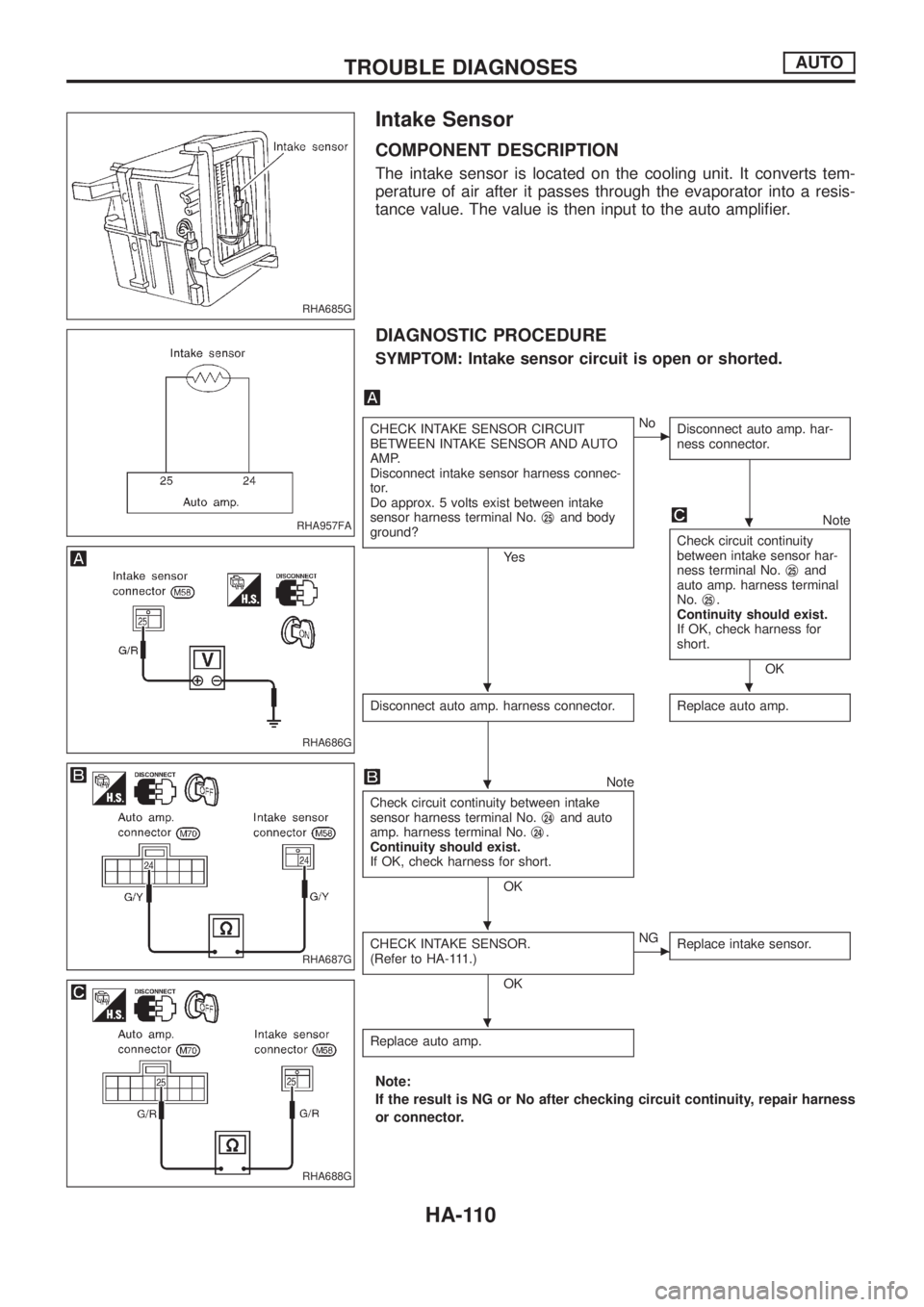
Intake Sensor
COMPONENT DESCRIPTION
The intake sensor is located on the cooling unit. It converts tem-
perature of air after it passes through the evaporator into a resis-
tance value. The value is then input to the auto ampli®er.
DIAGNOSTIC PROCEDURE
SYMPTOM: Intake sensor circuit is open or shorted.
CHECK INTAKE SENSOR CIRCUIT
BETWEEN INTAKE SENSOR AND AUTO
AMP.
Disconnect intake sensor harness connec-
tor.
Do approx. 5 volts exist between intake
sensor harness terminal No.j
25and body
ground?
Ye s
cNo
Disconnect auto amp. har-
ness connector.
Note
Check circuit continuity
between intake sensor har-
ness terminal No.j
25and
auto amp. harness terminal
No.j
25.
Continuity should exist.
If OK, check harness for
short.
OK
Disconnect auto amp. harness connector.
Replace auto amp.
Note
Check circuit continuity between intake
sensor harness terminal No.j
24and auto
amp. harness terminal No.j24.
Continuity should exist.
If OK, check harness for short.
OK
CHECK INTAKE SENSOR.
(Refer to HA-111.)
OK
cNG
Replace intake sensor.
Replace auto amp.
Note:
If the result is NG or No after checking circuit continuity, repair harness
or connector.
RHA685G
RHA957FA
RHA686G
RHA687G
RHA688G
.
..
.
.
.
TROUBLE DIAGNOSESAUTO
HA-110
Page 935 of 1226
Maintenance of Lubricant Quantity in
Compressor
The lubricant used to lubricate the compressor circulates through
the system with the refrigerant. Add lubricant to compressor when
replacing any component or after a large gas leakage occurred. It
is important to maintain the speci®ed amount.
If lubricant quantity is not maintained properly, the following mal-
functions may result:
+Lack of lubricant: May lead to a seized compressor
+Excessive lubricant: Inadequate cooling (thermal exchange
interference)
LUBRICANT
Name: Nissan A/C System Oil Type S
Part number: KLH00-PAGS0
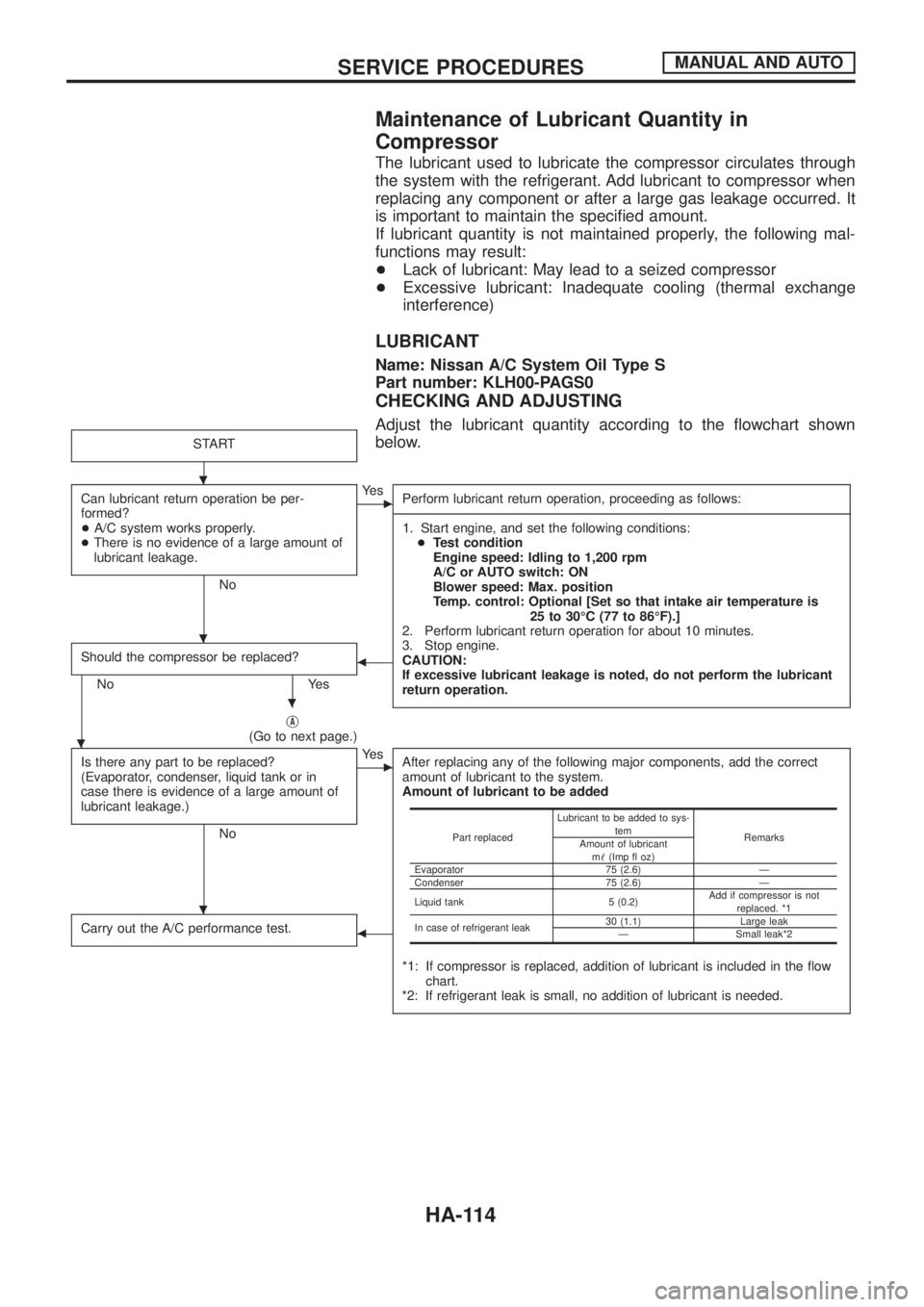
CHECKING AND ADJUSTING
Adjust the lubricant quantity according to the ¯owchart shown
below.
START
Can lubricant return operation be per-
formed?
+A/C system works properly.
+There is no evidence of a large amount of
lubricant leakage.
No
cYe s
Perform lubricant return operation, proceeding as follows:
------------------------------------------------------------------------------------------------------------------------------------------------------------------------------------------------------------------------------------------------------------------------------------------------------------------------------------------------------------------------------------------------------------------------------------------------------------------------------------------------------------------------------------
1. Start engine, and set the following conditions:
+Test condition
Engine speed: Idling to 1,200 rpm
A/C or AUTO switch: ON
Blower speed: Max. position
Temp. control: Optional [Set so that intake air temperature is
25 to 30ÉC (77 to 86ÉF).]
2. Perform lubricant return operation for about 10 minutes.
3. Stop engine.
CAUTION:
If excessive lubricant leakage is noted, do not perform the lubricant
return operation.
Should the compressor be replaced?
No Yes
b
jA(Go to next page.)
Is there any part to be replaced?
(Evaporator, condenser, liquid tank or in
case there is evidence of a large amount of
lubricant leakage.)
No
cYe s
After replacing any of the following major components, add the correct
amount of lubricant to the system.
Amount of lubricant to be added
*1: If compressor is replaced, addition of lubricant is included in the ¯ow
chart.
*2: If refrigerant leak is small, no addition of lubricant is needed.
Carry out the A/C performance test.b
Part replacedLubricant to be added to sys-
tem
Remarks
Amount of lubricant
m!(Imp ¯ oz)
Evaporator 75 (2.6) Ð
Condenser 75 (2.6) Ð
Liquid tank 5 (0.2)Add if compressor is not
replaced. *1
In case of refrigerant leak30 (1.1) Large leak
Ð Small leak*2
.
.
.
.
.
SERVICE PROCEDURESMANUAL AND AUTO
HA-114
Page 937 of 1226
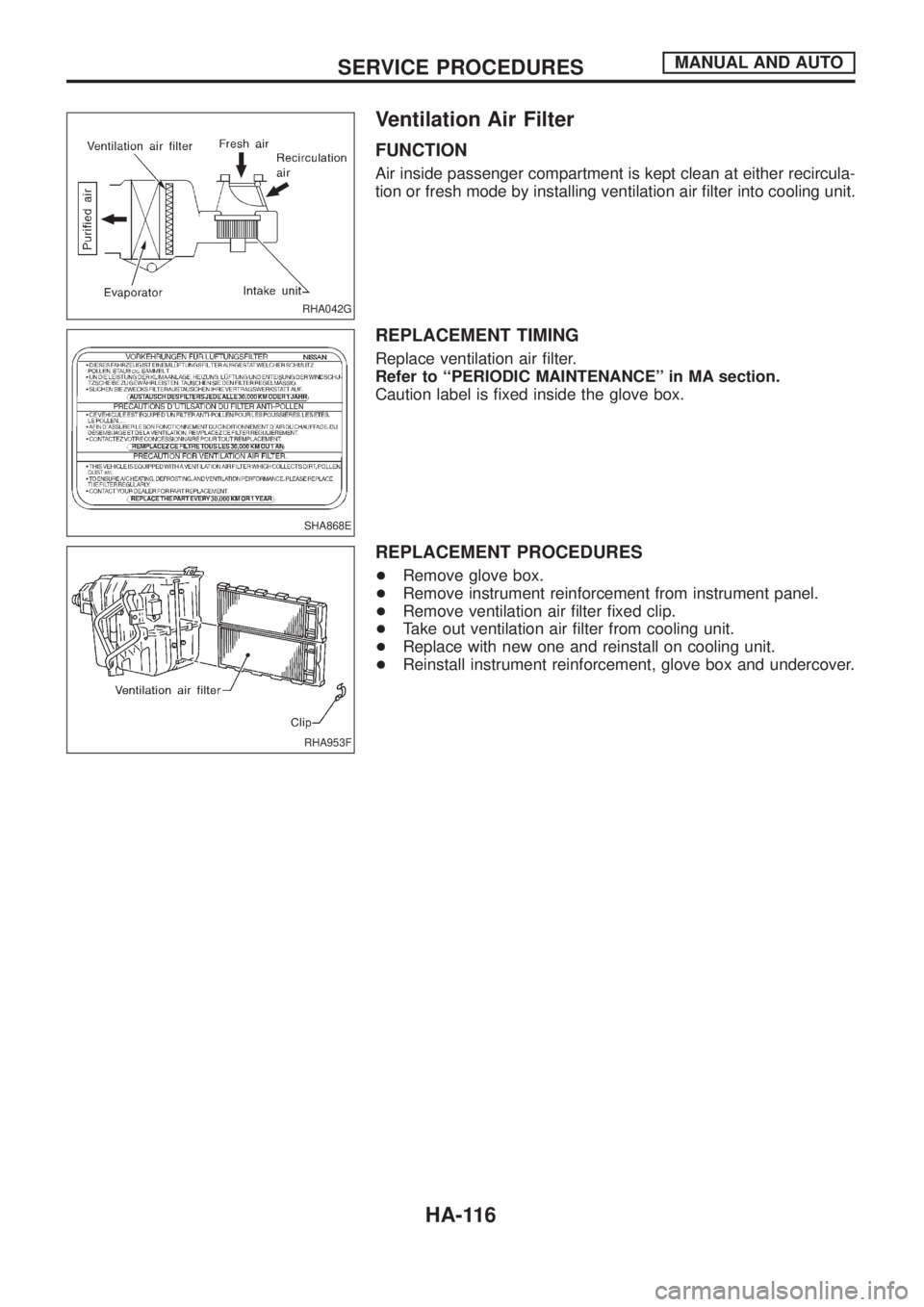
Ventilation Air Filter
FUNCTION
Air inside passenger compartment is kept clean at either recircula-
tion or fresh mode by installing ventilation air ®lter into cooling unit.
REPLACEMENT TIMING
Replace ventilation air ®lter.
Refer to ``PERIODIC MAINTENANCE'' in MA section.
Caution label is ®xed inside the glove box.
REPLACEMENT PROCEDURES
+Remove glove box.
+Remove instrument reinforcement from instrument panel.
+Remove ventilation air ®lter ®xed clip.
+Take out ventilation air ®lter from cooling unit.
+Replace with new one and reinstall on cooling unit.
+Reinstall instrument reinforcement, glove box and undercover.
RHA042G
SHA868E
RHA953F
SERVICE PROCEDURESMANUAL AND AUTO
HA-116
Page 941 of 1226
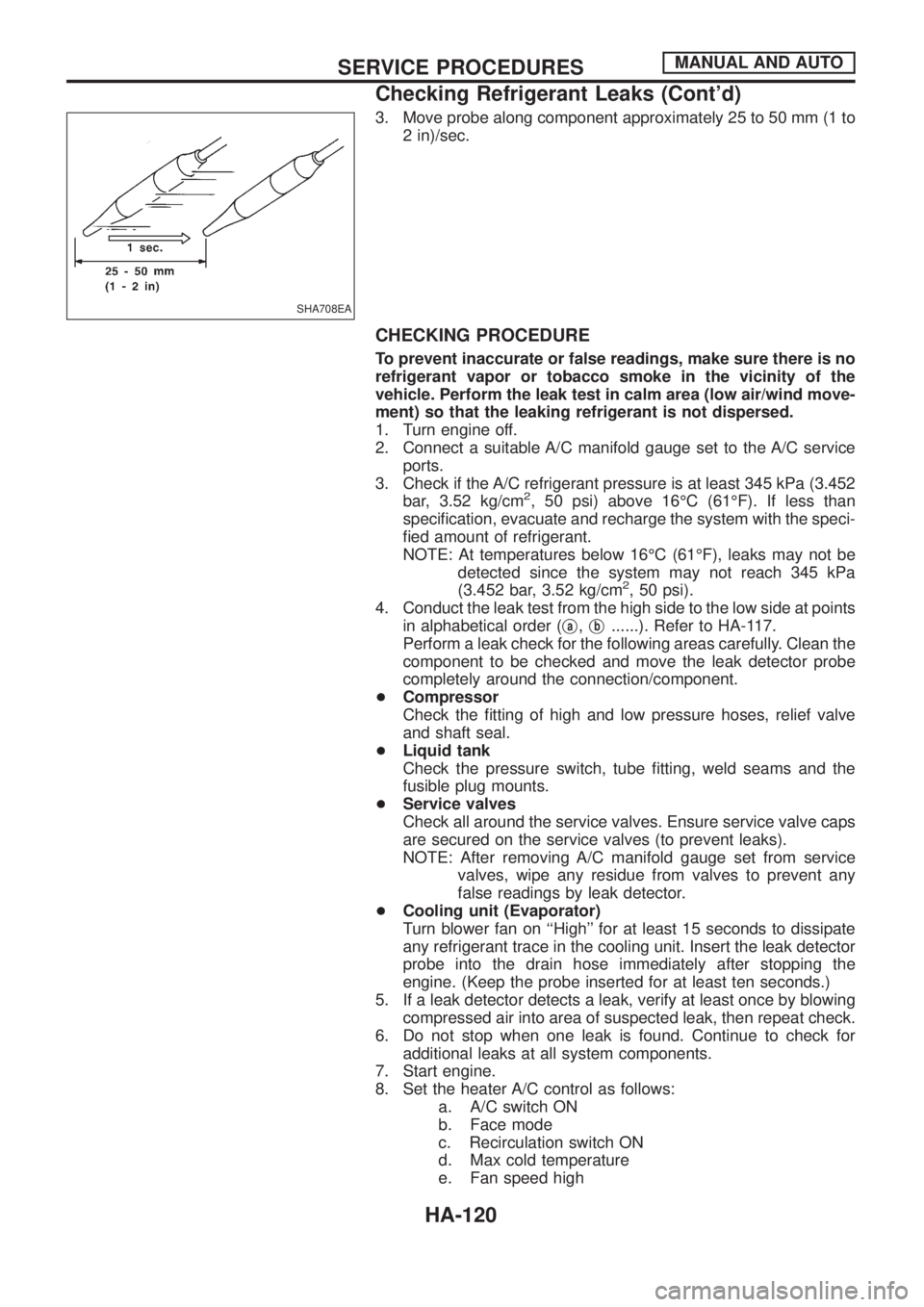
3. Move probe along component approximately 25 to 50 mm (1 to
2 in)/sec.
CHECKING PROCEDURE
To prevent inaccurate or false readings, make sure there is no
refrigerant vapor or tobacco smoke in the vicinity of the
vehicle. Perform the leak test in calm area (low air/wind move-
ment) so that the leaking refrigerant is not dispersed.
1. Turn engine off.
2. Connect a suitable A/C manifold gauge set to the A/C service
ports.
3. Check if the A/C refrigerant pressure is at least 345 kPa (3.452
bar, 3.52 kg/cm
2, 50 psi) above 16ÉC (61ÉF). If less than
speci®cation, evacuate and recharge the system with the speci-
®ed amount of refrigerant.
NOTE: At temperatures below 16ÉC (61ÉF), leaks may not be
detected since the system may not reach 345 kPa
(3.452 bar, 3.52 kg/cm
2, 50 psi).
4. Conduct the leak test from the high side to the low side at points
in alphabetical order (j
a,jb......). Refer to HA-117.
Perform a leak check for the following areas carefully. Clean the
component to be checked and move the leak detector probe
completely around the connection/component.
+Compressor
Check the ®tting of high and low pressure hoses, relief valve
and shaft seal.
+Liquid tank
Check the pressure switch, tube ®tting, weld seams and the
fusible plug mounts.
+Service valves
Check all around the service valves. Ensure service valve caps
are secured on the service valves (to prevent leaks).
NOTE: After removing A/C manifold gauge set from service
valves, wipe any residue from valves to prevent any
false readings by leak detector.
+Cooling unit (Evaporator)
Turn blower fan on ``High'' for at least 15 seconds to dissipate
any refrigerant trace in the cooling unit. Insert the leak detector
probe into the drain hose immediately after stopping the
engine. (Keep the probe inserted for at least ten seconds.)
5. If a leak detector detects a leak, verify at least once by blowing
compressed air into area of suspected leak, then repeat check.
6. Do not stop when one leak is found. Continue to check for
additional leaks at all system components.
7. Start engine.
8. Set the heater A/C control as follows:
a. A/C switch ON
b. Face mode
c. Recirculation switch ON
d. Max cold temperature
e. Fan speed high
SHA708EA
SERVICE PROCEDURESMANUAL AND AUTO
Checking Refrigerant Leaks (Cont'd)
HA-120