oil NISSAN PULSAR 1987 Owners Manual
[x] Cancel search | Manufacturer: NISSAN, Model Year: 1987, Model line: PULSAR, Model: NISSAN PULSAR 1987Pages: 238, PDF Size: 28.91 MB
Page 201 of 238

Electrical System 201
nosed pliers. This will safeguard the diodes
by transferring any excess heat to the jaws of
the pliers.
Using a suitable drift, install the bearing into
the drive end bracket, install the retainer plate and
screws. Tighten the screws securely. Using a suitable press and press plates, install
the bearing to the slip ring end of the rotor shaft.
Ensure that pressure is ex erted only on the inner race
and that the stop ring groove is nearest to the sl i p
rings. Ensure that the rotor sh aft rear bearing stop
ring is positioned so that the protruding part of the
ring is located in the deepest part of the groove. Install the stator, diode pack and
regulator
assembly to the slip ring e nd bracket. Install the
retaining nuts and washers and tighten securely. Install the nut and insulator to the terminal
and tighten securely. Using a piece of wire, hold the brushes in a
retracted position. Hold the drive end bracket in a soft jawed
vice and install the rotor shaft assembly to the drive
end bracket. Install the pulley, retaining nut and washer to
the rotor shaft and tighten the retaining nut to the
specified torque. Apply a heated 200 watt soldering iron to the
slip ring end bracket at the bearing mounting boss for
3-4 minutes to heat the bracket and allow the
installation of the rotor shaft rear bearing. Aligning the marks made on dismantling and
ensuring that the rotor sh aft rear bearing retaining
ring protrusion is located in the deepest part of its
groove, install the rotor/stator assembly to the slip ring
end bracket.
Remove the brush retr acting wire from the
alternator, ensure that the alternator component
marks are aligned, install the retaining through bolts
and tighten them securely. Check the alternator rotor for smooth oper-
ation and install the al ternator to the vehicle
as
previously described.
Check the alternator operation on the vehicle
as previously described.
8. STARTER MOTOR
Special Equipment Required:
To Renew Brushes — Soldering iron
To Renew Armature Bearings — Bearing puller
DESCRIPTION
Two types of starter motors are installed to the
range of vehicles covere d by this manual, either
Hitachi or Bosch.
The starter motor is the induced pole type with
four brushes and four pole shoes with field coils.
A solenoid switch is attached to the starter drive
end bracket. The solenoid plunger is connected to
the overrunning clutch and drive pinion assembly
through a lever and pivot arrangement.
When the solenoid windings are energized, the
plunger acting on the lever and pivot engages the drive
pinion with the flywheel ri ng gear and at the same
time closes the switch supplying power from the
positive lead of the battery to the starter motor field
coils and armature to operate the motor.
As the engine fires, the over-running clutch of the
drive pinion assembly prevents high speed rotation of.
and possible damage to, the starter armature if the
solenoid windings are not immediately de-energized
by releasing the ignition key.
The starter solenoid switch windings are energized
by the ignition switch.
TO TEST ON VEHICLE
Should the starter motor fail to operate when the
ignition switch is turned to the Start position, check
the following points:
Check the battery condition and state of
charge. Refer to the Battery heading for the correct
procedure.
Clean the battery terminals, taking particular
care to remove the scale from the positive ( + )
terminal post and terminal. Check the earth connection for tightness and
cleanliness.
Switch on the headlamps and turn the igni-
tion switch to Start. If the lamps dim but the starter
motor does not operate, it could indicate that a short
circuit has developed in the starting system. Check that the engine is not seized or that the
starter motor drive pinion and ring gear are not
locked as these conditions would -give the same
indications as above.
(5) If the lamps do not dim and the starter
motor does not operate, this would indicate an open
circuit such as a broken or disconnected wire or a
switch not operating.
If the vehicle is equipped with an automatic
transaxle, turn the ignition switch to Start and move
the selector lever through all the gear selection range.
If the starter motor operates in any position other
than N or P, the neutral safety switch is faulty.
(6) Check all the external wiring to ensure that
the fault is not external. If the external circuit proves
satisfactory, indicating that the problem is in the
starter motor, the unit will have to be removed and
tested.
TO REMOVE AND INSTAL
Disconnect the negative battery terminal.
Disconnect the wiring from the starter motor
solenoid. Remove the starter motor mounting bolts,
Page 202 of 238
202 Electrical System
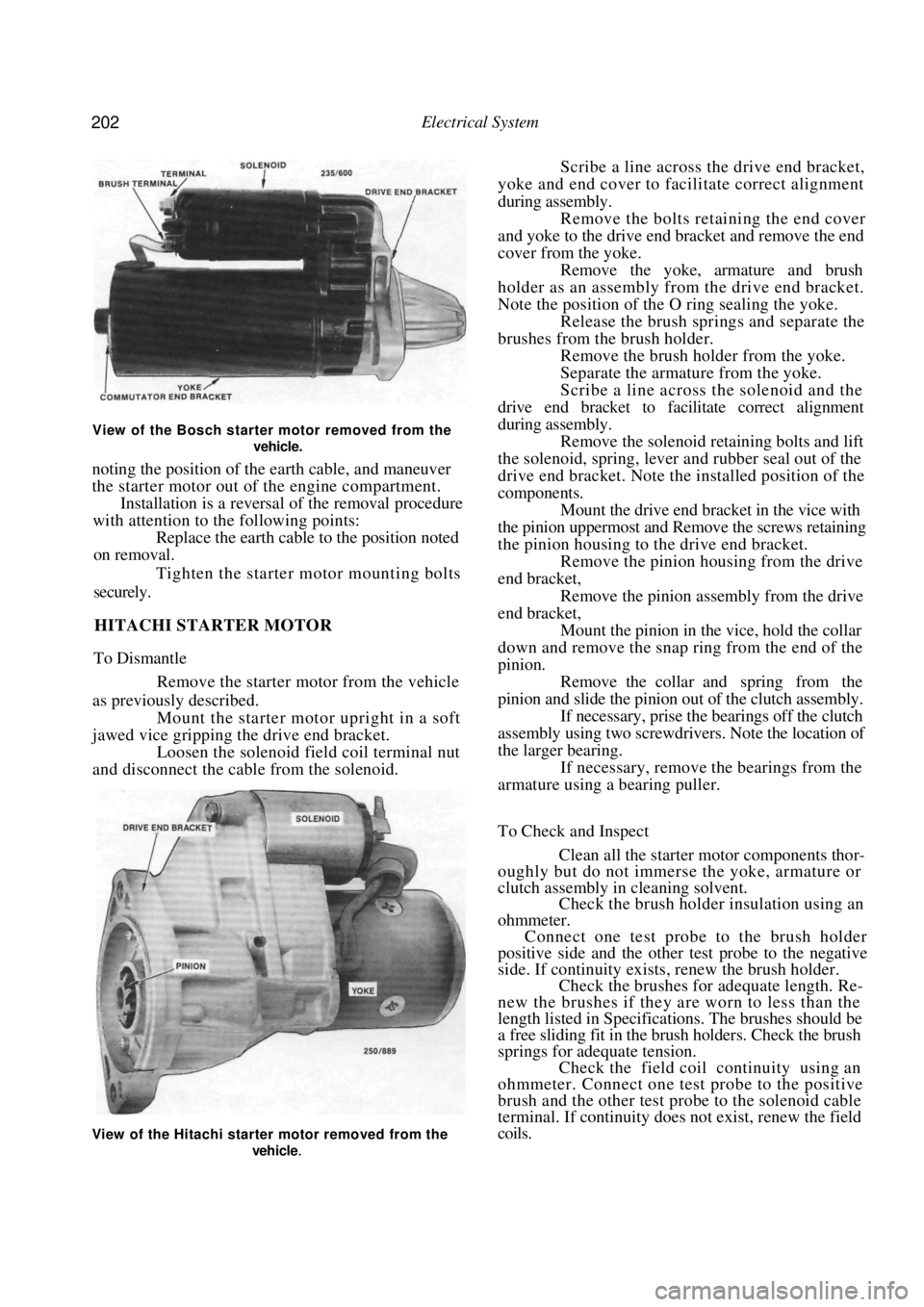
View of the Bosch starter motor removed from the
vehicle.
noting the position of the earth cable, and maneuver
the starter motor out of the engine compartment.
Installation is a reversal of the removal procedure
with attention to the following points:
Replace the earth cable to the position noted
on removal.
Tighten the starter motor mounting bolts
securely.
HITACHI STARTER MOTOR
To Dismantle
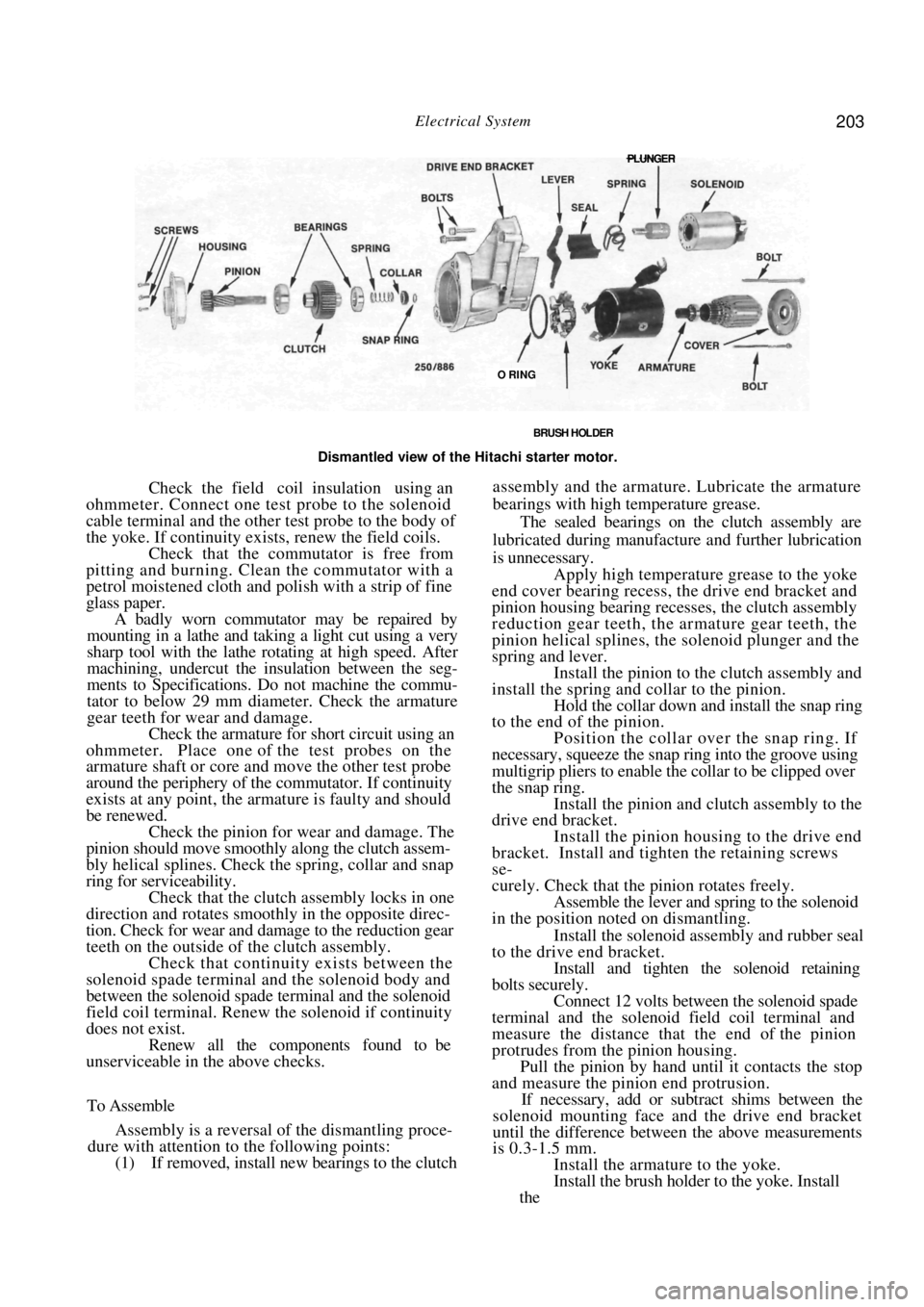
Remove the starter motor from the vehicle
as previously described. Mount the starter motor upright in a soft
jawed vice gripping the drive end bracket. Loosen the solenoid field coil terminal nut
and disconnect the cable from the solenoid.
Scribe a line across the drive end bracket,
yoke and end cover to facilitate correct alignment
during assembly. Remove the bolts retaining the end cover
and yoke to the drive end bracket and remove the end
cover from the yoke. Remove the yoke, armature and brush
holder as an assembly from the drive end bracket.
Note the position of the O ring sealing the yoke. Release the brush spri ngs and separate the
brushes from the brush holder. Remove the brush holder from the yoke.
Separate the armature from the yoke.
Scribe a line across the solenoid and the
drive end bracket to facilitate correct alignment
during assembly. Remove the solenoid retaining bolts and lift
the solenoid, spring, lever an d rubber seal out of the
drive end bracket. Note the installed position of the
components. Mount the drive end bracket in the vice with
the pinion uppermost and Remove the screws retaining
the pinion housing to the drive end bracket. Remove the pinion housing from the drive
end bracket,
Remove the pinion assembly from the drive
end bracket, Mount the pinion in the vice, hold the collar
down and remove the snap ring from the end of the
pinion. Remove the collar and spring from the
pinion and slide the pinion out of the clutch assembly. If necessary, prise the bearings off the clutch
assembly using two screwdri vers. Note the location of
the larger bearing. If necessary, remove the bearings from the
armature using a bearing puller.
To Check and Inspect
Clean all the starter motor components thor-
oughly but do not immerse the yoke, armature or
clutch assembly in cleaning solvent.
Check the brush holder insulation using an
ohmmeter. Connect one test probe to the brush holder
positive side and the other test probe to the negative
side. If continuity exists , renew the brush holder.
Check the brushes for adequate length. Re-
new the brushes if they are worn to less than the
length listed in Specifications. The brushes should be
a free sliding fit in the brush holders. Check the brush
springs for adequate tension.
Check the field coil continuity using an
ohmmeter. Connect one test probe to the positive
brush and the other test probe to the solenoid cable
terminal. If continuity does not exist, renew the field
coils.
View of the Hitachi starter motor removed from the
vehicle
.
Page 203 of 238
Electrical System 203
BRUSH HOLDER
Dismantled view of the Hitachi starter motor.
Check the field coil insulation using an
ohmmeter. Connect one test probe to the solenoid
cable terminal and the other test probe to the body of
the yoke. If continuity exists, renew the field coils. Check that the commutator is free from
pitting and burning. Clean the commutator with a
petrol moistened cloth and polish with a strip of fine
glass paper.
A badly worn commutator may be repaired by
mounting in a lathe and taking a light cut using a very
sharp tool with the lathe rotating at high speed. After
machining, undercut the insulation between the seg-
ments to Specifications. Do not machine the commu-
tator to below 29 mm diameter. Check the armature
gear teeth for wear and damage.
Check the armature for short circuit using an
ohmmeter. Place one of the test probes on the
armature shaft or core and move the other test probe
around the periphery of the commutator. If continuity
exists at any point, the armature is faulty and should
be renewed. Check the pinion for wear and damage. The
pinion should move smoothl y along the clutch assem-
bly helical splines. Check the spring, collar and snap
ring for serviceability.
Check that the clutch assembly locks in one
direction and rotates smoothly in the opposite direc-
tion. Check for wear and damage to the reduction gear
teeth on the outside of the clutch assembly.
Check that continuity exists between the
solenoid spade terminal and the solenoid body and
between the solenoid spade terminal and the solenoid
field coil terminal. Renew the solenoid if continuity
does not exist. Renew all the components found to be
unserviceable in the above checks.
To Assemble
Assembly is a reversal of the dismantling proce-
dure with attention to the following points:
(1) If removed, install new bearings to the clutch
assembly and the armature. Lubricate the armature
bearings with high temperature grease.
The sealed bearings on the clutch assembly are
lubricated during manufacture and further lubrication
is unnecessary.
Apply high temperature grease to the yoke
end cover bearing recess, the drive end bracket and
pinion housing bearing recesses, the clutch assembly
reduction gear teeth, the armature gear teeth, the
pinion helical splines, th e solenoid plunger and the
spring and lever. Install the pinion to the clutch assembly and
install the spring and collar to the pinion. Hold the collar down and install the snap ring
to the end of the pinion.
Position the collar over the snap ring. If
necessary, squeeze the snap ring into the groove using
multigrip pliers to enable the collar to be clipped over
the snap ring. Install the pinion and clutch assembly to the
drive end bracket.
Install the pinion housing to the drive end
bracket. Install and tighten the retaining screws
se-
curely. Check that the pinion rotates freely.
Assemble the lever and spring to the solenoid
in the position noted on dismantling.
Install the solenoid assembly and rubber seal
to the drive end bracket.
Install and tighten the solenoid retaining
bolts securely. Connect 12 volts between the solenoid spade
terminal and the solenoid field coil terminal and
measure the distance that the end of the pinion
protrudes from the pinion housing. Pull the pinion by hand until it contacts the stop
and measure the pinion end protrusion.
If necessary, add or subt ract shims between the
solenoid mounting face and the drive end bracket
until the difference between the above measurements
is 0.3-1.5 mm.
Install the armature to the yoke.
Install the brush holder to the yoke. Install
the
PLUNGER
O RING
Page 204 of 238

204 Electrical System
brushes to the brush holder and position the springs
against the ends of the brushes.
Install the O ring to the yoke taking care
that
the O ring is not twisted. Install the yoke, armature and brush
holder
assembly to the drive end bracket, aligning the marks
made on dismantling. Install the end cover to the yoke. Install
and
tighten the retaining bolts securely. Connect the cable to the solenoid field coil
terminal and tighten the terminal nut securely. Install the starter motor to the vehicle
as
previously described.
BOSCH STARTER MOTOR
To Dismantle
Disconnect the brush connector strap from
the lower terminal on the solenoid switch.
Remove the screws retaining the solenoid to
the drive end bracket and remove the solenoid from
the drive end bracket.
Loosen, but do not remove the screws retain-
ing the armature end cover to the commutator end
bracket. Remove the through bolts retaining the drive
end bracket to the commutator end bracket.
Remove the yoke, armature and commutator
end bracket from the drive end bracket as an assem-
bly. Hold the rubber seal in place in the drive end
bracket to keep the engaging lever in position.
Remove the rubber seal from the drive end
bracket. Remove the cover plate from the planetary
gear set and remove the gear set, drive assembly and
engaging lever as an assembly. Remove the armature end cover and com-
mutator end bracket from the yoke. Remove the screws retaining the armature
end cover to the commutator end cover and remove
the armature end cover, C clip and shims from the
armature shaft. Remove the commutator end bracket
from the armature. Carefully remove the brush holder from the
armature. Support the gear set and drive assembly in a
vertical position with the drive assembly uppermost.
Using a suitable drift, tap the stop collar
towards the drive assembly and remove the snap ring
from the drive shaft. Remove any burrs from the drive shaft and
withdraw the drive assembly and stop ring from the
drive shaft.
Clean all parts thoroughly but do not im-
merse the armature, solenoid or drive assembly in
cleaning solvent.
To Check and Inspect
(1) With the starter motor dismantled, check the
brush holder insulation using an ohmmeter.
Connect one test lead to the brush holder positive
BRACKET
Dismantled view of the Bosch starter motor.
Page 205 of 238

Electrical System 205
Dismantled view of the brush holder assembly. Bosch
starter motor.
side and the other lead to the negative side. If there is
any indication of leakage the ohmmeter will show a
reading other than infinity. Repair or renew the brush
holder if leakage is evident.
(2) Check the brushes for adequate length.
Brushes should be renewed when their length is below
Specifications. They should be a free sliding fit in the
brush holders.
NOTE: Due to the difficulty involved in
removing and installing the brushes in the
Bosch starter motor, it is recommended that
the brush holder be renewed as an assembly.
(3) Check that the commutator is free from
pitting and burning. Clean with a petrol moistened
cloth and polish with a strip of fine glass paper.
A badly worn commutator may be repaired by
mounting in a lathe, spi nning at high speed, and
taking a light cut with a very sharp tool. After turning,
undercut the insulation between the segments.
(4) Check the armature for short circuit using an
ohmmeter.
Place one of the test lead s on the armature shaft
or core and move the other lead around the circum-
ference of the commutator. If the ohmmeter shows a
reading at any point the armature is faulty and should
be renewed.
Check the drive assembly clutch pinion teeth
for wear, scoring or chipping. A clutch in good
condition should take up the drive in one direction
only. It should rotate easily and smoothly in the
non-drive direction and the assembly should move
smoothly along the armature or drive shaft helical
splines.
Check the armature shaft bushes for wear
and renew as necessary. The old bushes must be
removed and the new ones pressed into the end
brackets using a polished mandrel of the exact diam-
eter of the armature shaft. NOTE: The new bushes must not be reamed
to size, as reaming will impair the porosity
of the bushes and cause early failure. New
bushes should be allowed to stand immersed
in clean light engine oil for one hour before
installation.
To Assemble
Assembly is a reversal of the dismantling proce-
dure with attention to the following points:
Lubricate the helix of the drive shaft lightly
with graphite grease and install the drive assembly
to
the drive shaft. Install the stop collar and snap ring, slide the
stop collar over the snap ring to lock the snap ring in
position.
Lubricate the bushes in both end brackets
sparingly with engine oil. Install the engaging lever and gear set into the
drive end bracket. Install the centre rear bracket and the engag-
ing lever seal into the drive end bracket.
Slide the brush holder assembly into position
on the commutator ensuring that the brush holders
are correctly positioned in the anchor points. Install the commutator end bracket to
the
armature, install the shims and C clip. Check that the armature end float is satisfac-
tory and adjust as necessary using shims of the correct
thickness.
Align the slot in the commutator end bracket
with the cut out on the wiring seal and install the
armature end cover to the commutator end bracket.
Install the cover retaini ng screws but do not tighten.
Ensure that the permanent magnets in the
yoke have not picked up any debris and slide the yoke
over the armature ensuring that the wiring seal locates
correctly in the slot in the yoke.
View showing the planetary gear set. Bosch starter
motor.
Page 219 of 238
Electrical System 219
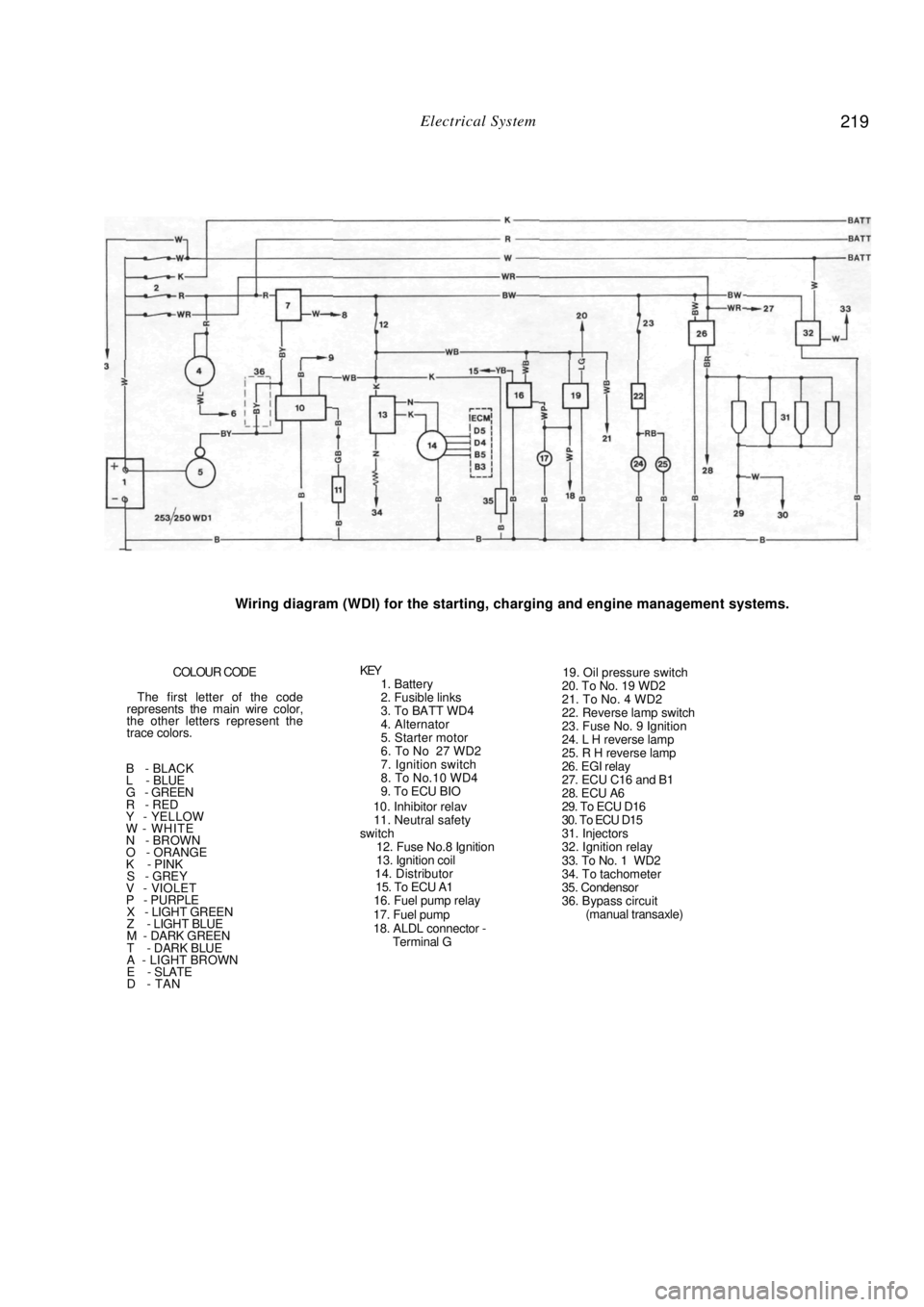
Wiring diagram (WDI) for the starting, charging and engine management systems.
COLOUR CODE
The first letter of the code
represents the main wire color,
the other letters represent the
trace colors.
B - BLACK
L - BLUE
G - GREEN
R - RED
Y - YELLOW
W - WHITE
N - BROWN
O - ORANGE
K - PINK
S - GREY V - VIOLET
P - PURPLE X - LIGHT GREEN
Z - LIGHT BLUE
M - DARK GREEN
T - DARK BLUE
A - LIGHT BROWN
E - SLATE
D - TAN
KEY 1. Battery
2. Fusible links
3. To BATT WD4
4. Alternator
5. Starter motor
6. To No 27 WD2
7. Ignition switch
8. To No.10 WD4
9. To ECU BIO
10. Inhibitor relav
11. Neutral safety
switch
12. Fuse No.8 Ignition
13. Ignition coil
14. Distributor
15. To ECU A1
16. Fuel pump relay
17. Fuel pump
18. ALDL connector - Terminal G
19. Oil pressure switch
20. To No. 19 WD2
21. To No. 4 WD2
22. Reverse lamp switch
23. Fuse No. 9 Ignition
24. L H reverse lamp
25. R H reverse lamp
26. EGI relay
27. ECU C16 and B1
28. ECU A6
29. To ECU D16
30. To ECU D15
31. Injectors
32. Ignition relay
33. To No. 1 WD2
34. To tachometer
35. Condensor
36. Bypass circuit (manual transaxle)
Page 220 of 238
220 Electrical System
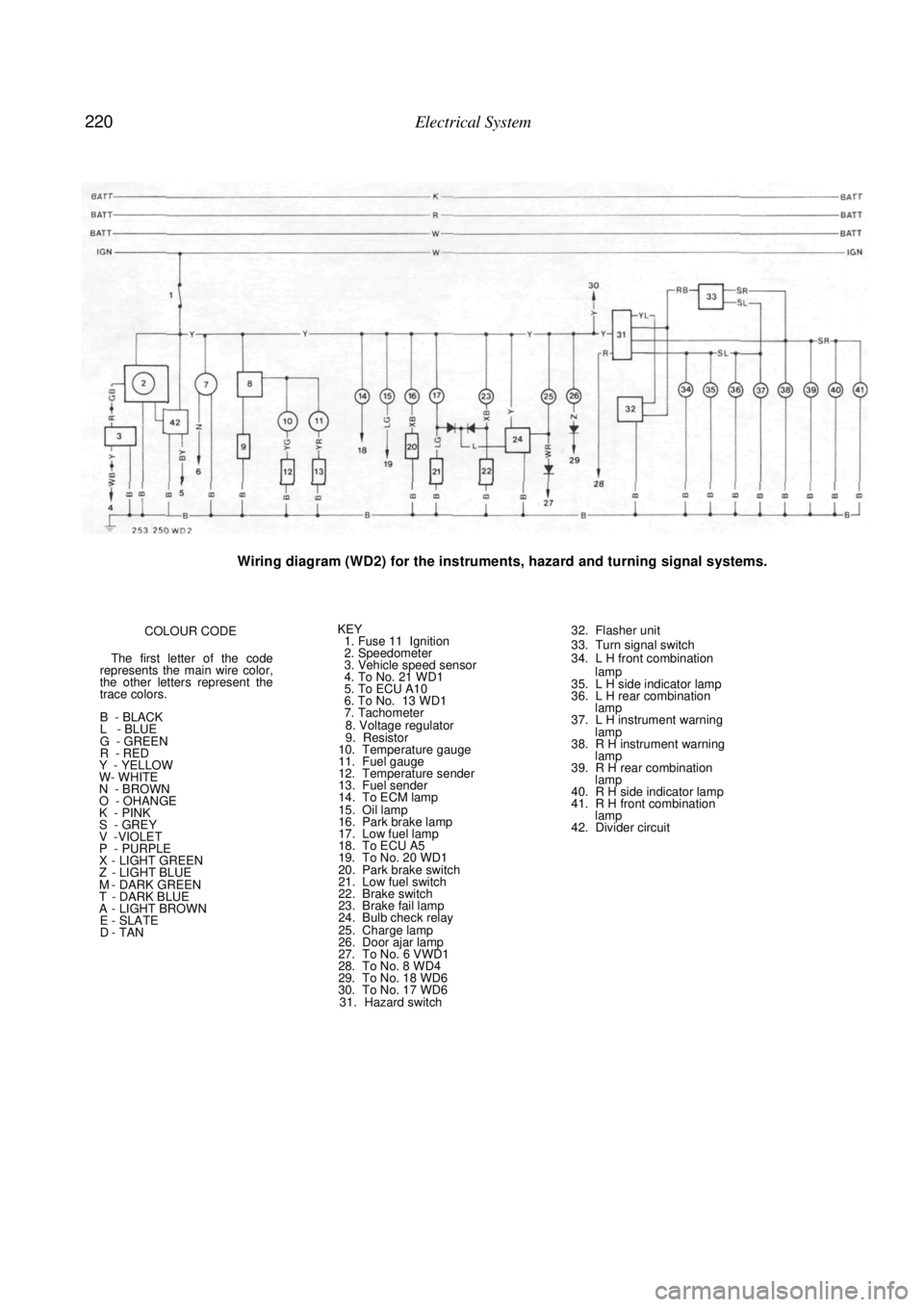
Wiring diagram (WD2) for the instruments, hazard and turning signal systems.
COLOUR CODE
The first letter of the code
represents the main wire color,
the other letters represent the
trace colors.
B - BLACK
L - BLUE
G - GREEN
R - RED
Y - YELLOW
W- WHITE
N - BROWN
O - OHANGE
K - PINK
S - GREY V -VIOLET
P - PURPLE X - LIGHT GREEN Z - LIGHT BLUE M - DARK GREEN T - DARK BLUE A - LIGHT BROWN E - SLATE D - TAN
KEY 1. Fuse 11 Ignition
2. Speedometer
3. Vehicle speed sensor
4. To No. 21 WD1
5. To ECU A10
6. To No. 13 WD1
7. Tachometer
8. Voltage regulator
9. Resistor
10. Temperature gauge
11. Fuel gauge
12. Temperature sender
13. Fuel sender
14. To ECM lamp
15. Oil lamp
16. Park brake lamp
17. Low fuel lamp
18. To ECU A5
19. To No. 20 WD1
20. Park brake switch
21. Low fuel switch
22. Brake switch
23. Brake fail lamp
24. Bulb check relay
25. Charge lamp
26. Door ajar lamp
27. To No. 6 VWD1
28. To No. 8 WD4
29. To No. 18 WD6
30. To No. 17 WD6 31. Hazard switch
32. Flasher unit
33. Turn signal switch
34. L H front combination
lamp
35. L H side indicator lamp
36. L H rear combination lamp
37. L H instrument warning
lamp
38. R H instrument warning lamp
39. R H rear combination lamp
40. R H side indicator lamp
41. R H front combination lamp
42. Divider circuit
Page 236 of 238

236 Body
top of the dashboard rearwards and maneuver the
dashboard through the front door opening.
Installation is a reversal of the removal procedure
with attention to the following points:
With the aid of an assistant, ensure that the
outer edges of the dashboard engage properly with the
door pillar brackets.
Hold the dashboard in position and loosely
install all retaining bolts. Align the dashboard
and
tighten all screws and bolts securely.
10. SEAT BELTS
The front and outer rear seats are equipped with
lap/sash inertia reel seat belts, which are designed to
lock with any sudden change in vehicle motion.
The centre rear seat is equipped with a manually
adjustable lap seat belt.
Child restraint anchorages are located on the
parcel shelf behind the rear seat on Sedan models and
at the rear of the lugg age compartment floor on
Hatchback models. These anchorages must be used if
a child's seat or capsule is installed to the vehicle. The
anchorages should not be used for adult scat bells or
harnesses.
The seat belts should be periodically inspected as
described below. Any seat belt assembly that is worn
or damaged, or has been subjected to abnormal
loadings in a collision, should be renewed as a
complete assembly.
Only mild soap and water should be used to clean
the webbing. Contamination wi th polish, oil, bleaches
and other chemicals should be avoided.
TO INSPECT
(1) Check the seat belt webbing for fraying, cuts,
burns or other damage. On inertia reel belts, slowly
pull the belt from the reel to allow the entire length to
be examined. If the webbing is damaged or worn,
renew the seat belt assembly.
Check the seat belt webbing for fraying, cuts, burns or
other damage.
Ensure that the belts are not twisted.
Check all retaining nuts and bolts for secu-
rity.
Inspect the belt buckles for correct and
secure engagement. If the buckles are damaged or do
not function correctly, renew the seat belt assembly. On inertia reel seat belts, check the retractor
mechanism as follows:
Pull the belt slowly from the reel and check
for smooth operation. Release the belt and ensure that
it retracts fully.
Pull the belt rapidly from the reel. The reel
should lock.
Drive the vehicle at walking pace and at-
tempt to withdraw the belt slowly while braking
sharply. The reel should lock. If the retractor mechanism does not function
correctly, renew the seat belt assembly.
11. SEATS
FRONT SEAT
To Remove and Install
Adjust the seat to the most forward position.
Remove the mounting bolts from the rear of
the seat.
Adjust the seat to allow access to the mount-
ing bolts at the front of the seat. Remove the mounting bolts and withdraw
the seat from the vehicle.
Installed view of the fron t seat belt with the door pillar
trim removed showing the mounting points.
Page 237 of 238

Body 237
Installed view of the front seat mounting bolts.
Installation is a reversal of the removal procedure
with attention to the following points:
Lubricate the seat slides with multi-purpose
grease prior to installation of the seat.
Install all mounting bolts by hand prior to
tightening the mounting bolts securely.
REAR SEAT CUSHION
To Remove and Install
Firmly bump the lower front of the seat
cushion rearwards and up lo release the retaining clips
from the vehicle floor panel.
With the retaining clips released, lift the
front of the seat cushion and release the rear mounting
wires. (3) Lift the rear seat cushion out of the vehicle.
Installation is a reversal of the removal procedure
with attention to the following points:
Position the centre seat belts on top of the
rear seat cushion prior to in stallation of the cushion.
Ensure that the clips at the forward edge of
the seat cushion are proper ly engaged in the floor
panel.
REAR SEAT BACKREST
To Remove and Install
Fold the rear seat backrest forward.
Remove the outer seat backrest hinge bolts.
Pull each backrest to wards the door and off
the centre hinge pins. Remove the rear seat backrest from the
vehicle. Installation is a reversal of the removal procedure.
12. VEHICLE CLEANING
CLEANING THE EXTERIOR
In order to remove dirt and road grime and thus
preserve paint finish, vehicles in continuous use
should be washed at least once a week.
Before washing the paintwork, it is good policy to
first hose all dirt from the underbody and clean out
the drain holes in the doors and sill panels.
Hose the vehicle to remove as much grit as
possible and wash using a clean chamois or sponge,
ensuring that the chamois or sponge is free from dirt
or grit which could scratch the paint surface.
Avoid washing the vehicle in bright sunlight with
high temperature as this will give the paintwork a
streaky watermarked finish.
If necessary, wash the vehicle using a reputable
brand Wash and Wax liquid. The Wash and Wax
liquid will restore the paint luster and leave the
paintwork with a protective coating of wax.
After a period it may become necessary to polish
the vehicle in order to remove built up foreign matter
and give the paintwork maximum protection from
industrial fall-out and salt from sea air etc. Before
polishing the paintwork, always wash the surface to
remove as much road grime as possible. When
polishing follow the polishing instructions which come
with the polish.
NOTE: Grease, oil or tar on the paint
surface can be removed with a little kerosene
or white spirits. To prevent staining, wash
and polish the affected area as soon as the
grease, oil or tar is removed.
CLEANING VINYL TRIM
To maintain the vinyl interior trim in good
condition it should be regularly vacuumed to remove
loose dirt and then wiped with a dry or damp cloth.
If the trim is soiled or stained, the following
cleaning procedure is recommended:
Using warm water, cheese cloth and a mild
soap, thoroughly wash the affected areas.
Repeat the operation using damp cheese
cloth only.
To complete the cleaning operation wipe the
trim over with a dry piece of cheese cloth.
NOTE: If the interior trim is badly soiled or
stained, wash with a reputable brand of
upholstery cleaner care fully following the
makers instructions.
CLEANING CLOTH TRIM
Loose dirt and dust on cloth trim should be
removed with a vacuum cleaner or a very soft brush.
Do not use a whisk brush or any other type of coarse
brush or damage to the cloth could result. If the fabric
is soiled the following cl eaning procedure is recom-
mended.
Sponge the fabric ligh tly with warm water
containing a little detergen t and household ammonia.
After sponging, rub the fabric lightly. If
soiling is still apparent, re peat the sponging operation.
Use a clean dry cloth to soak up excess fluid.