wheel NISSAN PULSAR 1987 Owner's Manual
[x] Cancel search | Manufacturer: NISSAN, Model Year: 1987, Model line: PULSAR, Model: NISSAN PULSAR 1987Pages: 238, PDF Size: 28.91 MB
Page 60 of 238

60 Engine
NOTE: Should the ring end gap be greater
than the specified gap, another ring set
should be obtained and the ring end gaps
checked and compared with the Specifica-
tions.
(3) Treat each ring and cylinder bore individu-
ally and ensure that the rings are assembled to the
respective piston for the cylinder bore in which they
were installed to check the end gap.
(4) Assemble each oil control ring to its respec-
tive piston bottom groove as follows:
(a) Install the oil ring expander to the
piston
groove, ensuring that the ends of the expander are
bulled together and not overlapped. (b) Position one end of the lower side rail in the
groove and peel the ring over the piston and into the
groove. (c) Similarly install the upper side rail.
(5) Install the lower compression ring into
the
lower piston groove.
NOTE: The compression rings should be
installed with the manufacturers mark fac-
ing the top of the piston. To minimize the
possibility of ring breakage the rings can be
immersed in hot water prior to installation.
(6) Install the upper compression ring into
the
upper piston groove.
(7) Space the compression ring gaps 120 degrees
apart, and ensure that the o il ring gaps and the join in
the oil ring expander are not aligned. (8) With the rings correctly installed and
gapped, remove the bearing cap from the connecting
rod. (9) Liberally lubricate the piston assembly and
install the piston ring compressor to number one
piston.
NOTE: When installing the pistons to the
cylinder ensure that the front marking on
the piston is towards the front of the engine.
(10) Turn the crankshaft until number one crank-
pin is at the bottom of its stroke. (11) Install number one piston and connecting
rod
assembly into its bore. Push the assembly down the
bore until the connecting rod can be aligned with
number one crankpin.
NOTE: The bearing shells should be lubri-
cated with engine oil before installation.
(12) Install the connecting rod cap and tighten
the
retaining bolts to the specified torque.
NOTE: If new bearing shells were installed,
check the bearing clearance with Plastigage
as previously described.
(13) With the bearing clearance as specified, in-
stal the remaining pistons in the same manner.
(14) Ensure that the crankshaft turns without
binding.
(15) With all connecting rod bolts tightened to
the specified torque, install the associated
components
by referring to the relevant headings in this section.
11. CRANKSHAFT AND MAIN BEARINGS
Special Equipment Required:
To Inspect — Micrometer, Vee blocks, dial gauge
TO REMOVE
(1) With the engine assembly removed from the
vehicle and the transaxle separated from the engine,
refer to the appropriate headings or sections and
remove the following components: sump, oil pump
pickup pipe, oil pump, and flywheel or drive plate. (2) Remove the crankshaft rear oil seal from the
Using a ring compressor to install the piston.
Checking the crankshaft end float using feeler gauges.
Page 62 of 238
Engine
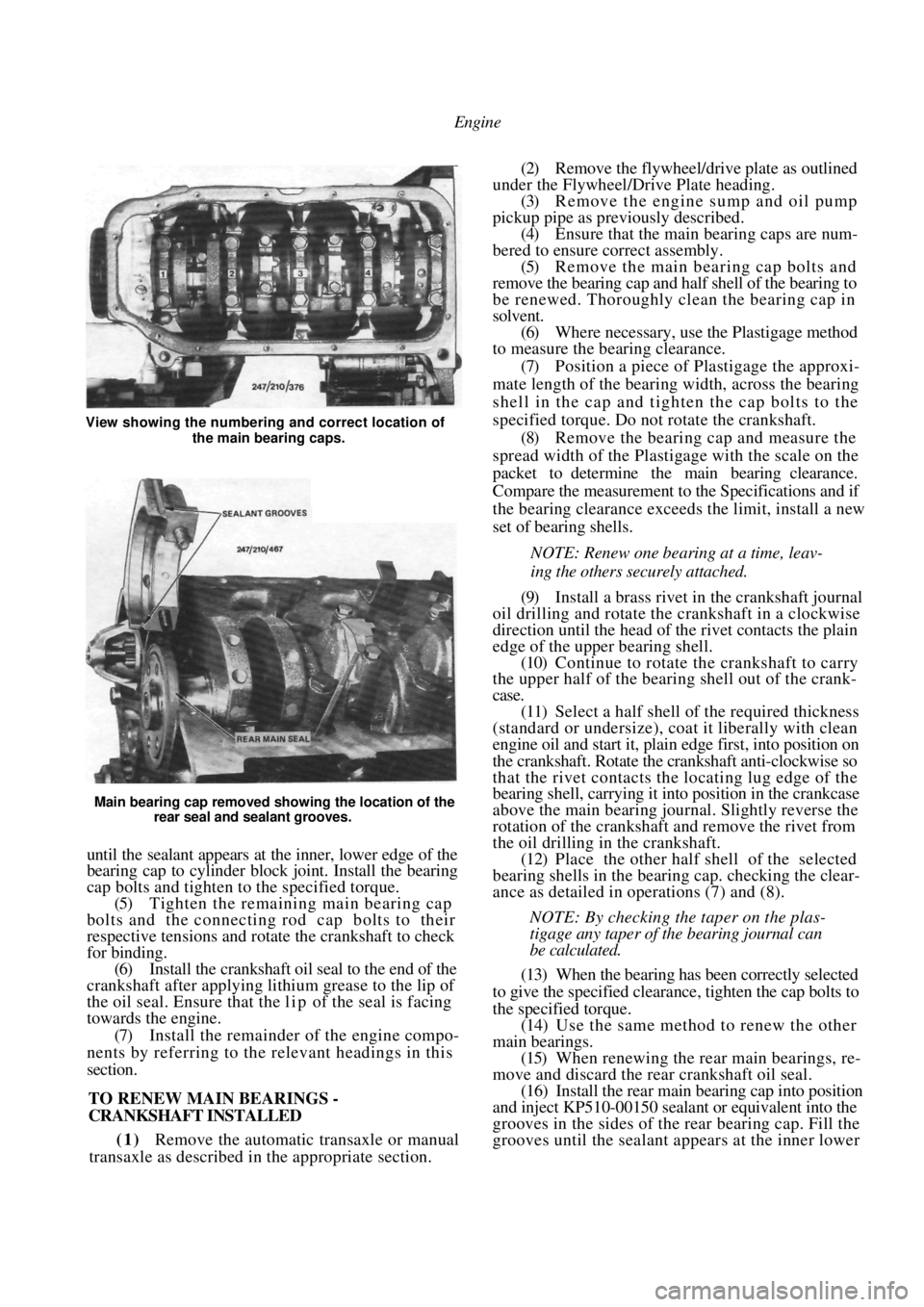
Main bearing cap removed showing the location of the rear seal and sealant grooves.
until the sealant appears at the inner, lower edge of the
bearing cap to cylinder block joint. Install the bearing
cap bolts and tighten to the specified torque.
(5) Tighten the remaining main bearing cap
bolts and the connecting rod cap bolts to their
respective tensions and rotate the crankshaft to check
for binding. (6) Install the crankshaft oil seal to the end of the
crankshaft after applying lithium grease to the lip of
the oil seal. Ensure that the l i p of the seal is facing
towards the engine.
(7) Install the remainder of the engine compo-
nents by referring to the relevant headings in this
section.
TO RENEW MAIN BEARINGS -
CRANKSHAFT INSTALLED
(1) Remove the automatic transaxle or manual
transaxle as described in the appropriate section.
(2) Remove the flywheel/drive plate as outlined
under the Flywheel/Drive Plate heading. (3) Remove the engine sump and oil pump
pickup pipe as previously described. (4) Ensure that the main bearing caps are num-
bered to ensure correct assembly. (5) Remove the main bearing cap bolts and
remove the bearing cap and half shell of the bearing to
be renewed. Thoroughly clean the bearing cap in
solvent. (6) Where necessary, use the Plastigage method
to measure the bearing clearance.
(7) Position a piece of Plastigage the approxi-
mate length of the bearing width, across the bearing
shell in the cap and tigh ten the cap bolts to the
specified torque. Do not rotate the crankshaft. (8) Remove the bearing cap and measure the
spread width of the Plastigage with the scale on the
packet to determine the main bearing clearance.
Compare the measurement to the Specifications and if
the bearing clearance exceeds the limit, install a new
set of bearing shells.
NOTE: Renew one bearing at a time, leav-
ing the others securely attached.
(9) Install a brass rivet in the crankshaft journal
oil drilling and rotate the crankshaft in a clockwise
direction until the head of the rivet contacts the plain
edge of the upper bearing shell. (10) Continue to rotate the crankshaft to carry
the upper half of the bearing shell out of the crank-
case.
(11) Select a half shell of the required thickness
(standard or undersize), coat it liberally with clean
engine oil and start it, plai n edge first, into position on
the crankshaft. Rotate the crankshaft anti-clockwise so
that the rivet contacts the locating lug edge of the
bearing shell, carrying it into position in the crankcase
above the main bearing journal. Slightly reverse the
rotation of the crankshaft and remove the rivet from
the oil drilling in the crankshaft. (12) Place the other half shell of the selected
bearing shells in the bear ing cap. checking the clear-
ance as detailed in operations (7) and (8).
NOTE: By checking the taper on the plas-
tigage any taper of the bearing journal can
be calculated.
(13) When the bearing has been correctly selected
to give the specified clearance, tighten the cap bolts to
the specified torque. (14) Use the same method to renew the other
main bearings. (15) When renewing the rear main bearings, re-
move and discard the rear crankshaft oil seal. (16) Install the rear main bearing cap into position
and inject KP510-00150 sealant or equivalent into the
grooves in the sides of the rear bearing cap. Fill the
grooves until the sealant a ppears at the inner lower
View showing the numbering and correct location of
the main bearing caps.
Page 63 of 238
Engine
edge of the bearing cap to cylinder block joint. Install
the bearing cap bolts and tighten to the specified
torque.
(17) Lubricate the l i p of the new oil seal with
lithium grease and carefully install the seal into
position over the crankshaft . Insert the seal as far as
possible using finger pressure and then fully install the
sea! using a tubular drift. Ensure that the seal is not
damaged during installation and that the seal is
mounted square to the block face.
(18) Install the remainder of the engine
compo-
nents by referring to the relevant headings in
this
section.
TO RENEW CRANKSHAFT OIL SEALS
Front
(1) Remove the camshaft drive belt as previ-
ously described.
(2) Disconnect the lower radiator hose and drain
the cooling system. (3) Select fifth gear on manual transaxle models
and firmly apply the handbrake. (4) On automatic transaxle models, remove the
torque converter inspection cover to allow access to
the ring gear. Have an assi stant hold the ring gear
using a suitable lever. (5) Remove the crankshaft timing gear retaining
bolt and discard. (6) Remove the crankshaft timing gear from the
crankshaft. It may be necessary to lever the gear from
the crankshaft using two screwdrivers. Remove the
key and spacer from the crankshaft. (7) Using a centre punch, tap a small hole in the
front face of the oil seal. (8) Insert a self tapping screw into the hole.
(9) Remove the seal from the oil pump by
gripping and pulling the end of the screw with a pair
of pliers. (10) Coat the l i p of a new seal with multi-purpose
grease. (11) Install the oil seal to the oil pump using a
tubular drift. Ensure that the lip of the oil seal faces
the inside of the housing.
(12) Install the remaining components in the re-
verse order of removal, usi ng a new crankshaft timing
gear retaining bolt and referring to the relevant
headings in this section as necessary.
Rear
(1) Remove the automatic transaxle or manual
transaxle as described in the appropriate section. (2) Remove the flywheel/drive plate as described
under the following heading. (3) Lever the oil seal from the rear of the
crankcase being careful not to damage the crankshaft.
(4) Coat the lip of a new seal with Lithium
grease.
(5) Install the oil seal over the crankshaft. Ensure
that the li p of the oil sea l faces towards the engine.
(6) Insert the seal as far as possible using finger
pressure, and then fully seat the seal using a tubular
drift. (7) Install the remaining components in the
re-
verse order of removal, referring to the relevant
headings in this section as necessary.
12. FLYWHEEL/DRIVE PLATE
Special Equipment Required:
To Renew Ring Gear — Suitable heat source
TO REMOVE
(1) Remove the transaxle from the vehicle as
described in the Manual or Automatic Transaxle
sections, whichever is applicable. (2) On manual transaxle models, mark the fly-
wheel and the clutch pressure plate cover to ensure
correct assembly.
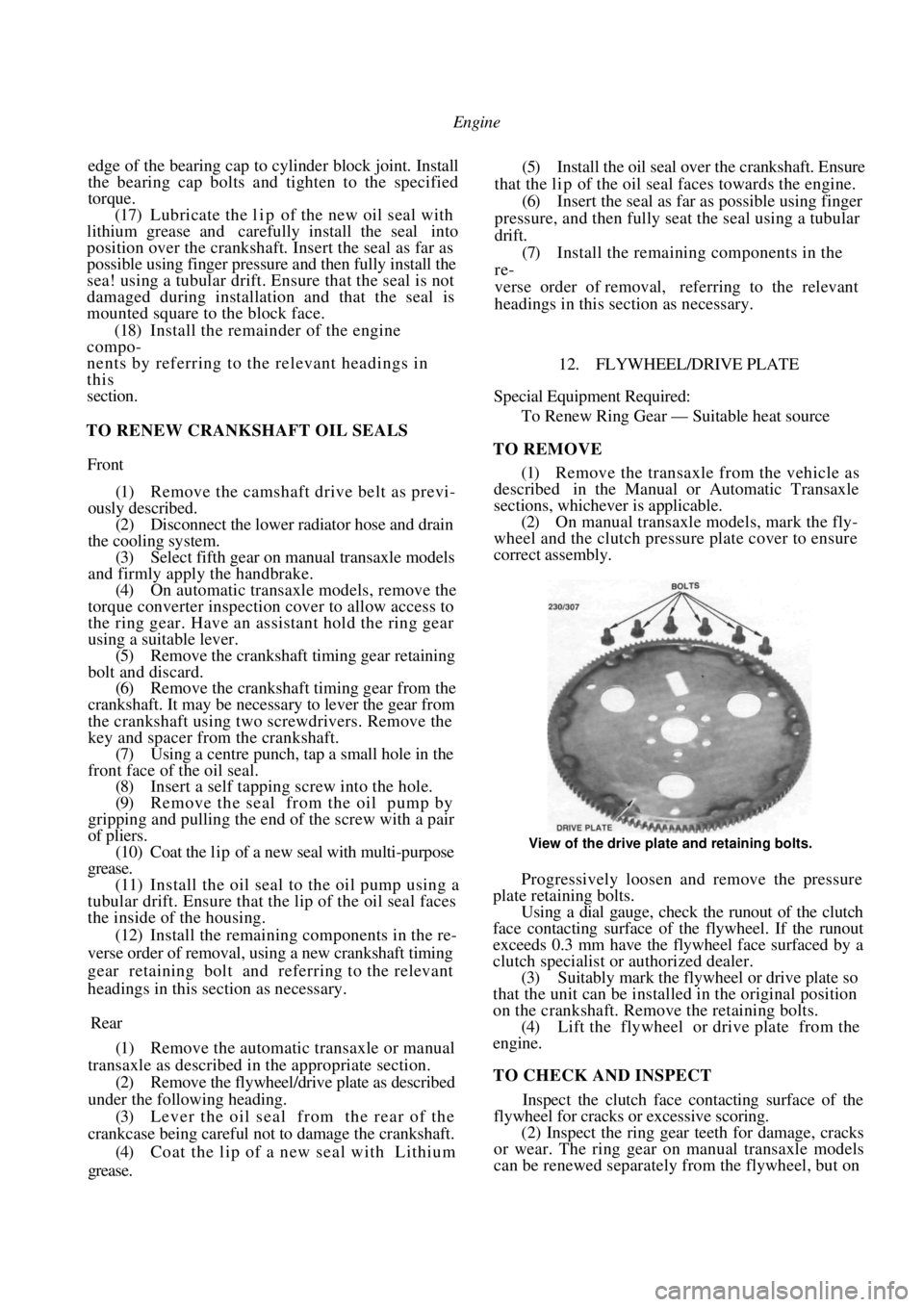
View of the drive plate and retaining bolts.
Progressively loosen and remove the pressure
plate retaining bolts.
Using a dial gauge, check the runout of the clutch
face contacting surface of the flywheel. If the runout
exceeds 0.3 mm have the flywheel face surfaced by a
clutch specialist or authorized dealer.
(3) Suitably mark the flywheel or drive plate so
that the unit can be installed in the original position
on the crankshaft. Remove the retaining bolts. (4) Lift the flywheel or drive plate from the
engine.
TO CHECK AND INSPECT
Inspect the clutch face contacting surface of the
flywheel for cracks or excessive scoring.
(2) Inspect the ring gear teeth for damage, cracks
or wear. The ring gear on manual transaxle models
can be renewed separately from the flywheel, but on
Page 64 of 238
64 Engine
automatic transaxle models the complete drive plate
must be renewed.
(3) Inspect the drive plate bolt holes for elonga-
tion which is caused by loose retaining bolts.
(4) Inspect the drive plate for cracks.
(5) Repair or renew the flywheel if necessary.
TO INSTAL
Installation is a reversal of the removal procedure
with attention to the following points:
(1) The flywheel and drive plate retaining bolts
are special micro-encapsulated fasteners.
Install new micro-encapsulated bolts of the
correct
strength classification on assembly.
(2) Thoroughly clean the crankshaft threads with
a thread tap. Clean the threads with solvent and dry
before installing the flywh eel or drive plate retaining
bolts.
(3) Tighten the flywheel or drive plate retaining
bolts to the specified torque and on manual transaxle
models, align the clutch plate as described in the
Clutch section.
TO RENEW FLYWHEEL RING GEAR
(1) With the flywheel removed from the vehicle,
drill a 6 mm diameter hole between two teeth of the
ring gear.
NOTE: Do not drill right through the ring
gear as this will damage the flange on the
flywheel.
(2) Secure the flywheel, with the drilled hole
uppermost in a soft jawed vice.
(3) Place a cold chisel above the hole in the ring
gear and hit it sharply to split the ring gear.
(4) Check the direction of the chamfered face of
the old ring gear. The new ring gear must be installed
to the flywheel with the chamfer in the same direction. (5) Remove the ring gear, clean the mounting
face on the flywheel and remove any burrs. (6) Polish a few spots of the ring gear with emery
cloth and heat the ring gear evenly until the polished
spots turn dark blue.
NOTE; Do not heat the ring gear past the
point required to achieve a dark blue color
or the tempering of the ring gear teeth will
be impaired.
(7) With the flywheel suitably supported, pick
the ring gear up using plie rs, and place it evenly onto
the flywheel. Use a hammer and a brass drift to ensure
that the ring gear seats ag ainst the flywheel flange.
NOTE: Allow the ring gear to cool slowly.
Do not quench it in water.
13. ENGINE MOUNTINGS
TO RENEW LEFT HAND SIDE MOUNTING
(1) Disconnect the positive and negative battery
terminals, loosen the battery clamp nuts and withdraw
the battery from the engine compartment.
(2) Remove the bolts retaining the battery car-
rier to the inner mudguard and remove the battery
carrier and associ ated components from the engine
compartment. (3) Support the transaxle using a jack. Interpose
a block of wood between the head of the jack and the
transaxle to prevent damage to the transaxle.
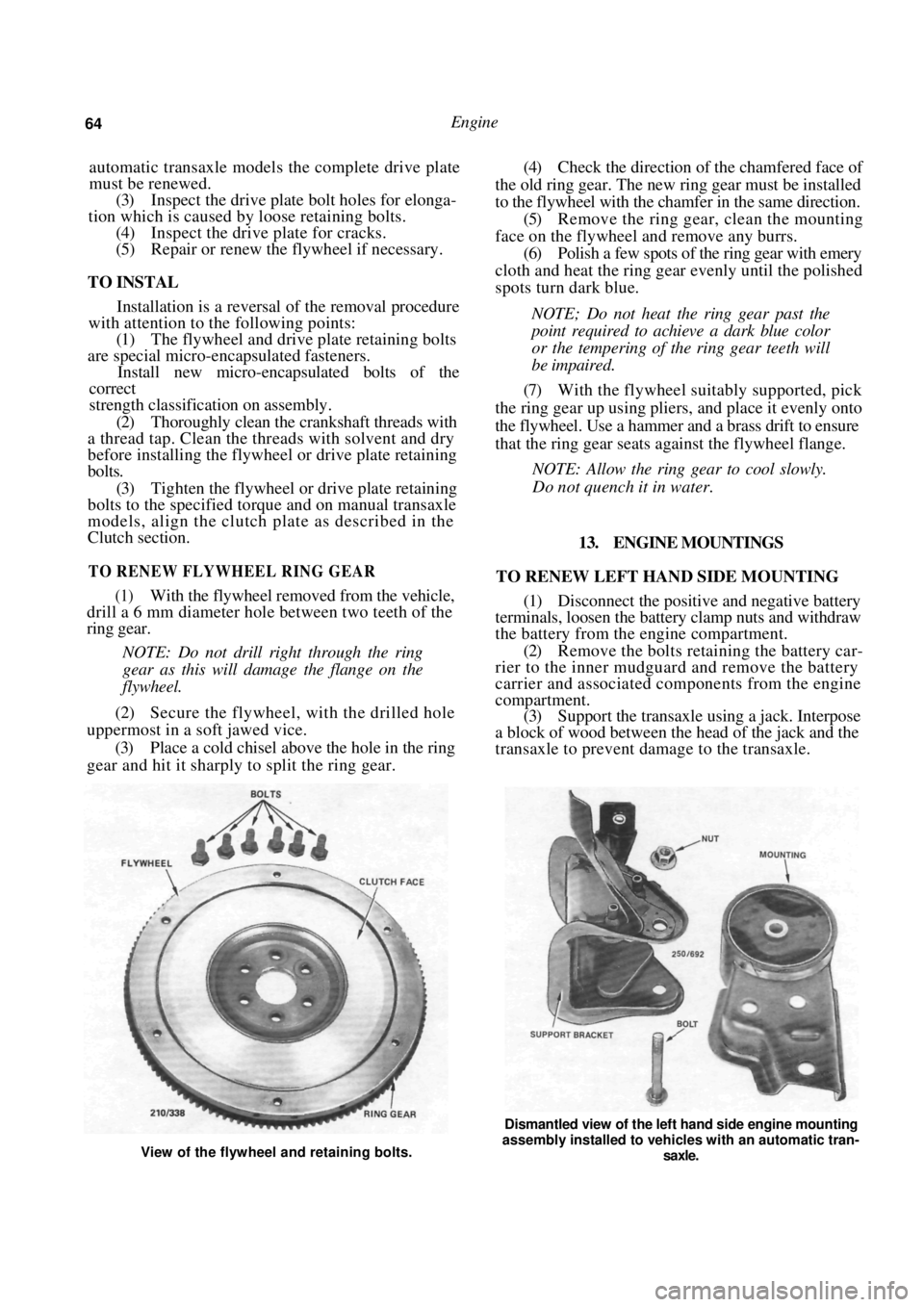
View of the flywheel and retaining bolts.
Dismantled view of the left hand side engine mounting
assembly installed to vehicles with an automatic tran-
saxle.
Page 97 of 238
Fuel and Engine Management 97
circuitry do not immerse it in cleaning
solvent as this may result in irreparable
damage.
Installation is a reversal of the removal procedure
with attention to the following points:
(1) Lubricate the new O ring seals with auto-
matic transmission fluid prior to installing them to the
injector. If removed, ensure that the lower filter screen
is installed. (2) Firmly push the injector into the throttle
body assembly until it is fully seated, ensuring that the
injector connection terminals face towards the rear of
the vehicle.
(3) Apply Loctite 262 to the injector retaining
plate screw and tighten securely.
(4) Start the engine and check for fuel leaks as
previously described.
(5) Install the air cleaner and tighten the retain-
ing nuts securely.
FUEL METER ASSEMBLY - 1.6 LITRE
ENGINE
To Remove and Install
(1) Remove the injector as previously described.
(2) Mark the fuel supp ly and return hoses,
release the clamps and disconnect the hoses from the
fuel meter assembly.
(3) Remove the air cleaner assembly base gasket
from the fuel meter assembly. (4) Remove the bolts and screws securing the
fuel meter assembly to the throttle body and remove the fuel meter assembly. Remove and discard the
gasket.
(5) If necessary, remove the fuel pressure regu-
lator as previously described.
Installation is a reversal to the removal procedure
with attention to the following points;
(1) If removed, install the fuel pressure
regulator
as previously described.
(2) Place a new gasket on the throttle body,
aligning the holes in the gasket with those in the
throttle body, ensuring that the idle air passage is not
blocked. (3) Coat the fuel meter assembly retaining
screws with Loctite 26 2 and tighten securely.
(4) Install the fuel meter assembly retaining bolts
and tighten to the specified torque.
(5) Connect the fuel supply and return hoses and
tighten the clamps securely. (6) Install the injector as previously described.
(7) Start the engine and check for fuel leaks.
Rectify as necessary. (8) Install the air cleaner assembly.
FUEL TANK
To Remove and Install
(1) Depressurize the fuel system as previously
described.
(2) Disconnect the negative battery terminal.
(3) Remove the fuel pump cover plate retaining
screws, disconnect the wi ring harness rubber grommet
from the cover plate and remove the cover plate from
the wiring harness. (4) Raise the rear of the vehicle and support it
on chassis stands. Refer to the Wheels and Tires
section if necessary. (5) Remove the fuel tank drain plug and drain
the fuel into a petroleum resistant container. (6) Mark the fuel hoses and disconnect the hoses
from the fuel pump.
(7) Disconnect the hoses from the fuel filler neck
pipe, the fuel check valve and the fuel tank breather
pipe.
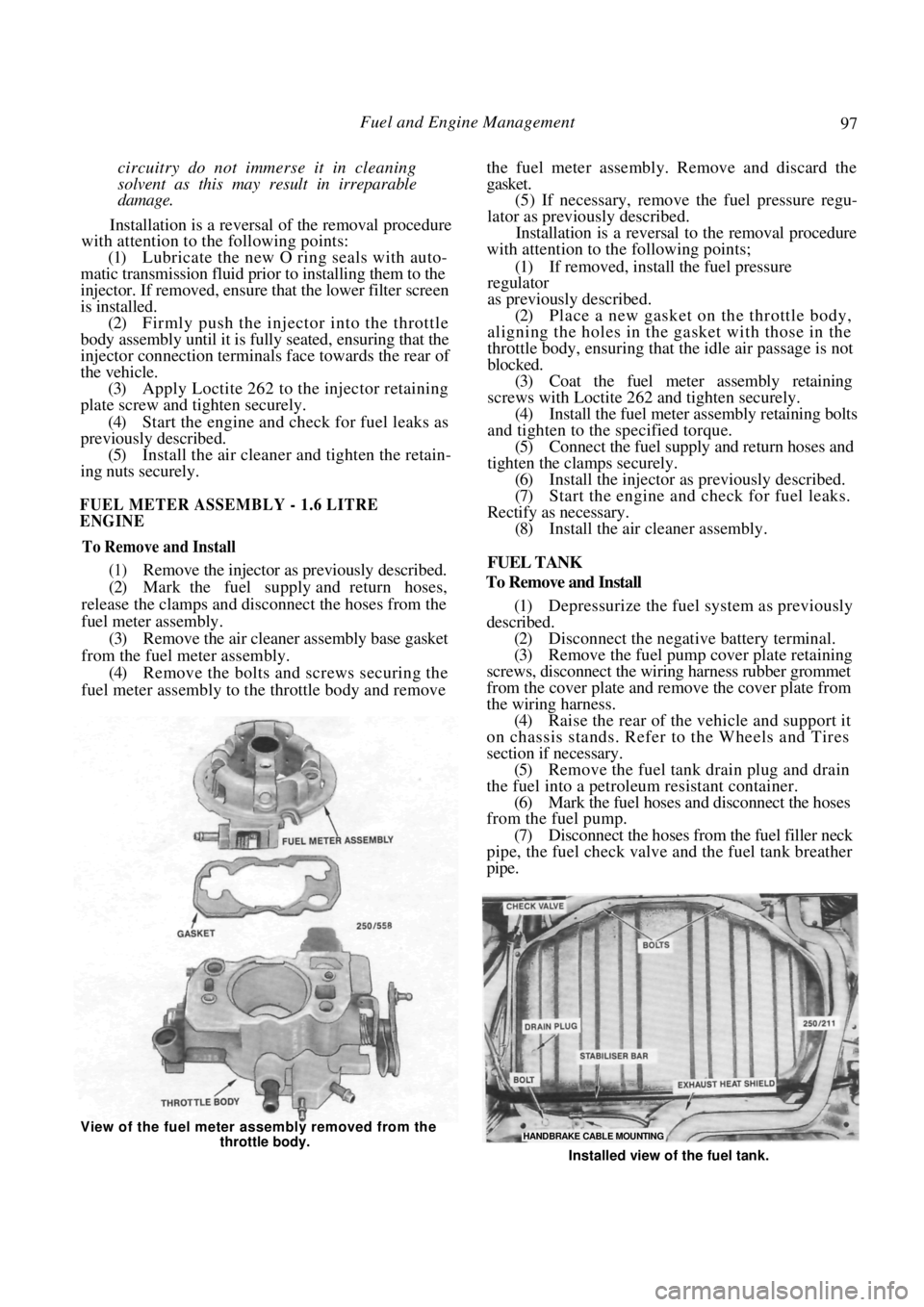
View of the fuel meter assembly removed from the
throttle body. HANDBRAKE CABLE MOUNTING
Installed view of the fuel tank.
Page 115 of 238

Fuel and Engine Management 115
Erase the fault codes and retest for fault codes as
follows:
(2) Start and run the engine until normal oper-
ating temperature is attained. (3) Drive the vehicle at a speed of at least 80
km/h and, with the throttle closed, allow the vehicle to
decelerate until the engine speed is below 1 500 rpm.
NOTE: After rectifying any fault it will be
necessary to retest for fault codes. To test for
Code 24 the vehicle must be driven as
previously described.
(4) Switch the engine Off and connect a jumper
lead between terminals A and B on the diagnostic link
connector. Switch the ignition On and note the fault
codes. If code 24 is displayed proceed as follows. (5) Check the operation of the speedometer and
the instrument cluster warning lamps. If the speed-
ometer only is not functioning, proceed to operation
(13).
If the speedometer and the instrument cluster
warning lamps are not functioning, a fault in the
instrument cluster wiring harness is indicated. Refer
the fault to an auto electrical workshop or a Nissan
dealer.
If the speedometer is functioning, proceed as
follows:
(6) Raise the front of the vehicle and support it
on chassis stands. (7) Place the transaxle in Neutral and switch the
ignition On. (8) With the aid of assistants, slowly spin the
front wheels by hand while backprobing the control
unit wiring connector terminal A10 with a digital
voltmeter to earth. The voltage should alternate from under 1 volt to
over 10 volts.
If the voltmeter readi ng is not as specified,
proceed to operation (9).
If the voltmeter reading is as specified, the vehicle
speed sensor is operating satisfactorily, indicating an
intermittent fault was the cause of the fault code.
Proceed as follows:
(a) Check for faulty wiri ng connections. Check
that all wiring connectors are clean and secure. (b) Check that all earth c onnections are secure.
(9) Remove the instrument cluster as described
in the Electrical System section. (10) With the ignition switched On, backprobe
the control unit wiring connector terminal A10 with a
voltmeter to earth. The voltage should be over 10
volts. If the voltage is less than specified, check the
wiring harness for shorts to earth between the black
and yellow wire terminal on the instrument cluster
wiring connector and the control unit connector
terminal A10. Repair or renew the wiring harness as
necessary. If no fault can be found, renew the control
unit.
(11) With the ignition switched On, backprobe
the black and yellow wire terminal on the instrument
cluster wiring connector with a voltmeter to earth.
The voltage should be over 10 volts.
If the voltage is less than specified, locate the open
circuit between the instrument cluster black and
yellow wire terminal and the control unit wiring
connector terminal A10. Repair or renew the wiring
harness as necessary.
(12) With a test lamp connected to 12 volts,
backprobe the black wire terminals on the instrument
cluster wiring connectors. The test lamp should light.
If the test lamp does not light locate the open
circuit between the black wire terminals and earth.
Repair or renew the wiring harness as necessary.
If the test lamp does light, renew the signal
divider circuit board which is located in the instru-
ment cluster.
(13) With the ignition switched On and the
engine not running, disconnect the vehicle speed
sensor wiring connector from the harness connector.
(14) With a test lamp connected to earth, probe
the yellow wire terminal on the harness wiring con-
nector. The test lamp should light. If the test lamp does not light, locate the open
circuit between the yellow wi re terminal and the Fuel
Pump fuse. Repair or renew the wiring harness as
necessary.
(15) With a test lamp connected to 12 volts,
probe the black wire terminal on the harness wiring
connector. The test lamp should light.
If the test lamp does not light, locate the open
circuit between the black wire terminal and earth.
Repair or renew the wiring harness as necessary.
(16) Using a voltmeter measure the voltage at the
red wire terminal on the harness wiring connector.
If the voltage is 5-9 volts proceed to operation
(19).
If the voltage is over 9 vol ts proceed to operation
(18).
Installed view of the vehicle speed sensor.
Page 116 of 238

116 Fuel and Engine Management
Rear view of the instrument cluster showing the flexible printed circuit.
If the voltage is under 5 volts proceed as follows.
(17) Check the wiring harness for continuity or
shorts to earth between th e red wire terminal on the
speed sensor harness connector and the green and
black wire terminal on th e instrument cluster wiring
connector.
If no fault can be found check the instrument
cluster printed circuit for continuity or shorts. If no
fault can be found, renew the speedometer and the
signal divider circuit board.
(18) Remove the instrument cluster as described
in the Electrical System se ction and repeat operation
(16).
If the voltage is under 1 volt, check the flexible
printed circuit on the rear of the instrument cluster for
continuity or shorts and re new as necessary. If no fault
can be found, renew the speedometer and the signal
divider circuit board.
(19) Connect the harness connector to the vehicle
speed sensor wiring connector. (20) Raise the front of the vehicle and support it on chassis stands. Place the transaxle in Neutral.
(21) With the aid of assistants, slowly spin the
front wheels by hand while backprobing the brown
wire terminal on the vehicle speed sensor wiring
connector with a voltmeter to earth.
The voltage should alternate between approxi-
mately 1 and 7 volts.
If the voltage is as specif ied, check the flexible
printed circuit on the rear of the instrument cluster for
continuity or shorts. If no fault can be found, renew
the speedometer and the signal divider circuit board.
If the voltage is not as specified, proceed as
follows.
(22) Disconnect the vehicle speed sensor wiring
connector and unscrew the sensor from the speedom-
eter drive housing. (23) Rotate both front wheels in the same direc-
tion and check that the speedometer drive shaft is
turning and does not slip. If the drive shaft does not operate as described,
renew the drive assembly as described in the Manual
or Automatic Transaxle section.
If the drive shaft operates satisfactorily, renew the
vehicle speed sensor.
To Remove and Install
(1) Disconnect the negative battery terminal.
(2) Disconnect the vehicle speed sensor wiring
connector. (3) Unscrew the vehicle speed sensor from the
speedometer drive housing.
Installation is a reversal of the removal procedure
with attention to the following points:
(1) Align the cut-out in the speedometer drive
shaft with the notch in the vehicle speed sensor shaft.
(2) Tighten the vehicle speed sensor securely.
Page 118 of 238

118 Emission Control
Installed view of the charcoal canister.
When the engine is at rest, fuel vapor through
evaporation gradually fills the air space in the fuel
tank. The sealed filler cap pr events the escape of this
vapor and pressure builds up within the system,
forcing the vapor to flow into the charcoal canister
which is located in the engine compartment beneath
the windscreen wiper motor.
The fuel check valve prevents liquid fuel entering
the charcoal canister when the fuel tank is full or the
vehicle is parked on a steep incline. When the engine
is running, the vapor is drawn via a hose from the
charcoal canister to the throttle body and burnt in the
combustion chambers.
TO RENEW CHARCOAL CANISTER
(1) Suitably mark and disconnect the hoses from
the canister. (2) Release the retaining spring and remove the
canister from the engine compartment. Installation is a reversal of the removal procedure.
TO RENEW FUEL CHECK VALVE
(1) Disconnect the negative battery terminal.
(2) Raise the rear of the vehicle and support it
on chassis stands. Remove the left hand rear wheel. (3) Drain the fuel from the fuel tank using a
hand pump or a suitable siphon. Do not siphon fuel
using the mouth.
(4) Remove the hoses from the check valve.
(5) Squeeze the retaining clip and remove the
check valve from the mounting bracket. Installation is a reversal of the removal procedure.
TO SERVICE THE SYSTEM
(1) Inspect the vacuum lines and connectors for
signs of leakage, cracks and deterioration and renew
as necessary. (2) Remove the fuel tank cap and check that a
slight resistance is felt, when vacuum is applied to the
one-way relief valve in the centre of the cap. Renew the fuel tank cap if no resistance is felt or
if the valve is blocked.
(3) Inspect the fuel tank cap seal for deteriora-
tion. Renew as necessary.
Installed view of the fuel check valve as seen with the
left hand rear wheel removed.
Check the fuel filler cap seal for damage.
23Q/LDZ GAUGE
Line drawing showing a hand vacuum pump.
Page 121 of 238
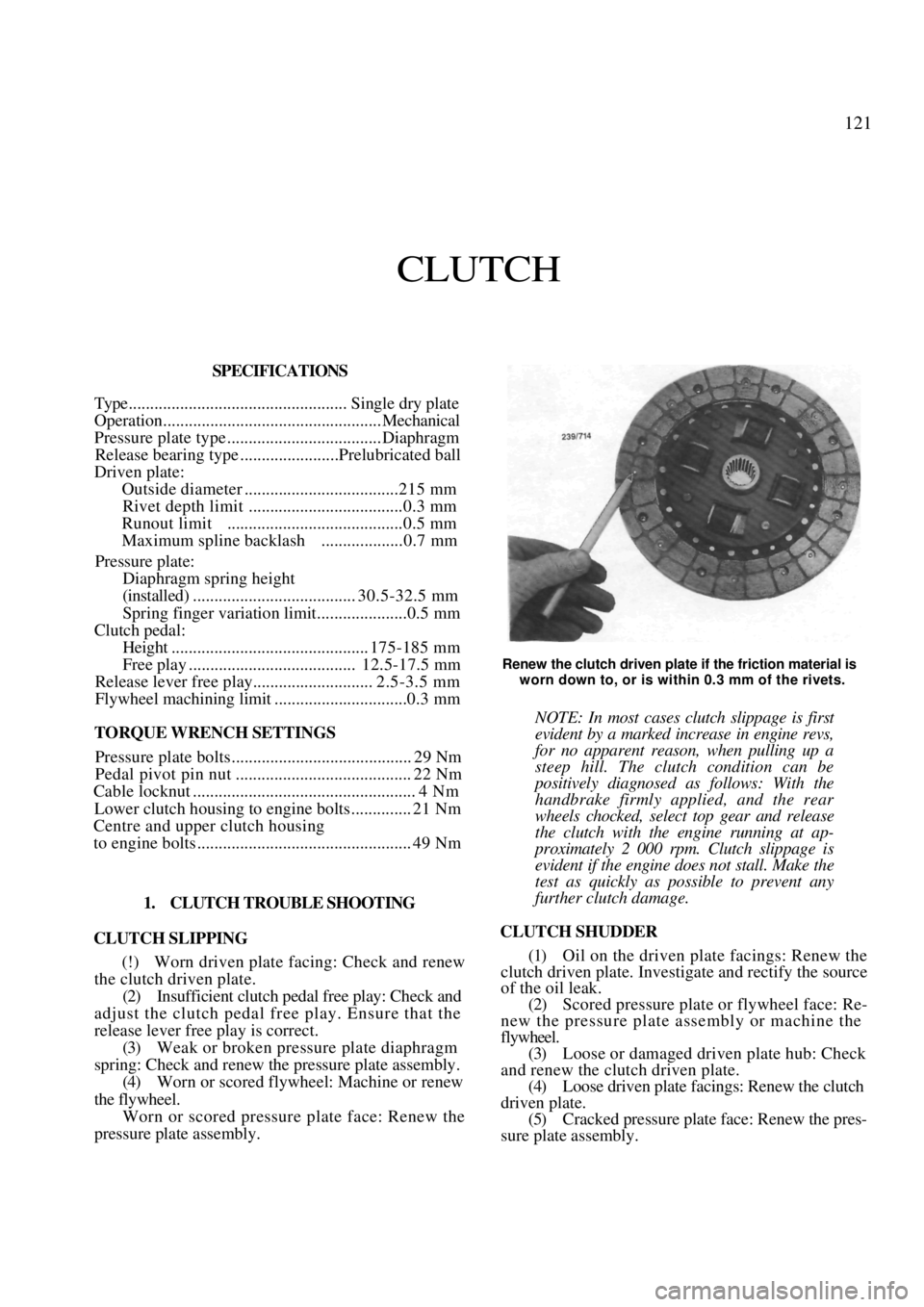
121
CLUTCH
SPECIFICATIONS
Type................................................... Single dry plate
Operation................................................... Mechanical
Pressure plate type .................................... Diaphragm
Release bearing type .......................Prelubri cated ball
Driven plate:
Outside diameter .................................... 215 mm
Rivet depth limit ....................................0.3 mm
Runout limit .........................................0.5 mm
Maximum spline backlash ...................0.7 mm
Pressure plate:
Diaphragm spring height
(installed) ...................................... 30.5-32.5 mm
Spring finger vari ation limit.....................0.5 mm
Clutch pedal:
Height .............................................. 175-185 mm
Free play ....................................... 12.5-17.5 mm
Release lever free play............................ 2.5-3.5 mm
Flywheel machining limit ...............................0.3 mm
TORQUE WRENCH SETTINGS
Pressure plate bolts.......................................... 29 Nm
Pedal pivot pin nut ......................................... 22 Nm
Cable loc knut.................................................... 4 Nm
Lower clutch housing to engine bolts.............. 21 Nm
Centre and upper clutch housing
to engine bolts .................................................. 49 Nm
1. CLUTCH TROUBLE SHOOTING
CLUTCH SLIPPING
(!) Worn driven plate facing: Check and renew
the clutch driven plate.
(2) Insufficient clutch pedal free play: Check and
adjust the clutch pedal free play. Ensure that the
release lever free play is correct.
(3) Weak or broken pressure plate diaphragm
spring: Check and renew the pressure plate assembly. (4) Worn or scored flywh eel: Machine or renew
the flywheel. Worn or scored pressure plate face: Renew the
pressure plate assembly.
Renew the clutch driven plate if the friction material is
worn down to, or is within 0.3 mm of the rivets.
NOTE: In most cases clutch slippage is first
evident by a marked increase in engine revs,
for no apparent reason, when pulling up a
steep hill. The clutch condition can be
positively diagnosed as follows: With the
handbrake firmly applied, and the rear
wheels chocked, select top gear and release
the clutch with the engine running at ap-
proximately 2 000 rpm. Clutch slippage is
evident if the engine does not stall. Make the
test as quickly as possible to prevent any
further clutch damage.
CLUTCH SHUDDER
(1) Oil on the driven plate facings: Renew the
clutch driven plate. Invest igate and rectify the source
of the oil leak.
(2) Scored pressure plate or flywheel face: Re-
new the pressure plate assembly or machine the
flywheel. (3) Loose or damaged driven plate hub: Check
and renew the clutch driven plate. (4) Loose driven plate facings: Renew the clutch
driven plate. (5) Cracked pressure plate face: Renew the pres-
sure plate assembly.
Page 122 of 238
122 Clutch
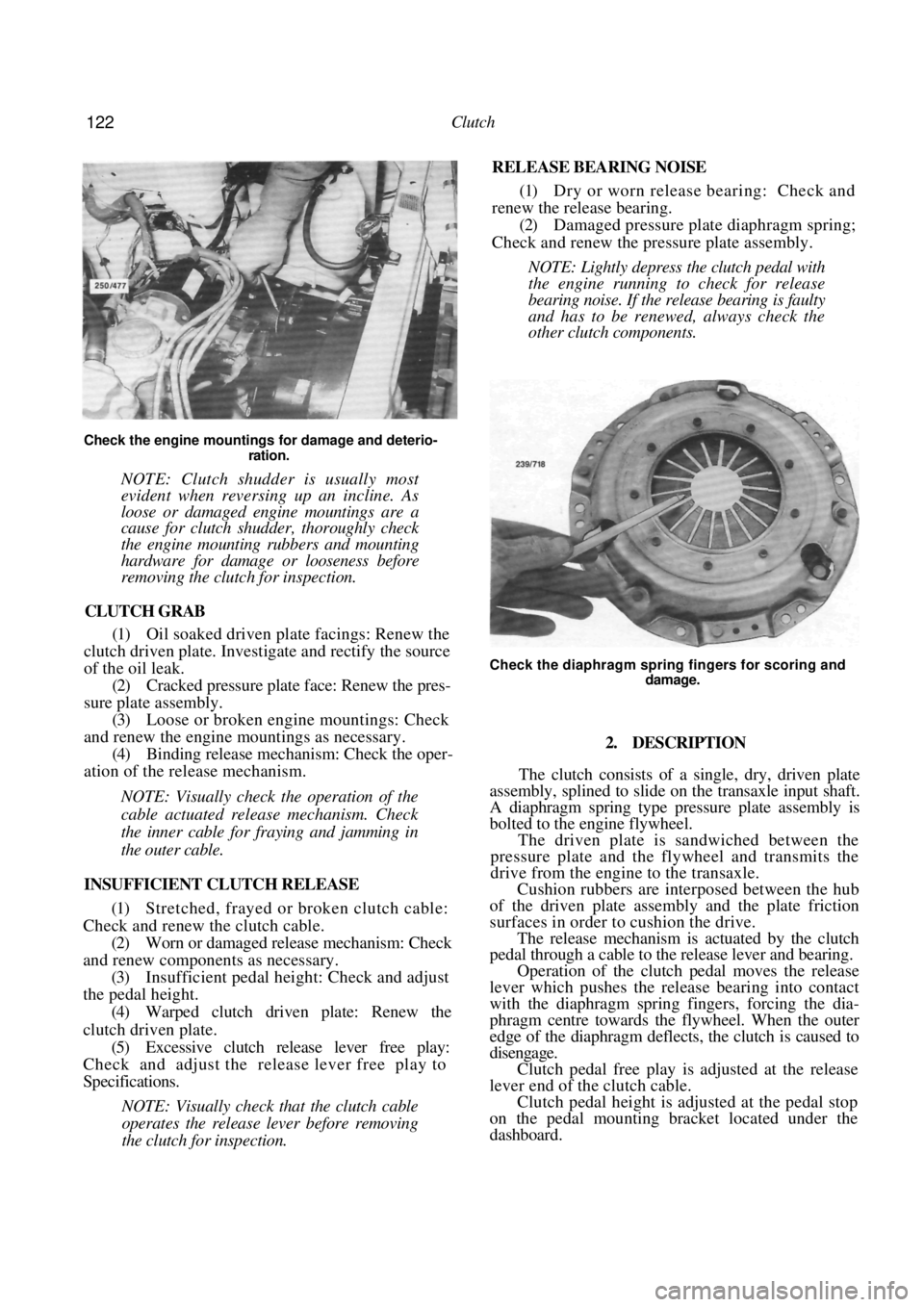
Check the engine mountings for damage and deterio- ration.
NOTE: Clutch shudder is usually most
evident when reversing up an incline. As
loose or damaged engine mountings are a
cause for clutch shudder, thoroughly check
the engine mounting rubbers and mounting
hardware for damage or looseness before
removing the clutch for inspection.
CLUTCH GRAB
(1) Oil soaked driven plate facings: Renew the
clutch driven plate. Invest igate and rectify the source
of the oil leak.
(2) Cracked pressure plate face: Renew the pres-
sure plate assembly. (3) Loose or broken engine mountings: Check
and renew the engine mountings as necessary.
(4) Binding release mechanism: Check the oper-
ation of the release mechanism.
NOTE: Visually check the operation of the
cable actuated release mechanism. Check
the inner cable for fraying and jamming in
the outer cable.
INSUFFICIENT CLUTCH RELEASE
(1) Stretched, frayed or broken clutch cable:
Check and renew the clutch cable. (2) Worn or damaged release mechanism: Check
and renew components as necessary. (3) Insufficient pedal height: Check and adjust
the pedal height.
(4) Warped clutch driven plate: Renew the
clutch driven plate. (5) Excessive clutch release lever free play:
Check and adjust the release lever free play to
Specifications.
NOTE: Visually check that the clutch cable
operates the release lever before removing
the clutch for inspection.
RELEASE BEARING NOISE
(1) Dry or worn release bearing: Check and
renew the release bearing.
(2) Damaged pressure plate diaphragm spring;
Check and renew the pressure plate assembly.
NOTE: Lightly depress the clutch pedal with
the engine running to check for release
bearing noise. If the release bearing is faulty
and has to be renewed, always check the
other clutch components.
Check the diaphragm spring fingers for scoring and damage.
2. DESCRIPTION
The clutch consists of a single, dry, driven plate
assembly, splined to slide on the transaxle input shaft.
A diaphragm spring type pr essure plate assembly is
bolted to the engine flywheel.
The driven plate is sandwiched between the
pressure plate and the flywheel and transmits the
drive from the engine to the transaxle.
Cushion rubbers are interposed between the hub
of the driven plate assembly and the plate friction
surfaces in order to cushion the drive.
The release mechanism is actuated by the clutch
pedal through a cable to the release lever and bearing.
Operation of the clutch pedal moves the release
lever which pushes the release bearing into contact
with the diaphragm spring fingers, forcing the dia-
phragm centre towards the flywheel. When the outer
edge of the diaphragm deflects, the clutch is caused to
disengage.
Clutch pedal free play is adjusted at the release
lever end of the clutch cable.
Clutch pedal height is adjusted at the pedal stop
on the pedal mounting bracket located under the
dashboard.