engine cover NISSAN QASHQAI 2011 Service Manual
[x] Cancel search | Manufacturer: NISSAN, Model Year: 2011, Model line: QASHQAI, Model: NISSAN QASHQAI 2011Pages: 297, PDF Size: 4.09 MB
Page 245 of 297
Downloaded from www.Manualslib.com manuals search engine BLEEDING THE FUEL SYSTEM
Except for models with R9M diesel engine:
Bleed the air out of the fuel system after refilling
an empty fuel tank by the following procedure:
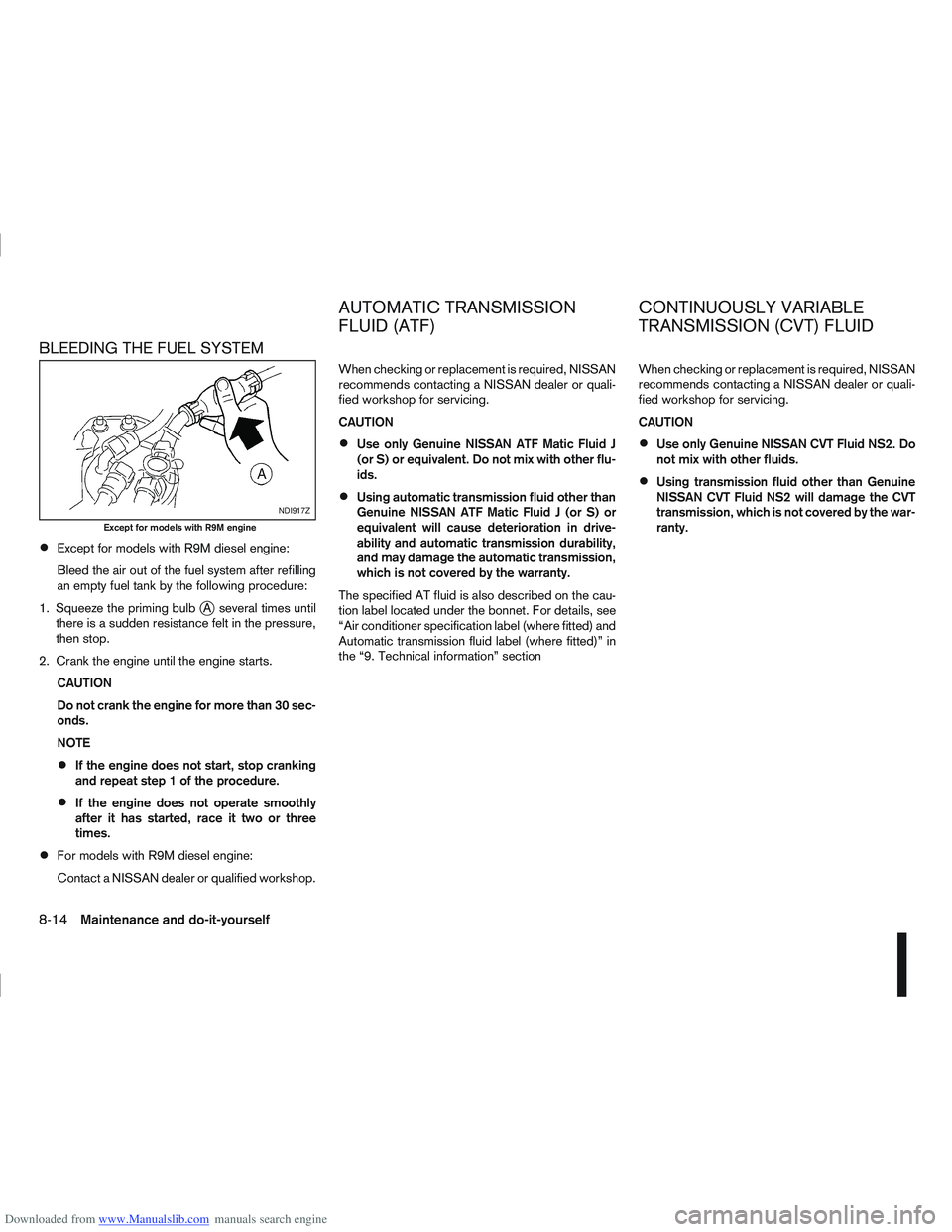
1. Squeeze the priming bulb
jA several times until
there is a sudden resistance felt in the pressure,
then stop.
2. Crank the engine until the engine starts. CAUTION
Do not crank the engine for more than 30 sec-
onds.
NOTE
If the engine does not start, stop cranking
and repeat step 1 of the procedure.
If the engine does not operate smoothly
after it has started, race it two or three
times.
For models with R9M diesel engine:
Contact a NISSAN dealer or qualified workshop. When checking or replacement is required, NISSAN
recommends contacting a NISSAN dealer or quali-
fied workshop for servicing.
CAUTION
Use only Genuine NISSAN ATF Matic Fluid J
(or S) or equivalent. Do not mix with other flu-
ids.
Using automatic transmission fluid other than
Genuine NISSAN ATF Matic Fluid J (or S) or
equivalent will cause deterioration in drive-
ability and automatic transmission durability,
and may damage the automatic transmission,
which is not covered by the warranty.
The specified AT fluid is also described on the cau-
tion label located under the bonnet. For details, see
“Air conditioner specification label (where fitted) and
Automatic transmission fluid label (where fitted)” in
the “9. Technical information” section When checking or replacement is required, NISSAN
recommends contacting a NISSAN dealer or quali-
fied workshop for servicing.
CAUTION
Use only Genuine NISSAN CVT Fluid NS2. Do
not mix with other fluids.
Using transmission fluid other than Genuine
NISSAN CVT Fluid NS2 will damage the CVT
transmission, which is not covered by the war-
ranty.
NDI917Z
Except for models with R9M engine
AUTOMATIC TRANSMISSION
FLUID (ATF)
CONTINUOUSLY VARIABLE
TRANSMISSION (CVT) FLUID
8-14Maintenance and do-it-yourself
Page 253 of 297
Downloaded from www.Manualslib.com manuals search engine Be careful when working on the engine with-
out the air cleaner filter.
VISCOUS PAPER TYPE
The filter elementjA should not be cleaned and
reused.
Replace it according to the maintenance schedule
shown in the separately provided Warranty Informa-
tion & Maintenance Booklet. When replacing the fil-
ter, wipe the inside of the air cleaner housing and
the cover with a damp cloth.
DRY PAPER TYPE (where fitted)
Check the filter elementjA to see if it is dirty. If it is
dirty, shake the element to remove dust.
Clean or replace it according to the maintenance
schedule shown in the separately provided War-
ranty Information & Maintenance Booklet. When
cleaning or replacing the filter, wipe the inside of the
air cleaner housing and the cover with a damp cloth.
CLEANING
If the windscreen or back door window is not clear
after using the window washer or if a wiper blade
chatters when running, wax or other material may be
on the blade or windscreen.
Clean the outside of the windscreen or back door
window with a washer solution or a mild detergent.
The windscreen or back door window is clean if
beads do not form when rinsing with clear water.
Clean the blade by wiping it with a cloth soaked in a
washer solution or a mild detergent. Then rinse the
blade with clear water. If the windscreen or back
door window is still not clear after cleaning the
blades and using the wiper, replace the blades.
CAUTION
After wiper blade replacement, return the
wiper arm to its original position. Otherwise it
may be damaged when the bonnet is opened.
Make sure the wiper blade contacts the glass.
Otherwise, the arm may be damaged from
wind pressure.
Do not open the bonnet when the front wiper
is in the servicing position other wise it can
damage the paint surface of the bonnet.
FRONT WINDOW WIPER
REPLACEMENT
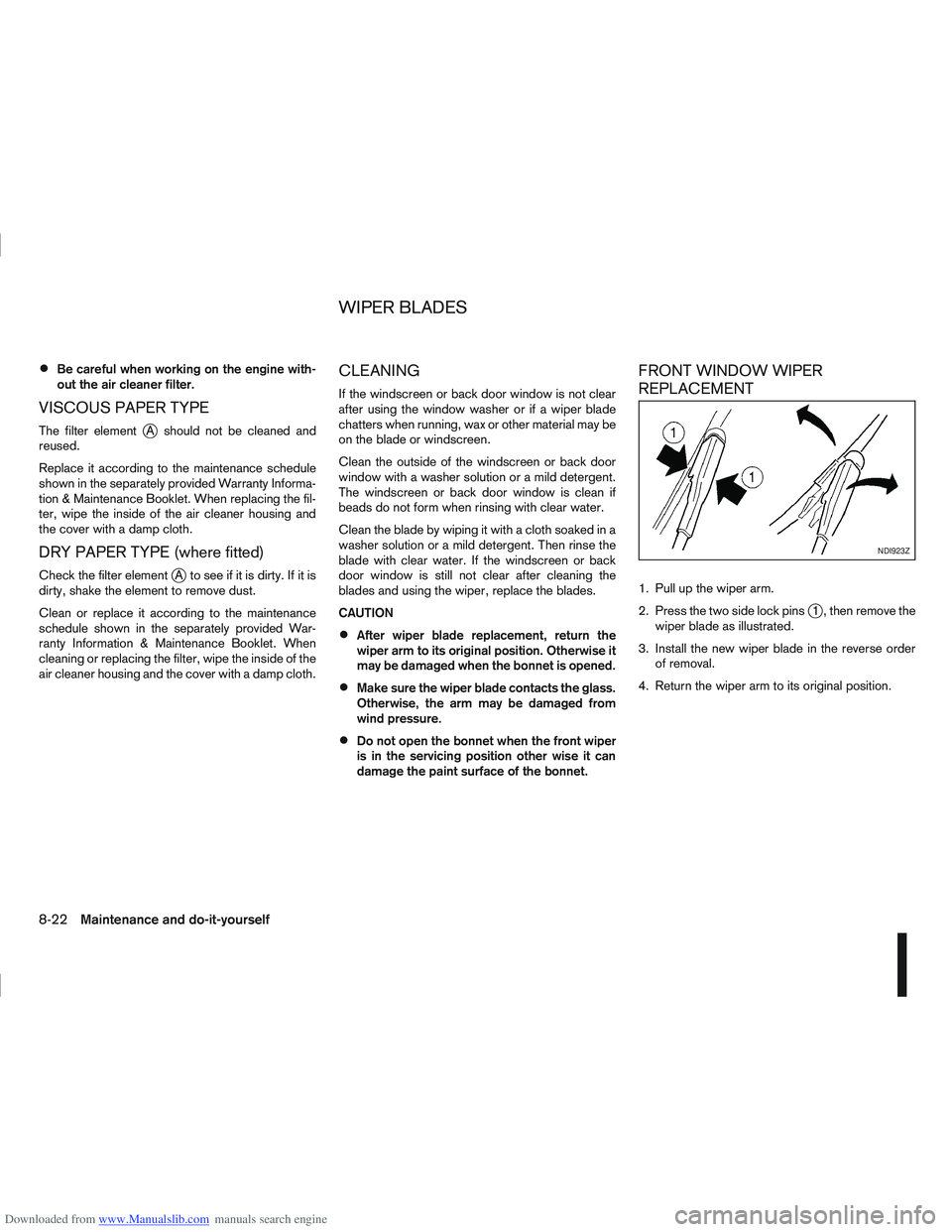
1. Pull up the wiper arm.
2. Press the two side lock pins
j1 , then remove the
wiper blade as illustrated.
3. Install the new wiper blade in the reverse order of removal.
4. Return the wiper arm to its original position.
NDI923Z
WIPER BLADES
8-22Maintenance and do-it-yourself
Page 254 of 297

Downloaded from www.Manualslib.com manuals search engine BACK DOOR WINDOW WIPER
REPLACEMENT
1. Lift the wiper arm.
2. Hold and rotate carefully the wiper blade clock-wise until the blade becomes free.
3. Insert the new wiper blade onto the wiper arm and snap it into place.
4. Return the wiper arm to its original position.
WINDSCREEN WASHER NOZZLE
If you wax the surface of the engine bonnet, be care-
ful not to let wax get into the washer nozzlejA . This
may cause clogging or improper windscreen washer
operation. If wax gets into the nozzle, remove it with
aneedleorsmallpin
jB.
PASSENGER COMPARTMENT
CAUTION
Never use a fuse of higher or lower amperage
rating than that specified on the fuse box
cover.
Never pull the harness or wires when discon-
necting the connector.
NDI924Z
NDI892Z
NDI1088
FUSES
Maintenance and do-it-yourself8-23
Page 255 of 297
Downloaded from www.Manualslib.com manuals search engine Be careful not to damage the connector sup-
port bracket when disconnecting the connec-
tor.
If any electrical equipment does not operate, check
for an open fuse.
The fuse box is located in the lower part of the
instrument panel at the driver’s side.
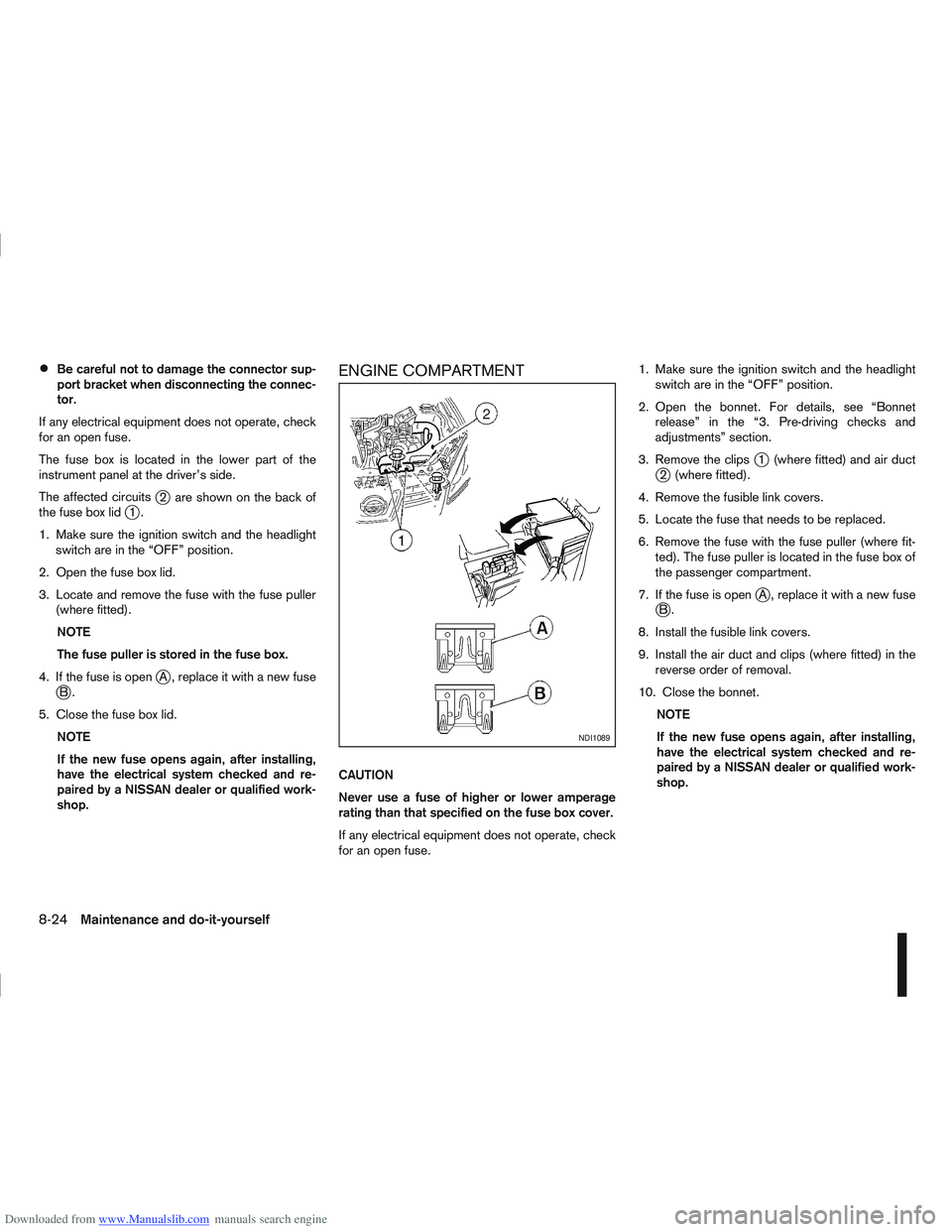
The affected circuits
j2 are shown on the back of
the fuse box lidj1.
1. Make sure the ignition switch and the headlight switch are in the “OFF” position.
2. Open the fuse box lid.
3. Locate and remove the fuse with the fuse puller (where fitted).
NOTE
The fuse puller is stored in the fuse box.
4. If the fuse is open
jA , replace it with a new fusejB.
5. Close the fuse box lid. NOTE
If the new fuse opens again, after installing,
have the electrical system checked and re-
paired by a NISSAN dealer or qualified work-
shop.
ENGINE COMPARTMENT
CAUTION
Never use a fuse of higher or lower amperage
rating than that specified on the fuse box cover.
If any electrical equipment does not operate, check
for an open fuse. 1. Make sure the ignition switch and the headlight
switch are in the “OFF” position.
2. Open the bonnet. For details, see “Bonnet release” in the “3. Pre-driving checks and
adjustments” section.
3. Remove the clips
j1 (where fitted) and air ductj2 (where fitted).
4. Remove the fusible link covers.
5. Locate the fuse that needs to be replaced.
6. Remove the fuse with the fuse puller (where fit- ted). The fuse puller is located in the fuse box of
the passenger compartment.
7. If the fuse is open
jA , replace it with a new fusejB.
8. Install the fusible link covers.
9. Install the air duct and clips (where fitted) in the reverse order of removal.
10. Close the bonnet. NOTE
If the new fuse opens again, after installing,
have the electrical system checked and re-
paired by a NISSAN dealer or qualified work-
shop.
NDI1089
8-24Maintenance and do-it-yourself
Page 259 of 297
Downloaded from www.Manualslib.com manuals search engine Replacing procedures
m
NDI707
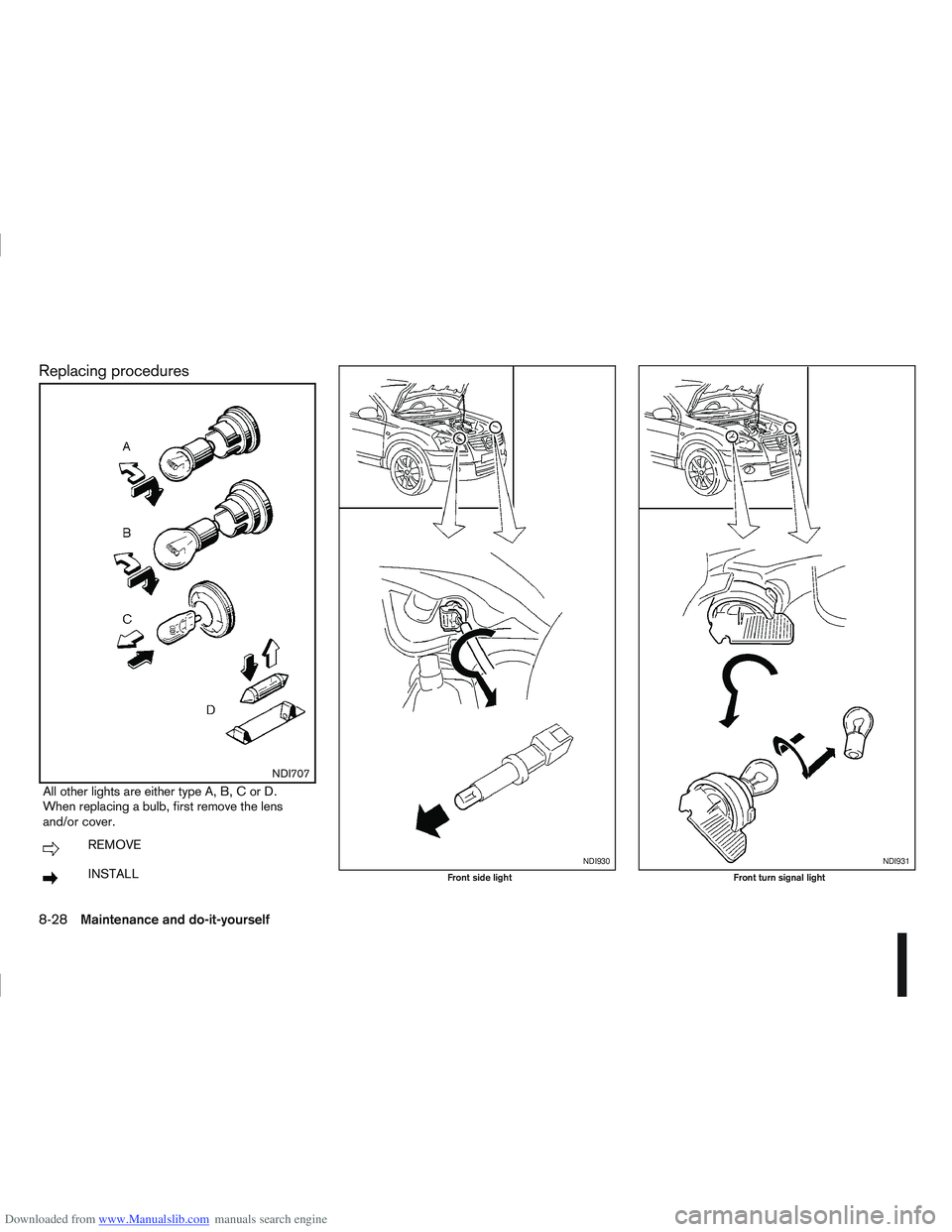
All other lights are either type A, B, C or D.
When replacing a bulb, first remove the lens
and/or cover.
mREMOVE
mINSTALLNDI930
Front side light
NDI931
Front turn signal light
8-28Maintenance and do-it-yourself
Page 269 of 297
Downloaded from www.Manualslib.com manuals search engine *1: For further details, see “Recommended SAE viscosity number” later in this section.
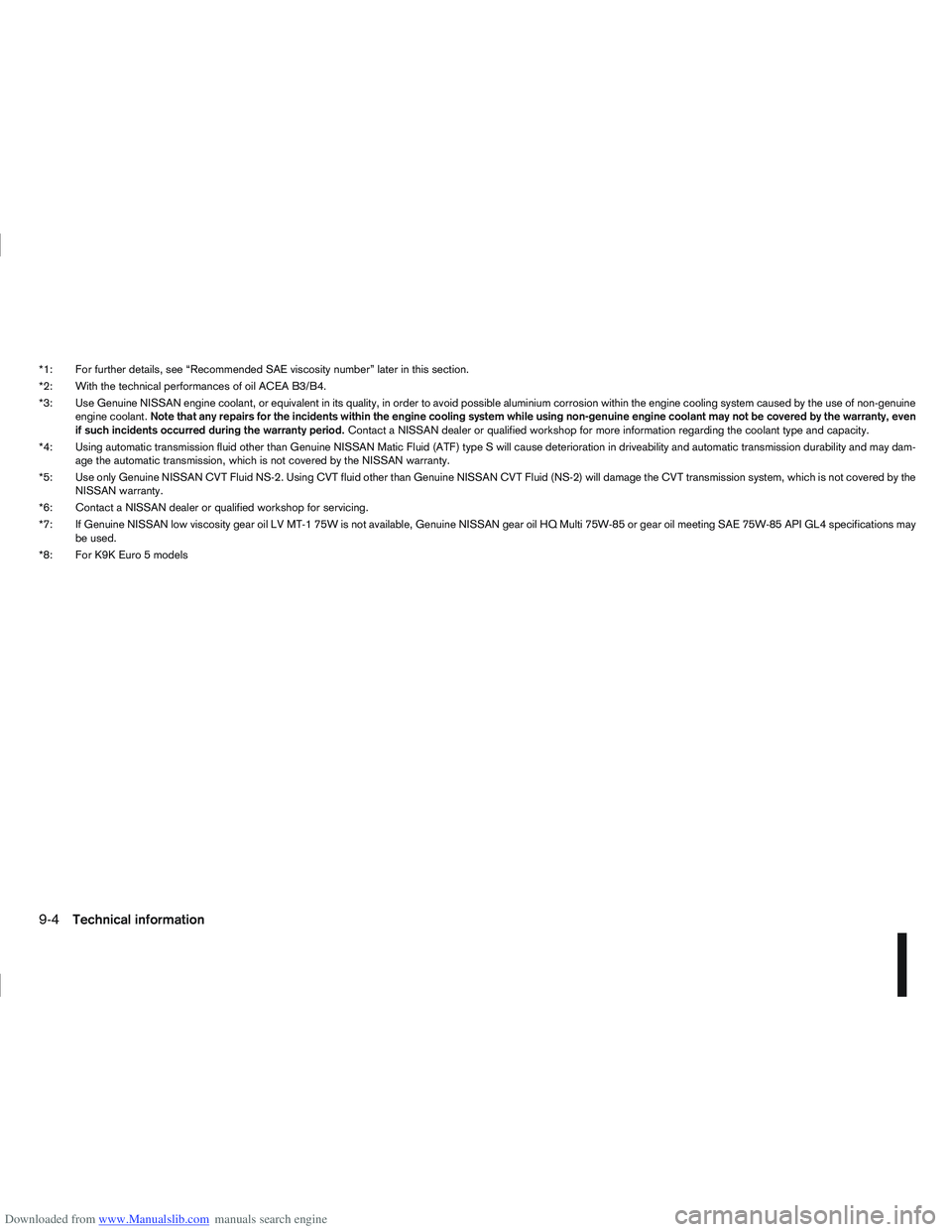
*2: With the technical performances of oil ACEA B3/B4.
*3: Use Genuine NISSAN engine coolant, or equivalent in its quality, in order to avoid possible aluminium corrosion within the engine cooling system caused by the use of non-genuineengine coolant. Note that any repairs for the incidents within the engine cooling system while using non-genuine engine coolant may not be covered by the warranty, eve n
if such incidents occurred during the warranty period. Contact a NISSAN dealer or qualified workshop for more information regarding the coolant type and capacity.
*4: Using automatic transmission fluid other than Genuine NISSAN Matic Fluid (ATF) type S will cause deterioration in driveability and automatic transmission durability and may dam- age the automatic transmission, which is not covered by the NISSAN warranty.
*5: Use only Genuine NISSAN CVT Fluid NS-2. Using CVT fluid other than Genuine NISSAN CVT Fluid (NS-2) will damage the CVT transmission system, which is not covered by the NISSAN warranty.
*6: Contact a NISSAN dealer or qualified workshop for servicing.
*7: If Genuine NISSAN low viscosity gear oil LV MT-1 75W is not available, Genuine NISSAN gear oil HQ Multi 75W-85 or gear oil meeting SAE 75W-85 API GL4 specifications may be used.
*8: For K9K Euro 5 models
9-4Technical information
Page 271 of 297
Downloaded from www.Manualslib.com manuals search engine AIR CONDITIONING SYSTEM
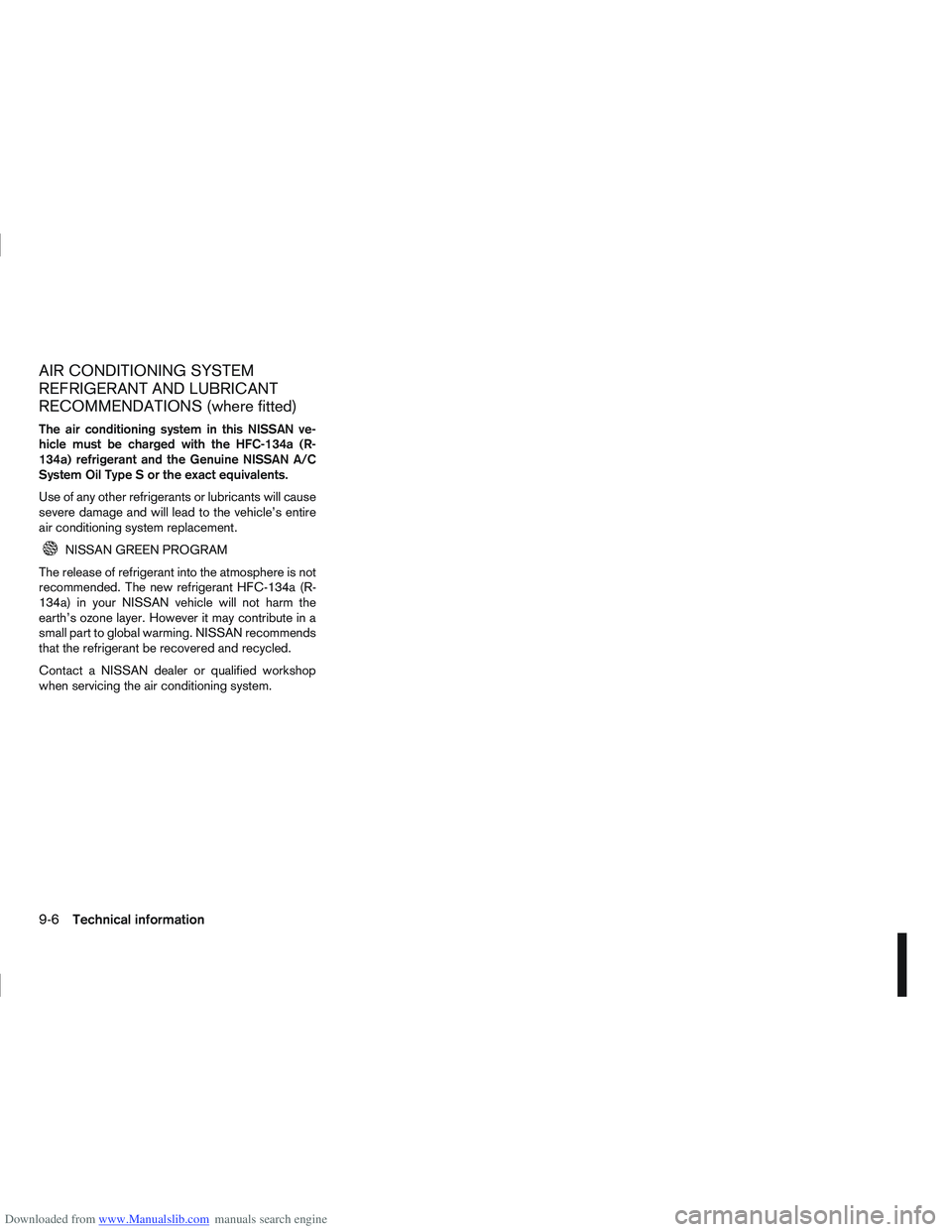
REFRIGERANT AND LUBRICANT
RECOMMENDATIONS (where fitted)
The air conditioning system in this NISSAN ve-
hicle must be charged with the HFC-134a (R-
134a) refrigerant and the Genuine NISSAN A/C
System Oil Type S or the exact equivalents.
Use of any other refrigerants or lubricants will cause
severe damage and will lead to the vehicle’s entire
air conditioning system replacement.
NISSAN GREEN PROGRAM
The release of refrigerant into the atmosphere is not
recommended. The new refrigerant HFC-134a (R-
134a) in your NISSAN vehicle will not harm the
earth’s ozone layer. However it may contribute in a
small part to global warming. NISSAN recommends
that the refrigerant be recovered and recycled.
Contact a NISSAN dealer or qualified workshop
when servicing the air conditioning system.
9-6Technical information
Page 289 of 297
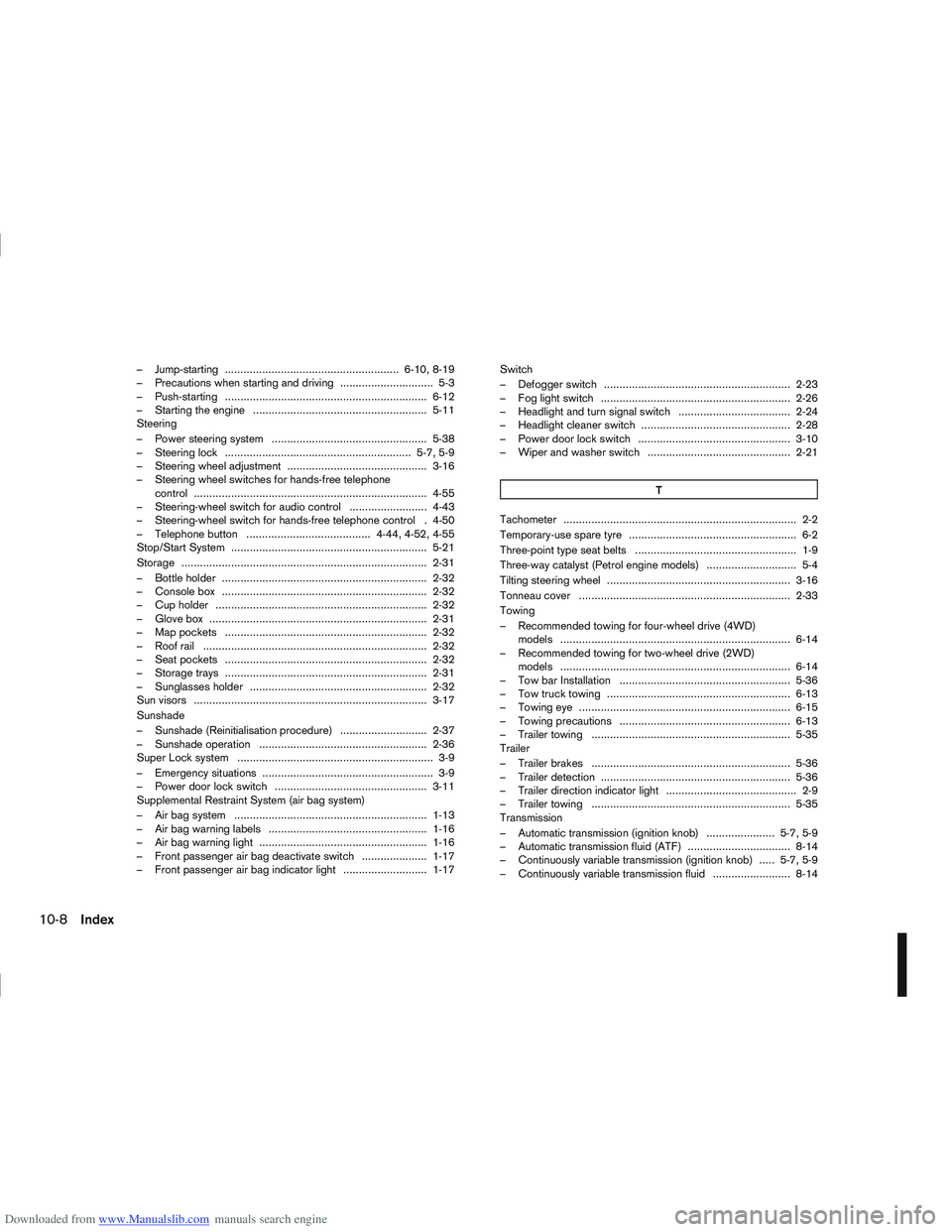
Downloaded from www.Manualslib.com manuals search engine – Jump-starting ........................................................ 6-10, 8-19
– Precautions when starting and driving .............................. 5-3
– Push-starting ................................................................. 6-12
– Starting the engine ........................................................ 5-11
Steering
– Power steering system .................................................. 5-38
– Steering lock ............................................................ 5-7, 5-9
– Steering wheel adjustment ............................................. 3-16
– Steering wheel switches for hands-free telephonecontrol ........................................................................\
... 4-55
– Steering-wheel switch for audio control ......................... 4-43
– Steering-wheel switch for hands-free telephone control . 4-50
– Telephone button ........................................ 4-44, 4-52, 4-55
Stop/Start System ............................................................... 5-21
Storage ........................................................................\
....... 2-31
– Bottle holder .................................................................. 2-32
– Console box .................................................................. 2-32
– Cup holder .................................................................... 2-32
– Glove box ...................................................................... 2-31
– Map pockets ................................................................. 2-32
– Roof rail ........................................................................\
2-32
– Seat pockets ................................................................. 2-32
– Storage trays ................................................................. 2-31
– Sunglasses holder ......................................................... 2-32
Sun visors ........................................................................\
... 3-17
Sunshade
– Sunshade (Reinitialisation procedure) ............................ 2-37
– Sunshade operation ...................................................... 2-36
Super Lock system ............................................................... 3-9
– Emergency situations ....................................................... 3-9
– Power door lock switch ................................................. 3-11
Supplemental Restraint System (air bag system)
– Air bag system .............................................................. 1-13
– Air bag warning labels ................................................... 1-16
– Air bag warning light ...................................................... 1-16
– Front passenger air bag deactivate switch ..................... 1-17
– Front passenger air bag indicator light ........................... 1-17 Switch
– Defogger switch ............................................................ 2-23
– Fog light switch ............................................................. 2-26
– Headlight and turn signal switch .................................... 2-24
– Headlight cleaner switch ................................................ 2-28
– Power door lock switch ................................................. 3-10
– Wiper and washer switch .............................................. 2-21
T
Tachometer ........................................................................\
... 2-2
Temporary-use spare tyre ...................................................... 6-2
Three-point type seat belts .................................................... 1-9
Three-way catalyst (Petrol engine models) ............................. 5-4
Tilting steering wheel ........................................................... 3-16
Tonneau cover .................................................................... 2-33
Towing
– Recommended towing for four-wheel drive (4WD)models ........................................................................\
.. 6-14
– Recommended towing for two-wheel drive (2WD) models ........................................................................\
.. 6-14
– Tow bar Installation ....................................................... 5-36
– Tow truck towing ........................................................... 6-13
– Towing eye .................................................................... 6-15
– Towing precautions ....................................................... 6-13
– Trailer towing ................................................................ 5-35
Trailer
– Trailer brakes ................................................................ 5-36
– Trailer detection ............................................................. 5-36
– Trailer direction indicator light .......................................... 2-9
– Trailer towing ................................................................ 5-35
Transmission
– Automatic transmission (ignition knob) ...................... 5-7, 5-9
– Automatic transmission fluid (ATF) ................................. 8-14
– Continuously variable transmission (ignition knob) ..... 5-7, 5-9
– Continuously variable transmission fluid ......................... 8-14
10-8Index
Page 290 of 297
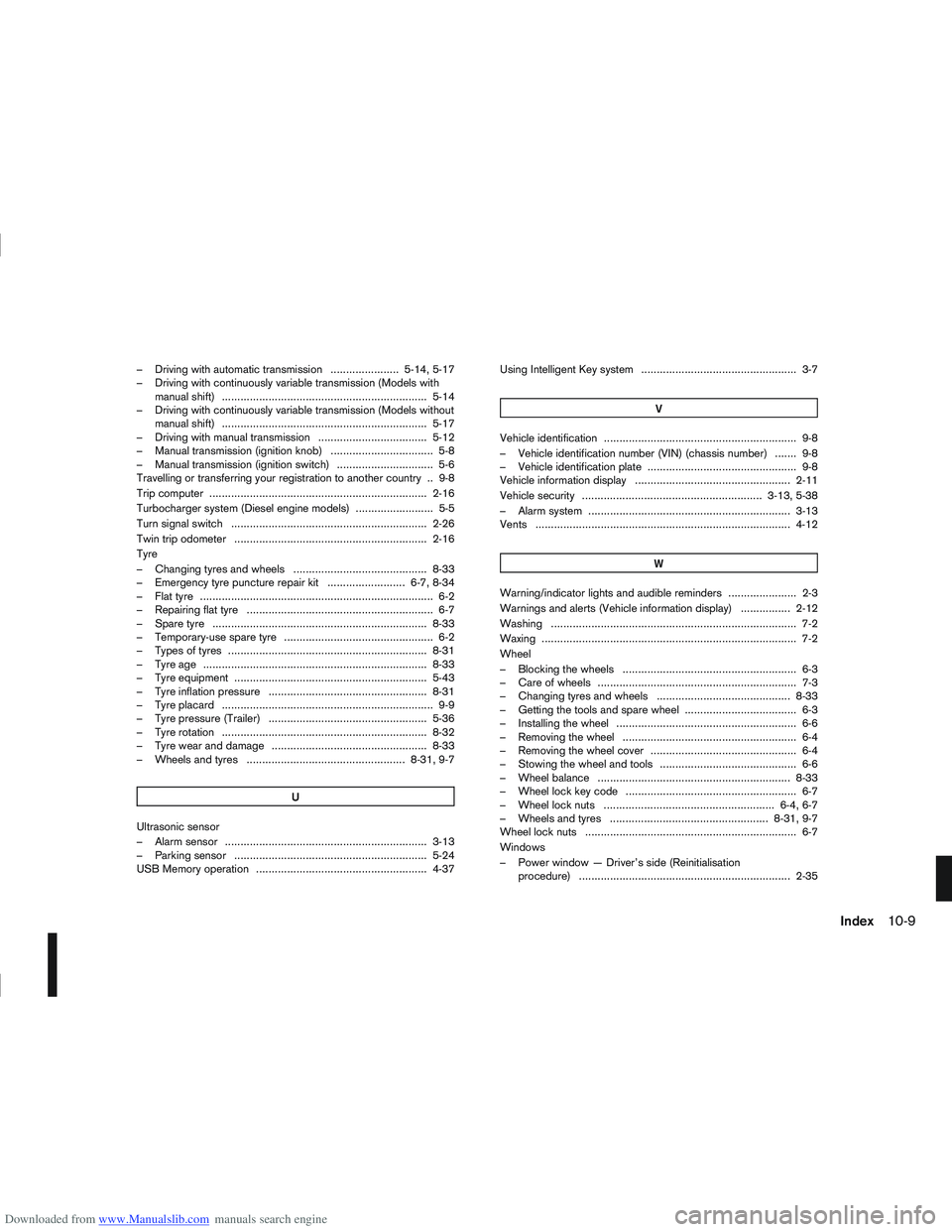
Downloaded from www.Manualslib.com manuals search engine – Driving with automatic transmission ...................... 5-14, 5-17
– Driving with continuously variable transmission (Models withmanual shift) .................................................................. 5-14
– Driving with continuously variable transmission (Models without manual shift) .................................................................. 5-17
– Driving with manual transmission ................................... 5-12
– Manual transmission (ignition knob) ................................. 5-8
– Manual transmission (ignition switch) ............................... 5-6
Travelling or transferring your registration to another country .. 9-8
Trip computer ...................................................................... 2-16
Turbocharger system (Diesel engine models) ......................... 5-5
Turn signal switch ............................................................... 2-26
Twin trip odometer .............................................................. 2-16
Tyre
– Changing tyres and wheels ........................................... 8-33
– Emergency tyre puncture repair kit ......................... 6-7, 8-34
– Flat tyre ........................................................................\
... 6-2
– Repairing flat tyre ............................................................ 6-7
– Spare tyre ..................................................................... 8-33
– Temporary-use spare tyre ................................................ 6-2
– Types of tyres ................................................................ 8-31
– Tyre age ........................................................................\
8-33
– Tyre equipment .............................................................. 5-43
– Tyre inflation pressure ................................................... 8-31
– Tyre placard .................................................................... 9-9
– Tyre pressure (Trailer) ................................................... 5-36
– Tyre rotation .................................................................. 8-32
– Tyre wear and damage .................................................. 8-33
– Wheels and tyres ................................................... 8-31, 9-7
U
Ultrasonic sensor
– Alarm sensor ................................................................. 3-13
– Parking sensor .............................................................. 5-24
USB Memory operation ....................................................... 4-37 Using Intelligent Key system .................................................. 3-7
V
Vehicle identification .............................................................. 9-8
– Vehicle identification number (VIN) (chassis number) ....... 9-8
– Vehicle identification plate ................................................ 9-8
Vehicle information display .................................................. 2-11
Vehicle security .......................................................... 3-13, 5-38
– Alarm system ................................................................. 3-13
Vents ........................................................................\
.......... 4-12W
Warning/indicator lights and audible reminders ...................... 2-3
Warnings and alerts (Vehicle information display) ................ 2-12
Washing ........................................................................\
....... 7-2
Waxing ........................................................................\
.......... 7-2
Wheel
– Blocking the wheels ........................................................ 6-3
– Care of wheels ................................................................ 7-3
– Changing tyres and wheels ........................................... 8-33
– Getting the tools and spare wheel .................................... 6-3
– Installing the wheel .......................................................... 6-6
– Removing the wheel ........................................................ 6-4
– Removing the wheel cover ............................................... 6-4
– Stowing the wheel and tools ............................................ 6-6
– Wheel balance .............................................................. 8-33
– Wheel lock key code ....................................................... 6-7
– Wheel lock nuts ....................................................... 6-4, 6-7
– Wheels and tyres ................................................... 8-31, 9-7
Wheel lock nuts .................................................................... 6-7
Windows
– Power window — Driver’s side (Reinitialisationprocedure) .................................................................... 2-35
Index10-9
Page 293 of 297
Downloaded from www.Manualslib.com manuals search engine ENVIRONMENTAL CONCERN
NISSAN GREEN PROGRAM
Today, the efforts made by NISSAN to fulfil our
responsibilities to protect and sustain the environ-
ment are far-reaching. Within NISSAN, we promote
the highest levels of practice in every region and in
every area of operations.
COMPLIANCE AT EVERY STEP
NISSAN focuses on ensuring that end of life vehicle
components are reused, recycled or recovered as
thermal energy, and guarantees compliance with EU
legislation (the End of Life Vehicle Directive).
WE BUILD OUR VEHICLES WITH
RECYCLING IN MIND
Reducing landfill waste, emissions, conserving natu-
ral resources, and enhancing recycling activities are
emphasised daily in our manufacturing, sales and
service operations and in the disposal of end of life
vehicles (ELV).
Design phase
To reduce environmental impact we have developed
your NISSAN vehicle to be 95% recyclable. We
mark the components to facilitate dismantling, recy-
cling and to reduce hazardous substances. We
carefully verify and control substances of concern.
We have already reduced to a minimum the cad-
mium, mercury and lead in your NISSAN vehicle.
NISSAN includes recycled material in your vehicle
and looks for opportunities to increase the percent-
age of recycled materials used.
Manufacturing phase
NISSAN plants based in the UK and Spain already
achieve a recycling rate of over 90% and are look-
ing for further improvements. The UK plant installed
8 windmills to cut carbon dioxide emissions at power
plants by more than 3,000 tonnes per year. Since
the end of March 2007, NMISA (Spain) uses a solar
panel water heating system to save energy. This will
generate 33% of the energy consumed in the baths
during the painting of your vehicle.
Production and distribution phase
Using resources efficiently to reduce the amount of
waste generated during the production and distribu-
tion stage. NISSAN promotes activities based on
Reducing, Reusing, and Recycling materials when-
ever possible. The NISSAN GREEN PROGRAM
2010 (NGP2010) is our midterm environmental ac-
tion plan defining our goals for achieving a 100%
recycling rate for operations in Japan and globally.
Use and service phase
NISSAN dealers are our window to you, our cus-
tomer. In order to meet your expectations they pro-
vide not only high quality services but are also envi-
ronmentally responsible. NISSAN promotes activi-
ties to recycle the waste generated as a result of
service centre activities.
Disposal phase
Recycle your end of life vehicle or its components.
When your NISSAN reaches the end of its life, and
is no longer suitable for daily use, it still has value. You can help prevent waste affecting the environ-
ment by bringing your NISSAN to be recycled at our
collection networks in your area. Our collection net-
works guarantee no cost for the treatment of your
ELV. For further information on how and where to
dispose of your ELV refer to your local NISSAN
dealer or consult: www.nissan-europe.com.
PROTECT THE ENVIRONMENT
WHEN DRIVING
Your driving behaviour has significant impact on fuel
economy and the environment. Follow the tips be-
low for better fuel-efficiency, better driving habits,
and to be environmentally friendly by reducing emis-
sions:
Defensive driving
Anticipating traffic conditions and acting accordingly
reduces fuel consumption, helping to protect of our
natural environment. Take your foot off the accelera-
tor while approaching traffic lights and avoid last
minute braking when the light turns red.
Avoid speeding, harsh acceleration, and strong
braking. The gain in time does not offset pollution of
the environment. Try to maintain speed when driving
uphill to reduce fuel consumption and pollution.
Maintain speed or allow the vehicle to go slower
where traffic allows.
Close windows when driving
Driving with a window open at 100 km/h (62 MPH)
increases fuel consumption by up to 4%. Driving
with the windows closed allows for better fuel
economy.
ENVIRONMENT (End of Life
Vehicles)