light NISSAN QASHQAI 2014 Owner´s Manual
[x] Cancel search | Manufacturer: NISSAN, Model Year: 2014, Model line: QASHQAI, Model: NISSAN QASHQAI 2014Pages: 338, PDF Size: 4.87 MB
Page 19 of 338
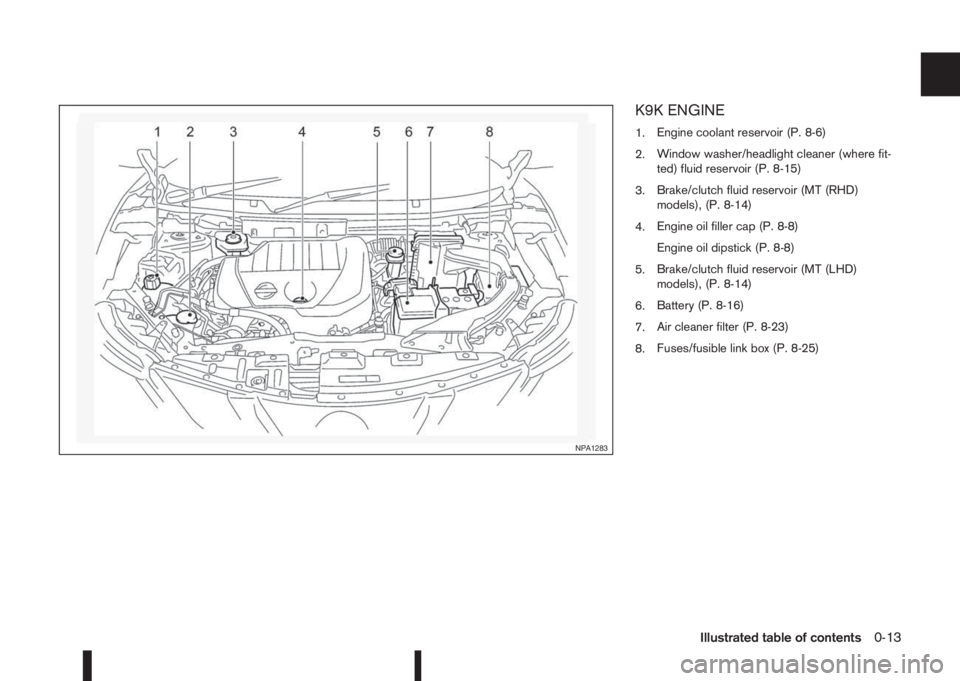
K9K ENGINE
1.Engine coolant reservoir (P. 8-6)
2.Window washer/headlight cleaner (where fit-
ted) fluid reservoir (P. 8-15)
3.Brake/clutch fluid reservoir (MT (RHD)
models), (P. 8-14)
4.Engine oil filler cap (P. 8-8)
Engine oil dipstick (P. 8-8)
5.Brake/clutch fluid reservoir (MT (LHD)
models), (P. 8-14)
6.Battery (P. 8-16)
7.Air cleaner filter (P. 8-23)
8.Fuses/fusible link box (P. 8-25)
NPA1283
Illustrated table of contents0-13
Page 20 of 338
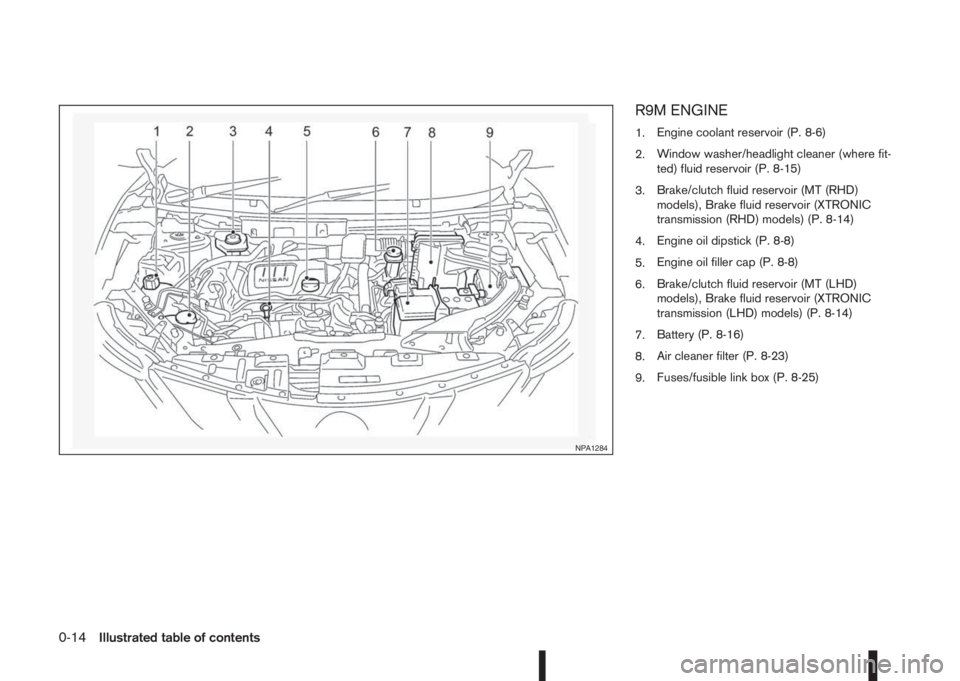
R9M ENGINE
1.Engine coolant reservoir (P. 8-6)
2.Window washer/headlight cleaner (where fit-
ted) fluid reservoir (P. 8-15)
3.Brake/clutch fluid reservoir (MT (RHD)
models), Brake fluid reservoir (XTRONIC
transmission (RHD) models) (P. 8-14)
4.Engine oil dipstick (P. 8-8)
5.Engine oil filler cap (P. 8-8)
6.Brake/clutch fluid reservoir (MT (LHD)
models), Brake fluid reservoir (XTRONIC
transmission (LHD) models) (P. 8-14)
7.Battery (P. 8-16)
8.Air cleaner filter (P. 8-23)
9.Fuses/fusible link box (P. 8-25)
NPA1284
0-14Illustrated table of contents
Page 25 of 338
•If any malfunctions are found or the seat does
not operate, turn the switch off and have the
system checked by a NISSAN dealer or quali-
fied workshop.
Heated seats
The seats can be warmed by built-in heaters. The
switches are located on the centre console (for front
seats) and can be operated independently of each
other.
1. Start the engine.
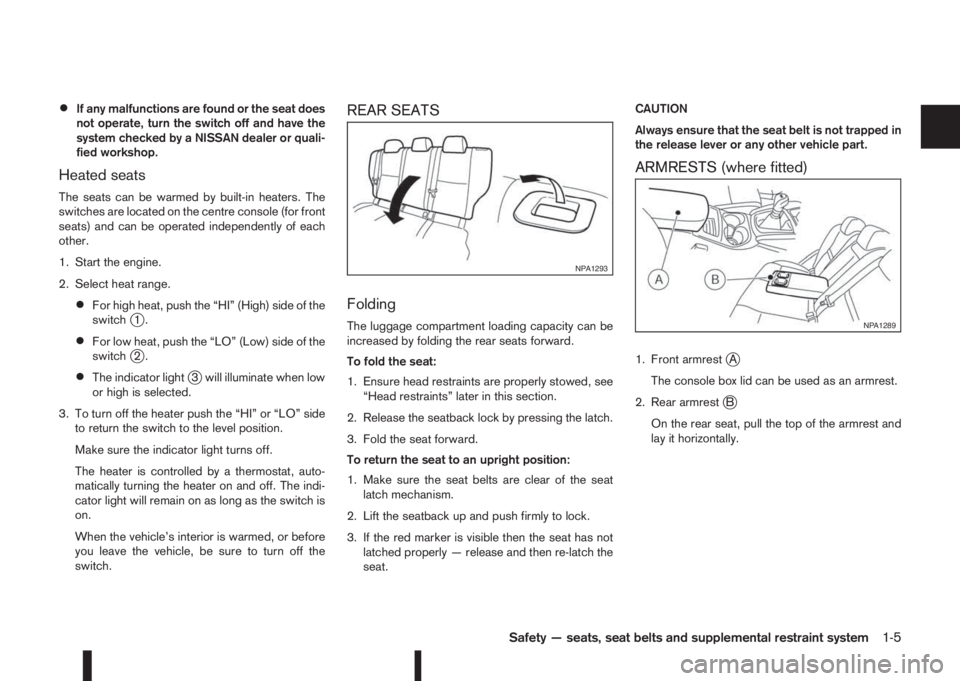
2. Select heat range.
•For high heat, push the “HI” (High) side of the
switchj1.
•For low heat, push the “LO” (Low) side of the
switchj2.
•The indicator lightj3 will illuminate when low
or high is selected.
3. To turn off the heater push the “HI” or “LO” side
to return the switch to the level position.
Make sure the indicator light turns off.
The heater is controlled by a thermostat, auto-
matically turning the heater on and off. The indi-
cator light will remain on as long as the switch is
on.
When the vehicle’s interior is warmed, or before
you leave the vehicle, be sure to turn off the
switch.
REAR SEATS
Folding
The luggage compartment loading capacity can be
increased by folding the rear seats forward.
To fold the seat:
1. Ensure head restraints are properly stowed, see
“Head restraints” later in this section.
2. Release the seatback lock by pressing the latch.
3. Fold the seat forward.
To return the seat to an upright position:
1. Make sure the seat belts are clear of the seat
latch mechanism.
2. Lift the seatback up and push firmly to lock.
3. If the red marker is visible then the seat has not
latched properly — release and then re-latch the
seat.CAUTION
Always ensure that the seat belt is not trapped in
the release lever or any other vehicle part.
ARMRESTS (where fitted)
1. Front armrestjA
The console box lid can be used as an armrest.
2. Rear armrest
jB
On the rear seat, pull the top of the armrest and
lay it horizontally.
NPA1293
NPA1289
Safety — seats, seat belts and supplemental restraint system1-5
Page 29 of 338
•No modifications or additions should be made
by the user which will either prevent the seat
belt adjusting devices from operating to re-
move slack, or prevent the seat belt assembly
from being adjusted to remove slack.
•Seat belts should be adjusted as firmly as
possible, consistent with comfort, to provide
the protection for which they have been de-
signed. A slack belt will greatly reduce the
protection afforded to the wearer.
•Be sure the seat belt tongue is securely fas-
tened to the proper buckle.
•Do not wear the seat belt inside out or twisted.
Doing so may reduce its effectiveness.
•Do not allow more than one person to use the
same seat belt.
•Never carry more people in the vehicle than
there are seat belts.
•Each belt assembly must only be used by one
occupant; it is dangerous to put a belt around
a child being carried on the occupant’s lap.
•If the seat belt warning light illuminates con-
tinuously while the ignition switch is in the ON
position, with all doors closed, and all seat
belts fastened, it may indicate a malfunction
in the system. Have the system checked by a
NISSAN dealer or qualified workshop.
•No changes should be made to the seat belt
system. For example, do not modify the seat
belt, add material, or install devices that maychange the seat belt routing or tension. Doing
so may affect the operation of the seat belt
system. Modifying or tampering with the seat
belt system may result in serious personal in-
jury.
•Once a seat belt pre-tensioner has been acti-
vated, it cannot be reused and must be re-
placed together with the retractor. See a
NISSAN dealer or qualified workshop.
•Removal and installation of the pre-tensioner
seat belt system components should be done
by a NISSAN dealer or qualified workshop.
•All seat belt assemblies, including retractors
and attaching hardware, should be inspected
by a NISSAN dealer or qualified workshop af-
ter any collision. NISSAN recommends that
all seat belt assemblies in use during a colli-
sion be replaced unless the collision was mi-
nor and the belts show no damage and con-
tinue to operate properly. Seat belt assem-
blies not in use during a collision should also
be inspected and replaced if either damage
or improper operation is noted.
•All child restraints and attaching hardware
should be inspected after any collision. Al-
ways follow the restraint manufacturer’s in-
spection instructions and replacement rec-
ommendations. The child restraints should be
replaced if they are damaged.
•It is essential to replace the entire assembly
after it has been worn in a severe impact even
if damage to the assembly is not obvious.
•Care should be taken to avoid contamination
of the webbing with polishes, oils and chemi-
cals, and particularly battery acid. Cleaning
may safely be carried out using mild soap and
water. The belt should be replaced if webbing
becomes frayed, contaminated or damaged.
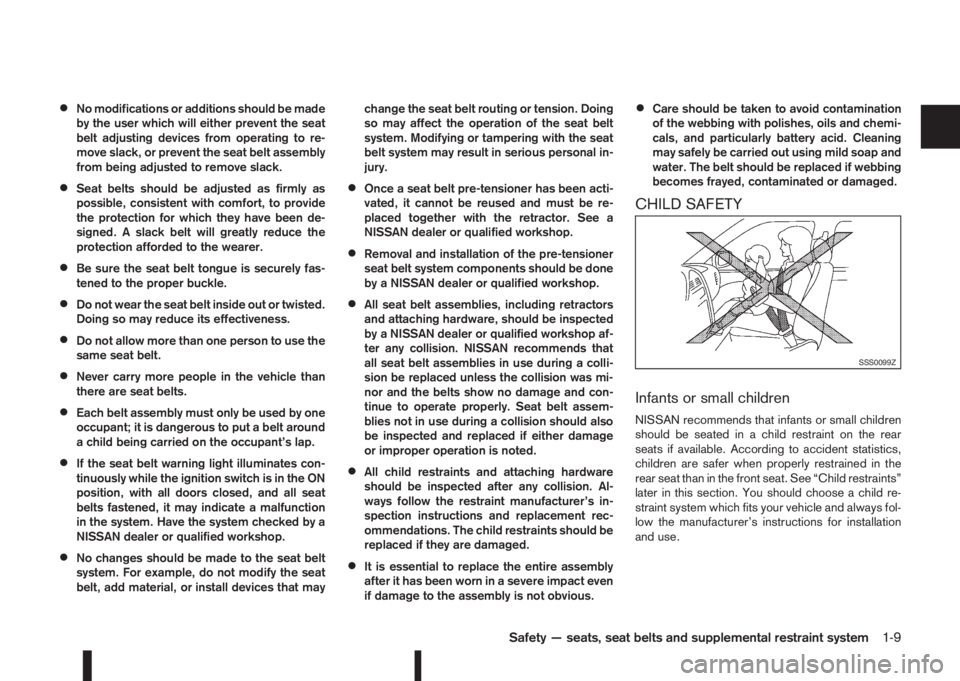
CHILD SAFETY
Infants or small children
NISSAN recommends that infants or small children
should be seated in a child restraint on the rear
seats if available. According to accident statistics,
children are safer when properly restrained in the
rear seat than in the front seat. See “Child restraints”
later in this section. You should choose a child re-
straint system which fits your vehicle and always fol-
low the manufacturer’s instructions for installation
and use.
SSS0099Z
Safety — seats, seat belts and supplemental restraint system1-9
Page 30 of 338
Children
Children who are too large for child restraints should
be seated and restrained by the seat belts that are
provided.
The use of a booster seat (commercially available)
may help to avoid the shoulder belt coming across
the face or neck area of a child’s seating position.
The booster seat should raise the child so that the
shoulder belt is properly positioned across the top,
middle portion of the shoulder and the lap belt is low
on the hips. The booster seat should fit the vehicle’s
seat. Once the child has grown so the shoulder belt
is no longer on or near the face and neck, use the
shoulder belt without the booster seat.
WARNING
Never let a child stand or kneel on any seat and
do not allow a child in the cargo areas while the
vehicle is moving.
PREGNANT WOMEN
NISSAN recommends that pregnant women use
seat belts. The seat belt should be worn snug, and
always position the lap belt as low as possible
around the hips, not the waist. Place the shoulder
belt over your shoulder and across your chest. Never
put the lap/shoulder belt over your abdominal area.
Contact your doctor for specific recommendations.
INJURED PERSONS
NISSAN recommends that injured persons use seat
belts, depending on the injury. Check with your doc-
tor for specific recommendations.
SEAT BELT WARNINGS
Driver and front passenger
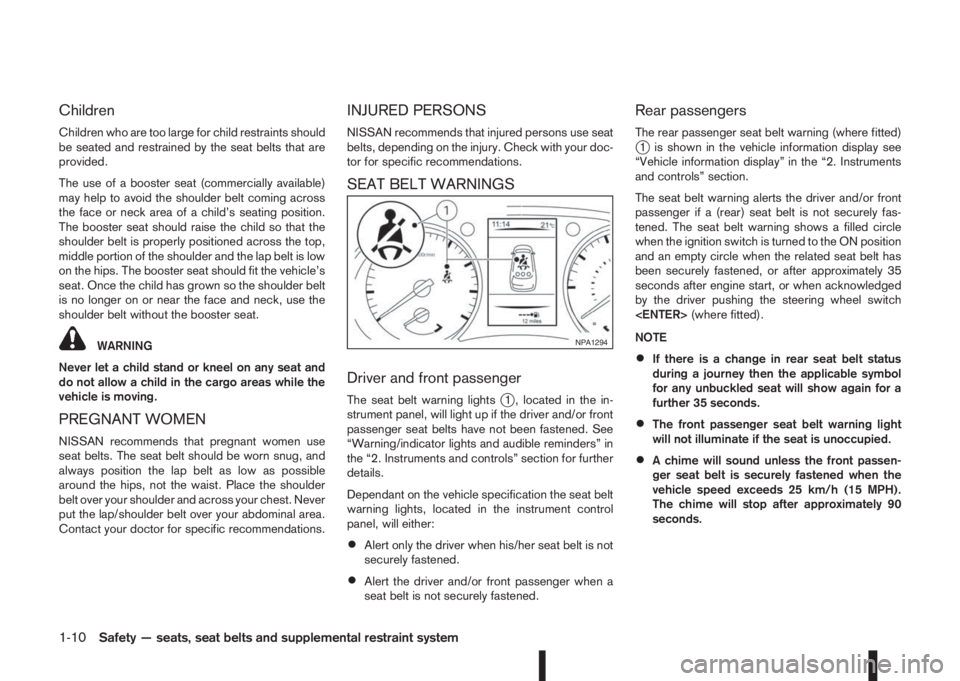
The seat belt warning lightsj1 , located in the in-
strument panel, will light up if the driver and/or front
passenger seat belts have not been fastened. See
“Warning/indicator lights and audible reminders” in
the “2. Instruments and controls” section for further
details.
Dependant on the vehicle specification the seat belt
warning lights, located in the instrument control
panel, will either:
•Alert only the driver when his/her seat belt is not
securely fastened.
•Alert the driver and/or front passenger when a
seat belt is not securely fastened.
Rear passengers
The rear passenger seat belt warning (where fitted)j1 is shown in the vehicle information display see
“Vehicle information display” in the “2. Instruments
and controls” section.
The seat belt warning alerts the driver and/or front
passenger if a (rear) seat belt is not securely fas-
tened. The seat belt warning shows a filled circle
when the ignition switch is turned to the ON position
and an empty circle when the related seat belt has
been securely fastened, or after approximately 35
seconds after engine start, or when acknowledged
by the driver pushing the steering wheel switch
NOTE
•If there is a change in rear seat belt status
during a journey then the applicable symbol
for any unbuckled seat will show again for a
further 35 seconds.
•The front passenger seat belt warning light
will not illuminate if the seat is unoccupied.
•A chime will sound unless the front passen-
ger seat belt is securely fastened when the
vehicle speed exceeds 25 km/h (15 MPH).
The chime will stop after approximately 90
seconds.
NPA1294
1-10Safety — seats, seat belts and supplemental restraint system
Page 33 of 338
•If dirt builds up in the shoulder belt guideof
the seat belt anchors, the seat belts may retract
slowly. Wipe the shoulder belt guide with a clean,
dry cloth.
•Periodically check to see that the seat belt
and the metal components, such as buckles,
tongues, retractors, flexible wires and anchors,
work properly. If loose parts, deterioration, cuts
or other damage on the webbing is found, the
entire seat belt assembly should be replaced.
WARNING
•The pre-tensioner seat belt cannot be reused
after activation. It must be replaced together
with the retractor as a unit.
•If the vehicle is involved in a frontal collision
but the pre-tensioner is not activated, be sure
to have the pre-tensioner system checked
and, if necessary, replaced by a NISSAN
dealer or qualified workshop.
•No unauthorised changes should be made to
any components or wiring of the pre-tensioner
seat belt system. This is to prevent accidental
activation of the pre-tensioner seat belt or
damage to the pre-tensioner seat belt opera-
tion. Tampering with the pre-tensioner seat
belt system may result in serious personal in-
jury.
•Work on and around the pre-tensioner system
should be done by an authorised NISSAN
dealer or qualified workshop. Installation of
electrical equipment should also be done by a
NISSAN dealer or qualified workshop. Unau-
thorised electrical test equipment and prob-
ing devices should not be used on the pre-
tensioner seat belt system.
•If you need to dispose of the pre-tensioner or
scrap the vehicle, contact a NISSAN dealer or
qualified workshop. Correct pre-tensioner
disposal procedures are set forth in the ap-propriate NISSAN Service Manual. Incorrect
disposal procedures could cause personal in-
jury.
The front seat pre-tensioner seat belt system is acti-
vated in conjunction with the front air bag system. It
helps tighten the seat belt when the vehicle is in-
volved in certain types of collisions by restraining
the seat occupants via the seat belt retractor.
The pre-tensioner is encased with the seat belt’s
retractor. These seat belts are used in the same way
as conventional seat belts.
Additionally, the driver’s side pre-tensioner seat belt
system is also equipped with a lap pre-tensioner.
Both the retractor pre-tensioner and lap pre-ten-
sioner provide significant protection against injury in
an accident and increase the safety performance of
your vehicle.
When the pre-tensioner seat belt system activates,
smoke is released and a loud noise may be heard.
The smoke is harmless, but care should be taken
not to inhale it as it may cause irritation and choking.
When the ignition switch is in the ON or START
position, the Supplemental Restraint System (SRS)
air bag warning light will illuminate. The SRS air bag
warning light will turn off after approximately 7 sec-
onds if the system is operational. If any of the follow-
ing conditions occur, the air bag and/or pre-ten-
sioner seat belt need servicing and your vehicle must
be taken to the nearest NISSAN dealer or qualified
workshop.
PRE-TENSIONER SEAT BELT
SYSTEM
Safety — seats, seat belts and supplemental restraint system1-13
Page 34 of 338
•The air bag warning light remains on after ap-
proximately 7 seconds.
•The air bag warning light flashes intermittently.
•The air bag warning light does not come on at
all.
Unless checked and repaired, the Supplemental Re-
straint System (SRS) and/or pre-tensioner seat belt
may not function properly. It must be checked and
repaired.
When selling your vehicle, we request that you in-
form the buyer about the pre-tensioner seat belt sys-
tem and guide the buyer to the appropriate sections
in this Owner’s Manual.Children need adults to help protect them.
They need to be properly restrained.
In addition to the general information in this manual,
child safety information is available from many other
sources, including doctors, teachers, government
traffic safety offices, and community organisations.
Every child is different, so be sure to learn the best
way to transport your child.
There are two basic types of child restraint system:
•Rear-facing child restraints
•Front-facing child restraints
The proper restraint depends on the child’s size.
Generally, infants (up to about 1 year and less than
9 kg) should be placed in rear-facing child restraints.
Front-facing child restraints are available for chil-
dren who outgrow rear-facing child restraints and
are at least 1 year old.
WARNING
Infants and children need special protection. The
vehicle’s seat belts may not fit them properly.
The shoulder belt may come too close to the
face or neck. The lap belt may not fit over their
small hip bones. In an accident, an improperly fit-
ting seat belt could cause serious or fatal injury.
Always use appropriate child restraints.
A child restraint may be secured in the vehicle by
using either the ISOFIX child restraint system or
with the vehicle seat belt, see “Child restraints” later
in this section for more information.NISSAN recommends that all pre-teens and chil-
dren be restrained in the rear seat. According to
accident statistics, children are safer when prop-
erly restrained in the rear seat than in the front
seat.
This is especially important because your vehicle
has a supplemental restraint system (air bag sys-
tem) for the front passenger. (See “Supplemen-
tal Restraint System (SRS)” later in this section.)
INFANTS
Infants up to at least 1 year old should be placed in
a rear-facing child restraint. You should choose a
child restraint that fits your vehicle and always follow
the manufacturer’s instructions for installation and
use.
SMALL CHILDREN
Children that are over 1 year old and weigh at least
9 kg can be placed in a front-facing child restraint.
Refer to the manufacturer’s instructions for mini-
mum and maximum weight and height recommen-
dations. You should choose a child restraint that fits
your vehicle and always follow the manufacturer’s
instructions for installation and use.
LARGER CHILDREN
Children who are too large for a child restraint sys-
tem should be seated and restrained by the seat
belts that are provided. If the child’s seating position
has a shoulder belt that fits close to the face or
neck, the use of a booster seat (commercially avail-
able) may help overcome this. The booster seat
should raise the child so that the shoulder belt is
CHILD SAFETY
1-14Safety — seats, seat belts and supplemental restraint system
Page 47 of 338
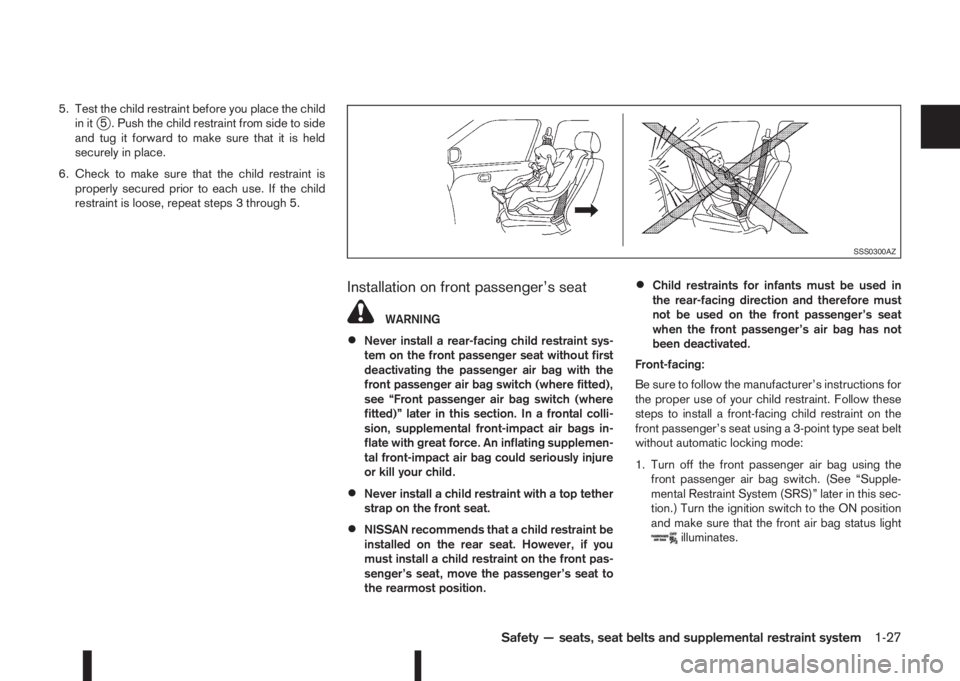
5. Test the child restraint before you place the child
in itj5 . Push the child restraint from side to side
and tug it forward to make sure that it is held
securely in place.
6. Check to make sure that the child restraint is
properly secured prior to each use. If the child
restraint is loose, repeat steps 3 through 5.
Installation on front passenger’s seat
WARNING
•Never install a rear-facing child restraint sys-
tem on the front passenger seat without first
deactivating the passenger air bag with the
front passenger air bag switch (where fitted),
see “Front passenger air bag switch (where
fitted)” later in this section. In a frontal colli-
sion, supplemental front-impact air bags in-
flate with great force. An inflating supplemen-
tal front-impact air bag could seriously injure
or kill your child.
•Never install a child restraint with a top tether
strap on the front seat.
•NISSAN recommends that a child restraint be
installed on the rear seat. However, if you
must install a child restraint on the front pas-
senger’s seat, move the passenger’s seat to
the rearmost position.
•Child restraints for infants must be used in
the rear-facing direction and therefore must
not be used on the front passenger’s seat
when the front passenger’s air bag has not
been deactivated.
Front-facing:
Be sure to follow the manufacturer’s instructions for
the proper use of your child restraint. Follow these
steps to install a front-facing child restraint on the
front passenger’s seat using a 3-point type seat belt
without automatic locking mode:
1. Turn off the front passenger air bag using the
front passenger air bag switch. (See “Supple-
mental Restraint System (SRS)” later in this sec-
tion.) Turn the ignition switch to the ON position
and make sure that the front air bag status light
illuminates.
SSS0300AZ
Safety — seats, seat belts and supplemental restraint system1-27
Page 48 of 338
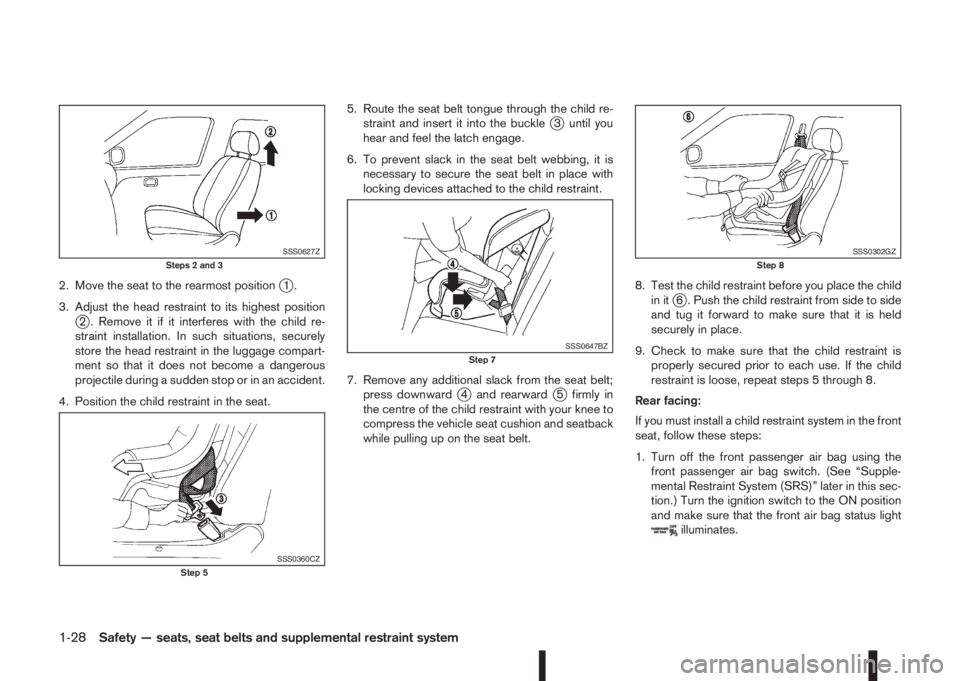
2. Move the seat to the rearmost positionj1.
3. Adjust the head restraint to its highest position
j2 . Remove it if it interferes with the child re-
straint installation. In such situations, securely
store the head restraint in the luggage compart-
ment so that it does not become a dangerous
projectile during a sudden stop or in an accident.
4. Position the child restraint in the seat.5. Route the seat belt tongue through the child re-
straint and insert it into the buckle
j3 until you
hear and feel the latch engage.
6. To prevent slack in the seat belt webbing, it is
necessary to secure the seat belt in place with
locking devices attached to the child restraint.
7. Remove any additional slack from the seat belt;
press downward
j4 and rearwardj5 firmly in
the centre of the child restraint with your knee to
compress the vehicle seat cushion and seatback
while pulling up on the seat belt.8. Test the child restraint before you place the child
in it
j6 . Push the child restraint from side to side
and tug it forward to make sure that it is held
securely in place.
9. Check to make sure that the child restraint is
properly secured prior to each use. If the child
restraint is loose, repeat steps 5 through 8.
Rear facing:
If you must install a child restraint system in the front
seat, follow these steps:
1. Turn off the front passenger air bag using the
front passenger air bag switch. (See “Supple-
mental Restraint System (SRS)” later in this sec-
tion.) Turn the ignition switch to the ON position
and make sure that the front air bag status light
illuminates.
SSS0627ZSteps 2 and 3
SSS0360CZStep 5
SSS0647BZStep 7
SSS0302GZStep 8
1-28Safety — seats, seat belts and supplemental restraint system
Page 50 of 338
Roof-mounted curtain side-impact
supplemental air bag system
(where fitted)
This system can help cushion the impact force to
the head of the driver and passengers in front and
rear outer seating positions in certain side-impact
collisions. The roof-mounted curtain side-impact
supplemental air bag is designed to inflate on the
side where the vehicle is impacted.
The SRS is designed tosupplementthe crash pro-
tection provided by the driver and front passenger
seat belts and isnot designed to substitutethem.
Seat belts should always be correctly worn and the
driver and front passenger seated a suitable dis-
tance away from the steering wheel, instrument
panel and front door finishers. For additional infor-
mation, see “Seat belts” earlier in this section.
After placing the ignition switch in the ON or
START position, the air bag warning light will illu-
minate. The air bag warning light will turn off
after approximately 7 seconds if the system is
operational. See “Warning/indicator lights and
audible reminders” in the “2. Instruments and
controls” sectionfor further details.
The air bag will operate only when the ignition
switch is in the ON or START position.Driver and front passenger air bags:
WARNING
•The supplemental front-impact air bags ordi-
narily will not inflate in the event of a side
impact, rear impact, rollover, or lower sever-
ity frontal collision. Always wear the seat belts
to help reduce the risk or severity of injury in
accidents.
•The seat belts and the supplemental front-im-
pact air bags are most effective when you are
sitting well back and upright in the seat. The
front-impact air bags inflate with great force.
If you are unrestrained, leaning forward, sit-
ting sideways, or out of position in any way,
you are at greater risk of injury or death in an
accident. You may also receive serious or fa-
tal injuries from the supplemental front-im-
pact air bag if you are up against it when itinflates. Always sit back against the seatback
and as far away as practical from the steering
wheel. Always use the seat belts.
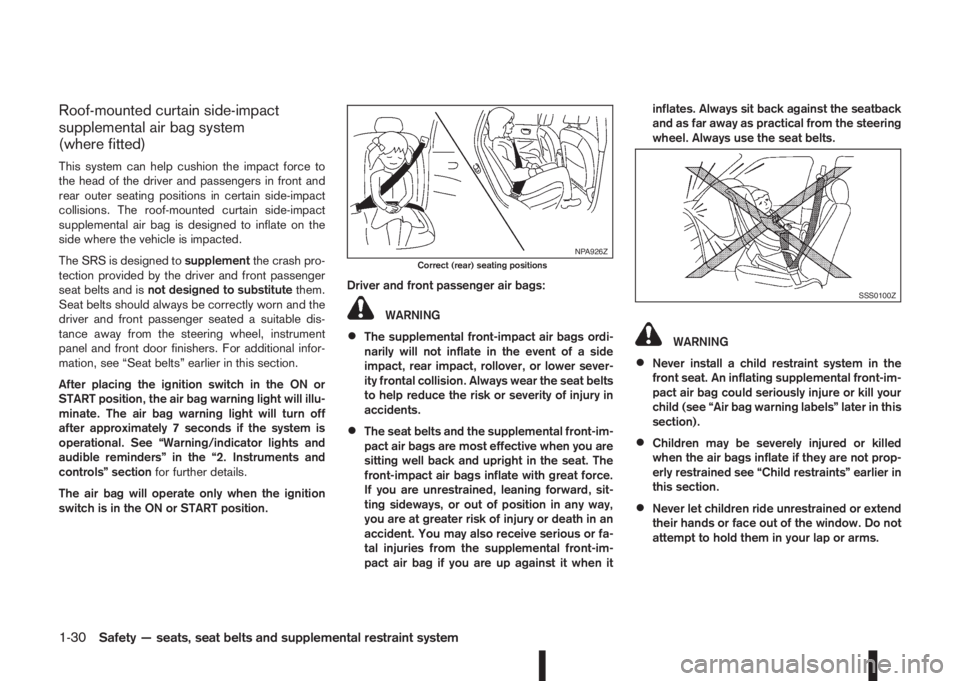
WARNING
•Never install a child restraint system in the
front seat. An inflating supplemental front-im-
pact air bag could seriously injure or kill your
child (see “Air bag warning labels” later in this
section).
•Children may be severely injured or killed
when the air bags inflate if they are not prop-
erly restrained see “Child restraints” earlier in
this section.
•Never let children ride unrestrained or extend
their hands or face out of the window. Do not
attempt to hold them in your lap or arms.
NPA926ZCorrect (rear) seating positions
SSS0100Z
1-30Safety — seats, seat belts and supplemental restraint system