heating NISSAN QASHQAI 2015 Owner´s Manual
[x] Cancel search | Manufacturer: NISSAN, Model Year: 2015, Model line: QASHQAI, Model: NISSAN QASHQAI 2015Pages: 338, PDF Size: 4.88 MB
Page 275 of 338
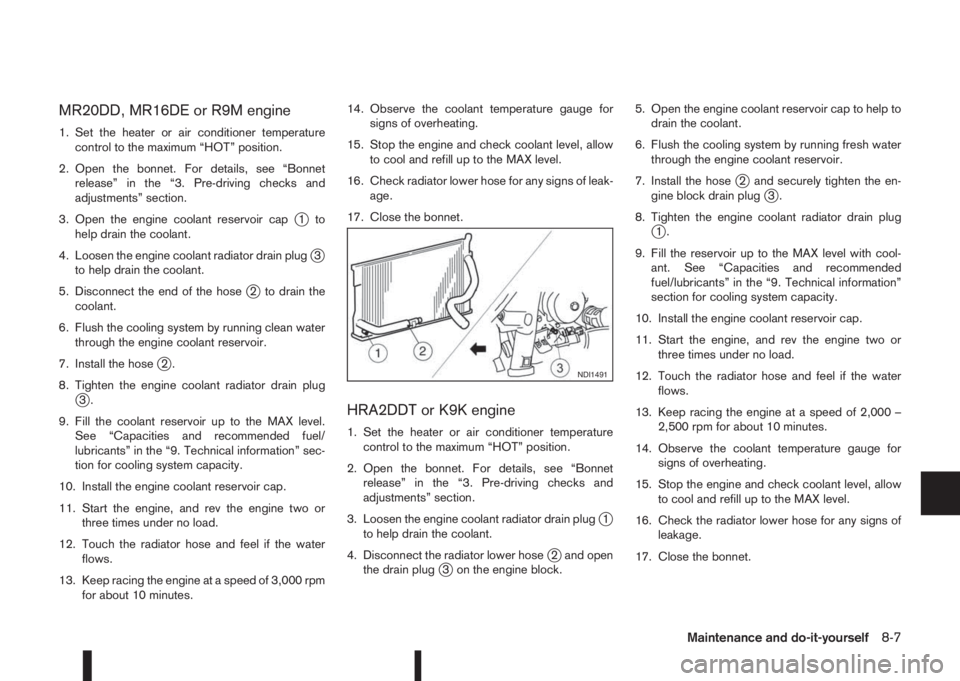
MR20DD, MR16DE or R9M engine
1. Set the heater or air conditioner temperature
control to the maximum “HOT” position.
2. Open the bonnet. For details, see “Bonnet
release” in the “3. Pre-driving checks and
adjustments” section.
3. Open the engine coolant reservoir cap
j1to
help drain the coolant.
4. Loosen the engine coolant radiator drain plug
j3
to help drain the coolant.
5. Disconnect the end of the hose
j2 to drain the
coolant.
6. Flush the cooling system by running clean water
through the engine coolant reservoir.
7. Install the hose
j2.
8. Tighten the engine coolant radiator drain plug
j3.
9. Fill the coolant reservoir up to the MAX level.
See “Capacities and recommended fuel/
lubricants” in the “9. Technical information” sec-
tion for cooling system capacity.
10. Install the engine coolant reservoir cap.
11. Start the engine, and rev the engine two or
three times under no load.
12. Touch the radiator hose and feel if the water
flows.
13. Keep racing the engine at a speed of 3,000 rpm
for about 10 minutes.14. Observe the coolant temperature gauge for
signs of overheating.
15. Stop the engine and check coolant level, allow
to cool and refill up to the MAX level.
16. Check radiator lower hose for any signs of leak-
age.
17. Close the bonnet.HRA2DDT or K9K engine
1. Set the heater or air conditioner temperature
control to the maximum “HOT” position.
2. Open the bonnet. For details, see “Bonnet
release” in the “3. Pre-driving checks and
adjustments” section.
3. Loosen the engine coolant radiator drain plug
j1
to help drain the coolant.
4. Disconnect the radiator lower hose
j2 and open
the drain plugj3 on the engine block.5. Open the engine coolant reservoir cap to help to
drain the coolant.
6. Flush the cooling system by running fresh water
through the engine coolant reservoir.
7. Install the hose
j2 and securely tighten the en-
gine block drain plugj3.
8. Tighten the engine coolant radiator drain plug
j1.
9. Fill the reservoir up to the MAX level with cool-
ant. See “Capacities and recommended
fuel/lubricants” in the “9. Technical information”
section for cooling system capacity.
10. Install the engine coolant reservoir cap.
11. Start the engine, and rev the engine two or
three times under no load.
12. Touch the radiator hose and feel if the water
flows.
13. Keep racing the engine at a speed of 2,000 –
2,500 rpm for about 10 minutes.
14. Observe the coolant temperature gauge for
signs of overheating.
15. Stop the engine and check coolant level, allow
to cool and refill up to the MAX level.
16. Check the radiator lower hose for any signs of
leakage.
17. Close the bonnet.
NDI1491
Maintenance and do-it-yourself8-7
Page 301 of 338
In case of a flat tyre, see “Flat tyre” in the “6. In case
of emergency” section.
TYRE INFLATION PRESSURE
Periodically check the tyre pressure (including the
spare tyre). An incorrect tyre pressure may ad-
versely affect tyre life and vehicle handling. After
adjusting the tyre pressure, perform a TPMS tem-
perature calibration (see “TPMS temperature
calibration” in the “5. Starting and driving” section).
NOTE
Incorrectly inflated tyres can also lead to poor
steering ability and make the driver suspect a
steering problem: keep the vehicle’s tyres in-
flated to the correct pressure at all times.
The tyre pressure should be checked when tyres
are COLD. Tyres are considered COLD after the
vehicle has been parked for three or more hours, or
driven less than 1.6 km (1 mile). COLD tyre pres-
sures are shown on the tyre placard affixed to the
driver’s side centre pillar.
Insufficient pressure can lead to an overheating of
the tyre and subsequent internal damage. At high
speeds, this could result in tread separation and
even bursting of the tyre.
TYPES OF TYRES
CAUTION
•When changing or replacing tyres, be sure all
four tyres are of the same type (i.e., summer,
all season or snow) and construction.
NDI1480Reverse light, and/or rear fog light (where fitted)
NDI1438Rear turn signal light
WHEELS AND TYRES
Maintenance and do-it-yourself8-33
Page 308 of 338
FUEL INFORMATION
Petrol engine
CAUTION
Do not use leaded petrol. Using leaded petrol will
damage the catalytic converter.
MR20DD engine:
Use UNLEADED REGULAR petrol with an octane
rating of at least 91 (RON).
HRA2DDT engine:
Use UNLEADED PREMIUM petrol with an octane
rating of at least 95 (RON).
Diesel engine
Diesel fuel above 51 cetane and with less than 10
ppm of sulphur (EN590 and Euro 5 specification)
must be used.
If two types of diesel fuel are available, use summer
or winter fuel properly according to the following
temperature conditions.
•Above –7°C (20°F)...Summer type diesel fuel.
•Below–7°C(20°F)...Wintertypedieselfuel.
If you are in any doubt, please consult a NISSAN
dealer or qualified workshop.
CAUTION
•Do not use home heating oil, petrol or other
alternate fuels in the diesel engine, this can
cause engine damage.
•Do not add petrol or other alternate fuels to
diesel fuel.
•Do not use summer fuel at temperatures be-
low −7°C (20°F). Cold temperatures will cause
wax to form in the fuel and may prevent the
engine from running smoothly.
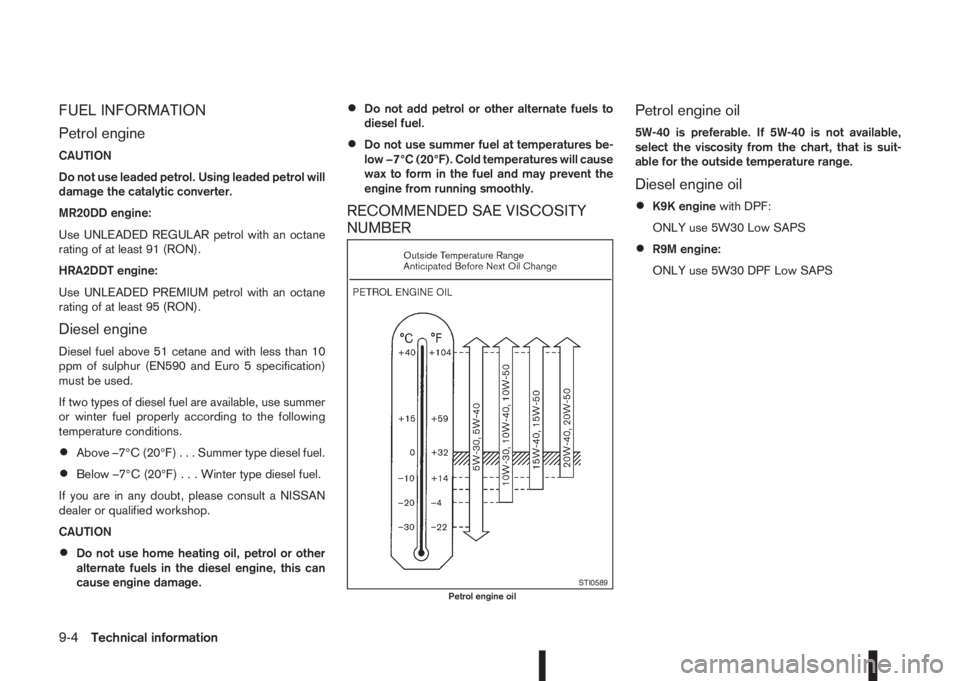
RECOMMENDED SAE VISCOSITY
NUMBERPetrol engine oil
5W-40 is preferable. If 5W-40 is not available,
select the viscosity from the chart, that is suit-
able for the outside temperature range.
Diesel engine oil
•K9K enginewith DPF:
ONLY use 5W30 Low SAPS
•R9M engine:
ONLY use 5W30 DPF Low SAPS
STI0589Petrol engine oil
9-4Technical information
Page 327 of 338
Predictive course lines
– Around View Monitor settings ........................................ 4-13
Pregnant women ................................................................. 1-10
Protect
– Protect the environment ................................................. 8-12
– Protect your vehicle from corrosion .................................. 7-6
Push-button ignition switch .................................................. 5-12
Push-starting ....................................................................... 6-13
R
Radio
– FM AM radio with CD player ......................................... 4-24
– NissanConnect .............................................................. 4-38
Rear parcel shelf ................................................................. 2-45
Rear seat .............................................................................. 1-5
Rear window defogger ........................................................ 2-35
Rear-view monitor ................................................................. 4-2
– Operating tips ................................................................. 4-3
– Rear-view monitor setting ................................................ 4-3
Recommended SAE viscosity number ................................... 9-4
Remote control system (integrated keyfob) ............................ 3-4
Repair and replacement procedure ...................................... 1-37
Repairing flat tyre .................................................................. 6-8
Roof
– glass ............................................................................. 2-49
Roof rail .............................................................................. 2-45
Room light control switch .................................................... 2-50
Running-in schedule .............................................................. 5-2
S
Safety
– Child safety ..................................................................... 1-9– Child safety rear door locks ........................................... 3-11
– Head restraints adjustment .............................................. 1-6
– Safety chains (Trailer) .................................................... 5-55
Seat
– Armrest ........................................................................... 1-5
– CENTRE mark on rear centre seat ................................. 1-12
– Child restraint installation using 3-point type seat belt ..... 1-25
– Front seats – Adjustment ................................................. 1-3
– Head restraints adjustment .............................................. 1-6
– Rear seat ......................................................................... 1-5
– Seat heater ...................................................................... 1-4
– Seat heating .................................................................. 2-41
– Seats .............................................................................. 1-2
– Three-point type seat belts ............................................. 1-11
– Universal child restraints for front seat and rear seats ..... 1-16
Seat belt
– CENTRE mark on rear centre seat ................................. 1-12
– Child safety ..................................................................... 1-9
– Pre-tensioner seat belt system ....................................... 1-13
– Seat belt warning .......................................................... 1-10
– Seat belt warning light ..................................................... 2-4
– Seat belts ................................................................. 1-8, 7-5
Seat belt(s)
– Child restraint installation using 3-point type seat belt ..... 1-25
– Child safety ................................................................... 1-14
– Infants ........................................................................... 1-14
– Larger children .............................................................. 1-14
– Seat belt maintenance ................................................... 1-12
– Shoulder belt height adjustment ..................................... 1-12
– Small children ................................................................ 1-14
– Three-point type seat belts ............................................. 1-11
Security system ................................................................... 3-12
– Alarm system ................................................................. 3-12
– NISSAN Anti-Theft System (NATS) ............... 3-12, 3-13, 3-2
Servicing air conditioner ............................................. 4-19, 4-22
Shoulder belt height adjustment (for front seats) .................. 1-12
Snow chains ....................................................................... 8-34
Index10-7
Page 331 of 338
FUEL INFORMATION
Petrol engine
CAUTION
Do not use leaded petrol. Using leaded petrol will
damage the catalytic converter.
MR20DD engine:
Use UNLEADED REGULAR petrol with an octane
rating of at least 91 (RON).
HRA2DDT engine:
Use UNLEADED PREMIUM petrol with an octane
rating of at least 95 (RON).
For further details, see “Fuel information” in the
“9. Technical information” section.
Diesel engine
Diesel fuel above 51 cetane and with less than 10
ppm of sulphur (EN590 and Euro 5 specification)
must be used.
For further details, see “Fuel information” in the
“9. Technical information” section.
CAUTION
•Do not use home heating oil, petrol or other
alternate fuels in the diesel engine, this can
cause engine damage.
•Do not add petrol or other alternate fuels to
diesel fuel.
•Do not use summer fuel at temperatures be-
low −7°C (20°F). Cold temperatures will cause
wax to form in the fuel and may prevent the
engine from running smoothly.
RECOMMENDED ENGINE OIL*
HRA2DDT engine
•Genuine NISSAN engine oil 5W40
•ACEA A3/B4
MR20DD engine
•Genuine NISSAN engine oil 5W40
•ACEA A3/B4
K9K engine
•Genuine NISSAN engine oil 5W30 DPF
•ACEA C4, SAE 5W30 low SAPS
R9M engine
•Genuine NISSAN engine oil 5W30 DPF
•ACEA C4, SAE 5W30 low SAPS
* For further details, see “Capacities and recom-
mended fuel/lubricants” in the “9. Technical
information” section.
COLD TYRE PRESSURE
See the tyre placard affixed to the driver’s side
centre pillar.
ENVIRONMENTAL CONCERN
BLUE CITIZENSHIP
Today, the efforts made by NISSAN to fulfil our
responsibilities to protect and sustain the environ-
ment are far-reaching. Within NISSAN, we promote
the highest levels of practice in every region and in
every area of operations.
COMPLIANCE AT EVERY STEP
NISSAN focuses on ensuring that end of life vehicle
components are reused, recycled or recovered, and
guarantees compliance with EU legislation (the End
of Life Vehicle Directive).
WE BUILD OUR VEHICLES WITH
RECYCLING IN MIND
Reducing landfill waste, emissions, conserving natu-
ral resources, and enhancing recycling activities are
emphasised daily in our manufacturing, sales and
service operations and in the disposal of end of life
vehicles (ELV).
Design phase
To reduce environmental impact we have developed
your NISSAN vehicle to be 95% recoverable. We
mark the components to facilitate dismantling, recy-
cling and to reduce hazardous substances. We
carefully verify and control substances of concern.
We have already reduced to a minimum the cad-
mium, mercury and lead in your NISSAN vehicle.
NISSAN includes recycled material in your vehicle
and looks for opportunities to increase the percent-
age of recycled materials used.
PETROL STATION INFORMATION ENVIRONMENT (End of Life
Vehicles)
Page 332 of 338
Manufacturing phase
NISSAN plants based in the UK and Spain already
achieve a recycling rate of over 90% and are look-
ing for further improvements. The UK plant installed
10 wind turbines to cut carbon dioxide emissions at
power plants by more than 3,000 tonnes per year.
NMISA (Spain) uses a solar panel water heating
system to save energy. This will generate 33% of
the energy consumed in the baths during the paint-
ing of your vehicle.
Production and distribution phase
Using resources efficiently to reduce the amount of
waste generated during the production and distribu-
tion stage. NISSAN promotes activities based on
Reducing, Reusing, and Recycling materials when-
ever possible. NISSAN’s goal is to achieve a 100%
recycling rate for operations in Japan and globally.
Use and service phase
NISSAN dealers are our window to you, our cus-
tomer. In order to meet your expectations they pro-
vide not only high quality services but are also envi-
ronmentally responsible. NISSAN promotes activi-
ties to recycle the waste generated as a result of
service centre activities.
Disposal phase
Recycle your end of life vehicle or its components.
When your NISSAN reaches the end of its life, and
is no longer suitable for daily use, it still has value.
You can help prevent waste affecting the environ-
ment by bringing your NISSAN to be recycled at ourcollection networks in your area. Our collection net-
works guarantee no cost for the treatment of your
ELV. For further information on how and where to
dispose of your ELV refer to your local NISSAN
dealer or consult: www.nissan-europe.com or con-
sult: www.nissan-global.com.
PROTECT THE ENVIRONMENT
WHEN DRIVING
Your driving behaviour has significant impact on fuel
economy and the environment. Follow the tips be-
low for better fuel-efficiency, better driving habits,
and to be environmentally friendly by reducing emis-
sions:
Fuel efficient driving
Anticipating traffic conditions and acting accordingly
reduces fuel consumption, helping to protect of our
natural environment. Take your foot off the accelera-
tor while approaching traffic lights and avoid last
minute braking when the light turns red.
Avoid speeding, harsh acceleration, and strong
braking. The gain in time does not offset pollution of
the environment. Try to maintain speed when driving
uphill to reduce fuel consumption and pollution.
Maintain speed or allow the vehicle to go slower
where traffic allows.
Close windows when driving
Driving with a window open at 100 km/h (62 MPH)
increases fuel consumption by up to 4%. Driving
with the windows closed allows for better fuel
economy.
Use the roof rack only when necessary
Only install the roof luggage system when you really
need it, otherwise put it inside the vehicle or store it
in your garage. Do not drive around with an empty
roof rack, kayak holder, or ski rack, this will reduce
your aerodynamic drag significantly.
Optimise the use of air conditioning
The air conditioning system has a positive effect on
driving and vehicle safety through comfort cooling
and dehumidifying, drivers are more alert and have
better visibility when window demisting/defogging
becomes necessary. However, use of the air condi-
tioning system will increase fuel consumption sub-
stantially in an urban environment. Optimise the use
of air conditioning by using the vents as much as
possible.
Use the parking brake on slopes
Use the parking brake when holding your vehicle on
a slope. Avoid using the clutch (manual transmis-
sion) or the accelerator (continuously variable trans-
mission) to hold your vehicle as this leads to unnec-
essary fuel consumption and wear.
Maintain a safe distance
Anticipate traffic conditions for a smoother drive and
to assure comfort and safety during your trip. Drive
and maintain a safe distance from other vehicles
while in traffic. This will help reduce fuel consump-
tion as you will not be constantly tapping your
brakes.
Page 336 of 338
•In case of emergency ... 6-2
(Flat tyre, engine will not start, overheating,
towing)
•How to start the engine ... 5-15
•How to read the meters and gauges ... 2-2
•Maintenance and do-it-yourself ... 8-2
•Technical information ... 9-2
QUICK REFERENCE