roof NISSAN QASHQAI 2016 Owner´s Manual
[x] Cancel search | Manufacturer: NISSAN, Model Year: 2016, Model line: QASHQAI, Model: NISSAN QASHQAI 2016Pages: 338, PDF Size: 4.87 MB
Page 169 of 338
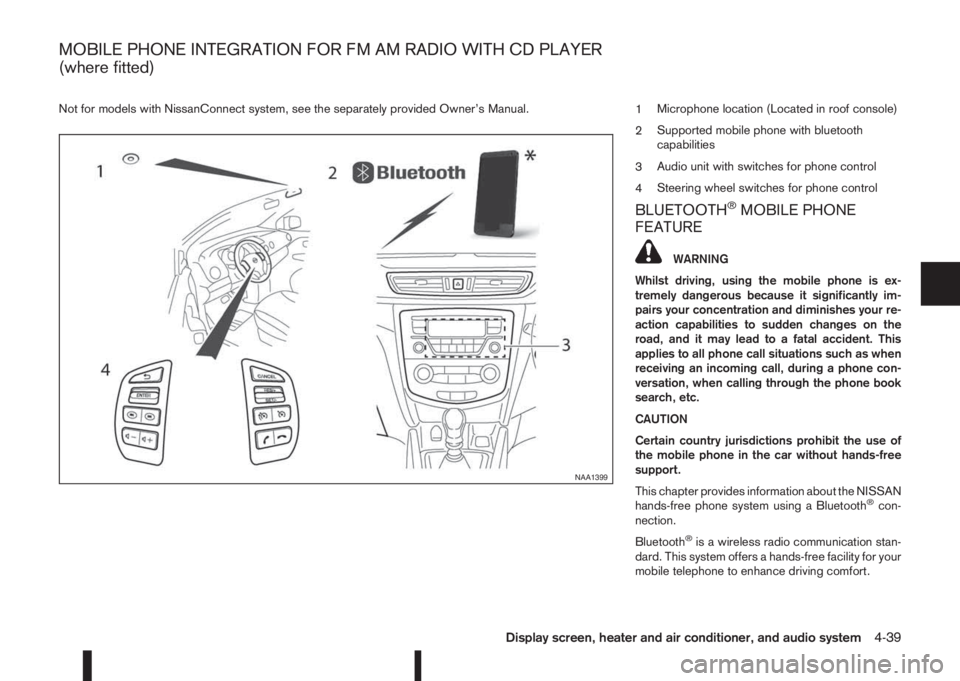
Not for models with NissanConnect system, see the separately provided Owner’s Manual.
1Microphone location (Located in roof console)
2Supported mobile phone with bluetooth
capabilities
3Audio unit with switches for phone control
4Steering wheel switches for phone control
BLUETOOTH®MOBILE PHONE
FEATURE
WARNING
Whilst driving, using the mobile phone is ex-
tremely dangerous because it significantly im-
pairs your concentration and diminishes your re-
action capabilities to sudden changes on the
road, and it may lead to a fatal accident. This
applies to all phone call situations such as when
receiving an incoming call, during a phone con-
versation, when calling through the phone book
search, etc.
CAUTION
Certain country jurisdictions prohibit the use of
the mobile phone in the car without hands-free
support.
This chapter provides information about the NISSAN
hands-free phone system using a Bluetooth
®con-
nection.
Bluetooth
®is a wireless radio communication stan-
dard. This system offers a hands-free facility for your
mobile telephone to enhance driving comfort.
NAA1399
MOBILE PHONE INTEGRATION FOR FM AM RADIO WITH CD PLAYER
(where fitted)
Display screen, heater and air conditioner, and audio system4-39
Page 178 of 338
During the first 1,600 km (1,000 miles), follow these
recommendations for the future reliability and
economy of your new vehicle. Failure to follow the
recommendations may result in shortened engine
life and reduced engine performance.
•Avoid driving for long periods at a constant
speed, either fast or slow.
•Do not accelerate at full throttle in any gear.
•Avoid quick starts.
•Avoid hard braking as much as possible.
•Do not tow a trailer during the first 800 km (500
miles).
NOTE
Models with K9K diesel engine will achieve top
performance only after approximately 5,000 km
(3,000 miles).
WARNING
The driving characteristics of your vehicle can be
changed remarkably by any additional load and
its distribution as well as by adding optional
equipment (trailer couplings, roof racks, etc.).
Your driving style and speed have to be adjusted
accordingly. Especially when carrying heavy
loads, your speed must be reduced adequately.
•Make sure the area around the vehicle is free of
obstacles.
•Check fluid levels such as engine oil, coolant,
brake and clutch fluid, and window washer fluid
as frequently as possible, at least whenever you
refuel.
•Visually inspect tyres for their appearance and
condition. Also check the tyre pressure for
proper inflation.
•Maintenance items in the “8. Maintenance and
do-it-yourself” section should be checked peri-
odically.
•Check that all windows and light lenses are
clean.
•Check that all doors are closed.
•Position the seat and adjust the head restraints.
•Adjust the inside and outside mirrors.
•Fasten your seat belt and ask all passengers to
do likewise.
•Check the operation of the warning/indicator
lights when the ignition switch is turned to the
ON position.
•Do not place hard or heavy objects on the dash-
board or rear parcel shelf in order to prevent
injury in the event of a sudden stop.
RUNNING-IN SCHEDULE BEFORE STARTING THE ENGINE
5-2Starting and driving
Page 186 of 338
The turbocharger system uses engine oil for lubrica-
tion and cooling of its rotating components. The tur-
bocharger turbine turns at extremely high speeds
and it can reach an extremely high temperature. It is
essential to maintain a flow of clean oil through the
turbocharger system. A sudden interruption to the
oil supply may cause a malfunction in the turbo-
charger.
To ensure prolonged life and performance of the
turbocharger, it is essential to comply with the fol-
lowing maintenance procedure:
CAUTION
•Change the engine oil of the turbo-charged
diesel engine as prescribed. See the sepa-
rately provided Warranty Information & Main-
tenance Booklet for additional information.
•Use only the recommended engine oil. See
“Capacities and recommended fuel/
lubricants” in the “9. Technical information”
section.
•If the engine has been operating at high rpm
for an extended period of time, let it idle for a
few minutes prior to shutdown.
•Do not accelerate the engine to high rpm im-
mediately after starting it.Driving your vehicle to fit the circumstances is es-
sential for your safety and comfort. As a driver, you
should be the one who knows best how to drive in
the given circumstances.
ENGINE COLD START PERIOD
Due to the higher engine speeds when the engine is
cold, extra caution must be exercised when select-
ing a gear during the engine warm-up period after
starting the engine.
LOADING LUGGAGE
Loads, their distribution and the attachment of equip-
ment (coupling devices, roof luggage carriers, etc.)
will change the driving characteristics of the vehicle
considerably. Driving style and speed must be ad-
justed accordingly.
DRIVING ON WET ROADS
•Avoid starting off, accelerating and stopping sud-
denly.
•Avoid sharp turns or lane changes.
•Extra distance should be kept from the vehicle in
front.
•When water covers the road surface in puddles,
small streams, etc, REDUCE SPEED to prevent
aquaplaning which will cause skidding and loss
of control. Worn tyres increase this risk.
DRIVING UNDER WINTER
CONDITIONS
•Drive safely.
•Avoid starting off, accelerating or stopping sud-
denly.
•Avoid sharp turns or lane changes.
•Avoid sudden steering actions.
•Extra distance should be kept from the vehicle in
front.
TURBOCHARGER SYSTEM
(Diesel engine models)CARE WHEN DRIVING
5-10Starting and driving
Page 205 of 338
•If the engine of the vehicle stalls or you cannot
make it to the top of a steep grade, never at-
tempt to turn around. Your vehicle could tip or
roll over. Always drive backwards and straight
down in R (reverse) gear.
Never drive backwards with the shift lever in N
(Neutral) and/or with the clutch depressed and
using the brake as this could result in loss of
control.
•Heavy braking down a hill could cause your
brakes to overheat and fade, resulting in loss of
control and an accident. Apply the brakes lightly
and use a low gear to control your vehicle speed.
•Unsecured cargo can be thrown around when
driving over rough terrain. Properly secure it so
that it will not be thrown forwards and cause
injury to you or your passengers.
•To avoid raising the centre of gravity excessively,
do not exceed the rated capacity of the roof rack/
gear bin (where fitted) and evenly distribute the
load. Secure heavy loads in the luggage area as
far forwards and as low as possible. Do not equip
the vehicle with tyres larger than specified. This
could cause your vehicle to roll over.
•Accelerating quickly, sharp steering manoeuvres
or sudden braking may cause loss of control.
•Do not drive beyond the performance of the
tyres, even with 4WD. Sudden acceleration,
steering or braking may result in loss of control
and could cause the vehicle to become stuck.
•If at all possible, avoid sharp turning manoeuvres,
particularly at high speeds. Your 4WD vehicle
has a higher centre of gravity than a 2WD ve-
hicle and can tip over more easily. The vehicle is
not designed for cornering at the same speeds
as conventional 2WD models any more than low
sports cars are designed to perform satisfacto-
rily under off-road conditions. Failure to operate
this vehicle correctly could result in loss of con-
trol and/or a rollover accident.
•Do not grip the inside or spokes of the steering
wheel when driving off-road. The steering wheel
could jerk and injure your hands. Instead, drive
with your fingers and thumbs on the outside of
the rim.
•Before operating the vehicle, ensure that the
driver and all passengers have their seat belts
fastened.
•Always drive with the floor mats in place as the
floor may become very hot. Particular care
should be taken if you are barefoot.
•Lower your speed when encountering strong
crosswinds. With its higher centre of gravity your
NISSAN is more affected by gusty side winds.
Slower speeds ensure better vehicle control.
•Be sure to check the brakes immediately after
driving in mud or water as specified in “Wet
brakes” later in this section.
•Whenever you drive off-road through sand, mud
or water as deep as the wheel hub, more fre-quent maintenance may be required. For details,
refer to the separately provided Warranty Infor-
mation and Maintenance Booklet.
•Rinse the underside of the vehicle with fresh
water after driving through mud or sand. Re-
move any brush or sticks that are trapped.
•Install the same size of winter tyres on all four (4)
wheels (such as studless tyres) or install snow
chains to the front wheels when driving on slip-
pery roads (e.g. after a snowfall) and drive care-
fully using 4WD.
•Avoid parking your vehicle on steep hills. If you
get out of the vehicle and it rolls forwards, back-
wards or sideways, you could be injured.
Starting and driving5-29
Page 230 of 338
Your new vehicle was designed to be used primarily
to carry passengers and luggage.
Remember that towing a trailer will place additional
loads on your vehicle’s engine, drive-train, steering,
braking and other systems. Towing a trailer will also
exaggerate other conditions, such as sway caused
by crosswinds, rough road surfaces or passing
trucks. Driving style and speed must be adjusted
according to the circumstances. Before towing a
trailer, see a NISSAN dealer or qualified workshop
for an explanation of towing equipment and its
proper use.
OPERATING PRECAUTIONS
•Avoid towing a trailer during the running-in
schedule.
•Choose proper coupling devices (trailer hitch,
safety chain, roof carrier, etc.) for your vehicle
and trailer. These devices are available from a
NISSAN dealer or qualified workshop where you
can also obtain more detailed information about
trailer towing.
Heavy-duty kits are available at a NISSAN dealer
or qualified workshop.
•It is advisable to contact a NISSAN dealer or
qualified workshop for towing details, before
towing a trailer up steep slopes for long dis-
tances.
•Never allow the total trailer load (trailer weight
plus its cargo weight) to exceed the maximum
set for the coupling device.Contact a NISSAN dealer or qualified workshop
for more information on this matter.
•The trailer must be loaded so that heavy goods
are distributed over the axle and as low in the
trailer as possible. Poor load distribution can se-
riously affect the stability of the trailer and tow
vehicle.
•Do not exceed the maximum permitted vertical
load on the trailer hitch.
•Before driving, make sure that the lighting sys-
tem of the trailer works properly.
•When towing with 4WD models, the 4WD mode
switch should be in the AUTO position. Using
the vehicle in AUTO mode gives better traction,
particularly when moving off from stationary and/
or on an incline, as the vehicle is less likely to
wheel spin.
•Avoid abrupt starts, accelerations and stops.
•Avoid sharp turns and lane changes.
•Always drive your vehicle at a moderate speed.
•Always block the wheels on both vehicle and
trailer when parking. Apply the handbrake (where
fitted) on the trailer. Parking on a steep slope is
not recommended.
If parking on a steep slope is unavoidable it is
also advisable to put the vehicle into gear, or
select P (Park (XTRONIC models)), and turn the
front wheels into the kerb (in addition to the other
precautions described). Before parking on asteep slope consider the incline (the towing
weights quoted are for a 12% slope).
•Follow the trailer manufacturer’s instructions.
•Have your vehicle serviced more often than at
the intervals specified in the separately provided
Warranty Information and Maintenance booklet.
•Trailer towing requires more fuel than under nor-
mal circumstances because of a considerable
increase in traction power required and resis-
tance.
•When towing a trailer, observe the following re-
stricted towing speed:
Speed: below 100 km/h (62 MPH)
•Observe the legal maximum speeds for trailer
operation.
CAUTION
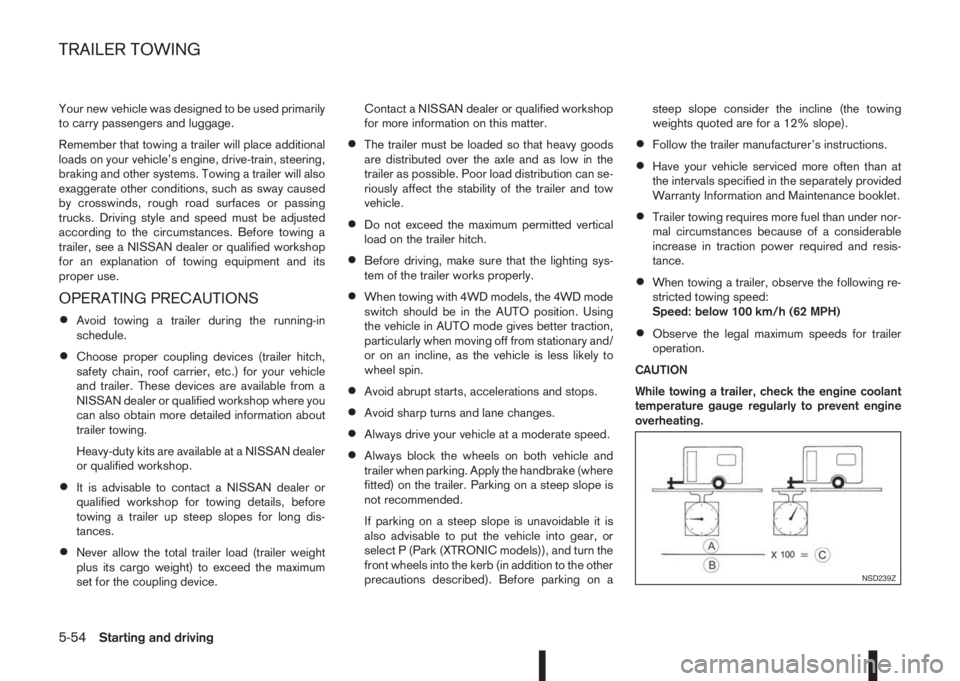
While towing a trailer, check the engine coolant
temperature gauge regularly to prevent engine
overheating.
NSD239Z
TRAILER TOWING
5-54Starting and driving
Page 233 of 338
When leaving your vehicle unoccupied:
•Always remove the ignition key and take it with
you – even in your own garage.
•Always remove the ignition key or Intelligent Key
(where fitted) and take it with you – even in your
own garage.
•Close all windows completely and lock all doors.
•Always park your vehicle where it can be seen.
At night, park in a well lit area.
•If the vehicle is equipped with an alarm or immo-
bilization device, use it – even for short periods.
•Do not leave children and pets in the vehicle
unattended.
•Do not leave valuables on view to tempt a thief.
Always take your valuables with you. If you must
leave something in your vehicle, lock it in the lug-
gage compartment or hide it out of sight.
•Do not leave the vehicle documents in your ve-
hicle. In the unfortunate event of your vehicle
being stolen, the documents will only help a thief
to sell the vehicle.
•Do not leave articles on a roof rack as they are
particularly vulnerable. If possible, remove them
from the rack and lock them inside the vehicle.
•Do not leave the spare key in the vehicle – keep
it in a safe place at home.
•Do not leave the spare key or Intelligent Key in
the vehicle – keep it in a safe place at home.
•Do not leave a note of your vehicle’s key number
in the vehicle. A thief may break into the vehicle,
note the key number and return with a new key
and drive the vehicle.WARNING
•If the engine is not running or is turned off
while driving, the power assistance for the
steering will not work. The steering will be
harder to operate.
•When the electric power steering warning light
illuminates with the engine running, the power
assistance for the steering will cease opera-
tion. You will still have control of the vehicle
but the steering will be harder to operate.
The electric power steering system is designed to
provide power assistance while driving to allow you
to operate the steering wheel with light force.
The steering effort can be set to [Normal] or [Sport]
in the vehicle information display under the heading
[Driver assistance]. (See “[Driver assistance]” in the
“2. Instruments and controls” section.)
NOTE
When the steering wheel is operated repeatedly
or continuously while parking or driving at a very
low speed, the power assistance for the steering
wheel will be reduced. This is to prevent over-
heating of the electric power steering system and
protect it from becoming damaged. While the
power assistance is reduced, steering wheel op-
eration will become heavy. When the tempera-
ture of the electric power steering system de-
creases, the power assistance level will return to
normal. Avoid repeating such steering wheel op-
erations that could cause the electric power
steering system to overheat.
VEHICLE SECURITY ELECTRIC POWER STEERING
SYSTEM
Starting and driving5-57
Page 310 of 338
Unit: mm (in)
Model mm (in.)
Overall length 2WD/ 4WD 4379 (172.3)
Overall width 2WD/ 4WD 1806 (71.1)
Overall height 2WD 1590 (62.6)
4WD 1595 (62.8)
2WD 1624 (63.9)*1
4WD 1630 (64.2)*1
Front tread 2WD/ 4WD 1560 (61.4)
Rear tread 2WD 1560 (61.4)
2WD*2/4WD 1550 (61)
Wheelbase 2WD/ 4WD 2646 (104.2)
*1 : with roof rail
*2: models with Independent Multi-link type suspen-
sion (where fitted)When planning to travel in another country,you
should first find out if the fuel available is suitable for
your vehicle’s engine.
Using fuel with too low octane/cetane rating may
cause engine damage. Therefore, avoid taking your
vehicle to areas where appropriate fuel is not avail-
able.
When transferring your vehicle registration to an-
other country,check with the appropriate authori-
ties that the vehicle complies with the requirements
as it may not be possible to adapt it. In some cases,
a vehicle cannot meet the legal requirements and in
other cases, it may be necessary to modify the ve-
hicle to meet specific laws and regulations.
The laws and regulations for motor vehicle emission
control and safety standards vary according to the
country; therefore, vehicle specifications may differ.
NISSAN is not responsible for any inconvenience
when the vehicle is taken and registered into an-
other country. The necessary modifications,
transportation and registration are the owner’s
responsibility.
VEHICLE IDENTIFICATION PLATE
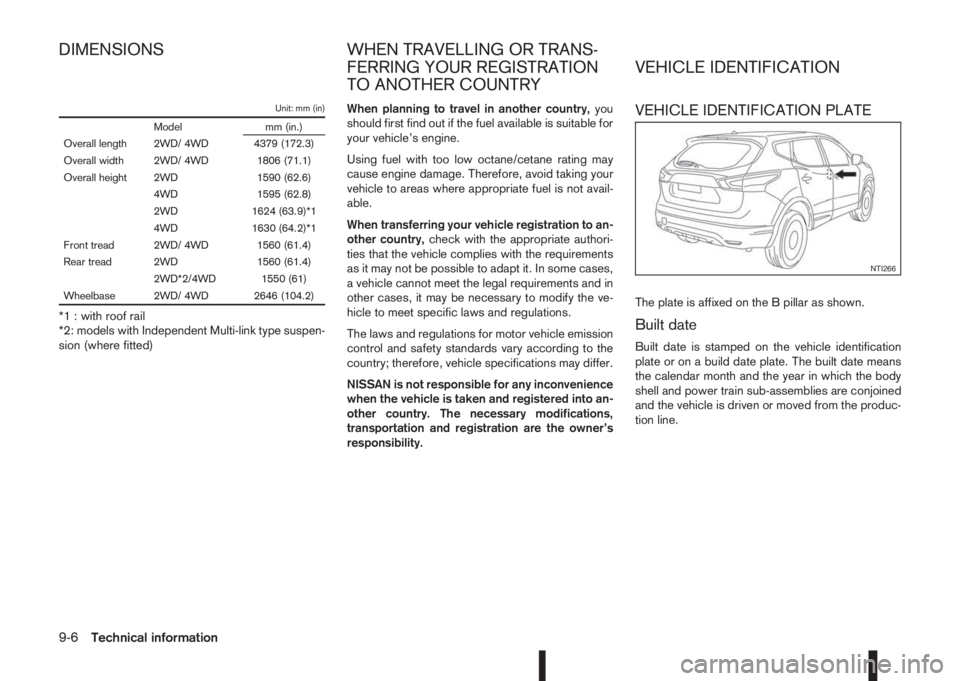
The plate is affixed on the B pillar as shown.
Built date
Built date is stamped on the vehicle identification
plate or on a build date plate. The built date means
the calendar month and the year in which the body
shell and power train sub-assemblies are conjoined
and the vehicle is driven or moved from the produc-
tion line.
NTI266
DIMENSIONS WHEN TRAVELLING OR TRANS-
FERRING YOUR REGISTRATION
TO ANOTHER COUNTRYVEHICLE IDENTIFICATION
9-6Technical information
Page 324 of 338
Fuel
– Bleeding the fuel system ................................................ 8-13
– Capacities and recommended fuel/lubricants ................... 9-2
– Draining water (Fuel filter) .............................................. 8-13
– Fuel filter (Diesel engine models) ................................... 8-13
– Fuel gauge ...................................................................... 2-2
– Fuel information ............................................................... 9-4
Fuel filler lid
– Cap ............................................................................... 3-15
– Opener lever ................................................................. 3-15
Fuses .................................................................................. 8-25
– Engine compartment ...................................................... 8-26
– Passenger compartment ................................................ 8-25
G
Gauges
– Engine coolant temperature gauge ................................... 2-3
– Fuel gauge ...................................................................... 2-2
– Meters and gauges .......................................................... 2-2
Glass roof ........................................................................... 2-49
– Sunshade operation ...................................................... 2-50
Glove box ............................................................................ 2-42
Guide lines ............................................................................ 4-7
H
Hazard warning flasher switch ............................................... 6-2
Head restraint
– Adjustment ...................................................................... 1-6
Headlight
– Headlight aiming control switch ..................................... 2-39
– Headlight and turn signal switch .................................... 2-36
– Headlight cleaner .......................................................... 2-40
– Headlight switch ............................................................ 2-36– Headlights (bulb replacement) ....................................... 8-28
– Replacement (bulb) ....................................................... 8-28
– Turn signal switch .......................................................... 2-38
Heated seats ....................................................................... 2-41
Heater and air conditioner ................................................... 4-15
Hill Start Assist (HSA) system ............................................. 5-64
Horn ................................................................................... 2-41
How to adjust the screen view ............................................. 4-13
I
Ignition
– Ignition switch ............................................................... 5-11
Ignition switch ..................................................................... 5-12
Ignition switch positions ...................................................... 5-13
Immobilizer
– NISSAN Anti-Theft System (NATS) ............................... 3-12
Indicator lights ....................................................................... 2-4
Injured persons ................................................................... 1-10
Inside rear-view mirror ......................................................... 3-18
Instrument and control layout .......................................... 0-8, 0-9
Integrated keyfob (remote control system) ............................. 3-4
– Battery replacement ...................................................... 8-18
– Ignition switch ............................................................... 5-11
– Keyfob operation failure ................................................... 3-5
– Locking the doors ............................................................ 3-5
– Setting the unlock mode .................................................. 3-5
– Super Lock system .......................................................... 3-5
– Unlocking the doors ......................................................... 3-5
Intelligent Key operating range ............................................... 3-6
Intelligent Key system ................................................... 3-6, 5-12
– Anti-hijack mode .............................................................. 3-7
– Battery replacement ...................................................... 8-18
– Intelligent Key battery discharge .................................... 5-14
– Locking/unlocking ........................................................... 3-7
10-4Index
Page 327 of 338
Predictive course lines
– Around View Monitor settings ........................................ 4-13
Pregnant women ................................................................. 1-10
Protect
– Protect the environment ................................................. 8-12
– Protect your vehicle from corrosion .................................. 7-6
Push-button ignition switch .................................................. 5-12
Push-starting ....................................................................... 6-13
R
Radio
– FM AM radio with CD player ......................................... 4-24
– NissanConnect .............................................................. 4-38
Rear parcel shelf ................................................................. 2-45
Rear seat .............................................................................. 1-5
Rear window defogger ........................................................ 2-35
Rear-view monitor ................................................................. 4-2
– Operating tips ................................................................. 4-3
– Rear-view monitor setting ................................................ 4-3
Recommended SAE viscosity number ................................... 9-4
Remote control system (integrated keyfob) ............................ 3-4
Repair and replacement procedure ...................................... 1-37
Repairing flat tyre .................................................................. 6-8
Roof
– glass ............................................................................. 2-49
Roof rail .............................................................................. 2-45
Room light control switch .................................................... 2-50
Running-in schedule .............................................................. 5-2
S
Safety
– Child safety ..................................................................... 1-9– Child safety rear door locks ........................................... 3-11
– Head restraints adjustment .............................................. 1-6
– Safety chains (Trailer) .................................................... 5-55
Seat
– Armrest ........................................................................... 1-5
– CENTRE mark on rear centre seat ................................. 1-12
– Child restraint installation using 3-point type seat belt ..... 1-25
– Front seats – Adjustment ................................................. 1-3
– Head restraints adjustment .............................................. 1-6
– Rear seat ......................................................................... 1-5
– Seat heater ...................................................................... 1-4
– Seat heating .................................................................. 2-41
– Seats .............................................................................. 1-2
– Three-point type seat belts ............................................. 1-11
– Universal child restraints for front seat and rear seats ..... 1-16
Seat belt
– CENTRE mark on rear centre seat ................................. 1-12
– Child safety ..................................................................... 1-9
– Pre-tensioner seat belt system ....................................... 1-13
– Seat belt warning .......................................................... 1-10
– Seat belt warning light ..................................................... 2-4
– Seat belts ................................................................. 1-8, 7-5
Seat belt(s)
– Child restraint installation using 3-point type seat belt ..... 1-25
– Child safety ................................................................... 1-14
– Infants ........................................................................... 1-14
– Larger children .............................................................. 1-14
– Seat belt maintenance ................................................... 1-12
– Shoulder belt height adjustment ..................................... 1-12
– Small children ................................................................ 1-14
– Three-point type seat belts ............................................. 1-11
Security system ................................................................... 3-12
– Alarm system ................................................................. 3-12
– NISSAN Anti-Theft System (NATS) ............... 3-12, 3-13, 3-2
Servicing air conditioner ............................................. 4-19, 4-22
Shoulder belt height adjustment (for front seats) .................. 1-12
Snow chains ....................................................................... 8-34
Index10-7
Page 328 of 338
Spare tyre ............................................................................. 6-2
Spark plugs (Petrol engine models) ..................................... 8-21
Speed limiter ....................................................................... 5-38
Speed limiter operations ...................................................... 5-39
Speedometer ........................................................................ 2-2
Starting
– Before starting the engine ................................................ 5-2
– Jump-starting ........................................................ 6-11, 8-18
– Precautions when starting and driving .............................. 5-3
– Push-starting ................................................................. 6-13
– Starting engine .............................................................. 5-15
Steering
– Electric power steering system ...................................... 5-57
– Phone operating buttons ................................................ 4-44
– Steering lock ........................................................ 5-11, 5-14
– Steering wheel adjustment ............................................. 3-18
– Steering wheel switches for hands-free telephone
control ........................................................................... 4-44
– Steering-wheel switch for audio control ......................... 4-38
– Telephone button ........................................................... 4-39
Stop/Start System ............................................................... 5-22
Storage ............................................................................... 2-42
– Bottle holder .................................................................. 2-44
– Coat hooks ................................................................... 2-44
– Console box .................................................................. 2-43
– Cup holder .................................................................... 2-44
– Glove box ...................................................................... 2-42
– Luggage hooks ............................................................. 2-47
– Luggage/boot compartment ........................................... 2-47
– Map pockets ................................................................. 2-44
– Roof rail ........................................................................ 2-45
– Seat pockets ................................................................. 2-44
– Storage trays ................................................................. 2-42
– Sunglasses holder ......................................................... 2-43
Sun visors ........................................................................... 3-18
Sunshade
– Sunshade operation ...................................................... 2-50Super Lock system ............................................................... 3-8
– Emergency situations ....................................................... 3-9
– Power door lock switch ................................................. 3-11
Supplemental Restraint System ........................................... 1-29
Supplemental Restraint System (air bag system)
– Air bag system .............................................................. 1-29
Switch
– Defogger switch ............................................................ 2-35
– Fog light switch ............................................................. 2-38
– Front passenger air bag switch ...................................... 1-34
– Headlight and turn signal switch .................................... 2-36
– Headlight cleaner switch ................................................ 2-40
– Ignition switch positions ................................................. 5-13
– Ignition switch push button ............................................ 5-12
– Power door lock switch ................................................. 3-10
– Precautions on push-button ignition switch operation ..... 5-12
– Push-button ignition switch ............................................ 5-12
– Room light control switch .............................................. 2-50
– Wiper and washer switch .............................................. 2-32
Switch - Defogger switch
– ThermaClear ................................................................. 2-34
System operation ................................................................ 5-41
T
Tachometer ........................................................................... 2-2
Temporary-use spare tyre ...................................................... 6-2
ThermaClear Heated Windscreen
– ThermaClear Heated Windscreen button ....................... 2-34
Three-point type seat belts .................................................. 1-11
Three-way catalyst (Petrol engine models) ............................. 5-9
Tilting steering wheel ........................................................... 3-18
Towing
– Recommended towing for four-wheel drive (4WD)
models .......................................................................... 6-15
10-8Index