heater NISSAN QASHQAI 2016 Owner´s Manual
[x] Cancel search | Manufacturer: NISSAN, Model Year: 2016, Model line: QASHQAI, Model: NISSAN QASHQAI 2016Pages: 338, PDF Size: 4.87 MB
Page 272 of 338
longer to stop, contact a NISSAN dealer or qualified
workshop immediately. Keep the floor mat away
from the pedal.
Parking brake*:
Confirm that your vehicle is held securely on a fairly
steep hill with only the parking brake applied.
Seats:
Check seat position controls such as seat adjust-
ers, seatback recliner, etc. to ensure they operate
smoothly and all latches lock securely in every posi-
tion. Check that the head restraints move up and
down smoothly and the locks hold securely in all
latched positions.
Seat belts:
Check that all parts of the seat belt system (e.g.
buckles, anchors, adjusters and retractors) operate
properly and smoothly, and are installed securely.
Check the belt webbing for cuts, fraying, wear or
damage. See “Seat belts” in the “1. Safety — Seats,
Seat belts and Supplemental Restraint System” sec-
tion for further details.
Steering wheel:
Check for any change in the steering conditions,
such as excessive free play, hard steering or strange
noises.
Warning lights and audible reminders:
Make sure that all warning/indicator lights and au-
dible reminders are operating properly.Windscreen defogger:
Check that the air comes out of the defogger outlets
properly when operating the heater or air condi-
tioner.
Windscreen wiper and washer*:
Check that the wipers and washer operate properly
and that the wipers do not streak.When performing any inspection or maintenance
work on your vehicle, always take care to prevent
serious accidental injury to yourself or damage to
the vehicle. The following are general precautions
which should be closely observed.
•Park the vehicle on a level surface, apply the
parking brake securely and block the wheels
to prevent the vehicle from moving. For
manual transmission models, move the shift
lever to N (Neutral) position.For continuously
variable transmission models: move the shift
lever to P (Park) position.
•Do not work under the engine bonnet while
the engine is hot. Turn off the engine and wait
until it cools down.
•Be sure to turn the ignition switch to the “OFF”
or LOCK position.
When the ignition switch is in the ON or Acc
position, the cooling fan may start to operate
suddenly even when the engine is not run-
ning. To avoid injury, always disconnect the
negative battery cable before working near
the engine.
•If you must work with the engine running,
keep your hands, clothing, hair and tools away
from moving fans, belts and any other moving
parts.
•It is advisable to remove ties and any jewel-
lery, such as rings, watches, etc. before work-
ing on your vehicle.
MAINTENANCE PRECAUTIONS
8-4Maintenance and do-it-yourself
Page 274 of 338
WARNING
•Never remove the engine coolant reservoir
cap when the engine is hot. Serious burns
could be caused by high pressure fluid es-
caping from the engine coolant reservoir. Wait
until the engine and radiator have cooled
down.
•Engine coolant is poisonous and should be
stored carefully in marked containers out of
the reach of children.
The engine cooling system is filled at the factory
with a high-quality, year-round and extended life en-
gine coolant. The high quality engine coolant con-
tains the specific solutions effective for the anti-cor-
rosion and the anti-freeze function. Therefore, addi-
tional cooling system additives are not necessary.
CAUTION
•Never use any cooling system additives such
as radiator sealer. Additives may clog the
cooling system and cause damage to the en-
gine, transmission and/or cooling system.
•When adding or replacing engine coolant, be
sure to use Genuine NISSAN engine coolant
or equivalent.
•The use of other types of engine coolant may
damage the engine cooling system.
•The engine coolant reservoir tank is equipped
with a pressure cap, use a Genuine NISSAN
cap or its equivalent when replacement is re-
quired.
CHECKING ENGINE COOLANT
LEVEL
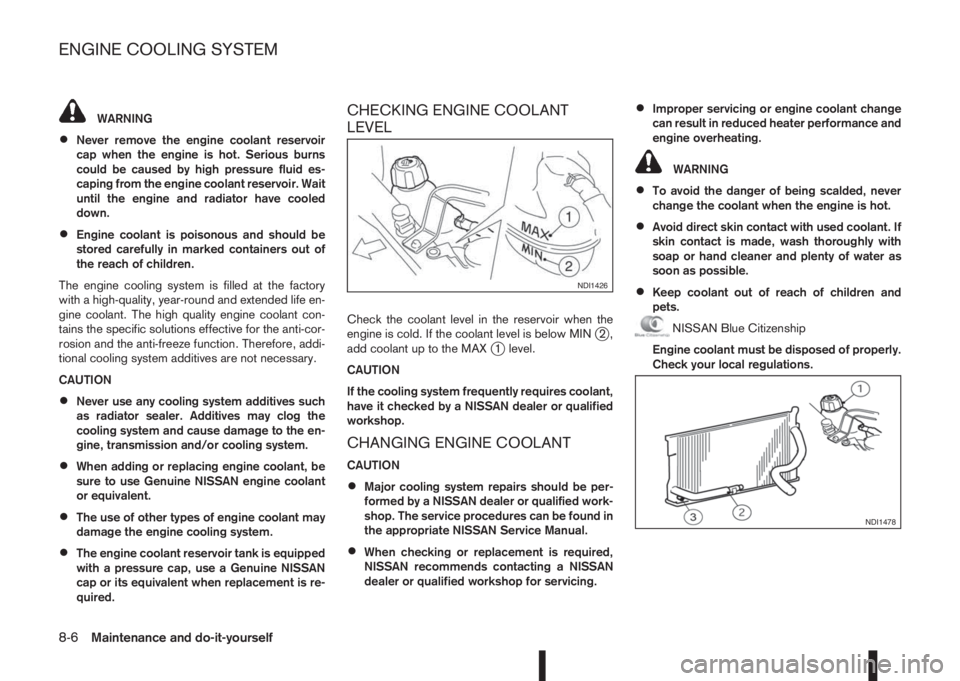
Check the coolant level in the reservoir when the
engine is cold. If the coolant level is below MINj2,
add coolant up to the MAXj1 level.
CAUTION
If the cooling system frequently requires coolant,
have it checked by a NISSAN dealer or qualified
workshop.
CHANGING ENGINE COOLANT
CAUTION
•Major cooling system repairs should be per-
formed by a NISSAN dealer or qualified work-
shop. The service procedures can be found in
the appropriate NISSAN Service Manual.
•When checking or replacement is required,
NISSAN recommends contacting a NISSAN
dealer or qualified workshop for servicing.
•Improper servicing or engine coolant change
can result in reduced heater performance and
engine overheating.
WARNING
•To avoid the danger of being scalded, never
change the coolant when the engine is hot.
•Avoid direct skin contact with used coolant. If
skin contact is made, wash thoroughly with
soap or hand cleaner and plenty of water as
soon as possible.
•Keep coolant out of reach of children and
pets.
NISSAN Blue Citizenship
Engine coolant must be disposed of properly.
Check your local regulations.
NDI1426
NDI1478
ENGINE COOLING SYSTEM
8-6Maintenance and do-it-yourself
Page 275 of 338
MR20DD, MR16DE or R9M engine
1. Set the heater or air conditioner temperature
control to the maximum “HOT” position.
2. Open the bonnet. For details, see “Bonnet
release” in the “3. Pre-driving checks and
adjustments” section.
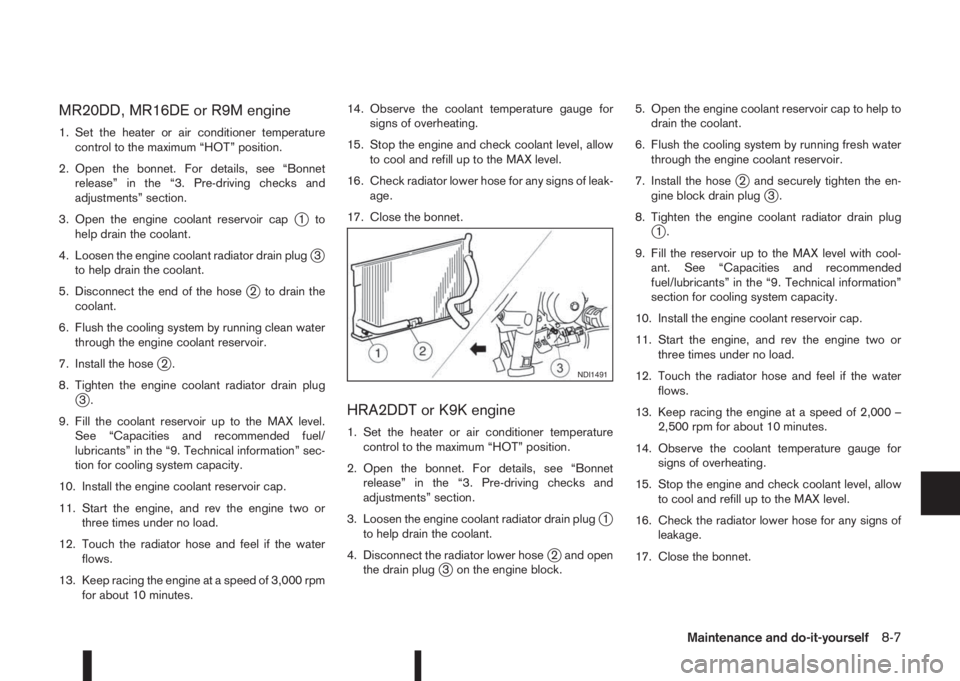
3. Open the engine coolant reservoir cap
j1to
help drain the coolant.
4. Loosen the engine coolant radiator drain plug
j3
to help drain the coolant.
5. Disconnect the end of the hose
j2 to drain the
coolant.
6. Flush the cooling system by running clean water
through the engine coolant reservoir.
7. Install the hose
j2.
8. Tighten the engine coolant radiator drain plug
j3.
9. Fill the coolant reservoir up to the MAX level.
See “Capacities and recommended fuel/
lubricants” in the “9. Technical information” sec-
tion for cooling system capacity.
10. Install the engine coolant reservoir cap.
11. Start the engine, and rev the engine two or
three times under no load.
12. Touch the radiator hose and feel if the water
flows.
13. Keep racing the engine at a speed of 3,000 rpm
for about 10 minutes.14. Observe the coolant temperature gauge for
signs of overheating.
15. Stop the engine and check coolant level, allow
to cool and refill up to the MAX level.
16. Check radiator lower hose for any signs of leak-
age.
17. Close the bonnet.HRA2DDT or K9K engine
1. Set the heater or air conditioner temperature
control to the maximum “HOT” position.
2. Open the bonnet. For details, see “Bonnet
release” in the “3. Pre-driving checks and
adjustments” section.
3. Loosen the engine coolant radiator drain plug
j1
to help drain the coolant.
4. Disconnect the radiator lower hose
j2 and open
the drain plugj3 on the engine block.5. Open the engine coolant reservoir cap to help to
drain the coolant.
6. Flush the cooling system by running fresh water
through the engine coolant reservoir.
7. Install the hose
j2 and securely tighten the en-
gine block drain plugj3.
8. Tighten the engine coolant radiator drain plug
j1.
9. Fill the reservoir up to the MAX level with cool-
ant. See “Capacities and recommended
fuel/lubricants” in the “9. Technical information”
section for cooling system capacity.
10. Install the engine coolant reservoir cap.
11. Start the engine, and rev the engine two or
three times under no load.
12. Touch the radiator hose and feel if the water
flows.
13. Keep racing the engine at a speed of 2,000 –
2,500 rpm for about 10 minutes.
14. Observe the coolant temperature gauge for
signs of overheating.
15. Stop the engine and check coolant level, allow
to cool and refill up to the MAX level.
16. Check the radiator lower hose for any signs of
leakage.
17. Close the bonnet.
NDI1491
Maintenance and do-it-yourself8-7
Page 285 of 338
Battery (Type A)
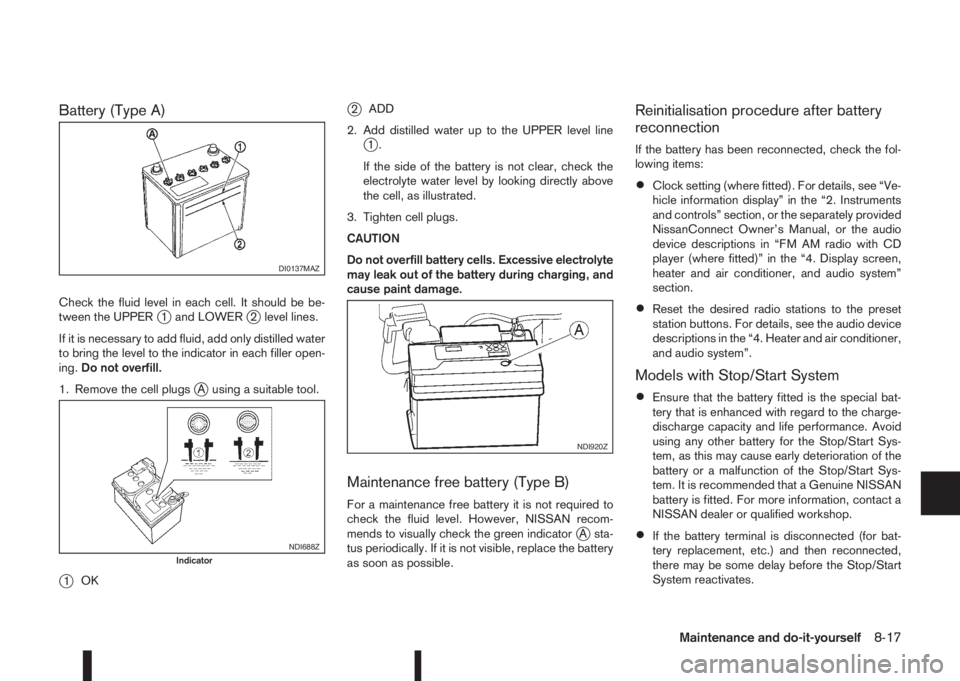
Check the fluid level in each cell. It should be be-
tween the UPPERj1 and LOWERj2 level lines.
If it is necessary to add fluid, add only distilled water
to bring the level to the indicator in each filler open-
ing.Do not overfill.
1. Remove the cell plugs
jA using a suitable tool.
j1OK
j2ADD
2. Add distilled water up to the UPPER level line
j1.
If the side of the battery is not clear, check the
electrolyte water level by looking directly above
the cell, as illustrated.
3. Tighten cell plugs.
CAUTION
Do not overfill battery cells. Excessive electrolyte
may leak out of the battery during charging, and
cause paint damage.
Maintenance free battery (Type B)
For a maintenance free battery it is not required to
check the fluid level. However, NISSAN recom-
mends to visually check the green indicator
jA sta-
tus periodically. If it is not visible, replace the battery
as soon as possible.
Reinitialisation procedure after battery
reconnection
If the battery has been reconnected, check the fol-
lowing items:
•Clock setting (where fitted). For details, see “Ve-
hicle information display” in the “2. Instruments
and controls” section, or the separately provided
NissanConnect Owner’s Manual, or the audio
device descriptions in “FM AM radio with CD
player (where fitted)” in the “4. Display screen,
heater and air conditioner, and audio system”
section.
•Reset the desired radio stations to the preset
station buttons. For details, see the audio device
descriptions in the “4. Heater and air conditioner,
and audio system”.
Models with Stop/Start System
•Ensure that the battery fitted is the special bat-
tery that is enhanced with regard to the charge-
discharge capacity and life performance. Avoid
using any other battery for the Stop/Start Sys-
tem, as this may cause early deterioration of the
battery or a malfunction of the Stop/Start Sys-
tem. It is recommended that a Genuine NISSAN
battery is fitted. For more information, contact a
NISSAN dealer or qualified workshop.
•If the battery terminal is disconnected (for bat-
tery replacement, etc.) and then reconnected,
there may be some delay before the Stop/Start
System reactivates.
DI0137MAZ
NDI688ZIndicator
NDI920Z
Maintenance and do-it-yourself8-17
Page 321 of 338
10IndexIndex
A
Active engine brake ............................................................. 5-63
Active ride control ............................................................... 5-64
Active trace control ............................................................. 5-62
Air cleaner filter ................................................................... 8-23
Air conditioner
– Air conditioner filter .............................................. 4-19, 4-22
– Air conditioner specification label ..................................... 9-8
– Automatic air conditioner ............................................... 4-20
– Heater and air conditioner .............................................. 4-15
– Manual air conditioner ................................................... 4-16
– Servicing air conditioner ....................................... 4-19, 4-22
Air duct removal .................................................................. 8-21
Alarm system ...................................................................... 3-12
Antenna .............................................................................. 4-23
Anti-hijack – unlock mode ...................................................... 3-5
Anti-Lock Braking System (ABS) ......................................... 5-59
Anti-Theft System (NISSAN) ................................................ 3-13
Approval numbers ................................................................. 9-8
Armrest ................................................................................. 1-5
Around View Monitor ............................................................. 4-4
– Around View Monitor settings ........................................ 4-13
– Moving object detection (MOD) ..................................... 4-12
– Operating tips ............................................................... 4-13
Around view monitor operation .............................................. 4-7
Audible reminders, warning/indicator lights ............................ 2-4
Audio
– Audio operation precautions .......................................... 4-23
– Audio system ................................................................. 4-23
– AUX socket ................................................................... 4-30– Bluetooth® audio streaming main operation ................... 4-34
– FM AM radio with CD player ......................................... 4-24
– iPod® player operation .................................................. 4-31
– NissanConnect .............................................................. 4-38
– Steering-wheel switch for audio control ......................... 4-38
– USB Memory operation ................................................. 4-30
B
Battery ....................................................................... 5-66, 8-16
– Caution label ................................................................. 8-16
– Integrated keyfob battery replacement ........................... 8-18
– Intelligent Key battery discharge .................................... 5-14
– Intelligent Key battery replacement ................................. 8-18
– Vehicle battery ............................................................... 8-16
Before starting the engine ..................................................... 5-2
Blind Spot Warning (BSW)
– BSW driving situations .................................................. 5-32
– BSW system operation .................................................. 5-30
Blind Spot Warning (BSW) system ..................................... 5-30
Bluetooth® .......................................................................... 4-39
– Bluetooth® mobile phone feature .................................. 4-39
– Bluetooth® operation .................................................... 4-32
– Bluetooth® settings ....................................................... 4-32
Bonnet release .................................................................... 3-14
Boot .................................................................................... 2-47
Brake .................................................................................. 8-13
– Brake booster ............................................................... 8-14
– Brake fluid ..................................................................... 8-14
– Brake precautions ......................................................... 5-58
– Brake system ................................................................ 5-58
Page 324 of 338
Fuel
– Bleeding the fuel system ................................................ 8-13
– Capacities and recommended fuel/lubricants ................... 9-2
– Draining water (Fuel filter) .............................................. 8-13
– Fuel filter (Diesel engine models) ................................... 8-13
– Fuel gauge ...................................................................... 2-2
– Fuel information ............................................................... 9-4
Fuel filler lid
– Cap ............................................................................... 3-15
– Opener lever ................................................................. 3-15
Fuses .................................................................................. 8-25
– Engine compartment ...................................................... 8-26
– Passenger compartment ................................................ 8-25
G
Gauges
– Engine coolant temperature gauge ................................... 2-3
– Fuel gauge ...................................................................... 2-2
– Meters and gauges .......................................................... 2-2
Glass roof ........................................................................... 2-49
– Sunshade operation ...................................................... 2-50
Glove box ............................................................................ 2-42
Guide lines ............................................................................ 4-7
H
Hazard warning flasher switch ............................................... 6-2
Head restraint
– Adjustment ...................................................................... 1-6
Headlight
– Headlight aiming control switch ..................................... 2-39
– Headlight and turn signal switch .................................... 2-36
– Headlight cleaner .......................................................... 2-40
– Headlight switch ............................................................ 2-36– Headlights (bulb replacement) ....................................... 8-28
– Replacement (bulb) ....................................................... 8-28
– Turn signal switch .......................................................... 2-38
Heated seats ....................................................................... 2-41
Heater and air conditioner ................................................... 4-15
Hill Start Assist (HSA) system ............................................. 5-64
Horn ................................................................................... 2-41
How to adjust the screen view ............................................. 4-13
I
Ignition
– Ignition switch ............................................................... 5-11
Ignition switch ..................................................................... 5-12
Ignition switch positions ...................................................... 5-13
Immobilizer
– NISSAN Anti-Theft System (NATS) ............................... 3-12
Indicator lights ....................................................................... 2-4
Injured persons ................................................................... 1-10
Inside rear-view mirror ......................................................... 3-18
Instrument and control layout .......................................... 0-8, 0-9
Integrated keyfob (remote control system) ............................. 3-4
– Battery replacement ...................................................... 8-18
– Ignition switch ............................................................... 5-11
– Keyfob operation failure ................................................... 3-5
– Locking the doors ............................................................ 3-5
– Setting the unlock mode .................................................. 3-5
– Super Lock system .......................................................... 3-5
– Unlocking the doors ......................................................... 3-5
Intelligent Key operating range ............................................... 3-6
Intelligent Key system ................................................... 3-6, 5-12
– Anti-hijack mode .............................................................. 3-7
– Battery replacement ...................................................... 8-18
– Intelligent Key battery discharge .................................... 5-14
– Locking/unlocking ........................................................... 3-7
10-4Index
Page 327 of 338
Predictive course lines
– Around View Monitor settings ........................................ 4-13
Pregnant women ................................................................. 1-10
Protect
– Protect the environment ................................................. 8-12
– Protect your vehicle from corrosion .................................. 7-6
Push-button ignition switch .................................................. 5-12
Push-starting ....................................................................... 6-13
R
Radio
– FM AM radio with CD player ......................................... 4-24
– NissanConnect .............................................................. 4-38
Rear parcel shelf ................................................................. 2-45
Rear seat .............................................................................. 1-5
Rear window defogger ........................................................ 2-35
Rear-view monitor ................................................................. 4-2
– Operating tips ................................................................. 4-3
– Rear-view monitor setting ................................................ 4-3
Recommended SAE viscosity number ................................... 9-4
Remote control system (integrated keyfob) ............................ 3-4
Repair and replacement procedure ...................................... 1-37
Repairing flat tyre .................................................................. 6-8
Roof
– glass ............................................................................. 2-49
Roof rail .............................................................................. 2-45
Room light control switch .................................................... 2-50
Running-in schedule .............................................................. 5-2
S
Safety
– Child safety ..................................................................... 1-9– Child safety rear door locks ........................................... 3-11
– Head restraints adjustment .............................................. 1-6
– Safety chains (Trailer) .................................................... 5-55
Seat
– Armrest ........................................................................... 1-5
– CENTRE mark on rear centre seat ................................. 1-12
– Child restraint installation using 3-point type seat belt ..... 1-25
– Front seats – Adjustment ................................................. 1-3
– Head restraints adjustment .............................................. 1-6
– Rear seat ......................................................................... 1-5
– Seat heater ...................................................................... 1-4
– Seat heating .................................................................. 2-41
– Seats .............................................................................. 1-2
– Three-point type seat belts ............................................. 1-11
– Universal child restraints for front seat and rear seats ..... 1-16
Seat belt
– CENTRE mark on rear centre seat ................................. 1-12
– Child safety ..................................................................... 1-9
– Pre-tensioner seat belt system ....................................... 1-13
– Seat belt warning .......................................................... 1-10
– Seat belt warning light ..................................................... 2-4
– Seat belts ................................................................. 1-8, 7-5
Seat belt(s)
– Child restraint installation using 3-point type seat belt ..... 1-25
– Child safety ................................................................... 1-14
– Infants ........................................................................... 1-14
– Larger children .............................................................. 1-14
– Seat belt maintenance ................................................... 1-12
– Shoulder belt height adjustment ..................................... 1-12
– Small children ................................................................ 1-14
– Three-point type seat belts ............................................. 1-11
Security system ................................................................... 3-12
– Alarm system ................................................................. 3-12
– NISSAN Anti-Theft System (NATS) ............... 3-12, 3-13, 3-2
Servicing air conditioner ............................................. 4-19, 4-22
Shoulder belt height adjustment (for front seats) .................. 1-12
Snow chains ....................................................................... 8-34
Index10-7