seat adjustment NISSAN QASHQAI 2017 Owner´s Manual
[x] Cancel search | Manufacturer: NISSAN, Model Year: 2017, Model line: QASHQAI, Model: NISSAN QASHQAI 2017Pages: 508, PDF Size: 2.68 MB
Page 8 of 508
Illustrated table of contents0
Safety — Seats, seat belts and supplemental restraint system1
Instruments and controls
Pre-driving checks and adjustments
Heater, air conditioner, audio and phone systems
Starting and driving
In case of emergency
Appearance and care
Do-it-yourself
Maintenance and schedules
Technical and consumer information
2
3
4
5
6
7
8
9
10
Table of
Contents
Index11
Page 21 of 508
1-2Safety — Seats, seat belts and supplemental restraint system
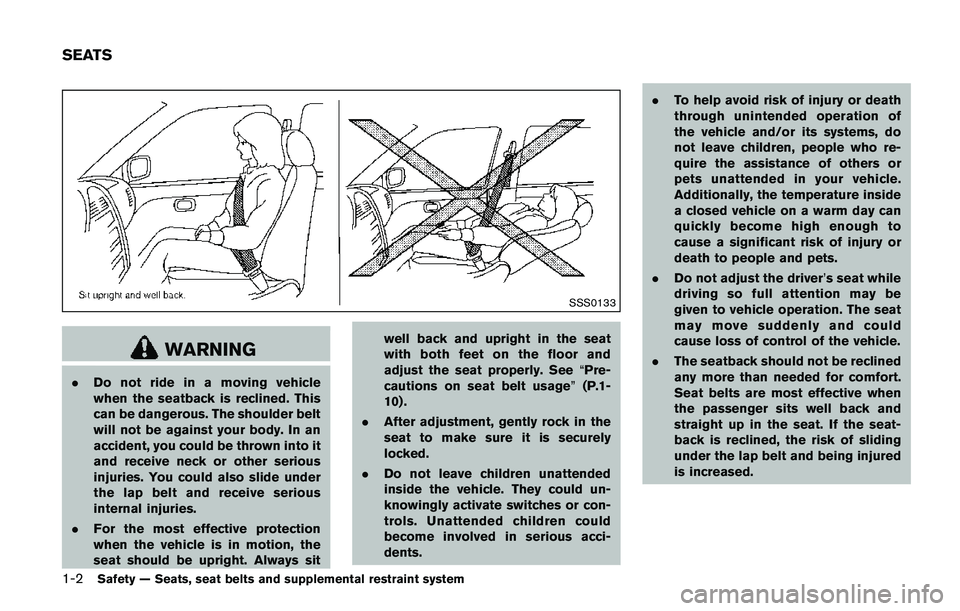
SSS0133
WARNING
.Do not ride in a moving vehicle
when the seatback is reclined. This
can be dangerous. The shoulder belt
will not be against your body. In an
accident, you could be thrown into it
and receive neck or other serious
injuries. You could also slide under
the lap belt and receive serious
internal injuries.
.For the most effective protection
when the vehicle is in motion, the
seat should be upright. Always sitwell back and upright in the seat
with both feet on the floor and
adjust the seat properly. See“Pre-
cautions on seat belt usage”(P.1-
10) .
.After adjustment, gently rock in the
seat to make sure it is securely
locked.
.Do not leave children unattended
inside the vehicle. They could un-
knowingly activate switches or con-
trols. Unattended children could
become involved in serious acci-
dents..To help avoid risk of injury or death
through unintended operation of
the vehicle and/or its systems, do
not leave children, people who re-
quire the assistance of others or
pets unattended in your vehicle.
Additionally, the temperature inside
a closed vehicle on a warm day can
quickly become high enough to
cause a significant risk of injury or
death to people and pets.
.Do not adjust the driver’s seat while
driving so full attention may be
given to vehicle operation. The seat
may move suddenly and could
cause loss of control of the vehicle.
.The seatback should not be reclined
any more than needed for comfort.
Seat belts are most effective when
the passenger sits well back and
straight up in the seat. If the seat-
back is reclined, the risk of sliding
under the lap belt and being injured
is increased.
SEATS
Page 22 of 508
CAUTION
When adjusting the seat positions, be
sure not to contact any moving parts to
avoid possible injuries and/or damage.
FRONT SEATS
Front manual seat adjustment
WARNING
After adjusting a seat, gently shake the
seat to confirm that the seat is locked
securely. If the seat is not locked
securely, it may move suddenly and
could cause the loss of control of the
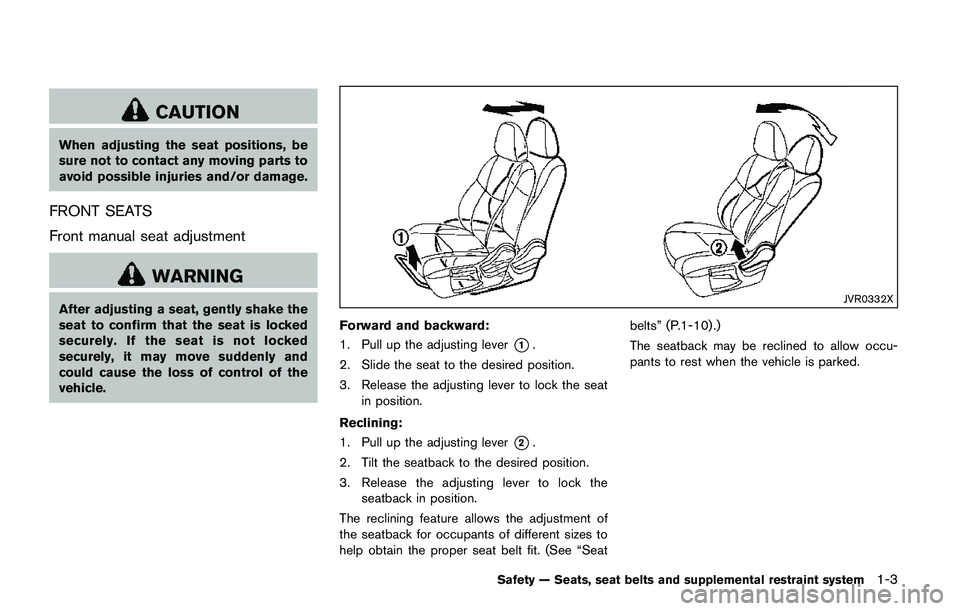
vehicle.JVR0332X
Forward and backward:
1. Pull up the adjusting lever
*1.
2. Slide the seat to the desired position.
3. Release the adjusting lever to lock the seat
in position.
Reclining:
1. Pull up the adjusting lever
*2.
2. Tilt the seatback to the desired position.
3. Release the adjusting lever to lock the
seatback in position.
The reclining feature allows the adjustment of
the seatback for occupants of different sizes to
help obtain the proper seat belt fit. (See “Seatbelts” (P.1-10) .)
The seatback may be reclined to allow occu-
pants to rest when the vehicle is parked.
Safety — Seats, seat belts and supplemental restraint system1-3
Page 23 of 508
1-4Safety — Seats, seat belts and supplemental restraint system
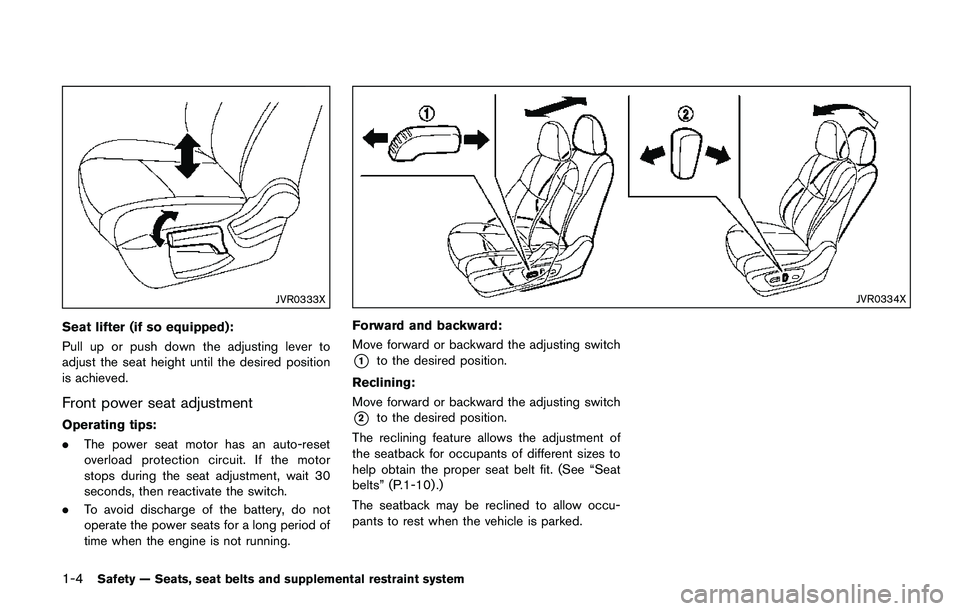
JVR0333X
Seat lifter (if so equipped):
Pull up or push down the adjusting lever to
adjust the seat height until the desired position
is achieved.
Front power seat adjustment
Operating tips:
.The power seat motor has an auto-reset
overload protection circuit. If the motor
stops during the seat adjustment, wait 30
seconds, then reactivate the switch.
.To avoid discharge of the battery, do not
operate the power seats for a long period of
time when the engine is not running.
JVR0334X
Forward and backward:
Move forward or backward the adjusting switch
*1to the desired position.
Reclining:
Move forward or backward the adjusting switch
*2to the desired position.
The reclining feature allows the adjustment of
the seatback for occupants of different sizes to
help obtain the proper seat belt fit. (See “Seat
belts” (P.1-10) .)
The seatback may be reclined to allow occu-
pants to rest when the vehicle is parked.
Page 25 of 508
1-6Safety — Seats, seat belts and supplemental restraint system
straints could result in serious injury
in an accident or sudden stop.
.Do not fold down the rear seats
when occupants are in the rear seat
area or any cargo is on the rear
seats.
.Properly secure all cargo to help
prevent it from sliding or shifting.
Do not place cargo higher than the
seatbacks.
.When returning the seatbacks to the
upright position, be certain they are
completely secured in the latched
position. If they are not completely
secured, passengers may be injured
in an accident or sudden stop.
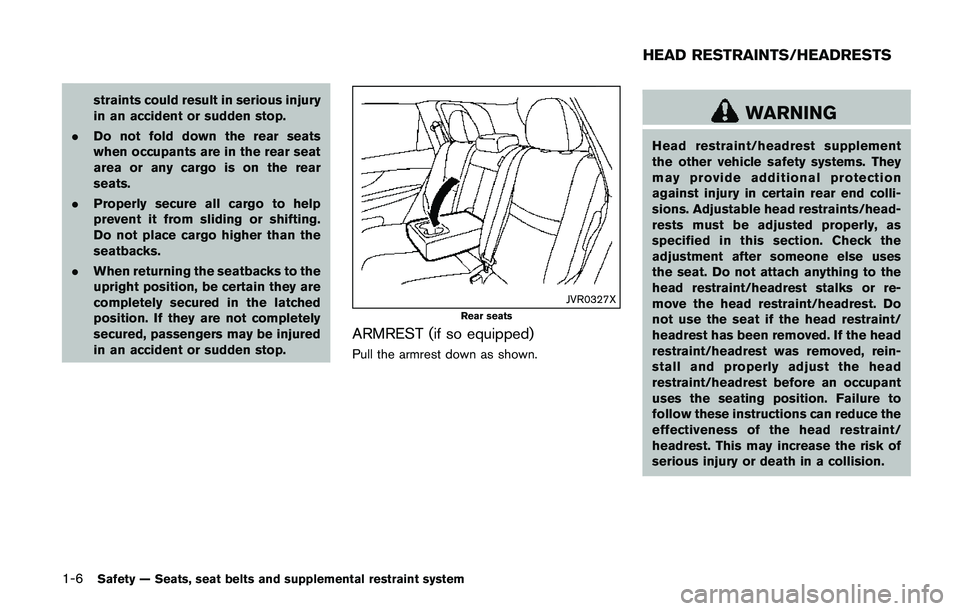
JVR0327X
Rear seats
ARMREST (if so equipped)
Pull the armrest down as shown.
WARNING
Head restraint/headrest supplement
the other vehicle safety systems. They
may provide additional protection
against injury in certain rear end colli-
sions. Adjustable head restraints/head-
rests must be adjusted properly, as
specified in this section. Check the
adjustment after someone else uses
the seat. Do not attach anything to the
head restraint/headrest stalks or re-
move the head restraint/headrest. Do
not use the seat if the head restraint/
headrest has been removed. If the head
restraint/headrest was removed, rein-
stall and properly adjust the head
restraint/headrest before an occupant
uses the seating position. Failure to
follow these instructions can reduce the
effectiveness of the head restraint/
headrest. This may increase the risk of
serious injury or death in a collision.
HEAD RESTRAINTS/HEADRESTS
Page 26 of 508
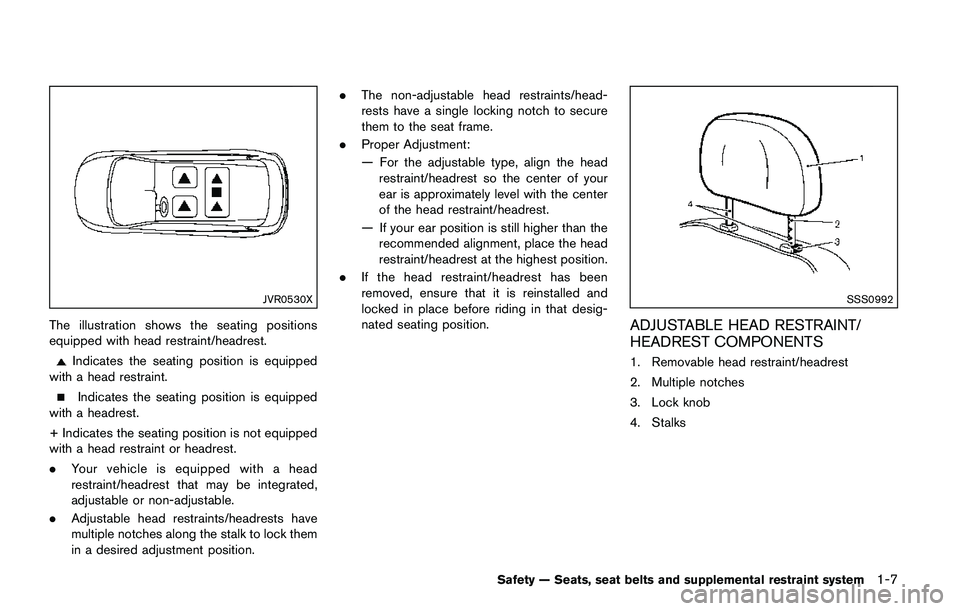
JVR0530X
The illustration shows the seating positions
equipped with head restraint/headrest.
Indicates the seating position is equipped
with a head restraint.
Indicates the seating position is equipped
with a headrest.
+ Indicates the seating position is not equipped
with a head restraint or headrest.
.Your vehicle is equipped with a head
restraint/headrest that may be integrated,
adjustable or non-adjustable.
.Adjustable head restraints/headrests have
multiple notches along the stalk to lock them
in a desired adjustment position..The non-adjustable head restraints/head-
rests have a single locking notch to secure
them to the seat frame.
.Proper Adjustment:
— For the adjustable type, align the head
restraint/headrest so the center of your
ear is approximately level with the center
of the head restraint/headrest.
— If your ear position is still higher than the
recommended alignment, place the head
restraint/headrest at the highest position.
.If the head restraint/headrest has been
removed, ensure that it is reinstalled and
locked in place before riding in that desig-
nated seating position.
SSS0992
ADJUSTABLE HEAD RESTRAINT/
HEADREST COMPONENTS
1. Removable head restraint/headrest
2. Multiple notches
3. Lock knob
4. Stalks
Safety — Seats, seat belts and supplemental restraint system1-7
Page 27 of 508
1-8Safety — Seats, seat belts and supplemental restraint system
JVR0203X
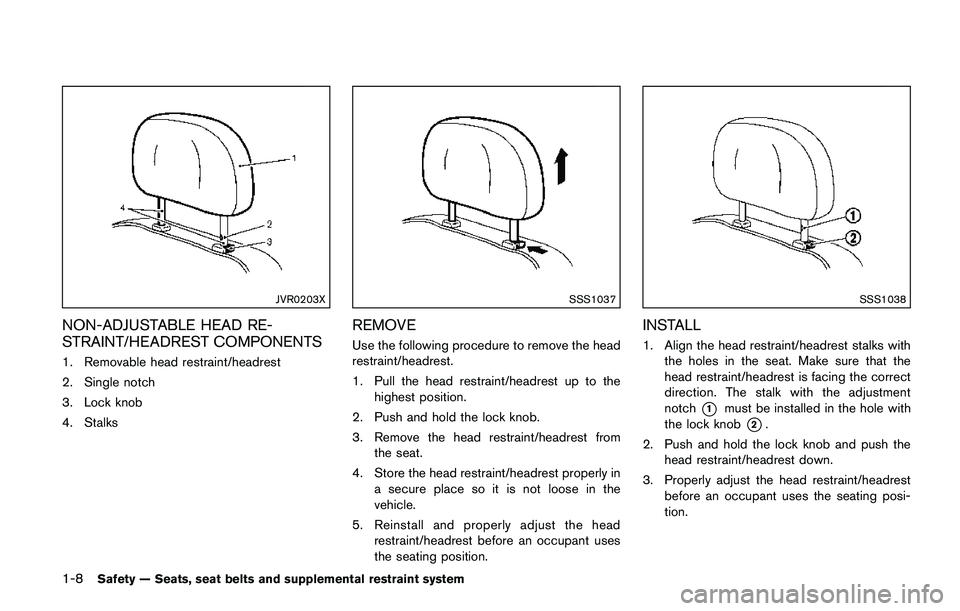
NON-ADJUSTABLE HEAD RE-
STRAINT/HEADREST COMPONENTS
1. Removable head restraint/headrest
2. Single notch
3. Lock knob
4. Stalks
SSS1037
REMOVE
Use the following procedure to remove the head
restraint/headrest.
1. Pull the head restraint/headrest up to the
highest position.
2. Push and hold the lock knob.
3. Remove the head restraint/headrest from
the seat.
4. Store the head restraint/headrest properly in
a secure place so it is not loose in the
vehicle.
5. Reinstall and properly adjust the head
restraint/headrest before an occupant uses
the seating position.
SSS1038
INSTALL
1. Align the head restraint/headrest stalks with
the holes in the seat. Make sure that the
head restraint/headrest is facing the correct
direction. The stalk with the adjustment
notch
*1must be installed in the hole with
the lock knob
*2.
2. Push and hold the lock knob and push the
head restraint/headrest down.
3. Properly adjust the head restraint/headrest
before an occupant uses the seating posi-
tion.
Page 34 of 508
SSS0326
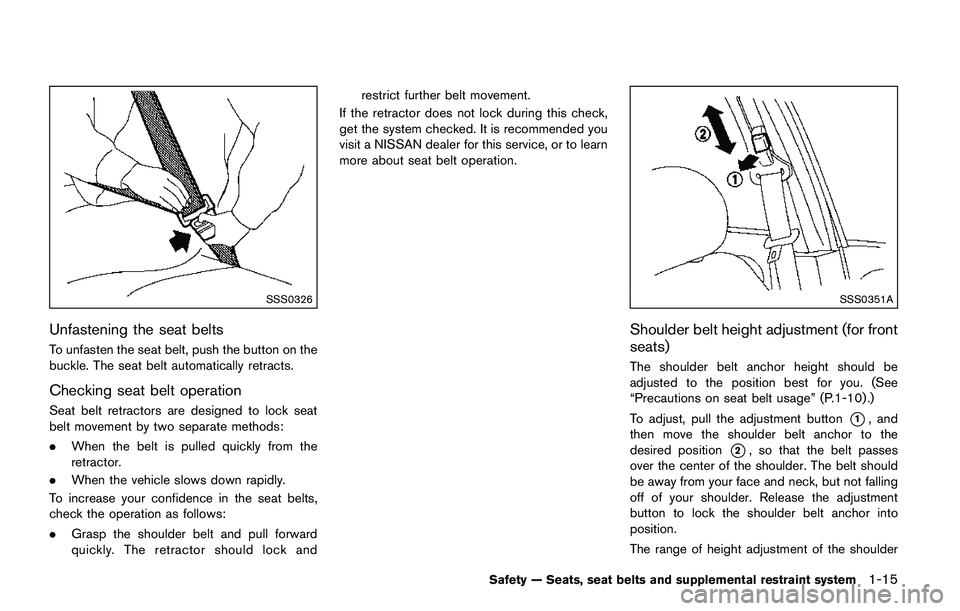
Unfastening the seat belts
To unfasten the seat belt, push the button on the
buckle. The seat belt automatically retracts.
Checking seat belt operation
Seat belt retractors are designed to lock seat
belt movement by two separate methods:
.When the belt is pulled quickly from the
retractor.
.When the vehicle slows down rapidly.
To increase your confidence in the seat belts,
check the operation as follows:
.Grasp the shoulder belt and pull forward
quickly. The retractor should lock andrestrict further belt movement.
If the retractor does not lock during this check,
get the system checked. It is recommended you
visit a NISSAN dealer for this service, or to learn
more about seat belt operation.
SSS0351A
Shoulder belt height adjustment (for front
seats)
The shoulder belt anchor height should be
adjusted to the position best for you. (See
“Precautions on seat belt usage” (P.1-10) .)
To adjust, pull the adjustment button
*1, and
then move the shoulder belt anchor to the
desired position
*2, so that the belt passes
over the center of the shoulder. The belt should
be away from your face and neck, but not falling
off of your shoulder. Release the adjustment
button to lock the shoulder belt anchor into
position.
The range of height adjustment of the shoulder
Safety — Seats, seat belts and supplemental restraint system1-15
Page 35 of 508
1-16Safety — Seats, seat belts and supplemental restraint system
belt may vary depending on the model.
WARNING
.After adjustment, release the ad-
justment button and try to move the
shoulder belt anchor up and down
to make sure it is securely fixed in
position.
.The shoulder belt anchor height
should be adjusted to the position
best for you. Failure to do so may
reduce the effectiveness of the
entire restraint system and increase
the chance or severity of injury in an
accident.
SEAT BELT EXTENDERS
If, because of body size or driving position, it is
not possible to properly fit the lap/shoulder belt
and fasten it, an extender that is compatible with
the installed seat belts is available that can be
purchased. The extender adds approximately 8
in (200 mm) of length and may be used for either
the driver or front passenger seating position. It
is recommended you visit a NISSAN dealer for
assistance with purchasing an extender if an
extender is required.
WARNING
.It is recommended that only
NISSAN seat belt extenders, made
by the same company which made
the original equipment seat belts,
be used with NISSAN seat belts.
.Adults and children who can use the
standard seat belt should not use an
extender. Such unnecessary use
could result in serious personal
injury in the event of an accident.
.Never use seat belt extenders to
install child restraints. If the child
restraint is not secured properly, the
child could be seriously injured or
killed in a collision or a sudden stop.
SEAT BELT MAINTENANCE
.To clean the seat belt webbing,apply a
mild soap solution or any solution recom-
mended for cleaning upholstery or carpets.
Then wipe with a cloth and allow the seat
belts to dry in the shade. Do not allow the
seat belts to retract until they are completely
dry.
.If dirt builds up in the shoulder belt
guideof the seat belt anchors, the seatbelts may retract slowly. Wipe the shoulder
belt guide with a clean, dry cloth.
.Periodically check to see that the seat
belt and the metal components, such as
buckles, tongues, retractors, flexible wires
and anchors, work properly. If loose parts,
deterioration, cuts or other damage on the
webbing is found, the entire seat belt
assembly should be replaced.
Page 39 of 508
1-20Safety — Seats, seat belts and supplemental restraint system
in the front seat. If you must
install a forward-facing child
restraint in the front seat, see
“Forward-facing child restraint
installation using the seat belts”
(P.1-31) .
— Even with the NISSAN Advanced
Air Bag System, never install a
rear-facing child restraint in the
front seat. An inflating air bag
could seriously injure or kill a
child. A rear-facing child re-
straint must only be used in the
rear seat.
— Be sure to purchase a child
restraint that will fit the child
and vehicle. Some child re-
straints may not fit properly in
your vehicle.
— Child restraint anchor points are
designed to withstand loads
from child restraints that are
properly fitted.
— Never use the anchor points for
adult seat belts or harnesses.— A child restraint with a top tether
strap should not be used in the
front passenger seat.
— Keep seatbacks as upright as
possible after fitting the child
restraint.
— Infants and children should al-
ways be placed in an appropri-
ate child restraint while in the
vehicle.
.When the child restraint is not in
use, keep it secured with the LATCH
system or a seat belt. In a sudden
stop or collision, loose objects can
injure occupants or damage the
vehicle.
CAUTION
A child restraint in a closed vehicle can
become very hot. Check the seating
surface and buckles before placing a
child in the child restraint.
This vehicle is equipped with a universal child
restraint anchor system, referred to as the
LATCH (Lower Anchors and Tethers for CHil-dren) system. Some child restraints include rigid
or webbing-mounted attachments that can be
connected to these anchors.
For details, see “Lower Anchors and Tethers for
CHildren (LATCH) system” (P.1-21) .
If you do not have a LATCH compatible child
restraint, the vehicle seat belts can be used.
Several manufacturers offer child restraints for
infants and small children of various sizes. When
selecting any child restraint, keep the following
points in mind:
.Choose only a restraint with a label certifying
that it complies with Federal Motor Vehicle
Safety Standard 213 or Canadian Motor
Vehicle Safety Standard 213.
.Check the child restraint in your vehicle to
be sure it is compatible with the vehicle’s
seat and seat belt system.
.If the child restraint is compatible with your
vehicle, place your child in the child restraint
and check the various adjustments to be
sure the child restraint is compatible with
your child. Choose a child restraint that is
designed for your child’s height and weight.
Always follow all recommended procedures.
.If the combined weight of the child and child
restraint is less than 65 lbs (29.5 kg) , you
may use either the LATCH anchors or the
seat belt to install the child restraint (not