towing NISSAN QASHQAI 2017 Owner´s Manual
[x] Cancel search | Manufacturer: NISSAN, Model Year: 2017, Model line: QASHQAI, Model: NISSAN QASHQAI 2017Pages: 508, PDF Size: 2.68 MB
Page 398 of 508
6 In case of emergency
Hazard warning flasher switch .............................................. 6-2
Roadside assistance program ............................................... 6-2
Emergency engine shut off (models with push-button
ignition switch) .......................................................................... 6-3
Flat tire ......................................................................................... 6-3
Tire Pressure Monitoring System (TPMS) .................... 6-3
Changing a flat tire ............................................................. 6-4Jump starting ............................................................................. 6-9
Push starting ........................................................................... 6-11
If your vehicle overheats ...................................................... 6-11
Towing your vehicle .............................................................. 6-13
Towing recommended by NISSAN ........................... 6-14
Vehicle recovery (freeing a stuck vehicle) ............... 6-16
Page 405 of 508
6-8In case of emergency
SCE0933
Installing the spare tire
The spare tire is designed for emergency
use. (See specific instructions under the
heading “Wheels and tires” (P.8-29) .)
1. Clean any mud or dirt from the surface
between the wheel and hub.
2. Carefully put the spare tire on and tighten
the wheel nuts finger tight. Check that all the
wheel nuts contact the wheel surface
horizontally.
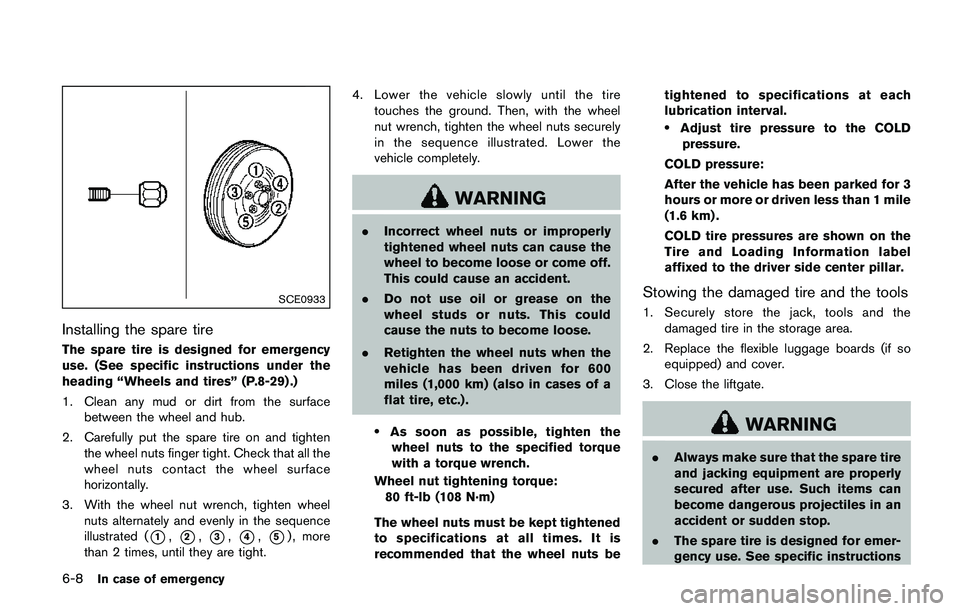
3. With the wheel nut wrench, tighten wheel
nuts alternately and evenly in the sequence
illustrated (
*1,*2,*3,*4,*5) , more
than 2 times, until they are tight.4. Lower the vehicle slowly until the tire
touches the ground. Then, with the wheel
nut wrench, tighten the wheel nuts securely
in the sequence illustrated. Lower the
vehicle completely.
WARNING
.Incorrect wheel nuts or improperly
tightened wheel nuts can cause the
wheel to become loose or come off.
This could cause an accident.
.Do not use oil or grease on the
wheel studs or nuts. This could
cause the nuts to become loose.
.Retighten the wheel nuts when the
vehicle has been driven for 600
miles (1,000 km) (also in cases of a
flat tire, etc.) .
.As soon as possible, tighten the
wheel nuts to the specified torque
with a torque wrench.
Wheel nut tightening torque:
80 ft-lb (108 N·m)
The wheel nuts must be kept tightened
to specifications at all times. It is
recommended that the wheel nuts betightened to specifications at each
lubrication interval.
.Adjust tire pressure to the COLD
pressure.
COLD pressure:
After the vehicle has been parked for 3
hours or more or driven less than 1 mile
(1.6 km) .
COLD tire pressures are shown on the
Tire and Loading Information label
affixed to the driver side center pillar.
Stowing the damaged tire and the tools
1. Securely store the jack, tools and the
damaged tire in the storage area.
2. Replace the flexible luggage boards (if so
equipped) and cover.
3. Close the liftgate.
WARNING
.Always make sure that the spare tire
and jacking equipment are properly
secured after use. Such items can
become dangerous projectiles in an
accident or sudden stop.
.The spare tire is designed for emer-
gency use. See specific instructions
Page 408 of 508
7. Start the engine of the booster vehicle*B
and let it run for a few minutes.
8. Keep the engine speed of the booster
vehicle
*Bat about 2,000 rpm, and start
the engine of the vehicle
*Abeing jump
started.
CAUTION
Do not keep the starter motor engaged
for more than 10 seconds. If the engine
does not start right away, place the
ignition switch in the OFF position and
wait 10 seconds before trying again.
9. After starting your engine, carefully discon-
nect the negative cable and then the positive
cable (
*4?*3?*2?*1).
10. Replace the vent caps (if so equipped) . Be
sure to dispose of the cloth used to cover
the vent holes as it may be contaminated
with corrosive acid.Do not attempt to start the engine by pushing.
CAUTION
.Continuously Variable Transmission
(CVT) models cannot be push-
started or tow-started. Attempting
to do so may cause transmission
damage.
.Three-way catalyst equipped mod-
els should not be started by pushing
since the three way catalyst may be
damaged.
.Never try to start the vehicle by
towing it; when the engine starts,
the forward surge could cause the
vehicle to collide with the tow
vehicle.
WARNING
.Never continue driving if your vehi-
cle overheats. Doing so could cause
a vehicle fire.
.Never open the hood if steam is
coming out.
.Never remove the radiator or cool-
ant reservoir cap while the engine is
hot. If the radiator or coolant reser-
voir cap is removed when the engine
is hot, pressurized hot water will
spurt out and possibly cause burn-
ing, scalding or serious injury.
.If steam or coolant is coming from
the engine, stand clear of the vehi-
cle to prevent getting burned.
.The engine cooling fan will start at
anytime when the coolant tempera-
ture exceeds preset degrees.
.Be careful not to allow your hands,
hair, jewelry or clothing to come into
contact with, or to get caught in the
cooling fan or drive belts.
If your vehicle is overheating (indicated by an
extremely high temperature gauge reading) , or if
In case of emergency6-11
PUSH STARTING IF YOUR VEHICLE OVERHEATS
Page 410 of 508
When towing your vehicle, all jurisdictional and
local regulations for towing must be followed.
Incorrect towing equipment could damage your
vehicle. Towing instructions are available from a
NISSAN dealer. Local service operators are
generally familiar with the applicable laws and
procedures for towing. To assure proper towing
and to prevent accidental damage to your
vehicle, NISSAN recommends that you have a
service operator tow your vehicle. It is advisable
to have the service operator carefully read the
following precautions.
WARNING
.Never ride in a vehicle that is being
towed.
.Never get under your vehicle after it
has been lifted by a tow truck.
CAUTION
.When towing, make sure that the
transmission, axles, steering system
and powertrain are in working con-
dition. If any of these conditions
apply, dollies or a flatbed tow truck
must be used..Always attach safety chains before
towing.
For information about towing your vehicle behind
a recreational vehicle (RV) , see “Flat towing for
All–Wheel Drive vehicle” (P.10-15) of this
manual.
In case of emergency6-13
TOWING YOUR VEHICLE
Page 411 of 508
6-14In case of emergency
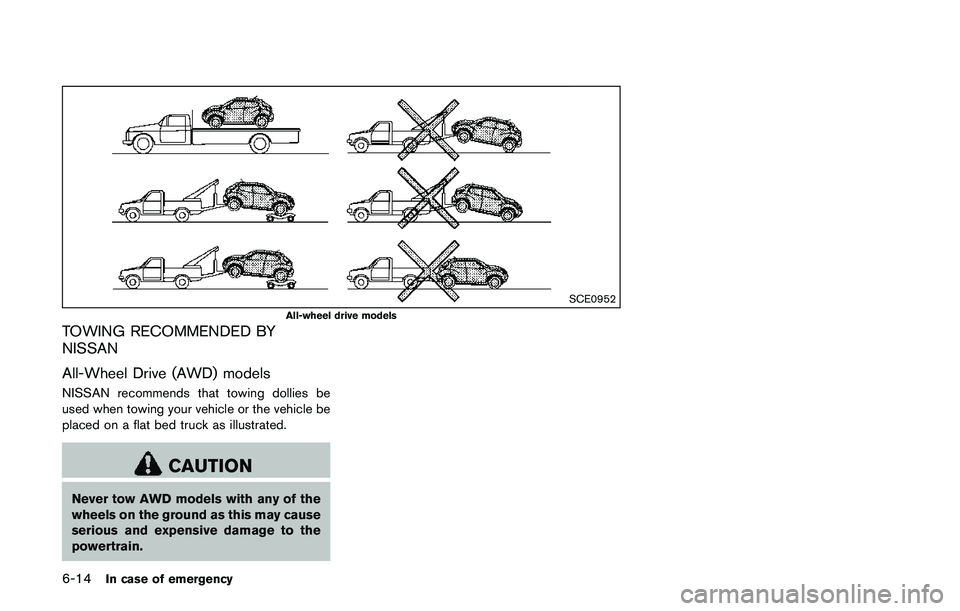
SCE0952
All-wheel drive models
TOWING RECOMMENDED BY
NISSAN
All-Wheel Drive (AWD) models
NISSAN recommends that towing dollies be
used when towing your vehicle or the vehicle be
placed on a flat bed truck as illustrated.
CAUTION
Never tow AWD models with any of the
wheels on the ground as this may cause
serious and expensive damage to the
powertrain.
Page 412 of 508
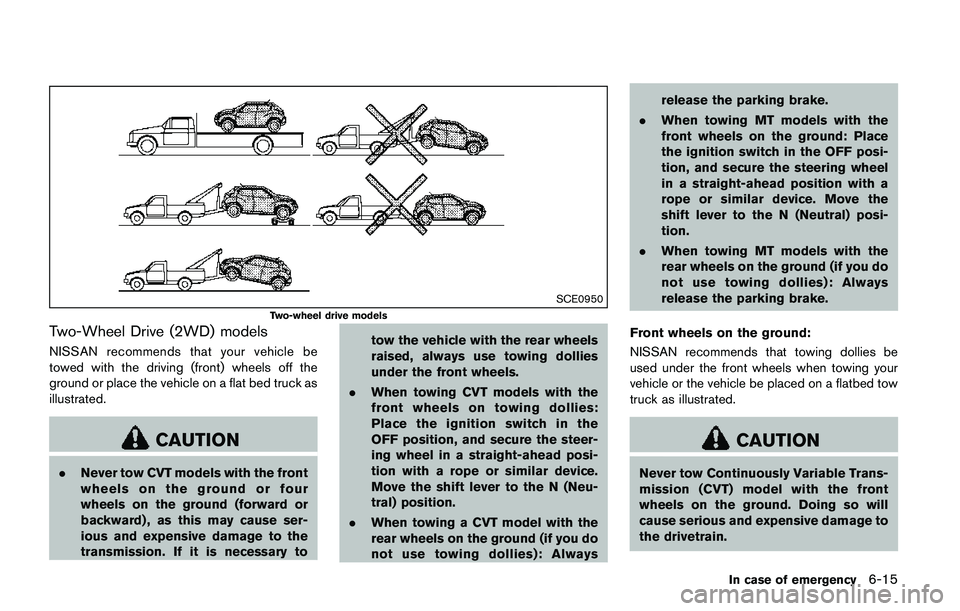
SCE0950
Two-wheel drive models
Two-Wheel Drive (2WD) models
NISSAN recommends that your vehicle be
towed with the driving (front) wheels off the
ground or place the vehicle on a flat bed truck as
illustrated.
CAUTION
.Never tow CVT models with the front
wheels on the ground or four
wheels on the ground (forward or
backward) , as this may cause ser-
ious and expensive damage to the
transmission. If it is necessary totow the vehicle with the rear wheels
raised, always use towing dollies
under the front wheels.
.When towing CVT models with the
front wheels on towing dollies:
Place the ignition switch in the
OFF position, and secure the steer-
ing wheel in a straight-ahead posi-
tion with a rope or similar device.
Move the shift lever to the N (Neu-
tral) position.
.When towing a CVT model with the
rear wheels on the ground (if you do
not use towing dollies): Alwaysrelease the parking brake.
.When towing MT models with the
front wheels on the ground: Place
the ignition switch in the OFF posi-
tion, and secure the steering wheel
in a straight-ahead position with a
rope or similar device. Move the
shift lever to the N (Neutral) posi-
tion.
.When towing MT models with the
rear wheels on the ground (if you do
not use towing dollies): Always
release the parking brake.
Front wheels on the ground:
NISSAN recommends that towing dollies be
used under the front wheels when towing your
vehicle or the vehicle be placed on a flatbed tow
truck as illustrated.
CAUTION
Never tow Continuously Variable Trans-
mission (CVT) model with the front
wheels on the ground. Doing so will
cause serious and expensive damage to
the drivetrain.
In case of emergency6-15
Page 413 of 508
6-16In case of emergency
Manual Transmission (MT) model:
1. Place the ignition switch in the OFF position.
2. Secure the steering wheel in a straight-
ahead position with rope or a similar device.
3. Move the shift lever to the N (Neutral)
position.
4. Release the parking brake.
5. Attach the safety chains whenever towing.
Rear wheels on the ground:
1. Place the ignition switch in the OFF position.
2. Move the shift lever to the N (Neutral)
position.
3. Release the parking brake.
4. Attach safety chains whenever towing.
All four wheels on the ground:
NISSAN recommends that the vehicle be placed
on a flatbed tow truck as illustrated.
CAUTION
Never tow CVT model with all four
wheels on the ground. Doing so will
cause serious and expensive damage to
the drivetrain.Manual Transmission (MT) model:
1. Place the ignition switch in the OFF position.
2. Move the shift lever to the N (Neutral)
position.
3. Release the parking brake.
VEHICLE RECOVERY (freeing a stuck
vehicle)
WARNING
To avoid vehicle damage, serious per-
sonal injury or death when recovering a
stuck vehicle:
.Contact a professional towing ser-
vice to recover the vehicle if you
have any questions regarding the
recovery procedure.
.Tow chains or cables must be at-
tached only to main structural mem-
bers of the vehicle.
.Do not use the vehicle tie-downs to
tow or free a stuck vehicle.
.Only use devices specifically de-
signed for vehicle recovery and
follow the manufacturer’s instruc-
tions..Always pull the recovery device
straight out from the front of the
vehicle. Never pull at an angle.
.Route recovery devices so they do
not touch any part of the vehicle
except the attachment point.
If your vehicle is stuck in sand, snow, mud, etc.,
use a tow strap or other device designed
specifically for vehicle recovery. Always follow
the manufacturer’s instructions for the recovery
device.
Rocking a stuck vehicle
WARNING
.Stand clear of a stuck vehicle.
.Do not spin your tires at high speed.
This could cause them to explode
and result in serious injury. Parts of
your vehicle could also overheat
and be damaged.
If your vehicle is stuck in sand, snow, mud, etc.,
use the following procedure:
1. Turn off the Vehicle Dynamic Control (VDC)
system.
Page 414 of 508
2. Make sure the area in front and behind the
vehicle is clear of obstructions.
3. Turn the steering wheel right and left to clear
an area around the front tires.
4. Slowly rock the vehicle forward and back-
ward.
.Shift back and forth between R (Reverse)
and D (Drive) (Continuously Variable
Transmission (CVT) models) or 1st and
R (Reverse) (Manual Transmission (MT)
models) .
.Apply the accelerator as little as possible
to maintain the rocking motion.
.Release the accelerator pedal before
shifting between R and D (CVT models)
or 1st and R (MT models) .
.Do not spin the tires above 35 MPH (55
km/h) .
5. If the vehicle cannot be freed after a few
tries, contact a professional towing service
to remove the vehicle.
In case of emergency6-17
Page 480 of 508
10 Technical and consumer information
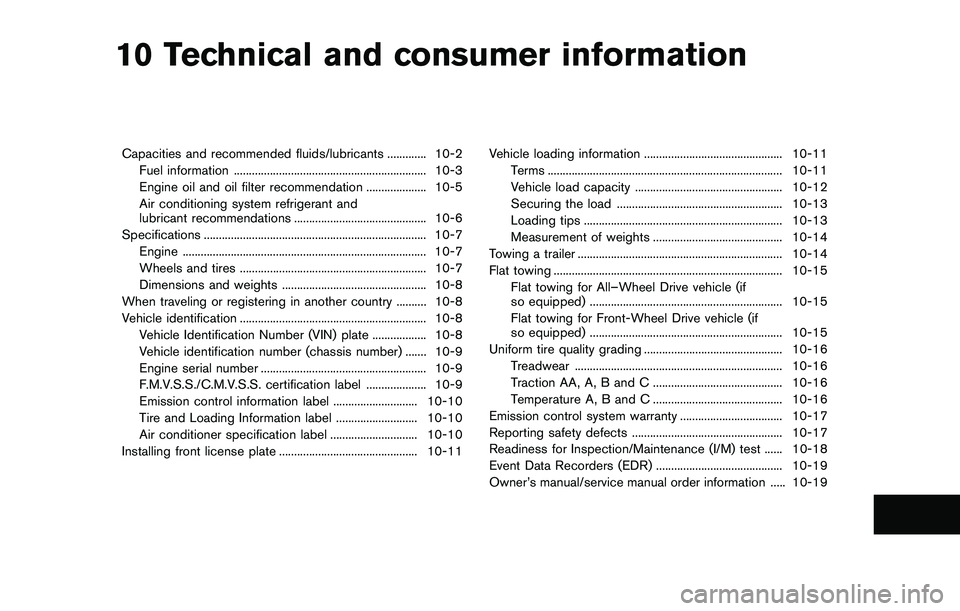
Capacities and recommended fluids/lubricants ............. 10-2
Fuel information ................................................................ 10-3
Engine oil and oil filter recommendation .................... 10-5
Air conditioning system refrigerant and
lubricant recommendations ............................................ 10-6
Specifications .......................................................................... 10-7
Engine ................................................................................. 10-7
Wheels and tires .............................................................. 10-7
Dimensions and weights ................................................ 10-8
When traveling or registering in another country .......... 10-8
Vehicle identification .............................................................. 10-8
Vehicle Identification Number (VIN) plate .................. 10-8
Vehicle identification number (chassis number) ....... 10-9
Engine serial number ....................................................... 10-9
F.M.V.S.S./C.M.V.S.S. certification label .................... 10-9
Emission control information label ............................ 10-10
Tire and Loading Information label ........................... 10-10
Air conditioner specification label ............................. 10-10
Installing front license plate .............................................. 10-11Vehicle loading information .............................................. 10-11
Terms .............................................................................. 10-11
Vehicle load capacity ................................................. 10-12
Securing the load ....................................................... 10-13
Loading tips .................................................................. 10-13
Measurement of weights ........................................... 10-14
Towing a trailer .................................................................... 10-14
Flat towing ............................................................................ 10-15
Flat towing for All–Wheel Drive vehicle (if
so equipped) ................................................................ 10-15
Flat towing for Front-Wheel Drive vehicle (if
so equipped) ................................................................ 10-15
Uniform tire quality grading .............................................. 10-16
Treadwear ..................................................................... 10-16
Traction AA, A, B and C ........................................... 10-16
Temperature A, B and C ........................................... 10-16
Emission control system warranty .................................. 10-17
Reporting safety defects .................................................. 10-17
Readiness for Inspection/Maintenance (I/M) test ...... 10-18
Event Data Recorders (EDR) .......................................... 10-19
Owner’s manual/service manual order information ..... 10-19
Page 493 of 508
10-14Technical and consumer information
WARNING
.Properly secure all cargo with
ropes or straps to help prevent
it from sliding or shifting. Do
not place cargo higher than
the seatbacks. In a sudden
stop or collision, unsecured
cargo could cause personal
injury.
.Do not load your vehicle any
heavier than the GVWR or the
maximum front and rear
GAWRs. If you do, parts of
your vehicle can break, tire
damage could occur, or it can
change the way your vehicle
handles. This could result in
loss of control and cause per-
sonal injury.
.Overloading not only can
shorten the life of your vehicle
and the tire, but can cause
unsafe vehicle handling and
longer braking distances. Thismay cause a premature tire
failure, which could result in a
serious accident and personal
injury. Failures caused by
overloading are not covered
by the vehicle’s warranty.
MEASUREMENT OF WEIGHTS
Secure loose items to prevent weight
shifts that could affect the balance of
your vehicle. When the vehicle is loaded,
drive to a scale and weigh the front and
the rear wheels separately to determine
axle loads. Individual axle loads should
not exceed either of the Gross Axle
Weight Ratings (GAWR) . The total of
the axle loads should not exceed the
Gross Vehicle Weight Rating (GVWR) .
These ratings are given on the vehicle
certification label. If weight ratings are
exceeded, move or remove items to bring
all weights below the ratings.Do not tow a trailer with your
vehicle. TOWING A TRAILER