wheel size NISSAN QASHQAI 2019 Owner´s Manual
[x] Cancel search | Manufacturer: NISSAN, Model Year: 2019, Model line: QASHQAI, Model: NISSAN QASHQAI 2019Pages: 500, PDF Size: 2.38 MB
Page 374 of 500
5-146Starting and driving
BRAKE ASSIST
When the force applied to the brake pedal
exceeds a certain level, the Brake Assist is
activated generating greater braking
force than a conventional brake booster
even with light pedal force.
WARNING
The Brake Assist is only an aid to
assist braking operation and is not a
collision warning or avoidance de-
vice. It is the driver’s responsibility to
stay alert, drive safely and be in
control of the vehicle at all times.
ANTI-LOCK BRAKING SYSTEM (ABS)
WARNING
.The Anti-lock Braking System
(ABS) is a sophisticated device,
but it cannot prevent accidents
resulting from careless or dan-
gerous driving techniques. It can
help maintain vehicle control dur-
ing braking on slippery surfaces.
Remember that stopping dis-
tances on slippery surfaces will
be longer than on normal sur- faces even with ABS. Stopping
distances may also be longer on
rough, gravel or snow covered
roads, or if you are using tire
chains. Always maintain a safe
distance from the vehicle in front
of you. Ultimately, the driver is
responsible for safety.
. Tire type and condition may also
affect braking effectiveness.
— When replacing tires, install
the specified size of tires on
all four wheels.
— When installing a spare tire, make sure that it is the proper
size and type as specified on
the Tire and Loading Informa-
tion label. See “Tire and Load-
ing Information label” (P.10-
10) of this manual.
— For detailed information, see “Wheels and tires” (P.8-29) of
this manual.
The Anti-lock Braking System (ABS) con-
trols the brakes so the wheels do not lock
during hard braking or when braking on
slippery surfaces. The system detects the
rotation speed at each wheel and varies
the brake fluid pressure to prevent each
wheel from locking and sliding. By pre- venting each wheel from locking, the
system helps the driver maintain steering
control and helps to minimize swerving
and spinning on slippery surfaces.
Using the system
Depress the brake pedal and hold it down.
Depress the brake pedal with firm steady
pressure, but do not pump the brakes.
The ABS will operate to prevent the
wheels from locking up. Steer the vehicle
to avoid obstacles.
WARNING
Do not pump the brake pedal. Doing
so may result in increased stopping
distances.
Self-test feature
The ABS includes electronic sensors, elec-
tric pumps, hydraulic solenoids and a
computer. The computer has a built-in
diagnostic feature that tests the system
each time you start the engine and move
the vehicle at a low speed in forward or
reverse. When the self-test occurs, you
may hear a “clunk” noise and/or feel a
pulsation in the brake pedal. This is
normal and does not indicate a malfunc-
tion. If the computer senses a malfunc-
BRAKE ASSIST
Page 385 of 500
apply additional paint near the sonar
sensors.
Do not strike or damage the area around
the sonar sensors. It is recommended
that you visit a NISSAN dealer if the area
around the sonar sensors is damaged
due to a collision.FREEING A FROZEN DOOR LOCK
To prevent a door lock from freezing,
apply deicer through the key hole. If the
lock becomes frozen, heat the key before
inserting it into the key hole, or use the
Intelligent Key system or the remote
keyless entry key fob.
ANTI-FREEZE
In the winter when it is anticipated that
the outside temperature will drop below
32°F (0°C), check the anti-freeze to assure
proper winter protection. For additional
information, see “Engine cooling system”
(P.8-4).
BATTERY
If the battery is not fully charged during
extremely cold weather conditions, the
battery fluid may freeze and damage the
battery. To maintain maximum efficiency,
the battery should be checked regularly.
For additional information, see “Battery”
(P.8-11).
DRAINING OF COOLANT WATER
If the vehicle is to be left outside without
anti-freeze, drain the cooling system,
including the engine block. Refill before
operating the vehicle. For details, see
“Engine cooling system” (P.8-4).
TIRE EQUIPMENT
SUMMER tires have a tread designed to
provide superior performance on dry
pavement. However, the performance of
these tires will be substantially reduced in
snowy and icy conditions. If you operate
your vehicle on snowy or icy roads,
NISSAN recommends the use of MUD &
SNOW or ALL SEASON tires on all four
wheels. It is recommended you consult a
NISSAN dealer for the tire type, size, speed
rating and availability information.
For additional traction on icy roads,
studded tires may be used. However,
some U.S. states and Canadian provinces
prohibit their use. Check local, state and
provincial laws before installing studded
tires.
Skid and traction capabilities of
studded snow tires, on wet or dry
surfaces, may be poorer than that of
non-studded snow tires.
Tire chains may be used. For details, see
“Tire chains” (P.8-36) of this manual.
Starting and driving5-157
COLD WEATHER DRIVING
Page 386 of 500
5-158Starting and driving
All-Wheel Drive (AWD) model
If you install snow tires, they must also be
the same size, brand, construction and
tread pattern on all four wheels.
SPECIAL WINTER EQUIPMENT
It is recommended that the following
items be carried in the vehicle during
winter:
.A scraper and stiff-bristled brush to
remove ice and snow from the win-
dows and wiper blades.
. A sturdy, flat board to be placed under
the jack to give it firm support.
. A shovel to dig the vehicle out of
snow-drifts.
. Extra window washer fluid to refill the
reservoir tank.
DRIVING ON SNOW OR ICE
WARNING
.Wet ice (32°F, 0°C and freezing
rain), very cold snow or ice can be
slick and very hard to drive on.
The vehicle will have much less
traction or “grip” under these
conditions. Try to avoid driving
on wet ice until the road is salted
or sanded. .
Whatever the condition, drive
with caution. Accelerate and slow
down with care. If accelerating or
downshifting too fast, the drive
wheels will lose even more trac-
tion.
. Allow more stopping distance
under these conditions. Braking
should be started sooner than on
dry pavement.
. Allow greater following distances
on slippery roads.
. Watch for slippery spots (glare
ice). These may appear on an
otherwise clear road in shaded
areas. If a patch of ice is seen
ahead, brake before reaching it.
Try not to brake while on the ice,
and avoid any sudden steering
maneuvers.
. Do not use cruise control on
slippery roads.
. Snow can trap dangerous ex-
haust gases under your vehicle.
Keep snow clear of the exhaust
pipe and from around your vehi-
cle.
Page 446 of 500
8-34Do-it-yourself
SDI1606Example
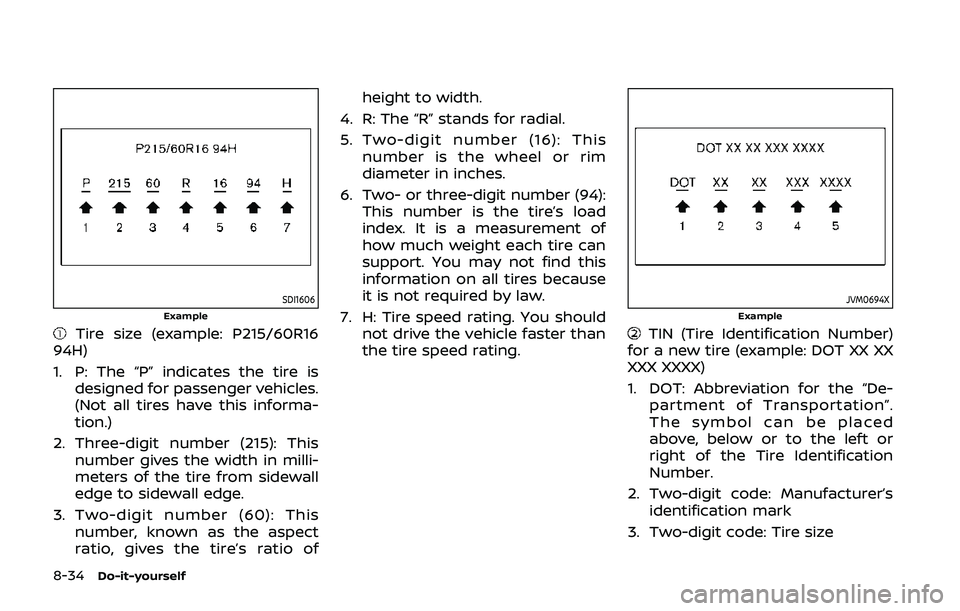
Tire size (example: P215/60R16
94H)
1. P: The “P” indicates the tire is designed for passenger vehicles.
(Not all tires have this informa-
tion.)
2. Three-digit number (215): This number gives the width in milli-
meters of the tire from sidewall
edge to sidewall edge.
3. Two-digit number (60): This number, known as the aspect
ratio, gives the tire’s ratio of height to width.
4. R: The “R” stands for radial.
5. Two-digit number (16): This number is the wheel or rim
diameter in inches.
6. Two- or three-digit number (94): This number is the tire’s load
index. It is a measurement of
how much weight each tire can
support. You may not find this
information on all tires because
it is not required by law.
7. H: Tire speed rating. You should not drive the vehicle faster than
the tire speed rating.
JVM0694XExample
TIN (Tire Identification Number)
for a new tire (example: DOT XX XX
XXX XXXX)
1. DOT: Abbreviation for the “De- partment of Transportation”.
The symbol can be placed
above, below or to the left or
right of the Tire Identification
Number.
2. Two-digit code: Manufacturer’s identification mark
3. Two-digit code: Tire size
Page 448 of 500
8-36Do-it-yourself
.For additional information re-
garding tires, refer to “Important
Tire Safety Information” (US) or
“Tire Safety Information” (Cana-
da) in the Warranty Information
Booklet.
. Always use tires of the same type,
size, brand, construction and
tread pattern on all four wheels.
Failure to do so may result in a
circumference difference be-
tween tires on the front and rear
axles which can cause the Vehicle
Dynamic Control (VDC) system to
malfunction resulting in personal
injury or death, excessive tire
wear and may damage the trans-
mission, transfer case and differ-
ential gears.
All season tires
NISSAN specifies all season tires on some
models to provide good performance all
year, including snowy and icy road con-
ditions. All Season tires are identified by
ALL SEASON and/or M&S (Mud and Snow)
on the tire sidewall. Snow tires have
better snow traction than All Season tires
and may be more appropriate in some
areas.
Summer tires
NISSAN specifies summer tires on some
models to provide superior performance
on dry roads. Summer tire performance is
substantially reduced in snow and ice.
Summer tires do not have the tire trac-
tion rating M&S on the tire sidewall.
If you plan to operate your vehicle in
snowy or icy conditions, NISSAN recom-
mends the use of SNOW tires or ALL
SEASON tires on all four wheels.
Snow tires
If snow tires are needed, it is necessary to
select tires equivalent in size and load
rating to the original equipment tires. If
you do not, it can adversely affect the
safety and handling of your vehicle.
Generally, snow tires will have lower
speed ratings than factory equipped tires
and may not match the potential max-
imum vehicle speed. Never exceed the
maximum speed rating of the tire.
If you install snow tires, they must be the
same size, brand, construction and tread
pattern on all four wheels.
For additional traction on icy roads,
studded tires may be used. However,
some U.S. states and Canadian provinces
prohibit their use. Check local, state and
provincial laws before installing studded tires. Skid and traction capabilities of
studded snow tires, on wet or dry sur-
faces, may be poorer than that of non-
studded snow tires.
TIRE CHAINS
Use of tire chains may be prohibited
according to location. Check the local
laws before installing tire chains. When
installing tire chains, make sure they are
the proper size for the tires on your
vehicle and are installed according to
the chain manufacturer’s suggestions.
Use only SAE Class S chains.
Class “S”
chains are used on vehicles with re-
stricted tire to vehicle clearance. Vehicles
that can use Class “S” chains are designed
to meet the SAE standard minimum
clearances between the tire and the
closest vehicle suspension or body com-
ponent required to accommodate the
use of a winter traction device (tire chains
or cables). The minimum clearances are
determined using the factory equipped
tire size. Other types may damage your
vehicle. Use chain tensioners when re-
commended by the tire chain manufac-
turer to ensure a tight fit. Loose end links
of the tire chain must be secured or
removed to prevent the possibility of
whipping action damage to the fenders
or underbody. If possible, avoid fully load-
ing your vehicle when using tire chains. In
Page 450 of 500
8-38Do-it-yourself
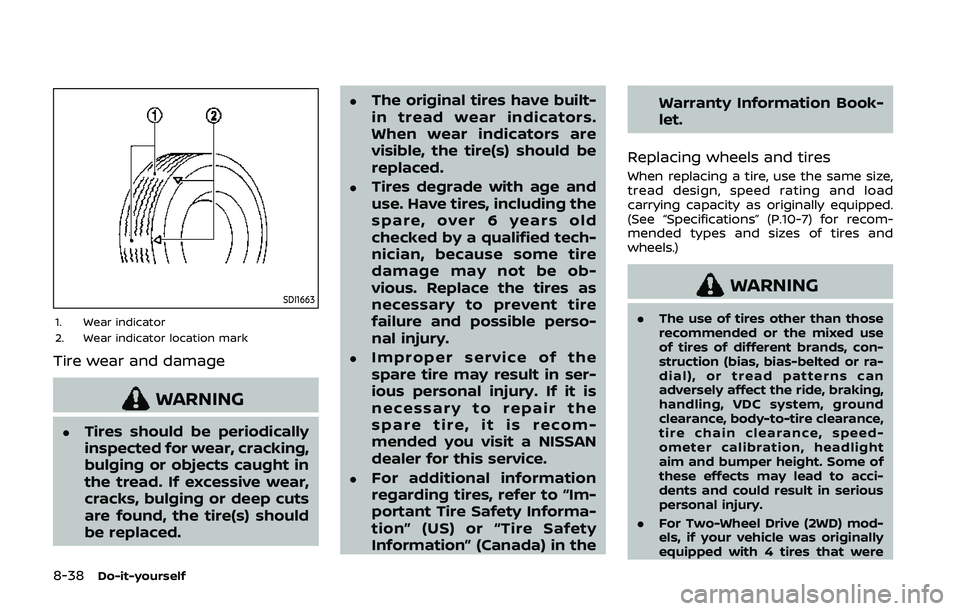
SDI1663
1. Wear indicator
2. Wear indicator location mark
Tire wear and damage
WARNING
.Tires should be periodically
inspected for wear, cracking,
bulging or objects caught in
the tread. If excessive wear,
cracks, bulging or deep cuts
are found, the tire(s) should
be replaced.
.The original tires have built-
in tread wear indicators.
When wear indicators are
visible, the tire(s) should be
replaced.
.Tires degrade with age and
use. Have tires, including the
spare, over 6 years old
checked by a qualified tech-
nician, because some tire
damage may not be ob-
vious. Replace the tires as
necessary to prevent tire
failure and possible perso-
nal injury.
.Improper service of the
spare tire may result in ser-
ious personal injury. If it is
necessary to repair the
spare tire, it is recom-
mended you visit a NISSAN
dealer for this service.
.For additional information
regarding tires, refer to “Im-
portant Tire Safety Informa-
tion” (US) or “Tire Safety
Information” (Canada) in theWarranty Information Book-
let.
Replacing wheels and tires
When replacing a tire, use the same size,
tread design, speed rating and load
carrying capacity as originally equipped.
(See “Specifications” (P.10-7) for recom-
mended types and sizes of tires and
wheels.)
WARNING
. The use of tires other than those
recommended or the mixed use
of tires of different brands, con-
struction (bias, bias-belted or ra-
dial), or tread patterns can
adversely affect the ride, braking,
handling, VDC system, ground
clearance, body-to-tire clearance,
tire chain clearance, speed-
ometer calibration, headlight
aim and bumper height. Some of
these effects may lead to acci-
dents and could result in serious
personal injury.
. For Two-Wheel Drive (2WD) mod-
els, if your vehicle was originally
equipped with 4 tires that were
Page 451 of 500
the same size and you are only
replacing 2 of the 4 tires, install
the new tires on the rear axle.
Placing new tires on the front
axle may cause loss of vehicle
control in some driving condi-
tions and cause an accident and
personal injury.
. If the wheels are changed for any
reason, always replace with
wheels which have the same off-
set dimension. Wheels of a differ-
ent off-set could cause prema-
ture tire wear, degrade vehicle
handling characteristics and/or
interference with the brake
discs/drums. Such interference
can lead to decreased braking
efficiency and/or early brake
pad/shoe wear. See “Wheels and
tires” (P.10-7) of this manual for
wheel off-set dimensions.
. Since the spare tire is not
equipped with the TPMS, when a
spare tire is mounted or a wheel
is replaced, the TPMS will not
function and the low tire pressure
warning light will flash for ap-
proximately 1 minute. The light
will remain on after 1 minute.
Have your tires replaced and/or
TPMS system reset as soon as possible. It is recommended you
visit a NISSAN dealer for these
services.
. Replacing tires with those not
originally specified by NISSAN
could affect the proper operation
of the TPMS.
. The TPMS sensor may be da-
maged if it is not handled cor-
rectly. Be careful when handling
the TPMS sensor.
. When replacing the TPMS sensor,
the ID registration may be re-
quired. It is recommended you
visit a NISSAN dealer for ID regis-
tration.
. Do not use a valve stem cap that
is not specified by NISSAN. The
valve stem cap may become
stuck.
. Be sure that the valve stem caps
are correctly fitted. Otherwise the
valve may be clogged up with dirt
and cause a malfunction or loss
of pressure.
. Do not install a damaged or
deformed wheel or tire even if it
has been repaired. Such wheels
or tires could have structural
damage and could fail without
warning. .
The use of retread tire is not
recommended.
. For additional information re-
garding tires, refer to “Important
Tire Safety Information” (US) or
“Tire Safety Information” (Cana-
da) in the Warranty Information
Booklet.
All-Wheel Drive (AWD) models
CAUTION
.Always use tires of the same size,
brand, construction (bias, bias-
belted or radial), and tread pat-
tern on all four wheels. Failure to
do so may result in a circumfer-
ence difference between tires on
the front and rear axles which will
cause excessive tire wear and
may damage the transmission,
transfer case and rear differential
gears.
. Only use spare tires specified for
each AWD model.
If excessive tire wear is found, it is
recommended that all four tires be re-
placed with tires of the same size, brand,
Do-it-yourself8-39
Page 477 of 500
ENGINE
ModelMR20DD
Type Gasoline, 4-cycle, DOHC
Cylinder arrangement 4-cylinder, in-line
Bore × Stroke in (mm)3.307 × 3.547 (84.0 × 90.1)
Displacement cu in (cm
3)121.86 (1,997)
Firing order 1-3-4-2
Idle speed rpm
No adjustment is necessary.
Ignition timing (B.T.D.C.) degree/rpm
Spark plug StandardDILKAR7D11H
Spark plug gap (Normal) in (mm)0.043 (1.1)
Camshaft operation Timing chain
This spark ignition system complies with the Canadian standard ICES-002.
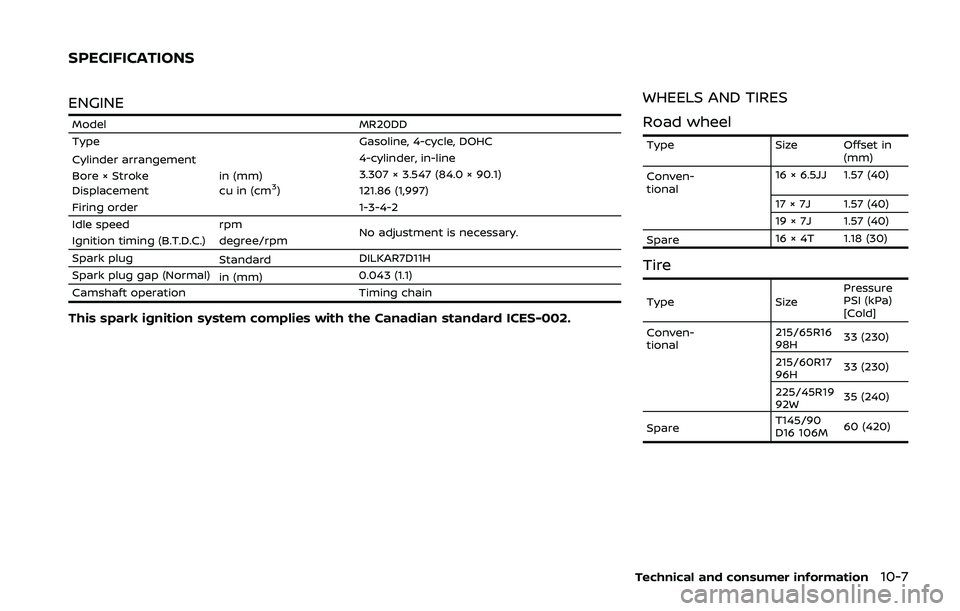
WHEELS AND TIRES
Road wheel
TypeSize Offset in
(mm)
Conven-
tional 16 × 6.5JJ 1.57 (40)
17 × 7J 1.57 (40)
19 × 7J 1.57 (40)
Spare 16 × 4T 1.18 (30)
Tire
Type
SizePressure
PSI (kPa)
[Cold]
Conven-
tional 215/65R16
98H
33 (230)
215/60R17
96H 33 (230)
225/45R19
92W 35 (240)
Spare T145/90
D16 106M
60 (420)
Technical and consumer information10-7
SPECIFICATIONS
Page 496 of 500
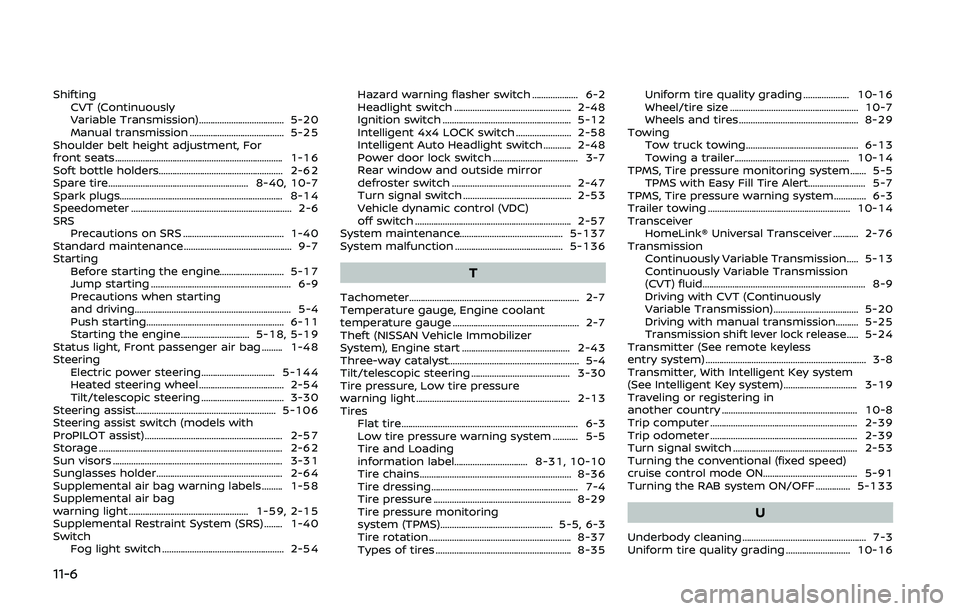
11-6
ShiftingCVT (Continuously
Variable Transmission)..................................... 5-20
Manual transmission ......................................... 5-25
Shoulder belt height adjustment, For
front seats........................................................................\
. 1-16
Soft bottle holders...................................................... 2-62
Spare tire............................................................. 8-40, 10-7
Spark plugs....................................................................... 8-14
Speedometer ...................................................................... 2-6
SRS Precautions on SRS ............................................ 1-40
Standard maintenance ............................................... 9-7
Starting Before starting the engine............................ 5-17
Jump starting ............................................................. 6-9
Precautions when starting
and driving.................................................................... 5-4
Push starting............................................................ 6-11
Starting the engine.............................. 5-18, 5-19
Status light, Front passenger air bag ......... 1-48
Steering Electric power steering................................ 5-144
Heated steering wheel ..................................... 2-54
Tilt/telescopic steering .................................... 3-30
Steering assist............................................................. 5-106
Steering assist switch (models with
ProPILOT assist) ............................................................ 2-57
Storage ........................................................................\
........ 2-62
Sun visors ........................................................................\
.. 3-31
Sunglasses holder....................................................... 2-64
Supplemental air bag warning labels ......... 1-58
Supplemental air bag
warning light .................................................... 1-59, 2-15
Supplemental Restraint System (SRS) ........ 1-40
Switch Fog light switch ..................................................... 2-54 Hazard warning flasher switch .................... 6-2
Headlight switch ................................................... 2-48
Ignition switch ........................................................ 5-12
Intelligent 4x4 LOCK switch ........................ 2-58
Intelligent Auto Headlight switch ............ 2-48
Power door lock switch ..................................... 3-7
Rear window and outside mirror
defroster switch .................................................... 2-47
Turn signal switch ............................................... 2-53
Vehicle dynamic control (VDC)
off switch .................................................................... 2-57
System maintenance............................................. 5-137
System malfunction ............................................... 5-136
T
Tachometer........................................................................\
.. 2-7
Temperature gauge, Engine coolant
temperature gauge ....................................................... 2-7
Theft (NISSAN Vehicle Immobilizer
System), Engine start ............................................... 2-43
Three-way catalyst......................................................... 5-4
Tilt/telescopic steering ........................................... 3-30
Tire pressure, Low tire pressure
warning light ................................................................... 2-13
Tires Flat tire........................................................................\
..... 6-3
Low tire pressure warning system ........... 5-5
Tire and Loading
information label................................ 8-31, 10-10
Tire chains.................................................................. 8-36
Tire dressing................................................................ 7-4
Tire pressure ............................................................ 8-29
Tire pressure monitoring
system (TPMS)................................................. 5-5, 6-3
Tire rotation.............................................................. 8-37
Types of tires ........................................................... 8-35 Uniform tire quality grading .................... 10-16
Wheel/tire size ........................................................ 10-7
Wheels and tires .................................................... 8-29
Towing Tow truck towing................................................. 6-13
Towing a trailer.................................................. 10-14
TPMS, Tire pressure monitoring system....... 5-5 TPMS with Easy Fill Tire Alert......................... 5-7
TPMS, Tire pressure warning system .............. 6-3
Trailer towing .............................................................. 10-14
Transceiver HomeLink® Universal Transceiver ........... 2-76
Transmission Continuously Variable Transmission ..... 5-13
Continuously Variable Transmission
(CVT) fluid....................................................................... 8-9
Driving with CVT (Continuously
Variable Transmission)..................................... 5-20
Driving with manual transmission.......... 5-25
Transmission shift lever lock release ..... 5-24
Transmitter (See remote keyless
entry system) ...................................................................... 3-8
Transmitter, With Intelligent Key system
(See Intelligent Key system) ................................ 3-19
Traveling or registering in
another country ........................................................... 10-8
Trip computer ................................................................ 2-39
Trip odometer ................................................................ 2-39
Turn signal switch ...................................................... 2-53
Turning the conventional (fixed speed)
cruise control mode ON......................................... 5-91
Turning the RAB system ON/OFF ............... 5-133
U
Underbody cleaning ...................................................... 7-3
Uniform tire quality grading ............................ 10-16
Page 497 of 500
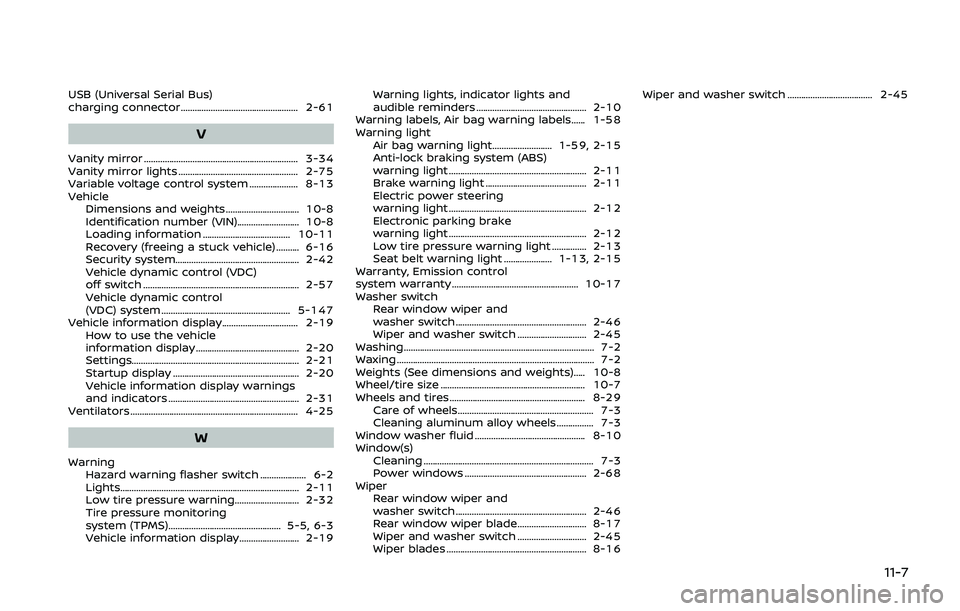
USB (Universal Serial Bus)
charging connector................................................... 2-61
V
Vanity mirror ................................................................... 3-34
Vanity mirror lights .................................................... 2-75
Variable voltage control system ..................... 8-13
VehicleDimensions and weights................................ 10-8
Identification number (VIN)........................... 10-8
Loading information ...................................... 10-11
Recovery (freeing a stuck vehicle) .......... 6-16
Security system...................................................... 2-42
Vehicle dynamic control (VDC)
off switch .................................................................... 2-57
Vehicle dynamic control
(VDC) system ........................................................ 5-147
Vehicle information display................................. 2-19 How to use the vehicle
information display ............................................. 2-20
Settings........................................................................\
. 2-21
Startup display ....................................................... 2-20
Vehicle information display warnings
and indicators ......................................................... 2-31
Ventilators ........................................................................\
. 4-25
W
Warning Hazard warning flasher switch .................... 6-2
Lights..................................................................\
............ 2-11
Low tire pressure warning............................ 2-32
Tire pressure monitoring
system (TPMS)................................................. 5-5, 6-3
Vehicle information display.......................... 2-19 Warning lights, indicator lights and
audible reminders ................................................ 2-10
Warning labels, Air bag warning labels...... 1-58
Warning light Air bag warning light.......................... 1-59, 2-15
Anti-lock braking system (ABS)
warning light ............................................................ 2-11
Brake warning light ............................................ 2-11
Electric power steering
warning light ............................................................ 2-12
Electronic parking brake
warning light ............................................................ 2-12
Low tire pressure warning light ............... 2-13
Seat belt warning light ..................... 1-13, 2-15
Warranty, Emission control
system warranty ....................................................... 10-17
Washer switch Rear window wiper and
washer switch ......................................................... 2-46
Wiper and washer switch .............................. 2-45
Washing........................................................................\
........... 7-2
Waxing ........................................................................\
.............. 7-2
Weights (See dimensions and weights)..... 10-8
Wheel/tire size ............................................................... 10-7
Wheels and tires ........................................................... 8-29 Care of wheels........................................................... 7-3
Cleaning aluminum alloy wheels ................ 7-3
Window washer fluid ................................................ 8-10
Window(s) Cleaning ........................................................................\
.. 7-3
Power windows ..................................................... 2-68
Wiper Rear window wiper and
washer switch ......................................................... 2-46
Rear window wiper blade.............................. 8-17
Wiper and washer switch .............................. 2-45
Wiper blades ............................................................. 8-16 Wiper and washer switch ..................................... 2-45
11-7