tire type NISSAN QASHQAI 2020 Owner´s Manual
[x] Cancel search | Manufacturer: NISSAN, Model Year: 2020, Model line: QASHQAI, Model: NISSAN QASHQAI 2020Pages: 492, PDF Size: 2.02 MB
Page 444 of 492
8-38Do-it-yourself
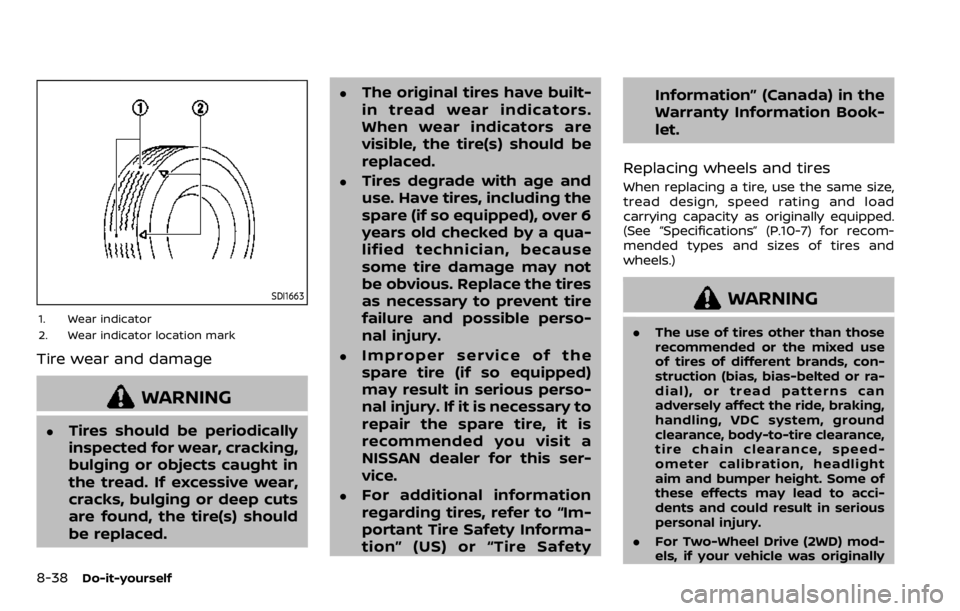
SDI1663
1. Wear indicator
2. Wear indicator location mark
Tire wear and damage
WARNING
.Tires should be periodically
inspected for wear, cracking,
bulging or objects caught in
the tread. If excessive wear,
cracks, bulging or deep cuts
are found, the tire(s) should
be replaced.
.The original tires have built-
in tread wear indicators.
When wear indicators are
visible, the tire(s) should be
replaced.
.Tires degrade with age and
use. Have tires, including the
spare (if so equipped), over 6
years old checked by a qua-
lified technician, because
some tire damage may not
be obvious. Replace the tires
as necessary to prevent tire
failure and possible perso-
nal injury.
.Improper service of the
spare tire (if so equipped)
may result in serious perso-
nal injury. If it is necessary to
repair the spare tire, it is
recommended you visit a
NISSAN dealer for this ser-
vice.
.For additional information
regarding tires, refer to “Im-
portant Tire Safety Informa-
tion” (US) or “Tire SafetyInformation” (Canada) in the
Warranty Information Book-
let.
Replacing wheels and tires
When replacing a tire, use the same size,
tread design, speed rating and load
carrying capacity as originally equipped.
(See “Specifications” (P.10-7) for recom-
mended types and sizes of tires and
wheels.)
WARNING
. The use of tires other than those
recommended or the mixed use
of tires of different brands, con-
struction (bias, bias-belted or ra-
dial), or tread patterns can
adversely affect the ride, braking,
handling, VDC system, ground
clearance, body-to-tire clearance,
tire chain clearance, speed-
ometer calibration, headlight
aim and bumper height. Some of
these effects may lead to acci-
dents and could result in serious
personal injury.
. For Two-Wheel Drive (2WD) mod-
els, if your vehicle was originally
Page 454 of 492

9-6Maintenance and schedules
Engine oil and oil filter:
Replace engine oil and oil filter at the
specified intervals. For recommended oil
grade and viscosity refer to “Capacities
and recommended fluids/lubricants”
(P.10-2).
Engine valve clearance*:
Inspect only if valve noise increases.
Adjust valve clearance if necessary.
Evaporative emissions control vapor
lines*:
Check vapor lines for leaks or looseness.
Tighten connections or replace parts as
necessary.
Fuel filter
Periodic maintenance is not required (in-
tank type filter).
Fuel lines*:
Check the fuel hoses, piping and connec-
tions for leaks, looseness, or deterioration.
Tighten connections or replace parts as
necessary.
Spark plugs:
Replace at specified intervals. Install new
plugs of the type as originally equipped.CHASSIS AND BODY MAINTENANCE
Brake lines and cables:
Visually inspect for proper installation.
Check for chafing, cracks, deterioration,
and signs of leaking. Replace any deterio-
rated or damaged parts immediately.
Brake pads and rotors:
Check for wear, deterioration and fluid
leaks. Replace any deteriorated or da-
maged parts immediately.
Exhaust system:
Visually inspect the exhaust pipes, muffler
and hangers for leaks, cracks, deteriora-
tion, and damage. Tighten connections or
replace parts as necessary.
In-cabin microfilter:
Replace at specified intervals. When driv-
ing for prolonged periods in dusty condi-
tions, replace the filter more frequently.
Propeller shaft(s):
Check for damage, looseness, and grease
leakage. (AWD)
Steering gear and linkage, axle and
suspension parts, drive shaft boots:
Check for damage, looseness, and leak-
age of oil or grease. Under severe driving
conditions, inspect more frequently.
Tire rotation:
Tires should be rotated every 7,500 miles(12,000 km) according to the instructions
under “Explanation of general mainte-
nance items” (P.9-2). When rotating tires,
check for damage and uneven wear.
Replace if necessary.
Transmission fluid/oil, differential oil
and transfer case oil:
Visually inspect for signs of leakage at
specified intervals.
If using a car-top carrier, or driving on
rough or muddy roads:
.
Replace the Manual Transmission
gear oil every 20,000 miles (32,000
km) or 24 months.
. Replace the CVT fluid every 60,000
miles (96,000 km) or request the deal-
er to inspect the fluid deterioration
data using a CONSULT. If the dete-
rioration data is more than 210,000,
replace the CVT fluid.
Page 456 of 492

9-8Maintenance and schedules
STANDARD MAINTENANCE
Abbreviations: I = Inspect and correct or replace as necessary, R = Replace
MAINTENANCE OPERATION
Perform at number of miles, kilometers or months,
whichever comes first.Miles × 1,000
(km × 1,000) Months MAINTENANCE INTERVAL
7.5
(12) 6 15
(24) 12 22.5
(36) 18 30
(48) 24 37.5
(60) 30 45
(72) 36 52.5
(84) 42 60
(96) 48 67.5
(108) 54 75
(120) 60 82.5
(132) 66 90
(144) 72 97.5
(156) 78 105
(168) 84 112.5
(180) 90 120
(192) 96
Air cleaner filter NOTE (1) R R R R
Brake fluid$ RR RR
Brake lines & cables II II I I I I
Brake pads & rotors$ II II I I I I
CVT fluid NOTE (2) I I I I I I I I
Drive belt NOTE (3) I* I* I* I* I*
Engine coolant* NOTE (4)(5)
Engine oil & oil filter$ RRRRR RRRRR RR R R R R
EVAP vapor lines & fuel lines I* I* I*I*
Exhaust system$ II II
Fuel filter NOTE (6)
In-cabin microfilter RR RR R R R R
Intake & exhaust valve clearance* NOTE (7)
Intelligent Key® battery IRRRR
Manual transaxle gear oil NOTE (8) I I I I I I I I
Propeller shaft & drive shaft boots (AWD models) $II II I I I I
Spark plugs (Iridium platinum-tipped type) NOTE (9) Replace every 105,000 miles (168,000 km)
Steering gear & linkage, axle & suspension parts $ II I I
Tire
rotation NOTE (10)
Transfer fluid & differential gear oil NOTE (8)II II I I II
Page 457 of 492

NOTE:
Maintenance items with “$” should be performed more frequently according to “Maintenance under severe driving conditions”
(P.9-10).
(1) If operating mainly in dusty conditions, more frequent maintenance may be required.
(2) If using a car-top, or driving on rough or muddy roads, inspect CVT fluid deterioration every 60,000 miles (96,000 km), then
change CVT fluid if necessary. And if inspection is not performed, change (not just inspect) CVT fluid every 60,000 miles (96,000
km). It is recommended that you visit a NISSAN dealer to perform this service.
(3) After 60,000 miles (96,000 km) or 48 months, inspect every 15,000 miles (24,000 km) or 12 months. Replace the drive belts if
found damaged.
(4) First replacement interval is 105,000 miles (168,000 km) or 84 months. After first replacement, replace every 75,000 miles
(120,000 km) or 60 months.
(5) Use Only Genuine NISSAN Long Life Antifreeze / Coolant (blue) or equivalent with proper mixture ratio of 50% anti-freeze and
50% demineralized or distilled water. Mixing any other type of coolant or the use of non-distilled water will reduce the life
expectancy of the factory-fill coolant.
(6) Periodic maintenance is not required.
(7) Periodic maintenance is not required. However, if valve noise increases, inspect valve clearance.
(8) If using a car-top, or driving on rough or muddy roads, change (not just inspect) oil at every 20,000 miles (32,000 km) or 24
months.
(9) Replace spark plug when the plug gap exceed 0.053 in (1.35 mm) even if within specified replacement mileage.
(10) For additional information on tire rotation, refer to “General maintenance” (P.9-2).
*: Maintenance items and intervals with “*” are recommended by NISSAN for reliable vehicle operation. The owner need not
perform such maintenance in order to maintain the emission warranty or manufacturer recall liability. Other maintenance
items and intervals are required.
Maintenance and schedules9-9
Page 469 of 492

ENGINE
ModelMR20DD
Type Gasoline, 4-cycle, DOHC
Cylinder arrangement 4-cylinder, in-line
Bore × Stroke in (mm)3.307 × 3.547 (84.0 × 90.1)
Displacement cu in (cm
3)121.86 (1,997)
Firing order 1-3-4-2
Idle speed rpm
No adjustment is necessary.
Ignition timing (B.T.D.C.) degree/rpm
Spark plug StandardDILKAR7D11H
Spark plug gap (Normal) in (mm)0.043 (1.1)
Camshaft operation Timing chain
This spark ignition system complies with the Canadian standard ICES-002.
WHEELS AND TIRES
Road wheel
TypeSizeOffset in
(mm)
Conventional 16 × 6.5JJ 1.57 (40)
17 × 7J 1.38 (35)
19 × 7J 1.57 (40)
Spare (if so
equipped) 16 × 4T 1.18 (30)
Tire
Type
SizePressure PSI
(kPa) [Cold]
Conventional 215/65R16
98H33 (230)
215/60R17
96H 33 (230)
225/45R19
92W 35 (240)
Spare (if so
equipped) T145/90 D16
106M
T135/90 D16
102M
60 (420)
Depending on the models, the emergency
tire puncture repair kit is supplied.
Technical and consumer information10-7
SPECIFICATIONS
Page 475 of 492
4.The resulting figure equals the
available amount of cargo and
luggage load capacity. For ex-
ample, if the XXX amount equals
1400 lbs. and there will be five
150 lb. passengers in your vehi-
cle, the amount of available
cargo and luggage load capacity
is 650 lbs. (1400 − 750 (5 x 150) =
650 lbs) or (640 − 340 (5 x 70) =
300 kg.)
5.Determine the combined weight
of luggage and cargo being
loaded on the vehicle. That
weight may not safely exceed
the available cargo and luggage
load capacity calculated in Step
4.
Before driving a loaded vehicle,
confirm that you do not exceed
the Gross Vehicle Weight Rating
(GVWR) or the Gross Axle Weight
Rating (GAWR) for your vehicle. (See
“Measurement of weights” (P.10-14).)
Also check tires for proper inflation
pressures. See the Tire and Loading
Information label.JVI1686X
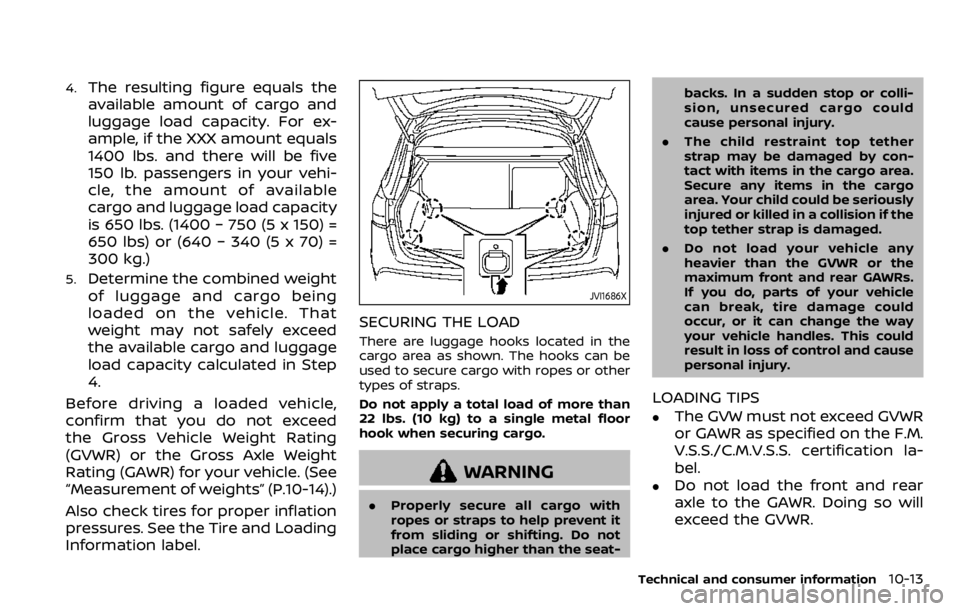
SECURING THE LOAD
There are luggage hooks located in the
cargo area as shown. The hooks can be
used to secure cargo with ropes or other
types of straps.
Do not apply a total load of more than
22 lbs. (10 kg) to a single metal floor
hook when securing cargo.
WARNING
. Properly secure all cargo with
ropes or straps to help prevent it
from sliding or shifting. Do not
place cargo higher than the seat- backs. In a sudden stop or colli-
sion, unsecured cargo could
cause personal injury.
. The child restraint top tether
strap may be damaged by con-
tact with items in the cargo area.
Secure any items in the cargo
area. Your child could be seriously
injured or killed in a collision if the
top tether strap is damaged.
. Do not load your vehicle any
heavier than the GVWR or the
maximum front and rear GAWRs.
If you do, parts of your vehicle
can break, tire damage could
occur, or it can change the way
your vehicle handles. This could
result in loss of control and cause
personal injury.
LOADING TIPS
.The GVW must not exceed GVWR
or GAWR as specified on the F.M.
V.S.S./C.M.V.S.S. certification la-
bel.
.Do not load the front and rear
axle to the GAWR. Doing so will
exceed the GVWR.
Technical and consumer information10-13
Page 487 of 492

ParkingBrake break-in .................................................... 5-127
Parking brake .......................................................... 5-27
Parking on hills................................................... 5-125
Parking brake Electronic parking brake
indicator light .......................................................... 2-16
Phone Bluetooth® Hands-Free Phone ..................... 4-2
Car phone or CB radio ..................................... 4-34
Power Electric power steering................................ 5-126
Power door lock ....................................................... 3-5
Power outlet ............................................................. 2-65
Power windows ..................................................... 2-73
Power moonroof.......................................................... 2-76
Precautions Braking precautions....................................... 5-127
Child restraints ....................................................... 1-22
Cruise control .......................................................... 5-65
Driving safety ........................................................... 5-10
Maintenance................................................................ 8-2
On-pavement and off-road driving .......... 5-9
Seat belt usage ...................................................... 1-12
SRS ........................................................................\
........... 1-42
When starting and driving................................ 5-4
ProPILOT assist ............................................................. 5-66
ProPILOT assist switches ...................................... 5-69
ProPILOT assist system display
and indicators ................................................................ 5-70
ProPILOT assist system operation ................ 5-68
Push starting................................................................\
... 6-16
Push-button ignition switch............................... 5-14R
RAB system limitations ........................................ 5-116
RAB system operation.......................................... 5-115
Radio Car phone or CB radio ..................................... 4-34
Rapid air pressure loss................................................ 5-9
Readiness for inspection/maintenance
(I/M) test........................................................................\
... 10-18
Rear Automatic Braking (RAB) ....................... 5-114
Rear Automatic Braking (RAB) system
warning light ................................................................... 2-13
Rear Cross Traffic Alert (RCTA)......................... 5-56
Rear door alert .............................................................. 2-63
Rear door lock, Child safety rear
door lock ........................................................................\
........ 3-7
Rear seats........................................................................\
...... 1-7
Rear sonar system (RSS)..................................... 5-134
Rear window and outside mirror
defroster switch ........................................................... 2-52
Rear window wiper and washer switch .... 2-51
RearView Monitor............................................................ 4-2
Recorders, Event data .......................................... 10-19
Registering in another country........................ 10-8
Remote engine start................................................. 3-23
Remote keyless entry function, For
Intelligent Key system ............................................. 3-19
Remote keyless entry system ............................... 3-8
Repairing a flat tire (models with
emergency tire puncture repair kit) ................. 6-9
Reporting safety defects .................................... 10-17
Roadside assistance program .............................. 6-2
Rollover ........................................................................\
............ 5-8
Roof Moonroof..................................................................... 2-77
Roof rack ........................................................................\
.... 2-72 Room light........................................................................\
. 2-79S
Safety
Child seat belts....................................................... 1-19
Reporting safety defects ............................ 10-17
Seat adjustment Front manual seat adjustment .................... 1-4
Front seats.................................................................... 1-4
Seat belt(s) Child safety................................................................ 1-19
Infants.................................................................\
........... 1-19
Injured persons ...................................................... 1-15
Larger children ....................................................... 1-20
Precautions on seat belt usage................ 1-12
Pregnant women.................................................. 1-15
Seat belt cleaning ................................................... 7-6
Seat belt extenders............................................. 1-18
Seat belt maintenance..................................... 1-18
Seat belt warning light
and chime.................................................... 1-14, 2-15
Seat belts .................................................................... 1-12
Seat belts with pretensioners .................... 1-61
Shoulder belt height adjustment ............ 1-17
Small children .......................................................... 1-20
Three-point type with retractor ............... 1-15
Seat(s) Heated seats ............................................................ 2-60
Seats ........................................................................\
.......... 1-3
Security system (NISSAN Vehicle
Immobilizer System), Engine start ................. 2-48
Security system, Vehicle
security system ............................................................. 2-46
Servicing air conditioner........................................ 4-33
Shift lever Shift lock release................................................... 5-24
11-5
Page 488 of 492

11-6
Shift lock releaseTransmission............................................................ 5-24
Shifting CVT (Continuously
Variable Transmission)..................................... 5-20
Manual transmission ......................................... 5-25
Shoulder belt height adjustment, For
front seats........................................................................\
. 1-17
Soft bottle holders...................................................... 2-67
Spare tire............................................................. 8-40, 10-7
Spark plugs....................................................................... 8-14
Speedometer ...................................................................... 2-6
SPORT mode switch.................................................. 5-32
SRS Precautions on SRS ............................................ 1-42
Standard maintenance ............................................... 9-7
Starting Before starting the engine............................ 5-17
Jump starting .......................................................... 6-14
Precautions when starting
and driving.................................................................... 5-4
Push starting............................................................ 6-16
Starting the engine.............................. 5-18, 5-19
Status light, Front passenger air bag ......... 1-50
Steering Electric power steering................................ 5-126
Heated steering wheel ..................................... 2-59
Tilt/telescopic steering .................................... 3-30
Steering assist................................................................ 5-86
Steering assist switch (models with
ProPILOT assist) ............................................................ 2-62
Storage ........................................................................\
........ 2-66
Sun visors ........................................................................\
.. 3-31
Sunglasses holder....................................................... 2-69
Supplemental air bag warning labels ......... 1-62
Supplemental air bag
warning light .................................................... 1-62, 2-15 Supplemental Restraint System (SRS) ........ 1-42
Switch
Fog light switch ..................................................... 2-58
Hazard warning flasher switch .................... 6-2
Headlight switch ................................................... 2-53
Ignition switch ........................................................ 5-12
Intelligent 4x4 LOCK switch ........................ 2-63
Intelligent Auto Headlight switch ............ 2-53
Power door lock switch ..................................... 3-7
Rear window and outside mirror
defroster switch .................................................... 2-52
Turn signal switch ............................................... 2-58
Vehicle dynamic control (VDC)
off switch .................................................................... 2-62
System maintenance............................................. 5-119
System malfunction ............................................... 5-118
T
Tachometer........................................................................\
.. 2-7
Temperature gauge, Engine coolant
temperature gauge ....................................................... 2-7
Theft (NISSAN Vehicle Immobilizer
System), Engine start ............................................... 2-48
Three-way catalyst......................................................... 5-4
Tilt/telescopic steering ........................................... 3-30
Tire pressure, Low tire pressure
warning light ................................................................... 2-13
Tires Flat tire........................................................................\
..... 6-3
Low tire pressure warning system ........... 5-5
Tire and Loading
information label................................ 8-31, 10-10
Tire chains.................................................................. 8-36
Tire dressing................................................................ 7-4
Tire pressure ............................................................ 8-29 Tire pressure monitoring system
(TPMS) .................................................................... 5-5, 6-3
Tire rotation.............................................................. 8-37
Types of tires ........................................................... 8-35
Uniform tire quality grading .................... 10-16
Wheel/tire size ........................................................ 10-7
Wheels and tires .................................................... 8-29
Towing Tow truck towing................................................. 6-18
Towing a trailer.................................................. 10-14
TPMS, Tire pressure monitoring system....... 5-5 TPMS with Easy Fill Tire Alert......................... 5-8
TPMS, Tire pressure warning system .............. 6-3
Traffic Sign Recognition......................................... 2-44
Trailer towing .............................................................. 10-14
Transceiver HomeLink® Universal Transceiver ........... 2-80
Transmission Continuously Variable Transmission ..... 5-13
Continuously Variable Transmission
(CVT) fluid....................................................................... 8-9
Driving with CVT (Continuously
Variable Transmission)..................................... 5-20
Driving with manual transmission.......... 5-25
Transmission shift lever lock release ..... 5-24
Transmitter (See remote keyless
entry system) ...................................................................... 3-8
Transmitter, With Intelligent Key system
(See Intelligent Key system) ................................ 3-19
Traveling or registering in
another country ........................................................... 10-8
Trip computer ................................................................ 2-40
Trip odometer ................................................................ 2-40
Turn signal switch ...................................................... 2-58
Turning the conventional (fixed speed)
cruise control mode ON......................................... 5-71