belt NISSAN QUEST 2000 V41 / 2.G User Guide
[x] Cancel search | Manufacturer: NISSAN, Model Year: 2000, Model line: QUEST, Model: NISSAN QUEST 2000 V41 / 2.GPages: 292, PDF Size: 2.48 MB
Page 25 of 292
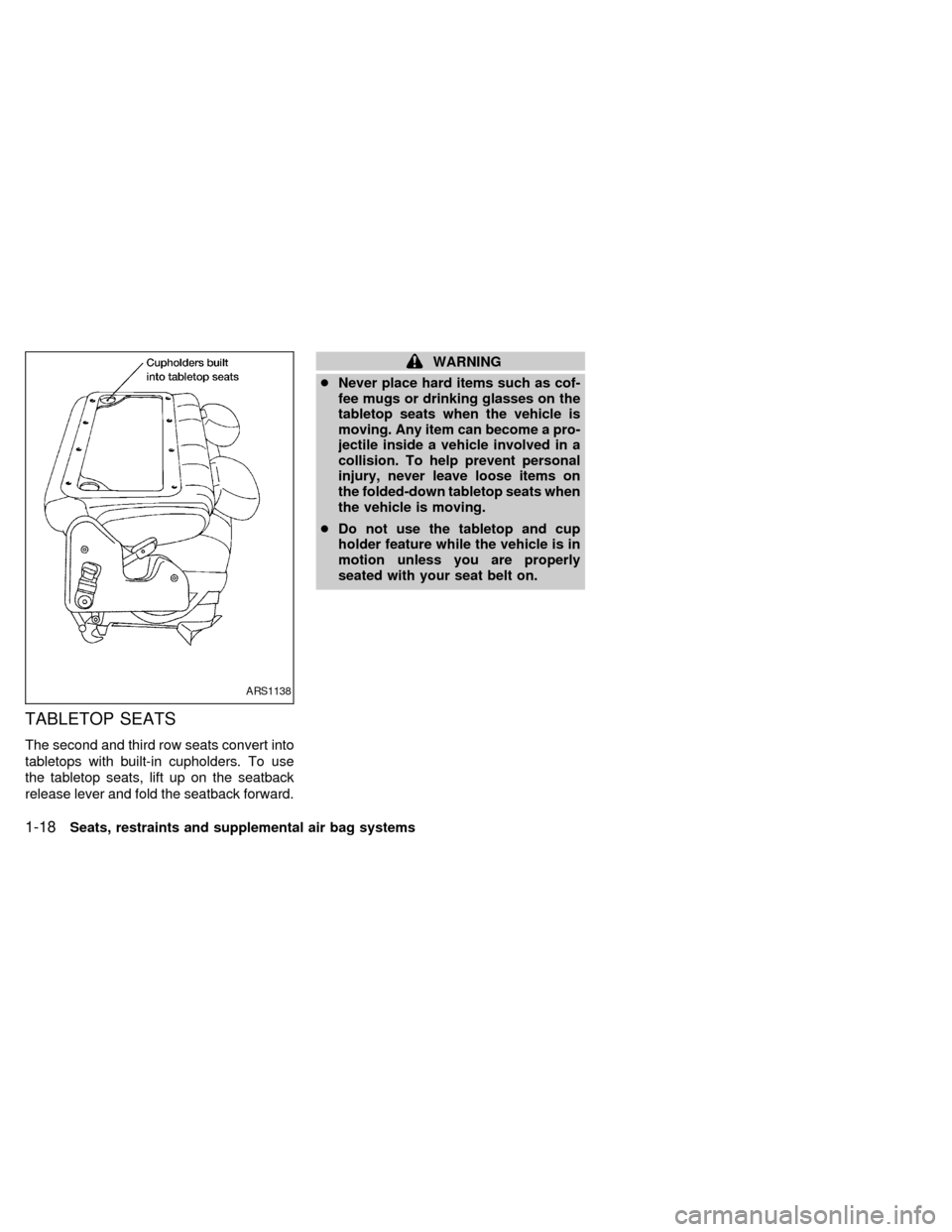
TABLETOP SEATS
The second and third row seats convert into
tabletops with built-in cupholders. To use
the tabletop seats, lift up on the seatback
release lever and fold the seatback forward.
WARNING
cNever place hard items such as cof-
fee mugs or drinking glasses on the
tabletop seats when the vehicle is
moving. Any item can become a pro-
jectile inside a vehicle involved in a
collision. To help prevent personal
injury, never leave loose items on
the folded-down tabletop seats when
the vehicle is moving.
cDo not use the tabletop and cup
holder feature while the vehicle is in
motion unless you are properly
seated with your seat belt on.
ARS1138
1-18Seats, restraints and supplemental air bag systems
ZX
Page 27 of 292
WARNING
cWhile the vehicle is in motion, pas-
sengers should always be seated in
a forward facing direction in a seat
which is properly secured and ad-
justed. Seat belts should always be
used. Sitting without a seat belt in a
seat that is not properly secured in
one of the locations shown in this
chapter, or in a place without a seat
and seat belt can result in personal
injury in a sudden stop or collision.
cDo not ride in a moving vehicle when
the seatback is reclined. This can be
dangerous. The shoulder belt will
not be against your body. In an acci-
dent, you could be thrown into it and
receive neck or other serious inju-
ries. You could also slide under the
lap belt and receive serious internal
injuries.
cFor the most effective protection
when the vehicle is in motion, the
seat should be upright. Always sit
well back in the seat and adjust the
seat belt properly.cIt is extremely dangerous to ride in a
cargo area inside of a vehicle. In a
collision, people riding in these ar-
eas are more likely to be seriously
injured or killed.
cDo not allow people to ride in any
area of your vehicle that is not
equipped with seats and seat belts.
cBe sure everyone in your vehicle is
in a seat and using a seat belt prop-
erly.
cDo not place hard items such as
coffee mugs or drinking glasses on
the tabletop seats when the vehicle
is moving. Any item can become a
projectile inside a vehicle involved in
a collision. To help prevent personal
injury, never leave loose items on
the fold-down tabletop seats when
the vehicle is moving.
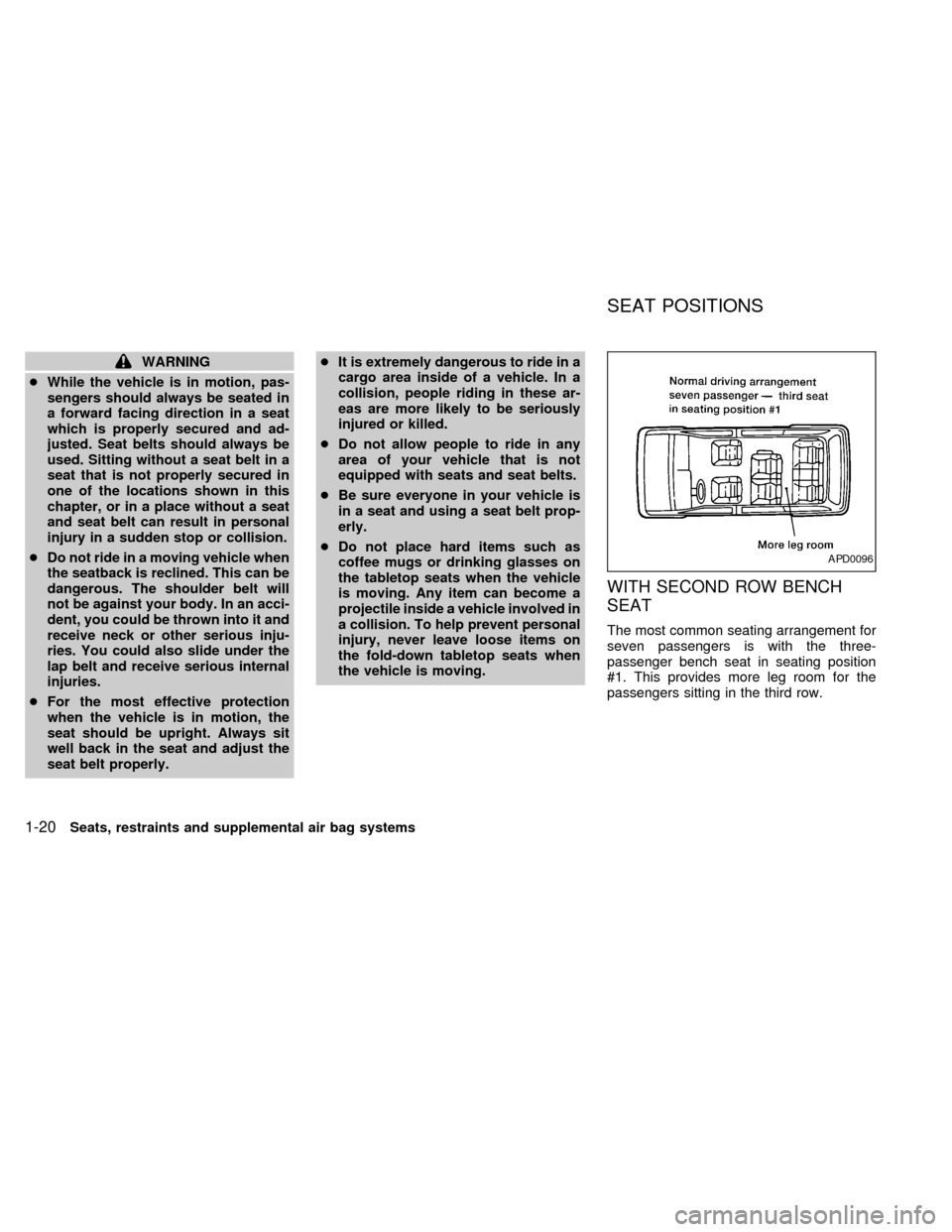
WITH SECOND ROW BENCH
SEAT
The most common seating arrangement for
seven passengers is with the three-
passenger bench seat in seating position
#1. This provides more leg room for the
passengers sitting in the third row.
APD0096
SEAT POSITIONS
1-20Seats, restraints and supplemental air bag systems
ZX
Page 31 of 292
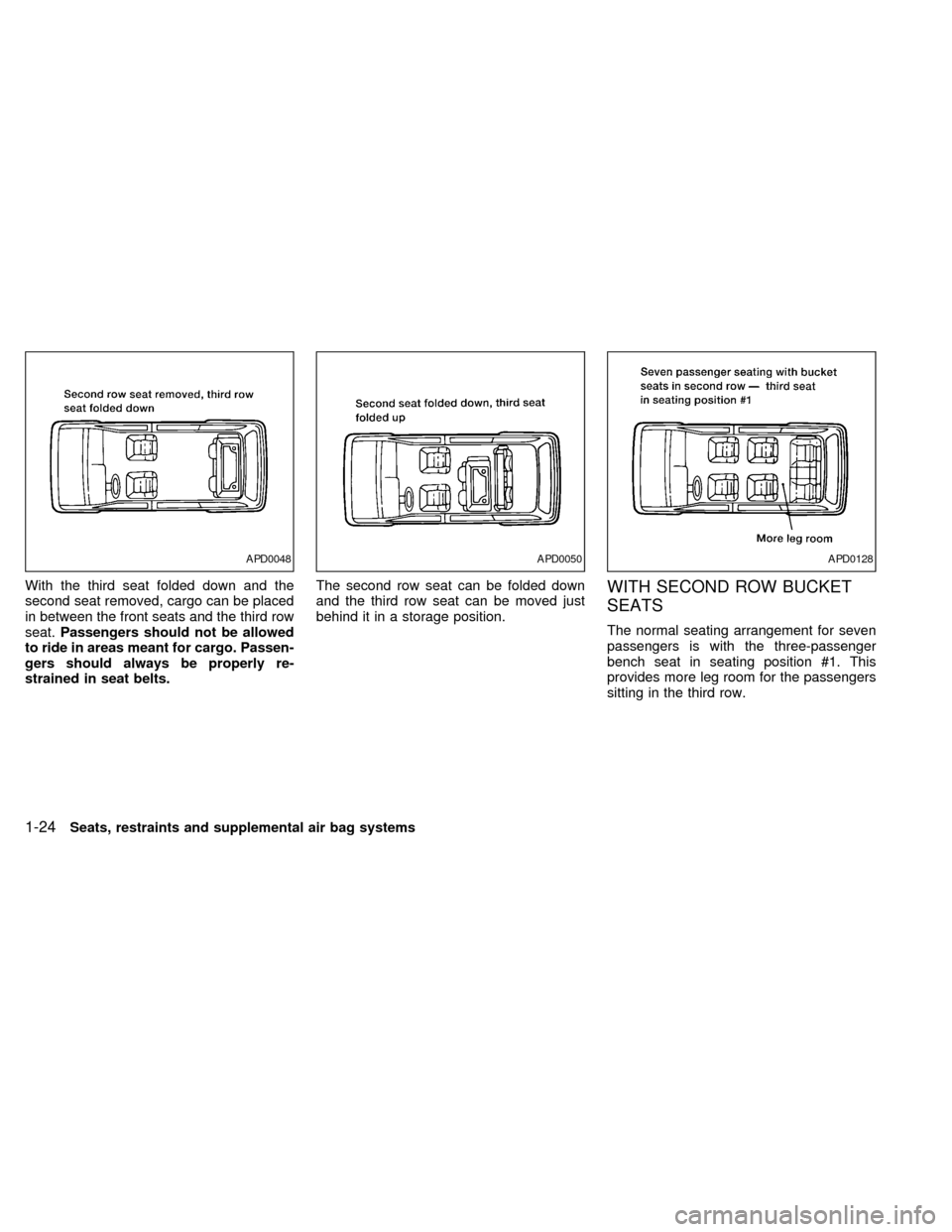
With the third seat folded down and the
second seat removed, cargo can be placed
in between the front seats and the third row
seat.Passengers should not be allowed
to ride in areas meant for cargo. Passen-
gers should always be properly re-
strained in seat belts.The second row seat can be folded down
and the third row seat can be moved just
behind it in a storage position.WITH SECOND ROW BUCKET
SEATS
The normal seating arrangement for seven
passengers is with the three-passenger
bench seat in seating position #1. This
provides more leg room for the passengers
sitting in the third row.
APD0048APD0050APD0128
1-24Seats, restraints and supplemental air bag systems
ZX
Page 33 of 292
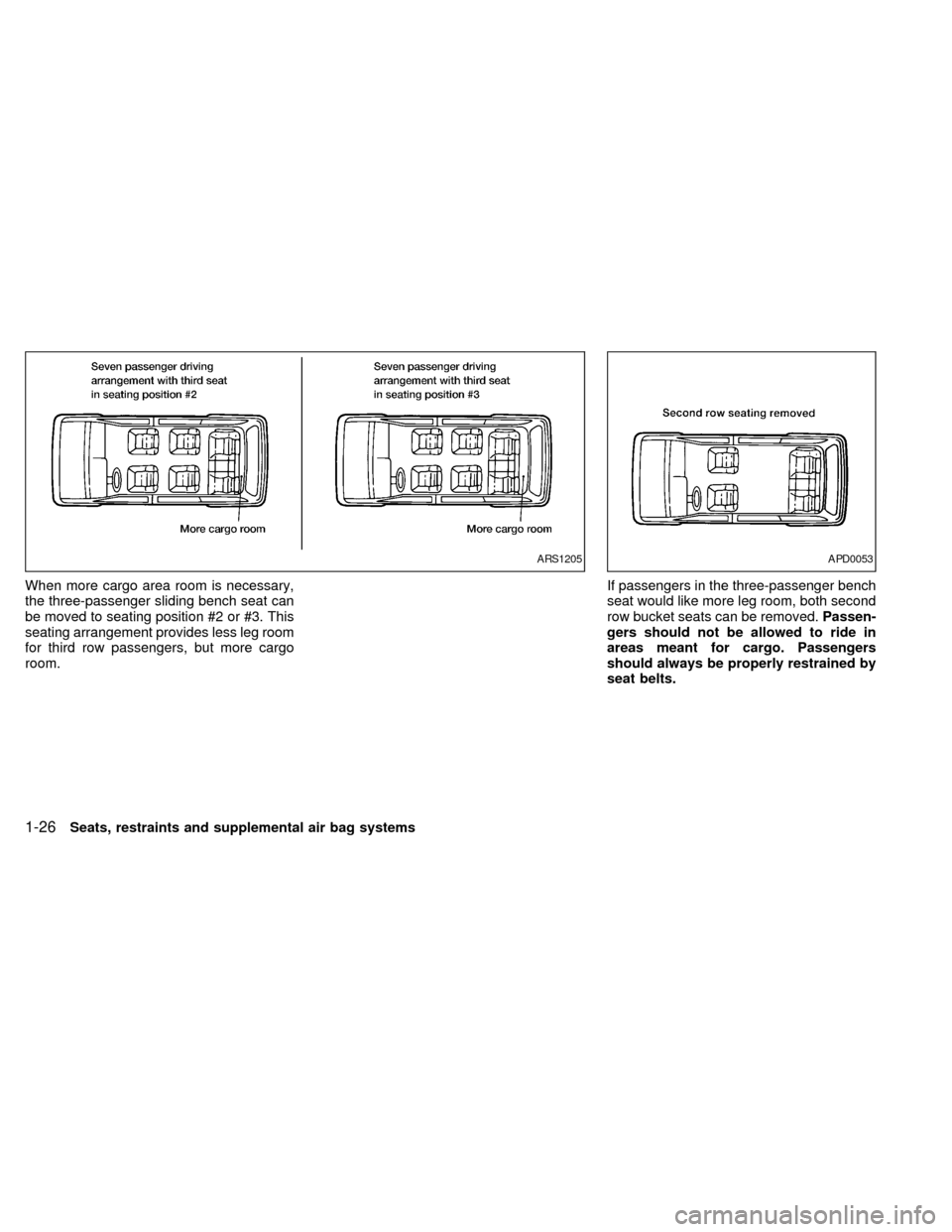
When more cargo area room is necessary,
the three-passenger sliding bench seat can
be moved to seating position #2 or #3. This
seating arrangement provides less leg room
for third row passengers, but more cargo
room.If passengers in the three-passenger bench
seat would like more leg room, both second
row bucket seats can be removed.Passen-
gers should not be allowed to ride in
areas meant for cargo. Passengers
should always be properly restrained by
seat belts.
ARS1205APD0053
1-26Seats, restraints and supplemental air bag systems
ZX
Page 37 of 292
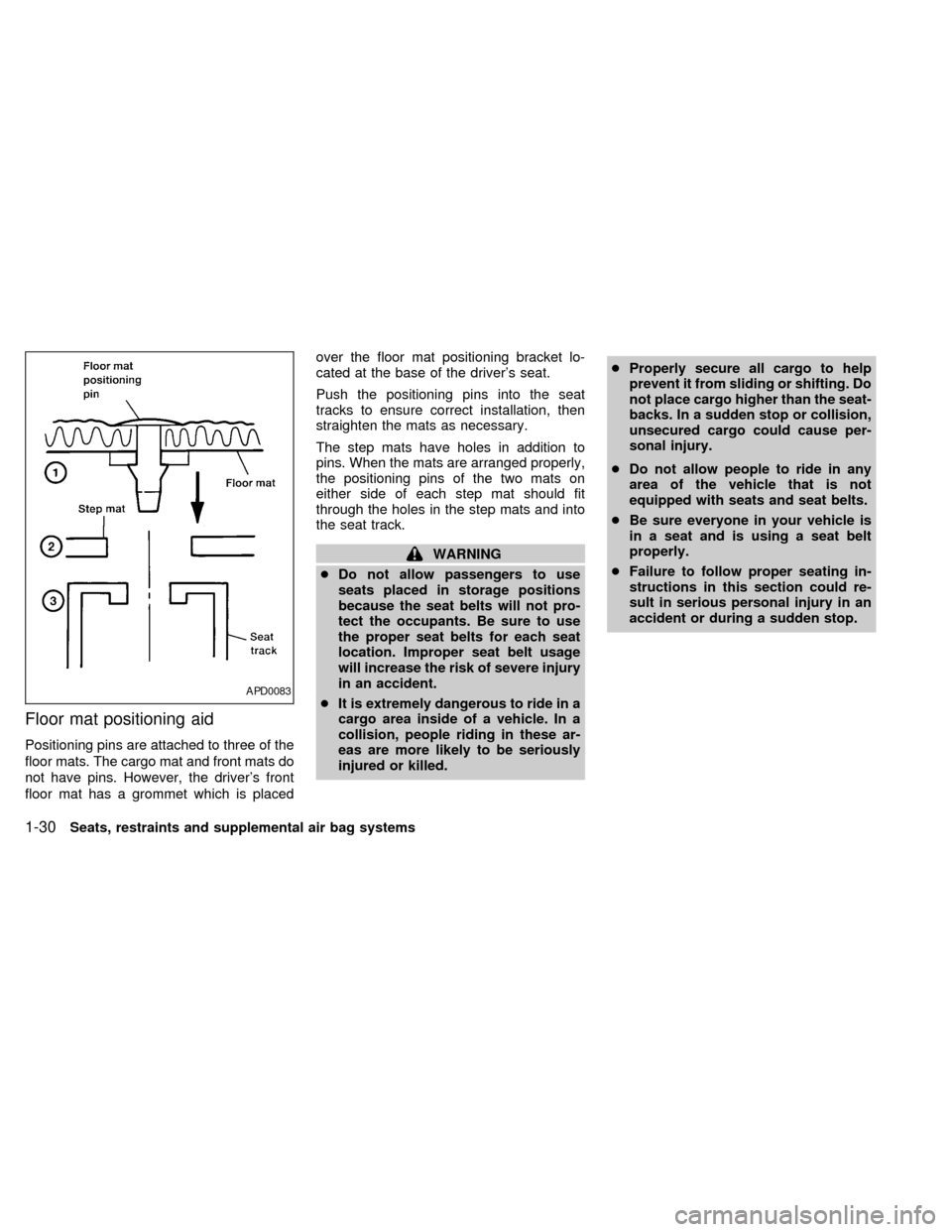
Floor mat positioning aid
Positioning pins are attached to three of the
floor mats. The cargo mat and front mats do
not have pins. However, the driver's front
floor mat has a grommet which is placedover the floor mat positioning bracket lo-
cated at the base of the driver's seat.
Push the positioning pins into the seat
tracks to ensure correct installation, then
straighten the mats as necessary.
The step mats have holes in addition to
pins. When the mats are arranged properly,
the positioning pins of the two mats on
either side of each step mat should fit
through the holes in the step mats and into
the seat track.
WARNING
cDo not allow passengers to use
seats placed in storage positions
because the seat belts will not pro-
tect the occupants. Be sure to use
the proper seat belts for each seat
location. Improper seat belt usage
will increase the risk of severe injury
in an accident.
cIt is extremely dangerous to ride in a
cargo area inside of a vehicle. In a
collision, people riding in these ar-
eas are more likely to be seriously
injured or killed.cProperly secure all cargo to help
prevent it from sliding or shifting. Do
not place cargo higher than the seat-
backs. In a sudden stop or collision,
unsecured cargo could cause per-
sonal injury.
cDo not allow people to ride in any
area of the vehicle that is not
equipped with seats and seat belts.
cBe sure everyone in your vehicle is
in a seat and is using a seat belt
properly.
cFailure to follow proper seating in-
structions in this section could re-
sult in serious personal injury in an
accident or during a sudden stop.
APD0083
1-30Seats, restraints and supplemental air bag systems
ZX
Page 38 of 292
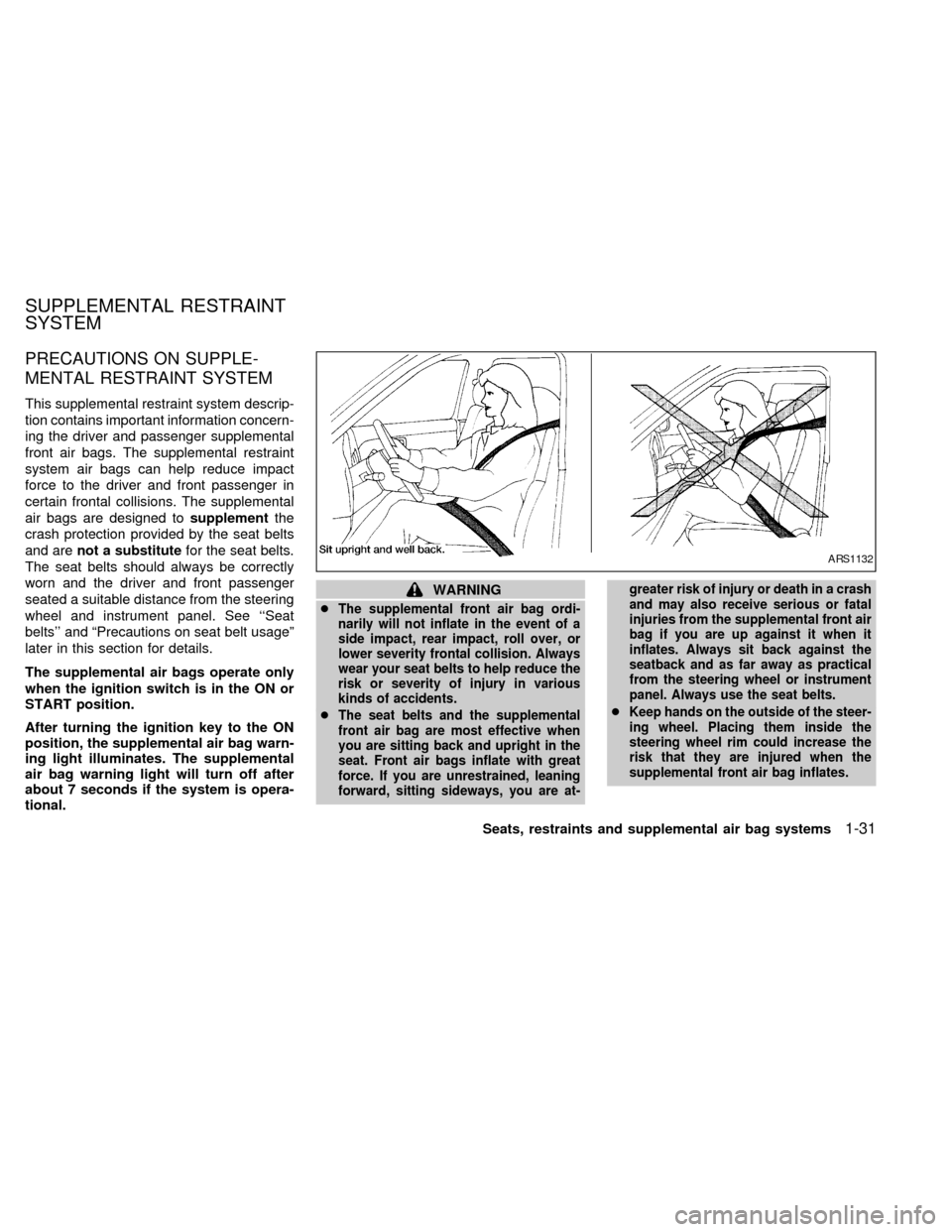
PRECAUTIONS ON SUPPLE-
MENTAL RESTRAINT SYSTEM
This supplemental restraint system descrip-
tion contains important information concern-
ing the driver and passenger supplemental
front air bags. The supplemental restraint
system air bags can help reduce impact
force to the driver and front passenger in
certain frontal collisions. The supplemental
air bags are designed tosupplementthe
crash protection provided by the seat belts
and arenot a substitutefor the seat belts.
The seat belts should always be correctly
worn and the driver and front passenger
seated a suitable distance from the steering
wheel and instrument panel. See ``Seat
belts'' and ªPrecautions on seat belt usageº
later in this section for details.
The supplemental air bags operate only
when the ignition switch is in the ON or
START position.
After turning the ignition key to the ON
position, the supplemental air bag warn-
ing light illuminates. The supplemental
air bag warning light will turn off after
about 7 seconds if the system is opera-
tional.
WARNING
c
The supplemental front air bag ordi-
narily will not inflate in the event of a
side impact, rear impact, roll over, or
lower severity frontal collision. Always
wear your seat belts to help reduce the
risk or severity of injury in various
kinds of accidents.
cThe seat belts and the supplemental
front air bag are most effective when
you are sitting back and upright in the
seat. Front air bags inflate with great
force. If you are unrestrained, leaning
forward, sitting sideways, you are at-greater risk of injury or death in a crash
and may also receive serious or fatal
injuries from the supplemental front air
bag if you are up against it when it
inflates. Always sit back against the
seatback and as far away as practical
from the steering wheel or instrument
panel. Always use the seat belts.cKeep hands on the outside of the steer-
ing wheel. Placing them inside the
steering wheel rim could increase the
risk that they are injured when the
supplemental front air bag inflates.
ARS1132
SUPPLEMENTAL RESTRAINT
SYSTEM
Seats, restraints and supplemental air bag systems1-31
ZX
Page 41 of 292

Supplemental front air bag system
The driver supplemental air bag is located in
the center of the steering wheel. The front
passenger supplemental air bag is mounted in
the dashboard above the glove box.
These systems are designed to meet optional
certification requirements under U.S. regula-
tions. They are also permitted in Canada. The
optional certification allows front air bags to
be designed to inflate somewhat less force-
fully than previously.However, all of the
information, cautions and warnings in this
manual still apply and must be followed.
The supplemental front air bag system is
designed to inflate in higher severity frontal
collisions, although it may inflate if the forces
in another type of collision are similar to those
of a higher severity frontal impact. It may not
inflate in certain frontal collisions. Vehicle
damage (or lack of it) is not always an indica-
tion of proper supplemental air bag system
operation.
When the supplemental front air bag in-
flates, a fairly loud noise may be heard,
followed by the release of smoke. This
smoke is not harmful and does not indicate
a fire, but care should be taken to notintentionally inhale it, as it may cause irrita-
tion and choking. Those with a history of a
breathing condition should get fresh air
promptly.
The supplemental front air bags, along with
the use of seat belts, help to cushion the
impact force on the face and chest of the
occupant. They can help save lives and
reduce serious injuries. However, an inflat-
ing front air bag may cause facial abrasions
or other injuries. Front air bags do not
provide restraint to the lower body.
Seat belts should be correctly worn and the
driver and passenger seated upright as far
away as practical from the steering wheel or
instrument panel. Since the supplemental
front air bag inflates quickly in order to help
protect the occupant, the force of the front air
bag inflating can increase the risk of injury if
the occupant is too close to or is against the
air bag module during inflation.The air bag
deflates quickly after a collision.
The supplemental air bags operate only
when the ignition switch is in the ON or
START position.
After turning the ignition key to the ON
position, the supplemental air bag warn-
WRS0014
1-34Seats, restraints and supplemental air bag systems
ZX
Page 46 of 292
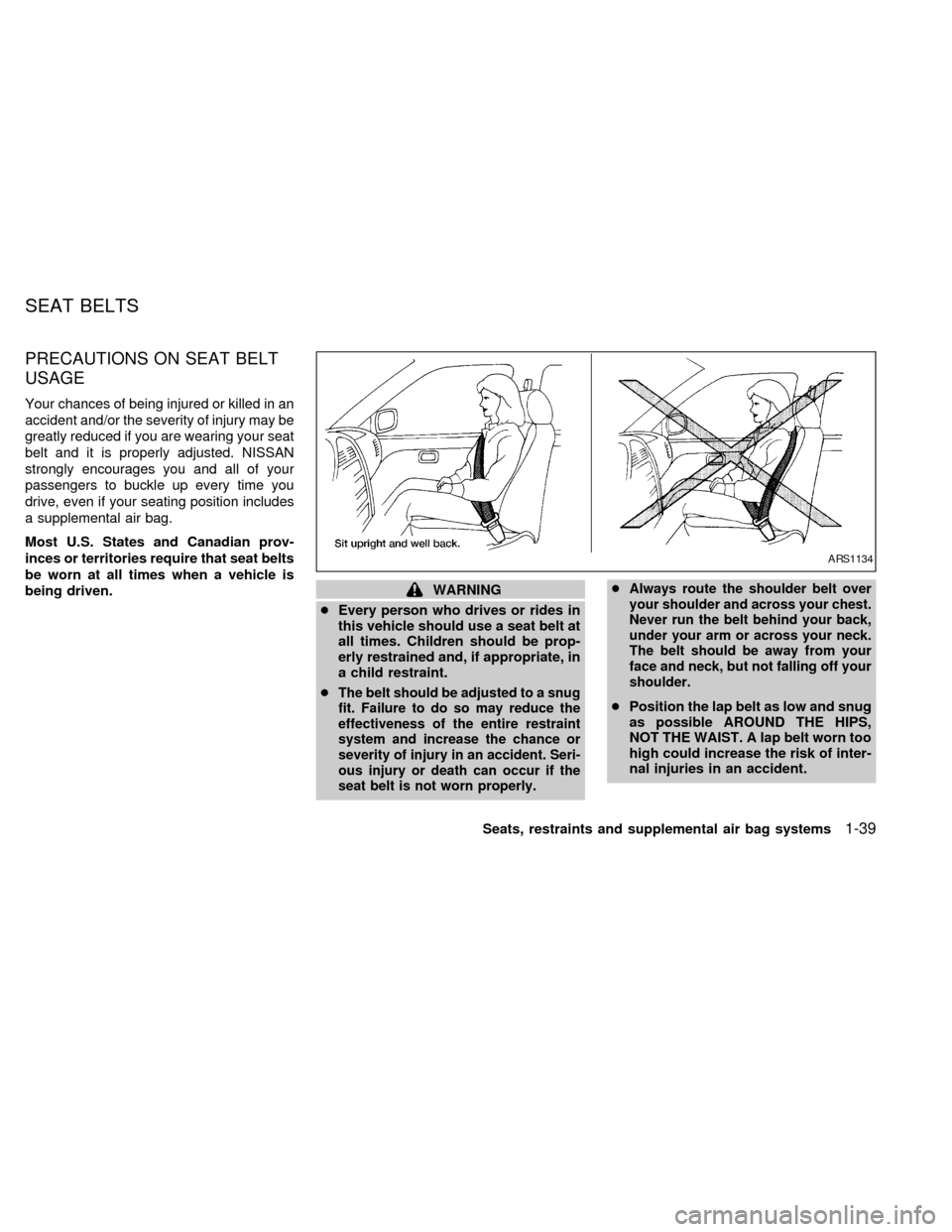
PRECAUTIONS ON SEAT BELT
USAGE
Your chances of being injured or killed in an
accident and/or the severity of injury may be
greatly reduced if you are wearing your seat
belt and it is properly adjusted. NISSAN
strongly encourages you and all of your
passengers to buckle up every time you
drive, even if your seating position includes
a supplemental air bag.
Most U.S. States and Canadian prov-
inces or territories require that seat belts
be worn at all times when a vehicle is
being driven.
WARNING
cEvery person who drives or rides in
this vehicle should use a seat belt at
all times. Children should be prop-
erly restrained and, if appropriate, in
a child restraint.
c
The belt should be adjusted to a snug
fit. Failure to do so may reduce the
effectiveness of the entire restraint
system and increase the chance or
severity of injury in an accident. Seri-
ous injury or death can occur if the
seat belt is not worn properly.cAlways route the shoulder belt over
your shoulder and across your chest.
Never run the belt behind your back,
under your arm or across your neck.
The belt should be away from your
face and neck, but not falling off your
shoulder.cPosition the lap belt as low and snug
as possible AROUND THE HIPS,
NOT THE WAIST. A lap belt worn too
high could increase the risk of inter-
nal injuries in an accident.
ARS1134
SEAT BELTS
Seats, restraints and supplemental air bag systems1-39
ZX
Page 47 of 292
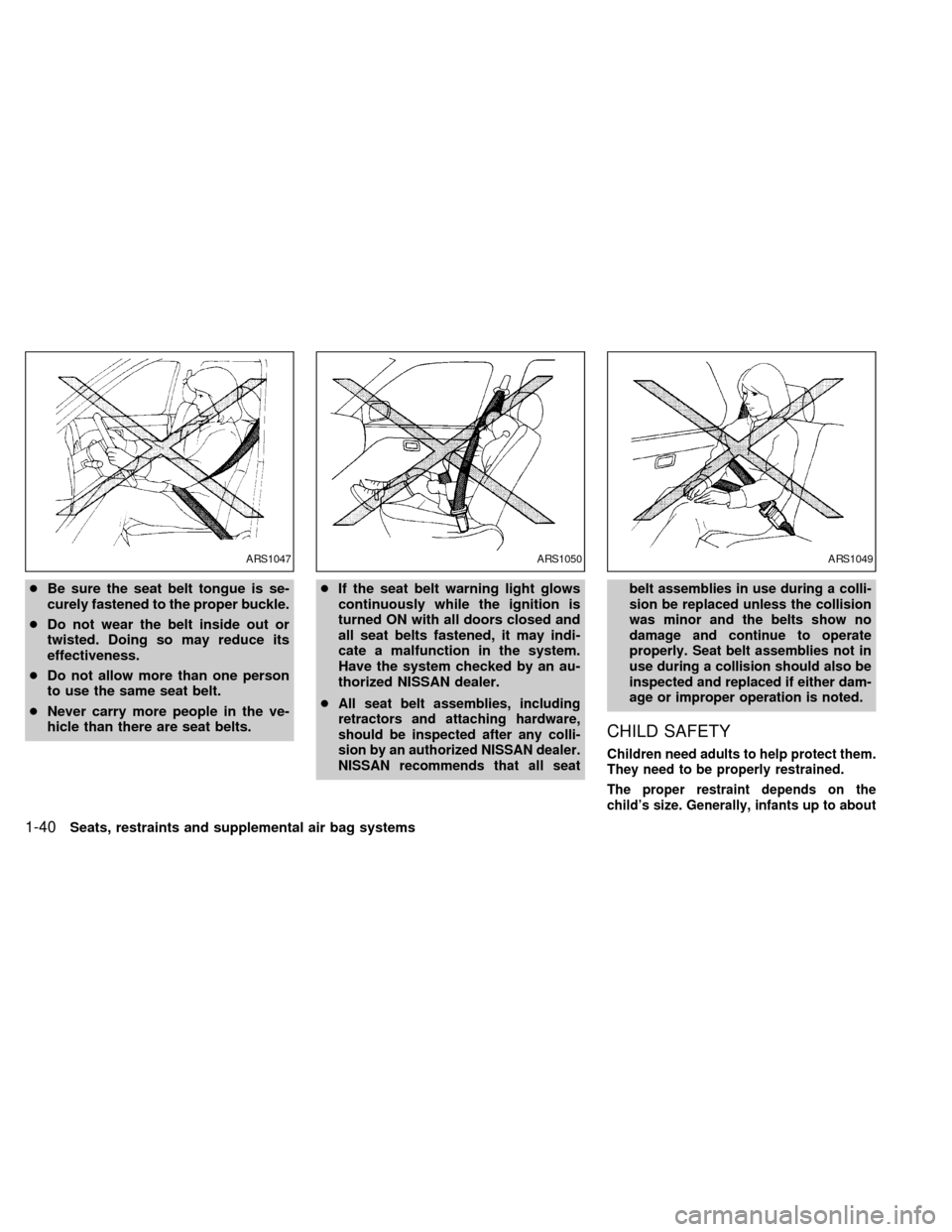
cBe sure the seat belt tongue is se-
curely fastened to the proper buckle.
cDo not wear the belt inside out or
twisted. Doing so may reduce its
effectiveness.
cDo not allow more than one person
to use the same seat belt.
cNever carry more people in the ve-
hicle than there are seat belts.cIf the seat belt warning light glows
continuously while the ignition is
turned ON with all doors closed and
all seat belts fastened, it may indi-
cate a malfunction in the system.
Have the system checked by an au-
thorized NISSAN dealer.
c
All seat belt assemblies, including
retractors and attaching hardware,
should be inspected after any colli-
sion by an authorized NISSAN dealer.
NISSAN recommends that all seatbelt assemblies in use during a colli-
sion be replaced unless the collision
was minor and the belts show no
damage and continue to operate
properly. Seat belt assemblies not in
use during a collision should also be
inspected and replaced if either dam-
age or improper operation is noted.
CHILD SAFETY
Children need adults to help protect them.
They need to be properly restrained.
The proper restraint depends on the
child's size. Generally, infants up to about
ARS1047ARS1050ARS1049
1-40Seats, restraints and supplemental air bag systems
ZX
Page 48 of 292
1 year and less than 20 pounds (9 kg)
should be placed in rear facing child re-
straints. Forward facing child restraints
are available for children who outgrow rear
facing child restraints.
WARNING
Infants and children need special pro-
tection. The vehicle's seat belts may
not fit them properly. The shoulder belt
may come too close to the face or neck.
The lap belt may not fit over their small
hip bones. In an accident, an improp-
erly fitting seat belt could cause seri-
ous or fatal injury. Always use appro-
priate child restraints.
All US States and Canadian provinces re-
quire the use of approved child restraints for
infants and small children. See ``Child re-
straints'' later in this section.
In addition, there are many types of child
restraints available for larger children which
should be used for maximum protection.
NISSAN recommends that all pre-teens
and children be restrained in the rear
seat if possible. According to accident
statistics, children are safer when prop-erly restrained in the rear seat than in the
front seat.
This is especially important because your
vehicle has a supplemental restraint sys-
tem (Air bag system) for the front passen-
ger (For precautions, see ``Supplemental
restraint system'' earlier in this section).
Infants and small children
NISSAN recommends that infants and small
children be placed in a child restraint that
complies with the Federal Motor Vehicle
Safety Standards or Canadian Motor Ve-
hicle Safety Standards. You should choose
a child restraint that fits your vehicle and
always follow the manufacturer's instruc-
tions for installation and use.
Larger children
Children who are too large for child re-
straints should be seated and restrained by
the seat belts which are provided.
If the child's seating position has a shoulder
belt that fits close to the face or neck, the use
of a booster seat (commercially available)
may help overcome this. The booster seat
should raise the child so the shoulder belt is
properly positioned across the top, middle
portion of the shoulder and the lap belt is lowon the hips. The booster seat should fit the
vehicle seat and have a label certifying that
it complies with Federal Motor Vehicle
Safety Standards or Canadian Motor Ve-
hicle Safety Standards. Once the child has
grown enough so the shoulder belt is no
longer on or near the face and neck, use the
shoulder belt without the booster seat.
WARNING
Never let a child stand or kneel on any
seat and do not allow a child in the
cargo areas while the vehicle is mov-
ing. The child could be seriously in-
jured or killed in an accident or sudden
stop.
PREGNANT WOMEN
NISSAN recommends that pregnant women
use seat belts. The seat belt should be worn
snug, and always position the lap belt as
low as possible around the hips, not the
waist. Place the shoulder belt over your
shoulder and across your chest. Never run
the lap/shoulder belt over your abdominal
area. Contact your doctor for specific rec-
ommendations.
Seats, restraints and supplemental air bag systems
1-41
ZX