remove seats NISSAN QUEST 2000 V41 / 2.G User Guide
[x] Cancel search | Manufacturer: NISSAN, Model Year: 2000, Model line: QUEST, Model: NISSAN QUEST 2000 V41 / 2.GPages: 292, PDF Size: 2.48 MB
Page 32 of 292
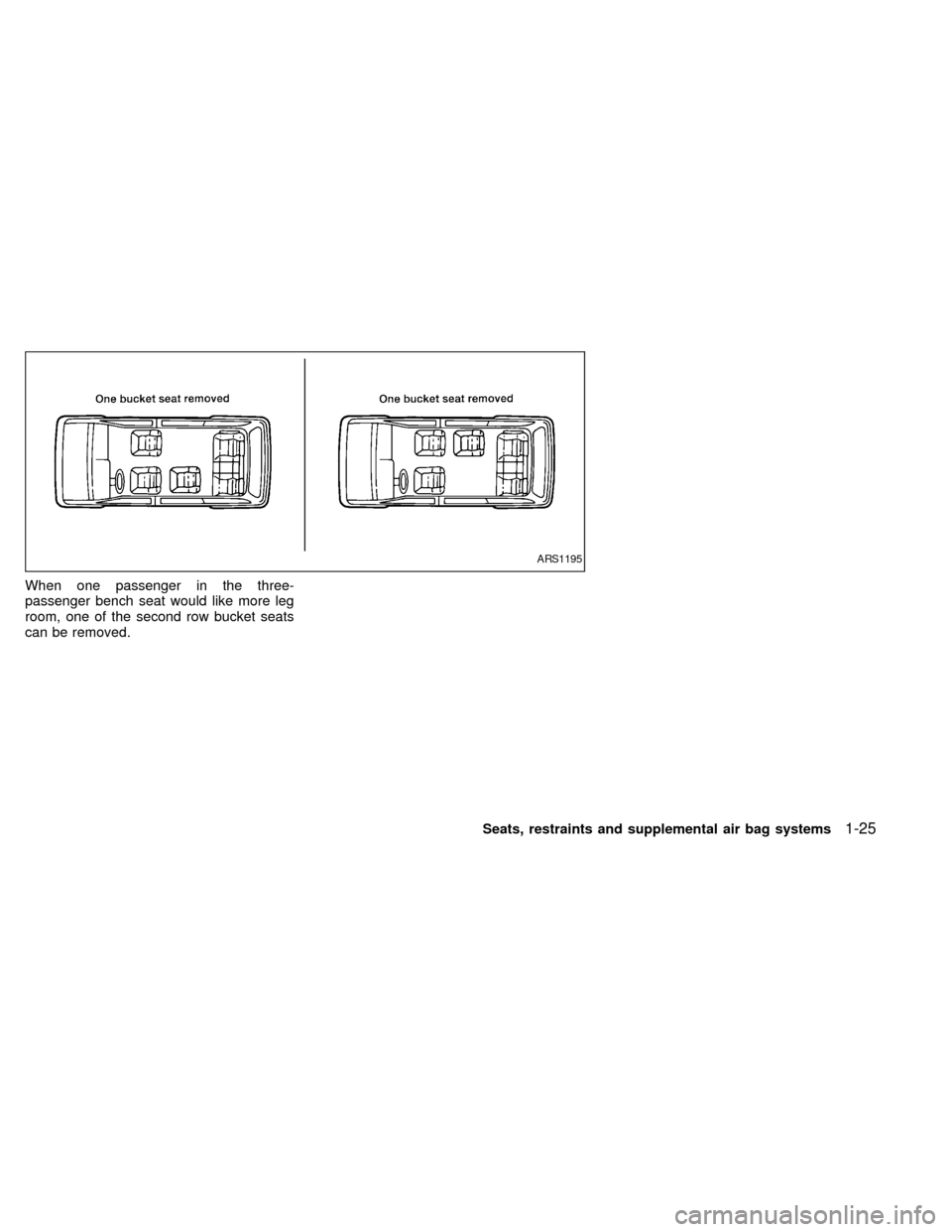
When one passenger in the three-
passenger bench seat would like more leg
room, one of the second row bucket seats
can be removed.
ARS1195
Seats, restraints and supplemental air bag systems1-25
ZX
Page 33 of 292
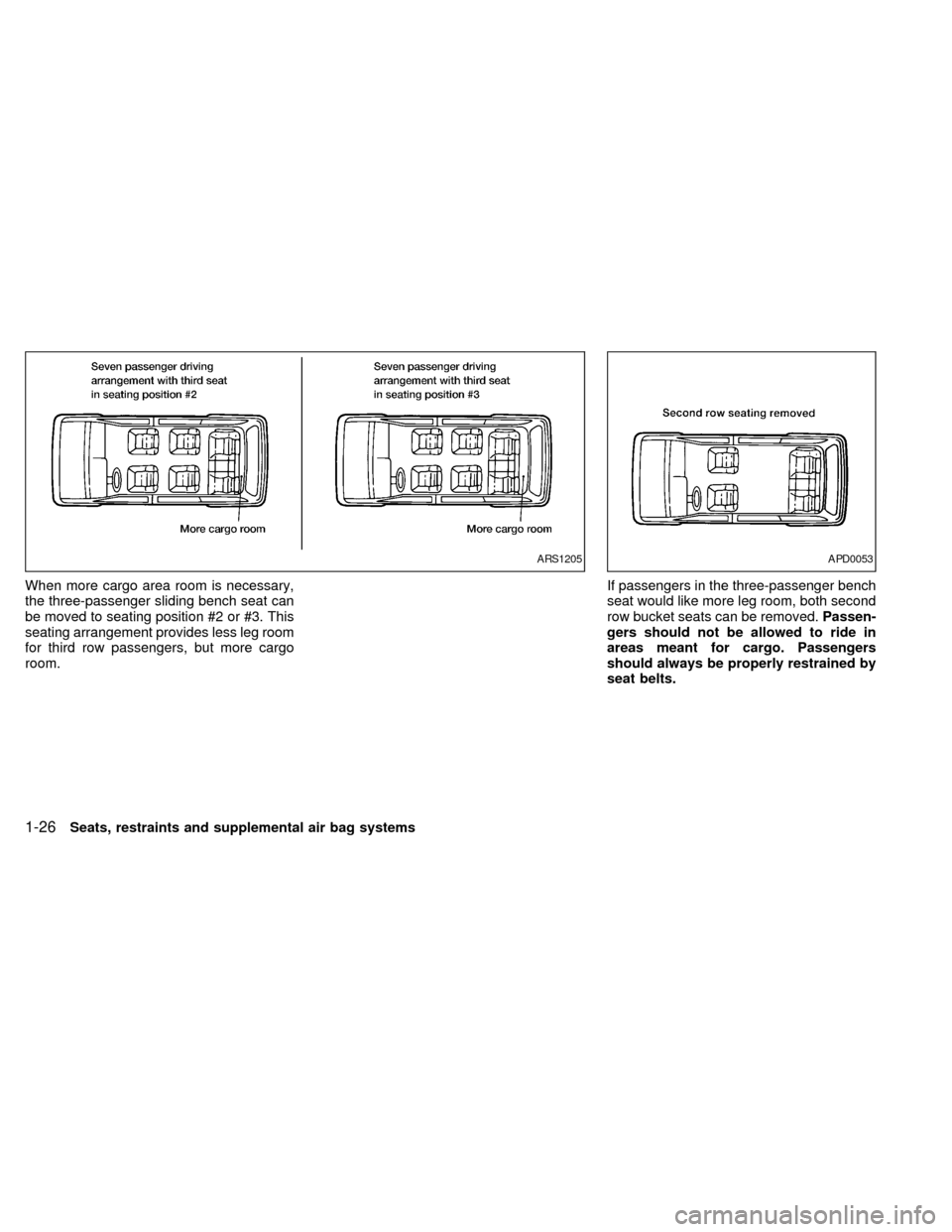
When more cargo area room is necessary,
the three-passenger sliding bench seat can
be moved to seating position #2 or #3. This
seating arrangement provides less leg room
for third row passengers, but more cargo
room.If passengers in the three-passenger bench
seat would like more leg room, both second
row bucket seats can be removed.Passen-
gers should not be allowed to ride in
areas meant for cargo. Passengers
should always be properly restrained by
seat belts.
ARS1205APD0053
1-26Seats, restraints and supplemental air bag systems
ZX
Page 34 of 292
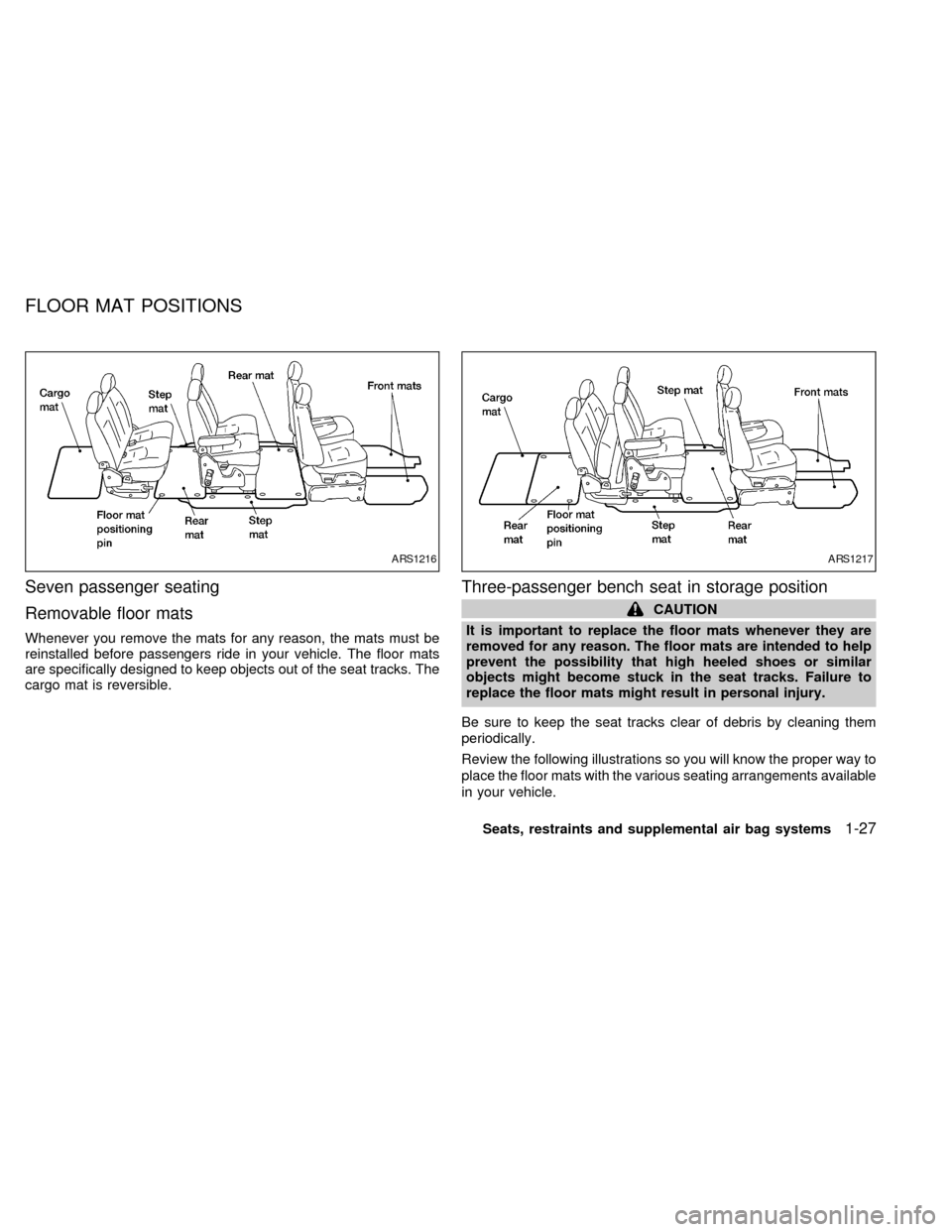
Seven passenger seating
Removable floor mats
Whenever you remove the mats for any reason, the mats must be
reinstalled before passengers ride in your vehicle. The floor mats
are specifically designed to keep objects out of the seat tracks. The
cargo mat is reversible.
Three-passenger bench seat in storage position
CAUTION
It is important to replace the floor mats whenever they are
removed for any reason. The floor mats are intended to help
prevent the possibility that high heeled shoes or similar
objects might become stuck in the seat tracks. Failure to
replace the floor mats might result in personal injury.
Be sure to keep the seat tracks clear of debris by cleaning them
periodically.
Review the following illustrations so you will know the proper way to
place the floor mats with the various seating arrangements available
in your vehicle.
ARS1216ARS1217
FLOOR MAT POSITIONS
Seats, restraints and supplemental air bag systems1-27
ZX
Page 54 of 292
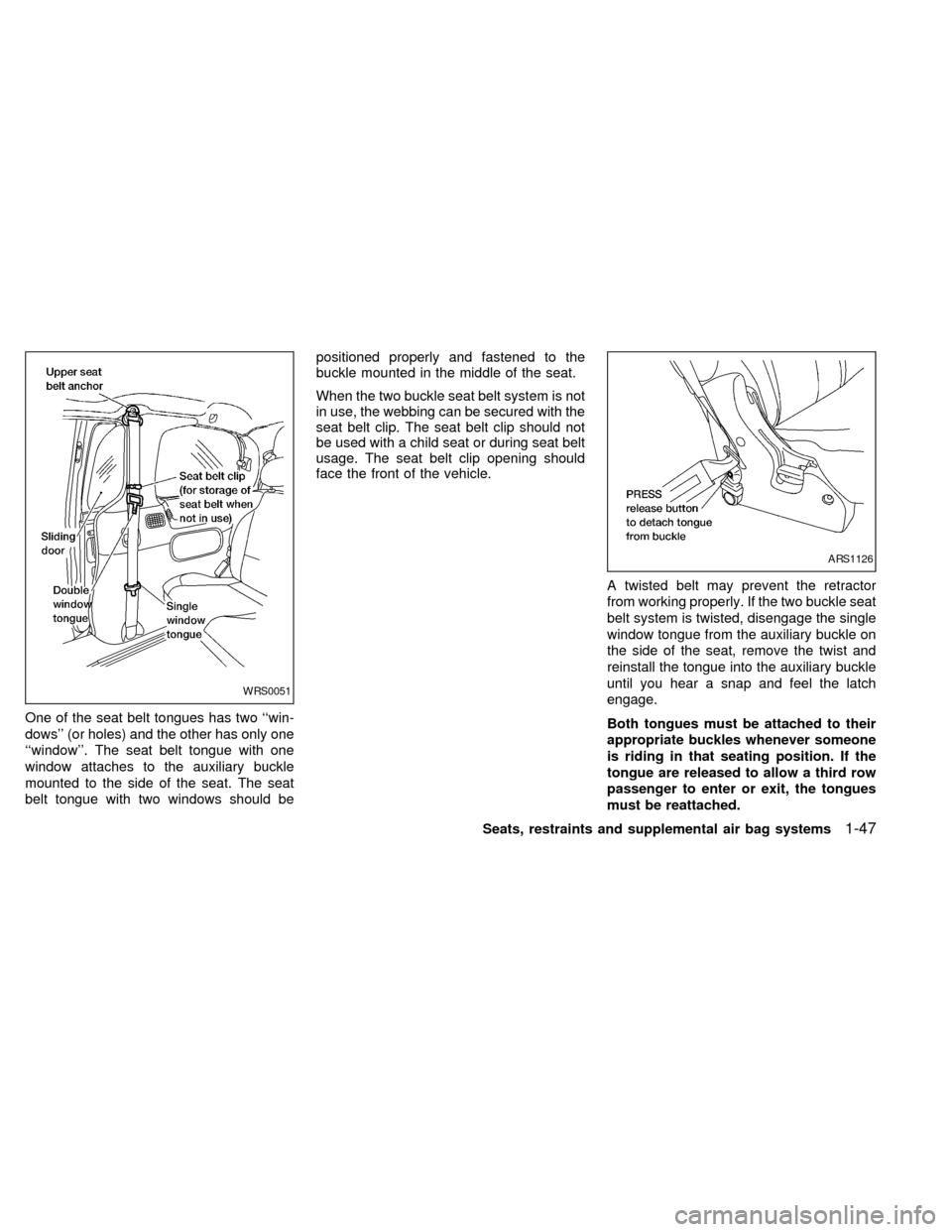
One of the seat belt tongues has two ``win-
dows'' (or holes) and the other has only one
``window''. The seat belt tongue with one
window attaches to the auxiliary buckle
mounted to the side of the seat. The seat
belt tongue with two windows should bepositioned properly and fastened to the
buckle mounted in the middle of the seat.
When the two buckle seat belt system is not
in use, the webbing can be secured with the
seat belt clip. The seat belt clip should not
be used with a child seat or during seat belt
usage. The seat belt clip opening should
face the front of the vehicle.
A twisted belt may prevent the retractor
from working properly. If the two buckle seat
belt system is twisted, disengage the single
window tongue from the auxiliary buckle on
the side of the seat, remove the twist and
reinstall the tongue into the auxiliary buckle
until you hear a snap and feel the latch
engage.
Both tongues must be attached to their
appropriate buckles whenever someone
is riding in that seating position. If the
tongue are released to allow a third row
passenger to enter or exit, the tongues
must be reattached.
WRS0051
ARS1126
Seats, restraints and supplemental air bag systems1-47
ZX
Page 64 of 292
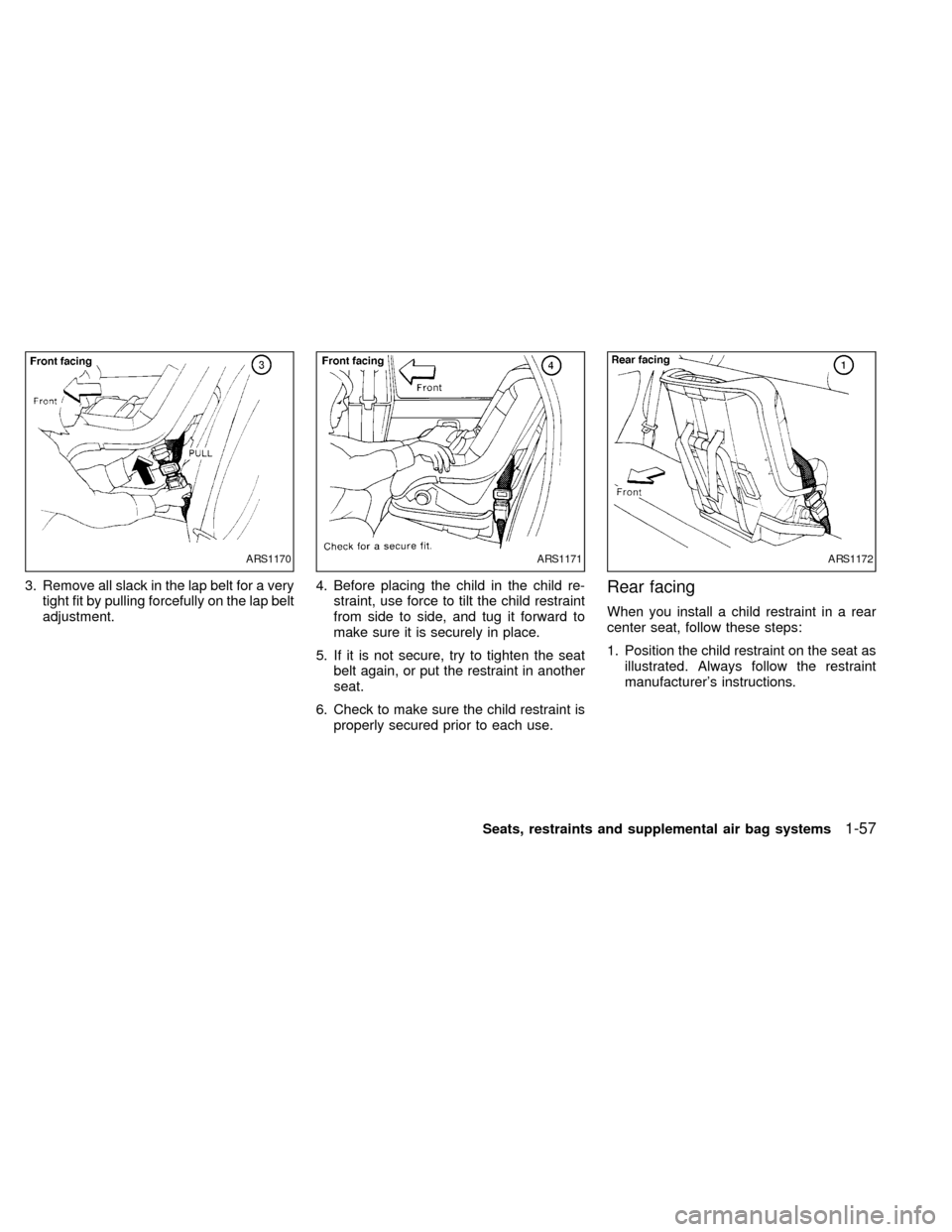
3. Remove all slack in the lap belt for a very
tight fit by pulling forcefully on the lap belt
adjustment.4. Before placing the child in the child re-
straint, use force to tilt the child restraint
from side to side, and tug it forward to
make sure it is securely in place.
5. If it is not secure, try to tighten the seat
belt again, or put the restraint in another
seat.
6. Check to make sure the child restraint is
properly secured prior to each use.Rear facing
When you install a child restraint in a rear
center seat, follow these steps:
1. Position the child restraint on the seat as
illustrated. Always follow the restraint
manufacturer's instructions.
ARS1170ARS1171ARS1172
Seats, restraints and supplemental air bag systems1-57
ZX
Page 65 of 292
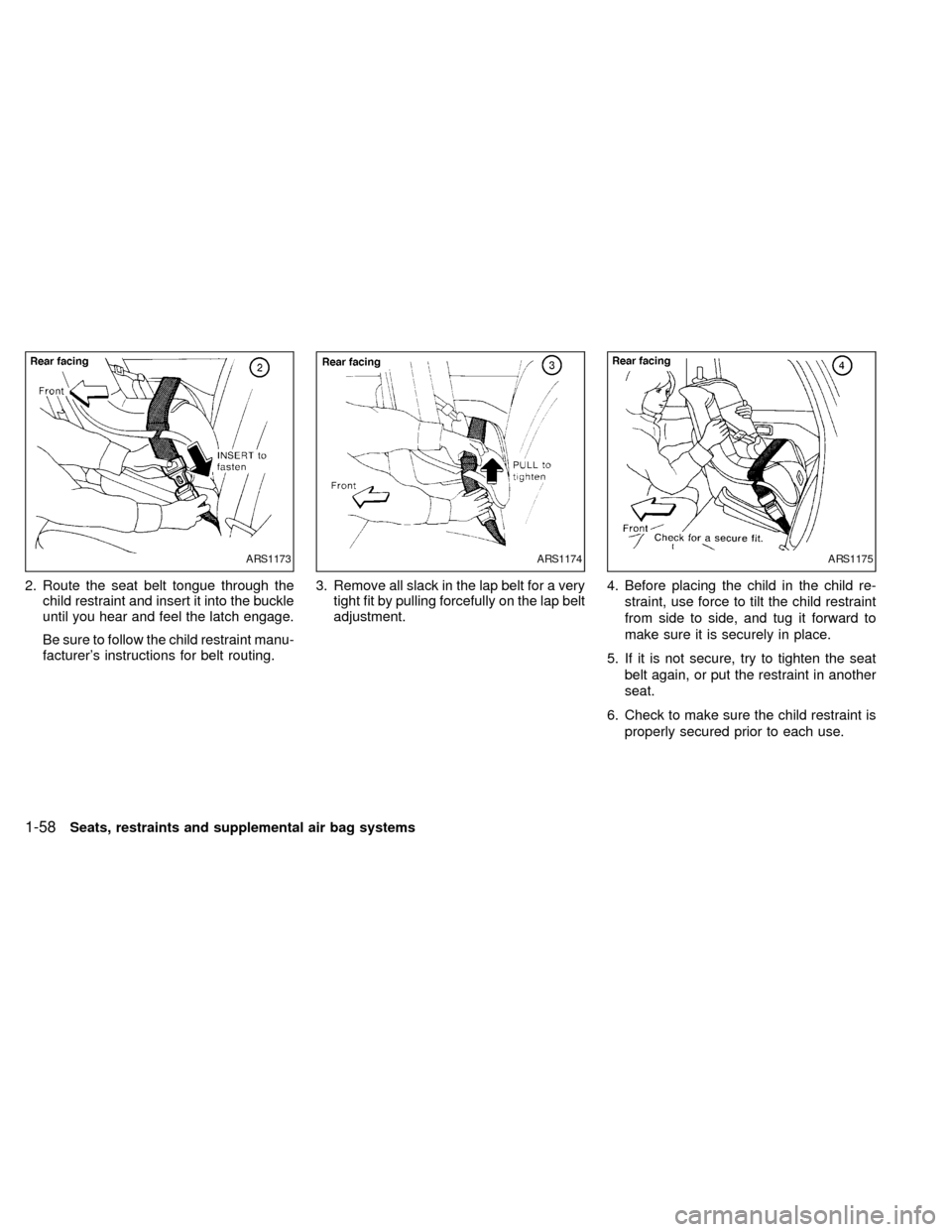
2. Route the seat belt tongue through the
child restraint and insert it into the buckle
until you hear and feel the latch engage.
Be sure to follow the child restraint manu-
facturer's instructions for belt routing.3. Remove all slack in the lap belt for a very
tight fit by pulling forcefully on the lap belt
adjustment.4. Before placing the child in the child re-
straint, use force to tilt the child restraint
from side to side, and tug it forward to
make sure it is securely in place.
5. If it is not secure, try to tighten the seat
belt again, or put the restraint in another
seat.
6. Check to make sure the child restraint is
properly secured prior to each use.
ARS1173ARS1174ARS1175
1-58Seats, restraints and supplemental air bag systems
ZX
Page 67 of 292
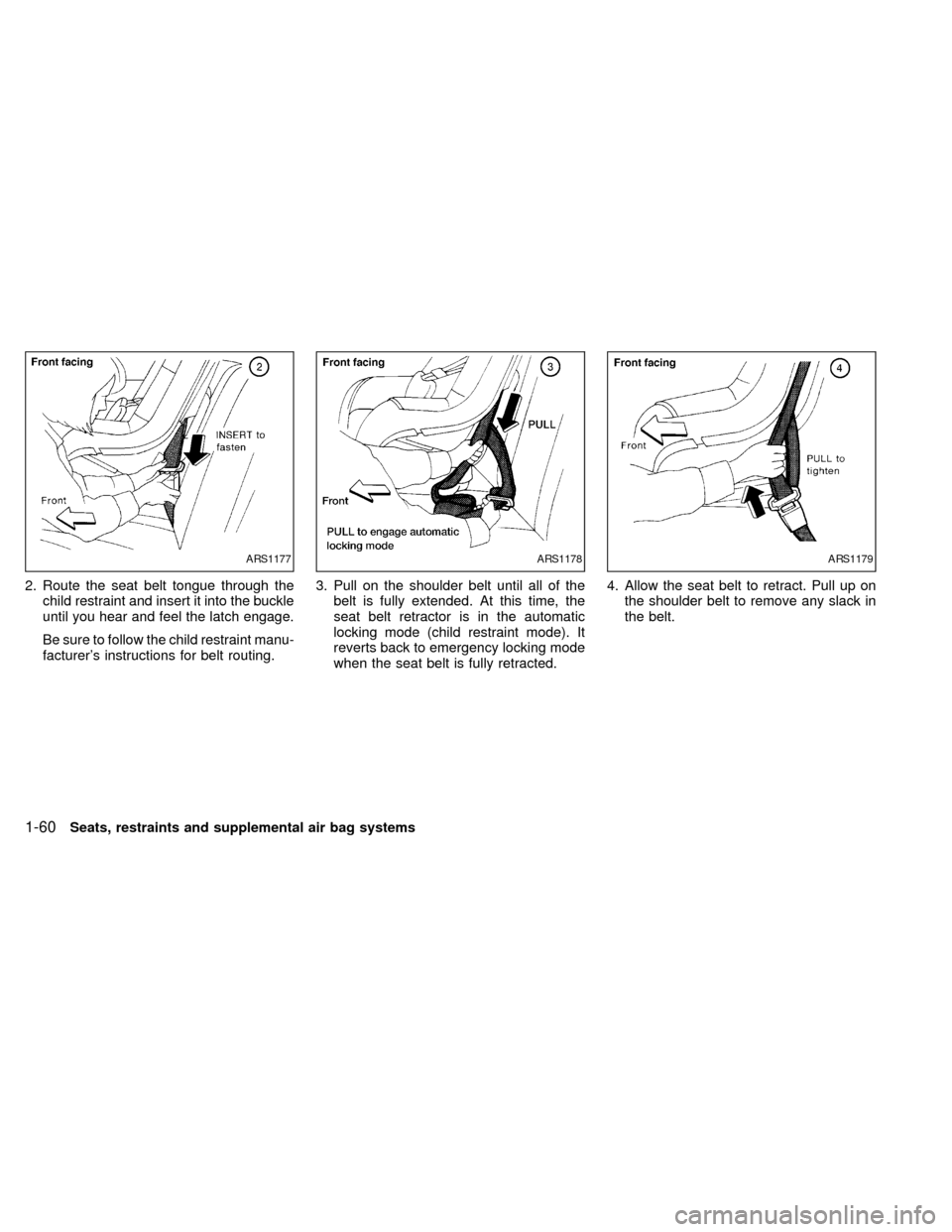
2. Route the seat belt tongue through the
child restraint and insert it into the buckle
until you hear and feel the latch engage.
Be sure to follow the child restraint manu-
facturer's instructions for belt routing.3. Pull on the shoulder belt until all of the
belt is fully extended. At this time, the
seat belt retractor is in the automatic
locking mode (child restraint mode). It
reverts back to emergency locking mode
when the seat belt is fully retracted.4. Allow the seat belt to retract. Pull up on
the shoulder belt to remove any slack in
the belt.
ARS1177ARS1178ARS1179
1-60Seats, restraints and supplemental air bag systems
ZX
Page 68 of 292
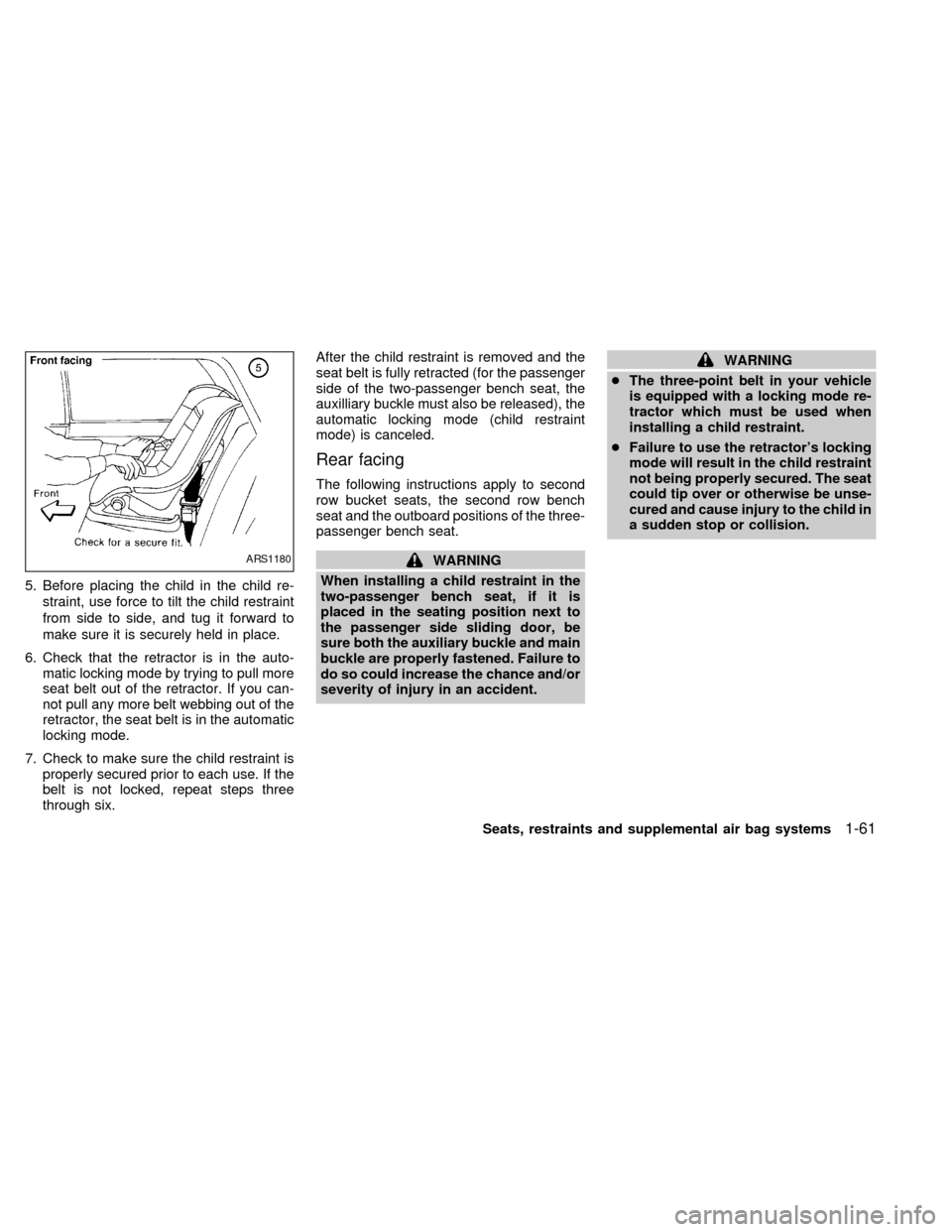
5. Before placing the child in the child re-
straint, use force to tilt the child restraint
from side to side, and tug it forward to
make sure it is securely held in place.
6. Check that the retractor is in the auto-
matic locking mode by trying to pull more
seat belt out of the retractor. If you can-
not pull any more belt webbing out of the
retractor, the seat belt is in the automatic
locking mode.
7. Check to make sure the child restraint is
properly secured prior to each use. If the
belt is not locked, repeat steps three
through six.After the child restraint is removed and the
seat belt is fully retracted (for the passenger
side of the two-passenger bench seat, the
auxilliary buckle must also be released), the
automatic locking mode (child restraint
mode) is canceled.
Rear facing
The following instructions apply to second
row bucket seats, the second row bench
seat and the outboard positions of the three-
passenger bench seat.
WARNING
When installing a child restraint in the
two-passenger bench seat, if it is
placed in the seating position next to
the passenger side sliding door, be
sure both the auxiliary buckle and main
buckle are properly fastened. Failure to
do so could increase the chance and/or
severity of injury in an accident.
WARNING
cThe three-point belt in your vehicle
is equipped with a locking mode re-
tractor which must be used when
installing a child restraint.
cFailure to use the retractor's locking
mode will result in the child restraint
not being properly secured. The seat
could tip over or otherwise be unse-
cured and cause injury to the child in
a sudden stop or collision.
ARS1180
Seats, restraints and supplemental air bag systems1-61
ZX
Page 70 of 292
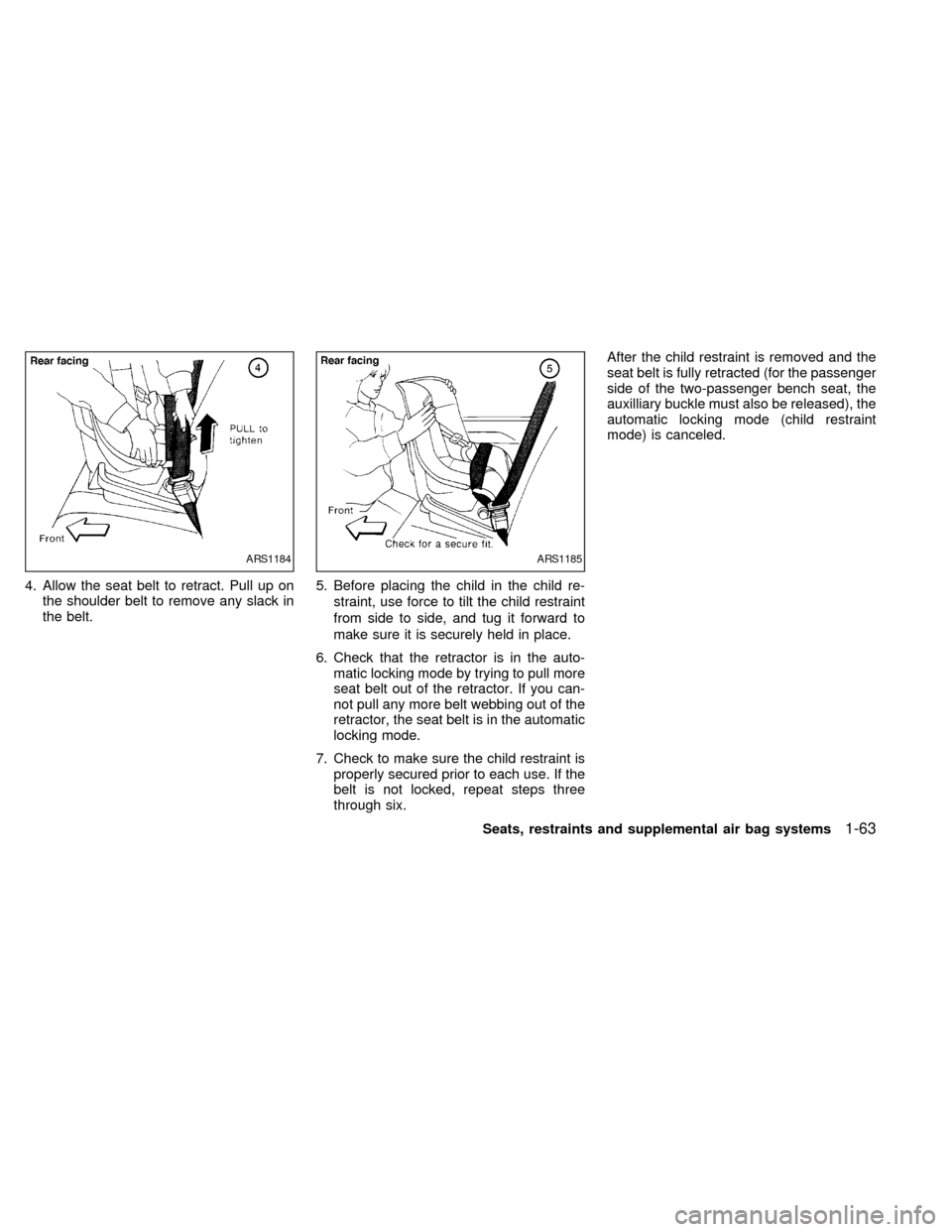
4. Allow the seat belt to retract. Pull up on
the shoulder belt to remove any slack in
the belt.5. Before placing the child in the child re-
straint, use force to tilt the child restraint
from side to side, and tug it forward to
make sure it is securely held in place.
6. Check that the retractor is in the auto-
matic locking mode by trying to pull more
seat belt out of the retractor. If you can-
not pull any more belt webbing out of the
retractor, the seat belt is in the automatic
locking mode.
7. Check to make sure the child restraint is
properly secured prior to each use. If the
belt is not locked, repeat steps three
through six.After the child restraint is removed and the
seat belt is fully retracted (for the passenger
side of the two-passenger bench seat, the
auxilliary buckle must also be released), the
automatic locking mode (child restraint
mode) is canceled.
ARS1184ARS1185
Seats, restraints and supplemental air bag systems1-63
ZX
Page 73 of 292
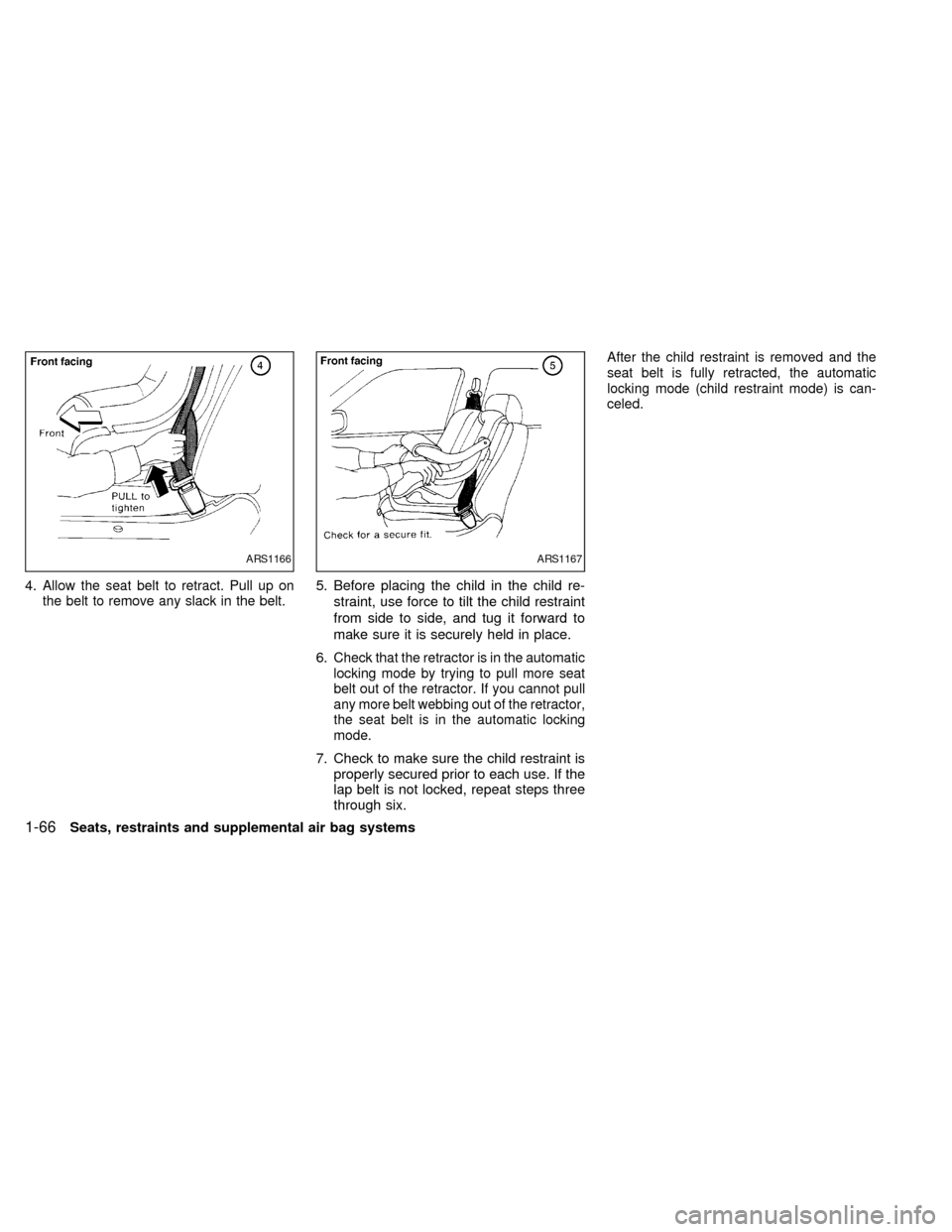
4.Allow the seat belt to retract. Pull up on
the belt to remove any slack in the belt.5. Before placing the child in the child re-
straint, use force to tilt the child restraint
from side to side, and tug it forward to
make sure it is securely held in place.
6.
Check that the retractor is in the automatic
locking mode by trying to pull more seat
belt out of the retractor. If you cannot pull
any more belt webbing out of the retractor,
the seat belt is in the automatic locking
mode.
7. Check to make sure the child restraint is
properly secured prior to each use. If the
lap belt is not locked, repeat steps three
through six.
After the child restraint is removed and the
seat belt is fully retracted, the automatic
locking mode (child restraint mode) is can-
celed.
ARS1166ARS1167
1-66Seats, restraints and supplemental air bag systems
ZX