service NISSAN QUEST 2000 V41 / 2.G Owner's Manual
[x] Cancel search | Manufacturer: NISSAN, Model Year: 2000, Model line: QUEST, Model: NISSAN QUEST 2000 V41 / 2.GPages: 292, PDF Size: 2.48 MB
Page 265 of 292

of the vehicle, for which NISSAN is not
responsible.
Incorrect ignition timing may result in spark
knock, after-run, and/or overheating, which
may cause excessive fuel consumption or
engine damage. If any of the above symp-
toms are encountered, have your vehicle
checked at an authorized NISSAN dealer or
other competent service facility.
However, now and then you may notice
light spark knock for a short time while
accelerating or driving up hills. This is
no cause for concern, because you get
the greatest fuel benefit when there is
light spark knock for a short time under
heavy engine load.
ENGINE OIL AND OIL FILTER
RECOMMENDATION
Selecting the correct oil
It is essential to choose engine oil with the
correct quality and viscosity to ensure sat-
isfactory engine life and performance. NIS-
SAN recommends the use of a low friction
oil (energy conserving oil) in order to im-
prove fuel economy and conserve energy.
Oils which do not have the specified quality
label should not be used as they could
cause engine damage.Only those engine oils with the American
Petroleum Institute (API) CERTIFICATION
MARK on the front of the container should
be used. This type of oil supersedes the
existing API SG, SH, or SJ and Energy
Conserving II categories.
If you cannot find engine oil with the API
CERTIFICATION MARK, use an API grade
SG/SH, Energy Conserving II or API grade
SJ, Energy Conserving oil. An oil with a
single designation SG or SH, or in combi-
nation with other categories (for example,
SG/CC or SG/CD) may also be used if one
ATI0507
10-4Technical and consumer information
ZX
Page 267 of 292
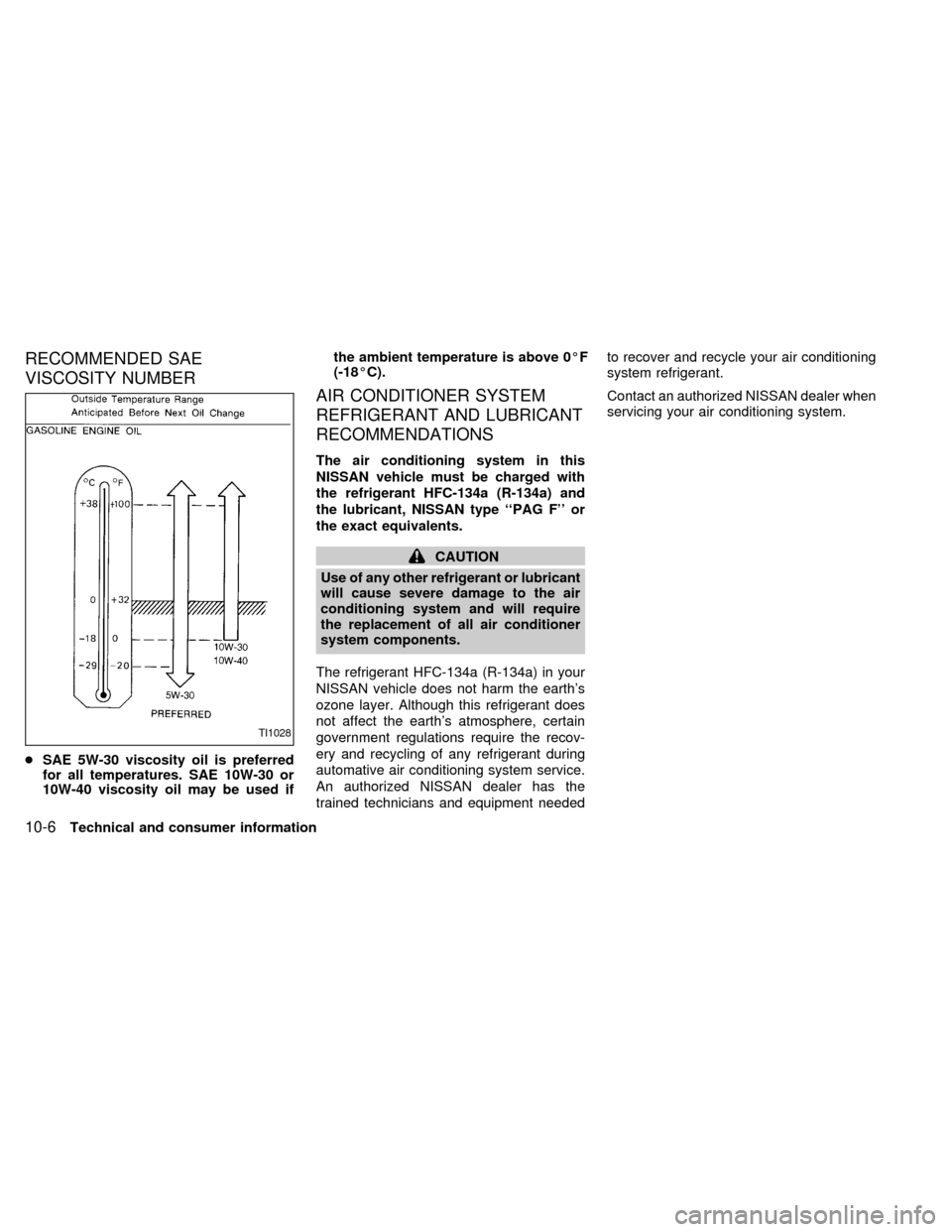
RECOMMENDED SAE
VISCOSITY NUMBER
cSAE 5W-30 viscosity oil is preferred
for all temperatures. SAE 10W-30 or
10W-40 viscosity oil may be used ifthe ambient temperature is above 0ÉF
(-18ÉC).
AIR CONDITIONER SYSTEM
REFRIGERANT AND LUBRICANT
RECOMMENDATIONS
The air conditioning system in this
NISSAN vehicle must be charged with
the refrigerant HFC-134a (R-134a) and
the lubricant, NISSAN type ``PAG F'' or
the exact equivalents.
CAUTION
Use of any other refrigerant or lubricant
will cause severe damage to the air
conditioning system and will require
the replacement of all air conditioner
system components.
The refrigerant HFC-134a (R-134a) in your
NISSAN vehicle does not harm the earth's
ozone layer. Although this refrigerant does
not affect the earth's atmosphere, certain
government regulations require the recov-
ery and recycling of any refrigerant during
automative air conditioning system service.
An authorized NISSAN dealer has the
trained technicians and equipment neededto recover and recycle your air conditioning
system refrigerant.
Contact an authorized NISSAN dealer when
servicing your air conditioning system.
TI1028
10-6Technical and consumer information
ZX
Page 279 of 292
Trailer brakes
If your trailer is equipped with a braking
system, make sure it conforms to Federal
and/or local regulations and it is properly
installed.
WARNING
Never connect a trailer brake system
directly to the vehicle brake system.
Pre-towing tips
cBe certain your vehicle maintains a level
position when a loaded and/or unloaded
trailer is hitched. Do not drive the vehicle
if it has an abnormal nose-up or nose-
down condition; check for improper
tongue load, overload, worn suspension
or other possible causes of either condi-
tion.
cAlways secure items in the trailer to
prevent load shift while driving.
cBe certain your rear view mirrors conform
to all federal, state or local regulations. If
not, install any mirrors required for towing
before driving the vehicle.
Trailer towing tips
In order to gain skill and an understanding
of the vehicle's behavior, you should prac-
tice turning, stopping and backing up in an
area which is free from traffic. Steering,
stability, and braking performance are
somewhat different than under normal driv-
ing conditions.
cAlways secure items in the trailer to
prevent load shift while driving.
c
Avoid abrupt starts, acceleration or stops.
cAvoid sharp turns or lane changes.
cAlways drive your vehicle at a moderate
speed.
cAlways block the wheels on both vehicle
and trailer when parking. Parking on a
slope is not recommended; however, if
you must do so, first block the wheels
and apply the parking brake, and then
move the transmission shift selector le-
ver into the P (Park) position. If you move
the shift selector lever to the P (Park)
position before blocking the wheels and
applying the parking brake, transmission
damage could occur.
cWhen going down a hill, shift into a lowergear and use the engine braking effect.
When ascending a long grade, downshift
the transmission to a lower gear and
reduce speed to reduce chances of en-
gine overloading and/or overheating.
cIf the engine coolant rises to an ex-
tremely high temperature when the air
conditioning system is on, turn the air
conditioner off. Coolant heat can be ad-
ditionally vented by opening the win-
dows, switching the fan control dial to
high and setting the temperature control
dial to the WARM position.
cTrailer towing requires more fuel than
normal circumstances.
cAvoid towing a trailer for the first 500
miles (800 km) of the vehicle's life.
cHave your vehicle serviced more often
than at intervals specified in the recom-
mended Maintenance Schedule.
cWhen making a turn, your trailer wheels
will be closer to the inside of the turn than
your vehicle wheels. To compensate for
this, make a larger than normal turning
radius during the turn.
cCrosswinds and rough roads adversely
10-18Technical and consumer information
ZX
Page 280 of 292
affect vehicle/trailer handling, possibly
causing vehicle sway. When being
passed by larger vehicles, be prepared
for possible changes in crosswinds that
could affect vehicle handling. If swaying
does occur, firmly grip the steering
wheel, steer straight ahead, and immedi-
ately (but gradually) reduce vehicle
speed. This combination helps to stabi-
lize the vehicle. Never increase speed.
cBe careful when passing other vehicles.
Passing while towing a trailer requires
considerably more distance than normal
passing. Remember the length of the
trailer must also pass the other vehicle
before you can safely change lanes.
cTo maintain engine braking efficiency
and electrical charging performance, do
not use overdrive.
cAvoid holding the brake pedal down too
long or too frequently. This could cause
the brakes to overheat, resulting in re-
duced braking efficiency.
When towing a trailer, change fluid in the
transmission more frequently. For addi-
tional information see the ``Mainte-
nance'' section earlier in this manual.Department of Transportation (DOT) Qual-
ity Grades: All passenger car tires must
conform to Federal Safety Requirements in
addition to these grades.
Quality grades can be found where appli-
cable on the tire sidewall between tread
shoulder and maximum section width. For
example:
Treadwear 200 Traction AA Temperature A
Treadwear
Treadwear grade is a comparative rating
based on tire wear rate when tested under
controlled conditions on specified govern-
ment test courses. For example, a tire
graded 150 would wear one and a half
(1-1/2) times as well on the government
course as a tire graded 100. However,
relative tire performance depends on actual
driving conditions, and may vary signifi-
cantly, due to variations in driving habits,
service practices and differences in road
characteristics and climate.
Traction AA, A, B and C
The traction grades, from highest to lowest,
are AA, A, B, and C. Those grades repre-
sent the tire's ability to stop on wet pave-ment as measured under controlled condi-
tions, on specified government test surfaces
of asphalt and concrete. A tire marked C
may have poor traction performance.
WARNING
The traction grade assigned to your ve-
hicle tires is based on straight-ahead
braking traction tests, and does not in-
clude acceleration, cornering, hydro-
planing, or peak traction characteristics.
Temperature A, B and C
Temperature grades are A (the highest), B,
and C. They represent a tire's resistance to
heat build-up, and its ability to dissipate
heat when tested under controlled condi-
tions on a specified indoor laboratory test
wheel. Sustained high temperature can
cause tire material to degenerate, reducing
tire life. Excessive temperatures can lead to
sudden tire failure. Grade C corresponds to
a performance level which all passenger car
tires must meet under the Federal Motor
Vehicle Safety Standard No. 109. Grades A
and B represent higher levels of perfor-
mance on laboratory test wheels than the
minimum required by law.
UNIFORM TIRE QUALITY
GRADING
Technical and consumer information10-19
ZX
Page 283 of 292

OWNER'S MANUAL/SERVICE
MANUAL ORDER INFORMATION
A genuine NISSAN Service Manual is the
best source of service and repair informa-
tion for your vehicle. Filled with wiring dia-
grams, illustrations and step-by-step diag-
nostic and adjustment procedures, this
manual is the same one used by the factory
trained technicians working at authorized
NISSAN dealerships. Also available are
genuine NISSAN Owner's Manuals, and
genuine NISSAN Service and Owner's
Manuals for older NISSAN models.
In the USA:
For current pricing and availability of genu-
ineNISSAN Service Manualsfor the 2000
model year, contact:
Tweddle Litho Company
1-800-639-8841
www.nissan-techinfo.com
For current pricing and availability of genu-
ineNISSAN Service Manualsfor the 1999
model year and prior, see an authorized
NISSAN dealer, or contact:
Dyment Distribution Services
20770 Westwood Road
Strongsville OH 44136
1-800-247-5321
10-22Technical and consumer information
ZX
Page 284 of 292

For current pricing and availability of genu-
ineNISSAN Owner's Manualsfor the 2000
model year and prior, see an authorized
NISSAN dealer, or contact:
Dyment Distribution Services
20770 Westwood Road
Strongsville OH 44136
1-800-247-5321
In Canada:
To purchase a copy of a Genuine NISSAN
Service Manual or Owner's Manual please
contact your nearest NISSAN Dealer. For the
phone number and location of a NISSAN
Dealer in your area call the NISSAN Satisfac-
tion Center at 1-800-387-0122 and a bilingual
NISSAN representative will assist you.
Also available are Genuine NISSAN Service
and Owner's Manuals for older NISSAN
models.
Technical and consumer information10-23
ZX
Page 286 of 292

11 Index
A
Accident
Interia fuel shut-off switch .................... 6-11
After an accident........................................ 6-11
Air bag (See supplemental restraint
system) ...................................................... 1-31
Air bag warning light .................................. 1-37
Air cleaner housing filter ............................ 8-13
Air conditioner
Air conditioner operation ........................ 4-5
Air conditioner service .......................... 4-15
Air conditioner specification label ....... 10-12
Air conditioner system refrigerant and
lubrication recommendations ................ 10-6
Heater and air conditioner (automatic)
(if so equipped)..................................... 4-11
Heater and air conditioner (manual)....... 4-3
Rear seat air conditioner ...................... 4-14
Air filter
Cabin air filter ....................................... 8-14
Air flow charts .............................................. 4-7
Alarm system (See theft warning) ............. 2-10
Anti-lock brake system (ABS).................... 5-15
Anti-lock brake warning light ....................... 2-8
Armrests..................................................... 1-11
Ashtray (See cigarette lighter and
ashtray) ...................................................... 2-19Audio system
Compact disc (CD) player ........... 4-28, 4-30
FM-AM radio with cassette player ........ 4-16
FM-AM radio with cassette player and
compact disc (CD) player ..................... 4-22
Autolamp switch......................................... 2-15
Automatic
Automatic power window switch .......... 2-28
Automatic transmission fluid (ATF) ........ 8-8
Driving with automatic transmission ....... 5-6
Transmission selector lever lock
release .................................................... 5-6
B
Battery........................................................ 8-10
Battery replacement (See multi-remote
control system) ............................................ 3-8
Before starting the engine ........................... 5-5
Brake
Anti-lock brake system (ABS) .............. 5-15
Brake booster ....................................... 8-20
Brake fluid ..................................... 10-2, 8-9
Brake light (See stop light) ................... 8-24
Brake pedal .......................................... 8-19
Brake system ........................................ 5-14
Brake warning light ................................. 2-7
Brake wear indicators ........................... 2-10Parking brake check ............................. 8-19
Parking brake operation ......................... 5-9
Self-adjusting brakes ............................ 8-19
Break-in schedule ...................................... 5-11
Bulb check/instrument panel ....................... 2-6
Bulb replacement ....................................... 8-24
C
Cabin air filter ............................................ 8-14
Capacities and recommended fuel/
lubricants.................................................... 10-2
Car phone or CB radio .............................. 4-35
Cargo net ................................................... 2-24
Cargo (See vehicle loading
information) .............................................. 10-13
Check engine indicator light
(See malfunction indicator light) .................. 2-9
Child restraint with top tether strap ........... 1-67
Child restraints ........................................... 1-54
Child safety sliding door lock....................... 3-5
Cigarette lighter (accessory)
and ashtray ................................................ 2-19
Cleaning exterior and interior ...................... 7-2
Clock................................................. 4-18, 4-24
Cold weather driving .................................. 5-16
Compact disc (CD) player ................ 4-28, 4-30
ZX
Page 289 of 292

M
Maintenance
General maintenance ............................. 9-2
Inside the vehicle.................................... 9-3
Maintenance precautions ....................... 8-2
Outside the vehicle ................................. 9-2
Periodic maintenance schedules ............ 9-5
Seat belt maintenance.......................... 1-54
Under the hood and vehicle ................... 9-4
Malfunction indicator lamp (MIL) ................. 2-9
Manual front seat adjustment ...................... 1-3
Manual vent windows ................................ 2-29
Map lights .................................................. 2-32
Map pocket ................................................ 2-20
Mirror
Outside mirrors ..................................... 3-15
Vanity mirror ......................................... 3-12
Multi-remote control system ........................ 3-6
Multi-remote controller battery
replacement ............................................... 8-22
O
Odometer ..................................................... 2-4
Oil
Capacities and recommended fuel/
lubricants .............................................. 10-2
Changing engine oil................................ 8-6
Changing engine oil filter........................ 8-7
Checking engine oil level ....................... 8-5Engine oil ................................................ 8-5
Engine oil and oil filter
recommendation ................................... 10-4
Engine oil viscosity ............................... 10-5
Outside mirrors .......................................... 3-15
Overdrive switch .......................................... 5-8
Overheat
If your vehicle overheats ...................... 6-10
Owner's manual/service manual order
information ............................................... 10-22
P
Parcel Shelf ............................................... 2-25
Parking
Parking brake check ............................. 8-19
Parking brake operation ......................... 5-9
Parking/parking on hills ........................ 5-13
Periodic maintenance schedules ................. 9-5
Personal reading light ................................ 2-31
Power
Power door locks ............................ 3-2, 3-4
Power steering fluid ...................... 10-2, 8-9
Power support front seat ........................ 1-4
Power vent windows............................. 2-29
Power windows..................................... 2-27
Precautions
Maintenance precautions ....................... 8-2
Precautions on seat belt usage............ 1-39
Precautions when starting and driving ... 5-2
Push starting .............................................. 6-10R
Radio
Car phone or CB radio ......................... 4-35
FM-AM radio with cassette player ........ 4-16
FM-AM radio with cassette player and
compact disc (CD) player ..................... 4-22
Readiness for inspection maintenance
(I/M) test................................................... 10-21
Rear door ................................................... 3-10
Rear door lock ........................................... 3-10
Rear power socket..................................... 2-18
Rear seat air conditioner ........................... 4-14
Rear window defogger switch ................... 2-14
Rear window wiper and washer
switches ..................................................... 2-13
Refrigerant recommendation ..................... 10-6
Registering your vehicle in another
country ..................................................... 10-10
Remote keyless entry system
(See multi-remote control system) .............. 3-6
Removing and installing the second row
bench seat ................................................. 1-12
Reporting safety defects (USA) ............... 10-20
S
Safety
Child safety sliding door lock ................. 3-5
Reporting safety defects (USA) .......... 10-20
Seat belt
Precautions on seat belt usage............ 1-39
11-4
ZX