engine NISSAN QUEST 2000 V41 / 2.G Manual PDF
[x] Cancel search | Manufacturer: NISSAN, Model Year: 2000, Model line: QUEST, Model: NISSAN QUEST 2000 V41 / 2.GPages: 292, PDF Size: 2.48 MB
Page 259 of 292

Additional information on the following
items with an ``*'' is found in the ``Do-it-
yourself operations'' section of this
manual.
Emission control system
maintenance
Drive belts* ÐCheck drive belts for wear,
fraying or cracking and also for proper ten-
sion. Replace any damaged drive belts.
Air cleaner filter ÐUnder normal driving
conditions, the air cleaner filter should be
replaced in accordance with the maintenance
schedule. However, driving the vehicle in
dusty areas may cause rapid clogging of the
element. Consequently, the element may
have to be replaced more frequently.
EVAP vapor lines ÐCheck vapor lines
and connections for leaks, looseness or
deterioration. If leaks are found, replace
them.
Fuel lines ÐCheck the fuel hoses, piping
and connections for leaks, looseness or
deterioration. Replace any damaged parts.
Fuel filter ÐIf the vehicle is operated under
extremely adverse weather conditions or in
areas where ambient temperatures are ei-ther extremely low or extremely high, the
filter might become clogged. In such an
event, replace the filter immediately.
Engine coolant* ÐChanging engine cool-
ant can be performed by your NISSAN
dealer or procedures can be found in the
Service Manual. Improper air relief after
changing coolant can result in reduced
heater performance and overheating.
Engine oil & oil filter* ÐUnder normal
driving conditions, the engine oil and oil filter
should be replaced in accordance with the
maintenance schedule. However, under se-
vere driving conditions, they may have to be
replaced more frequently.
Spark plugs* ÐReplace with new plugs
having the correct heat range.
Timing belt ÐReplace the timing belt for
driving the camshaft.
Chassis and body maintenance
Brake lines & cables ÐCheck the brake
lines and hoses (including brake booster
vacuum hoses, connections & check valve)
and parking brake cables for proper attach-
ment, leaks, cracks, chafing, abrasion, de-
terioration, etc.Brake pads, rotors, drums & linings Ð
Check these and the other brake compo-
nents for wear, deterioration and leaks. Un-
der severe driving conditions, they may
have to be inspected more frequently.
Automatic transmission fluid* ÐCheck
the fluid level and visually inspect for signs
of leakage.
Under severe driving conditions, the fluid
should be replaced at the specified interval.
Steering gear & linkage, axle & suspen-
sion parts, and drive axle shaft boots Ð
Check for damage, looseness and leakage of
oil or grease. Under severe driving condi-
tions, they may have to be inspected more
frequently.
Exhaust system ÐVisually check the ex-
haust pipes, muffler, and hangers for proper
attachment, leaks, cracks, chafing, abra-
sion, deterioration, etc. Under severe driv-
ing conditions, inspection should be per-
formed more frequently.
Supplemental air bag system ÐCheck
the supplemental air bag system compo-
nents for proper attachment, damage, de-
formities, cracks, rust, etc. Work around and
EXPLANATION OF
MAINTENANCE ITEMS
9-10Maintenance
ZX
Page 262 of 292

10 Technical and consumer information
Capacities and recommended fuel/lubricants ......10-2
Fuel recommendation...........................................10-2
Engine oil and oil filter recommendation..............10-4
Recommended SAE viscosity number.................10-6
Air conditioner system refrigerant and
lubricant recommendations ..................................10-6
Specifications .......................................................10-7
Engine ..................................................................10-7
Wheels and tires ..................................................10-9
Dimensions and weights ......................................10-9
When traveling or registering your vehicle in
another country ..................................................10-10
Vehicle identification ..........................................10-10
Vehicle identification number (VIN) plate...........10-10
Vehicle identification number
(chassis number) ................................................10-10
Engine serial number .........................................10-11
F.M.V.S.S. certification label ..............................10-11
Emission control information label .....................10-11Tire placard ........................................................10-12
Air conditioner specification label.......................10-12
Installing front license plate................................10-12
Vehicle loading information ................................10-13
Terms .................................................................10-13
Determining vehicle load capacity .....................10-13
Loading tips ........................................................10-13
Towing a trailer...................................................10-14
Maximum load limts ...........................................10-14
Towing safety .....................................................10-15
Uniform tire quality grading ................................10-19
Emission control system warranty .....................10-20
Reporting safety defects (US only) ....................10-20
Readiness for inspection/maintenance (I/M)
test (US only) .....................................................10-21
Owner's manual/service manual order
information ..........................................................10-22
ZX
Page 263 of 292
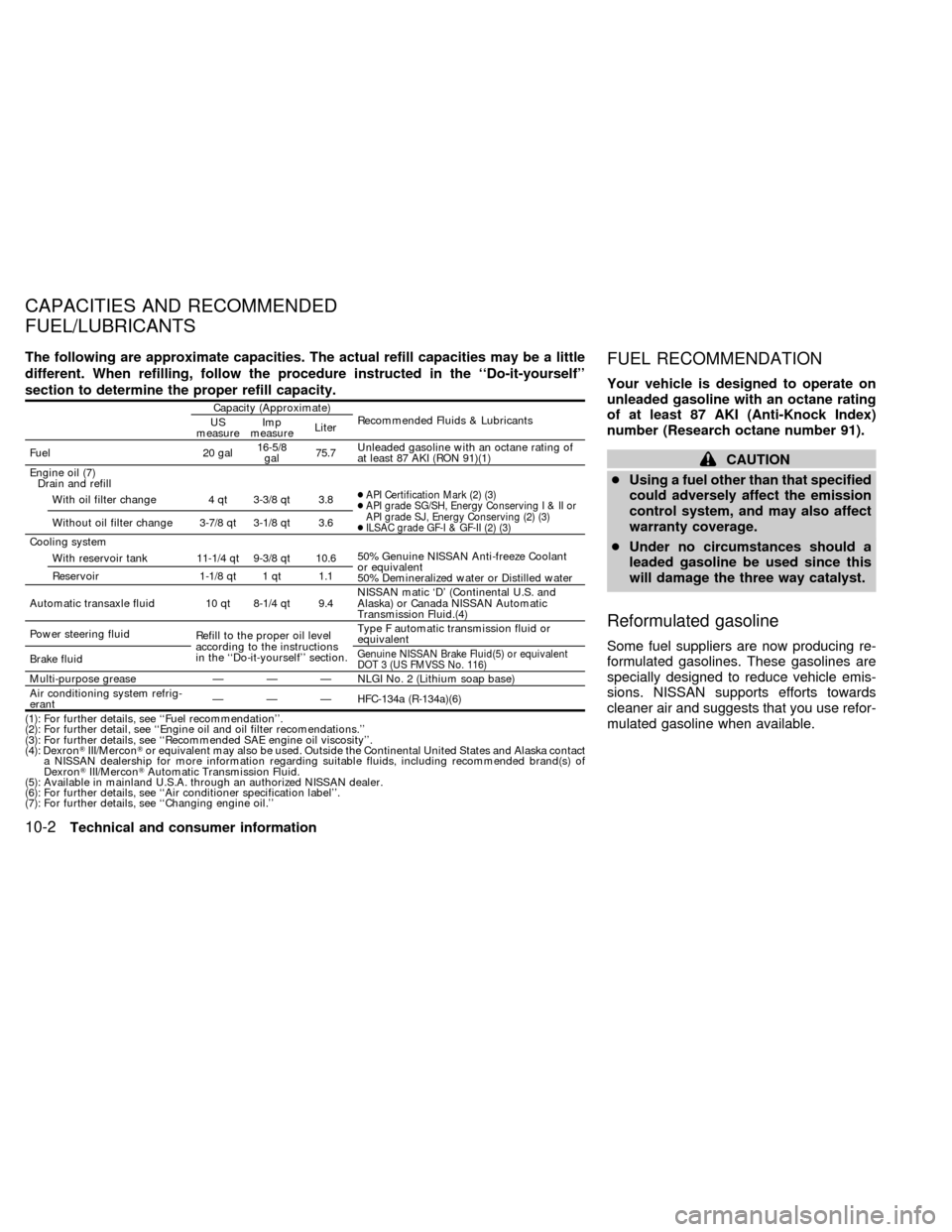
The following are approximate capacities. The actual refill capacities may be a little
different. When refilling, follow the procedure instructed in the ``Do-it-yourself''
section to determine the proper refill capacity.
Capacity (Approximate)
Recommended Fluids & Lubricants
US
measureImp
measureLiter
Fuel 20 gal16-5/8
gal75.7Unleaded gasoline with an octane rating of
at least 87 AKI (RON 91)(1)
Engine oil (7)
Drain and refill
With oil filter change 4 qt 3-3/8 qt 3.8
cAPI Certification Mark (2) (3)
cAPI grade SG/SH, Energy ConservingI&IIor
API grade SJ, Energy Conserving (2) (3)
cILSAC grade GF-I & GF-II (2) (3)
Without oil filter change 3-7/8 qt 3-1/8 qt 3.6
Cooling system
With reservoir tank 11-1/4 qt 9-3/8 qt 10.650% Genuine NISSAN Anti-freeze Coolant
or equivalent
50% Demineralized water or Distilled water Reservoir 1-1/8 qt 1 qt 1.1
Automatic transaxle fluid 10 qt 8-1/4 qt 9.4NISSAN matic `D' (Continental U.S. and
Alaska) or Canada NISSAN Automatic
Transmission Fluid.(4)
Power steering fluid
Refill to the proper oil level
according to the instructions
in the ``Do-it-yourself'' section.Type F automatic transmission fluid or
equivalent
Brake fluid
Genuine NISSAN Brake Fluid(5) or equivalent
DOT 3 (US FMVSS No. 116)
Multi-purpose grease Ð Ð Ð NLGI No. 2 (Lithium soap base)
Air conditioning system refrig-
erantÐ Ð Ð HFC-134a (R-134a)(6)
(1): For further details, see ``Fuel recommendation''.
(2): For further detail, see ``Engine oil and oil filter recomendations.''
(3): For further details, see ``Recommended SAE engine oil viscosity''.
(4): DexronTIII/MerconTor equivalent may also be used. Outside the Continental United States and Alaska contact
a NISSAN dealership for more information regarding suitable fluids, including recommended brand(s) of
DexronTIII/MerconTAutomatic Transmission Fluid.
(5): Available in mainland U.S.A. through an authorized NISSAN dealer.
(6): For further details, see ``Air conditioner specification label''.
(7): For further details, see ``Changing engine oil.''
FUEL RECOMMENDATION
Your vehicle is designed to operate on
unleaded gasoline with an octane rating
of at least 87 AKI (Anti-Knock Index)
number (Research octane number 91).
CAUTION
cUsing a fuel other than that specified
could adversely affect the emission
control system, and may also affect
warranty coverage.
cUnder no circumstances should a
leaded gasoline be used since this
will damage the three way catalyst.
Reformulated gasoline
Some fuel suppliers are now producing re-
formulated gasolines. These gasolines are
specially designed to reduce vehicle emis-
sions. NISSAN supports efforts towards
cleaner air and suggests that you use refor-
mulated gasoline when available.
CAPACITIES AND RECOMMENDED
FUEL/LUBRICANTS
10-2Technical and consumer information
ZX
Page 264 of 292

Gasoline containing oxygenates
Some fuel suppliers sell gasoline containing
oxygenates such as ethanol, MTBE and
methanol with or without advertising their
presence. NISSAN does not recommend
the use of fuels of which the oxygenate
content and the fuel compatibility for your
vehicle cannot be readily determined. If in
doubt, ask your service station manager.
If you use oxygenate-blend gasoline, please
take the following precautions as the usage
of such fuels may cause vehicle perfor-
mance problems and/or fuel system dam-
age.
cThe fuel should be unleaded and have
an octane rating no lower than that
recommended for unleaded gasoline.
cIf an oxygenate-blend, excepting a
methanol blend, is used, it should
contain no more than 10% oxygenate.
(MTBE may, however, be added up to
15%.)
cIf a methanol blend is used, it should
contain no more than 5% methanol
(methyl alcohol, wood alcohol). It
should also contain a suitable amount
of appropriate cosolvents and corro-sion inhibitors. If not properly formu-
lated with appropriate cosolvents and
corrosion inhibitors, such methanol
blends may cause fuel system dam-
age and/or vehicle performance prob-
lems. At this time, sufficient data is
not available to ensure that all metha-
nol blends are suitable for use in
NISSAN vehicles.
If any undesirable driveability problems
such as engine stalling and difficult hot-
starting are experienced after using
oxygenate-blend fuels, immediately change
to a non-oxygenate fuel or a fuel with a low
blend of MTBE.
Take care not to spill gasoline during
refueling. Gasoline containing oxygen-
ates can cause paint damage.
Aftermarket fuel additives
NISSAN does not recommend the use of
any fuel additives (i.e.: fuel injector cleaner,
octane booster, intake valve deposit remov-
ers, etc.) which are sold commercially.
Many of these additives intended for gum,
varnish or deposit removal may contain
active solvents or similar ingredients thatcan be harmful to the fuel system and
engine.
Octane rating tips
In most parts of North America, you should
use unleaded gasoline with an octane rating
of at least 87 AKI (Anti-Knock Index) num-
ber. However, you may use unleaded gaso-
line with an octane rating as low as 85 AKI
(Anti-Knock Index) in high altitude areas
(over 4,000 ft [1,219 m]) such as: Colorado,
Montana, New Mexico, Utah, Wyoming,
northeastern Nevada, southern Idaho,
western South Dakota, western Nebraska,
and the part of Texas which is directly south
of New Mexico.
Using unleaded gasoline with an octane
rating lower than stated above can cause
persistent, heavy ``spark knock.'' (``Spark
knock'' is a metallic rapping noise.) If
severe, this can lead to engine damage. If
you detect a persistent heavy spark
knock even when using gasoline of the
stated octane rating, or if you hear steady
spark knock while holding a steady
speed on level roads, have an authorized
NISSAN dealer correct the condition.
Failure to correct the condition is misuse
Technical and consumer information10-3
ZX
Page 265 of 292

of the vehicle, for which NISSAN is not
responsible.
Incorrect ignition timing may result in spark
knock, after-run, and/or overheating, which
may cause excessive fuel consumption or
engine damage. If any of the above symp-
toms are encountered, have your vehicle
checked at an authorized NISSAN dealer or
other competent service facility.
However, now and then you may notice
light spark knock for a short time while
accelerating or driving up hills. This is
no cause for concern, because you get
the greatest fuel benefit when there is
light spark knock for a short time under
heavy engine load.
ENGINE OIL AND OIL FILTER
RECOMMENDATION
Selecting the correct oil
It is essential to choose engine oil with the
correct quality and viscosity to ensure sat-
isfactory engine life and performance. NIS-
SAN recommends the use of a low friction
oil (energy conserving oil) in order to im-
prove fuel economy and conserve energy.
Oils which do not have the specified quality
label should not be used as they could
cause engine damage.Only those engine oils with the American
Petroleum Institute (API) CERTIFICATION
MARK on the front of the container should
be used. This type of oil supersedes the
existing API SG, SH, or SJ and Energy
Conserving II categories.
If you cannot find engine oil with the API
CERTIFICATION MARK, use an API grade
SG/SH, Energy Conserving II or API grade
SJ, Energy Conserving oil. An oil with a
single designation SG or SH, or in combi-
nation with other categories (for example,
SG/CC or SG/CD) may also be used if one
ATI0507
10-4Technical and consumer information
ZX
Page 266 of 292

with the API CERTIFICATION MARK can-
not be found. An ILSAC grade, GF-I and
GF-II oil can also be used.
Mineral based or synthetic type oils may be
used in your NISSAN vehicle. These oils
must, however, meet the API quality and
SAE viscosity ratings specified for your ve-
hicle. Do not mix mineral based and syn-
thetic type oils in the engine.
Oil additives
NISSAN does not recommend the use of oil
additives. The use of an oil additive is not
necessary when the proper oil type is used
and maintenance intervals are followed.
Oil which may contain foreign matter or has
been previously used should not be used.
Oil viscosity
The engine oil viscosity or thickness
changes with temperature. Because of this,
it is important to select the engine oil viscos-
ity based on the temperatures at which the
vehicle will be operated before the next oil
change. The chart ``Recommended SAE
viscosity number'' shows the recommended
oil viscosities for the expected ambient tem-
peratures. Choosing an oil viscosity otherthan that recommended could cause seri-
ous engine damage.
Selecting the correct oil filter
Your new NISSAN vehicle is equipped with
a high- quality genuine NISSAN oil filter.
When replacing, use a genuine NISSAN oil
filter or its equivalent for the reason de-
scribed in ``Change intervals''.
Change intervals
The oil and oil filter change intervals for your
engine are based on the use of the specified
quality oils and filters. Oil and filter other
than the specified quality, or oil and filter
change intervals longer than recommended
could reduce engine life. Damage to the
engine caused by improper maintenance or
use of incorrect oil and filter quality and/or
viscosity is not covered by the new NISSAN
vehicle warranties.
Your engine was filled with a high quality
engine oil when it was built. You do not have
to change the oil before the first recom-
mended change interval. Oil and filter
change intervals depend upon how you use
your vehicle. Operation under the following
conditions may require more frequent oil
and filter changes:Ð repeated short distance driving at cold
outside temperatures,
Ð driving in dusty conditions,
Ð extensive idling,
Ð towing a trailer.
Technical and consumer information
10-5
ZX
Page 268 of 292
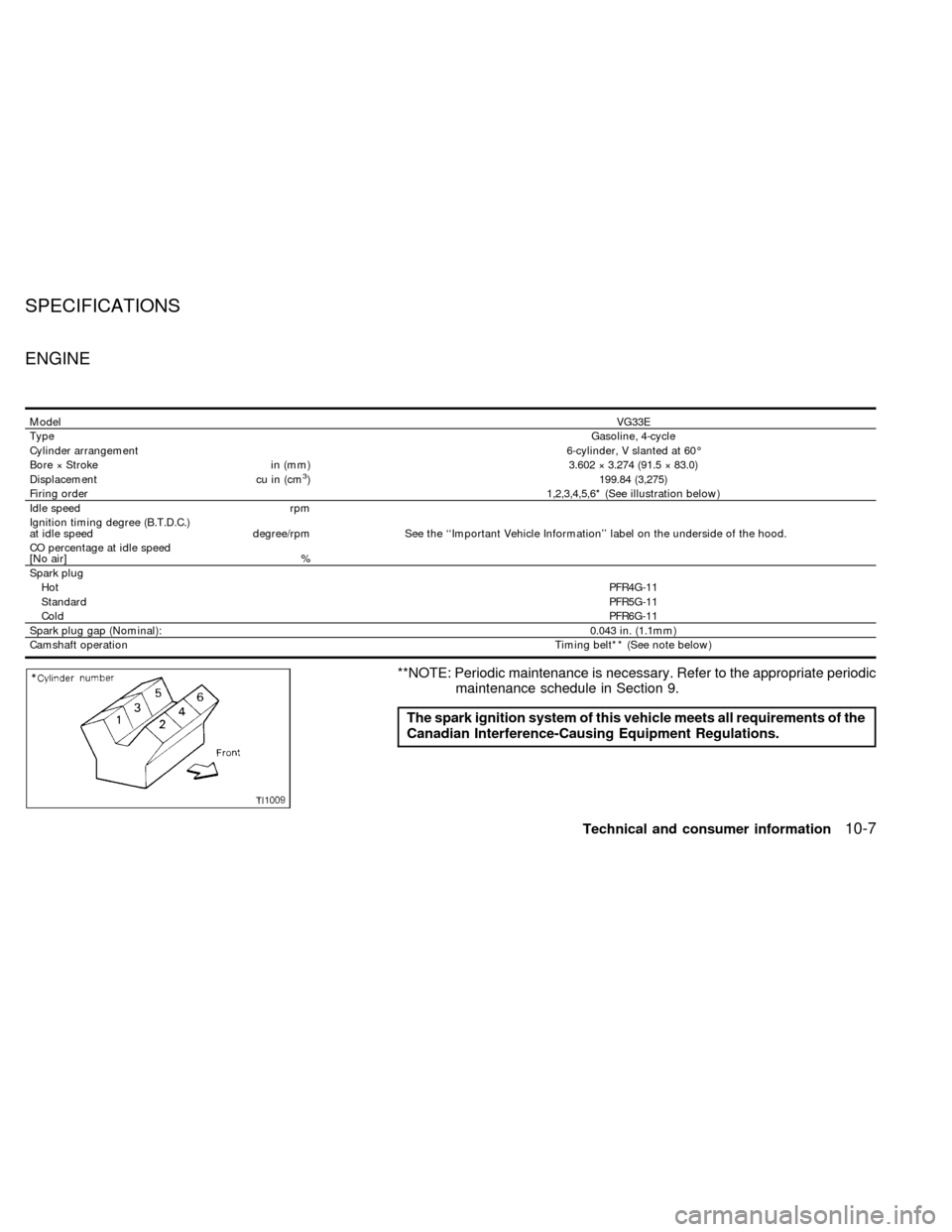
ENGINE
ModelVG33E
TypeGasoline, 4-cycle
Cylinder arrangement6-cylinder, V slanted at 60É
Bore ý Stroke in (mm) 3.602 ý 3.274 (91.5 ý 83.0)
Displacement cu in (cm
3) 199.84 (3,275)
Firing order1,2,3,4,5,6* (See illustration below)
Idle speed rpm
See the ``Important Vehicle Information'' label on the underside of the hood. Ignition timing degree (B.T.D.C.)
at idle speed degree/rpm
CO percentage at idle speed
[No air] %
Spark plug
HotPFR4G-11
StandardPFR5G-11
ColdPFR6G-11
Spark plug gap (Nominal):0.043 in. (1.1mm)
Camshaft operationTiming belt** (See note below)
**NOTE: Periodic maintenance is necessary. Refer to the appropriate periodic
maintenance schedule in Section 9.
The spark ignition system of this vehicle meets all requirements of the
Canadian Interference-Causing Equipment Regulations.
SPECIFICATIONS
Technical and consumer information10-7
ZX
Page 271 of 292

When planning to travel in another coun-
try,you should first find out if the fuel
available is suitable for your vehicle's en-
gine.
Using fuel with an octane/cetane rating that
is too low may cause engine damage. All
gasoline vehicles must be operated with
unleaded gasoline. Therefore, avoid taking
your vehicle to areas where appropriate fuel
is not available.
When transferring the registration of
your vehicle to another country, state,
province or district,it may be necessary to
modify the vehicle to meet local laws and
regulations.
The laws and regulations for motor vehicle
emission control and safety standards vary
according to the country, state, province or
district. Therefore, vehicle specifications
may differ.
When any vehicle is to be taken into
another country, state, province or dis-
trict and registered, its modifications,
transportation, and registration are the
responsibility of the user. NISSAN is not
responsible for any inconvenience that
may result.
VEHICLE IDENTIFICATION
NUMBER (VIN) PLATE
The vehicle identification number plate is
attached to the upper portion of the dash-
board on the driver's side. This number is
the identification for your vehicle and is
used in the vehicle registration.
VEHICLE IDENTIFICATION
NUMBER (Chassis number)
ATI0563ATI1021
WHEN TRAVELING OR
REGISTERING YOUR VEHICLE
IN ANOTHER COUNTRYVEHICLE IDENTIFICATION
10-10Technical and consumer information
ZX
Page 272 of 292

ENGINE SERIAL NUMBER
The number is stamped on the engine as
shown.
F.M.V.S.S. CERTIFICATION
LABEL
The F.M.V.S.S. certification label is affixed
as shown. This label contains valuable ve-
hicle information, such as: Gross Vehicle
Weight Rating (GVWR), Gross Axle Weight
Rating (GAWR), month and year of manu-
facture, Vehicle Identification Number
(VIN), etc. Review it carefully.
EMISSION CONTROL
INFORMATION LABEL
The emission control information label is
attached as shown.
ATI0550ATI1022ATI0005
Technical and consumer information10-11
ZX
Page 275 of 292
cDo not load your vehicle any heavier
than the GVWR or the maximum front
and rear GAWRs. If you do, parts of
your vehicle can break, or it can
change the way your vehicle handles.
This could result in loss of control
and cause personal injury.
cOverloading can shorten the life of
the vehicle. Failures caused by over-
loading are not covered by the vehi-
cle's warranty.
Your new vehicle was designed to be used
primarily to carry passengers and cargo.
Remember that towing a trailer places ad-
ditional loads on your vehicle's engine, drive
train, steering, braking and other systems.
A NISSAN Trailer Towing Guide (U.S. only)
contains information on your vehicle's trailer
towing ability and the special equipment
required, and may be obtained from an
authorized NISSAN dealer.
Do not tow a trailer if your vehicle is a cargo
van model.
MAXIMUM LOAD LIMTS
Maximum trailer loads
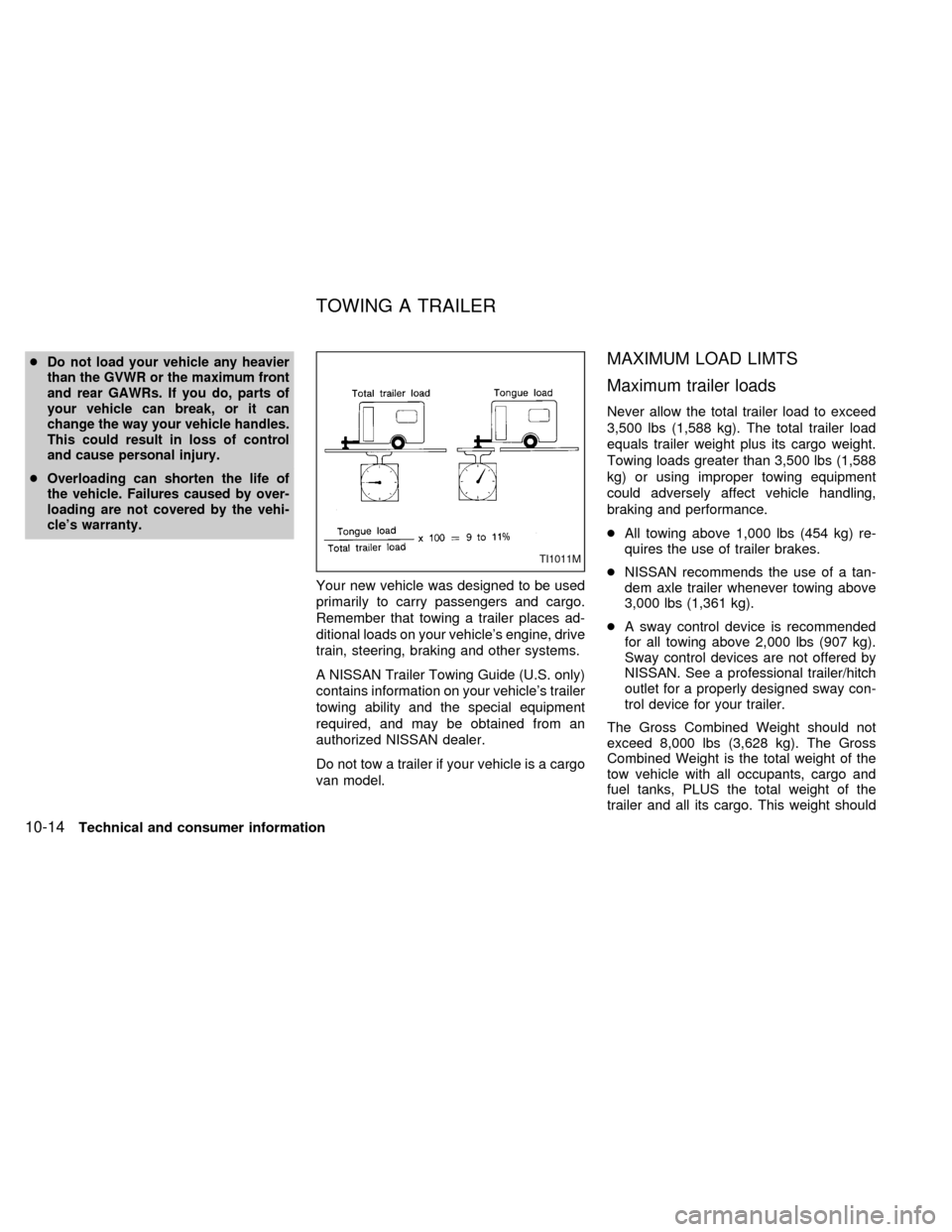
Never allow the total trailer load to exceed
3,500 lbs (1,588 kg). The total trailer load
equals trailer weight plus its cargo weight.
Towing loads greater than 3,500 lbs (1,588
kg) or using improper towing equipment
could adversely affect vehicle handling,
braking and performance.
cAll towing above 1,000 lbs (454 kg) re-
quires the use of trailer brakes.
cNISSAN recommends the use of a tan-
dem axle trailer whenever towing above
3,000 lbs (1,361 kg).
cA sway control device is recommended
for all towing above 2,000 lbs (907 kg).
Sway control devices are not offered by
NISSAN. See a professional trailer/hitch
outlet for a properly designed sway con-
trol device for your trailer.
The Gross Combined Weight should not
exceed 8,000 lbs (3,628 kg). The Gross
Combined Weight is the total weight of the
tow vehicle with all occupants, cargo and
fuel tanks, PLUS the total weight of the
trailer and all its cargo. This weight should
TI1011M
TOWING A TRAILER
10-14Technical and consumer information
ZX