warning NISSAN QUEST 2001 V41 / 2.G User Guide
[x] Cancel search | Manufacturer: NISSAN, Model Year: 2001, Model line: QUEST, Model: NISSAN QUEST 2001 V41 / 2.GPages: 304, PDF Size: 2.54 MB
Page 21 of 304
Removing second row bucket seats
WARNING
cDo not remove or install seats while
the vehicle is moving.
cAfter adjustment, gently rock in the
seat to make sure it is securely
locked.
cDo not ride in a moving vehicle when
the seatback is reclined. This can be
dangerous. The shoulder belt will
not be against your body. In an acci-
dent you could be thrown into it and
receive neck or other serious inju-
ries. You could also slide under the
lap belt and receive serious internal
injuries.
c
For most effective protection when
the vehicle is in motion, the seat
should be upright. Always sit well
back in the seat and adjust the seat
belt properly. See ``Precautions on
seat belt usage'' later in this section.cWhen adjusting or moving any of the
seats in your vehicle, do not use any
of the seat belt buckles, tongues, or
webbing to carry or move the seats.
Lifting the seats by any of the seat
belts could damage them. Damaged
seat belts should be replaced at your
NISSAN dealer. Failure to follow
these instructions could increase the
chance and/or severity of injury in an
accident.
CAUTION
cThe seats are heavy. Two people
should remove or install them.
cDo not sit in seats that have been
removed from the vehicle. They may
tip over and you could be injured.
1-14Seats, restraints and supplemental air bag systems
ZX
Page 25 of 304
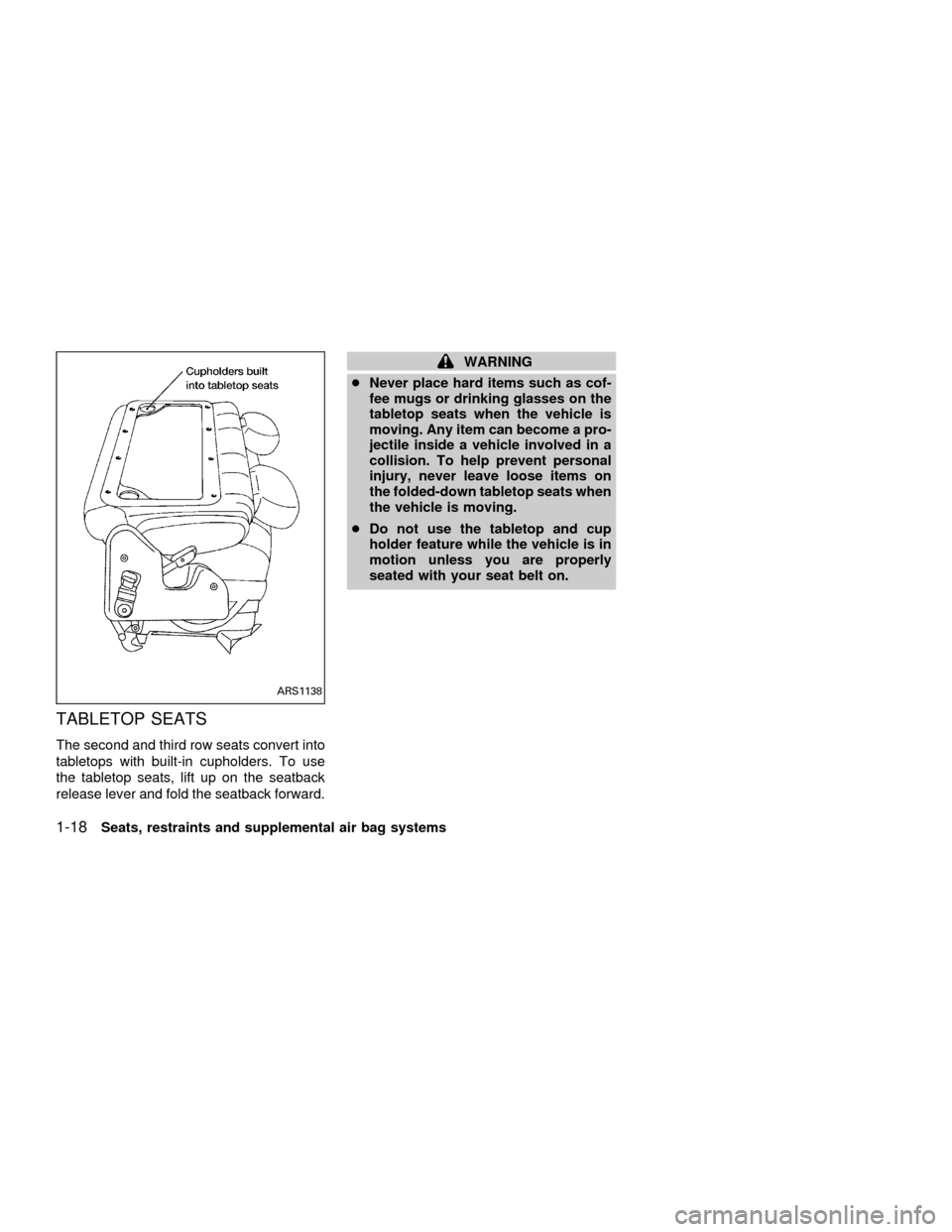
TABLETOP SEATS
The second and third row seats convert into
tabletops with built-in cupholders. To use
the tabletop seats, lift up on the seatback
release lever and fold the seatback forward.
WARNING
cNever place hard items such as cof-
fee mugs or drinking glasses on the
tabletop seats when the vehicle is
moving. Any item can become a pro-
jectile inside a vehicle involved in a
collision. To help prevent personal
injury, never leave loose items on
the folded-down tabletop seats when
the vehicle is moving.
cDo not use the tabletop and cup
holder feature while the vehicle is in
motion unless you are properly
seated with your seat belt on.
ARS1138
1-18Seats, restraints and supplemental air bag systems
ZX
Page 26 of 304

There is also a lever behind the passenger
bucket seat that allows third seat passen-
gers to move the bucket seat forward with-
out help from another passenger.
SEATING ARRANGEMENTS
Many different arrangements for passenger
seating or cargo hauling are available as
you will see in the following illustrations. The
second row seats may be removed and the
third row seat may be moved forward to the
second row seating position. The second
and third row seats have a folddown table-
top feature. This offers a variety of uses for
the vehicle when moving or stopped.
The illustrations shown reflect the different
seating positions available.
Before you begin to arrange the seats in
your vehicle, read all of the cautions and
warnings in this section, including the
information on the removable floor mats.
Also observe any labels that are in the
vehicle.
LRS0050
SEATS/FLOOR MATS
Seats, restraints and supplemental air bag systems1-19
ZX
Page 27 of 304
WARNING
cWhile the vehicle is in motion, pas-
sengers should always be seated in
a forward facing direction in a seat
which is properly secured and ad-
justed. Seat belts should always be
used. Sitting without a seat belt in a
seat that is not properly secured in
one of the locations shown in this
chapter, or in a place without a seat
and seat belt can result in personal
injury in a sudden stop or collision.
cDo not ride in a moving vehicle when
the seatback is reclined. This can be
dangerous. The shoulder belt will
not be against your body. In an acci-
dent, you could be thrown into it and
receive neck or other serious inju-
ries. You could also slide under the
lap belt and receive serious internal
injuries.
cFor the most effective protection
when the vehicle is in motion, the
seat should be upright. Always sit
well back in the seat and adjust the
seat belt properly.cIt is extremely dangerous to ride in a
cargo area inside of a vehicle. In a
collision, people riding in these ar-
eas are more likely to be seriously
injured or killed.
cDo not allow people to ride in any
area of your vehicle that is not
equipped with seats and seat belts.
cBe sure everyone in your vehicle is
in a seat and using a seat belt prop-
erly.
cDo not place hard items such as
coffee mugs or drinking glasses on
the tabletop seats when the vehicle
is moving. Any item can become a
projectile inside a vehicle involved in
a collision. To help prevent personal
injury, never leave loose items on
the fold-down tabletop seats when
the vehicle is moving.
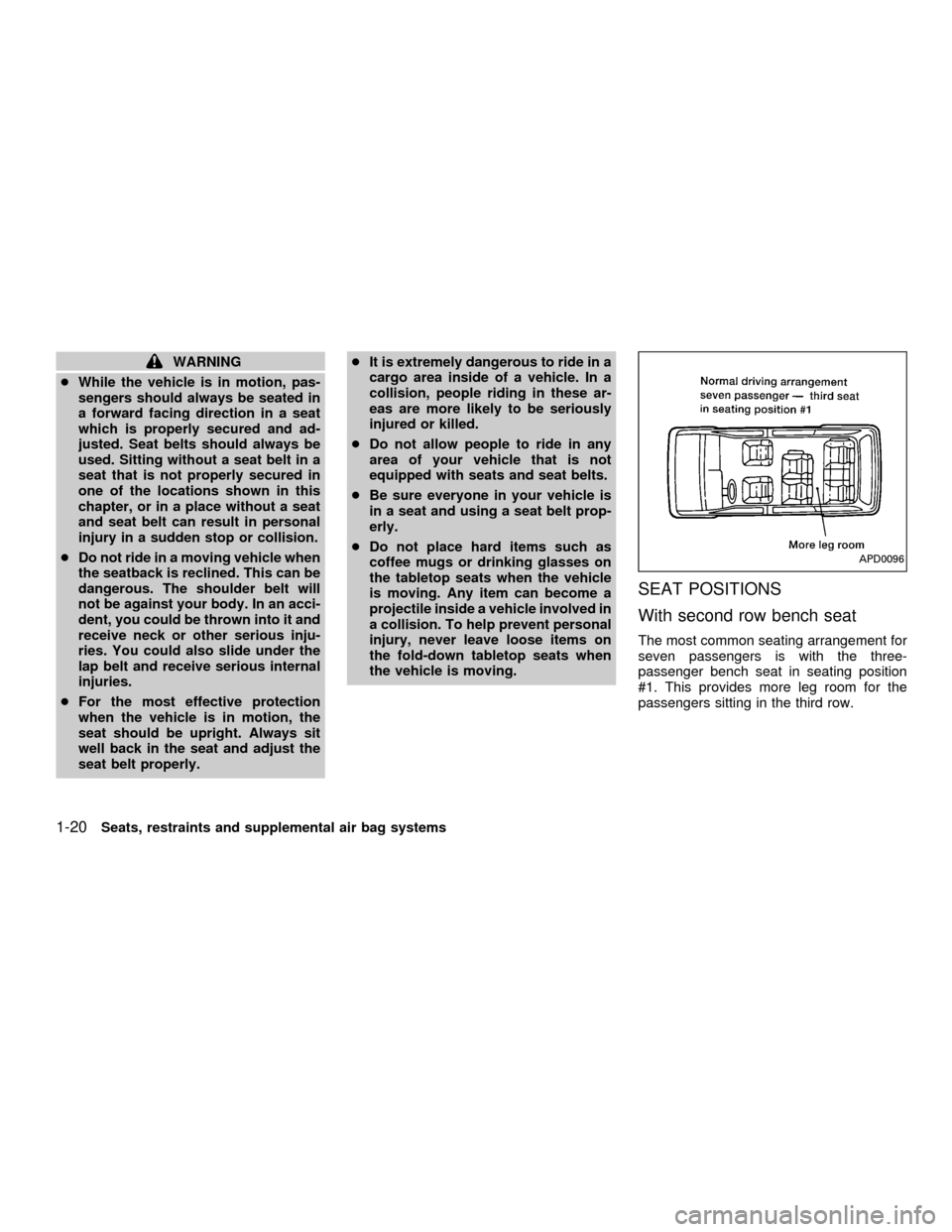
SEAT POSITIONS
With second row bench seat
The most common seating arrangement for
seven passengers is with the three-
passenger bench seat in seating position
#1. This provides more leg room for the
passengers sitting in the third row.
APD0096
1-20Seats, restraints and supplemental air bag systems
ZX
Page 37 of 304
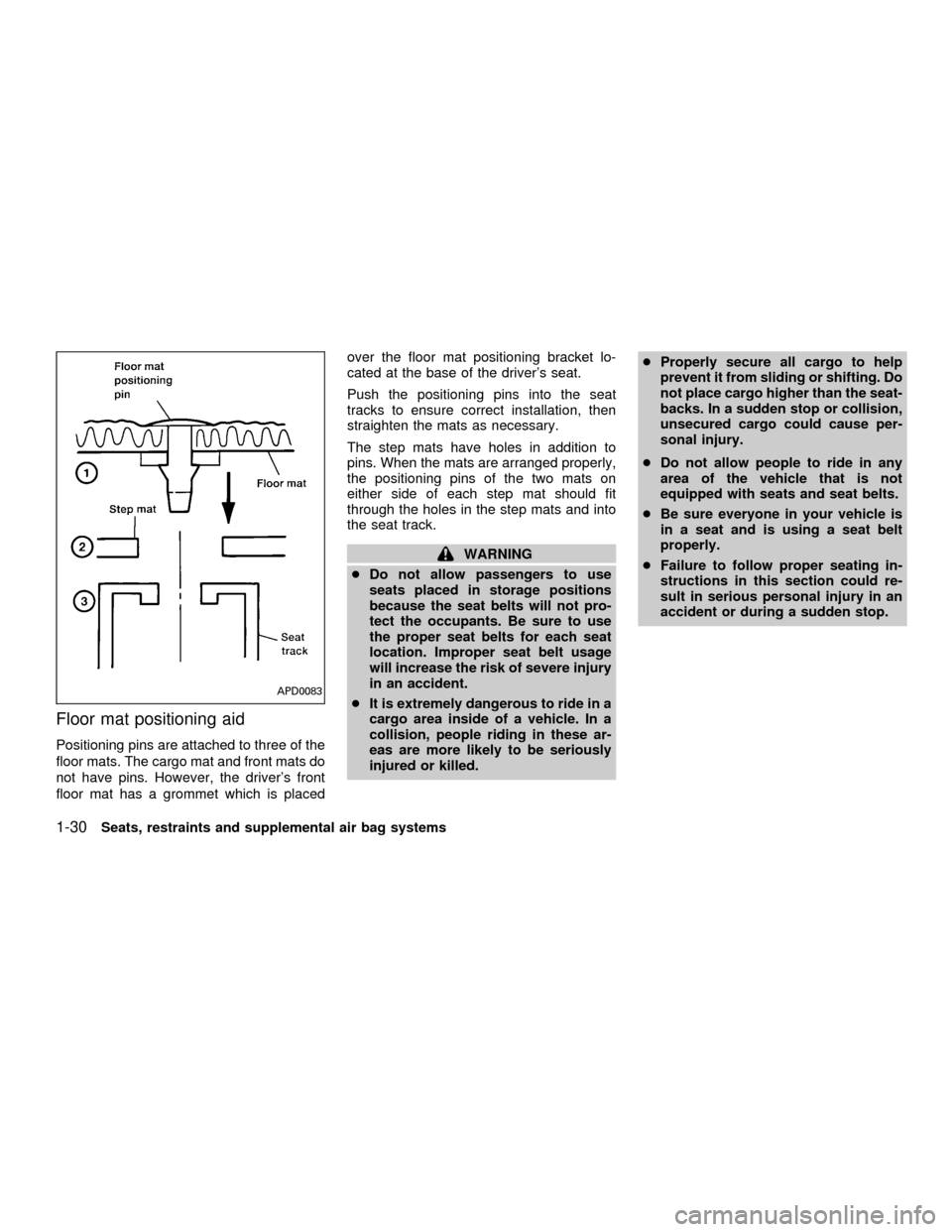
Floor mat positioning aid
Positioning pins are attached to three of the
floor mats. The cargo mat and front mats do
not have pins. However, the driver's front
floor mat has a grommet which is placedover the floor mat positioning bracket lo-
cated at the base of the driver's seat.
Push the positioning pins into the seat
tracks to ensure correct installation, then
straighten the mats as necessary.
The step mats have holes in addition to
pins. When the mats are arranged properly,
the positioning pins of the two mats on
either side of each step mat should fit
through the holes in the step mats and into
the seat track.
WARNING
cDo not allow passengers to use
seats placed in storage positions
because the seat belts will not pro-
tect the occupants. Be sure to use
the proper seat belts for each seat
location. Improper seat belt usage
will increase the risk of severe injury
in an accident.
cIt is extremely dangerous to ride in a
cargo area inside of a vehicle. In a
collision, people riding in these ar-
eas are more likely to be seriously
injured or killed.cProperly secure all cargo to help
prevent it from sliding or shifting. Do
not place cargo higher than the seat-
backs. In a sudden stop or collision,
unsecured cargo could cause per-
sonal injury.
cDo not allow people to ride in any
area of the vehicle that is not
equipped with seats and seat belts.
cBe sure everyone in your vehicle is
in a seat and is using a seat belt
properly.
cFailure to follow proper seating in-
structions in this section could re-
sult in serious personal injury in an
accident or during a sudden stop.
APD0083
1-30Seats, restraints and supplemental air bag systems
ZX
Page 38 of 304
PRECAUTIONS ON SUPPLE-
MENTAL RESTRAINT SYSTEM
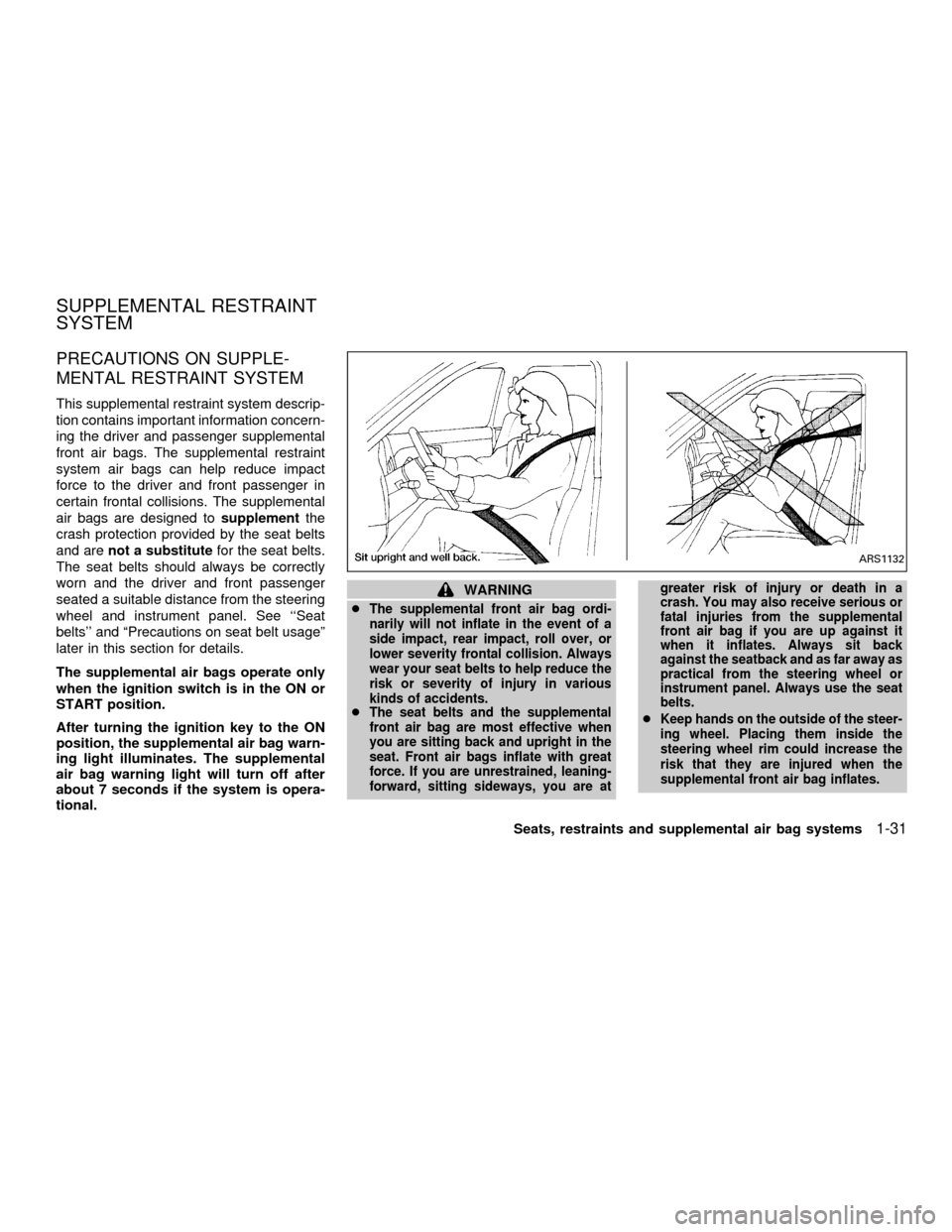
This supplemental restraint system descrip-
tion contains important information concern-
ing the driver and passenger supplemental
front air bags. The supplemental restraint
system air bags can help reduce impact
force to the driver and front passenger in
certain frontal collisions. The supplemental
air bags are designed tosupplementthe
crash protection provided by the seat belts
and arenot a substitutefor the seat belts.
The seat belts should always be correctly
worn and the driver and front passenger
seated a suitable distance from the steering
wheel and instrument panel. See ``Seat
belts'' and ªPrecautions on seat belt usageº
later in this section for details.
The supplemental air bags operate only
when the ignition switch is in the ON or
START position.
After turning the ignition key to the ON
position, the supplemental air bag warn-
ing light illuminates. The supplemental
air bag warning light will turn off after
about 7 seconds if the system is opera-
tional.
WARNING
c
The supplemental front air bag ordi-
narily will not inflate in the event of a
side impact, rear impact, roll over, or
lower severity frontal collision. Always
wear your seat belts to help reduce the
risk or severity of injury in various
kinds of accidents.
cThe seat belts and the supplemental
front air bag are most effective when
you are sitting back and upright in the
seat. Front air bags inflate with great
force. If you are unrestrained, leaning-
forward, sitting sideways, you are atgreater risk of injury or death in a
crash. You may also receive serious or
fatal injuries from the supplemental
front air bag if you are up against it
when it inflates. Always sit back
against the seatback and as far away as
practical from the steering wheel or
instrument panel. Always use the seat
belts.cKeep hands on the outside of the steer-
ing wheel. Placing them inside the
steering wheel rim could increase the
risk that they are injured when the
supplemental front air bag inflates.
ARS1132
SUPPLEMENTAL RESTRAINT
SYSTEM
Seats, restraints and supplemental air bag systems1-31
ZX
Page 40 of 304
WARNING
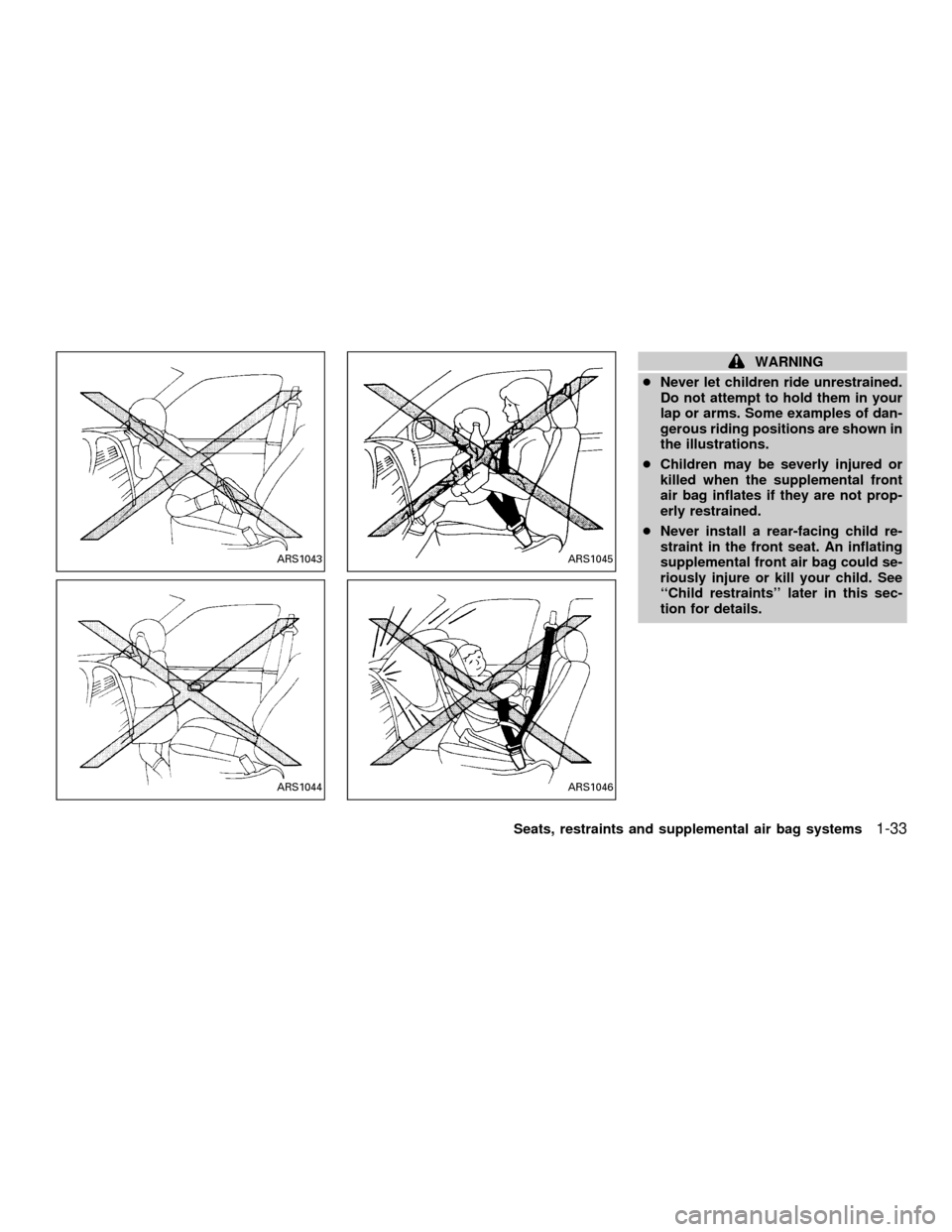
cNever let children ride unrestrained.
Do not attempt to hold them in your
lap or arms. Some examples of dan-
gerous riding positions are shown in
the illustrations.
cChildren may be severly injured or
killed when the supplemental front
air bag inflates if they are not prop-
erly restrained.
cNever install a rear-facing child re-
straint in the front seat. An inflating
supplemental front air bag could se-
riously injure or kill your child. See
``Child restraints'' later in this sec-
tion for details.
ARS1043
ARS1044
ARS1045
ARS1046
Seats, restraints and supplemental air bag systems1-33
ZX
Page 41 of 304

Supplemental front air bag system
The driver supplemental air bag is located in
the center of the steering wheel. The front
passenger supplemental air bag is mounted in
the dashboard above the glove box.
These systems are designed to meet optional
certification requirements under U.S. regula-
tions. They are also permitted in Canada. The
optional certification allows front air bags to
be designed to inflate somewhat less force-
fully than previously.However, all of the
information, cautions and warnings in this
manual still apply and must be followed.
The supplemental front air bag system is
designed to inflate in higher severity frontal
collisions, although it may inflate if the forces
in another type of collision are similar to those
of a higher severity frontal impact. It may not
inflate in certain frontal collisions. Vehicle
damage (or lack of it) is not always an indica-
tion of proper supplemental air bag system
operation.
When the supplemental front air bag in-
flates, a fairly loud noise may be heard,
followed by the release of smoke. This
smoke is not harmful and does not indicate
a fire. Care should be taken to not intention-ally inhale it, as it may cause irritation and
choking. Those with a history of a breathing
condition should get fresh air promptly.
The supplemental front air bags, along with
the use of seat belts, help to cushion the
impact force on the face and chest of the
occupant. They can help save lives and
reduce serious injuries. However, an inflat-
ing front air bag may cause facial abrasions
or other injuries. Front air bags do not
provide restraint to the lower body.
Seat belts should be correctly worn and the
driver and passenger seated upright as far
away as practical from the steering wheel or
instrument panel. The supplemental front air
bag inflates quickly in order to help protect
the front occupants. Because of this, the
force of the front air bag inflating can in-
crease the risk of injury if the occupant is too
close to, or is against, the air bag module
during inflation.The air bag deflates quickly
after a collision.
The supplemental air bags operate only
when the ignition switch is in the ON or
START position.
After turning the ignition key to the ON
position, the supplemental air bag warn-
WRS0075
1-34Seats, restraints and supplemental air bag systems
ZX
Page 42 of 304
ing light illuminates. The supplemental
air bag warning light will turn off after
about 7 seconds if the system is opera-
tional.WARNING
cDo not place any objects on the
steering wheel pad or on the instru-
ment panel. Also, do not place any
objects between any occupant and
the steering wheel or instrument
panel. Such objects may become
dangerous projectiles and cause in-
jury if the supplemental front air bag
inflates.
cRight after inflation, several air bag
system components will be hot. Do
not touch them; you may severely
burn yourself.
cNo unauthorized changes should be
made to any components or wiring
of the supplemental front air bag
system. This is to prevent accidental
inflation of the air bag or damage to
the air bag system.
cDo not make unauthorized changes
to your vehicle's electrical system,
suspension system or front end
structure. This could affect proper
operation of the supplemental front
air bag system.cTampering with the supplemental
front air bag system may result in
serious personal injury. For ex-
ample, do not change the front seat
assembly by placing material over
the steering wheel pad and above
the instrument panel or by installing
additional trim material around the
air bag system.
cWork around and on the supplemen-
tal front air bag system should be
done by an authorized NISSAN
dealer. Installation of electrical
equipment should also be done by
an authorized NISSAN dealer. The
yellow Supplemental Restraint Sys-
tem (SRS) wiring should not be
modified or disconnected. Unautho-
rized electrical test equipment and
probing devices should not be used
on the air bag system.
cThe SRS wiring harnesses are cov-
ered with yellow insulation either
just before the harness connectors
or over the complete harness for
easy identification.
Seats, restraints and supplemental air bag systems
1-35
ZX
Page 43 of 304
When selling your vehicle, we request that
you inform the buyer about the supplemental
air bag system and guide the buyer to the
appropriate sections in this owner's manual.
Pre-tensioner seat belt system (For
front seats)
WARNING
cThe pre-tensioner seat belt cannot
be reused after activation. It must be
replaced together with the retractor
as a unit.
cIf the vehicle becomes involved in a
frontal collision but the pre-
tensioner is not activated, be sure to
have the pre-tensioner system
checked and, if necessary, replaced
by your NISSAN dealer.
cNo unauthorized changes should be
made to any components or wiring
of the pre-tensioner seat belt sys-
tem. This is to prevent accidental
activation of the pre-tensioner seat
belt or damage to the pre-tensioner
seat belt operation. Tampering with
the pre-tensioner seat belt systemmay result in serious personal in-
jury.
cWork around and on the pre-
tensioner system should be done by
an authorized NISSAN dealer. Instal-
lation of electrical equipment should
also be done by an authorized NIS-
SAN dealer. Unauthorized electrical
test equipment and probing devices
should not be used on the pre-
tensioner seat belt system.
cIf you need to dispose of the pre-
tensioner or scrap the vehicle, con-
tact an authorized NISSAN dealer.
Correct pre-tensioner disposal pro-
cedures are set forth in the appropri-
ate NISSAN Service Manual. Incor-
rect disposal procedures could
cause personal injury.
The front seat pre-tensioner seat belt sys-
tem activates in conjunction with the supple-
mental front air bag. Working with the seat
belt retractor, it helps tighten the seat belt
the instant the vehicle becomes involved in
certain types of collisions, thereby restrain-
ing seat occupants.The pre-tensioner is encased with the seat
belt's retractor. These seat belts are used
the same as conventional seat belts.
When the pre-tensioner seat belt activates,
smoke is released and a loud noise may be
heard. The smoke is not harmful and does
not indicate a fire. Care should be taken to
not intentionally inhale it, as it may cause
irritation and choking. Those with a history
of a breathing condition should get fresh air
promptly.
If any abnormality occurs in the pre-
tensioner system, the air bag warning light
will flash intermittently after the igni-
tion key is turned to the ON or START
position. In this case, the pre-tensioner seat
belt will not function properly.
When selling your vehicle, we request that
you inform the buyer about the pre-
tensioner seat belt system and guide the
buyer to the appropriate sections in this
owner's manual.
1-36Seats, restraints and supplemental air bag systems
ZX