ignition NISSAN QUEST 2004 V42 / 3.G Repair Manual
[x] Cancel search | Manufacturer: NISSAN, Model Year: 2004, Model line: QUEST, Model: NISSAN QUEST 2004 V42 / 3.GPages: 320, PDF Size: 5.6 MB
Page 269 of 320
BRAKE BOOSTER
Check the brake booster function as follows:
1. With the engine off, press and release the
brake pedal several times. When brake
pedal movement (distance of travel) remains
the same from one pedal application to the
next, continue on to the next step.
2. While depressing the brake pedal, start the
engine. The pedal height should drop a little.
3. With the brake pedal depressed, stop the
engine. Keep the pedal depressed for about
30 seconds. The pedal height should not
change.
4. Run the engine for one minute without de-
pressing the brake pedal, then turn it off.
Depress the brake pedal several times. The
pedal travel distance will decrease gradually
with each depression as the vacuum is re-
leased from the booster.
If the brakes do not operate properly, have the
brakes checked by a NISSAN dealer.
ENGINE COMPARTMENT
CAUTION
Never use a fuse of a higher or lower
amperage rating than specified on the
fuse box cover. This could damage the
electrical system or cause a fire.
If any electrical equipment does not come on,
check for an open fuse.
1. Be sure the ignition switch and the headlight
switch are OFF.
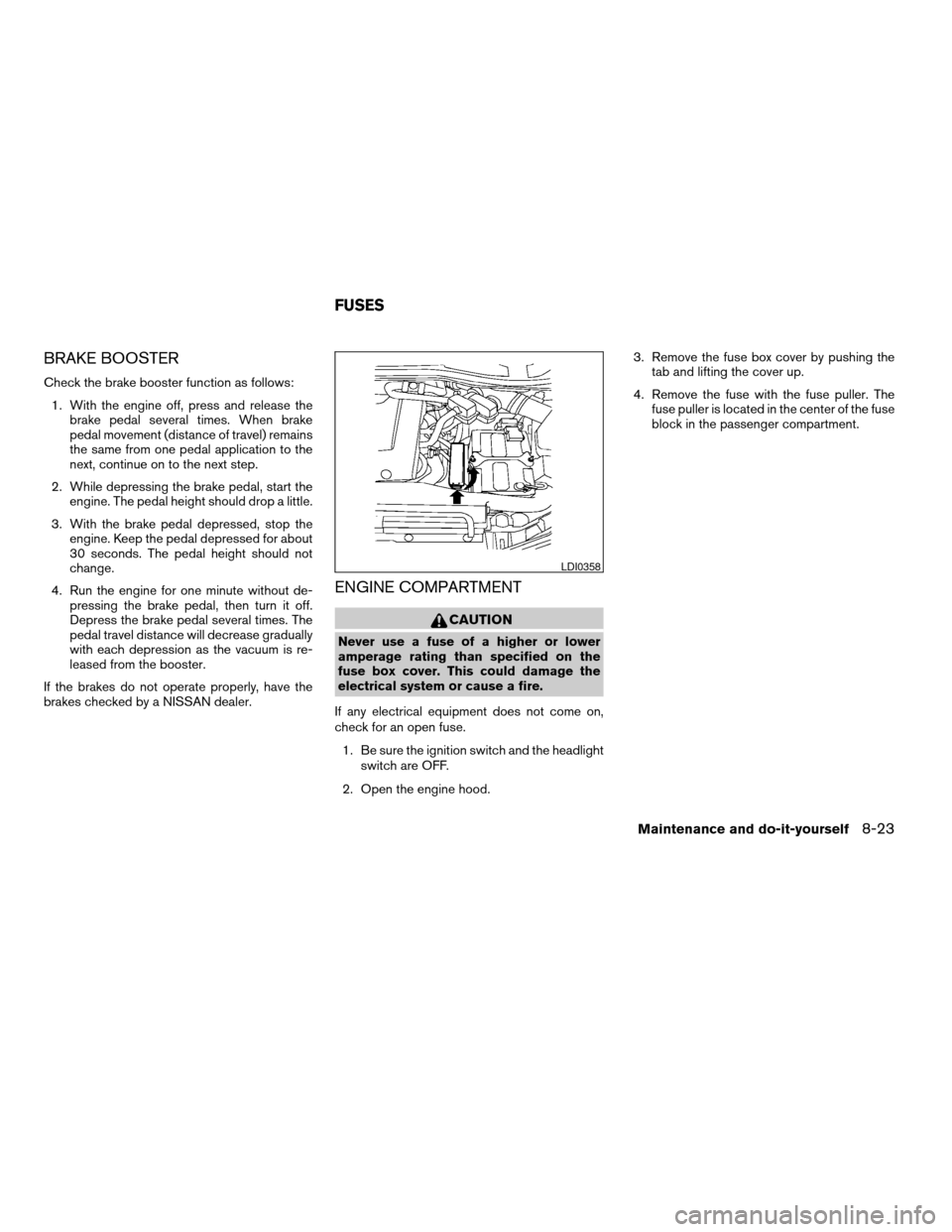
2. Open the engine hood.3. Remove the fuse box cover by pushing the
tab and lifting the cover up.
4. Remove the fuse with the fuse puller. The
fuse puller is located in the center of the fuse
block in the passenger compartment.
LDI0358
FUSES
Maintenance and do-it-yourself8-23
ZREVIEW COPY:Ð2004 Quest(van)
Owners Manual(owners)ÐUSA English(nna)
10/08/03Ðtbrooks
X
Page 270 of 320
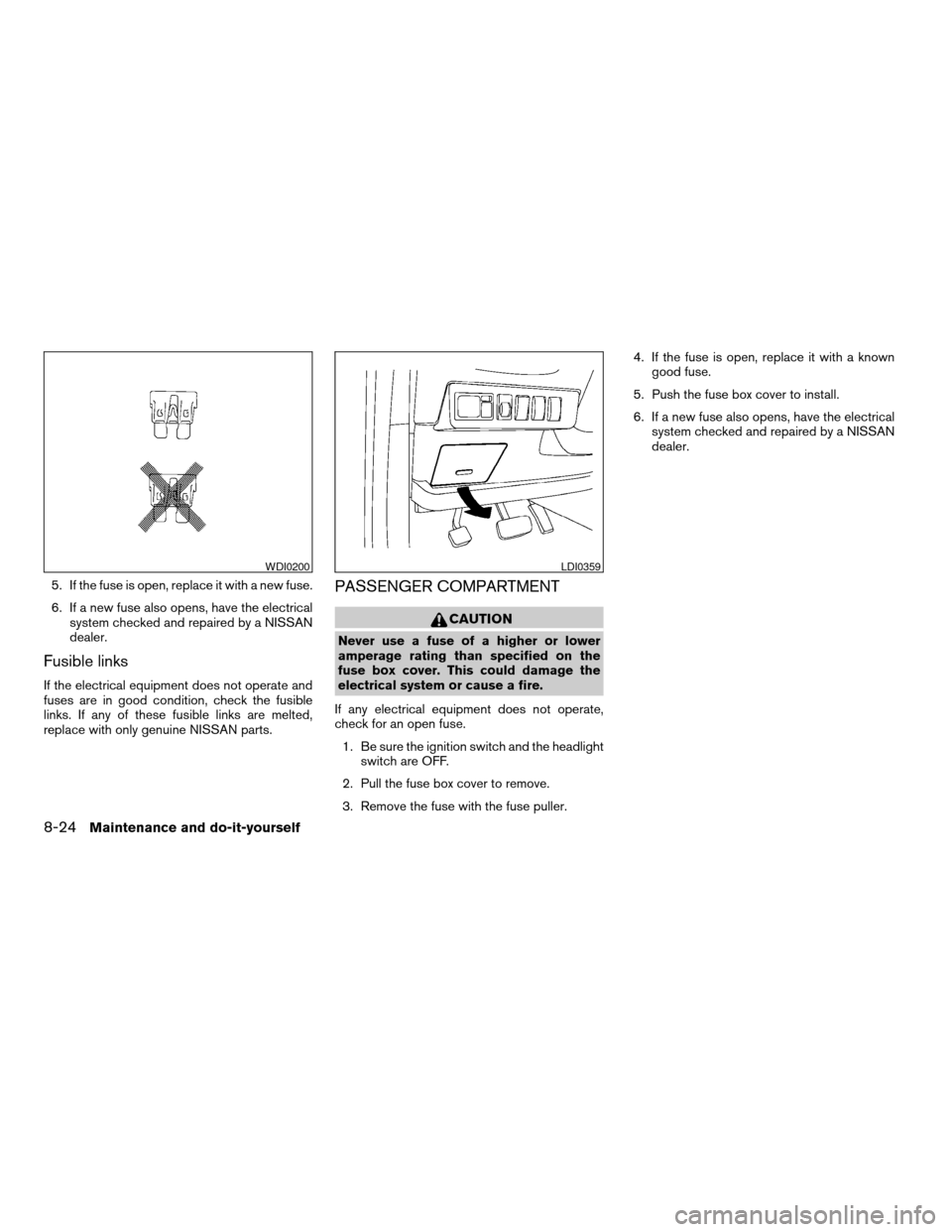
5. If the fuse is open, replace it with a new fuse.
6. If a new fuse also opens, have the electrical
system checked and repaired by a NISSAN
dealer.
Fusible links
If the electrical equipment does not operate and
fuses are in good condition, check the fusible
links. If any of these fusible links are melted,
replace with only genuine NISSAN parts.
PASSENGER COMPARTMENT
CAUTION
Never use a fuse of a higher or lower
amperage rating than specified on the
fuse box cover. This could damage the
electrical system or cause a fire.
If any electrical equipment does not operate,
check for an open fuse.
1. Be sure the ignition switch and the headlight
switch are OFF.
2. Pull the fuse box cover to remove.
3. Remove the fuse with the fuse puller.4. If the fuse is open, replace it with a known
good fuse.
5. Push the fuse box cover to install.
6. If a new fuse also opens, have the electrical
system checked and repaired by a NISSAN
dealer.
WDI0200LDI0359
8-24Maintenance and do-it-yourself
ZREVIEW COPY:Ð2004 Quest(van)
Owners Manual(owners)ÐUSA English(nna)
10/08/03Ðtbrooks
X
Page 290 of 320
![NISSAN QUEST 2004 V42 / 3.G Repair Manual least 87 AKI (Anti-Knock Index) number. How-
ever, you may use unleaded gasoline with an
octane rating as low as 85 AKI (Anti-Knock Index)
number in high altitude areas [over 4,000 ft
(1,219 m)] such](/img/5/680/w960_680-289.png "NISSAN QUEST 2004 V42 / 3.G Repair Manual least 87 AKI (Anti-Knock Index) number. How-
ever, you may use unleaded gasoline with an
octane rating as low as 85 AKI (Anti-Knock Index)
number in high altitude areas [over 4,000 ft
(1,219 m)] such")
least 87 AKI (Anti-Knock Index) number. How-
ever, you may use unleaded gasoline with an
octane rating as low as 85 AKI (Anti-Knock Index)
number in high altitude areas [over 4,000 ft
(1,219 m)] such as: Colorado, Montana, New
Mexico, Utah, Wyoming, northeastern Nevada,
southern Idaho, western South Dakota, western
Nebraska, and the part of Texas which is directly
south of New Mexico.
Using unleaded gasoline with an octane
rating lower than stated above can cause
persistent, heavy “spark knock.” (“Spark
knock” is a metallic rapping noise.) If se-
vere, this can lead to engine damage. If you
detect a persistent heavy spark knock even
when using gasoline of the stated octane
rating, or if you hear steady spark knock
while holding a steady speed on level
roads, have a NISSAN dealer correct the
condition. Failure to correct the condition
is misuse of the vehicle, for which NISSAN
is not responsible.
Incorrect ignition timing may result in spark
knock, after-run and/or overheating, which may
cause excessive fuel consumption or engine
damage. If any of the above symptoms are en-
countered, have your vehicle checked at a
NISSAN dealer.However, now and then you may notice
light spark knock for a short time while
accelerating or driving up hills. This is not a
cause for concern, because you get the
greatest fuel benefit when there is light
spark knock for a short time under heavy
engine load.
9-4Technical and consumer information
ZREVIEW COPY:Ð2004 Quest(van)
Owners Manual(owners)ÐUSA English(nna)
10/08/03Ðtbrooks
X
Page 293 of 320
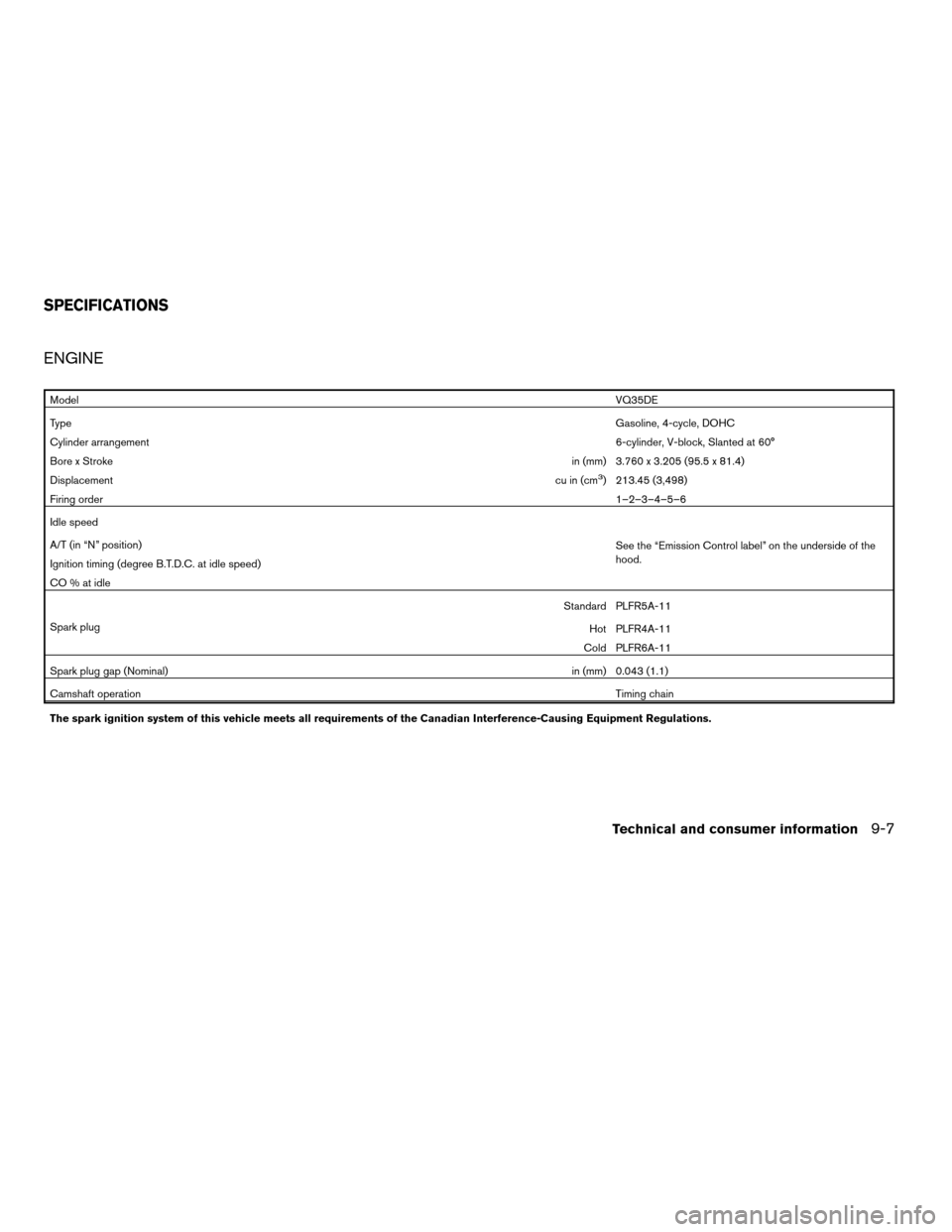
ENGINE
ModelVQ35DE
TypeGasoline, 4-cycle, DOHC
Cylinder arrangement6-cylinder, V-block, Slanted at 60°
Bore x Strokein (mm) 3.760 x 3.205 (95.5 x 81.4)
Displacementcu in (cm
3) 213.45 (3,498)
Firing order1–2–3–4–5–6
Idle speed
See the “Emission Control label” on the underside of the
hood. A/T (in “N” position)
Ignition timing (degree B.T.D.C. at idle speed)
CO % at idle
Spark plugStandard PLFR5A-11
Hot PLFR4A-11
Cold PLFR6A-11
Spark plug gap (Nominal)in (mm) 0.043 (1.1)
Camshaft operationTiming chain
The spark ignition system of this vehicle meets all requirements of the Canadian Interference-Causing Equipment Regulations.
SPECIFICATIONS
Technical and consumer information9-7
ZREVIEW COPY:Ð2004 Quest(van)
Owners Manual(owners)ÐUSA English(nna)
10/08/03Ðtbrooks
X
Page 311 of 320

Fuel
Capacities and recommended
fuel/lubricants.................9-2
Fuel economy................5-14
Fuel filler cap................3-20
Fuel filler lid.................3-20
Fuel filler lid and cap............3-20
Fuel gauge..................2-5
Fuel octane rating..............9-3
Fuel recommendation............9-3
Fuses......................8-23
Fusible links...................8-24
G
Garage door opener, HomeLinkTUniversal
Transceiver...................2-43
Garment hook..................2-34
Gascap.....................3-20
Gauge
Engine coolant temperature gauge.....2-4
Fuel gauge..................2-5
Odometer...................2-4
Speedometer.................2-4
Tachometer..................2-4
General maintenance..............8-2
Glove box....................2-28
Glove box lock.................2-28
Grocery hooks.................2-30
H
Hazard warning flasher switch.........2-20
Head restraints.................1-10Headlight and turn signal switch........2-15
Headlights....................8-26
Headphones
(See DVD entertainment system).......4-47
Headrest storage................2-34
Heated seats..................2-21
Heater
Heater and air conditioner
controls................4-17, 4-27
Heater operation...........4-19, 4-28
Rear seat air conditioner..........4-29
HomeLinkTUniversal Transceiver.......2-43
Hood release..................3-14
Horn.......................2-20
I
Ignition switch..................5-5
Immobilizer system..........2-12, 3-2, 5-6
Important vehicle information label.......9-10
In-cabin microfilter...............8-18
Increasing fuel economy............5-14
Indicator lights and audible reminders
(See warning/indicator lights and audible
reminders).....................2-6
Inside automatic anti-glare mirror.......3-23
Inside mirror...................3-23
Instrument brightness control.........2-18
Instrument panel.................2-2
Interior lights
(see Lights on demand switch)........2-41
ISOFIX child restraints.............1-51J
Jump starting...................6-7
K
Key ........................3-2
Keyless entry system
(See remote keyless entry system).......3-9
L
Labels
Air conditioner specification label.....9-11
Emission control information label.....9-10
Engine serial number............9-10
F.M.V.S.S. certification label........9-10
Vehicle identification number (VIN) plate . .9-9
Warning labels (for SRS)..........1-29
LATCH
(Lower Anchors and Tethers for CHildren)
System......................1-51
License plate
Installing the license plate.........9-11
Light
Air bag warning light.........1-30, 2-9
Brake light (See stop light).........8-27
Bulb check/instrument panel........2-6
Bulb replacement..............8-27
Charge warning light.............2-7
Cornering light...............2-19
Fog light switch...............2-19
Headlight and turn signal switch......2-15
10-3
ZREVIEW COPY:Ð2004 Quest(van)
Owners Manual(owners)ÐUSA English(nna)
10/08/03Ðtbrooks
X
Page 314 of 320

Supplemental air bag warning light . . .1-30, 2-9
Supplemental front impact air bag system . .1-22
Supplemental restraint system
Information and warning labels.......1-29
Precautions on supplemental
restraint system...............1-15
Supplemental restraint system
(Supplemental air bag system).........1-15
Supplemental side and curtain side-impact
air bag system..................1-27
Switch
Autolight switch...............2-16
Automatic power window switch.....2-37
Fog light switch...............2-19
Hazard warning flasher switch.......2-20
Headlight and turn signal switch......2-15
Ignition switch................5-5
Lights on demand switch..........2-41
Main ON/OFF switch
(for power doors)...........3-6, 3-16
Overdrive switch..............5-10
Power door lock switch...........3-5
Rear sonar system off switch.......2-22
Rear window and outside mirror
defroster switch...............2-15
Rear window wiper and washer
switches...................2-14
Traction control system (TCS) off
switch....................2-22
Vehicle dynamic control (VDC) off
switch....................2-22
Windshield wiper and washer switch . . .2-13T
Tachometer....................2-4
Temperature gauge
Engine coolant temperature gauge.....2-4
Engine oil pressure low/engine coolant
temperature high warning light.......2-7
Theft (Nissan vehicle immobilizer system) ,
engine start..............2-12, 3-2, 5-6
Third row bench seat adjustment.....1-8, 1-9
Three-way catalyst................5-2
Tilting steering wheel..............3-21
Tire
Flat tire....................6-2
Spare tire................6-3, 8-39
Tire chains..................8-36
Tire placard.................9-11
Tire pressure................8-31
Tire rotation.................8-37
Types of tires................8-36
Uniform tire quality grading.........9-18
Wheels and tires..............8-31
Wheel/tire size................9-8
Tire pressure
Low tire pressure warning light.......2-8
Top tether strap child restraint.........1-53
Towing
Flat towing..................9-17
Tow truck towing..............6-10
Towing load/specification chart......9-15
Trailer towing................9-14
Traction control system (TCS) off switch . . .2-22
Transceiver
HomeLinkTUniversal Transceiver.....2-43Transmission
Automatic transmission fluid (ATF). . . .8-11
Driving with automatic transmission.....5-7
Selector lever lock release..........5-9
Travel (See registering your vehicle in another
country)......................9-9
Turn signal switch (See headlight and
turn signal switch)............2-15, 2-19
U
Umbrella holder.................2-30
Uniform tire quality grading...........9-18
V
Vanity mirror...................3-23
Vehicle dimensions and weights........9-8
Vehicle dynamic control (VDC) off switch. . .2-22
Vehicle dynamic control (VDC) system. . . .5-19
Vehicle identification...............9-9
Vehicle identification number (VIN)
(Chassis number).................9-9
Vehicle identification number (VIN) plate. . . .9-9
Vehicle loading information...........9-12
Vehicle recovery..............6-12, 7-2
Vehicle security system
(Nissan vehicle immobilizer system) ,
engine start..............2-12, 3-2, 5-6
Ventilators....................4-17
Visors......................3-22
10-6
ZREVIEW COPY:Ð2004 Quest(van)
Owners Manual(owners)ÐUSA English(nna)
10/08/03Ðtbrooks
X