cooling NISSAN QUEST 2017 RE52 / 4.G User Guide
[x] Cancel search | Manufacturer: NISSAN, Model Year: 2017, Model line: QUEST, Model: NISSAN QUEST 2017 RE52 / 4.GPages: 520, PDF Size: 2.5 MB
Page 434 of 520
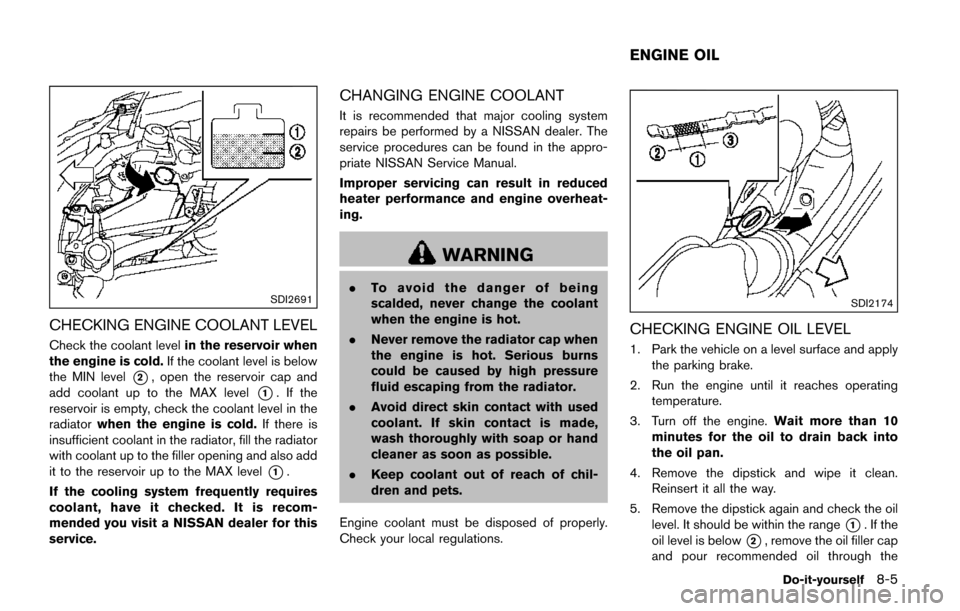
SDI2691
CHECKING ENGINE COOLANT LEVEL
Check the coolant levelin the reservoir when
the engine is cold. If the coolant level is below
the MIN level
*2, open the reservoir cap and
add coolant up to the MAX level
*1. If the
reservoir is empty, check the coolant level in the
radiator when the engine is cold. If there is
insufficient coolant in the radiator, fill the radiator
with coolant up to the filler opening and also add
it to the reservoir up to the MAX level
*1.
If the cooling system frequently requires
coolant, have it checked. It is recom-
mended you visit a NISSAN dealer for this
service.
CHANGING ENGINE COOLANT
It is recommended that major cooling system
repairs be performed by a NISSAN dealer. The
service procedures can be found in the appro-
priate NISSAN Service Manual.
Improper servicing can result in reduced
heater performance and engine overheat-
ing.
WARNING
. To avoid the danger of being
scalded, never change the coolant
when the engine is hot.
. Never remove the radiator cap when
the engine is hot. Serious burns
could be caused by high pressure
fluid escaping from the radiator.
. Avoid direct skin contact with used
coolant. If skin contact is made,
wash thoroughly with soap or hand
cleaner as soon as possible.
. Keep coolant out of reach of chil-
dren and pets.
Engine coolant must be disposed of properly.
Check your local regulations.SDI2174
CHECKING ENGINE OIL LEVEL
1. Park the vehicle on a level surface and apply the parking brake.
2. Run the engine until it reaches operating temperature.
3. Turn off the engine. Wait more than 10
minutes for the oil to drain back into
the oil pan.
4. Remove the dipstick and wipe it clean. Reinsert it all the way.
5. Remove the dipstick again and check the oil level. It should be within the range
*1. If the
oil level is below
*2, remove the oil filler cap
and pour recommended oil through the
Do-it-yourself8-5
ENGINE OIL
Page 472 of 520
The following descriptions are provided to give
you a better understanding of the scheduled
maintenance items that should be regularly
checked or replaced. The maintenance sche-
dule indicates at which mileage/time intervals
each item requires service.
In addition to scheduled maintenance, your
vehicle requires that some items be checked
during normal day-to-day operation. Refer to
“General maintenance” (P.9-2) .
Items marked with “*” are recommended by
NISSAN for reliable vehicle operation. You are
not required to perform maintenance on these
items in order to maintain the warranties which
come with your vehicle. Other maintenance
items and intervals are required.
When applicable, additional information can be
found in the “8. Do-it yourself” section of this
manual.
NOTE:
NISSAN does not advocate the use of non-
OEM approved aftermarket flushing sys-
tems and strongly advises against per-
forming these services on a NISSAN
product. Many of the aftermarket flushing
systems use non-OEM approved chemicals
or solvents, the use of which has not been
validated by NISSAN.
For recommended fuel, lubricants, fluids,grease, and refrigerant, refer to
“Capaci-
ties and recommended fluids/lubricants”
(P.10-2)of this manual.
EMISSION CONTROL SYSTEM MAIN-
TENANCE
Drive belts*:
Check engine drive belts for wear, fraying or
cracking and for proper tension. Replace any
damaged drive belts.
Engine air filter:
Replace at specified intervals. When driving for
prolonged periods in dusty conditions, check/
replace the filter more frequently.
Engine coolant*:
Replace coolant at the specified interval. When
adding or replacing coolant, be sure to use only
Genuine NISSAN Long Life Antifreeze/Coolant
(blue) or equivalent with the proper mixture.
(Refer to “Engine cooling system” (P.8-4) to
determine the proper mixture for your area.)
NOTE:
Mixing any other type of coolant or the use
of non-distilled water may reduce the
recommended service interval of the cool-
ant. Engine oil and oil filter:
Replace engine oil and oil filter at the specified
intervals. For recommended oil grade and vis-
cosity refer to “Capacities and recommended
fluids/lubricants” (P.10-2) .
Engine valve clearance*:
Inspect only if valve noise increases.
Adjust valve clearance if necessary.
Evaporative emissions control vapor
lines*:
Check vapor lines for leaks or looseness.
Tighten connections or replace parts as neces-
sary.
Fuel filter
Periodic maintenance is not required (in-tank
type filter) .
Fuel lines*:
Check the fuel hoses, piping and connections
for leaks, looseness, or deterioration. Tighten
connections or replace parts as necessary.
Spark plugs:
Replace at specified intervals. Install new plugs
of the type as originally equipped.
Maintenance and schedules9-5
EXPLANATION OF SCHEDULED
MAINTENANCE ITEMS
Page 513 of 520
11-2
Compact Disc (CD) player (See
audio system) .............................................................. 4-90
Compass ........................................................................ 2-8
Console box ................................................................. 2-47
Continuously Variable Transmission (CVT) fluid ... 8-8
Controls, Control panel ............................................... 4-5
CoolantCapacities and
recommended fluids/lubricants ........................ 10-2
Changing engine coolant ..................................... 8-5
Checking engine coolant level ............................ 8-5
Corrosion protection .................................................... 7-7
Cruise control .............................................................. 5-25
Cup holders ................................................................. 2-44
CVT, Driving with CVT (Continuously
Variable Transmission) .............................................. 5-13
D
Daytime running light system .................................. 2-37
Defroster switch, Rear window and outside
mirror defroster switch .............................................. 2-33
Dimensions and weights .......................................... 10-8
DISP button ................................................................. 4-10
Drive belt ...................................................................... 8-12
Drive positioner ........................................................... 3-36
Driving Cold weather driving .......................................... 5-34
Driving with CVT (Continuously
Variable Transmission) ....................................... 5-13
Precautions when starting and driving ............. 5-2
DVD player, NISSAN Mobile Entertainment ..... 4-110
E
ECON button .............................................................. 4-11
Economy, Fuel ............................................................. 5-28 Elapsed time ................................................................ 2-25
Emission control information label ...................... 10-10
Emission control system maintenance .................... 9-8
Emission control system warranty ....................... 10-25
Engine
Before starting the engine ................................ 5-11
Break-in schedule ................................................ 5-27
Capacities and
recommended fluids/lubricants ........................ 10-2
Changing engine coolant ..................................... 8-5
Changing engine oil and filter ............................. 8-6
Checking engine coolant level ............................ 8-5
Checking engine oil level ..................................... 8-5
Coolant temperature gauge ................................. 2-7
Emergency engine shut off ............................... 5-10
Engine block heater ............................................ 5-35
Engine compartment check locations ............... 8-3
Engine cooling system .......................................... 8-4
Engine oil .................................................................. 8-5
Engine oil and oil filter recommendation ....... 10-5
Engine oil replacement indicator ..................... 2-23
Engine oil viscosity .............................................. 10-6
Engine serial number .......................................... 10-9
Engine specifications .......................................... 10-7
Engine start operation indicator ...................... 2-21
If your vehicle overheats .................................... 6-12
Starting the engine ............................................. 5-12
Entry/exit function, Automatic drive positioner .... 3-36
Event Data Recorders (EDR) ............................... 10-27
Exhaust gas (carbon monoxide) ............................... 5-2
Explanation of scheduled maintenance items ....... 9-5
Extended storage fuse warning .............................. 2-22
F
F.M.V.S.S./C.M.V.S.S. certification label ............... 10-9 Filter
Air cleaner housing filter .................................... 8-14
Changing engine oil and filter ............................. 8-6
Flashers (See hazard warning flasher switch) ...... 6-2
Flat tire ............................................................................ 6-3
Flat towing ................................................................. 10-23
Flexible seating .............................................................. 1-8
Floor mat cleaning ........................................................ 7-5
Fluid Brake fluid ................................................................ 8-9
Capacities and
recommended fluids/lubricants ........................ 10-2
Continuously Variable Transmission
(CVT) fluid ................................................................ 8-8
Engine coolant ........................................................ 8-4
Engine oil .................................................................. 8-5
Power steering fluid ............................................... 8-8
Window washer fluid .......................................... 8-10
FM-AM radio with Compact Disc (CD) player .... 4-74
FM-AM-SAT radio with Compact Disc
(CD) player ....................................................... 4-77, 4-87
Fog light switch .......................................................... 2-39
Front manual seat adjustment ................................... 1-3
Front passenger air bag and status light ............. 1-55
Front power seat adjustment .................................... 1-4
Front seat, Front seat adjustment ............................ 1-3
Front-seat active head restraint .............................. 1-14
Fuel Capacities and
recommended fluids/lubricants ........................ 10-2
Fuel economy ....................................................... 5-28
Fuel economy information (display) ................ 4-12
Fuel octane rating ............................................... 10-3
Fuel recommendation ......................................... 10-3
Fuel-filler cap ........................................................ 3-30
Fuel-filler door ...................................................... 3-30
Gauge ........................................................................ 2-8