check NISSAN QUEST 2017 RE52 / 4.G Owners Manual
[x] Cancel search | Manufacturer: NISSAN, Model Year: 2017, Model line: QUEST, Model: NISSAN QUEST 2017 RE52 / 4.GPages: 520, PDF Size: 2.5 MB
Page 8 of 520
Illustrated table of contents0
Safety — Seats, seat belts and supplemental restraint system1
Instruments and controls
Pre-driving checks and adjustments
Monitor, heater, air conditioner, audio, phone and voice
recognition systems
Starting and driving
In case of emergency
Appearance and care
Do-it-yourself
Maintenance and schedules
Technical and consumer information
2
3
4
5
6
7
8
9
10
Table of
Contents
Index11
Page 26 of 520
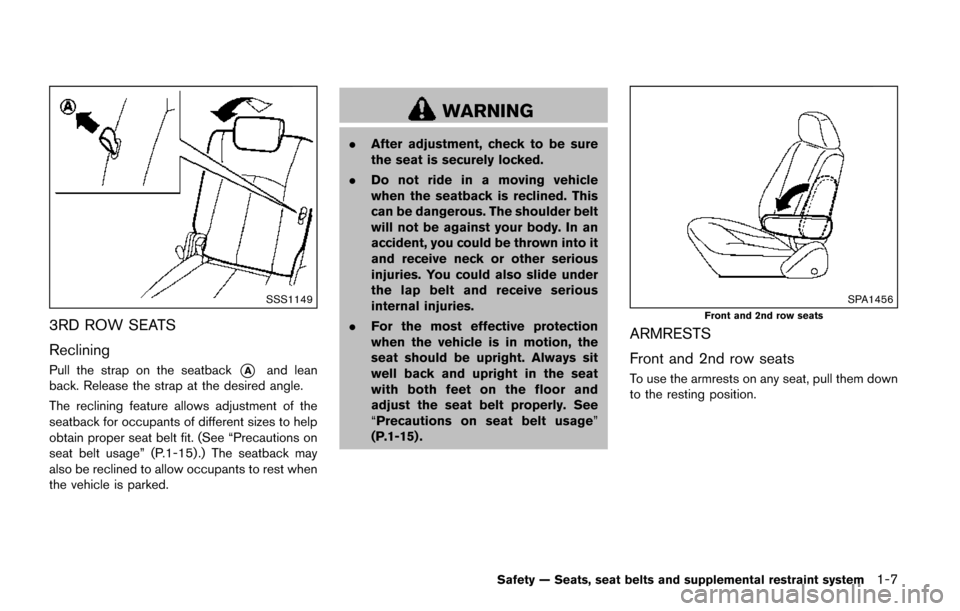
SSS1149
3RD ROW SEATS
Reclining
Pull the strap on the seatback*Aand lean
back. Release the strap at the desired angle.
The reclining feature allows adjustment of the
seatback for occupants of different sizes to help
obtain proper seat belt fit. (See “Precautions on
seat belt usage” (P.1-15) .) The seatback may
also be reclined to allow occupants to rest when
the vehicle is parked.
WARNING
. After adjustment, check to be sure
the seat is securely locked.
. Do not ride in a moving vehicle
when the seatback is reclined. This
can be dangerous. The shoulder belt
will not be against your body. In an
accident, you could be thrown into it
and receive neck or other serious
injuries. You could also slide under
the lap belt and receive serious
internal injuries.
. For the most effective protection
when the vehicle is in motion, the
seat should be upright. Always sit
well back and upright in the seat
with both feet on the floor and
adjust the seat belt properly. See
“Precautions on seat belt usage”
(P.1-15) .
SPA1456
Front and 2nd row seats
ARMRESTS
Front and 2nd row seats
To use the armrests on any seat, pull them down
to the resting position.
Safety — Seats, seat belts and supplemental restraint system1-7
Page 29 of 520
1-10Safety — Seats, seat belts and supplemental restraint system
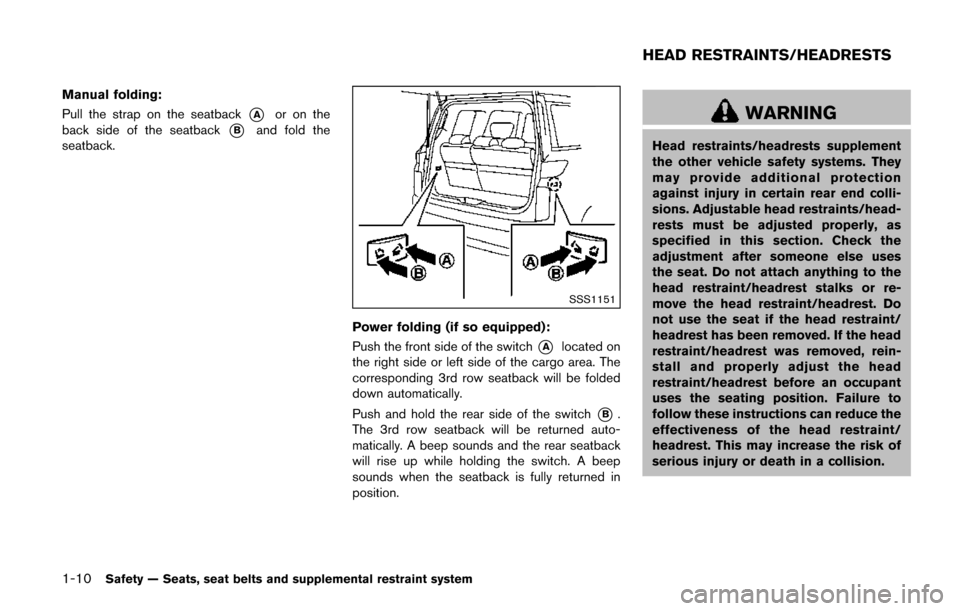
Manual folding:
Pull the strap on the seatback
*Aor on the
back side of the seatback
*Band fold the
seatback.
SSS1151
Power folding (if so equipped):
Push the front side of the switch
*Alocated on
the right side or left side of the cargo area. The
corresponding 3rd row seatback will be folded
down automatically.
Push and hold the rear side of the switch
*B.
The 3rd row seatback will be returned auto-
matically. A beep sounds and the rear seatback
will rise up while holding the switch. A beep
sounds when the seatback is fully returned in
position.
WARNING
Head restraints/headrests supplement
the other vehicle safety systems. They
may provide additional protection
against injury in certain rear end colli-
sions. Adjustable head restraints/head-
rests must be adjusted properly, as
specified in this section. Check the
adjustment after someone else uses
the seat. Do not attach anything to the
head restraint/headrest stalks or re-
move the head restraint/headrest. Do
not use the seat if the head restraint/
headrest has been removed. If the head
restraint/headrest was removed, rein-
stall and properly adjust the head
restraint/headrest before an occupant
uses the seating position. Failure to
follow these instructions can reduce the
effectiveness of the head restraint/
headrest. This may increase the risk of
serious injury or death in a collision.
HEAD RESTRAINTS/HEADRESTS
Page 35 of 520
1-16Safety — Seats, seat belts and supplemental restraint system
WARNING
.Every person who drives or rides in
this vehicle should use a seat belt at
all times. Children should be prop-
erly restrained in the rear seat and,
if appropriate, in a child restraint.
. The seat belt should be properly
adjusted to a snug fit. Failure to do
so may reduce the effectiveness of
the entire restraint system and in-
crease the chance or severity of
injury in an accident. Serious injury
or death can occur if the seat belt is
not worn properly.
. Always route the shoulder belt over
your shoulder and across your
chest. Never put the belt behind
your back, under your arm or across
your neck. The belt should be away
from your face and neck, but not
falling off your shoulder.
. Position the lap belt as low and
snug as possible AROUND THE
HIPS, NOT THE WAIST. A lap belt
worn too high could increase the
risk of internal injuries in an acci-
dent. .
Be sure the seat belt tongue is
securely fastened to the proper
buckle.
. Do not wear the seat belt inside out
or twisted. Doing so may reduce its
effectiveness.
. Do not allow more than one person
to use the same seat belt.
. Never carry more people in the
vehicle than there are seat belts.
. If the seat belt warning light glows
continuously while the ignition is
turned ON with all doors closed and
all seat belts fastened, it may in-
dicate a malfunction in the system.
Have the system checked. It is
recommended you visit a NISSAN
dealer for this service.
. No changes should be made to the
seat belt system. For example, do
not modify the seat belt, add mate-
rial or install devices that may
change the seat belt routing or
tension. Doing so may affect the
operation of the seat belt system.
Modifying or tampering with the
seat belt system may result in
serious personal injury. .
Once a seat belt pretensioner has
activated, it cannot be reused and
must be replaced together with the
retractor. It is recommended you
visit a NISSAN dealer for this ser-
vice.
. All seat belt assemblies, including
retractors and attaching hardware,
should be inspected after any colli-
sion. It is recommended you visit a
NISSAN dealer for this service.
NISSAN recommends that all seat
belt assemblies in use during a
collision be replaced unless the
collision was minor and the belts
show no damage and continue to
operate properly.
Seat belt assemblies not in use
during a collision should also be
inspected and replaced if either
damage or improper operation is
noted.
. All child restraints and attaching
hardware should be inspected after
any collision. Always follow the
restraint manufacturer’s inspection
instructions and replacement re-
commendations. The child restraints
should be replaced if they are
Page 36 of 520
damaged.
SSS0016
SSS0014
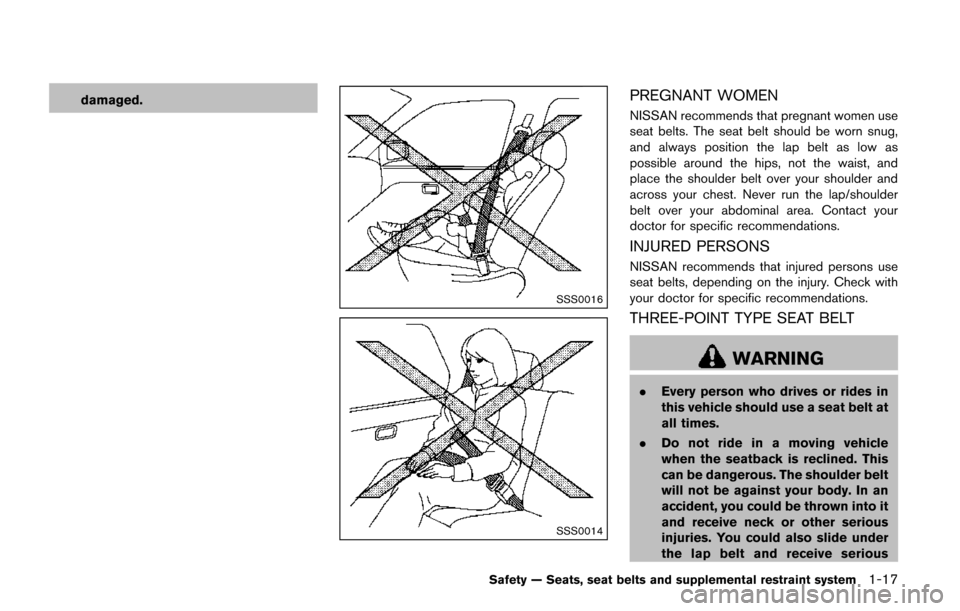
PREGNANT WOMEN
NISSAN recommends that pregnant women use
seat belts. The seat belt should be worn snug,
and always position the lap belt as low as
possible around the hips, not the waist, and
place the shoulder belt over your shoulder and
across your chest. Never run the lap/shoulder
belt over your abdominal area. Contact your
doctor for specific recommendations.
INJURED PERSONS
NISSAN recommends that injured persons use
seat belts, depending on the injury. Check with
your doctor for specific recommendations.
THREE-POINT TYPE SEAT BELT
WARNING
.Every person who drives or rides in
this vehicle should use a seat belt at
all times.
. Do not ride in a moving vehicle
when the seatback is reclined. This
can be dangerous. The shoulder belt
will not be against your body. In an
accident, you could be thrown into it
and receive neck or other serious
injuries. You could also slide under
the lap belt and receive serious
Safety — Seats, seat belts and supplemental restraint system1-17
Page 39 of 520
1-20Safety — Seats, seat belts and supplemental restraint system
SSS0326
Unfastening the seat belts
To unfasten the seat belt, push the button on the
buckle. The seat belt automatically retracts.
Checking seat belt operation
Seat belt retractors are designed to lock seat
belt movement by two separate methods:
.When the belt is pulled quickly from the
retractor.
. When the vehicle slows down rapidly.
To increase your confidence in the seat belts,
check the operation as follows:
. Grasp the shoulder belt and pull forward
quickly. The retractor should lock and restrict further belt movement.
If the retractor does not lock during this check,
get the system checked. It is recommended you
visit a NISSAN dealer for this service, or to learn
more about seat belt operation.
SSS0391
3rd row center seat belt
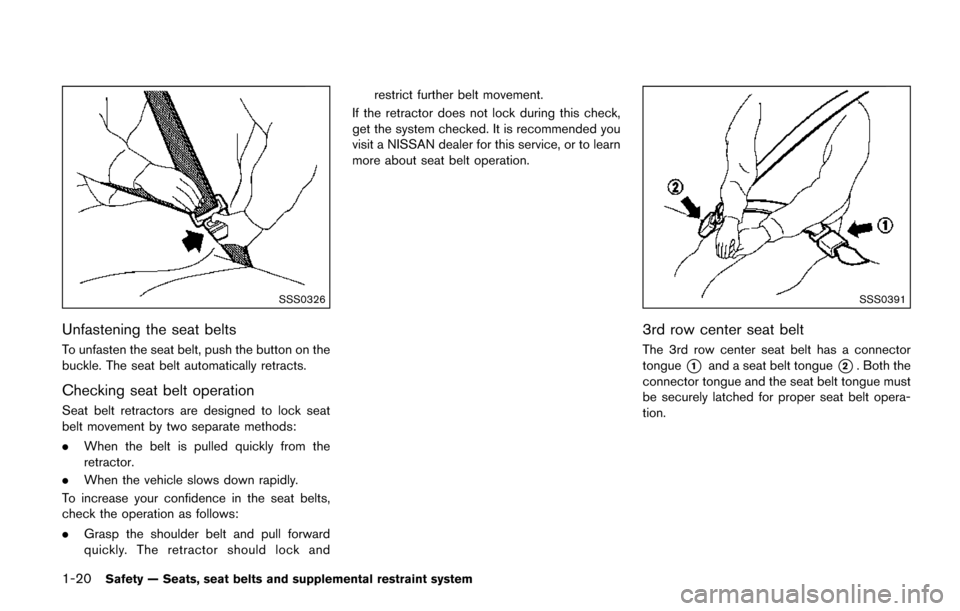
The 3rd row center seat belt has a connector
tongue
*1and a seat belt tongue*2. Both the
connector tongue and the seat belt tongue must
be securely latched for proper seat belt opera-
tion.
Page 43 of 520
1-24Safety — Seats, seat belts and supplemental restraint system
assistance with purchasing an extender if an
extender is required.
WARNING
.It is recommended that only
NISSAN seat belt extenders, made
by the same company which made
the original equipment seat belts,
be used with the NISSAN seat belts.
. Adults and children who can use the
standard seat belt should not use an
extender. Such unnecessary use
could result in serious personal
injury in the event of an accident.
. Never use seat belt extenders to
install child restraints. If the child
restraint is not secured properly, the
child could be seriously injured or
killed in a collision or a sudden stop.
SEAT BELT MAINTENANCE
.To clean the seat belt webbing, apply a
mild soap solution or any solution recom-
mended for cleaning upholstery or carpets.
Then, wipe with a cloth and allow the seat
belts to dry in the shade. Do not allow the
seat belts to retract until they are completely
dry. .
If dirt builds up in the shoulder belt
guide of the seat belt anchors, the seat
belts may retract slowly. Wipe the shoulder
belt guide with a clean, dry cloth.
. Periodically check to see that the seat
belt and the metal components such as
buckles, tongues, retractors, flexible wires
and anchors work properly. If loose parts,
deterioration, cuts or other damage on the
webbing is found, the entire seat belt
assembly should be replaced.
JVR0183X
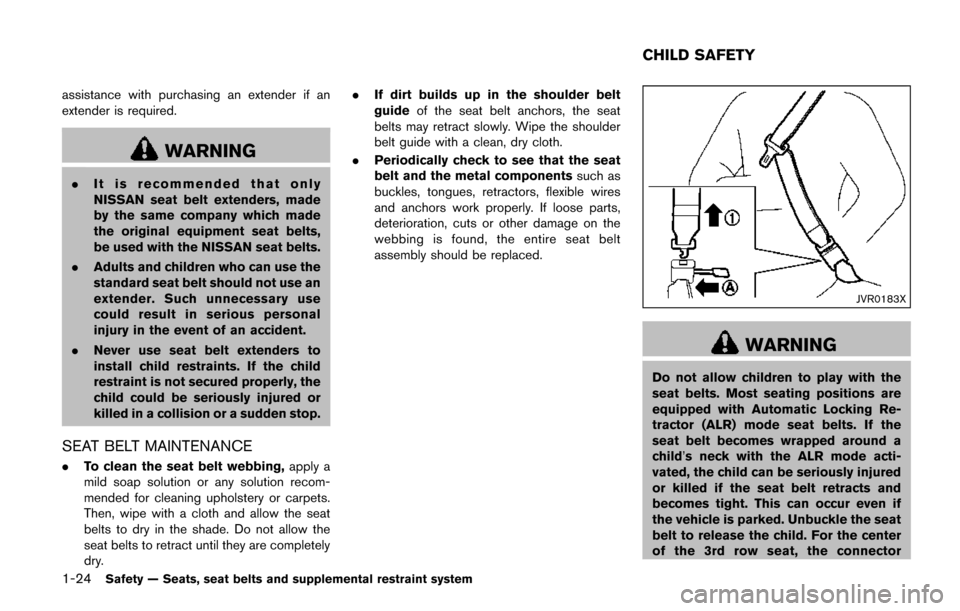
WARNING
Do not allow children to play with the
seat belts. Most seating positions are
equipped with Automatic Locking Re-
tractor (ALR) mode seat belts. If the
seat belt becomes wrapped around a
child’s neck with the ALR mode acti-
vated, the child can be seriously injured
or killed if the seat belt retracts and
becomes tight. This can occur even if
the vehicle is parked. Unbuckle the seat
belt to release the child. For the center
of the 3rd row seat, the connector
CHILD SAFETY
Page 45 of 520
1-26Safety — Seats, seat belts and supplemental restraint system
placed in child restraints that comply with
Federal Motor Vehicle Safety Standards or
Canadian Motor Vehicle Safety Standards. You
should choose a child restraint that fits your
vehicle and always follow the manufacturer’s
instructions for installation and use.
LARGER CHILDREN
Children should remain in a forward-facing child
restraint with a harness until they reach the
maximum height or weight limit allowed by the
child restraint manufacturer.
Once a child outgrows the height or weight limit
of the harness-equipped forward-facing child
restraint, NISSAN recommends that the child be
placed in a commercially available booster seat
to obtain proper seat belt fit. For a seat belt to fit
properly, the booster seat should raise the child
so that the shoulder belt is properly positioned
across the chest and the top, middle portion of
the shoulder. The shoulder belt should not cross
the neck or face and should not fall off the
shoulder. The lap belt should lie snugly across
the lower hips or upper thighs, not the abdomen.
A booster seat can only be used in seating
positions that have a three-point type seat belt.
The booster seat should fit the vehicle seat and
have a label certifying that it complies with
Federal Motor Vehicle Safety Standards or
Canadian Motor Vehicle Safety Standards.A booster seat should be used until the child
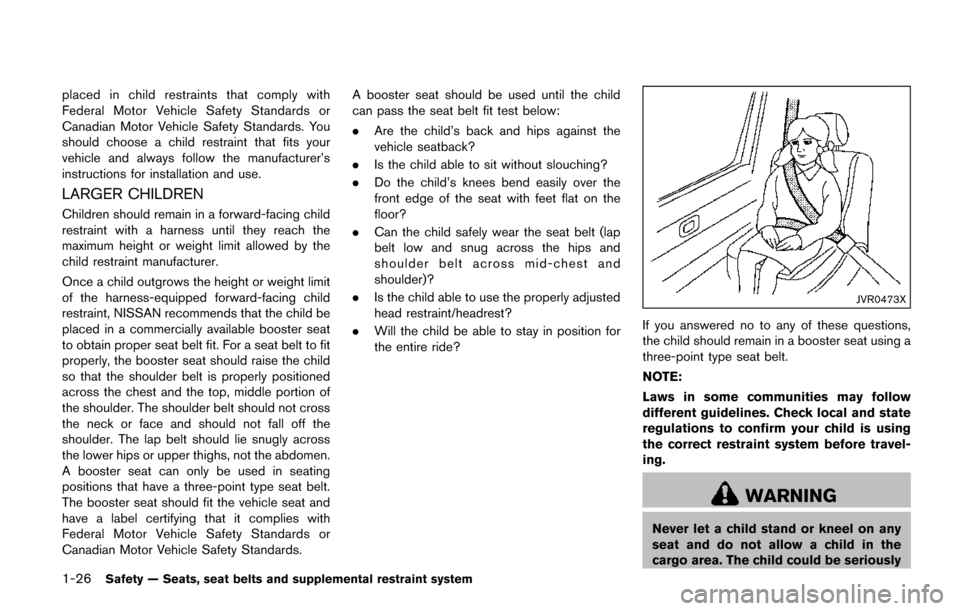
can pass the seat belt fit test below:
.
Are the child’s back and hips against the
vehicle seatback?
. Is the child able to sit without slouching?
. Do the child’s knees bend easily over the
front edge of the seat with feet flat on the
floor?
. Can the child safely wear the seat belt (lap
belt low and snug across the hips and
shoulder belt across mid-chest and
shoulder)?
. Is the child able to use the properly adjusted
head restraint/headrest?
. Will the child be able to stay in position for
the entire ride?
JVR0473X
If you answered no to any of these questions,
the child should remain in a booster seat using a
three-point type seat belt.
NOTE:
Laws in some communities may follow
different guidelines. Check local and state
regulations to confirm your child is using
the correct restraint system before travel-
ing.
WARNING
Never let a child stand or kneel on any
seat and do not allow a child in the
cargo area. The child could be seriously
Page 47 of 520
1-28Safety — Seats, seat belts and supplemental restraint system
in the front seat. If you must
install a forward-facing child
restraint in the front seat, see
“Forward-facing child restraint
installation using LATCH” (P.1-
37) .
— Even with the NISSAN Advanced Air Bag System, never install a
rear-facing child restraint in the
front seat. An inflating air bag
could seriously injure or kill a
child. A rear-facing child re-
straint must only be used in the
rear seat.
— Be sure to purchase a child restraint that will fit the child
and vehicle. Some child re-
straints may not fit properly in
your vehicle.
— Child restraint anchor points are designed to withstand loads
from child restraints that are
properly fitted.
— Never use the anchor points for adult seat belts or harnesses. — A child restraint with a top tether
strap should not be used in the
front passenger seat.
— Keep seatbacks as upright as possible after fitting the child
restraint.
— Infants and children should al- ways be placed in an appropri-
ate child restraint while in the
vehicle.
. When the child restraint is not in
use, keep it secured with the LATCH
system or a seat belt. In a sudden
stop or collision, loose objects can
injure occupants or damage the
vehicle.
CAUTION
A child restraint in a closed vehicle can
become very hot. Check the seating
surface and buckles before placing a
child in the child restraint.
This vehicle is equipped with a universal child
restraint anchor system, referred to as the
LATCH (Lower Anchors and Tethers for CHil- dren) system. Some child restraints include rigid
or webbing-mounted attachments that can be
connected to these anchors.
For details, see “Lower Anchors and Tethers for
CHildren System (LATCH)” (P.1-29) .
If you do not have a LATCH compatible child
restraint, the vehicle seat belts can be used.
Several manufacturers offer child restraints for
infants and small children of various sizes. When
selecting any child restraint, keep the following
points in mind:
.
Choose only a restraint with a label certifying
that it complies with Federal Motor Vehicle
Safety Standard 213 or Canadian Motor
Vehicle Safety Standard 213.
. Check the child restraint in your vehicle to
be sure it is compatible with the vehicle’s
seat and seat belt system.
. If the child restraint is compatible with your
vehicle, place your child in the child restraint
and check the various adjustments to be
sure the child restraint is compatible with
your child. Choose a child restraint that is
designed for your child’s height and weight.
Always follow all recommended procedures.
. If the combined weight of the child and child
restraint is less than 65 lbs (29.5 kg) , you
may use either the LATCH anchors or the
seat belt to install the child restraint (not
Page 50 of 520
SSS0643
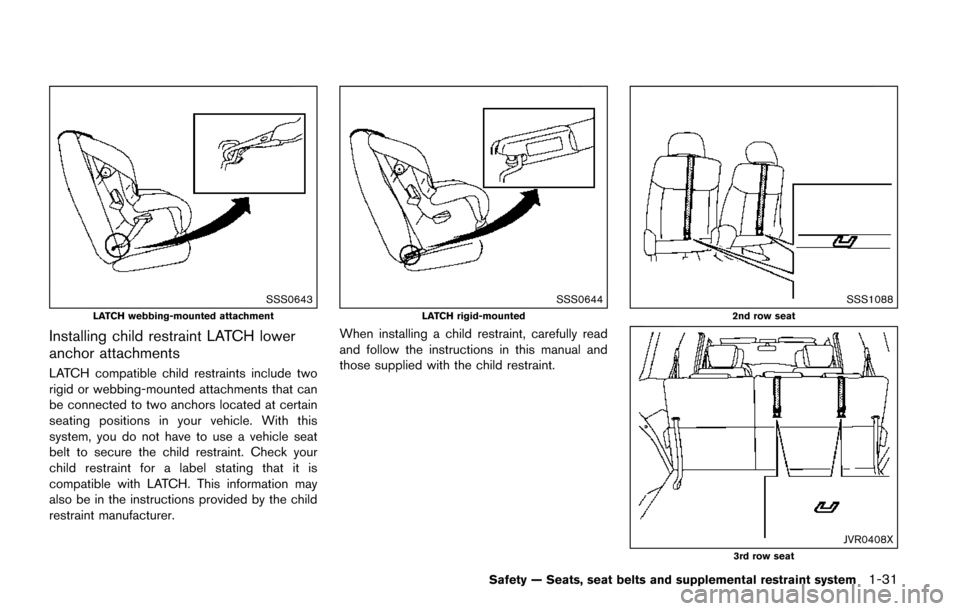
LATCH webbing-mounted attachment
Installing child restraint LATCH lower
anchor attachments
LATCH compatible child restraints include two
rigid or webbing-mounted attachments that can
be connected to two anchors located at certain
seating positions in your vehicle. With this
system, you do not have to use a vehicle seat
belt to secure the child restraint. Check your
child restraint for a label stating that it is
compatible with LATCH. This information may
also be in the instructions provided by the child
restraint manufacturer.
SSS0644
LATCH rigid-mounted
When installing a child restraint, carefully read
and follow the instructions in this manual and
those supplied with the child restraint.
SSS1088
2nd row seat
JVR0408X3rd row seat
Safety — Seats, seat belts and supplemental restraint system1-31