key NISSAN QUEST 2017 RE52 / 4.G Owners Manual
[x] Cancel search | Manufacturer: NISSAN, Model Year: 2017, Model line: QUEST, Model: NISSAN QUEST 2017 RE52 / 4.GPages: 520, PDF Size: 2.5 MB
Page 12 of 520
JVO0058X
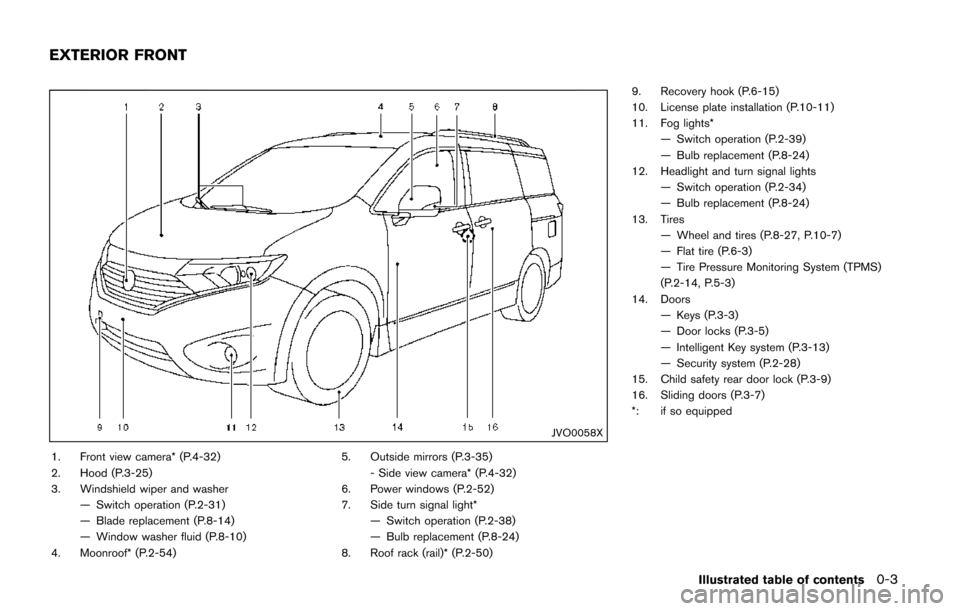
1. Front view camera* (P.4-32)
2. Hood (P.3-25)
3. Windshield wiper and washer— Switch operation (P.2-31)
— Blade replacement (P.8-14)
— Window washer fluid (P.8-10)
4. Moonroof* (P.2-54) 5. Outside mirrors (P.3-35)
- Side view camera* (P.4-32)
6. Power windows (P.2-52)
7. Side turn signal light*
— Switch operation (P.2-38)
— Bulb replacement (P.8-24)
8. Roof rack (rail)* (P.2-50) 9. Recovery hook (P.6-15)
10. License plate installation (P.10-11)
11. Fog lights*
— Switch operation (P.2-39)
— Bulb replacement (P.8-24)
12. Headlight and turn signal lights — Switch operation (P.2-34)
— Bulb replacement (P.8-24)
13. Tires — Wheel and tires (P.8-27, P.10-7)
— Flat tire (P.6-3)
— Tire Pressure Monitoring System (TPMS)
(P.2-14, P.5-3)
14. Doors — Keys (P.3-3)
— Door locks (P.3-5)
— Intelligent Key system (P.3-13)
— Security system (P.2-28)
15. Child safety rear door lock (P.3-9)
16. Sliding doors (P.3-7)
*: if so equipped
Illustrated table of contents0-3
EXTERIOR FRONT
Page 13 of 520
0-4Illustrated table of contents
SSI0822
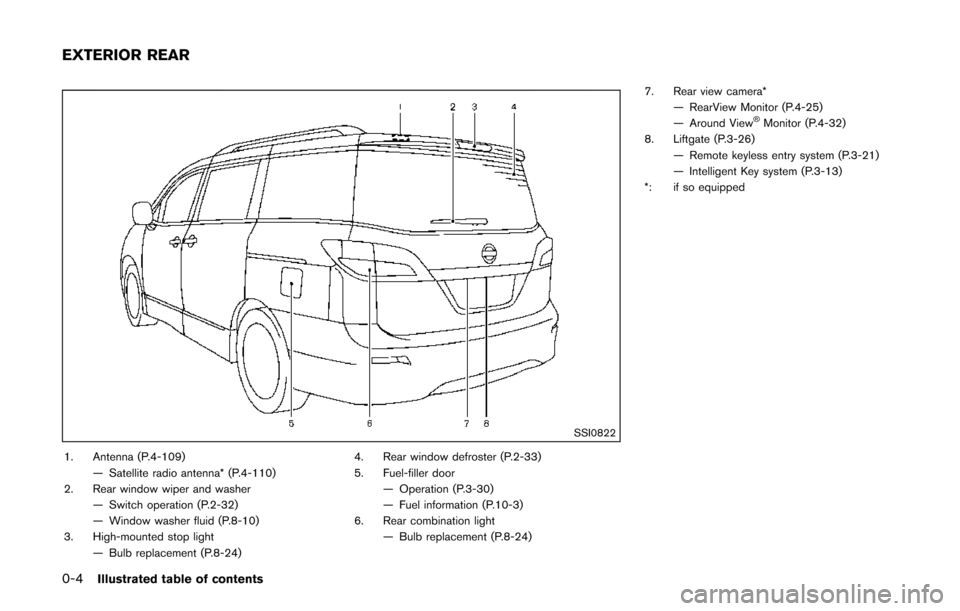
1. Antenna (P.4-109)— Satellite radio antenna* (P.4-110)
2. Rear window wiper and washer
— Switch operation (P.2-32)
— Window washer fluid (P.8-10)
3. High-mounted stop light — Bulb replacement (P.8-24) 4. Rear window defroster (P.2-33)
5. Fuel-filler door
— Operation (P.3-30)
— Fuel information (P.10-3)
6. Rear combination light — Bulb replacement (P.8-24) 7. Rear view camera*
— RearView Monitor (P.4-25)
— Around View
ŠMonitor (P.4-32)
8. Liftgate (P.3-26) — Remote keyless entry system (P.3-21)
— Intelligent Key system (P.3-13)
*: if so equipped
EXTERIOR REAR
Page 19 of 520
0-10Illustrated table of contents
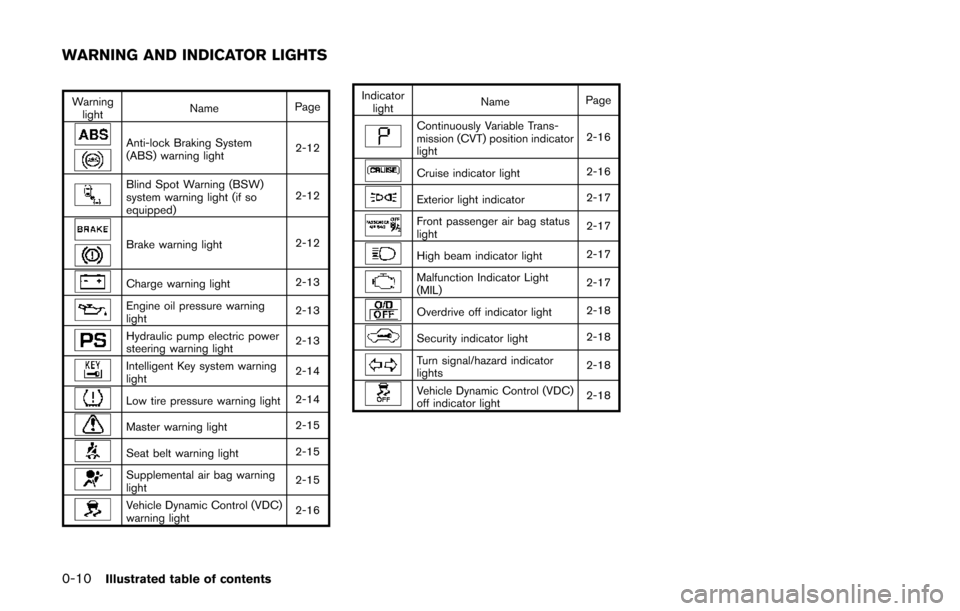
Warninglight Name
Page
Anti-lock Braking System
(ABS) warning light 2-12
Blind Spot Warning (BSW)
system warning light (if so
equipped)2-12
Brake warning light
2-12
Charge warning light2-13
Engine oil pressure warning
light2-13
Hydraulic pump electric power
steering warning light
2-13
Intelligent Key system warning
light2-14
Low tire pressure warning light
2-14
Master warning light2-15
Seat belt warning light2-15
Supplemental air bag warning
light2-15
Vehicle Dynamic Control (VDC)
warning light
2-16Indicator
light Name
Page
Continuously Variable Trans-
mission (CVT) position indicator
light 2-16
Cruise indicator light
2-16
Exterior light indicator2-17
Front passenger air bag status
light2-17
High beam indicator light
2-17
Malfunction Indicator Light
(MIL)2-17
Overdrive off indicator light
2-18
Security indicator light2-18
Turn signal/hazard indicator
lights2-18
Vehicle Dynamic Control (VDC)
off indicator light2-18
WARNING AND INDICATOR LIGHTS
Page 37 of 520
1-18Safety — Seats, seat belts and supplemental restraint system
internal injuries.
. For the most effective protection
when the vehicle is in motion, the
seat should be upright. Always sit
well back and upright in the seat
with both feet on the floor and
adjust the seat belt properly.
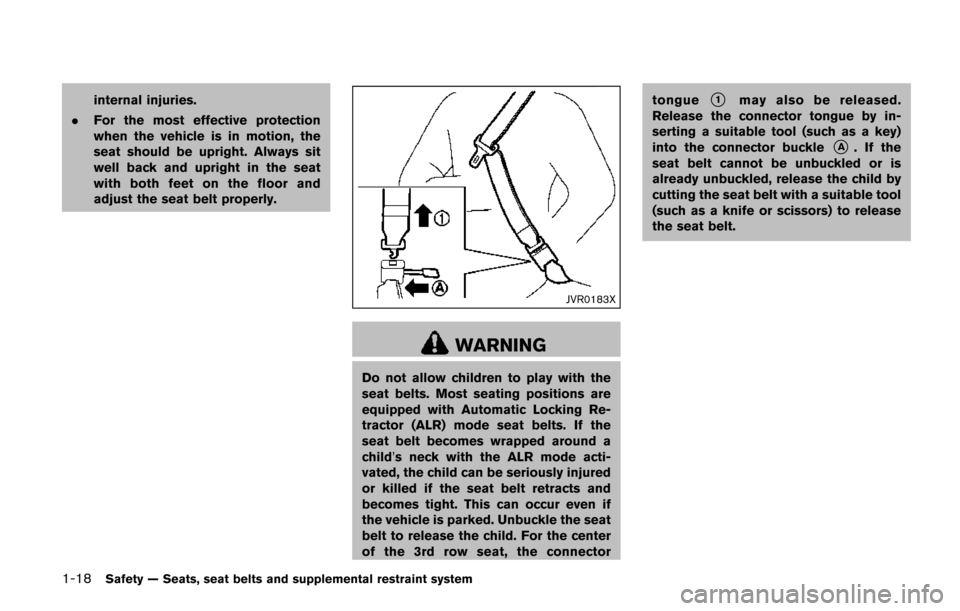
JVR0183X
WARNING
Do not allow children to play with the
seat belts. Most seating positions are
equipped with Automatic Locking Re-
tractor (ALR) mode seat belts. If the
seat belt becomes wrapped around a
child’s neck with the ALR mode acti-
vated, the child can be seriously injured
or killed if the seat belt retracts and
becomes tight. This can occur even if
the vehicle is parked. Unbuckle the seat
belt to release the child. For the center
of the 3rd row seat, the connector tongue
*1may also be released.
Release the connector tongue by in-
serting a suitable tool (such as a key)
into the connector buckle
*A. If the
seat belt cannot be unbuckled or is
already unbuckled, release the child by
cutting the seat belt with a suitable tool
(such as a knife or scissors) to release
the seat belt.
Page 40 of 520
SSS0241
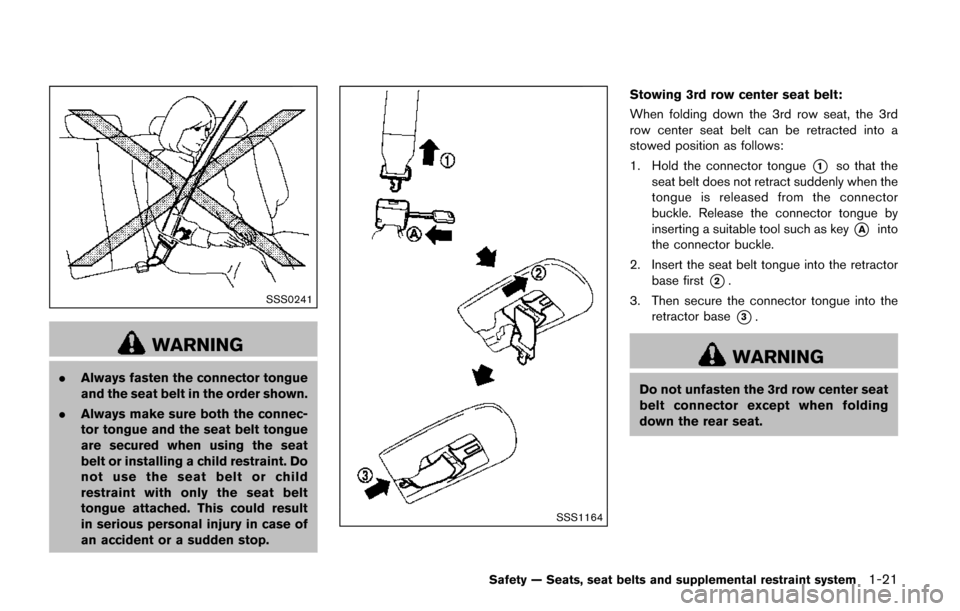
WARNING
.Always fasten the connector tongue
and the seat belt in the order shown.
. Always make sure both the connec-
tor tongue and the seat belt tongue
are secured when using the seat
belt or installing a child restraint. Do
not use the seat belt or child
restraint with only the seat belt
tongue attached. This could result
in serious personal injury in case of
an accident or a sudden stop.
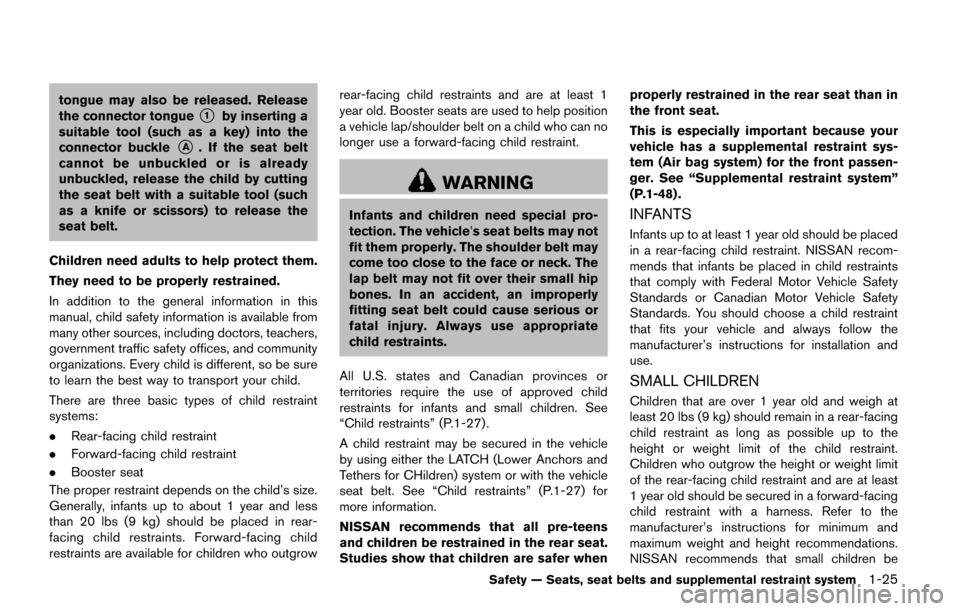
SSS1164
Stowing 3rd row center seat belt:
When folding down the 3rd row seat, the 3rd
row center seat belt can be retracted into a
stowed position as follows:
1. Hold the connector tongue
*1so that the
seat belt does not retract suddenly when the
tongue is released from the connector
buckle. Release the connector tongue by
inserting a suitable tool such as key
*Ainto
the connector buckle.
2. Insert the seat belt tongue into the retractor base first
*2.
3. Then secure the connector tongue into the retractor base
*3.
WARNING
Do not unfasten the 3rd row center seat
belt connector except when folding
down the rear seat.
Safety — Seats, seat belts and supplemental restraint system1-21
Page 44 of 520
tongue may also be released. Release
the connector tongue*1by inserting a
suitable tool (such as a key) into the
connector buckle
*A. If the seat belt
cannot be unbuckled or is already
unbuckled, release the child by cutting
the seat belt with a suitable tool (such
as a knife or scissors) to release the
seat belt.
Children need adults to help protect them.
They need to be properly restrained.
In addition to the general information in this
manual, child safety information is available from
many other sources, including doctors, teachers,
government traffic safety offices, and community
organizations. Every child is different, so be sure
to learn the best way to transport your child.
There are three basic types of child restraint
systems:
. Rear-facing child restraint
. Forward-facing child restraint
. Booster seat
The proper restraint depends on the child’s size.
Generally, infants up to about 1 year and less
than 20 lbs (9 kg) should be placed in rear-
facing child restraints. Forward-facing child
restraints are available for children who outgrow rear-facing child restraints and are at least 1
year old. Booster seats are used to help position
a vehicle lap/shoulder belt on a child who can no
longer use a forward-facing child restraint.
WARNING
Infants and children need special pro-
tection. The vehicle’s seat belts may not
fit them properly. The shoulder belt may
come too close to the face or neck. The
lap belt may not fit over their small hip
bones. In an accident, an improperly
fitting seat belt could cause serious or
fatal injury. Always use appropriate
child restraints.
All U.S. states and Canadian provinces or
territories require the use of approved child
restraints for infants and small children. See
“Child restraints” (P.1-27) .
A child restraint may be secured in the vehicle
by using either the LATCH (Lower Anchors and
Tethers for CHildren) system or with the vehicle
seat belt. See “Child restraints” (P.1-27) for
more information.
NISSAN recommends that all pre-teens
and children be restrained in the rear seat.
Studies show that children are safer when properly restrained in the rear seat than in
the front seat.
This is especially important because your
vehicle has a supplemental restraint sys-
tem (Air bag system) for the front passen-
ger. See “Supplemental restraint system”
(P.1-48) .INFANTS
Infants up to at least 1 year old should be placed
in a rear-facing child restraint. NISSAN recom-
mends that infants be placed in child restraints
that comply with Federal Motor Vehicle Safety
Standards or Canadian Motor Vehicle Safety
Standards. You should choose a child restraint
that fits your vehicle and always follow the
manufacturer’s instructions for installation and
use.
SMALL CHILDREN
Children that are over 1 year old and weigh at
least 20 lbs (9 kg) should remain in a rear-facing
child restraint as long as possible up to the
height or weight limit of the child restraint.
Children who outgrow the height or weight limit
of the rear-facing child restraint and are at least
1 year old should be secured in a forward-facing
child restraint with a harness. Refer to the
manufacturer’s instructions for minimum and
maximum weight and height recommendations.
NISSAN recommends that small children be
Safety — Seats, seat belts and supplemental restraint system1-25
Page 92 of 520
JVC0210X
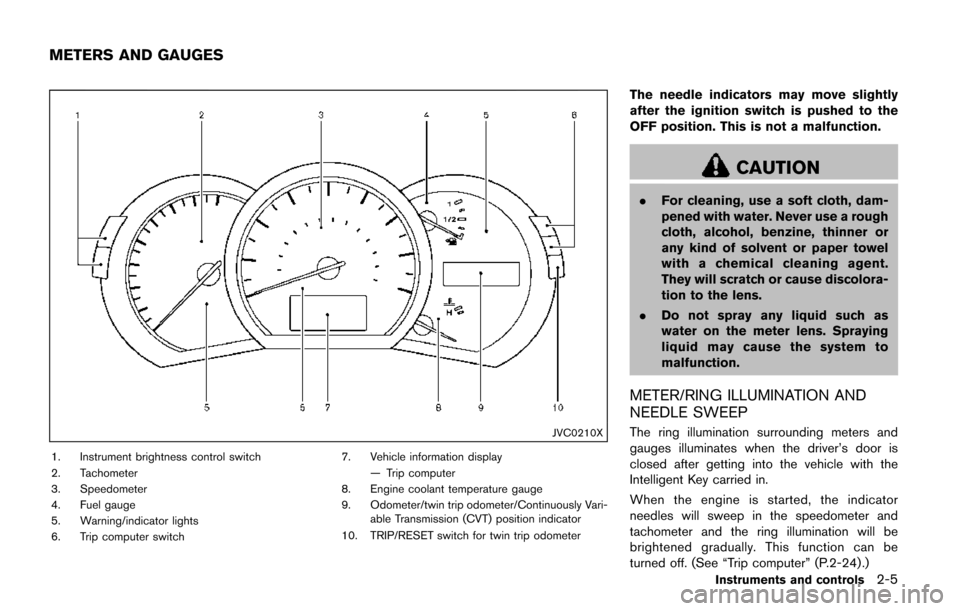
1. Instrument brightness control switch
2. Tachometer
3. Speedometer
4. Fuel gauge
5. Warning/indicator lights
6. Trip computer switch7. Vehicle information display
— Trip computer
8. Engine coolant temperature gauge
9. Odometer/twin trip odometer/Continuously Vari- able Transmission (CVT) position indicator
10. TRIP/RESET switch for twin trip odometer
The needle indicators may move slightly
after the ignition switch is pushed to the
OFF position. This is not a malfunction.
CAUTION
. For cleaning, use a soft cloth, dam-
pened with water. Never use a rough
cloth, alcohol, benzine, thinner or
any kind of solvent or paper towel
with a chemical cleaning agent.
They will scratch or cause discolora-
tion to the lens.
. Do not spray any liquid such as
water on the meter lens. Spraying
liquid may cause the system to
malfunction.
METER/RING ILLUMINATION AND
NEEDLE SWEEP
The ring illumination surrounding meters and
gauges illuminates when the driver’s door is
closed after getting into the vehicle with the
Intelligent Key carried in.
When the engine is started, the indicator
needles will sweep in the speedometer and
tachometer and the ring illumination will be
brightened gradually. This function can be
turned off. (See “Trip computer” (P.2-24) .)
Instruments and controls2-5
METERS AND GAUGES
Page 98 of 520
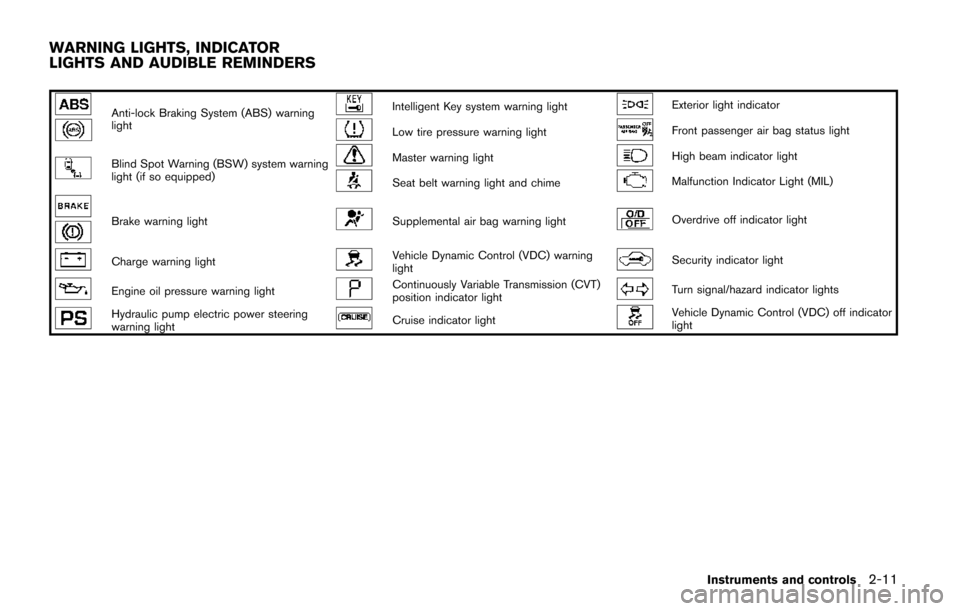
Anti-lock Braking System (ABS) warning
lightIntelligent Key system warning lightExterior light indicator
Low tire pressure warning lightFront passenger air bag status light
Blind Spot Warning (BSW) system warning
light (if so equipped)Master warning lightHigh beam indicator light
Seat belt warning light and chimeMalfunction Indicator Light (MIL)
Brake warning lightSupplemental air bag warning lightOverdrive off indicator light
Charge warning lightVehicle Dynamic Control (VDC) warning
lightSecurity indicator light
Engine oil pressure warning lightContinuously Variable Transmission (CVT)
position indicator lightTurn signal/hazard indicator lights
Hydraulic pump electric power steering
warning lightCruise indicator lightVehicle Dynamic Control (VDC) off indicator
light
Instruments and controls2-11
WARNING LIGHTS, INDICATOR
LIGHTS AND AUDIBLE REMINDERS
Page 101 of 520
2-14Instruments and controls
Intelligent Key system warning light
After the ignition switch is pushed to the ON
position, this light comes on for about 2 seconds
and then turns off.
This light warns of a malfunction with the
Intelligent Key system.
If the light comes on while the engine is
stopped, it may be impossible to start the
engine. If the light comes on while the engine
is running, you can drive the vehicle. However in
these cases, it is recommended you visit a
NISSAN dealer for repair as soon as possible.
Low tire pressure warning light
Your vehicle is equipped with a Tire Pressure
Monitoring System (TPMS) that monitors the tire
pressure of all tires except the spare.
The low tire pressure warning light warns of low
tire pressure or indicates that the TPMS is not
functioning properly.
After the ignition switch is pushed ON, this light
illuminates for about 1 second and turns off.
Low tire pressure warning:
If the vehicle is being driven with low tire
pressure, the warning light will illuminate. A
CHECK TIRE PRESSURE warning also appears
on the vehicle information display.When the low tire pressure warning light
illuminates, you should stop and adjust the tire
pressure to the recommended COLD tire
pressure shown on the Tire and Loading
Information label. The low tire pressure warning
light does not automatically turn off when the tire
pressure is adjusted. After the tire is inflated to
the recommended pressure, the vehicle must be
driven at speeds above 16 MPH (25 km/h) to
activate the TPMS and turn off the low tire
pressure warning light. Use a tire pressure
gauge to check the tire pressure.
The CHECK TIRE PRESSURE warning appears
each time the ignition switch is placed in the ON
position as long as the low tire pressure warning
light remains illuminated.
For additional information, see “Vehicle informa-
tion display” (P.2-19) , “Tire Pressure Monitoring
System (TPMS)” (P.5-3) and “Tire Pressure
Monitoring System (TPMS)” (P.6-3) .
TPMS malfunction:
If the TPMS is not functioning properly, the low
tire pressure warning light will flash for approxi-
mately 1 minute when the ignition switch is
pushed ON. The light will remain on after 1
minute. Have the system checked. It is recom-
mended you visit a NISSAN dealer for this
service. The CHECK TIRE PRESSURE warning
does not appear if the low tire pressure warninglight illuminates to indicate a TPMS malfunction.
For additional information, see “Tire Pressure
Monitoring System (TPMS)” (P.5-3) . For the
CHECK TIRE PRESSURE warning, see “Vehicle
information display” (P.2-19) .
WARNING
.
If the light does not illuminate with
the ignition switch pushed ON, have
the vehicle checked as soon as
possible. It is recommended you
visit a NISSAN dealer for this ser-
vice.
. If the light illuminates while driving,
avoid sudden steering maneuvers or
abrupt braking, reduce vehicle
speed, pull off the road to a safe
location and stop the vehicle as
soon as possible. Driving with un-
der-inflated tires may permanently
damage the tires and increase the
likelihood of tire failure. Serious
vehicle damage could occur and
may lead to an accident and could
result in serious personal injury.
Check the tire pressure for all four
tires. Adjust the tire pressure to the
recommended COLD tire pressure
Page 102 of 520
shown on the Tire and Loading
Information label to turn the low
tire pressure warning light OFF. If
the light still illuminates while driv-
ing after adjusting the tire pressure,
a tire may be flat or the TPMS may
be malfunctioning. If you have a flat
tire, replace it with a spare tire as
soon as possible. If no tire is flat
and all tires are properly inflated, it
is recommended you consult a
NISSAN dealer.
. Since the spare tire is not equipped
with the TPMS, when a spare tire is
mounted or a wheel is replaced, the
TPMS will not function and the low
tire pressure warning light will flash
for approximately 1 minute. The
light will remain on after 1 minute.
Have your tires replaced and/or
TPMS system reset as soon as
possible. It is recommended you
visit a NISSAN dealer for these
services.
. Replacing tires with those not ori-
ginally specified by NISSAN could
affect the proper operation of the
TPMS.CAUTION
.The TPMS is not a substitute for the
regular tire pressure check. Be sure
to check the tire pressure regularly.
. If the vehicle is being driven at
speeds of less than 16 MPH (25
km/h) , the TPMS may not operate
correctly.
. Be sure to correctly install the
specified size of tires to the four
wheels.
Master warning light
When the ignition switch is in the ON position,
the master warning light illuminates if any of the
following are displayed on the vehicle informa-
tion display:
.No key warning
. Low fuel warning
. Low washer fluid warning
. Parking brake release warning
. Door/liftgate open warning
. Loose fuel cap warning
. Check tire pressure warning .
Extended storage fuse warning
See “Vehicle information display” (P.2-19) .
Seat belt warning light and chime
The light and chime remind you to fasten seat
belts. The light illuminates whenever the ignition
switch is pushed to the ON position, and will
remain illuminated until the driver’s seat belt is
fastened. At the same time, the chime will sound
for approximately 6 seconds unless the driver’s
seat belt is securely fastened.
The seat belt warning light for the front
passenger will illuminate if the seat belt is not
fastened when the front passenger’s seat is
occupied. For approximately 5 seconds after the
ignition switch is in the ON position, the system
does not activate the warning light for the front
passenger.
See “Seat belts” (P.1-15) for precautions on
seat belt usage.
Supplemental air bag warning light
After pushing the ignition switch to the ON
position, the supplemental air bag warning light
will illuminate. The supplemental air bag warning
light will turn off after about 7 seconds if the
supplemental front air bag and supplemental
side air bag, curtain air bag systems and/or
pretensioner seat belt are operational.
Instruments and controls2-15