set NISSAN ROGUE 2008 1.G Towing Guide
[x] Cancel search | Manufacturer: NISSAN, Model Year: 2008, Model line: ROGUE, Model: NISSAN ROGUE 2008 1.GPages: 32, PDF Size: 1.16 MB
Page 2 of 32

2008 Nissan Towing Guide 1
INTRODUCTION
SAFETY IS PRIORITY ONE
Obviously, your first concern should be safety. Your vehicle was designed to be used primarily
to carry passengers and cargo. Always remember that towing a trailer places additional loads
on your vehicle’s engine, drivetrain, steering, braking, and other systems. Therefore, be certain
that your vehicle can meet the demands of the towing application you have in mind.
Rent or purchase only the highest-quality towing and safety equipment you can find.
Reinforced tow hitches designed especially for certain Nissan vehicles are available from your
Nissan dealer.* Hitches for the other Nissan models should be bought from and installed by a
professional supplier of towing equipment.
Finally, it is important to follow the towing capacity limit set for your specific vehicle, and to
ensure that your vehicle is in top mechanical condition, especially the tires, brakes,
suspension, and engine cooling system. See your vehicle owner’s manual for details.
NEVER EXCEED THE ESTABLISHED TOWING CAPACITY
Towing capacities vary from vehicle to vehicle. See the SPECIFICATIONS section of this
guide for the towing capacities of 2008 Nissan vehicles produced at the time of Towing
Guide publication. Use this data to help select the proper Nissan vehicle to meet your
anticipated towing needs, and refer to it when renting a trailer or other piece of towing
equipment.
EQUIP YOUR NISSAN FOR TOWING
The frequency and type of towing should influence the manner in which you equip your vehicle.
If you plan to tow often, either for recreation or work, select the engine size, transmission type,
suspension, and towing capacity that are best suited to your requirements. This guide can
help you select that equipment.
If, on the other hand, your towing will be infrequent, choose the Nissan vehicle and
equipment that best meets your day-to-day needs. Be careful not to exceed the towing
capacity on those few occasions when you do tow.
READ THIS GUIDE BEFORE YOU TOW
This guide was designed to provide an overview of safe towing practices. Here, you’ll find
information on towing equipment, safety, proper loading and driving techniques, towing tips,
and much more.
It is also a good idea to discuss your towing requirements with either your Nissan dealer or
a professional supplier of towing equipment before you equip your Nissan vehicle for towing.
*
Quest tow hitch is factory installed only.
Page 14 of 32
2008 Nissan Towing Guide 13
GROSS COMBINED WEIGHT (GCW)
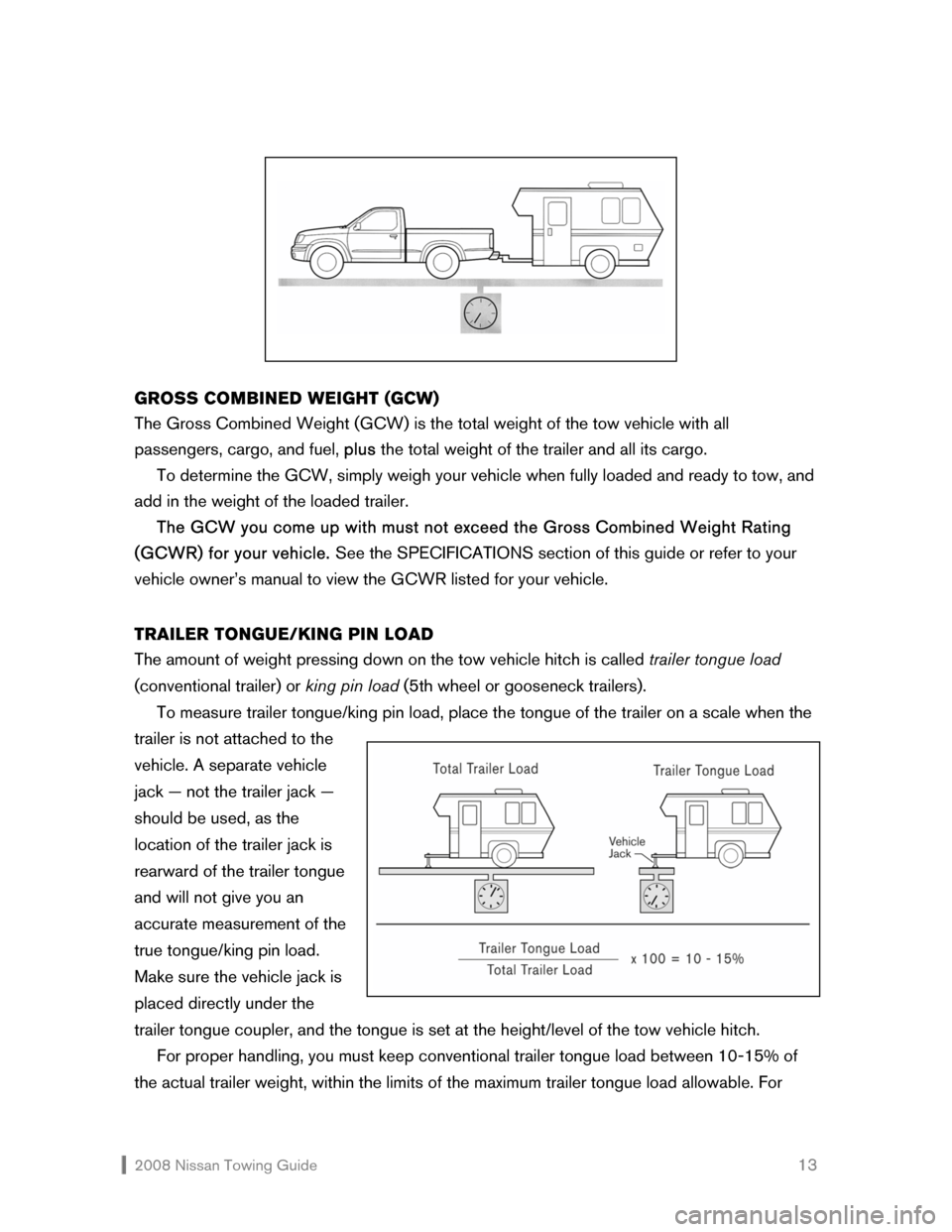
The Gross Combined Weight (GCW) is the total weight of the tow vehicle with all
passengers, cargo, and fuel, plus the total weight of the trailer and all its cargo.
To determine the GCW, simply weigh your vehicle when fully loaded and ready to tow, and
add in the weight of the loaded trailer.
The GCW you come up with must not exceed the Gross Combined Weight Rating
(GCWR) for your vehicle. See the SPECIFICATIONS section of this guide or refer to your
vehicle owner’s manual to view the GCWR listed for your vehicle.
TRAILER TONGUE/KING PIN LOAD
The amount of weight pressing down on the tow vehicle hitch is called trailer tongue load
(conventional trailer) or king pin load (5th wheel or gooseneck trailers).
To measure trailer tongue/king pin load, place the tongue of the trailer on a scale when the
trailer is not attached to the
vehicle. A separate vehicle
jack — not the trailer jack —
should be used, as the
location of the trailer jack is
rearward of the trailer tongue
and will not give you an
accurate measurement of the
true tongue/king pin load.
Make sure the vehicle jack is
placed directly under the
trailer tongue coupler, and the tongue is set at the height/level of the tow vehicle hitch.
For proper handling, you must keep conventional trailer tongue load between 10-15% of
the actual trailer weight, within the limits of the maximum trailer tongue load allowable. For
Page 16 of 32
2008 Nissan Towing Guide 15 Always make sure your vehicle’s towing capacity is adequate for the trailer you intend to tow.
Buy or lease only quality equipment, and have it installed only by professionals. In addition, be
certain that you have all of the equipment needed for safe towing, including safety
chains/cables, electric trailer brakes, electric trailer brake controller, breakaway switch,
extended rear view mirrors, and so on. All of these items have been discussed in a previous
section of this guide.
With regard to vehicle maintenance, you should follow a more frequent schedule and
check fluid levels, pressures, tire condition, etc., more often when on the road. See your
vehicle owner’s manual for details.
LOADING YOUR TRAILER
Taking the time to load and balance your trailer properly will improve overall handling and
minimize the strain on your tow vehicle. Incorrectly loaded trailers tend to sway or swing from
side to side, upsetting vehicle handling. Careful loading and balancing can help eliminate
these problems.
As mentioned earlier, conventional trailer tongue load must fall between 10-15% of the
total trailer weight. King pin load — if using a 5th wheel or gooseneck trailer — must be
between 15-25% of the total trailer weight.
Excessive tongue/king pin load can actually
push down the vehicle in back, lifting the front
wheels to a point where traction, steering
response, and braking are severely reduced.
Insufficient tongue/king pin load can cause
instability, which may lead to “tail wagging” or
jackknifing.
With this in mind, proper loading is extremely
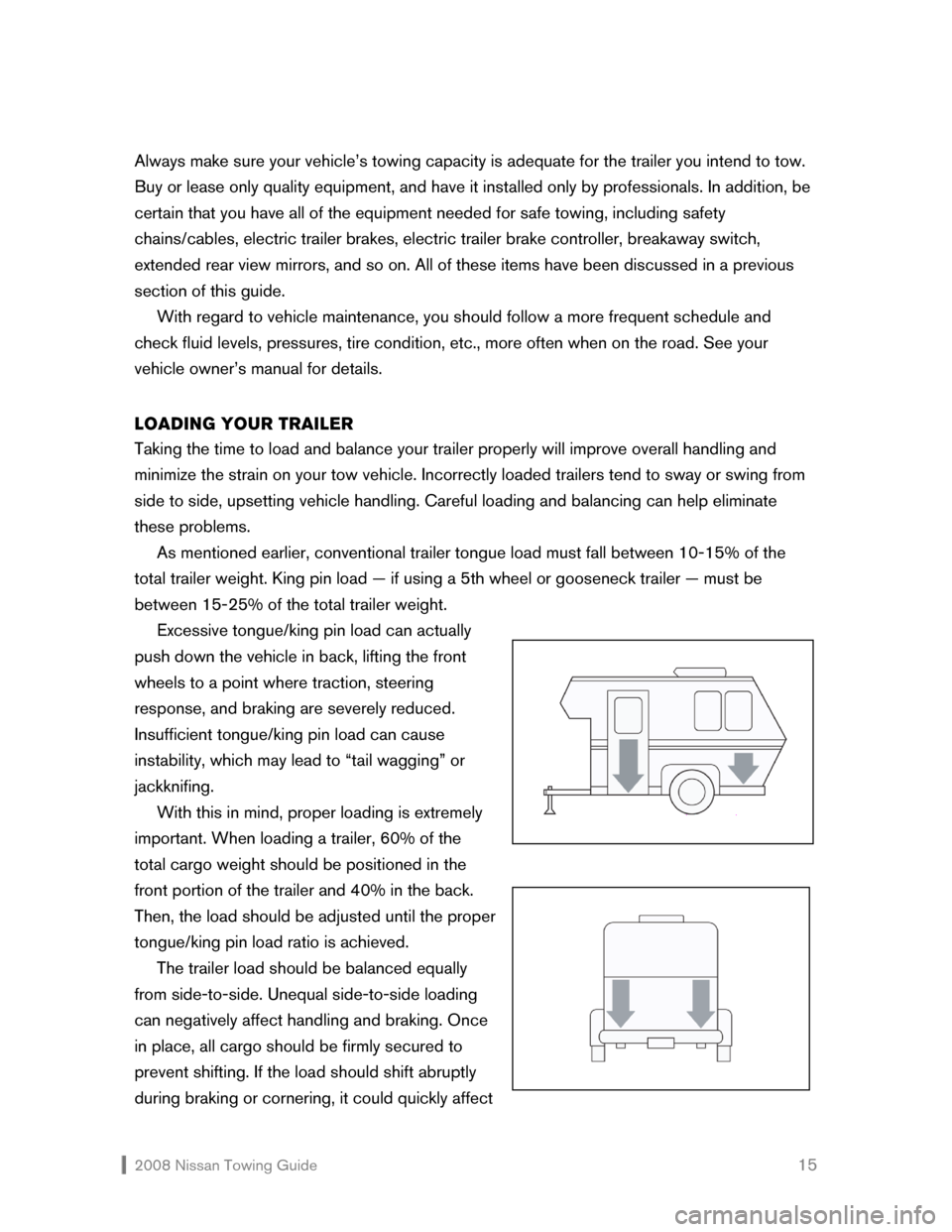
important. When loading a trailer, 60% of the
total cargo weight should be positioned in the
front portion of the trailer and 40% in the back.
Then, the load should be adjusted until the proper
tongue/king pin load ratio is achieved.
The trailer load should be balanced equally
from side-to-side. Unequal side-to-side loading
can negatively affect handling and braking. Once
in place, all cargo should be firmly secured to
prevent shifting. If the load should shift abruptly
during braking or cornering, it could quickly affect