brakes NISSAN ROGUE 2009 Owner´s Manual
[x] Cancel search | Manufacturer: NISSAN, Model Year: 2009, Model line: ROGUE, Model: NISSAN ROGUE 2009Pages: 316, PDF Size: 4.26 MB
Page 258 of 316
Black plate (256,1)
Model "S35-D" EDITED: 2008/ 7/ 24
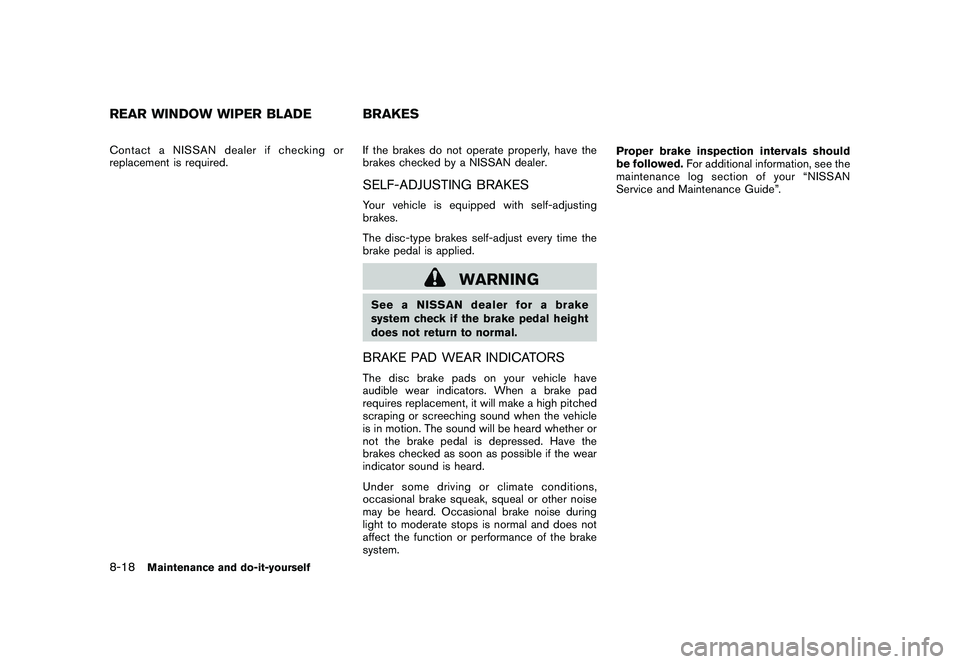
Contact a NISSAN dealer if checking or
replacement is required.If the brakes do not operate properly, have the
brakes checked by a NISSAN dealer.
SELF-ADJUSTING BRAKESYour vehicle is equipped with self-adjusting
brakes.
The disc-type brakes self-adjust every time the
brake pedal is applied.
WARNING
See a NISSAN dealer for a brake
system check if the brake pedal height
does not return to normal.BRAKE PAD WEAR INDICATORSThe disc brake pads on your vehicle have
audible wear indicators. When a brake pad
requires replacement, it will make a high pitched
scraping or screeching sound when the vehicle
is in motion. The sound will be heard whether or
not the brake pedal is depressed. Have the
brakes checked as soon as possible if the wear
indicator sound is heard.
Under some driving or climate conditions,
occasional brake squeak, squeal or other noise
may be heard. Occasional brake noise during
light to moderate stops is normal and does not
affect the function or performance of the brake
system.Proper brake inspection intervals should
be followed.For additional information, see the
maintenance log section of your “NISSAN
Service and Maintenance Guide”.
REAR WINDOW WIPER BLADE BRAKES8-18
Maintenance and do-it-yourself
Page 276 of 316
Black plate (274,1)
Model "S35-D" EDITED: 2008/ 7/ 24
.ONLY use spare tires specified for
the AWD model.
If excessive tire wear is found, it is recom-
mended that all four tires be replaced with tires
of the same size, brand, construction and tread
pattern. The tire pressure and wheel alignment
should also be checked and corrected as
necessary. Contact a NISSAN dealer.TIRE CHAINS
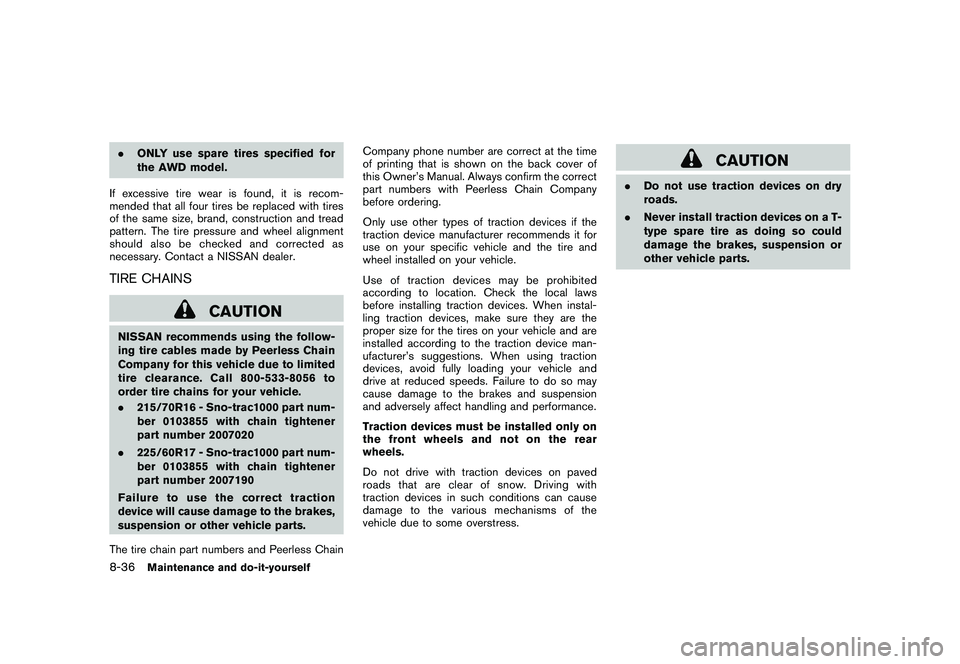
CAUTION
NISSAN recommends using the follow-
ing tire cables made by Peerless Chain
Company for this vehicle due to limited
tire clearance. Call 800-533-8056 to
order tire chains for your vehicle.
.215/70R16 - Sno-trac1000 part num-
ber 0103855 with chain tightener
part number 2007020
.225/60R17 - Sno-trac1000 part num-
ber 0103855 with chain tightener
part number 2007190
Failure to use the correct traction
device will cause damage to the brakes,
suspension or other vehicle parts.
The tire chain part numbers and Peerless ChainCompany phone number are correct at the time
of printing that is shown on the back cover of
this Owner’s Manual. Always confirm the correct
part numbers with Peerless Chain Company
before ordering.
Only use other types of traction devices if the
traction device manufacturer recommends it for
use on your specific vehicle and the tire and
wheel installed on your vehicle.
Use of traction devices may be prohibited
according to location. Check the local laws
before installing traction devices. When instal-
ling traction devices, make sure they are the
proper size for the tires on your vehicle and are
installed according to the traction device man-
ufacturer’s suggestions. When using traction
devices, avoid fully loading your vehicle and
drive at reduced speeds. Failure to do so may
cause damage to the brakes and suspension
and adversely affect handling and performance.
Traction devices must be installed only on
the front wheels and not on the rear
wheels.
Do not drive with traction devices on paved
roads that are clear of snow. Driving with
traction devices in such conditions can cause
damage to the various mechanisms of the
vehicle due to some overstress.
CAUTION
.Do not use traction devices on dry
roads.
.Never install traction devices on a T-
type spare tire as doing so could
damage the brakes, suspension or
other vehicle parts.
8-36
Maintenance and do-it-yourself
Page 300 of 316
Black plate (300,1)
Model "S35-D" EDITED: 2008/ 7/ 24
The available towing capacity may be less than
the maximum towing capacity due to the
passenger and cargo load in the vehicle.
Remember to keep trailer tongue weight be-
tween 10 to 15% of the trailer weight. If the
tongue load becomes excessive, rearrange the
cargo to obtain the proper tongue load. Do not
exceed the 10 to 15% tongue weight specifica-
tion even if the calculated available tongue
weight is greater than 15%. If the calculated
tongue weight is less than 10%, reduce the total
trailer weight to match the available tongue
weight.
Always verify that available capacities are within
the required ratings.
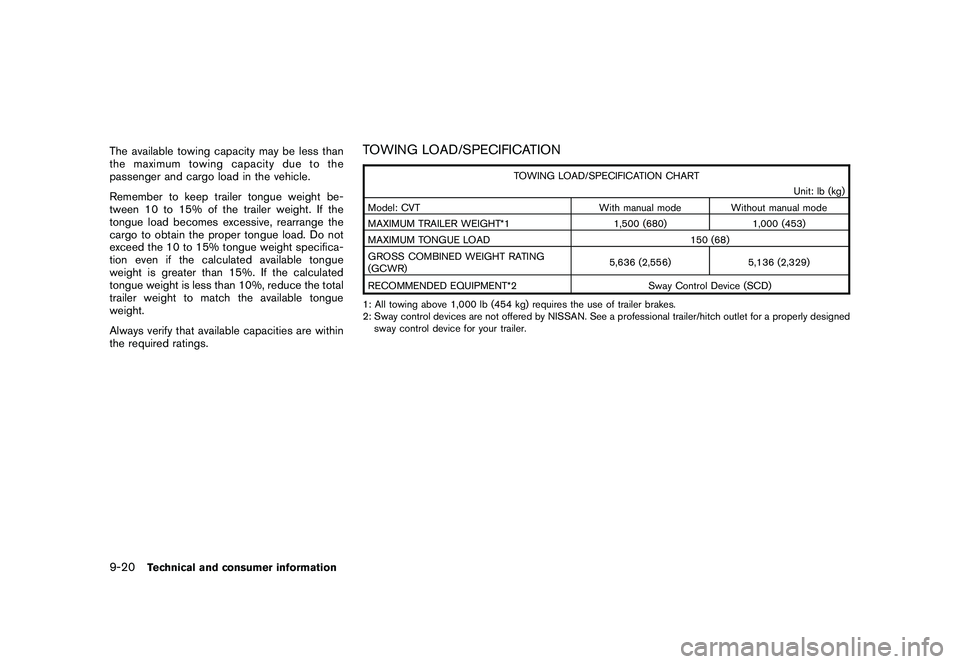
TOWING LOAD/SPECIFICATION
TOWING LOAD/SPECIFICATION CHART
Unit: lb (kg)
Model: CVT With manual mode Without manual mode
MAXIMUM TRAILER WEIGHT*1 1,500 (680) 1,000 (453)
MAXIMUM TONGUE LOAD 150 (68)
GROSS COMBINED WEIGHT RATING
(GCWR)5,636 (2,556) 5,136 (2,329)
RECOMMENDED EQUIPMENT*2
Sway Control Device (SCD)
1: All towing above 1,000 lb (454 kg) requires the use of trailer brakes.
2: Sway control devices are not offered by NISSAN. See a professional trailer/hitch outlet for a properly designed
sway control device for your trailer.
9-20
Technical and consumer information
Page 302 of 316
Black plate (302,1)
Model "S35-D" EDITED: 2008/ 7/ 24
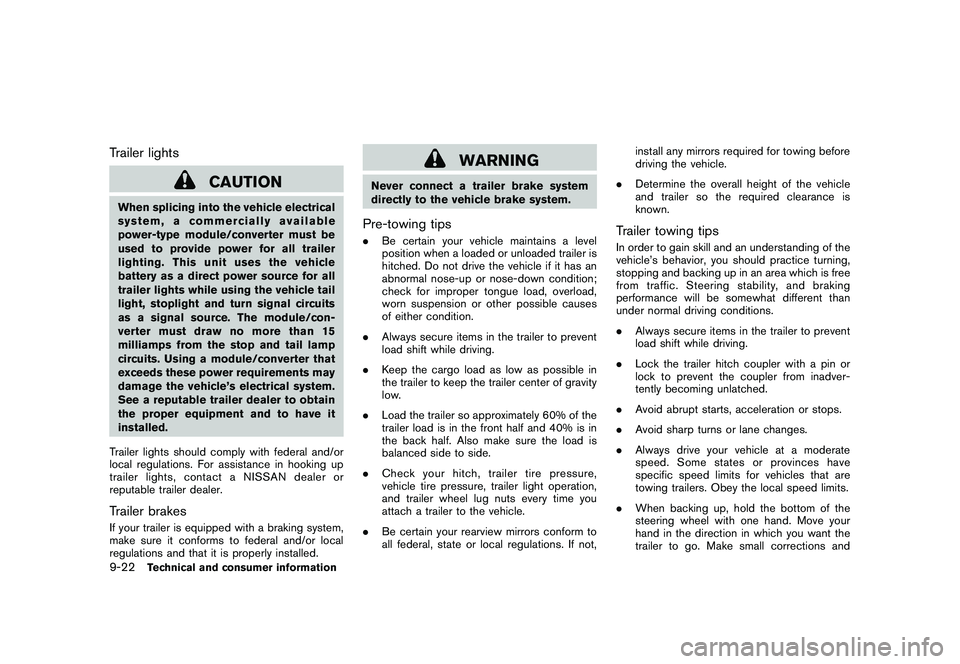
Trailer lights
CAUTION
When splicing into the vehicle electrical
system, a commercially available
power-type module/converter must be
used to provide power for all trailer
lighting. This unit uses the vehicle
battery as a direct power source for all
trailer lights while using the vehicle tail
light, stoplight and turn signal circuits
as a signal source. The module/con-
verter must draw no more than 15
milliamps from the stop and tail lamp
circuits. Using a module/converter that
exceeds these power requirements may
damage the vehicle’s electrical system.
See a reputable trailer dealer to obtain
the proper equipment and to have it
installed.
Trailer lights should comply with federal and/or
local regulations. For assistance in hooking up
trailer lights, contact a NISSAN dealer or
reputable trailer dealer.Trailer brakesIf your trailer is equipped with a braking system,
make sure it conforms to federal and/or local
regulations and that it is properly installed.
WARNING
Never connect a trailer brake system
directly to the vehicle brake system.Pre-towing tips.Be certain your vehicle maintains a level
position when a loaded or unloaded trailer is
hitched. Do not drive the vehicle if it has an
abnormal nose-up or nose-down condition;
check for improper tongue load, overload,
worn suspension or other possible causes
of either condition.
.Always secure items in the trailer to prevent
load shift while driving.
.Keep the cargo load as low as possible in
the trailer to keep the trailer center of gravity
low.
.Load the trailer so approximately 60% of the
trailer load is in the front half and 40% is in
the back half. Also make sure the load is
balanced side to side.
.Check your hitch, trailer tire pressure,
vehicle tire pressure, trailer light operation,
and trailer wheel lug nuts every time you
attach a trailer to the vehicle.
.Be certain your rearview mirrors conform to
all federal, state or local regulations. If not,install any mirrors required for towing before
driving the vehicle.
.Determine the overall height of the vehicle
and trailer so the required clearance is
known.
Trailer towing tipsIn order to gain skill and an understanding of the
vehicle’s behavior, you should practice turning,
stopping and backing up in an area which is free
from traffic. Steering stability, and braking
performance will be somewhat different than
under normal driving conditions.
.Always secure items in the trailer to prevent
load shift while driving.
.Lock the trailer hitch coupler with a pin or
lock to prevent the coupler from inadver-
tently becoming unlatched.
.Avoid abrupt starts, acceleration or stops.
.Avoid sharp turns or lane changes.
.Always drive your vehicle at a moderate
speed. Some states or provinces have
specific speed limits for vehicles that are
towing trailers. Obey the local speed limits.
.When backing up, hold the bottom of the
steering wheel with one hand. Move your
hand in the direction in which you want the
trailer to go. Make small corrections and
9-22
Technical and consumer information
Page 303 of 316
Black plate (303,1)
Model "S35-D" EDITED: 2008/ 7/ 24
back up slowly. If possible, have someone
guide you when you are backing up.
Always block the wheels on both vehicle and
trailer when parking. Parking on a slope is not
recommended; however, if you must do so:
CAUTION
If you move the shift selector lever to
the P (Park) position before blocking
the wheels and applying the parking
brake, transmission damage could oc-
cur.
1. Apply and hold the brake pedal.
2. Have someone place blocks on the downhill
side of the vehicle and trailer wheels.
3. After the wheel blocks are in place, slowly
release the brake pedal until the blocks
absorb the vehicle load.
4. Apply the parking brake.
5. Shift the transmission into P (Park) .
6. Turn off the engine.
To drive away:
1. Apply and hold the brake pedal.
2. Start the engine.3. Shift the transmission into gear.
4. Release the parking brake.
5. Drive slowly until the vehicle and trailer are
clear from the blocks.
6. Apply and hold the brake pedal.
7. Have someone retrieve and store the blocks.
.When going down a hill, shift into a lower
gear and use the engine braking effect.
When going up a long grade, downshift the
transmission to a lower gear and reduce
speed to reduce chances of engine over-
loading and/or overheating.
.If the engine coolant rises to an extremely
high temperature when the air conditioning
system is on, turn off the air conditioner.
Coolant heat can be additionally vented by
opening the windows, switching the fan
control to high and setting the temperature
control to the HOT position.
.Trailer towing requires more fuel than normal
circumstances.
.Avoid towing a trailer for the first 500 miles
(800 km) .
.Have your vehicle serviced more often than
at intervals specified in the recommended
maintenance schedule in the NISSAN Ser-
vice and Maintenance Guide..When making a turn, your trailer wheels will
be closer to the inside of the turn than your
vehicle wheels. To compensate for this,
make a larger than normal turning radius
during the turn.
.Crosswinds and rough roads will adversely
affect vehicle/trailer handling, possibly caus-
ing vehicle sway. When being passed by
larger vehicles, be prepared for possible
changes in crosswinds that could affect
vehicle handling. If swaying does occur,
firmly grip the steering wheel, steer straight
ahead, and immediately (but gradually)
reduce vehicle speed. This combination will
help stabilize the vehicle. Never increase
speed.
Do the following if the trailer begins to sway:
1. Take your foot off the accelerator pedal to
allow the vehicle to coast and steer as
straight ahead as the road conditions allow.
This combination will help stabilize the
vehicle.
— Do not correct trailer sway by steering or
applying the brakes.
2. When the trailer sway stops, gently apply
the brakes and pull to the side of the road in
a safe area.
3. Try to rearrange the trailer load so it is
balanced as described earlier in this section.
Technical and consumer information
9-23
Page 304 of 316
Black plate (304,1)
Model "S35-D" EDITED: 2008/ 7/ 24
.Be careful when passing other vehicles.
Passing while towing a trailer requires
considerably more distance than normal
passing. Remember the length of the trailer
must also pass the other vehicle before you
can safely change lanes.
.Down shift the transmission to a lower gear
for engine braking when driving down steep
or long hills. This will help slow the vehicle
without applying the brakes.
.Avoid holding the brake pedal down too
long or too frequently. This could cause the
brakes to overheat, resulting in reduced
braking efficiency.
.Increase your following distance to allow for
greater stopping distances while towing a
trailer. Anticipate stops and brake gradually.
.Do not use cruise control while towing a
trailer.
.Some states or provinces have specific
regulations and speed limits for vehicles
that are towing trailers. Obey the local
speed limits.
.Check your hitch, trailer wiring harness
connections, and trailer wheel lug nuts after
50 miles (80 km) of travel and at every
break.
.When stopped in traffic for long periods oftime in hot weather, put the vehicle in the P
(Park) position.
.When launching a boat, don’t allow the
water level to go over the exhaust tail pipe or
rear bumper.
.Make sure you disconnect the trailer lights
before backing the trailer into the water or
the trailer lights may burn out.
When towing a trailer, the transmission
fluid should be changed more frequently.
For additional information, see the “8.
Maintenance and do-it-yourself” section
earlier in this manual.
FLAT TOWINGTowing your vehicle with all four wheels on the
ground is sometimes called flat towing. This
method is sometimes used when towing a
vehicle behind a recreational vehicle, such as a
motor home.
CAUTION
.Failure to follow these guidelines
can result in severe transmission
damage.
.Whenever flat towing your vehicle,
always tow forward, never back-
ward..DO NOT tow any continuously vari-
able transmission vehicle with all
four wheels on the ground (flat
towing) . Doing so WILL DAMAGE
internal transmission parts due to
lack of transmission lubrication.
.DO NOT tow an All-Wheel Drive
(AWD) vehicle with any of the
wheels on the ground. Doing so
may cause serious and expensive
damage to the powertrain.
.For emergency towing procedures
refer to “TOWING RECOMMENDED
BY NISSAN” in the “6. In case of
emergency” section of this manual.
Continuously Variable Transmission
(CVT)All-Wheel Drive (AWD) models:
Do not tow an AWD vehicle with any of the
wheels on the ground.
Two-Wheel Drive (2WD) models:
To tow a vehicle equipped with a Continuously
Variable Transmission (CVT) , an appropriate
vehicle dollyMUSTbe placed under the towed
vehicle’s driving wheels.Alwaysfollow the dolly
manufacturer’s recommendations when using
9-24
Technical and consumer information