mirror NISSAN ROGUE 2009 Owner´s Manual
[x] Cancel search | Manufacturer: NISSAN, Model Year: 2009, Model line: ROGUE, Model: NISSAN ROGUE 2009Pages: 316, PDF Size: 4.26 MB
Page 119 of 316
Black plate (10,1)
3 Pre-driving checks and adjustments
Model "S35-D" EDITED: 2008/ 6/ 3
Keys ............................................................... 3-2
NISSAN Vehicle Immobilizer System keys............ 3-2
Intelligent Keys (if so equipped)......................... 3-3
Doors.............................................................. 3-4
Locking with key............................................ 3-4
Locking with inside lock knob........................... 3-4
Locking with power door lock switch.................. 3-5
Automatic door locks...................................... 3-5
Child safety rear door lock............................... 3-6
Remote keyless entry system (if so equipped)........... 3-6
How to use remote keyless entry system............. 3-7
Intelligent Key system (if so equipped).................... 3-8
Intelligent Key operating range........................ 3-10
Door locks/unlocks precaution........................ 3-11
Intelligent Key operation................................. 3-11Warning lights and audible reminders............... 3-13
Troubleshooting guide................................... 3-14
How to use remote keyless entry function.......... 3-16
Hood............................................................ 3-20
Lift gate......................................................... 3-21
Lift gate release........................................... 3-22
Fuel-filler door................................................. 3-22
Opening the fuel-filler door............................. 3-22
Fuel-filler cap.............................................. 3-22
Steering wheel................................................ 3-24
Tilt operation............................................... 3-24
Sun visors...................................................... 3-24
Mirrors........................................................... 3-25
Inside mirror................................................ 3-25
Outside mirrors............................................ 3-26
Page 143 of 316
Black plate (141,1)
Model "S35-D" EDITED: 2008/ 7/ 24
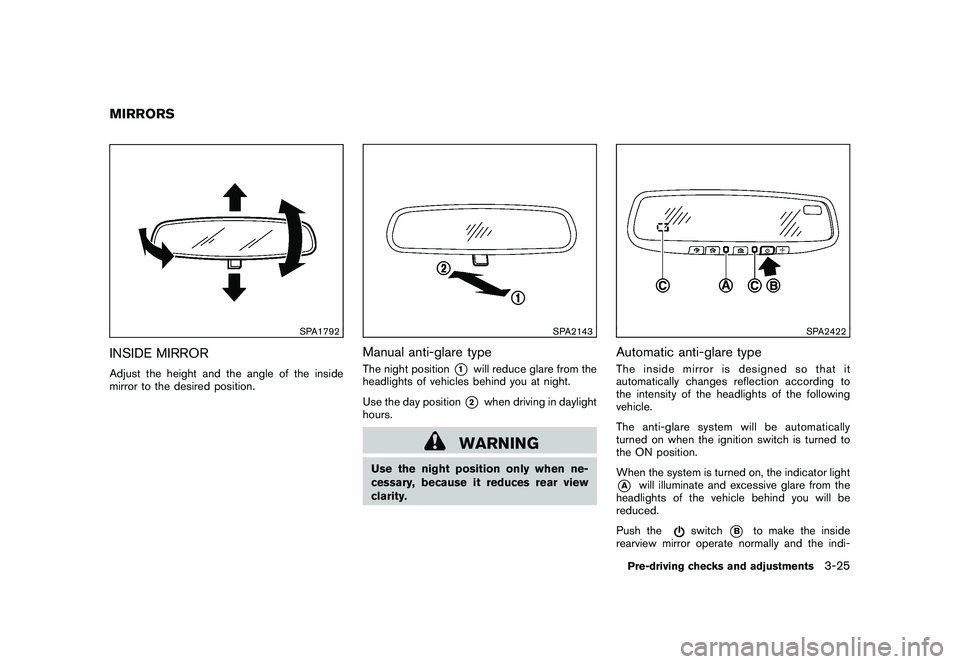
SPA1792
INSIDE MIRRORAdjust the height and the angle of the inside
mirror to the desired position.
SPA2143
Manual anti-glare typeThe night position
*1
will reduce glare from the
headlights of vehicles behind you at night.
Use the day position*2
when driving in daylight
hours.
WARNING
Use the night position only when ne-
cessary, because it reduces rear view
clarity.
SPA2422
Automatic anti-glare typeThe inside mirror is designed so that it
automatically changes reflection according to
the intensity of the headlights of the following
vehicle.
The anti-glare system will be automatically
turned on when the ignition switch is turned to
the ON position.
When the system is turned on, the indicator light*A
will illuminate and excessive glare from the
headlights of the vehicle behind you will be
reduced.
Push the
switch
*B
to make the inside
rearview mirror operate normally and the indi-
MIRRORS
Pre-driving checks and adjustments
3-25
Page 144 of 316
Black plate (142,1)
Model "S35-D" EDITED: 2008/ 7/ 24
cator light will turn off. Push the
switch
again to turn the system on.
Do not allow any object to cover the
sensors
*C
or apply glass cleaner on
them. Doing so will reduce the sensitivity
of the sensors, resulting in improper
operation.
For the compass operation, see “COMPASS” in
the “2. Instruments and controls” section.
For the HomeLink®Universal Transceiver opera-
tion, see “HomeLink®UNIVERSAL TRANSCEI-
VER” in the “2. Instruments and controls”
section.
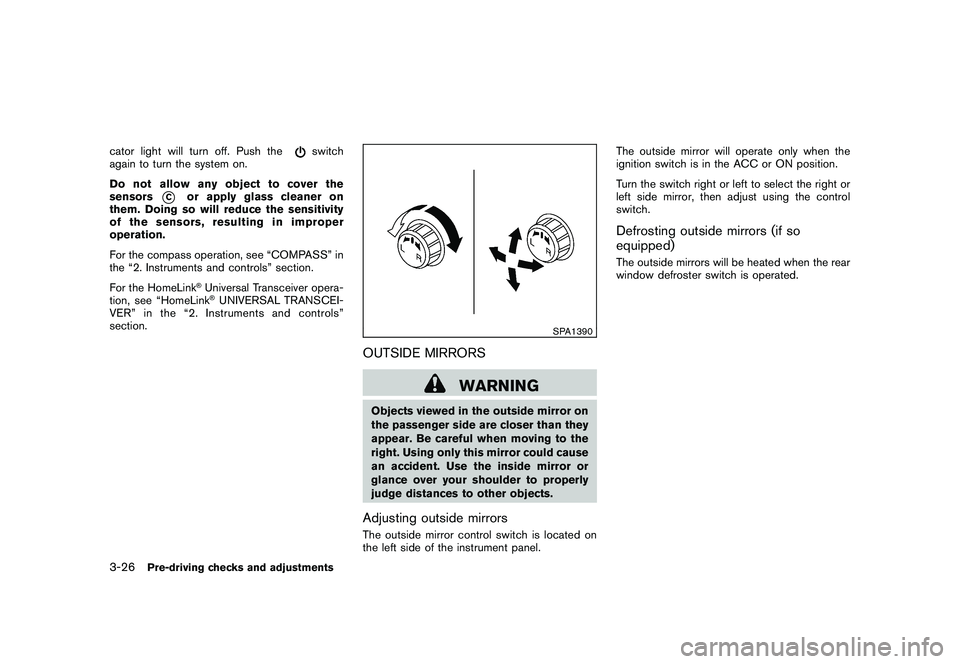
SPA1390
OUTSIDE MIRRORS
WARNING
Objects viewed in the outside mirror on
the passenger side are closer than they
appear. Be careful when moving to the
right. Using only this mirror could cause
an accident. Use the inside mirror or
glance over your shoulder to properly
judge distances to other objects.Adjusting outside mirrorsThe outside mirror control switch is located on
the left side of the instrument panel.The outside mirror will operate only when the
ignition switch is in the ACC or ON position.
Turn the switch right or left to select the right or
left side mirror, then adjust using the control
switch.
Defrosting outside mirrors (if so
equipped)The outside mirrors will be heated when the rear
window defroster switch is operated.
3-26
Pre-driving checks and adjustments
Page 145 of 316
Black plate (143,1)
Model "S35-D" EDITED: 2008/ 7/ 24
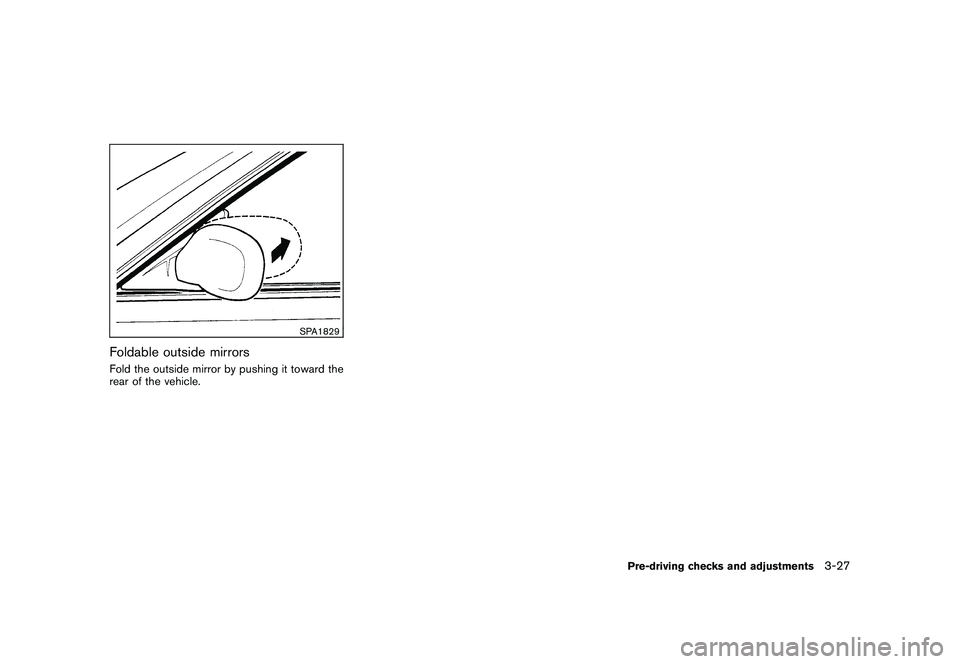
SPA1829
Foldable outside mirrorsFold the outside mirror by pushing it toward the
rear of the vehicle.
Pre-driving checks and adjustments
3-27
Page 149 of 316
Black plate (147,1)
Model "S35-D" EDITED: 2008/ 7/ 24
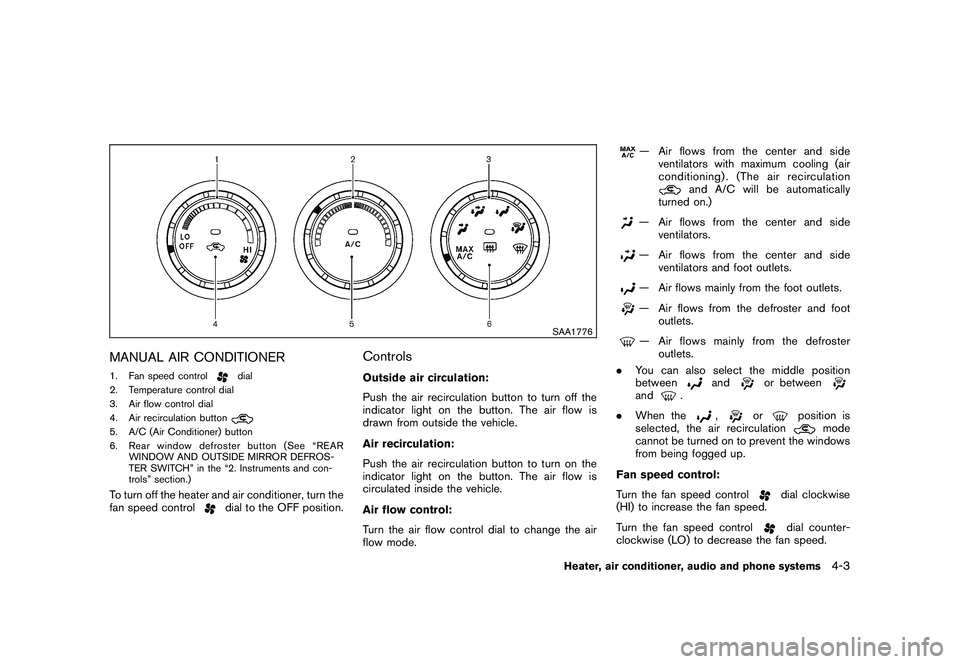
SAA1776
MANUAL AIR CONDITIONER1. Fan speed control
dial
2. Temperature control dial
3. Air flow control dial
4. Air recirculation button
5. A/C (Air Conditioner) button
6. Rear window defroster button (See “REAR
WINDOW AND OUTSIDE MIRROR DEFROS-
TER SWITCH” in the “2. Instruments and con-
trols” section.)To turn off the heater and air conditioner, turn the
fan speed control
dial to the OFF position.
ControlsOutside air circulation:
Push the air recirculation button to turn off the
indicator light on the button. The air flow is
drawn from outside the vehicle.
Air recirculation:
Push the air recirculation button to turn on the
indicator light on the button. The air flow is
circulated inside the vehicle.
Air flow control:
Turn the air flow control dial to change the air
flow mode.
— Air flows from the center and side
ventilators with maximum cooling (air
conditioning) . (The air recirculation
and A/C will be automatically
turned on.)
— Air flows from the center and side
ventilators.— Air flows from the center and side
ventilators and foot outlets.— Air flows mainly from the foot outlets.— Air flows from the defroster and foot
outlets.— Air flows mainly from the defroster
outlets.
.You can also select the middle position
between
and
or between
and
.
.When the
,
or
position is
selected, the air recirculation
mode
cannot be turned on to prevent the windows
from being fogged up.
Fan speed control:
Turn the fan speed control
dial clockwise
(HI) to increase the fan speed.
Turn the fan speed controldial counter-
clockwise (LO) to decrease the fan speed.
Heater, air conditioner, audio and phone systems
4-3
Page 198 of 316
Black plate (196,1)
Model "S35-D" EDITED: 2008/ 7/ 24
.Make sure the area around the vehicle is
clear.
.Check fluid levels such as engine oil, cool-
ant, brake fluid, and window washer fluid as
frequently as possible, or at least whenever
you refuel.
.Check that all windows and lights are clean.
.Visually inspect tires for their appearance
and condition. Also check tires for proper
inflation.
.Lock all doors.
.Position seat and adjust head restraints.
.Adjust inside and outside mirrors.
.Fasten seat belts and ask all passengers to
do likewise.
.Check the operation of warning lights when
the ignition key is turned to the ON position.
(See “WARNING/INDICATOR LIGHTS
AND AUDIBLE REMINDERS” in the “2.
Instruments and controls” section.)1. Apply the parking brake.
2. Move the selector lever to the P (Park) or N
(Neutral) position. (P is recommended.)
The starter is designed so that it does not
operate unless the selector lever is in either
of the above positions.
3. Crank the enginewith your foot off the
accelerator pedalby turning the ignition
switch to START. Release the switch when
the engine starts. If the engine starts, but
fails to run, repeat the above procedure.
.If the engine is very hard to start in
extremely cold weather or when restart-
ing, depress the accelerator pedal a little
(approximately 1/3 to the floor) and hold
it and then crank the engine. Release the
accelerator pedal when the engine
starts.
.If the engine is very hard to start
because it is flooded, depress the
accelerator pedal all the way to the floor
and hold it. Crank the engine for 5 - 6
seconds. After cranking the engine,
release the accelerator pedal. Crank
the enginewith your foot off the
accelerator pedalby turning the igni-
tion switch to START. Release the
ignition switch when the engine starts.
If the engine starts, but fails to run,repeat the above procedure.
CAUTION
Do not operate the starter for more
than 15 seconds at a time. If the engine
does not start, turn the ignition switch
off and wait 10 seconds before cranking
again, otherwise the starter could be
damaged.
4.Warm-up
Allow the engine to idle for at least 30
seconds after starting. Do not race the
engine while warming it up. Drive at
moderate speed for a short distance first,
especially in cold weather. In cold weather,
keep the engine running for a minimum of 2 -
3 minutes before shutting it off. Starting and
stopping the engine over a short period of
time may make the vehicle more difficult to
start.
BEFORE STARTING THE ENGINE STARTING THE ENGINE5-12
Starting and driving
Page 266 of 316
Black plate (264,1)
Model "S35-D" EDITED: 2008/ 7/ 24
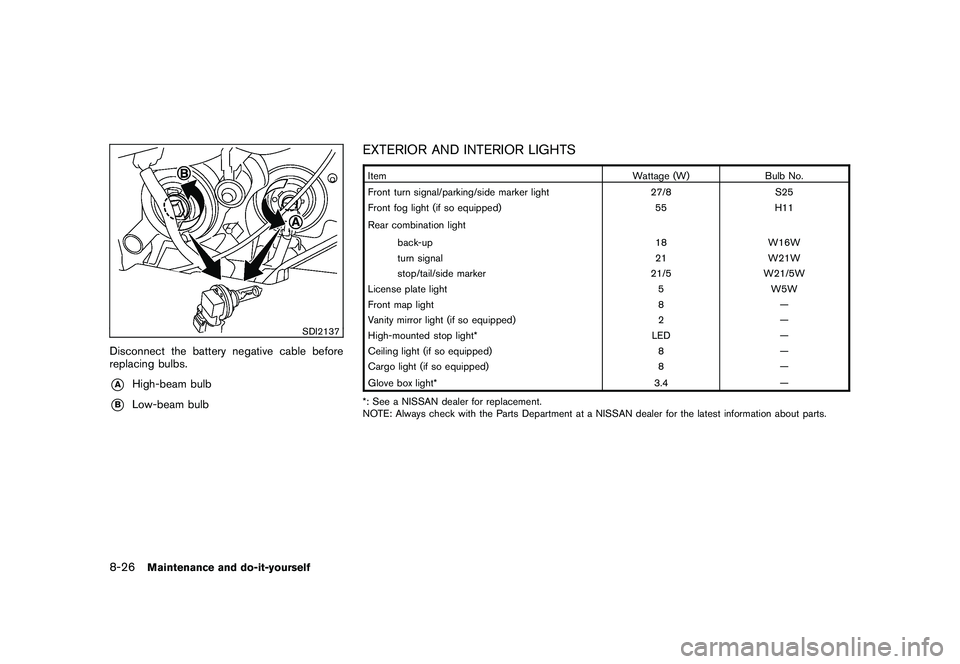
SDI2137
Disconnect the battery negative cable before
replacing bulbs.*A
High-beam bulb
*B
Low-beam bulb
EXTERIOR AND INTERIOR LIGHTSItem Wattage (W) Bulb No.
Front turn signal/parking/side marker light 27/8 S25
Front fog light (if so equipped) 55 H11
Rear combination light
back-up 18 W16W
turn signal 21 W21W
stop/tail/side marker 21/5 W21/5W
License plate light 5 W5W
Front map light 8 —
Vanity mirror light (if so equipped) 2 —
High-mounted stop light* LED —
Ceiling light (if so equipped) 8 —
Cargo light (if so equipped) 8 —
Glove box light* 3.4
—
*: See a NISSAN dealer for replacement.
NOTE: Always check with the Parts Department at a NISSAN dealer for the latest information about parts.
8-26
Maintenance and do-it-yourself
Page 269 of 316
Black plate (267,1)
Model "S35-D" EDITED: 2008/ 7/ 24
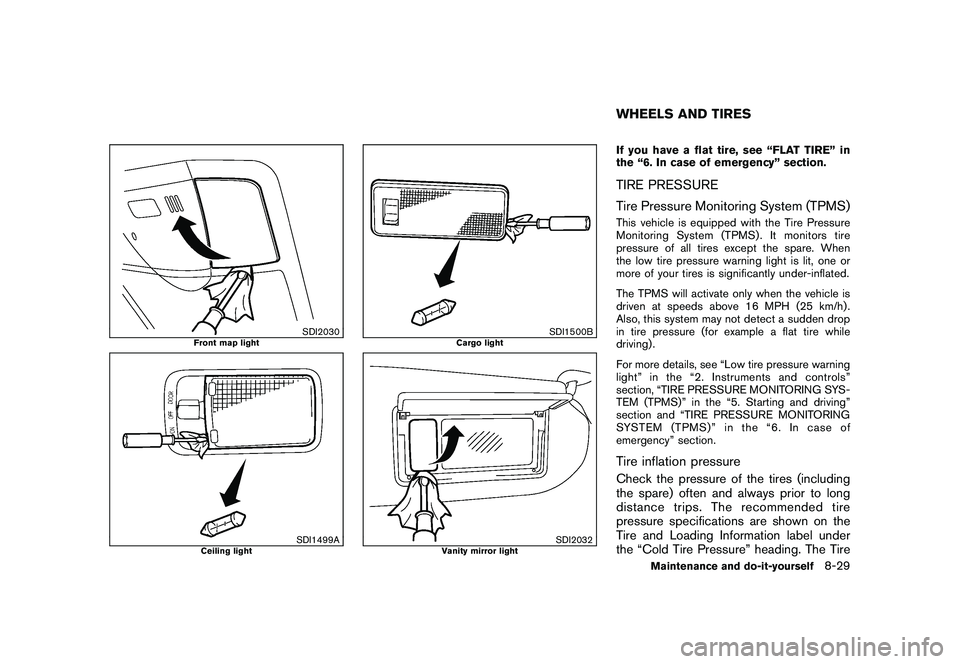
SDI2030
Front map light
SDI1499A
Ceiling light
SDI1500B
Cargo light
SDI2032
Vanity mirror light
If you have a flat tire, see “FLAT TIRE” in
the “6. In case of emergency” section.TIRE PRESSURE
Tire Pressure Monitoring System (TPMS)This vehicle is equipped with the Tire Pressure
Monitoring System (TPMS) . It monitors tire
pressure of all tires except the spare. When
the low tire pressure warning light is lit, one or
more of your tires is significantly under-inflated.
The TPMS will activate only when the vehicle is
driven at speeds above 16 MPH (25 km/h) .
Also, this system may not detect a sudden drop
in tire pressure (for example a flat tire while
driving) .
For more details, see “Low tire pressure warning
light” in the “2. Instruments and controls”
section, “TIRE PRESSURE MONITORING SYS-
TEM (TPMS)” in the “5. Starting and driving”
section and “TIRE PRESSURE MONITORING
SYSTEM (TPMS)” in the “6. In case of
emergency” section.Tire inflation pressureCheck the pressure of the tires (including
the spare) often and always prior to long
distance trips. The recommended tire
pressure specifications are shown on the
Tire and Loading Information label under
the “Cold Tire Pressure” heading. The TireWHEELS AND TIRES
Maintenance and do-it-yourself
8-29
Page 302 of 316
Black plate (302,1)
Model "S35-D" EDITED: 2008/ 7/ 24
Trailer lights
CAUTION
When splicing into the vehicle electrical
system, a commercially available
power-type module/converter must be
used to provide power for all trailer
lighting. This unit uses the vehicle
battery as a direct power source for all
trailer lights while using the vehicle tail
light, stoplight and turn signal circuits
as a signal source. The module/con-
verter must draw no more than 15
milliamps from the stop and tail lamp
circuits. Using a module/converter that
exceeds these power requirements may
damage the vehicle’s electrical system.
See a reputable trailer dealer to obtain
the proper equipment and to have it
installed.
Trailer lights should comply with federal and/or
local regulations. For assistance in hooking up
trailer lights, contact a NISSAN dealer or
reputable trailer dealer.Trailer brakesIf your trailer is equipped with a braking system,
make sure it conforms to federal and/or local
regulations and that it is properly installed.
WARNING
Never connect a trailer brake system
directly to the vehicle brake system.Pre-towing tips.Be certain your vehicle maintains a level
position when a loaded or unloaded trailer is
hitched. Do not drive the vehicle if it has an
abnormal nose-up or nose-down condition;
check for improper tongue load, overload,
worn suspension or other possible causes
of either condition.
.Always secure items in the trailer to prevent
load shift while driving.
.Keep the cargo load as low as possible in
the trailer to keep the trailer center of gravity
low.
.Load the trailer so approximately 60% of the
trailer load is in the front half and 40% is in
the back half. Also make sure the load is
balanced side to side.
.Check your hitch, trailer tire pressure,
vehicle tire pressure, trailer light operation,
and trailer wheel lug nuts every time you
attach a trailer to the vehicle.
.Be certain your rearview mirrors conform to
all federal, state or local regulations. If not,install any mirrors required for towing before
driving the vehicle.
.Determine the overall height of the vehicle
and trailer so the required clearance is
known.
Trailer towing tipsIn order to gain skill and an understanding of the
vehicle’s behavior, you should practice turning,
stopping and backing up in an area which is free
from traffic. Steering stability, and braking
performance will be somewhat different than
under normal driving conditions.
.Always secure items in the trailer to prevent
load shift while driving.
.Lock the trailer hitch coupler with a pin or
lock to prevent the coupler from inadver-
tently becoming unlatched.
.Avoid abrupt starts, acceleration or stops.
.Avoid sharp turns or lane changes.
.Always drive your vehicle at a moderate
speed. Some states or provinces have
specific speed limits for vehicles that are
towing trailers. Obey the local speed limits.
.When backing up, hold the bottom of the
steering wheel with one hand. Move your
hand in the direction in which you want the
trailer to go. Make small corrections and
9-22
Technical and consumer information
Page 311 of 316
Black plate (2,1)
10-2Continuously Variable Transmission (CVT)
fluid................................................. 8-11
Controls, Steering wheel audio controls......... 4-23
Coolant
Capacities and recommended fuel/
lubricants......................................... 9-2
Changing engine coolant........................ 8-8
Checking engine coolant level.................. 8-8
Corrosion protection................................. 7-5
Cover, Cargo cover................................ 2-37
Cruise control...................................... 5-19
Cup holders........................................ 2-33
CVT, Driving with CVT
(Continuously Variable Transmission)...... 5-11, 5-13
D
Daytime running light system..................... 2-27
Defroster switch, Rear window and outside
mirror defroster switch............................ 2-24
Dimensions and weights............................ 9-8
Door open warning light........................... 2-13
Drive belts.......................................... 8-14
Driving
All-wheel drive (AWD)......................... 5-22
Cold weather driving.......................... 5-30
Driving with CVT (Continuously Variable
Transmission)............................ 5-11, 5-13
On-pavement and off-road driving............. 5-5
Precautions when starting and driving......... 5-2
Safety precautions............................... 5-7
E
Economy, Fuel ..................................... 5-21
Elapsed time ......................................... 2-8Electric power steering system................... 5-26
Electric power steering warning light............ 2-13
Emission control information label................ 9-10
Emission control system warranty................ 9-26
Engine
Before starting the engine.................... 5-12
Break-in schedule.............................. 5-21
Capacities and recommended
fuel/lubricants.................................... 9-2
Changing engine coolant........................ 8-8
Changing engine oil and filter................... 8-9
Checking engine coolant level.................. 8-8
Checking engine oil level........................ 8-8
Coolant temperature gauge..................... 2-5
Engine block heater........................... 5-31
Engine compartment check locations.......... 8-6
Engine cooling system.......................... 8-7
Engine oil......................................... 8-8
Engine oil and oil filter recommendation....... 9-5
Engine oil viscosity.............................. 9-5
Engine serial number............................ 9-9
Engine specifications............................ 9-7
If your vehicle overheats....................... 6-11
Starting the engine............................ 5-12
Event Data Recorders (EDR)..................... 9-28
Exhaust gas (carbon monoxide).................... 5-2
F
F.M.V.S.S./C.M.V.S.S. certification label............ 9-9
Filter
Air cleaner housing filter...................... 8-16
Changing engine oil and filter................... 8-9
Flashers (See hazard warning flasher switch) . . . 2-29
Flat tire................................................ 6-2Flat towing.......................................... 9-24
Floor mat cleaning................................... 7-4
Fluid
Brake fluid...................................... 8-11
Capacities and recommended
fuel/lubricants.................................... 9-2
Continuously Variable Transmission (CVT)
fluid............................................. 8-11
Engine coolant ................................... 8-7
Engine oil......................................... 8-8
Window washer fluid .......................... 8-12
FM-AM radio with Compact Disc (CD)
player............................................... 4-13
FM-AM-SAT radio with Compact Disc (CD)
changer............................................. 4-17
Fog light switch.................................... 2-29
Front manual seat adjustment....................... 1-3
Front passenger air bag and status light........ 1-45
Front power seat adjustment....................... 1-4
Front seat adjustment............................... 1-3
Front-seat active head restraints................... 1-8
Fuel
Capacities and recommended
fuel/lubricants.................................... 9-2
Distance to empty............................... 2-7
Fuel economy.................................. 5-21
Fuel octane rating................................ 9-3
Fuel recommendation............................ 9-3
Fuel-filler cap................................... 3-22
Fuel-filler door.................................. 3-22
Gauge ............................................ 2-6
Fuses............................................... 8-19
Fusible links........................................ 8-19
Model "S35-D" EDITED: 2008/ 6/ 3