spare tire NISSAN ROGUE 2009 Owner´s Manual
[x] Cancel search | Manufacturer: NISSAN, Model Year: 2009, Model line: ROGUE, Model: NISSAN ROGUE 2009Pages: 316, PDF Size: 4.26 MB
Page 223 of 316
Black plate (221,1)
Model "S35-D" EDITED: 2008/ 7/ 24
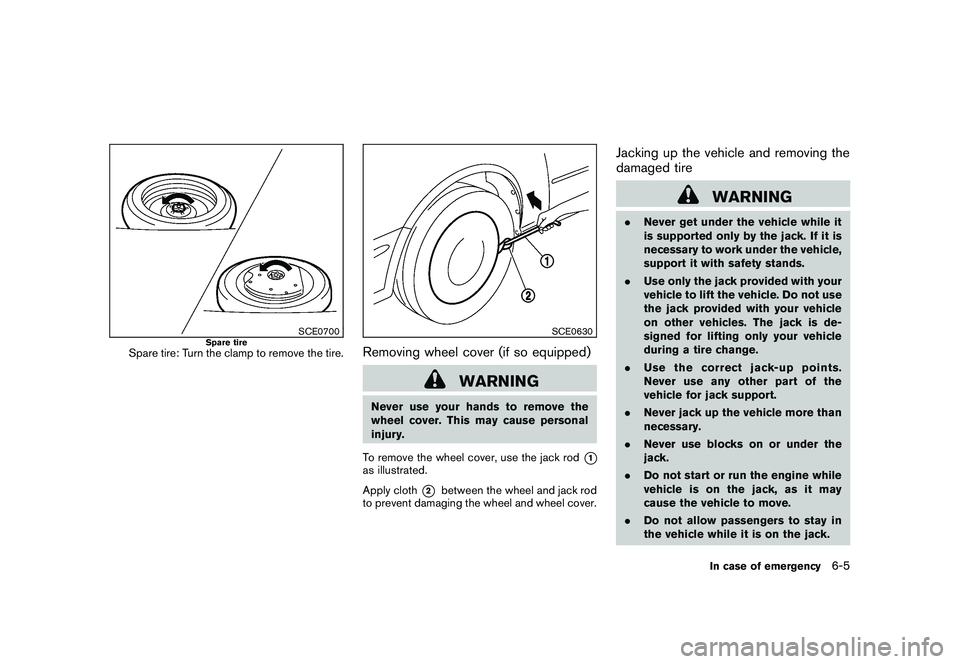
SCE0700
Spare tire
Spare tire: Turn the clamp to remove the tire.
SCE0630
Removing wheel cover (if so equipped)
WARNING
Never use your hands to remove the
wheel cover. This may cause personal
injury.
To remove the wheel cover, use the jack rod
*1
as illustrated.
Apply cloth
*2
between the wheel and jack rod
to prevent damaging the wheel and wheel cover.
Jacking up the vehicle and removing the
damaged tire
WARNING
.Never get under the vehicle while it
is supported only by the jack. If it is
necessary to work under the vehicle,
support it with safety stands.
.Use only the jack provided with your
vehicle to lift the vehicle. Do not use
the jack provided with your vehicle
on other vehicles. The jack is de-
signed for lifting only your vehicle
during a tire change.
.Use the correct jack-up points.
Never use any other part of the
vehicle for jack support.
.Never jack up the vehicle more than
necessary.
.Never use blocks on or under the
jack.
.Do not start or run the engine while
vehicle is on the jack, as it may
cause the vehicle to move.
.Do not allow passengers to stay in
the vehicle while it is on the jack.
In case of emergency
6-5
Page 225 of 316
Black plate (223,1)
Model "S35-D" EDITED: 2008/ 7/ 24
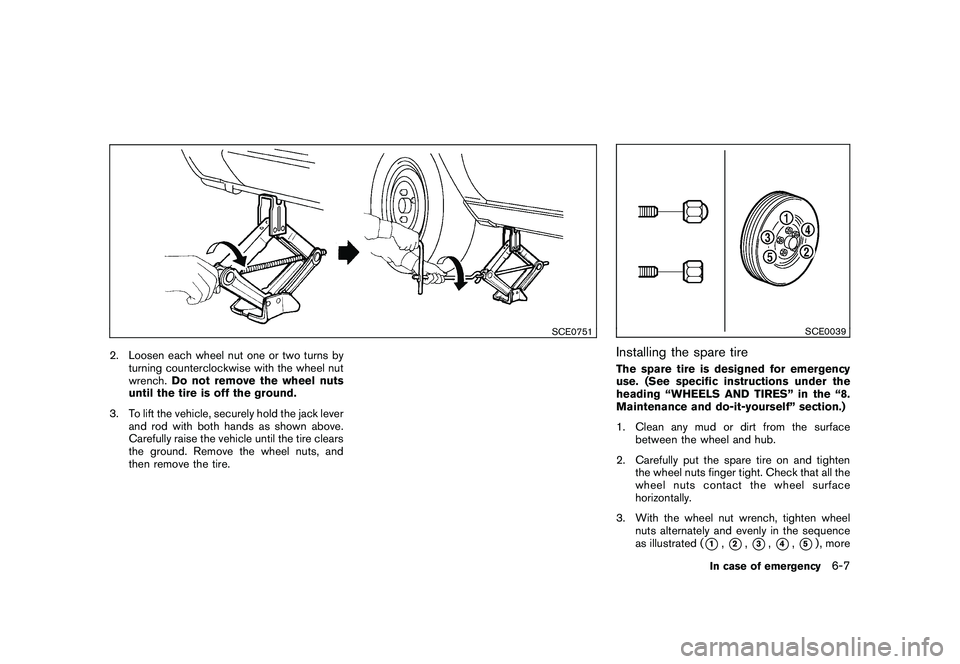
SCE0751
2. Loosen each wheel nut one or two turns by
turning counterclockwise with the wheel nut
wrench.Do not remove the wheel nuts
until the tire is off the ground.
3. To lift the vehicle, securely hold the jack lever
and rod with both hands as shown above.
Carefully raise the vehicle until the tire clears
the ground. Remove the wheel nuts, and
then remove the tire.
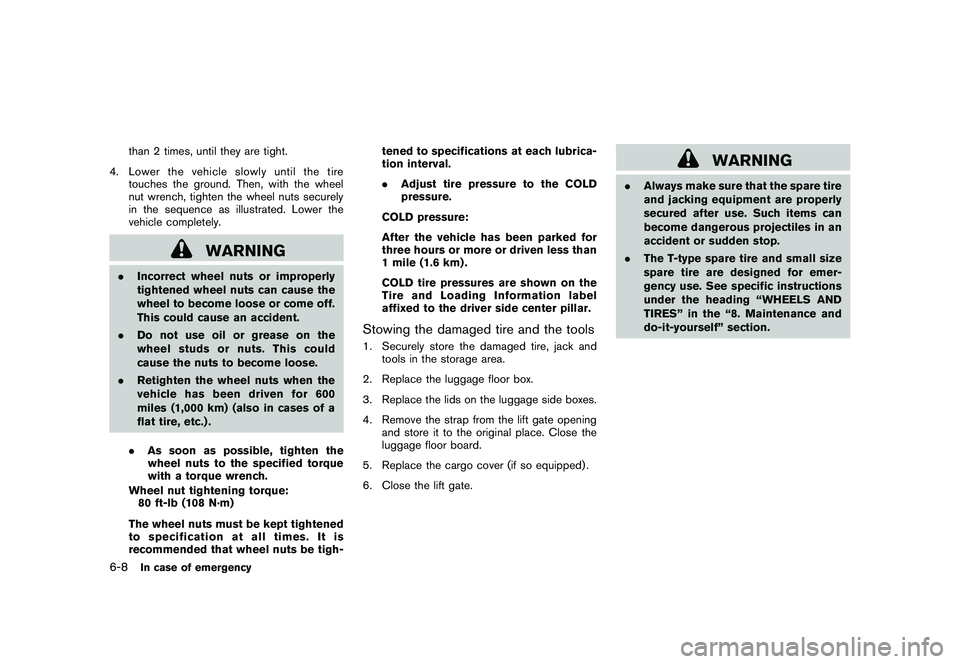
SCE0039
Installing the spare tireThe spare tire is designed for emergency
use. (See specific instructions under the
heading “WHEELS AND TIRES” in the “8.
Maintenance and do-it-yourself” section.)
1. Clean any mud or dirt from the surface
between the wheel and hub.
2. Carefully put the spare tire on and tighten
the wheel nuts finger tight. Check that all the
wheel nuts contact the wheel surface
horizontally.
3. With the wheel nut wrench, tighten wheel
nuts alternately and evenly in the sequence
as illustrated (
*1,*2,*3,*4,*5) , more
In case of emergency
6-7
Page 226 of 316
Black plate (224,1)
Model "S35-D" EDITED: 2008/ 7/ 24
than 2 times, until they are tight.
4. Lower the vehicle slowly until the tire
touches the ground. Then, with the wheel
nut wrench, tighten the wheel nuts securely
in the sequence as illustrated. Lower the
vehicle completely.
WARNING
.Incorrect wheel nuts or improperly
tightened wheel nuts can cause the
wheel to become loose or come off.
This could cause an accident.
.Do not use oil or grease on the
wheel studs or nuts. This could
cause the nuts to become loose.
.Retighten the wheel nuts when the
vehicle has been driven for 600
miles (1,000 km) (also in cases of a
flat tire, etc.) .
.As soon as possible, tighten the
wheel nuts to the specified torque
with a torque wrench.
Wheel nut tightening torque:
80 ft-lb (108 N·m)
The wheel nuts must be kept tightened
to specification at all times. It is
recommended that wheel nuts be tigh-tened to specifications at each lubrica-
tion interval.
.Adjust tire pressure to the COLD
pressure.
COLD pressure:
After the vehicle has been parked for
three hours or more or driven less than
1 mile (1.6 km) .
COLD tire pressures are shown on the
Tire and Loading Information label
affixed to the driver side center pillar.
Stowing the damaged tire and the tools1. Securely store the damaged tire, jack and
tools in the storage area.
2. Replace the luggage floor box.
3. Replace the lids on the luggage side boxes.
4. Remove the strap from the lift gate opening
and store it to the original place. Close the
luggage floor board.
5. Replace the cargo cover (if so equipped) .
6. Close the lift gate.
WARNING
.Always make sure that the spare tire
and jacking equipment are properly
secured after use. Such items can
become dangerous projectiles in an
accident or sudden stop.
.The T-type spare tire and small size
spare tire are designed for emer-
gency use. See specific instructions
under the heading “WHEELS AND
TIRES” in the “8. Maintenance and
do-it-yourself” section.
6-8
In case of emergency
Page 243 of 316
Black plate (241,1)
Model "S35-D" EDITED: 2008/ 7/ 24
Lights*:Clean the headlights on a regular basis.
Make sure that the headlights, stop lights, tail
lights, turn signal lights, and other lights are all
operating properly and installed securely. Also
check headlight aim.
Road wheel nuts (lug nuts)*:When checking
the tires, make sure no wheel nuts are missing,
and check for any loose wheel nuts. Tighten if
necessary.
Tire rotation*:Tires should be rotated every
7,500 miles (12,000 km).
Tires*:Check the pressure with a gauge often
and always prior to long distance trips. If
necessary, adjust the pressure in all tires,
including the spare, to the pressure specified.
Check carefully for damage, cuts or excessive
wear.
Tire Pressure Monitoring System (TPMS)
transmitter components:Replace the TPMS
transmitter grommet seal, valve core and cap
when the tires are replaced due to wear or age.
Wheel alignment and balance:If the vehicle
should pull to either side while driving on a
straight and level road, or if you detect uneven or
abnormal tire wear, there may be a need for
wheel alignment.
If the steering wheel or seat vibrates at normal
highway speeds, wheel balancing may be
needed.For additional information regarding tires, refer
to “Important Tire Safety Information” (US) or
“Tire Safety Information” (Canada) in the War-
ranty Information Booklet.
Windshield:Clean the windshield on a regular
basis. Check the windshield at least every six
months for cracks or other damage. Have a
damaged windshield repaired by a qualified
repair facility.
Windshield wiper blades*:Check for cracks
or wear if they do not wipe properly.
Inside the vehicleThe maintenance items listed here should be
checked on a regular basis, such as when
performing scheduled maintenance, cleaning
the vehicle, etc.
Accelerator pedal:Check the pedal for
smooth operation and make sure the pedal
does not catch or require uneven effort. Keep
the floor mat away from the pedal.
Brake pedal:Check the pedal for smooth
operation. If the brake pedal suddenly goes
down further than normal, the pedal feels
spongy or the vehicle seems to take longer to
stop, see a NISSAN dealer immediately. Keep
the floor mat away from the pedal.
Brakes:Check that the brakes do not pull the
vehicle to one side when applied.Continuously Variable Transmission (CVT)
P (Park) position mechanism:On a fairly
steep hill, check that the vehicle is held securely
with the selector lever in the P (Park) position
without applying any brakes.
Parking brake:Check the parking brake
operation regularly. The vehicle should be
securely held on a fairly steep hill with only the
parking brake applied. If the parking brake needs
adjusted, see a NISSAN dealer.
Seat belts:Check that all parts of the seat belt
system (for example, buckles, anchors, adjusters
and retractors) operate properly and smoothly,
and are installed securely. Check the belt
webbing for cuts, fraying, wear or damage.
Seats:Check seat position controls such as
seat adjusters, seatback recliner, etc. to ensure
they operate smoothly and that all latches lock
securely in every position. Check that the head
restraints move up and down smoothly and that
the locks (if so equipped) hold securely in all
latched positions.
Steering wheel:Check for changes in the
steering conditions, such as excessive free play,
hard steering or strange noises.
Warning lights and chimes:Make sure that
all warning lights and chimes are operating
properly.
Maintenance and do-it-yourself
8-3
Page 269 of 316
Black plate (267,1)
Model "S35-D" EDITED: 2008/ 7/ 24
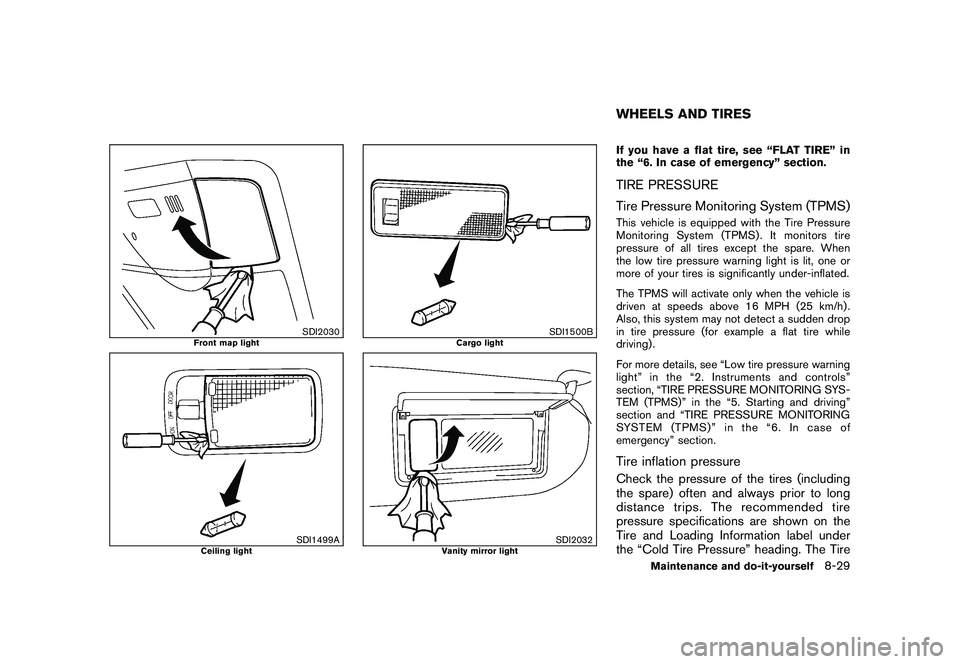
SDI2030
Front map light
SDI1499A
Ceiling light
SDI1500B
Cargo light
SDI2032
Vanity mirror light
If you have a flat tire, see “FLAT TIRE” in
the “6. In case of emergency” section.TIRE PRESSURE
Tire Pressure Monitoring System (TPMS)This vehicle is equipped with the Tire Pressure
Monitoring System (TPMS) . It monitors tire
pressure of all tires except the spare. When
the low tire pressure warning light is lit, one or
more of your tires is significantly under-inflated.
The TPMS will activate only when the vehicle is
driven at speeds above 16 MPH (25 km/h) .
Also, this system may not detect a sudden drop
in tire pressure (for example a flat tire while
driving) .
For more details, see “Low tire pressure warning
light” in the “2. Instruments and controls”
section, “TIRE PRESSURE MONITORING SYS-
TEM (TPMS)” in the “5. Starting and driving”
section and “TIRE PRESSURE MONITORING
SYSTEM (TPMS)” in the “6. In case of
emergency” section.Tire inflation pressureCheck the pressure of the tires (including
the spare) often and always prior to long
distance trips. The recommended tire
pressure specifications are shown on the
Tire and Loading Information label under
the “Cold Tire Pressure” heading. The TireWHEELS AND TIRES
Maintenance and do-it-yourself
8-29
Page 271 of 316

Black plate (269,1)
Model "S35-D" EDITED: 2008/ 7/ 24
SDI2340
Tire and Loading Information label*1
Seating capacity: The maximum num-
ber of occupants that can be seated
in the vehicle.
*2
Vehicle load limit: See “
VEHICLELOADING INFORMATION” in the “9.
Technical and consumer information”
section.
*3
Original size: The size of the tires
originally installed on the vehicle at
the factory.
*4
Cold tire pressure: Inflate the tires to
this pressure when the tires are cold.
Tires are considered COLD after the
vehicle has been parked for 3 or
more hours, or driven less than 1 mile
(1.6 km) at moderate speeds. The
recommended cold tire inflation is set
by the manufacturer to provide the
best balance of tire wear, vehicle
handling, driveability, tire noise, etc.,
up to the vehicle’s GVWR.
*5
Tire size — see “
TIRE LABELING”
later in this section.
*6
Spare tire size or compact spare tire
size (if so equipped)Maintenance and do-it-yourself
8-31
Page 272 of 316

Black plate (270,1)
Model "S35-D" EDITED: 2008/ 7/ 24
SDI1949
Checking the tire pressure1.
Remove the valve stem cap from the
tire.
2.
Press the pressure gauge squarely onto
the valve stem. Do not press too hard or
force the valve stem sideways, or air will
escape. If the hissing sound of air
escaping from the tire is heard while
checking the pressure, reposition the
gauge to eliminate this leakage.
3.
Remove the gauge.
4.
Read the tire pressure on the gauge
stem and compare it to the specifica-tion shown on the Tire and Loading
Information label.
5.
Add air to the tire as needed. If too
much air is added, press the core of the
valve stem briefly with the tip of the
gauge stem to release pressure. Re-
check the pressure and add or release
air as needed.
6.
Install the valve stem cap.
7.
Check the pressure of all other tires,
including the spare.SIZECOLD TIRE
INFLATION
PRESSURE
FRONT
ORIGINAL
TIREP215/70-
R16 99H230 kPa,
33 PSI
P225/60-
R17 98H230 kPa,
33 PSI
REAR
ORIGINAL
TIREP215/70-
R16 99H230 kPa,
33 PSI
P225/60-
R17 98H230 kPa,
33 PSI
SPARE
TIREOriginal tire230 kPa,
33 PSI
T155/90-
D16420 kPa,
60 PSI
8-32
Maintenance and do-it-yourself
Page 276 of 316
Black plate (274,1)
Model "S35-D" EDITED: 2008/ 7/ 24
.ONLY use spare tires specified for
the AWD model.
If excessive tire wear is found, it is recom-
mended that all four tires be replaced with tires
of the same size, brand, construction and tread
pattern. The tire pressure and wheel alignment
should also be checked and corrected as
necessary. Contact a NISSAN dealer.TIRE CHAINS
CAUTION
NISSAN recommends using the follow-
ing tire cables made by Peerless Chain
Company for this vehicle due to limited
tire clearance. Call 800-533-8056 to
order tire chains for your vehicle.
.215/70R16 - Sno-trac1000 part num-
ber 0103855 with chain tightener
part number 2007020
.225/60R17 - Sno-trac1000 part num-
ber 0103855 with chain tightener
part number 2007190
Failure to use the correct traction
device will cause damage to the brakes,
suspension or other vehicle parts.
The tire chain part numbers and Peerless ChainCompany phone number are correct at the time
of printing that is shown on the back cover of
this Owner’s Manual. Always confirm the correct
part numbers with Peerless Chain Company
before ordering.
Only use other types of traction devices if the
traction device manufacturer recommends it for
use on your specific vehicle and the tire and
wheel installed on your vehicle.
Use of traction devices may be prohibited
according to location. Check the local laws
before installing traction devices. When instal-
ling traction devices, make sure they are the
proper size for the tires on your vehicle and are
installed according to the traction device man-
ufacturer’s suggestions. When using traction
devices, avoid fully loading your vehicle and
drive at reduced speeds. Failure to do so may
cause damage to the brakes and suspension
and adversely affect handling and performance.
Traction devices must be installed only on
the front wheels and not on the rear
wheels.
Do not drive with traction devices on paved
roads that are clear of snow. Driving with
traction devices in such conditions can cause
damage to the various mechanisms of the
vehicle due to some overstress.
CAUTION
.Do not use traction devices on dry
roads.
.Never install traction devices on a T-
type spare tire as doing so could
damage the brakes, suspension or
other vehicle parts.
8-36
Maintenance and do-it-yourself
Page 277 of 316

Black plate (275,1)
Model "S35-D" EDITED: 2008/ 7/ 24
SDI1662
CHANGING WHEELS AND TIRES
Tire rotationNISSAN recommends rotating the tires
every 7,500 miles (12,000 km) . (See “FLAT
TIRE” in the “6. In case of emergency”
section for tire replacing procedures.)
As soon as possible, tighten the wheel
nuts to the specified torque with a
torque wrench.Wheel nut tightening torque:
80 ft-lb (108 N·m)
The wheel nuts must be kept tigh-
tened to the specification at all times.
It is recommended that wheel nuts be
tightened to the specification at each
tire rotation interval.
WARNING
.
After rotating the tires, check
and adjust the tire pressure.
.
Retighten the wheel nuts when
the vehicle has been driven for
600 miles (1,000 km) (also in
cases of a flat tire, etc.) .
.
Do not include the spare tire or
any other small size spare tire in
the tire rotation.
.
For additional information re-
garding tires, refer to “Important
Tire Safety Information” (US) or
“Tire Safety Information” (Cana-
da) in the Warranty Information
Booklet.
SDI1663
1. Wear indicator
2. Wear indicator location markTire wear and damage
WARNING
.
Tires should be periodically in-
spected for wear, cracking, bul-
ging or objects caught in the
tread. If excessive wear, cracks,
bulging or deep cuts are found,
the tire(s) should be replaced.
.
The original tires have built-in
tread wear indicators. WhenMaintenance and do-it-yourself
8-37
Page 278 of 316
Black plate (276,1)
Model "S35-D" EDITED: 2008/ 7/ 24
wear indicators are visible, the
tire(s) should be replaced.
.
Tires degrade with age and use.
Have tires, including the spare,
over 6 years old checked by a
qualified technician, because
some tire damage may not be
obvious. Replace the tires as
necessary to prevent tire failure
and possible personal injury.
.
Improper service of the spare
tire may result in serious perso-
nal injury. If it is necessary to
repair the spare tire, contact a
NISSAN dealer.
.
For additional information re-
garding tires, refer to “Important
Tire Safety Information” (US) or
“Tire Safety Information” (Cana-
da) in the Warranty Information
Booklet.
Replacing wheels and tiresWhen replacing a tire, use the same size, tread
design, speed rating and load carrying capacity
as originally equipped. (See “SPECIFICA-
TIONS” in the “9. Technical and consumer
information” section for recommended types
and sizes of tires and wheels.)
WARNING
.The use of tires other than those
recommended or the mixed use of
tires of different brands, construc-
tion (bias, bias-belted or radial) , or
tread patterns can adversely affect
the ride, braking, handling, ground
clearance, body-to-tire clearance,
tire chain clearance, speedometer
calibration, headlight aim and bum-
per height. Some of these effects
may lead to accidents and could
result in serious personal injury.
.If the wheels are changed for any
reason, always replace with wheels
which have the same off-set dimen-
sion. Wheels of a different off-set
could cause premature tire wear,
degrade vehicle handling character-
istics and/or interference with the
brake discs/drums. Such interfer-
ence can lead to decreased braking
efficiency and/or early brake pad/
shoe wear. See “WHEELS AND
TIRES” in the “9. Technical and
consumer information” section of
this manual for wheel off-set dimen-
sions..When a spare tire is mounted or a
wheel is replaced, the TPMS will not
function and the low tire pressure
warning light will flash for approxi-
mately 1 minute. The light will
remain on after 1 minute. Contact
your NISSAN dealer as soon as
possible for tire replacement and/
or system resetting.
.Replacing tires with those not ori-
ginally specified by NISSAN could
affect the proper operation of the
TPMS.
.Do not install a damaged or de-
formed wheel or tire even if it has
been repaired. Such wheels or tires
could have structural damage and
could fail without warning.
.The use of retread tire is not re-
commended.
.For additional information regard-
ing tires, refer to “Important Tire
Safety Information” (US) or “Tire
Safety Information” (Canada) in the
Warranty Information Booklet.
8-38
Maintenance and do-it-yourself