seats NISSAN ROGUE 2009 Owner´s Manual
[x] Cancel search | Manufacturer: NISSAN, Model Year: 2009, Model line: ROGUE, Model: NISSAN ROGUE 2009Pages: 316, PDF Size: 4.26 MB
Page 61 of 316
Black plate (60,1)
Model "S35-D" EDITED: 2008/ 7/ 24
placing material over the steering
wheel pad and above the instrument
panel or by installing additional trim
material around the air bag system.
.Modifying or tampering with the
front passenger seat may result in
serious personal injury. For exam-
ple, do not change the front seats by
placing material on the seat cushion
or by installing additional trim ma-
terial, such as seat covers, on the
seat that is not specifically designed
to assure proper air bag operation.
Additionally, do not stow any ob-
jects under the front passenger seat
or the seat cushion and seatback.
Such objects may interfere with the
proper operation of the occupant
classification sensor.
.No unauthorized changes should be
made to any components or wiring
of the seat belt system. This may
affect the front air bag system.
Tampering with the seat belt system
may result in serious personal in-
jury.
.Work on and around the front air
bag system should be done by a
NISSAN dealer. Installation of elec-trical equipment should also be
done by a NISSAN dealer. The
Supplemental Restraint System
(SRS) wiring should not be modified
or disconnected. Unauthorized elec-
trical test equipment and probing
devices should not be used on the
air bag system.
.A cracked windshield should be
replaced immediately by a qualified
repair facility. A cracked windshield
could affect the function of the
supplemental air bag system.
.The SRS wiring harness connectors
are yellow and orange for easy
identification.
When selling your vehicle, we request that you
inform the buyer about the front air bag system
and guide the buyer to the appropriate sections
in this Owner’s Manual.
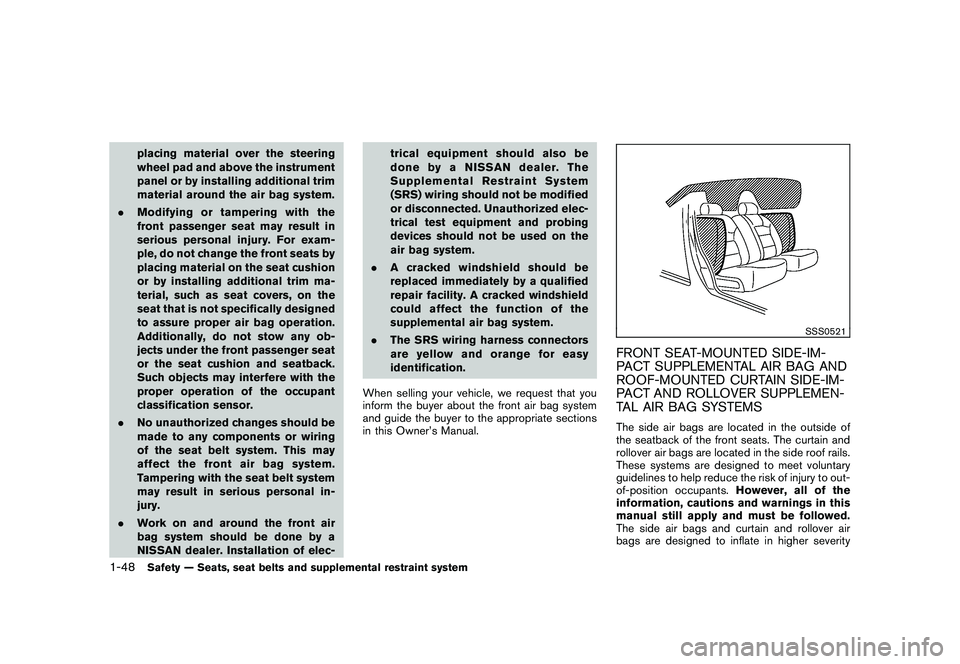
SSS0521
FRONT SEAT-MOUNTED SIDE-IM-
PACT SUPPLEMENTAL AIR BAG AND
ROOF-MOUNTED CURTAIN SIDE-IM-
PACT AND ROLLOVER SUPPLEMEN-
TAL AIR BAG SYSTEMSThe side air bags are located in the outside of
the seatback of the front seats. The curtain and
rollover air bags are located in the side roof rails.
These systems are designed to meet voluntary
guidelines to help reduce the risk of injury to out-
of-position occupants.However, all of the
information, cautions and warnings in this
manual still apply and must be followed.
The side air bags and curtain and rollover air
bags are designed to inflate in higher severity
1-48
Safety — Seats, seat belts and supplemental restraint system
Page 62 of 316
Black plate (61,1)
Model "S35-D" EDITED: 2008/ 7/ 24
side collisions, although they may inflate if the
forces in another type of collision are similar to
those of a higher severity side impact. They are
designed to inflate on the side where the vehicle
is impacted. They may not inflate in certain side
collisions on the side where the vehicle is
impacted. Curtain and rollover air bags are also
designed to inflate in certain types of rollover
collisions or near rollovers.
Vehicle damage (or lack of it) is not always an
indication of proper side air bag and curtain and
rollover air bag operation.
When the side air bags and curtain and rollover
air bags inflate, a fairly loud noise may be heard,
followed by release of smoke. This smoke is not
harmful and does not indicate a fire. Care should
be taken not to inhale it, as it may cause irritation
and choking. Those with a history of a breathing
condition should get fresh air promptly.
Side air bags, along with the use of seat belts,
help to cushion the impact force on the chest
and pelvic area of the front occupants. Curtain
and rollover air bags help to cushion the impact
force to the head of occupants in the front and
rear outboard seating positions. They can help
save lives and reduce serious injuries. However,
side air bags and curtain and rollover air bags
may cause abrasions or other injuries. Side air
bags and curtain and rollover air bags do not
provide restraint to the lower body.The seat belts should be correctly worn and the
driver and passenger seated upright as far as
practical away from the side air bags. Rear seat
passengers should be seated as far away as
practical from the door finishers and side roof
rails. The side air bags and curtain and rollover
air bags inflate quickly in order to help protect
the occupants in the outboard seating positions.
Because of this, the force of the side air bags
and curtain and rollover air bags inflating can
increase the risk of injury if the occupant is too
close to, or is against, these air bag modules
during inflation. The side air bags and curtain
and rollover air bags will deflate quickly after the
collision is over.
The side air bags and curtain and rollover
air bags operate only when the ignition
switch is in the ON position.
After turning the ignition switch to the ON
position, the supplemental air bag warning
light illuminates. The supplemental air bag
warning light will turn off after about 7
seconds if the systems are operational.
WARNING
.Do not place any objects near the
seatback of the front seats. Also, do
not place any objects (an umbrella,
bag, etc.) between the front doorfinisher and the front seat. Such
objects may become dangerous
projectiles and cause injury if a side
air bag inflates.
.Right after inflation, several side air
bag and curtain and rollover air bag
system components will be hot. Do
not touch them; you may severely
burn yourself.
.No unauthorized changes should be
made to any components or wiring
of the side air bag and curtain and
rollover air bag systems. This is to
prevent accidental inflation of the
side air bag and curtain and rollover
air bag or damage to the side air
bag and curtain and rollover air bag
systems.
.Do not make unauthorized changes
to your vehicle’s electrical system,
suspension system or side panel.
This could affect proper operation
of the side air bag and curtain and
rollover air bag systems.
.Tampering with the air bag system
may result in serious personal in-
jury. For example, do not change the
front seats by placing material near
Safety — Seats, seat belts and supplemental restraint system
1-49
Page 63 of 316
Black plate (62,1)
Model "S35-D" EDITED: 2008/ 7/ 24
the seatbacks or by installing addi-
tional trim material, such as seat
covers, around the side air bag.
.Work around and on the side air bag
and curtain and rollover air bag
systems should be done by a
NISSAN dealer. Installation of elec-
trical equipment should also be
done by a NISSAN dealer. The SRS
wiring harnesses* should not be
modified or disconnected. Un-
authorized electrical test equipment
and probing devices should not be
used on the side air bag and curtain
and rollover supplemental air bag
systems.
*The SRS wiring harnesses connec-
tors are yellow and orange for easy
identification.
When selling your vehicle, we request that you
inform the buyer about the side air bag and
curtain and rollover air bag systems and guide
the buyer to the appropriate sections in this
Owner’s Manual.
SEAT BELTS WITH PRETENSIONERS
(front seats)
WARNING
.The pretensioners cannot be reused
after activation. They must be re-
placed together with the retractor
and buckle as a unit.
.If the vehicle becomes involved in a
frontal collision but a pretensioner
is not activated, be sure to have the
pretensioner system checked and, if
necessary, replaced by a NISSAN
dealer.
.No unauthorized changes should be
made to any components or wiring
of the pretensioner system. This is
to prevent damage to or accidental
activation of the pretensioners.
Tampering with the pretensioner
system may result in serious perso-
nal injury.
.Work around and on the preten-
sioner system should be done by a
NISSAN dealer. Installation of elec-
trical equipment should also be
done by a NISSAN dealer. Un-
authorized electrical test equipmentand probing devices should not be
used on the pretensioner system.
.If you need to dispose of a preten-
sioner or scrap the vehicle, contact a
NISSAN dealer. Correct preten-
sioner disposal procedures are set
forthintheappropriateNISSAN
Service Manual. Incorrect disposal
procedures could cause personal
injury.
The pretensioner system activates in conjunc-
tion with the front air bag system. The preten-
sioner system also activates with the curtain and
rollover air bags in certain types of rollover
collisions or near rollovers. Working with the
seat belt retractor, it helps tighten the seat belt
when the vehicle becomes involved in certain
types of collisions, helping to restrain front seat
occupants.
The pretensioner is encased with the seat belt
retractor. These seat belts are used the same
way as conventional seat belts.
When a pretensioner activates, smoke is re-
leased and a loud noise may be heard. The
smoke is not harmful and does not indicate a
fire. Care should be taken not to inhale it, as it
may cause irritation and choking. Those with a
history of a breathing condition should get fresh
air promptly.
1-50
Safety — Seats, seat belts and supplemental restraint system
Page 64 of 316
Black plate (63,1)
Model "S35-D" EDITED: 2008/ 7/ 24
After pretensioner activation, load limiters allow
the seat belt to release webbing (if necessary) to
reduce forces against the chest.
If any abnormality occurs in the pretensioner
system, the supplemental air bag warning light
will not come on, will flash intermittently or
will turn on for 7 seconds and remain on after
the ignition switch has been turned to the ON
position. In this case, the pretensioner may not
function properly. They must be checked and
repaired. Take your vehicle to the nearest
NISSAN dealer.
When selling your vehicle, we request that you
inform the buyer about the pretensioner system
and guide the buyer to the appropriate sections
in this Owner’s Manual.
SSS0362
SUPPLEMENTAL AIR BAG WARNING
LABELSWarning labels about the supplemental front-
impact air bag and front seat-mounted side-
impact supplemental air bag systems are placed
in the vehicle as shown in the illustration.*1
SRS air bag
The warning labels are located on the surface of
the sun visors.*2
SRS side air bags
The warning label is located on the side of the
passenger’s side center pillar.
SPA1097
SUPPLEMENTAL AIR BAG WARNING
LIGHTThe supplemental air bag warning light, display-
ing
in the instrument panel, monitors the
circuits of the supplemental front-impact air bag,
front seat-mounted side-impact supplemental
air bag, roof-mounted curtain side-impact and
rollover supplemental air bag and seat belt
pretensioner systems. The monitored circuits
include Air bag Control Unit (ACU) , crash zone
sensor, satellite sensors, occupant classification
system, front air bag modules, side air bag
modules, curtain and rollover air bag modules,
pretensioners and all related wiring.
When the ignition switch is in the ON position,
Safety — Seats, seat belts and supplemental restraint system
1-51
Page 65 of 316
Black plate (64,1)
Model "S35-D" EDITED: 2008/ 7/ 24
the supplemental air bag warning light illumi-
nates for about 7 seconds and then turns off.
This means the system is operational.
If any of the following conditions occur, the front
air bag, side air bag, curtain and rollover air bag
and pretensioner systems need servicing:
.The supplemental air bag warning light
remains on after approximately 7 seconds.
.The supplemental air bag warning light
flashes intermittently.
.The supplemental air bag warning light does
not come on at all.
Under these conditions, the front air bag, side air
bag, curtain and rollover air bag and preten-
sioner systems may not operate properly. It must
be checked and repaired. Take your vehicle to
the nearest NISSAN dealer.
WARNING
If the supplemental air bag warning
light is on, it could mean that the front
air bag, side air bag, curtain and roll-
over air bag and/or pretensioner sys-
tems will not operate in an accident. To
help avoid injury to yourself or others,
have your vehicle checked by a NISSAN
dealer as soon as possible.REPAIR AND REPLACEMENT PRO-
CEDUREThe front air bags, side air bags, curtain and
rollover air bags and pretensioners are designed
to activate on a one-time-only basis. As a
reminder, unless it is damaged, the supplemen-
tal air bag warning light will remain illuminated
after inflation has occurred. Repair and replace-
ment of these systems should be done only by a
NISSAN dealer.
When maintenance work is required on the
vehicle, the front air bags, side air bags, curtain
and rollover air bags and pretensioners and
related parts should be pointed out to the
person performing the maintenance. The ignition
switch should always be in the LOCK position
when working under the hood or inside the
vehicle.
WARNING
.Once a front air bag, side air bag or
curtain and rollover air bag has
inflated, the air bag module will
not function again and must be
replaced. Additionally, if any of the
front air bags inflate, the activated
pretensioners must also be re-
placed. The air bag module and
pretensioner system should be re-
placed by a NISSAN dealer. The air
bag modules and pretensioner sys-
tem cannot be repaired.
.The front air bag, side air bag and
curtain and rollover air bag systems,
and pretensioner system should be
inspected by a NISSAN dealer if
there is any damage to the front
end or side portion of the vehicle.
1-52
Safety — Seats, seat belts and supplemental restraint system
Page 66 of 316
Black plate (65,1)
Model "S35-D" EDITED: 2008/ 7/ 24
.If you need to dispose of a supple-
mental air bag or pretensioner sys-
tems, or scrap the vehicle, contact a
NISSAN dealer. Correct supplemen-
tal air bag and pretensioner system
disposal procedures are set forth in
theappropriateNISSANService
Manual. Incorrect disposal proce-
dures could cause personal injury.
Safety — Seats, seat belts and supplemental restraint system
1-53
Page 67 of 316
Black plate (66,1)
Model "S35-D" EDITED: 2008/ 7/ 24
MEMO1-54
Safety — Seats, seat belts and supplemental restraint system
Page 68 of 316
Black plate (7,1)
2 Instruments and controls
Model "S35-D" EDITED: 2008/ 6/ 3
Instrument panel................................................ 2-2
Meters and gauges............................................. 2-3
Speedometer and odometer............................. 2-4
Tachometer................................................... 2-5
Engine coolant temperature gauge..................... 2-5
Fuel gauge................................................... 2-6
Vehicle information display................................ 2-6
Outside air temperature (if so equipped).............. 2-6
Continuously Variable Transmission (CVT)
position indicator............................................ 2-7
Trip computer (if so equipped).......................... 2-7
Compass (if so equipped).................................... 2-8
Zone variation change procedure....................... 2-9
Warning/indicator lights and audible reminders....... 2-11
Checking bulbs........................................... 2-11
Warning lights............................................. 2-12
Indicator lights............................................. 2-16
Audible reminders........................................ 2-18
Security systems.............................................. 2-19
Vehicle security system.................................. 2-19
NISSAN Vehicle Immobilizer System................. 2-20
Windshield wiper and washer switch.................... 2-22
Rear window wiper and washer switch.................. 2-23
Rear window and outside mirror defroster switch..... 2-24
Headlight and turn signal switch.......................... 2-25
Xenon headlights (if so equipped).................... 2-25Headlight switch.......................................... 2-26
Turn signal switch........................................ 2-28
Fog light switch (if so equipped)...................... 2-29
Hazard warning flasher switch............................. 2-29
Horn............................................................. 2-30
Heated seats (if so equipped)............................. 2-30
Vehicle Dynamic Control (VDC) OFF switch........... 2-31
Clock............................................................ 2-31
Adjusting the time........................................ 2-31
Power outlet................................................... 2-32
Storage......................................................... 2-33
Cup holders................................................ 2-33
Sunglasses holder........................................ 2-34
Glove box.................................................. 2-35
Console box............................................... 2-35
Luggage floor box (if so equipped)................... 2-36
Luggage side box......................................... 2-36
Cargo cover (if so equipped).......................... 2-37
Luggage hooks (if so equipped)...................... 2-38
Coat hooks (if so equipped)........................... 2-38
Utility hook................................................. 2-39
Roof rack (if so equipped).............................. 2-39
Windows....................................................... 2-40
Power windows........................................... 2-40
Moonroof (if so equipped).................................. 2-42
Automatic moonroof...................................... 2-42
Page 84 of 316
Black plate (82,1)
Model "S35-D" EDITED: 2008/ 7/ 24
not activate the warning light for the front
passenger.
See “SEAT BELTS” in the “1. Safety — Seats,
seat belts and supplemental restraint system”
section for precautions on seat belt usage.
Supplemental air bag warning light
After turning the ignition switch to the ON
position, the supplemental air bag warning light
will illuminate. The supplemental air bag warning
light will turn off after about 7 seconds if the
supplemental front air bag and supplemental
side air bag, curtain side-impact air bag systems
and/or pretensioner seat belt are operational.
If any of the following conditions occur, the front
air bag, side air bag, curtain and rollover air bag
and pretensioner systems need servicing and
your vehicle must be taken to your nearest
NISSAN dealer.
.The supplemental air bag warning light
remains on after approximately 7 seconds.
.The supplemental air bag warning light
flashes intermittently.
.The supplemental air bag warning light does
not illuminate at all.
Unless checked and repaired, the Supplemental
Restraint Systems and/or the pretensioners maynot function properly.
For additional information, see “SUPPLEMEN-
TAL RESTRAINT SYSTEM” in the “1. Safety —
Seats, seat belts and supplemental restraint
system” section.
WARNING
If the supplemental air bag warning
light is on, it could mean that the front
air bag, side air bag, curtain and roll-
over air bag and/or pretensioner sys-
tems will not operate in an accident. To
help avoid injury to yourself or others,
have your vehicle checked by a NISSAN
dealer as soon as possible.INDICATOR LIGHTS
All-Wheel Drive (AWD) LOCK
indicator light (AWD models)
This light illuminates when the ignition switch is
turned to the ON position, and turns off within 1
second.
When selecting the LOCK mode while the
engine is running, this light will illuminate. (See
“ALL-WHEEL DRIVE (AWD)” in the “5. Starting
and driving” section.)
Cruise main switch indicator light
This light illuminates when the cruise control
main switch is pushed. The light turns off when
the main switch is pushed again. When the
cruise main switch indicator light illuminates, the
cruise control system is operational. (See
“CRUISE CONTROL” in the “5. Starting and
driving” section.)
Cruise set indicator light
This light illuminates while the vehicle speed is
controlled by the cruise control system. If the
light blinks while the engine is running, it may
indicate the cruise control system is not
functioning properly. Have the system checked
by a NISSAN dealer. (See “CRUISE CON-
TROL” in the “5. Starting and driving” section.)
Front passenger air bag status
light
The front passenger air bag status light will be lit
and the passenger front air bag will be OFF
depending on how the front passenger seat is
being used.
For front passenger air bag status light opera-
tion,see“NISSANADVANCEDAIRBAG
SYSTEM (front seats)” in the “1. Safety —
2-16
Instruments and controls
Page 85 of 316
Black plate (83,1)
Model "S35-D" EDITED: 2008/ 7/ 24
Seats, seat belts and supplemental restraint
system” section of this manual.
High beam indicator light (Blue)
This light illuminates when the headlight high
beam is on and goes out when the low beam is
selected.
Malfunction Indicator Light (MIL)
If the malfunction indicator light illuminates
steady or blinks while the engine is running, it
may indicate a potential emission control and/or
Continuously Variable Transmission (CVT) mal-
function.
The malfunction indicator light may also illumi-
nate steady if the fuel-filler cap is loose or
missing, or if the vehicle runs out of fuel. Check
to make sure the fuel-filler cap is installed and
closed tightly, and that the vehicle has at least 3
US gallons (11.4 liters) of fuel in the fuel tank.
After a few driving trips, the
light should
turn off if no other potential emission control
system malfunction exists.
If this indicator light remains on for 20 seconds
and then blinks for 10 seconds when the engine
is not running, it indicates that the vehicle is not
ready for an emission control system inspection/
maintenance test. (See “READINESS FORINSPECTION/MAINTENANCE (I/M) TEST” in
the “9. Technical and consumer information”
section.)
Operation:
The malfunction indicator light will illuminate in
one of two ways:
.Malfunction indicator light illuminated steady
— An emission control system and/or CVT
malfunction has been detected. Check the
fuel-filler cap. If the fuel-filler cap is loose or
missing, tighten or install the cap and
continue to drive the vehicle. The
light
should turn off after a few driving trips. If the
light does not turn off after a few
driving trips, have the vehicle inspected by a
NISSAN dealer. You do not need to have
your vehicle towed to the dealer.
.Malfunction indicator light blinking — An
engine misfire has been detected which may
damage the emission control system.
To reduce or avoid emission control system
damage:
a) Do not drive at speeds above 45 MPH
(72 km/h) .
b) Avoid hard acceleration or deceleration.
c) Avoid steep uphill grades.
d) If possible, reduce the amount of cargobeing hauled or towed.
The malfunction indicator light may stop
blinking and remain illuminated.
Have the vehicle inspected by a NISSAN
dealer. You do not need to have your vehicle
towed to the dealer.
CAUTION
Continued vehicle operation without
having the emission control system
and/or CVT system checked and re-
paired as necessary could lead to poor
driveability, reduced fuel economy, and
possible damage to the emission con-
trol system.
Overdrive off indicator light (if so
equipped)
The overdrive off indicator light illuminates when
the overdrive off mode is selected.
For additional information, see ““CONTINU-
OUSLY VARIABLE TRANSMISSION (CVT)” in
the “5. Starting and driving” section of this
manual.
Instruments and controls
2-17