flat tire NISSAN ROGUE 2010 Owner´s Manual
[x] Cancel search | Manufacturer: NISSAN, Model Year: 2010, Model line: ROGUE, Model: NISSAN ROGUE 2010Pages: 328, PDF Size: 2.84 MB
Page 282 of 328
Black plate (282,1)
Model "S35-D" EDITED: 2009/ 9/ 4
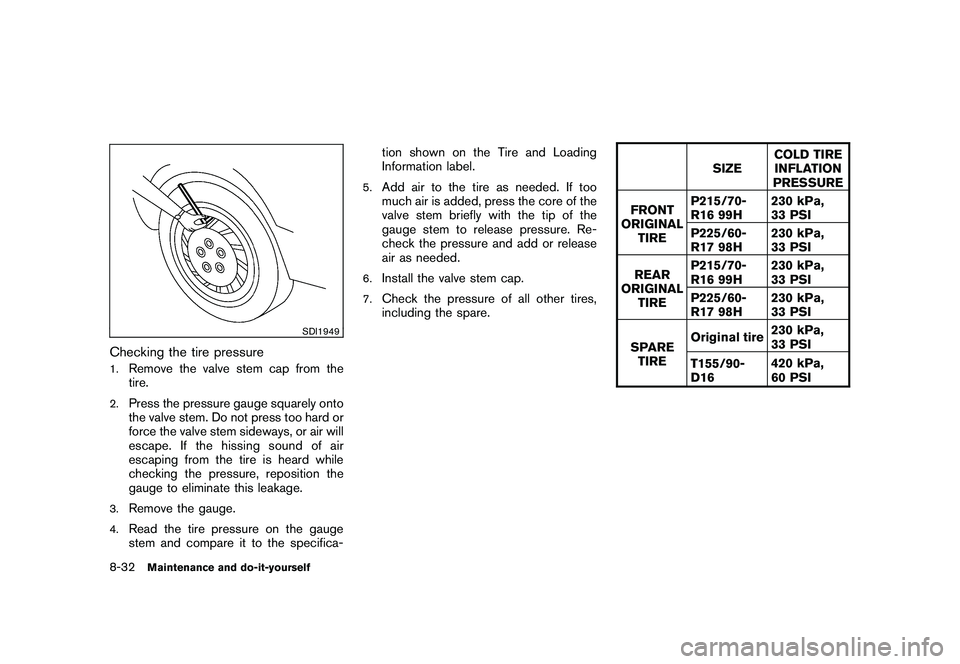
SDI1949
Checking the tire pressure1.
Remove the valve stem cap from the
tire.
2.
Press the pressure gauge squarely onto
the valve stem. Do not press too hard or
force the valve stem sideways, or air will
escape. If the hissing sound of air
escaping from the tire is heard while
checking the pressure, reposition the
gauge to eliminate this leakage.
3.
Remove the gauge.
4.
Read the tire pressure on the gauge
stem and compare it to the specifica-tion shown on the Tire and Loading
Information label.
5.
Add air to the tire as needed. If too
much air is added, press the core of the
valve stem briefly with the tip of the
gauge stem to release pressure. Re-
check the pressure and add or release
air as needed.
6.
Install the valve stem cap.
7.
Check the pressure of all other tires,
including the spare.
SIZE
COLD TIRE
INFLATION
PRESSURE
FRONT
ORIGINAL TIRE P215/70-
R16 99H
230 kPa,
33 PSI
P225/60-
R17 98H 230 kPa,
33 PSI
REAR
ORIGINAL
TIRE P215/70-
R16 99H
230 kPa,
33 PSI
P225/60-
R17 98H 230 kPa,
33 PSI
SPARE TIRE Original tire
230 kPa,
33 PSI
T155/90-
D16 420 kPa,
60 PSI
8-32
Maintenance and do-it-yourself
Page 284 of 328
Black plate (284,1)
Model "S35-D" EDITED: 2009/ 9/ 4
SDI1607
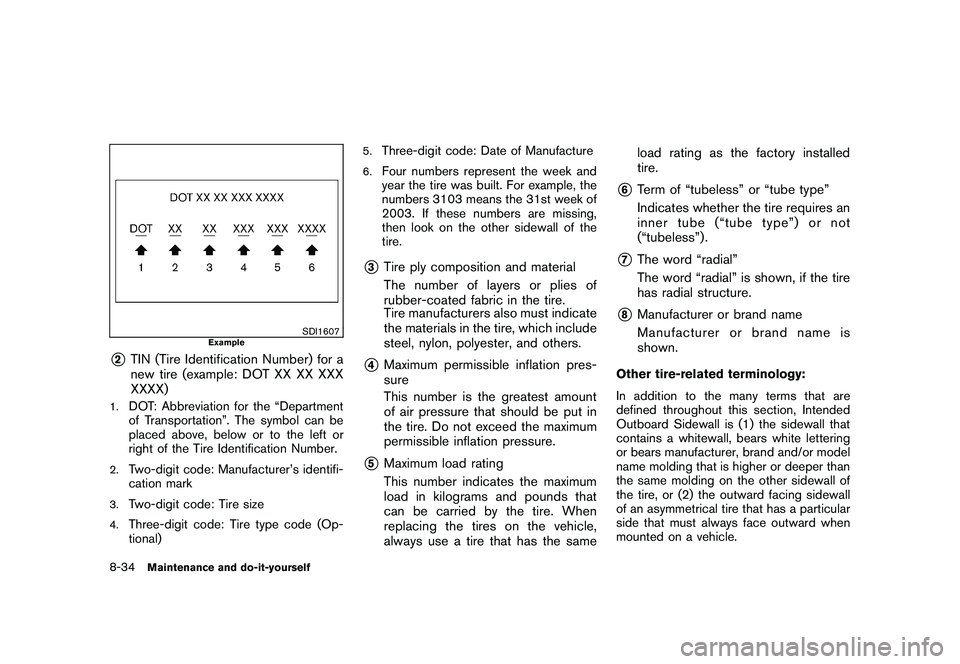
Example
*2
TIN (Tire Identification Number) for a
new tire (example: DOT XX XX XXX
XXXX)
1.
DOT: Abbreviation for the “Department
of Transportation”. The symbol can be
placed above, below or to the left or
right of the Tire Identification Number.
2.
Two-digit code: Manufacturer’s identifi-
cation mark
3.
Two-digit code: Tire size
4.
Three-digit code: Tire type code (Op-
tional)
5.
Three-digit code: Date of Manufacture
6.
Four numbers represent the week and
year the tire was built. For example, the
numbers 3103 means the 31st week of
2003. If these numbers are missing,
then look on the other sidewall of the
tire.
*3
Tire ply composition and material
The number of layers or plies of
rubber-coated fabric in the tire.
Tire manufacturers also must indicate
the materials in the tire, which include
steel, nylon, polyester, and others.
*4
Maximum permissible inflation pres-
sure
This number is the greatest amount
of air pressure that should be put in
the tire. Do not exceed the maximum
permissible inflation pressure.
*5
Maximum load rating
This number indicates the maximum
load in kilograms and pounds that
can be carried by the tire. When
replacing the tires on the vehicle,
always use a tire that has the sameload rating as the factory installed
tire.
*6
Term of “tubeless” or “tube type”
Indicates whether the tire requires an
inner tube (“tube type”) or not
(“tubeless”) .
*7
The word “radial”
The word “radial” is shown, if the tire
has radial structure.
*8
Manufacturer or brand name
Manufacturer or brand name is
shown.
Other tire-related terminology:
In addition to the many terms that are
defined throughout this section, Intended
Outboard Sidewall is (1) the sidewall that
contains a whitewall, bears white lettering
or bears manufacturer, brand and/or model
name molding that is higher or deeper than
the same molding on the other sidewall of
the tire, or (2) the outward facing sidewall
of an asymmetrical tire that has a particular
side that must always face outward when
mounted on a vehicle.
8-34
Maintenance and do-it-yourself
Page 287 of 328
Black plate (287,1)
Model "S35-D" EDITED: 2009/ 9/ 4
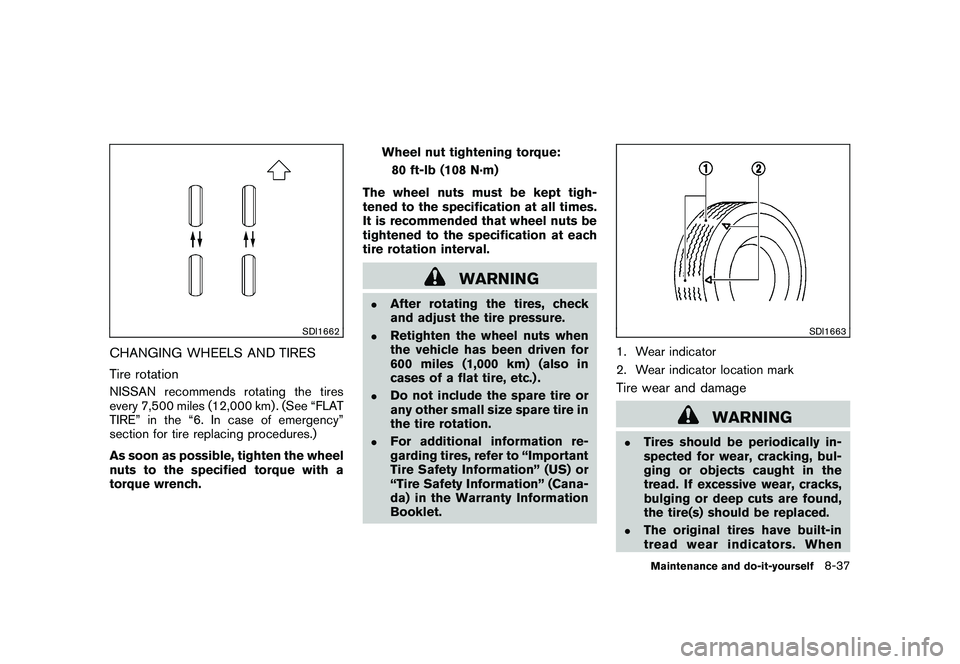
SDI1662
CHANGING WHEELS AND TIRES
Tire rotationNISSAN recommends rotating the tires
every 7,500 miles (12,000 km) . (See “FLAT
TIRE” in the “6. In case of emergency”
section for tire replacing procedures.)
As soon as possible, tighten the wheel
nuts to the specified torque with a
torque wrench.Wheel nut tightening torque:
80 ft-lb (108 N·m)
The wheel nuts must be kept tigh-
tened to the specification at all times.
It is recommended that wheel nuts be
tightened to the specification at each
tire rotation interval.
WARNING
.
After rotating the tires, check
and adjust the tire pressure.
.
Retighten the wheel nuts when
the vehicle has been driven for
600 miles (1,000 km) (also in
cases of a flat tire, etc.) .
.
Do not include the spare tire or
any other small size spare tire in
the tire rotation.
.
For additional information re-
garding tires, refer to “Important
Tire Safety Information” (US) or
“Tire Safety Information” (Cana-
da) in the Warranty Information
Booklet.
SDI1663
1. Wear indicator
2. Wear indicator location markTire wear and damage
WARNING
.
Tires should be periodically in-
spected for wear, cracking, bul-
ging or objects caught in the
tread. If excessive wear, cracks,
bulging or deep cuts are found,
the tire(s) should be replaced.
.
The original tires have built-in
tread wear indicators. WhenMaintenance and do-it-yourself
8-37
Page 291 of 328
Black plate (28,1)
9 Technical and consumer information
Model "S35-D" EDITED: 2009/ 9/ 7
Capacities and recommended fuel/lubricants............ 9-2
Fuel recommendation ...................................... 9-3
Engine oil and oil filter recommendation ............... 9-5
Air conditioning system refrigerant and lubricant
recommendations ........................................... 9-6
Specifications. ................................................... 9-7
Engine ......................................................... 9-7
Wheels and tires ............................................ 9-7
Dimensions and weights .................................. 9-8
When traveling or registering your vehicle in
another country .................................................. 9-8
Vehicle identification ........................................... 9-8
Vehicle Identification Number (VIN) plate ............. 9-8
Vehicle identification number (chassis number) ...... 9-9
Engine serial number ...................................... 9-9
F.M.V.S.S./C.M.V.S.S. certification label ............... 9-9
Emission control information label .................... 9-10
Tire and loading information label ..................... 9-10
Air conditioner specification label ..................... 9-10
Installing front license plate ................................ 9-11
Except for Kro ¯
m models ................................. 9-11
For Kro ¯
m models ......................................... 9-13 Vehicle loading information
................................. 9-13
Terms ........................................................ 9-13
Vehicle load capacity .................................... 9-14
Securing the load ......................................... 9-16
Loading tips ................................................ 9-17
Measurement of weights ................................ 9-17
Towing a trailer (except for Kro ¯
m models) .............. 9-17
Maximum load limits ...................................... 9-18
Maximum Gross Vehicle Weight (GVW)/
maximum Gross Axle Weight (GAW) ................ 9-19
Towing load/specification ............................... 9-21
Towing safety .............................................. 9-22
Flat towing ................................................. 9-25
Uniform tire quality grading ................................. 9-26
Treadwear .................................................. 9-26
Traction AA, A, B and C ................................ 9-26
Temperature A, B and C ................................ 9-26
Emission control system warranty ......................... 9-27
Reporting safety defects (US only) ....................... 9-27
Readiness for Inspection/Maintenance (I/M) test . . .... 9-28
Event Data Recorders (EDR) .............................. 9-29
Owner’s Manual/Service Manual order information . . . 9-29 In the event of a collision ............................... 9-29
Page 303 of 328
Black plate (305,1)
Model "S35-D" EDITED: 2009/ 9/ 4
FOR Kro¯
m MODELSUse the following steps to mount the license
plate:
Before mounting the license plate, confirm that
the following parts are enclosed in the vinyl bag.
. License plate bracket
. J-nut 62
. Screw 62
. Screw grommet 62
1. Park the vehicle on flat, level ground.
2. Temporarily place the license plate bracket while aligning points
*A
of the front bumper
fascia with holes
*B
in the license plate
bracket.
3. Confirm that points
*A
and
*B
are aligned.
4. Remove the license plate bracket.
5. Carefully drill two shallow pilot holes
*A
using a 0.39 in (10 mm) drill bit at the
marked locations. (Be sure that the drill
only goes through the fascia, or da-
mage to the nut may occur.)
6. Insert grommets into the hole on the fascia.
7. Insert a flat-blade screwdriver into the grommet hole to add a 90 8turn onto the
part
*C. 8. Insert a J-nut into the license plate bracket
before placing the license plate bracket on
the fascia.
9. Install the license plate bracket with the screws.
10. Install the license plate with bolts that are not longer than 0.55 in (14 mm) .
WARNING
.
It is extremely dangerous to ride
in a cargo area inside the vehi-
cle. In a collision, people riding
in these areas are more likely to
be seriously injured or killed.
.
Do not allow people to ride in
any area of your vehicle that is
not equipped with seats and
seat belts.
.
Be sure everyone in your vehicle
is in a seat and using a seat belt
properly.
TERMSIt is important to familiarize yourself with the
following terms before loading your vehicle:.
Curb Weight (actual weight of your
vehicle) - vehicle weight including:
standard and optional equipment,
fluids, emergency tools, and spare tire
assembly. This weight does notin-
clude passengers and cargo.
.
GVW (Gross Vehicle Weight) - curb
weight plus the combined weight of
passengers and cargo.
VEHICLE LOADING INFORMATIONTechnical and consumer information
9-13
Page 306 of 328
Black plate (308,1)
Model "S35-D" EDITED: 2009/ 9/ 4
6.
If your vehicle will be towing a trailer,
load from your trailer will be transferred
to your vehicle. Consult this manual to
determine how this reduces the avail-
able cargo and luggage load capacity
of your vehicle.
Before driving a loaded vehicle, confirm
that you do not exceed the Gross Vehicle
Weight Rating (GVWR) or the Gross Axle
Weight Rating (GAWR) for your vehicle.
(See “MEASUREMENT OF WEIGHTS”
later in this section.)
Also check tires for proper inflation pres-
sures. See the Tire and Loading Information
label.
SIC3504
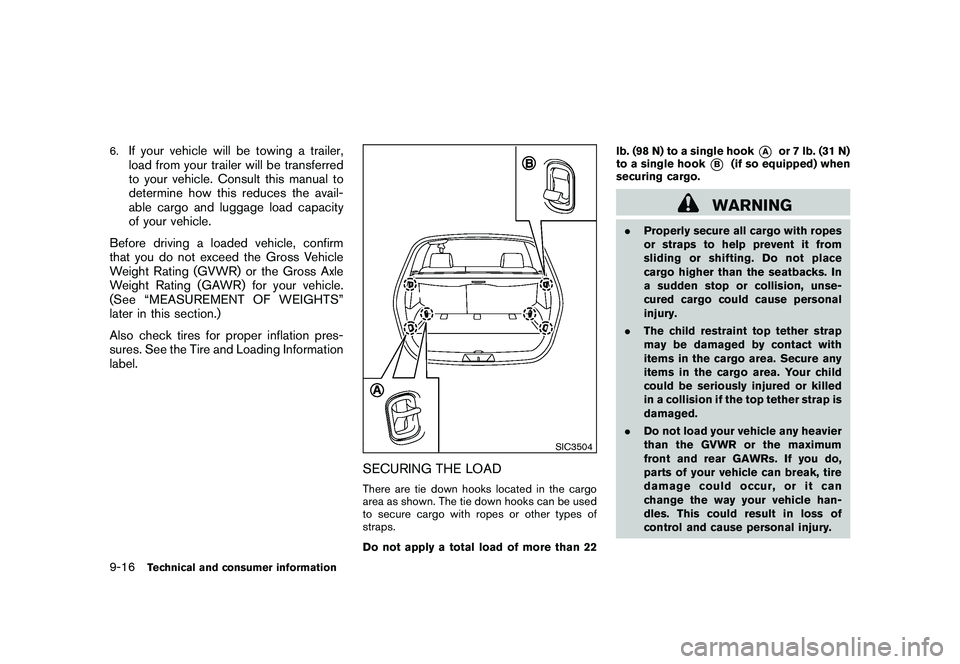
SECURING THE LOADThere are tie down hooks located in the cargo
area as shown. The tie down hooks can be used
to secure cargo with ropes or other types of
straps.
Do not apply a total load of more than 22 lb. (98 N) to a single hook
*A
or 7 lb. (31 N)
to a single hook
*B
(if so equipped) when
securing cargo.
WARNING
. Properly secure all cargo with ropes
or straps to help prevent it from
sliding or shifting. Do not place
cargo higher than the seatbacks. In
a sudden stop or collision, unse-
cured cargo could cause personal
injury.
. The child restraint top tether strap
may be damaged by contact with
items in the cargo area. Secure any
items in the cargo area. Your child
could be seriously injured or killed
in a collision if the top tether strap is
damaged.
. Do not load your vehicle any heavier
than the GVWR or the maximum
front and rear GAWRs. If you do,
parts of your vehicle can break, tire
damage could occur, or it can
change the way your vehicle han-
dles. This could result in loss of
control and cause personal injury.
9-16
Technical and consumer information
Page 312 of 328
Black plate (314,1)
Model "S35-D" EDITED: 2009/ 9/ 4
TOWING SAFETY
Trailer hitchChoose a proper hitch for your vehicle and
trailer. A genuine NISSAN trailer hitch is
available from a NISSAN dealer. Make sure the
trailer hitch is securely attached to the vehicle to
help avoid personal injury or property damage
due to sway caused by crosswinds, rough road
surfaces or passing trucks.Hitch ballChoose a hitch ball of the proper size and
weight rating for your trailer:
. The required hitch ball size is stamped on
most trailer couplers. Most hitch balls also
have the size printed on top of the ball.
. Choose the proper class hitch ball based on
the trailer weight.
. The diameter of the threaded shank of the
hitch ball must be matched to the ball mount
hole diameter. The hitch ball shank should
be no more than 1/16@ smaller than the hole
in the ball mount.
. The threaded shank of the hitch ball must be
long enough to be properly secured to the
ball mount. There should be at least 2
threads showing beyond the lock washer
and nut.
Sway control deviceSudden maneuvers, wind gusts and buffeting
caused by other vehicles can affect trailer
handling. Sway control devices may be used to
help control these affects. If you choose to use
one, contact a reputable trailer hitch supplier to
make sure the sway control device will work with
the vehicle, hitch, trailer and the trailer’s brake
system. Follow the instructions provided by the
manufacturer for installing and using the sway
control device.Class I hitchClass I trailer hitch equipment (receiver, ball
mount and hitch ball) can be used to tow trailers
of a maximum weight of 2,000 lb (909 kg) .
CAUTION
.The hitch should not be attached to
or affect the operation of the im-
pact-absorbing bumper.
. Do not use axle-mounted hitches.
. Do not modify the vehicle exhaust
system, brake system, etc. to install
a trailer hitch.
. To reduce the possibility of addi-
tional damage if your vehicle is
struck from the rear, where practi-
cal, remove the hitch and/or recei- ver when not in use. After the hitch
is removed, seal the bolt holes to
prevent exhaust fumes, water or
dust from entering the passenger
compartment.
. Regularly check that all trailer hitch
mounting bolts are securely
mounted.
Tire pressures.When towing a trailer, inflate the vehicle
tires to the recommended cold tire pressure
indicated on the Tire and Loading Informa-
tion label.
. Trailer tire condition, size, load rating and
proper inflation pressure should be in
accordance with the trailer and tire manu-
facturers’ specifications.Safety chainsAlways use a suitable chain between your
vehicle and the trailer. The safety chains should
be crossed and should be attached to the hitch,
not to the vehicle bumper or axle. The safety
chains can be attached to the bumper if the
hitch ball is mounted to the bumper. Be sure to
leave enough slack in the chains to permit
turning corners.
9-22
Technical and consumer information
Page 316 of 328
Black plate (318,1)
Model "S35-D" EDITED: 2009/ 9/ 4
manufacturer’s recommendations when using
their product.DOT (Department Of Transportation) Quality
Grades: All passenger car tires must conform to
federal safety requirements in addition to these
grades.
Quality grades can be found where applicable
on the tire sidewall between tread shoulder and
maximum section width. For example:
Treadwear 200 Traction AA Temperature A
TREADWEARThe treadwear grade is a comparative rating
based on the wear rate of the tire when tested
under controlled conditions on a specified
government test course. For example, a tire
graded 150 would wear one and one-half
(1 1/2) times as well on the government course
as a tire graded 100. The relative performance
of tires depends upon actual conditions of their
use, however, and may depart significantly from
the norm due to variations in driving habits,
service practices and differences in road char-
acteristics and climate.TRACTION AA, A, B AND CThe traction grades, from highest to lowest, are
AA, A, B and C. Those grades represent the
tire’s ability to stop on wet pavement as
measured under controlled conditions on spe-
cified government test surfaces of asphalt and
concrete. A tire marked C may have poor
traction performance.
WARNING
The traction grade assigned to this tire
is based on straight-ahead braking
traction tests, and does not include
acceleration, cornering, hydroplaning,
or peak traction characteristics.TEMPERATURE A, B AND CThe temperature grades A (the highest) , B, and
C, representing the tire’s resistance to the
generation of heat and its ability to dissipate
heat when tested under controlled conditions on
a specified indoor laboratory test wheel. Sus-
tained high temperature can cause the material
of the tire to degenerate and reduce tire life, and
excessive temperature can lead to sudden tire
failure. The grade C corresponds to a level of
performance which all passenger car tires must
meet under the Federal Motor Vehicle Safety
Standard No. 109. Grades B and A represent
higher levels of performance on the laboratory
test wheel than the minimum required by law.
WARNING
The temperature grade for this tire is
established for a tire that is properly
inflated and not overloaded. Excessive
speed, under-inflation, or excessive
UNIFORM TIRE QUALITY GRADING
9-26
Technical and consumer information
Page 322 of 328
Black plate (2,1)
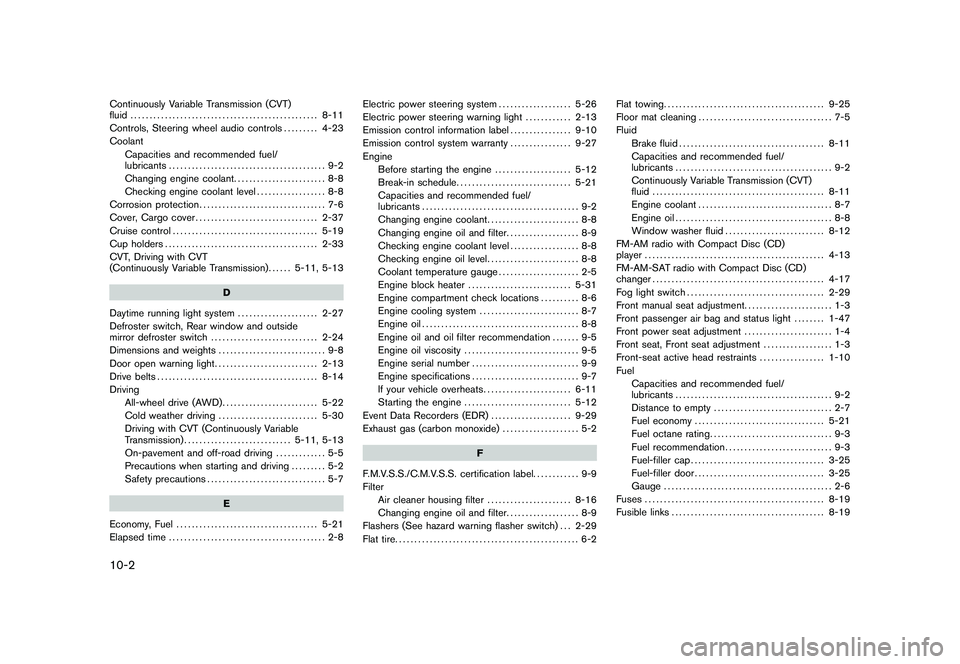
10-2Continuously Variable Transmission (CVT)
fluid................................................. 8-11
Controls, Steering wheel audio controls ......... 4-23
Coolant Capacities and recommended fuel/
lubricants ......................................... 9-2
Changing engine coolant ........................ 8-8
Checking engine coolant level .................. 8-8
Corrosion protection ................................. 7-6
Cover, Cargo cover ................................ 2-37
Cruise control ...................................... 5-19
Cup holders ........................................ 2-33
CVT, Driving with CVT
(Continuously Variable Transmission) ...... 5-11, 5-13
D
Daytime running light system ..................... 2-27
Defroster switch, Rear window and outside
mirror defroster switch ............................ 2-24
Dimensions and weights ............................ 9-8
Door open warning light ........................... 2-13
Drive belts .......................................... 8-14
Driving All-wheel drive (AWD) ......................... 5-22
Cold weather driving .......................... 5-30
Driving with CVT (Continuously Variable
Transmission) ............................ 5-11, 5-13
On-pavement and off-road driving ............. 5-5
Precautions when starting and driving ......... 5-2
Safety precautions ............................... 5-7
E
Economy, Fuel ..................................... 5-21
Elapsed time ......................................... 2-8 Electric power steering system
................... 5-26
Electric power steering warning light ............ 2-13
Emission control information label ................ 9-10
Emission control system warranty ................ 9-27
Engine Before starting the engine .................... 5-12
Break-in schedule .............................. 5-21
Capacities and recommended fuel/
lubricants ......................................... 9-2
Changing engine coolant ........................ 8-8
Changing engine oil and filter ................... 8-9
Checking engine coolant level .................. 8-8
Checking engine oil level ........................ 8-8
Coolant temperature gauge ..................... 2-5
Engine block heater ........................... 5-31
Engine compartment check locations .......... 8-6
Engine cooling system .......................... 8-7
Engine oil ......................................... 8-8
Engine oil and oil filter recommendation ....... 9-5
Engine oil viscosity .............................. 9-5
Engine serial number ............................ 9-9
Engine specifications ............................ 9-7
If your vehicle overheats ....................... 6-11
Starting the engine ............................ 5-12
Event Data Recorders (EDR) ..................... 9-29
Exhaust gas (carbon monoxide) .................... 5-2
F
F.M.V.S.S./C.M.V.S.S. certification label. ........... 9-9
Filter Air cleaner housing filter ...................... 8-16
Changing engine oil and filter ................... 8-9
Flashers (See hazard warning flasher switch) . . . 2-29
Flat tire ................................................ 6-2 Flat towing
.......................................... 9-25
Floor mat cleaning ................................... 7-5
Fluid Brake fluid ...................................... 8-11
Capacities and recommended fuel/
lubricants ......................................... 9-2
Continuously Variable Transmission (CVT)
fluid ............................................. 8-11
Engine coolant ................................... 8-7
Engine oil ......................................... 8-8
Window washer fluid .......................... 8-12
FM-AM radio with Compact Disc (CD)
player ............................................... 4-13
FM-AM-SAT radio with Compact Disc (CD)
changer ............................................. 4-17
Fog light switch .................................... 2-29
Front manual seat adjustment. ...................... 1-3
Front passenger air bag and status light ........ 1-47
Front power seat adjustment ....................... 1-4
Front seat, Front seat adjustment .................. 1-3
Front-seat active head restraints ................. 1-10
Fuel Capacities and recommended fuel/
lubricants ......................................... 9-2
Distance to empty ............................... 2-7
Fuel economy .................................. 5-21
Fuel octane rating ................................ 9-3
Fuel recommendation ............................ 9-3
Fuel-filler cap ................................... 3-25
Fuel-filler door .................................. 3-25
Gauge ............................................ 2-6
Fuses ............................................... 8-19
Fusible links ........................................ 8-19
Model "S35-D" EDITED: 2009/ 9/ 4
Page 326 of 328
Black plate (6,1)
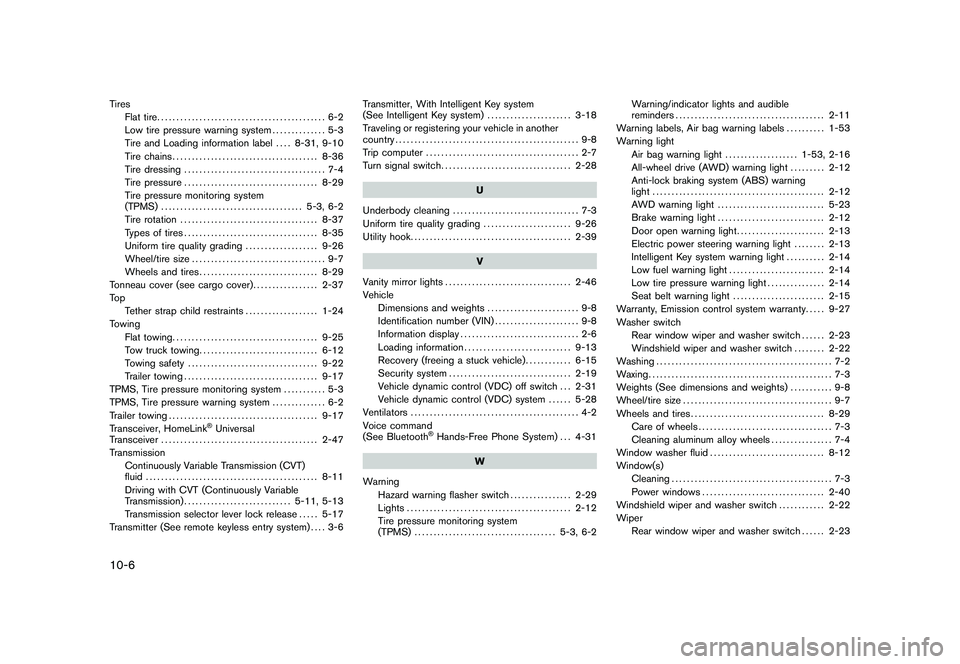
10-6TiresFlat tire ............................................ 6-2
Low tire pressure warning system .............. 5-3
Tire and Loading information label .... 8-31, 9-10
Tire chains ...................................... 8-36
Tire dressing ..................................... 7-4
Tire pressure ................................... 8-29
Tire pressure monitoring system
(TPMS) ..................................... 5-3, 6-2
Tire rotation .................................... 8-37
Types of tires ................................... 8-35
Uniform tire quality grading ................... 9-26
Wheel/tire size ................................... 9-7
Wheels and tires ............................... 8-29
Tonneau cover (see cargo cover) ................. 2-37
To p
Tether strap child restraints ................... 1-24
Towing Flat towing ...................................... 9-25
Tow truck towing ............................... 6-12
Towing safety .................................. 9-22
Trailer towing ................................... 9-17
TPMS, Tire pressure monitoring system ........... 5-3
TPMS, Tire pressure warning system .............. 6-2
Trailer towing ....................................... 9-17
Transceiver, HomeLink
®Universal
Transceiver ......................................... 2-47
Transmission Continuously Variable Transmission (CVT)
fluid ............................................. 8-11
Driving with CVT (Continuously Variable
Transmission) ............................ 5-11, 5-13
Transmission selector lever lock release ..... 5-17
Transmitter (See remote keyless entry system) .... 3-6Transmitter, With Intelligent Key system
(See Intelligent Key system)
...................... 3-18
Traveling or registering your vehicle in another
country ................................................ 9-8
Trip computer ........................................ 2-7
Turn signal switch .................................. 2-28
U
Underbody cleaning ................................. 7-3
Uniform tire quality grading ....................... 9-26
Utility hook .......................................... 2-39
V
Vanity mirror lights ................................. 2-46
Vehicle Dimensions and weights ........................ 9-8
Identification number (VIN) ...................... 9-8
Information display ............................... 2-6
Loading information ............................ 9-13
Recovery (freeing a stuck vehicle) ............ 6-15
Security system ................................ 2-19
Vehicle dynamic control (VDC) off switch . . . 2-31
Vehicle dynamic control (VDC) system ...... 5-28
Ventilators ............................................ 4-2
Voice command
(See Bluetooth
®Hands-Free Phone System) . . . 4-31
W
Warning Hazard warning flasher switch ................ 2-29
Lights ........................................... 2-12
Tire pressure monitoring system
(TPMS) ..................................... 5-3, 6-2 Warning/indicator lights and audible
reminders
....................................... 2-11
Warning labels, Air bag warning labels .......... 1-53
Warning light Air bag warning light ................... 1-53, 2-16
All-wheel drive (AWD) warning light ......... 2-12
Anti-lock braking system (ABS) warning
light ............................................. 2-12
AWD warning light ............................ 5-23
Brake warning light ............................ 2-12
Door open warning light ....................... 2-13
Electric power steering warning light ........ 2-13
Intelligent Key system warning light .......... 2-14
Low fuel warning light ......................... 2-14
Low tire pressure warning light ............... 2-14
Seat belt warning light ........................ 2-15
Warranty, Emission control system warranty ..... 9-27
Washer switch Rear window wiper and washer switch ...... 2-23
Windshield wiper and washer switch ........ 2-22
Washing .............................................. 7-2
Waxing ................................................ 7-3
Weights (See dimensions and weights) ........... 9-8
Wheel/tire size ....................................... 9-7
Wheels and tires ................................... 8-29
Care of wheels ................................... 7-3
Cleaning aluminum alloy wheels ................ 7-4
Window washer fluid .............................. 8-12
Window(s) Cleaning .......................................... 7-3
Power windows ................................ 2-40
Windshield wiper and washer switch ............ 2-22
Wiper Rear window wiper and washer switch ...... 2-23
Model "S35-D" EDITED: 2009/ 9/ 4