seats NISSAN ROGUE 2010 Owner´s Manual
[x] Cancel search | Manufacturer: NISSAN, Model Year: 2010, Model line: ROGUE, Model: NISSAN ROGUE 2010Pages: 328, PDF Size: 2.84 MB
Page 89 of 328
Black plate (85,1)
Model "S35-D" EDITED: 2009/ 9/ 4
Seats, seat belts and supplemental restraint
system” section of this manual.
High beam indicator light
This light illuminates when the headlight high
beam is on and goes out when the low beam is
selected.
Malfunction Indicator Light (MIL)
If the malfunction indicator light illuminates
steady or blinks while the engine is running, it
may indicate a potential emission control and/or
Continuously Variable Transmission (CVT) mal-
function.
The malfunction indicator light may also illumi-
nate steady if the fuel-filler cap is loose or
missing, or if the vehicle runs out of fuel. Check
to make sure the fuel-filler cap is installed and
closed tightly, and that the vehicle has at least 3
US gallons (11.4 liters) of fuel in the fuel tank.
After a few driving trips, the
light should
turn off if no other potential emission control
system malfunction exists.
If this indicator light remains on for 20 seconds
and then blinks for 10 seconds when the engine
is not running, it indicates that the vehicle is not
ready for an emission control system inspection/
maintenance test. (See “READINESS FOR INSPECTION/MAINTENANCE (I/M) TEST” in
the “9. Technical and consumer information”
section.)
Operation:
The malfunction indicator light will illuminate in
one of two ways:
.
Malfunction indicator light illuminated steady
— An emission control system and/or CVT
malfunction has been detected. Check the
fuel-filler cap. If the fuel-filler cap is loose or
missing, tighten or install the cap and
continue to drive the vehicle. The
light
should turn off after a few driving trips. If the
light does not turn off after a few
driving trips, have the vehicle inspected by a
NISSAN dealer. You do not need to have
your vehicle towed to the dealer.
. Malfunction indicator light blinking — An
engine misfire has been detected which may
damage the emission control system.
To reduce or avoid emission control system
damage:
a) Do not drive at speeds above 45 MPH (72 km/h) .
b) Avoid hard acceleration or deceleration.
c) Avoid steep uphill grades.
d) If possible, reduce the amount of cargo being hauled or towed.
The malfunction indicator light may stop
blinking and remain illuminated.
Have the vehicle inspected by a NISSAN
dealer. You do not need to have your vehicle
towed to the dealer.
CAUTION
Continued vehicle operation without
having the emission control system
and/or CVT system checked and re-
paired as necessary could lead to poor
driveability, reduced fuel economy, and
possible damage to the emission con-
trol system.
Overdrive off indicator light (if so
equipped)
The overdrive off indicator light illuminates when
the overdrive off mode is selected.
For additional information, see ““CONTINU-
OUSLY VARIABLE TRANSMISSION (CVT)” in
the “5. Starting and driving” section of this
manual.
Instruments and controls
2-17
Page 102 of 328
Black plate (98,1)
Model "S35-D" EDITED: 2009/ 9/ 4
SIC3404
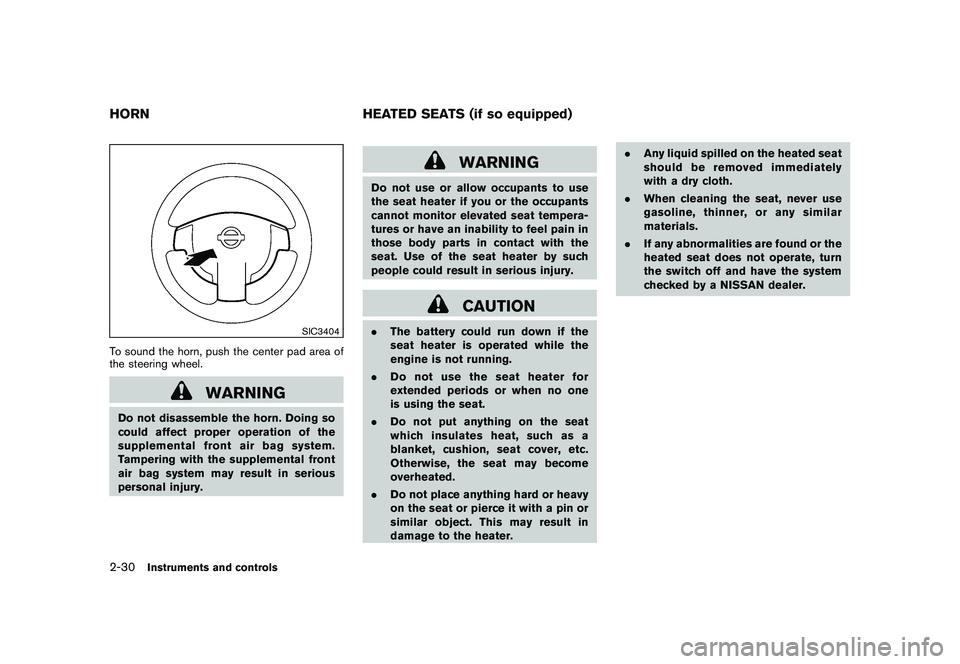
To sound the horn, push the center pad area of
the steering wheel.
WARNING
Do not disassemble the horn. Doing so
could affect proper operation of the
supplemental front air bag system.
Tampering with the supplemental front
air bag system may result in serious
personal injury.
WARNING
Do not use or allow occupants to use
the seat heater if you or the occupants
cannot monitor elevated seat tempera-
tures or have an inability to feel pain in
those body parts in contact with the
seat. Use of the seat heater by such
people could result in serious injury.
CAUTION
.The battery could run down if the
seat heater is operated while the
engine is not running.
. Do not use the seat heater for
extended periods or when no one
is using the seat.
. Do not put anything on the seat
which insulates heat, such as a
blanket, cushion, seat cover, etc.
Otherwise, the seat may become
overheated.
. Do not place anything hard or heavy
on the seat or pierce it with a pin or
similar object. This may result in
damage to the heater. .
Any liquid spilled on the heated seat
should be removed immediately
with a dry cloth.
. When cleaning the seat, never use
gasoline, thinner, or any similar
materials.
. If any abnormalities are found or the
heated seat does not operate, turn
the switch off and have the system
checked by a NISSAN dealer.
HORN HEATED SEATS (if so equipped)2-30
Instruments and controls
Page 103 of 328
Black plate (99,1)
Model "S35-D" EDITED: 2009/ 9/ 4
SIC3355
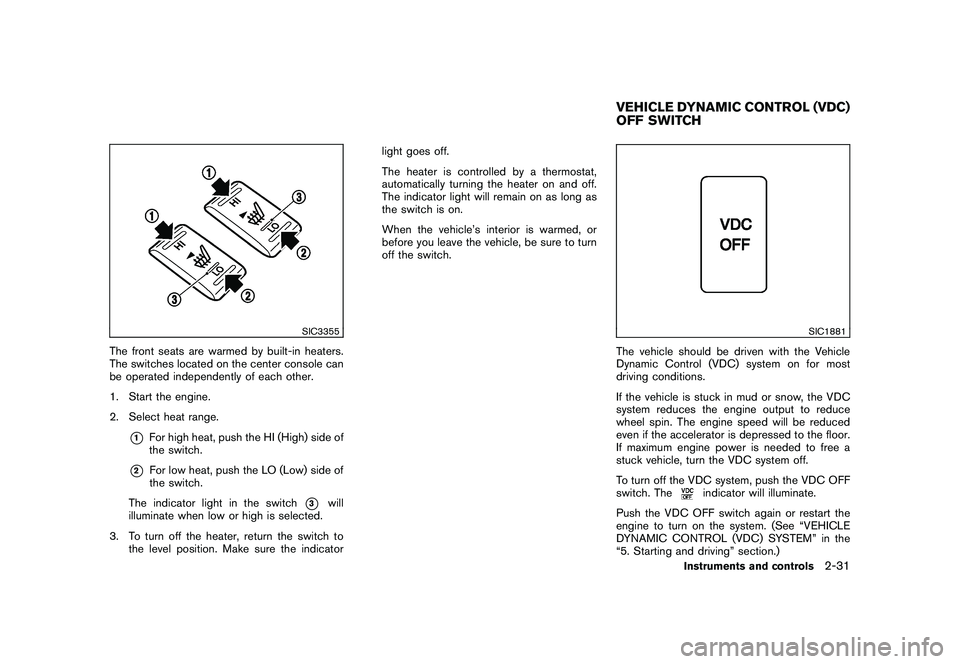
The front seats are warmed by built-in heaters.
The switches located on the center console can
be operated independently of each other.
1. Start the engine.
2. Select heat range.
*1
For high heat, push the HI (High) side of
the switch.
*2
For low heat, push the LO (Low) side of
the switch.
The indicator light in the switch
*3
will
illuminate when low or high is selected.
3. To turn off the heater, return the switch to the level position. Make sure the indicator light goes off.
The heater is controlled by a thermostat,
automatically turning the heater on and off.
The indicator light will remain on as long as
the switch is on.
When the vehicle’s interior is warmed, or
before you leave the vehicle, be sure to turn
off the switch.
SIC1881
The vehicle should be driven with the Vehicle
Dynamic Control (VDC) system on for most
driving conditions.
If the vehicle is stuck in mud or snow, the VDC
system reduces the engine output to reduce
wheel spin. The engine speed will be reduced
even if the accelerator is depressed to the floor.
If maximum engine power is needed to free a
stuck vehicle, turn the VDC system off.
To turn off the VDC system, push the VDC OFF
switch. The
indicator will illuminate.
Push the VDC OFF switch again or restart the
engine to turn on the system. (See “VEHICLE
DYNAMIC CONTROL (VDC) SYSTEM” in the
“5. Starting and driving” section.)
VEHICLE DYNAMIC CONTROL (VDC)
OFF SWITCH
Instruments and controls
2-31
Page 197 of 328
Black plate (197,1)
Model "S35-D" EDITED: 2009/ 9/ 4
pressure sensors, and the TPMS will
not function properly.
Some devices and transmitters may temporarily
interfere with the operation of the TPMS and
cause the low tire pressure warning light to
illuminate. Some examples are:
. Facilities or electric devices using similar
radio frequencies are near the vehicle.
. If a transmitter set to similar frequencies is
being used in or near the vehicle.
. If a computer (or similar equipment) or a DC/
AC converter is being used in or near the
vehicle.
FCC Notice:
Changes or modifications not expressly
approved by the party responsible for
compliance could void the user’s authority
to operate the equipment.
This device complies with Part 15 of the
FCC Rules and RSS-210 of Industry Cana-
da.
Operation is subject to the following two
conditions: (1) This device may not cause
harmful interference, and (2) this device
must accept any interference received,
including interference that may cause un-
desired operation of the device.
AVOIDING COLLISION AND ROLL-
OVER
WARNING
Failure to operate this vehicle in a safe
and prudent manner may result in loss
of control or an accident.
Be alert and drive defensively at all times. Obey
all traffic regulations. Avoid excessive speed,
high speed cornering, or sudden steering
maneuvers, because these driving practices
could cause you to lose control of your vehicle.
As with any vehicle, a loss of control could
result in a collision with other vehicles or
objects, or cause the vehicle to rollover,
particularly if the loss of control causes the
vehicle to slide sideways. Be attentive at all
times, and avoid driving when tired. Never drive
when under the influence of alcohol or drugs
(including prescription or over-the-counter
drugs which may cause drowsiness) . Always
wear your seat belt as outlined in the “SEAT
BELTS” in the “1. Safety — Seats, seat belts and
supplemental restraint system” section of this
manual, and also instruct your passengers to do
so.
Seat belts help reduce the risk of injury in
collisions and rollovers. In a rollover crash, an
unbelted or improperly belted person is significantly more likely to be injured or
killed than a person properly wearing a
seat belt.
ON-PAVEMENT AND OFF-ROAD
DRIVING PRECAUTIONSUtility vehicles have a significantly higher
rollover rate than other types of vehicles.
They have higher ground clearance than pas-
senger cars to make them capable of performing
in a variety of on-pavement and off-road
applications. This gives them a higher center of
gravity than ordinary cars. An advantage of
higher ground clearance is a better view of the
road, allowing you to anticipate problems.
However, they are not designed for cornering
at the same speeds as conventional passenger
cars any more than low-slung sports cars are
designed to perform satisfactorily under off-road
conditions. If at all possible, avoid sharp turns or
abrupt maneuvers, particularly at high speeds.
As with other vehicles of this type, failure to
operate this vehicle correctly may result in loss
of control or vehicle rollover. Seat belts help
reduce the risk of injury in collisions and
rollovers. In a rollover crash, an unbelted or
improperly belted person is significantly more
likely to be injured or killed than a person
properly wearing a seat belt.
Be sure to read “DRIVING SAFETY PRECAU-
TIONS” later in this section.
Starting and driving
5-5
Page 247 of 328
Black plate (247,1)
Model "S35-D" EDITED: 2009/ 9/ 4
Occasionally remove loose dust from the interior
trim, plastic parts and seats using a vacuum
cleaner or soft bristled brush. Wipe the vinyl and
leather surfaces with a clean, soft cloth dam-
pened in mild soap solution, then wipe clean
with a dry soft cloth.
Regular care and cleaning is required in order to
maintain the appearance of the leather.
Before using any fabric protector, read the
manufacturer’s recommendations. Some fabric
protectors contain chemicals that may stain or
bleach the seat material.
Use a cloth dampened only with water, to clean
the meter and gauge lens.
WARNING
Do not use water or acidic cleaners (hot
steam cleaners) on the seat. This can
damage the seat or occupant classifica-
tion sensor. This can also affect the
operation of the air bag system and
result in serious personal injury.
CAUTION
.Never use benzine, thinner, or any
similar material.
. Small dirt particles can be abrasive and damaging to the leather sur-
faces and should be removed
promptly. Do not use saddle soap,
car waxes, polishes, oils, cleaning
fluids, solvents, detergents or am-
monia-based cleaners as they may
damage the leather’s natural finish.
. Never use fabric protectors unless
recommended by the manufacturer.
. Do not use glass or plastic cleaner
on meter or gauge lens covers. It
may damage the lens cover.
AIR FRESHENERSMost air fresheners use a solvent that could
affect the vehicle interior. If you use an air
freshener, take the following precautions:
.Hanging-type air fresheners can cause
permanent discoloration when they contact
vehicle interior surfaces. Place the air
freshener in a location that allows it to hang
free and not contact an interior surface.
. Liquid-type air fresheners typically clip on
the vents. These products can cause
immediate damage and discoloration when
spilled on interior surfaces.
Carefully read and follow the manufacturer’s
instructions before using air fresheners.
FLOOR MATSThe use of genuine NISSAN floor mats can
extend the life of your vehicle carpet and make it
easier to clean the interior. No matter what
mats are used, be sure they are fitted for
your vehicle and are properly positioned in
the footwell to prevent interference with
pedal operation. Mats should be maintained
with regular cleaning and replaced if they
become excessively worn.
CLEANING INTERIOR
Appearance and care
7-5
Page 248 of 328
Black plate (248,1)
Model "S35-D" EDITED: 2009/ 9/ 4
SAI0038
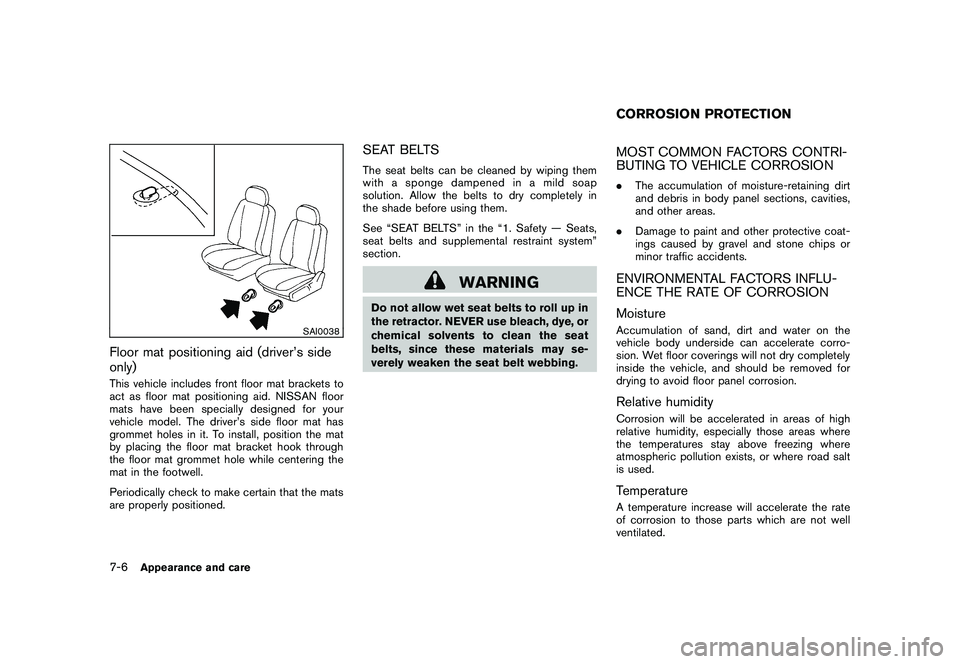
Floor mat positioning aid (driver’s side
only)This vehicle includes front floor mat brackets to
act as floor mat positioning aid. NISSAN floor
mats have been specially designed for your
vehicle model. The driver’s side floor mat has
grommet holes in it. To install, position the mat
by placing the floor mat bracket hook through
the floor mat grommet hole while centering the
mat in the footwell.
Periodically check to make certain that the mats
are properly positioned.
SEAT BELTSThe seat belts can be cleaned by wiping them
with a sponge dampened in a mild soap
solution. Allow the belts to dry completely in
the shade before using them.
See “SEAT BELTS” in the “1. Safety — Seats,
seat belts and supplemental restraint system”
section.
WARNING
Do not allow wet seat belts to roll up in
the retractor. NEVER use bleach, dye, or
chemical solvents to clean the seat
belts, since these materials may se-
verely weaken the seat belt webbing.
MOST COMMON FACTORS CONTRI-
BUTING TO VEHICLE CORROSION.The accumulation of moisture-retaining dirt
and debris in body panel sections, cavities,
and other areas.
. Damage to paint and other protective coat-
ings caused by gravel and stone chips or
minor traffic accidents.ENVIRONMENTAL FACTORS INFLU-
ENCE THE RATE OF CORROSION
MoistureAccumulation of sand, dirt and water on the
vehicle body underside can accelerate corro-
sion. Wet floor coverings will not dry completely
inside the vehicle, and should be removed for
drying to avoid floor panel corrosion.Relative humidityCorrosion will be accelerated in areas of high
relative humidity, especially those areas where
the temperatures stay above freezing where
atmospheric pollution exists, or where road salt
is used.TemperatureA temperature increase will accelerate the rate
of corrosion to those parts which are not well
ventilated.CORROSION PROTECTION
7-6
Appearance and care
Page 253 of 328
Black plate (253,1)
Model "S35-D" EDITED: 2009/ 9/ 4
Lights*:Clean the headlights on a regular basis.
Make sure that the headlights, stop lights, tail
lights, turn signal lights, and other lights are all
operating properly and installed securely. Also
check headlight aim.
Road wheel nuts (lug nuts)*: When checking
the tires, make sure no wheel nuts are missing,
and check for any loose wheel nuts. Tighten if
necessary.
Tire rotation*: Tires should be rotated every
7,500 miles (12,000 km).
Tires*: Check the pressure with a gauge often
and always prior to long distance trips. If
necessary, adjust the pressure in all tires,
including the spare, to the pressure specified.
Check carefully for damage, cuts or excessive
wear.
Tire Pressure Monitoring System (TPMS)
transmitter components: Replace the TPMS
transmitter grommet seal, valve core and cap
when the tires are replaced due to wear or age.
Wheel alignment and balance: If the vehicle
should pull to either side while driving on a
straight and level road, or if you detect uneven or
abnormal tire wear, there may be a need for
wheel alignment.
If the steering wheel or seat vibrates at normal
highway speeds, wheel balancing may be
needed. For additional information regarding tires, refer
to “Important Tire Safety Information” (US) or
“Tire Safety Information” (Canada) in the War-
ranty Information Booklet.
Windshield:
Clean the windshield on a regular
basis. Check the windshield at least every six
months for cracks or other damage. Have a
damaged windshield repaired by a qualified
repair facility.
Windshield wiper blades*: Check for cracks
or wear if they do not wipe properly.
Inside the vehicleThe maintenance items listed here should be
checked on a regular basis, such as when
performing scheduled maintenance, cleaning
the vehicle, etc.
Accelerator pedal: Check the pedal for
smooth operation and make sure the pedal
does not catch or require uneven effort. Keep
the floor mat away from the pedal.
Brake pedal: Check the pedal for smooth
operation. If the brake pedal suddenly goes
down further than normal, the pedal feels
spongy or the vehicle seems to take longer to
stop, see a NISSAN dealer immediately. Keep
the floor mat away from the pedal.
Brakes: Check that the brakes do not pull the
vehicle to one side when applied. Continuously Variable Transmission (CVT)
P (Park) position mechanism:
On a fairly
steep hill, check that the vehicle is held securely
with the selector lever in the P (Park) position
without applying any brakes.
Parking brake: Check the parking brake
operation regularly. The vehicle should be
securely held on a fairly steep hill with only the
parking brake applied. If the parking brake needs
adjusted, see a NISSAN dealer.
Seat belts: Check that all parts of the seat belt
system (for example, buckles, anchors, adjusters
and retractors) operate properly and smoothly,
and are installed securely. Check the belt
webbing for cuts, fraying, wear or damage.
Seats: Check seat position controls such as
seat adjusters, seatback recliner, etc. to ensure
they operate smoothly and that all latches lock
securely in every position. Check that the head
restraints move up and down smoothly and that
the locks (if so equipped) hold securely in all
latched positions.
Steering wheel: Check for changes in the
steering conditions, such as excessive free play,
hard steering or strange noises.
Warning lights and chimes: Make sure that
all warning lights and chimes are operating
properly.
Maintenance and do-it-yourself
8-3
Page 303 of 328
Black plate (305,1)
Model "S35-D" EDITED: 2009/ 9/ 4
FOR Kro¯
m MODELSUse the following steps to mount the license
plate:
Before mounting the license plate, confirm that
the following parts are enclosed in the vinyl bag.
. License plate bracket
. J-nut 62
. Screw 62
. Screw grommet 62
1. Park the vehicle on flat, level ground.
2. Temporarily place the license plate bracket while aligning points
*A
of the front bumper
fascia with holes
*B
in the license plate
bracket.
3. Confirm that points
*A
and
*B
are aligned.
4. Remove the license plate bracket.
5. Carefully drill two shallow pilot holes
*A
using a 0.39 in (10 mm) drill bit at the
marked locations. (Be sure that the drill
only goes through the fascia, or da-
mage to the nut may occur.)
6. Insert grommets into the hole on the fascia.
7. Insert a flat-blade screwdriver into the grommet hole to add a 90 8turn onto the
part
*C. 8. Insert a J-nut into the license plate bracket
before placing the license plate bracket on
the fascia.
9. Install the license plate bracket with the screws.
10. Install the license plate with bolts that are not longer than 0.55 in (14 mm) .
WARNING
.
It is extremely dangerous to ride
in a cargo area inside the vehi-
cle. In a collision, people riding
in these areas are more likely to
be seriously injured or killed.
.
Do not allow people to ride in
any area of your vehicle that is
not equipped with seats and
seat belts.
.
Be sure everyone in your vehicle
is in a seat and using a seat belt
properly.
TERMSIt is important to familiarize yourself with the
following terms before loading your vehicle:.
Curb Weight (actual weight of your
vehicle) - vehicle weight including:
standard and optional equipment,
fluids, emergency tools, and spare tire
assembly. This weight does notin-
clude passengers and cargo.
.
GVW (Gross Vehicle Weight) - curb
weight plus the combined weight of
passengers and cargo.
VEHICLE LOADING INFORMATIONTechnical and consumer information
9-13
Page 321 of 328
Black plate (1,1)
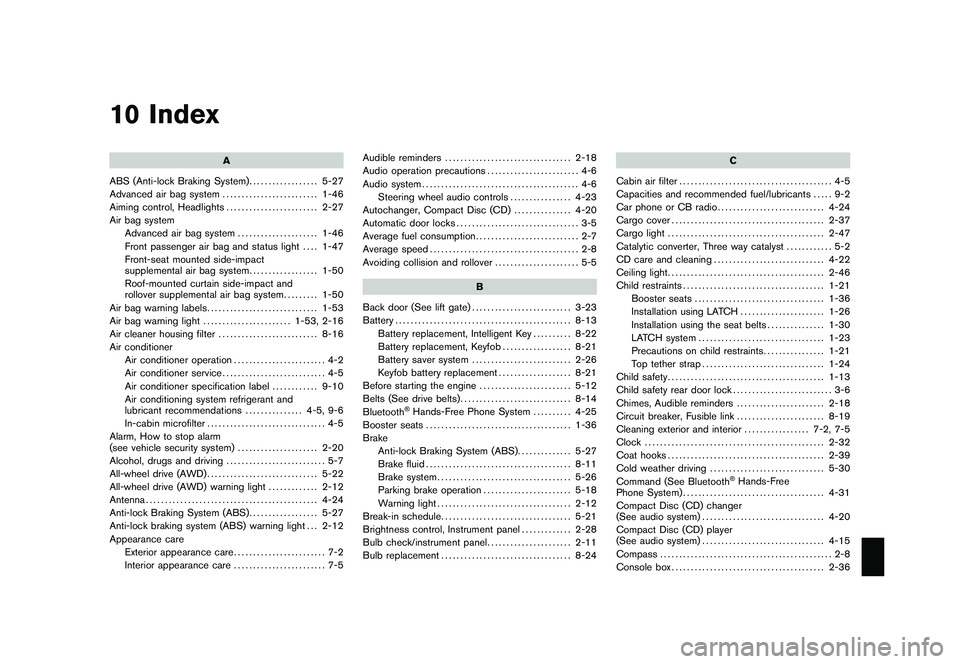
10 Index
A
ABS (Anti-lock Braking System) .................. 5-27
Advanced air bag system ......................... 1-46
Aiming control, Headlights ........................ 2-27
Air bag system Advanced air bag system ..................... 1-46
Front passenger air bag and status light .... 1-47
Front-seat mounted side-impact
supplemental air bag system .................. 1-50
Roof-mounted curtain side-impact and
rollover supplemental air bag system ......... 1-50
Air bag warning labels ............................. 1-53
Air bag warning light ....................... 1-53, 2-16
Air cleaner housing filter .......................... 8-16
Air conditioner Air conditioner operation ........................ 4-2
Air conditioner service ........................... 4-5
Air conditioner specification label ............ 9-10
Air conditioning system refrigerant and
lubricant recommendations ............... 4-5, 9-6
In-cabin microfilter ............................... 4-5
Alarm, How to stop alarm
(see vehicle security system) ..................... 2-20
Alcohol, drugs and driving .......................... 5-7
All-wheel drive (AWD) ............................. 5-22
All-wheel drive (AWD) warning light ............. 2-12
Antenna ............................................. 4-24
Anti-lock Braking System (ABS) .................. 5-27
Anti-lock braking system (ABS) warning light . . . 2-12
Appearance care Exterior appearance care ........................ 7-2
Interior appearance care ........................ 7-5 Audible reminders
................................. 2-18
Audio operation precautions ........................ 4-6
Audio system ......................................... 4-6
Steering wheel audio controls ................ 4-23
Autochanger, Compact Disc (CD) ............... 4-20
Automatic door locks ................................ 3-5
Average fuel consumption ........................... 2-7
Average speed ....................................... 2-8
Avoiding collision and rollover ...................... 5-5
B
Back door (See lift gate) .......................... 3-23
Battery .............................................. 8-13
Battery replacement, Intelligent Key .......... 8-22
Battery replacement, Keyfob .................. 8-21
Battery saver system .......................... 2-26
Keyfob battery replacement ................... 8-21
Before starting the engine ........................ 5-12
Belts (See drive belts) ............................. 8-14
Bluetooth
®Hands-Free Phone System .......... 4-25
Booster seats ...................................... 1-36
Brake Anti-lock Braking System (ABS) .............. 5-27
Brake fluid ...................................... 8-11
Brake system ................................... 5-26
Parking brake operation ....................... 5-18
Warning light ................................... 2-12
Break-in schedule .................................. 5-21
Brightness control, Instrument panel ............. 2-28
Bulb check/instrument panel ...................... 2-11
Bulb replacement .................................. 8-24 C
Cabin air filter ........................................ 4-5
Capacities and recommended fuel/lubricants ..... 9-2
Car phone or CB radio ............................ 4-24
Cargo cover ........................................ 2-37
Cargo light ......................................... 2-47
Catalytic converter, Three way catalyst ............ 5-2
CD care and cleaning ............................. 4-22
Ceiling light ......................................... 2-46
Child restraints ..................................... 1-21
Booster seats .................................. 1-36
Installation using LATCH ...................... 1-26
Installation using the seat belts ............... 1-30
LATCH system ................................. 1-23
Precautions on child restraints ................ 1-21
Top tether strap ................................ 1-24
Child safety ......................................... 1-13
Child safety rear door lock .......................... 3-6
Chimes, Audible reminders ....................... 2-18
Circuit breaker, Fusible link ....................... 8-19
Cleaning exterior and interior ................. 7-2, 7-5
Clock ............................................... 2-32
Coat hooks ......................................... 2-39
Cold weather driving .............................. 5-30
Command (See Bluetooth
®Hands-Free
Phone System) ..................................... 4-31
Compact Disc (CD) changer
(See audio system) ................................ 4-20
Compact Disc (CD) player
(See audio system) ................................ 4-15
Compass ............................................. 2-8
Console box ........................................ 2-36
Model "S35-D" EDITED: 2009/ 9/ 4
Page 323 of 328
Black plate (3,1)
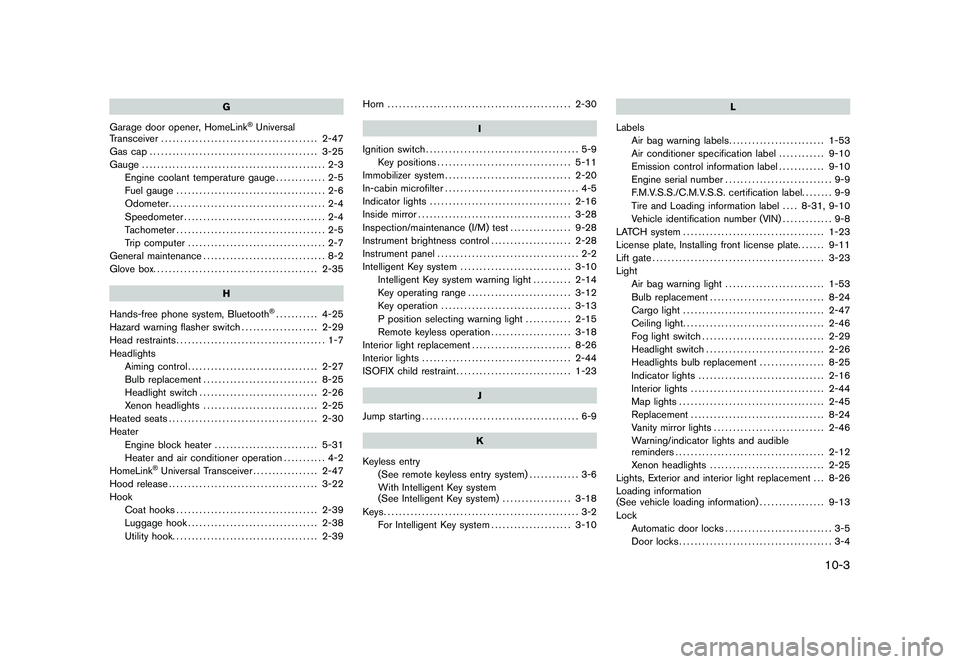
G
Garage door opener, HomeLink
®Universal
Transceiver ......................................... 2-47
Gas cap ............................................ 3-25
Gauge ................................................ 2-3
Engine coolant temperature gauge ............. 2-5
Fuel gauge ....................................... 2-6
Odometer ......................................... 2-4
Speedometer ..................................... 2-4
Tachometer ....................................... 2-5
Trip computer .................................... 2-7
General maintenance ................................ 8-2
Glove box. .......................................... 2-35
H
Hands-free phone system, Bluetooth®........... 4-25
Hazard warning flasher switch .................... 2-29
Head restraints ....................................... 1-7
Headlights Aiming control .................................. 2-27
Bulb replacement .............................. 8-25
Headlight switch ............................... 2-26
Xenon headlights .............................. 2-25
Heated seats ....................................... 2-30
Heater
Engine block heater ........................... 5-31
Heater and air conditioner operation ........... 4-2
HomeLink
®Universal Transceiver ................. 2-47
Hood release ....................................... 3-22
Hook Coat hooks ..................................... 2-39
Luggage hook .................................. 2-38
Utility hook ...................................... 2-39 Horn
................................................ 2-30
I
Ignition switch ........................................ 5-9
Key positions ................................... 5-11
Immobilizer system ................................. 2-20
In-cabin microfilter ................................... 4-5
Indicator lights ..................................... 2-16
Inside mirror ........................................ 3-28
Inspection/maintenance (I/M) test ................ 9-28
Instrument brightness control ..................... 2-28
Instrument panel ..................................... 2-2
Intelligent Key system ............................. 3-10
Intelligent Key system warning light .......... 2-14
Key operating range ........................... 3-12
Key operation .................................. 3-13
P position selecting warning light ............ 2-15
Remote keyless operation ..................... 3-18
Interior light replacement .......................... 8-26
Interior lights ....................................... 2-44
ISOFIX child restraint .............................. 1-23
J
Jump starting ......................................... 6-9
K
Keyless entry (See remote keyless entry system) ............. 3-6
With Intelligent Key system
(See Intelligent Key system) .................. 3-18
Keys................................................... 3-2 For Intelligent Key system ..................... 3-10 L
Labels Air bag warning labels ......................... 1-53
Air conditioner specification label ............ 9-10
Emission control information label ............ 9-10
Engine serial number ............................ 9-9
F.M.V.S.S./C.M.V.S.S. certification label. ....... 9-9
Tire and Loading information label .... 8-31, 9-10
Vehicle identification number (VIN) ............. 9-8
LATCH system ..................................... 1-23
License plate, Installing front license plate. ...... 9-11
Lift gate ............................................. 3-23
Light Air bag warning light .......................... 1-53
Bulb replacement .............................. 8-24
Cargo light ..................................... 2-47
Ceiling light ..................................... 2-46
Fog light switch ................................ 2-29
Headlight switch ............................... 2-26
Headlights bulb replacement ................. 8-25
Indicator lights ................................. 2-16
Interior lights ................................... 2-44
Map lights ...................................... 2-45
Replacement ................................... 8-24
Vanity mirror lights ............................. 2-46
Warning/indicator lights and audible
reminders ....................................... 2-12
Xenon headlights .............................. 2-25
Lights, Exterior and interior light replacement . . . 8-26
Loading information
(See vehicle loading information) ................. 9-13
Lock Automatic door locks ............................ 3-5
Door locks ........................................ 3-4
10-3
Model "S35-D" EDITED: 2009/ 9/ 4