belt NISSAN ROGUE 2010 Owner´s Manual
[x] Cancel search | Manufacturer: NISSAN, Model Year: 2010, Model line: ROGUE, Model: NISSAN ROGUE 2010Pages: 328, PDF Size: 2.84 MB
Page 264 of 328
Black plate (264,1)
Model "S35-D" EDITED: 2009/ 9/ 4
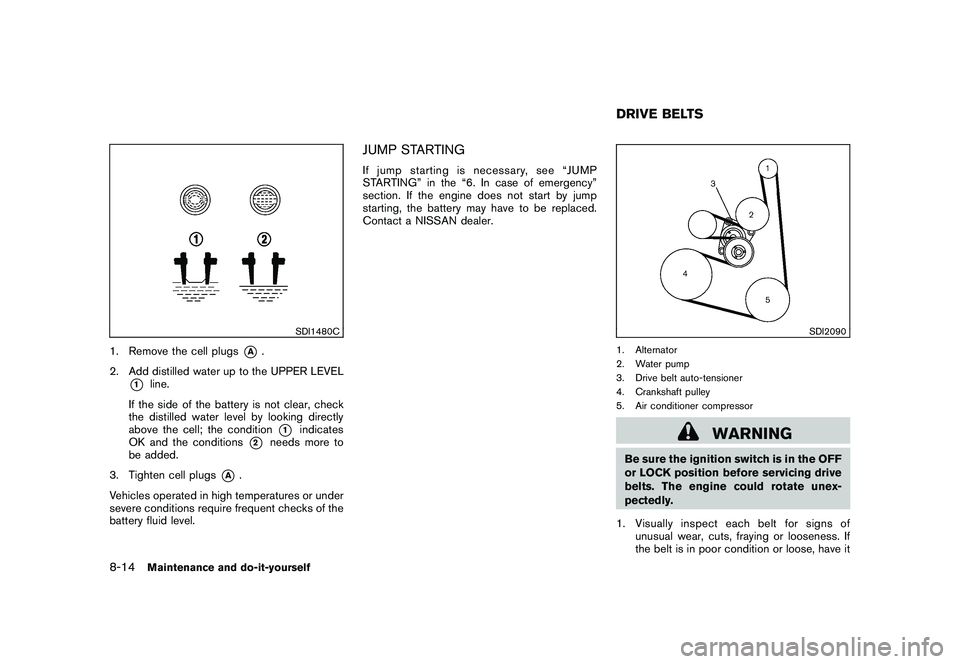
SDI1480C
1. Remove the cell plugs
*A
.
2. Add distilled water up to the UPPER LEVEL
*1
line.
If the side of the battery is not clear, check
the distilled water level by looking directly
above the cell; the condition
*1
indicates
OK and the conditions
*2
needs more to
be added.
3. Tighten cell plugs
*A
.
Vehicles operated in high temperatures or under
severe conditions require frequent checks of the
battery fluid level.
JUMP STARTINGIf jump starting is necessary, see “JUMP
STARTING” in the “6. In case of emergency”
section. If the engine does not start by jump
starting, the battery may have to be replaced.
Contact a NISSAN dealer.
SDI2090
1. Alternator
2. Water pump
3. Drive belt auto-tensioner
4. Crankshaft pulley
5. Air conditioner compressor
WARNING
Be sure the ignition switch is in the OFF
or LOCK position before servicing drive
belts. The engine could rotate unex-
pectedly.
1. Visually inspect each belt for signs of unusual wear, cuts, fraying or looseness. If
the belt is in poor condition or loose, have itDRIVE BELTS
8-14
Maintenance and do-it-yourself
Page 265 of 328
Black plate (265,1)
Model "S35-D" EDITED: 2009/ 9/ 4
replaced or adjusted by a NISSAN dealer.
2. Have the belts checked regularly for condi- tion.
WARNING
Be sure the engine and ignition switch
are off and that the parking brake is
engaged securely.
CAUTION
Be sure to use the correct socket to
remove the spark plugs. An incorrect
socket can damage the spark plugs.
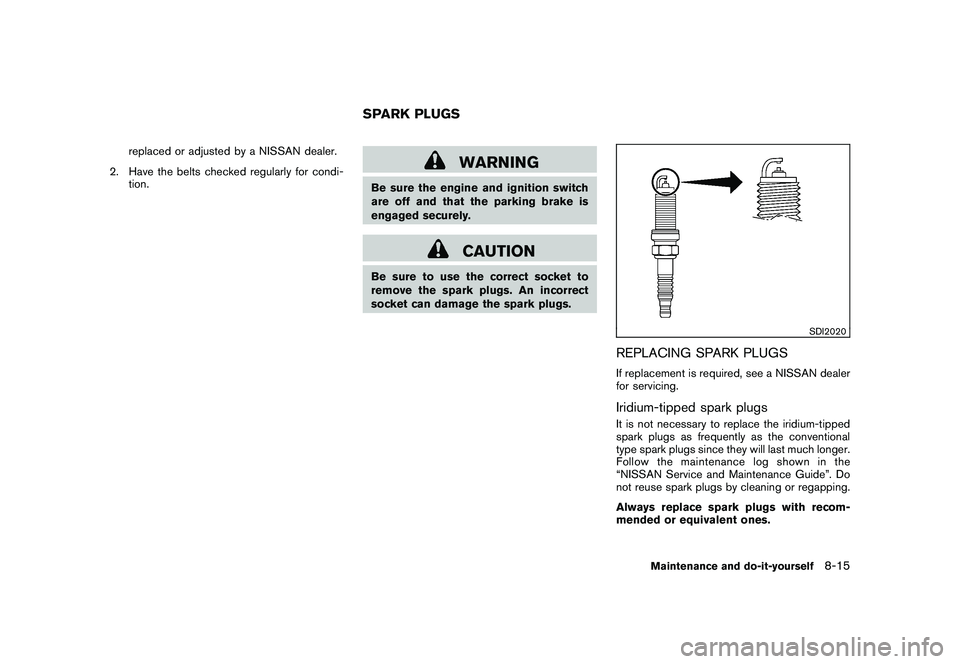
SDI2020
REPLACING SPARK PLUGSIf replacement is required, see a NISSAN dealer
for servicing.Iridium-tipped spark plugsIt is not necessary to replace the iridium-tipped
spark plugs as frequently as the conventional
type spark plugs since they will last much longer.
Follow the maintenance log shown in the
“NISSAN Service and Maintenance Guide”. Do
not reuse spark plugs by cleaning or regapping.
Always replace spark plugs with recom-
mended or equivalent ones.
SPARK PLUGS
Maintenance and do-it-yourself
8-15
Page 285 of 328
Black plate (285,1)
Model "S35-D" EDITED: 2009/ 9/ 4
TYPES OF TIRES
WARNING
.When changing or replacing tires,
be sure all four tires are of the same
type (Example: Summer, All Season
or Snow) and construction. A
NISSAN dealer may be able to help
you with information about tire type,
size, speed rating and availability.
. Replacement tires may have a lower
speed rating than the factory
equipped tires, and may not match
the potential maximum vehicle
speed. Never exceed the maximum
speed rating of the tire.
. Replacing tires with those not ori-
ginally specified by NISSAN could
affect the proper operation of the
TPMS.
. For additional information regard-
ing tires, refer to “Important Tire
Safety Information” (US) or “Tire
Safety Information” (Canada) in the
Warranty Information Booklet.
All season tiresNISSAN specifies all season tires on some
models to provide good performance all year,
including snowy and icy road conditions. All
Season tires are identified by ALL SEASON
and/or M&S (Mud and Snow) on the tire
sidewall. Snow tires have better snow traction
than All Season tires and may be more appro-
priate in some areas.Summer tiresNISSAN specifies summer tires on some
models to provide superior performance on dry
roads. Summer tire performance is substantially
reduced in snow and ice. Summer tires do not
have the tire traction rating M&S on the tire
sidewall.
If you plan to operate your vehicle in snowy or
icy conditions, NISSAN recommends the use of
SNOW tires or ALL SEASON tires on all four
wheels.Snow tiresIf snow tires are needed, it is necessary to select
tires equivalent in size and load rating to the
original equipment tires. If you do not, it can
adversely affect the safety and handling of your
vehicle.
Generally, snow tires will have lower speed
ratings than factory equipped tires and may not
match the potential maximum vehicle speed. Never exceed the maximum speed rating of the
tire.
If you install snow tires, they must be the same
size, brand, construction and tread pattern on all
four wheels.
For additional traction on icy roads, studded
tires may be used. However, some U.S. states
and Canadian provinces prohibit their use.
Check local, state and provincial laws before
installing studded tires. Skid and traction cap-
abilities of studded snow tires, on wet or dry
surfaces, may be poorer than that of non-
studded snow tires.
All-Wheel Drive (AWD) models
CAUTION
.
Always use tires of the same type,
size, brand, construction (bias, bias-
belted or radial) , and tread pattern
on all four wheels. Failure to do so
may result in a circumference differ-
ence between tires on the front and
rear axles which will cause exces-
sive tire wear and may damage the
transmission, transfer case and dif-
ferential gears.
Maintenance and do-it-yourself
8-35
Page 288 of 328
Black plate (288,1)
Model "S35-D" EDITED: 2009/ 9/ 4
wear indicators are visible, the
tire(s) should be replaced.
.
Tires degrade with age and use.
Have tires, including the spare,
over 6 years old checked by a
qualified technician, because
some tire damage may not be
obvious. Replace the tires as
necessary to prevent tire failure
and possible personal injury.
.
Improper service of the spare
tire may result in serious perso-
nal injury. If it is necessary to
repair the spare tire, contact a
NISSAN dealer.
.
For additional information re-
garding tires, refer to “Important
Tire Safety Information” (US) or
“Tire Safety Information” (Cana-
da) in the Warranty Information
Booklet.
Replacing wheels and tiresWhen replacing a tire, use the same size, tread
design, speed rating and load carrying capacity
as originally equipped. (See “SPECIFICA-
TIONS” in the “9. Technical and consumer
information” section for recommended types
and sizes of tires and wheels.)
WARNING
.The use of tires other than those
recommended or the mixed use of
tires of different brands, construc-
tion (bias, bias-belted or radial) , or
tread patterns can adversely affect
the ride, braking, handling, ground
clearance, body-to-tire clearance,
tire chain clearance, speedometer
calibration, headlight aim and bum-
per height. Some of these effects
may lead to accidents and could
result in serious personal injury.
. If the wheels are changed for any
reason, always replace with wheels
which have the same off-set dimen-
sion. Wheels of a different off-set
could cause premature tire wear,
degrade vehicle handling character-
istics and/or interference with the
brake discs/drums. Such interfer-
ence can lead to decreased braking
efficiency and/or early brake pad/
shoe wear. See “WHEELS AND
TIRES” in the “9. Technical and
consumer information” section of
this manual for wheel off-set dimen-
sions. .
When a spare tire is mounted or a
wheel is replaced, the TPMS will not
function and the low tire pressure
warning light will flash for approxi-
mately 1 minute. The light will
remain on after 1 minute. Contact
your NISSAN dealer as soon as
possible for tire replacement and/
or system resetting.
. Replacing tires with those not ori-
ginally specified by NISSAN could
affect the proper operation of the
TPMS.
. Do not install a damaged or de-
formed wheel or tire even if it has
been repaired. Such wheels or tires
could have structural damage and
could fail without warning.
. The use of retread tire is not re-
commended.
. For additional information regard-
ing tires, refer to “Important Tire
Safety Information” (US) or “Tire
Safety Information” (Canada) in the
Warranty Information Booklet.
8-38
Maintenance and do-it-yourself
Page 289 of 328
Black plate (289,1)
Model "S35-D" EDITED: 2009/ 9/ 4
CAUTION
Always use tires of the same type, size,
brand, construction (bias, bias-belted
or radial) , and tread pattern on all four
wheels. Failure to do so may result in a
circumference difference between tires
on the front and rear axles which will
cause excessive tire wear and may
damage the transmission, transfer case
and differential gears (AWD models) .Wheel balanceUnbalanced wheels may affect vehicle handling
and tire life. Even with regular use, wheels can
get out of balance. Therefore, they should be
balanced as required.
Wheel balance service should be per-
formed with the wheels off the vehicle.
Spin balancing the wheels on the vehicle
could lead to mechanical damage.
For additional information regarding tires, refer
to “Important Tire Safety Information” (US) or
“Tire Safety Information” (Canada) in the War-
ranty Information Booklet.Care of wheelsSee “CLEANING EXTERIOR” in the “7. Ap-
pearance and care” section for details aboutcare of the wheels.
Spare tireWhen a spare tire is mounted (TEMPORARY
USE ONLY or conventional) , the TPMS will not
function.
Observe the following precautions if the TEM-
PORARY USE ONLY spare tire must be used,
otherwise your vehicle could be damaged or
involved in an accident.
WARNING
.
The TEMPORARY USE ONLY spare
tire should be used for emergency
use. It should be replaced with the
standard tire at the first opportunity
to avoid possible tire or differential
damage.
. Drive carefully while the TEMPOR-
ARY USE ONLY spare tire is in-
stalled. Avoid sharp turns and
abrupt braking while driving.
. Periodically check spare tire infla-
tion pressure. Always keep the
pressure of the TEMPORARY USE
ONLY spare tire at 60 psi (420 kPa,
4.2 bar) . Always keep the pressure
of the full size spare tire (if so equipped) at the recommended
pressure for standard tires, as in-
dicated on the Tire and Loading
Information label.
. With the TEMPORARY USE ONLY
spare tire installed do not drive your
vehicle at speeds faster than 50
MPH (80 km/h) .
. When driving on roads covered with
snow or ice, the TEMPORARY USE
ONLY spare tire should be used on
the rear wheels and original tire
used on the front wheels (drive
wheels) . Use tire chains only on
the front (original) tires.
. Tire tread of the TEMPORARY USE
ONLY spare tire will wear at a faster
rate than the standard tire. Replace
the spare tire as soon as the tread
wear indicators appear.
. Do not use the spare tire on other
vehicles.
. Do not use more than one spare tire
at the same time.
. Do not tow a trailer while the
TEMPORARY USE ONLY spare tire
is installed.
Maintenance and do-it-yourself
8-39
Page 299 of 328
Black plate (301,1)
Model "S35-D" EDITED: 2009/ 9/ 4
STI0553
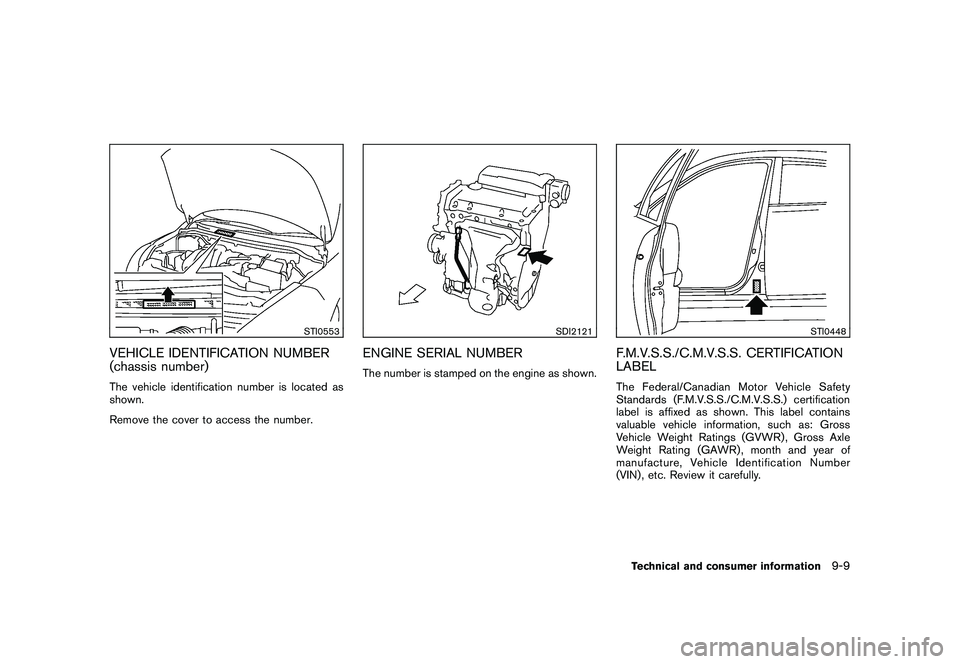
VEHICLE IDENTIFICATION NUMBER
(chassis number)The vehicle identification number is located as
shown.
Remove the cover to access the number.
SDI2121
ENGINE SERIAL NUMBERThe number is stamped on the engine as shown.
STI0448
F.M.V.S.S./C.M.V.S.S. CERTIFICATION
LABELThe Federal/Canadian Motor Vehicle Safety
Standards (F.M.V.S.S./C.M.V.S.S.) certification
label is affixed as shown. This label contains
valuable vehicle information, such as: Gross
Vehicle Weight Ratings (GVWR) , Gross Axle
Weight Rating (GAWR) , month and year of
manufacture, Vehicle Identification Number
(VIN) , etc. Review it carefully.
Technical and consumer information
9-9
Page 300 of 328
Black plate (302,1)
Model "S35-D" EDITED: 2009/ 9/ 4
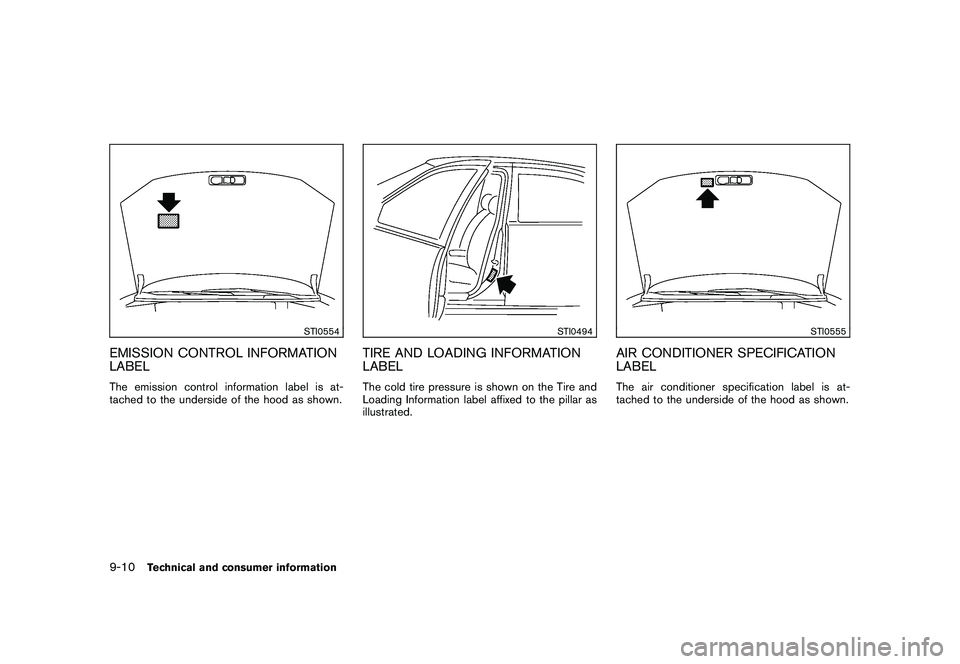
STI0554
EMISSION CONTROL INFORMATION
LABELThe emission control information label is at-
tached to the underside of the hood as shown.
STI0494
TIRE AND LOADING INFORMATION
LABELThe cold tire pressure is shown on the Tire and
Loading Information label affixed to the pillar as
illustrated.
STI0555
AIR CONDITIONER SPECIFICATION
LABELThe air conditioner specification label is at-
tached to the underside of the hood as shown.
9-10
Technical and consumer information
Page 303 of 328
Black plate (305,1)
Model "S35-D" EDITED: 2009/ 9/ 4
FOR Kro¯
m MODELSUse the following steps to mount the license
plate:
Before mounting the license plate, confirm that
the following parts are enclosed in the vinyl bag.
. License plate bracket
. J-nut 62
. Screw 62
. Screw grommet 62
1. Park the vehicle on flat, level ground.
2. Temporarily place the license plate bracket while aligning points
*A
of the front bumper
fascia with holes
*B
in the license plate
bracket.
3. Confirm that points
*A
and
*B
are aligned.
4. Remove the license plate bracket.
5. Carefully drill two shallow pilot holes
*A
using a 0.39 in (10 mm) drill bit at the
marked locations. (Be sure that the drill
only goes through the fascia, or da-
mage to the nut may occur.)
6. Insert grommets into the hole on the fascia.
7. Insert a flat-blade screwdriver into the grommet hole to add a 90 8turn onto the
part
*C. 8. Insert a J-nut into the license plate bracket
before placing the license plate bracket on
the fascia.
9. Install the license plate bracket with the screws.
10. Install the license plate with bolts that are not longer than 0.55 in (14 mm) .
WARNING
.
It is extremely dangerous to ride
in a cargo area inside the vehi-
cle. In a collision, people riding
in these areas are more likely to
be seriously injured or killed.
.
Do not allow people to ride in
any area of your vehicle that is
not equipped with seats and
seat belts.
.
Be sure everyone in your vehicle
is in a seat and using a seat belt
properly.
TERMSIt is important to familiarize yourself with the
following terms before loading your vehicle:.
Curb Weight (actual weight of your
vehicle) - vehicle weight including:
standard and optional equipment,
fluids, emergency tools, and spare tire
assembly. This weight does notin-
clude passengers and cargo.
.
GVW (Gross Vehicle Weight) - curb
weight plus the combined weight of
passengers and cargo.
VEHICLE LOADING INFORMATIONTechnical and consumer information
9-13
Page 319 of 328
Black plate (321,1)
Model "S35-D" EDITED: 2009/ 9/ 4
This vehicle is equipped with an Event Data
Recorder (EDR) . The main purpose of an EDR is
to record, in certain crash or near crash-like
situations, such as an air bag deployment or
hitting a road obstacle, data that will assist in
understanding how a vehicle’s systems per-
formed. The EDR is designed to record data
related to vehicle dynamics and safety systems
for a short period of time, typically 30 seconds
or less. The EDR in this vehicle is designed to
record such data as:
.How various systems in your vehicle were
operating;
. Whether or not the driver and passenger
safety belts were buckled/fastened;
. How far (if at all) the driver was depressing
the accelerator and/or brake pedal; and,
. How fast the vehicle was traveling.
. Sounds are not recorded.
These data can help provide a better under-
standing of the circumstances in which crashes
and injuries occur.
NOTE: EDR data are recorded by your vehicle
only if a nontrivial crash situation occurs; no data
are recorded by the EDR under normal driving
conditions and no personal data (e.g. name,
gender, age and crash location) are recorded.
However, other parties, such as law enforce- ment, could combine the EDR data with the type
of personally identifying data routinely acquired
during a crash investigation.
To read data recorded by an EDR, special
equipment is required and access to the vehicle
or the EDR is needed. In addition to the vehicle
manufacturer and NISSAN dealer, other parties,
such as law enforcement, that have the special
equipment, can read the information if they have
access to the vehicle or the EDR. EDR data will
only be accessed with the consent of the vehicle
owner or lessee or as otherwise required or
permitted by law.
Genuine NISSAN Service Manuals for this
model year and prior can be purchased. A
genuine NISSAN Service Manual is the best
source of service and repair information for your
vehicle. This manual is the same one used by the
factory trained technicians working at a NISSAN
dealer. Genuine NISSAN Owner’s Manuals can
also be purchased.
In the USA:
For current pricing and availability of genuine
NISSAN Service Manuals
contact:
1-800-450-9491
www.nissan-techinfo.com
For current pricing and availability of genuine
NISSAN Owner’s Manuals contact:
1-800-247-5321
In Canada:
To purchase a copy of a genuine NISSAN
Service Manual or Owner’s Manual for this
model year and prior please contact a NISSAN
dealer. For the phone number and location of a
NISSAN dealer in your area call the NISSAN
Information Center at 1-800-387-0122 and a
bilingual NISSAN representative will assist you.
IN THE EVENT OF A COLLISIONUnfortunately, accidents do occur. In this
unlikely event, there is some important informa-
EVENT DATA RECORDERS (EDR) OWNER’S MANUAL/SERVICE
MANUAL ORDER INFORMATION
Technical and consumer information
9-29
Page 321 of 328
Black plate (1,1)
10 Index
A
ABS (Anti-lock Braking System) .................. 5-27
Advanced air bag system ......................... 1-46
Aiming control, Headlights ........................ 2-27
Air bag system Advanced air bag system ..................... 1-46
Front passenger air bag and status light .... 1-47
Front-seat mounted side-impact
supplemental air bag system .................. 1-50
Roof-mounted curtain side-impact and
rollover supplemental air bag system ......... 1-50
Air bag warning labels ............................. 1-53
Air bag warning light ....................... 1-53, 2-16
Air cleaner housing filter .......................... 8-16
Air conditioner Air conditioner operation ........................ 4-2
Air conditioner service ........................... 4-5
Air conditioner specification label ............ 9-10
Air conditioning system refrigerant and
lubricant recommendations ............... 4-5, 9-6
In-cabin microfilter ............................... 4-5
Alarm, How to stop alarm
(see vehicle security system) ..................... 2-20
Alcohol, drugs and driving .......................... 5-7
All-wheel drive (AWD) ............................. 5-22
All-wheel drive (AWD) warning light ............. 2-12
Antenna ............................................. 4-24
Anti-lock Braking System (ABS) .................. 5-27
Anti-lock braking system (ABS) warning light . . . 2-12
Appearance care Exterior appearance care ........................ 7-2
Interior appearance care ........................ 7-5 Audible reminders
................................. 2-18
Audio operation precautions ........................ 4-6
Audio system ......................................... 4-6
Steering wheel audio controls ................ 4-23
Autochanger, Compact Disc (CD) ............... 4-20
Automatic door locks ................................ 3-5
Average fuel consumption ........................... 2-7
Average speed ....................................... 2-8
Avoiding collision and rollover ...................... 5-5
B
Back door (See lift gate) .......................... 3-23
Battery .............................................. 8-13
Battery replacement, Intelligent Key .......... 8-22
Battery replacement, Keyfob .................. 8-21
Battery saver system .......................... 2-26
Keyfob battery replacement ................... 8-21
Before starting the engine ........................ 5-12
Belts (See drive belts) ............................. 8-14
Bluetooth
®Hands-Free Phone System .......... 4-25
Booster seats ...................................... 1-36
Brake Anti-lock Braking System (ABS) .............. 5-27
Brake fluid ...................................... 8-11
Brake system ................................... 5-26
Parking brake operation ....................... 5-18
Warning light ................................... 2-12
Break-in schedule .................................. 5-21
Brightness control, Instrument panel ............. 2-28
Bulb check/instrument panel ...................... 2-11
Bulb replacement .................................. 8-24 C
Cabin air filter ........................................ 4-5
Capacities and recommended fuel/lubricants ..... 9-2
Car phone or CB radio ............................ 4-24
Cargo cover ........................................ 2-37
Cargo light ......................................... 2-47
Catalytic converter, Three way catalyst ............ 5-2
CD care and cleaning ............................. 4-22
Ceiling light ......................................... 2-46
Child restraints ..................................... 1-21
Booster seats .................................. 1-36
Installation using LATCH ...................... 1-26
Installation using the seat belts ............... 1-30
LATCH system ................................. 1-23
Precautions on child restraints ................ 1-21
Top tether strap ................................ 1-24
Child safety ......................................... 1-13
Child safety rear door lock .......................... 3-6
Chimes, Audible reminders ....................... 2-18
Circuit breaker, Fusible link ....................... 8-19
Cleaning exterior and interior ................. 7-2, 7-5
Clock ............................................... 2-32
Coat hooks ......................................... 2-39
Cold weather driving .............................. 5-30
Command (See Bluetooth
®Hands-Free
Phone System) ..................................... 4-31
Compact Disc (CD) changer
(See audio system) ................................ 4-20
Compact Disc (CD) player
(See audio system) ................................ 4-15
Compass ............................................. 2-8
Console box ........................................ 2-36
Model "S35-D" EDITED: 2009/ 9/ 4