Spark NISSAN ROGUE 2010 Owner´s Manual
[x] Cancel search | Manufacturer: NISSAN, Model Year: 2010, Model line: ROGUE, Model: NISSAN ROGUE 2010Pages: 328, PDF Size: 2.84 MB
Page 148 of 328
Black plate (146,1)
Model "S35-D" EDITED: 2009/ 9/ 4
mishandled. Always stop engine
and do not smoke or allow open
flames or sparks near the vehicle
when refueling.
. Do not attempt to top off the fuel
tank after the fuel pump nozzle
shuts off automatically. Continued
refueling may cause fuel overflow,
resulting in fuel spray and possibly
a fire.
. Use only an original equipment type
fuel-filler cap as a replacement. It
has a built-in safety valve needed
for proper operation of the fuel
system and emission control sys-
tem. An incorrect cap can result in a
serious malfunction and possible
injury. It could also cause the mal-
function indicator light to come on.
. Never pour fuel into the throttle
body to attempt to start your vehi-
cle.
. Do not fill a portable fuel container
in the vehicle or trailer. Static elec-
tricity can cause an explosion of
flammable liquid, vapor or gas in
any vehicle or trailer. To reduce the
risk of serious injury or death when filling portable fuel containers:
— Always place the container on
the ground when filling.
— Do not use electronic devices when filling.
— Keep the pump nozzle in contact with the container while you are
filling it.
— Use only approved portable fuel containers for flammable liquid.
CAUTION
. If fuel is spilled on the vehicle body,
flush it away with water to avoid
paint damage.
. Insert the cap straight into the fuel-
filler tube, then tighten until the
fuel-filler cap clicks. Failure to tight-
en the fuel-filler cap properly may
cause the
malfunction indicator
light (MIL) to illuminate. If the
light illuminates because the fuel-
filler cap is loose or missing, tighten
or install the cap and continue to
drive the vehicle. The
light
should turn off after a few driving
trips. If the
light does not turn off after a few driving trips, have the
vehicle inspected by a NISSAN deal-
er.
For additional information, see
“Malfunction Indicator Light (MIL)”
in the “2. Instruments and controls”
section.
3-26
Pre-driving checks and adjustments
Page 233 of 328
Black plate (233,1)
Model "S35-D" EDITED: 2009/ 9/ 4
To start your engine with a booster battery, the
instructions and precautions below must be
followed.
WARNING
.If done incorrectly, jump starting
can lead to a battery explosion,
resulting in severe injury or death.
It could also damage your vehicle.
. Explosive hydrogen gas is always
present in the vicinity of the battery.
Keep all sparks and flames away
from the battery.
. Do not allow battery fluid to come
into contact with eyes, skin, clothing
or painted surfaces. Battery fluid is
a corrosive sulfuric acid solution
which can cause severe burns. If
the fluid should come into contact
with anything, immediately flush the
contacted area with water.
. Keep the battery out of the reach of
children.
. The booster battery must be rated at
12 volts. Use of an improperly rated
battery can damage your vehicle.
. Whenever working on or near a
battery, always wear suitable eye protectors (for example, goggles or
industrial safety
spectacles) and
remove rings, metal bands, or any
other jewelry. Do not lean over the
battery when jump starting.
. Do not attempt to jump start a
frozen battery. It could explode
and cause serious injury.
. Your vehicle has an automatic en-
gine cooling fan. It could come on at
any time. Keep hands and other
objects away from it.
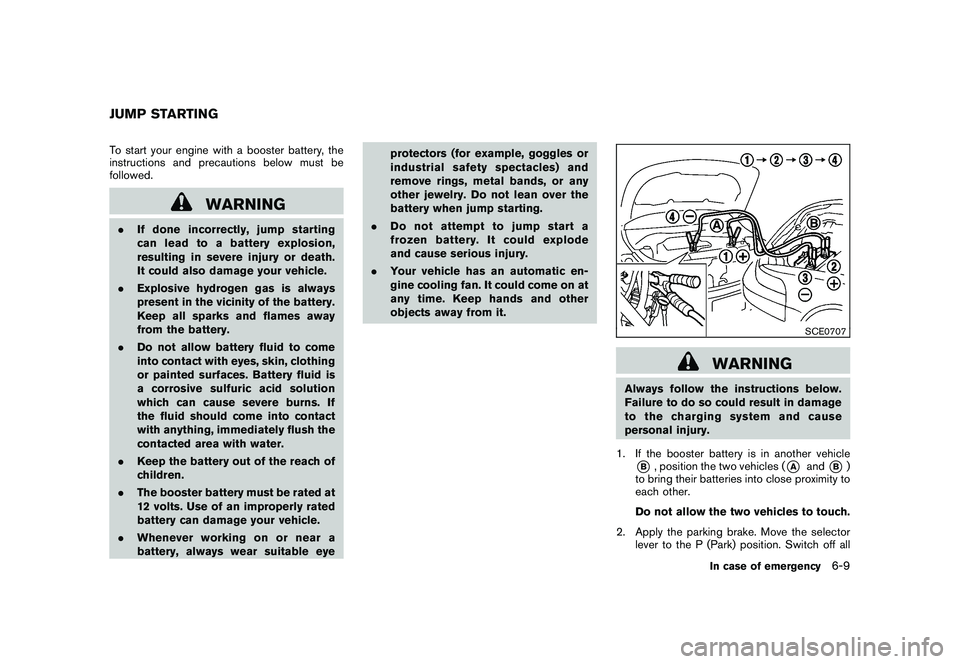
SCE0707
WARNING
Always follow the instructions below.
Failure to do so could result in damage
to the charging system and cause
personal injury.
1. If the booster battery is in another vehicle*B, position the two vehicles (
*A
and
*B)
to bring their batteries into close proximity to
each other.
Do not allow the two vehicles to touch.
2. Apply the parking brake. Move the selector lever to the P (Park) position. Switch off all
JUMP STARTING
In case of emergency
6-9
Page 251 of 328
Black plate (25,1)
8 Maintenance and do-it-yourself
Model "S35-D" EDITED: 2009/ 9/ 4
Maintenance requirement..................................... 8-2
Scheduled maintenance ................................... 8-2
General maintenance ...................................... 8-2
Where to go for service ................................... 8-2
General maintenance .......................................... 8-2
Explanation of maintenance items ....................... 8-2
Maintenance precautions ..................................... 8-5
Engine compartment check locations ...................... 8-6
QR25DE engine ............................................ 8-6
Engine cooling system ......................................... 8-7
Checking engine coolant level ........................... 8-8
Changing engine coolant ................................. 8-8
Engine oil ......................................................... 8-8
Checking engine oil level ................................. 8-8
Changing engine oil and filter ............................ 8-9
Continuously Variable Transmission (CVT) fluid ........ 8-11
Brake fluid ...................................................... 8-11
Window washer fluid ........................................ 8-12
Battery .......................................................... 8-13
Jump starting .............................................. 8-14
Drive belts ...................................................... 8-14
Spark plugs .................................................... 8-15
Replacing spark plugs ................................... 8-15 Air cleaner
...................................................... 8-16
Windshield wiper blades .................................... 8-16
Cleaning .................................................... 8-16
Replacing ................................................... 8-17
Rear window wiper blade ................................... 8-18
Brakes ........................................................... 8-18
Self-adjusting brakes .................................... 8-18
Brake pad wear indicators .............................. 8-18
Fuses ............................................................ 8-19
Engine compartment ..................................... 8-19
Passenger compartment ................................ 8-20
Battery replacement .......................................... 8-21
Keyfob ....................................................... 8-21
Intelligent Key battery .................................... 8-22
Lights ............................................................ 8-24
Headlights .................................................. 8-25
Exterior and interior lights ............................... 8-26
Wheels and tires .............................................. 8-29
Tire pressure ............................................... 8-29
Tire labeling ................................................ 8-33
Types of tires .............................................. 8-35
Tire chains .................................................. 8-36
Changing wheels and tires ............................. 8-37
Page 255 of 328
Black plate (255,1)
Model "S35-D" EDITED: 2009/ 9/ 4
When performing any inspection or mainte-
nance work on your vehicle, always take care
to prevent serious accidental injury to yourself or
damage to the vehicle. The following are general
precautions which should be closely observed.
WARNING
.Park the vehicle on a level surface,
apply the parking brake securely
and block the wheels to prevent
the vehicle from moving. Move the
selector lever to P (Park) .
. Be sure the ignition switch is in the
OFF or LOCK position when per-
forming any parts replacement or
repairs.
. If you must work with the engine
running, keep your hands, clothing,
hair and tools away from moving
fans, belts and any other moving
parts.
. It is advisable to secure or remove
any loose clothing and remove any
jewelry, such as rings, watches, etc.
before working on your vehicle.
. Always wear eye protection when-
ever you work on your vehicle.
. If you must run the engine in an enclosed space such as a garage, be
sure there is proper ventilation for
exhaust gases to escape.
. Never get under the vehicle while it
is supported only by a jack. If it is
necessary to work under the vehicle,
support it with safety stands.
. Keep smoking materials, flame and
sparks away from fuel tank and the
battery.
. The fuel filter or fuel lines should be
serviced by a NISSAN dealer be-
cause the fuel lines are under high
pressure even when the engine is
off.
CAUTION
.Do not work under the hood while
the engine is hot. Turn the engine
off and wait until it cools down.
. Avoid direct contact with used en-
gine oil and coolant. Improperly
disposed engine oil, and engine
coolant and/or other vehicle fluids
can damage the environment. Al-
ways conform to local regulations
for disposal of vehicle fluid. .
Never leave the engine or the CVT
related component harnesses dis-
connected while the ignition switch
is in the ON position.
. Never connect or disconnect the
battery or any transistorized com-
ponent while the ignition switch is
in the ON position.
. Your vehicle is equipped with an
automatic engine cooling fan. It may
come on at any time without warn-
ing, even if the ignition key is in the
OFF position and the engine is not
running. To avoid injury, always
disconnect the negative battery
cable before working near the fan.
This “8. Maintenance and do-it-yourself” section
gives instructions regarding only those items
which are relatively easy for an owner to perform.
A genuine NISSAN Service Manual is also
available. (See “OWNER’S MANUAL/SERVICE
MANUAL ORDER INFORMATION” in the “9.
Technical and consumer information” section.)
Youshouldbeawarethatincompleteor
improper servicing may result in operating
difficulties or excessive emissions, and could
affect warranty coverage. If in doubt about
any servicing, we recommend that it be
MAINTENANCE PRECAUTIONS
Maintenance and do-it-yourself
8-5
Page 263 of 328
Black plate (263,1)
Model "S35-D" EDITED: 2009/ 9/ 4
.Keep the battery surface clean and dry.
Clean the battery with a solution of baking
soda and water.
. Make certain the terminal connections are
clean and securely tightened.
. If the vehicle is not to be used for 30 days or
longer, disconnect the negative ( ) battery
terminal cable to prevent discharging it.
WARNING
. Do not expose the battery to flames
or electrical sparks. Hydrogen gas
generated by the battery is explo-
sive. Do not allow battery fluid to
contact your skin, eyes, fabrics, or
painted surfaces. After touching a
battery or battery cap, do not touch
or rub your eyes. Thoroughly wash
your hands. If the acid contacts your
eyes, skin or clothing, immediately
flush with water for at least 15
minutes and seek medical attention.
. Do not operate the vehicle if the
fluid in the battery is low. Low
battery fluid can cause a higher load
on the battery which can generate
heat, reduce battery life, and in
some cases lead to an explosion. .
When working on or near a battery,
always wear suitable eye protection
and remove all jewelry.
. Battery posts, terminals and related
accessories contain lead and lead
compounds. Wash hands after
handling.
. Keep the battery out of the reach of
children.
DI0137MA
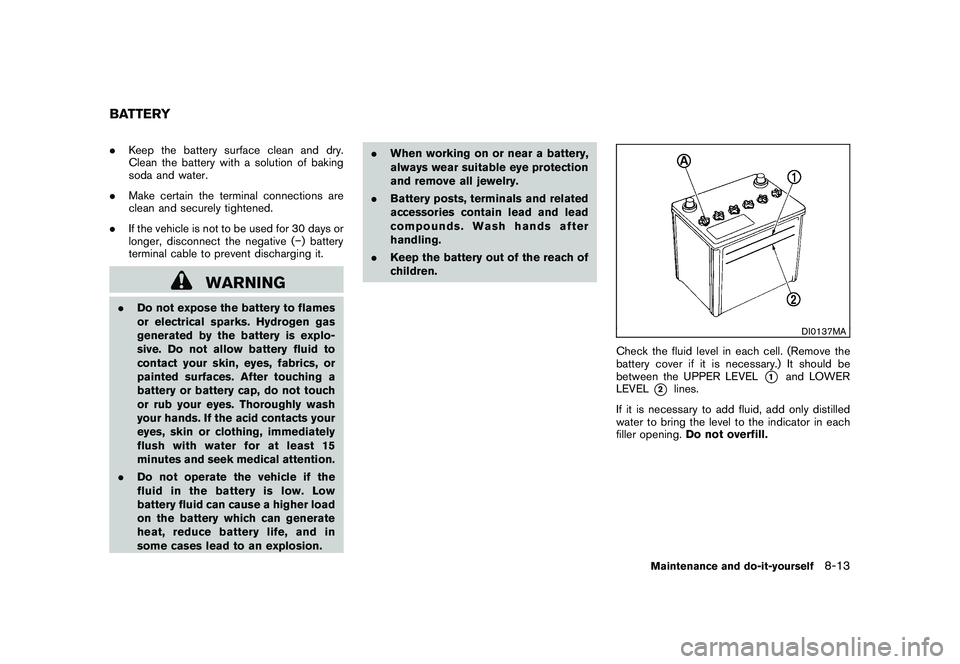
Check the fluid level in each cell. (Remove the
battery cover if it is necessary.) It should be
between the UPPER LEVEL
*1
and LOWER
LEVEL
*2
lines.
If it is necessary to add fluid, add only distilled
water to bring the level to the indicator in each
filler opening. Do not overfill.
BATTERY
Maintenance and do-it-yourself
8-13
Page 265 of 328
Black plate (265,1)
Model "S35-D" EDITED: 2009/ 9/ 4
replaced or adjusted by a NISSAN dealer.
2. Have the belts checked regularly for condi- tion.
WARNING
Be sure the engine and ignition switch
are off and that the parking brake is
engaged securely.
CAUTION
Be sure to use the correct socket to
remove the spark plugs. An incorrect
socket can damage the spark plugs.
SDI2020
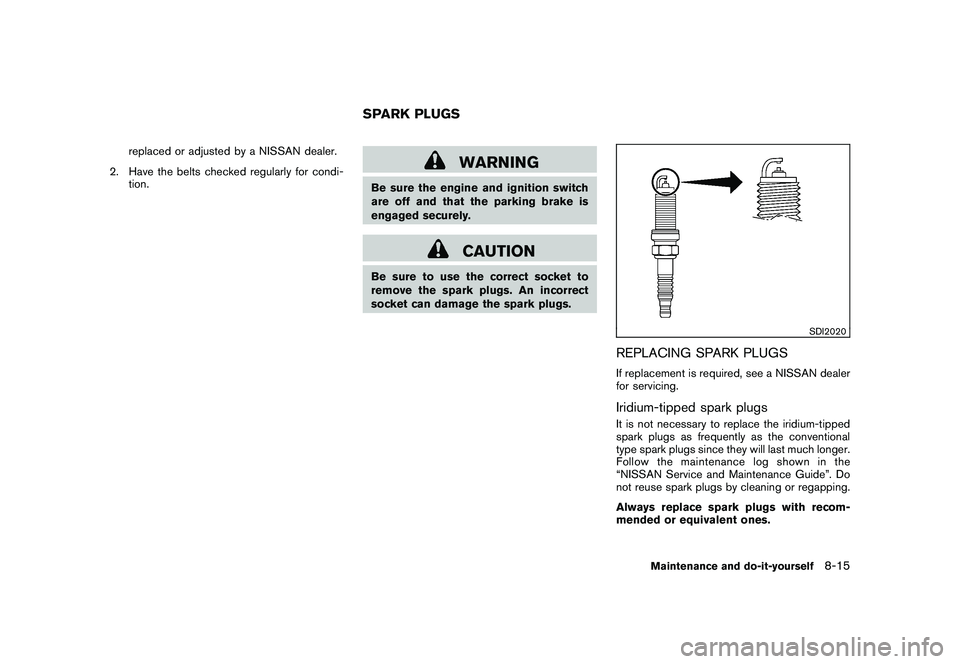
REPLACING SPARK PLUGSIf replacement is required, see a NISSAN dealer
for servicing.Iridium-tipped spark plugsIt is not necessary to replace the iridium-tipped
spark plugs as frequently as the conventional
type spark plugs since they will last much longer.
Follow the maintenance log shown in the
“NISSAN Service and Maintenance Guide”. Do
not reuse spark plugs by cleaning or regapping.
Always replace spark plugs with recom-
mended or equivalent ones.
SPARK PLUGS
Maintenance and do-it-yourself
8-15
Page 294 of 328
Black plate (296,1)
Model "S35-D" EDITED: 2009/ 9/ 4
pumps to be identified by a small, square,
orange and black label with the common
abbreviation or the appropriate percentage for
that region.Aftermarket fuel additivesNISSAN does not recommend the use of any
aftermarket fuel additives (for example, fuel
injector cleaner, octane booster, intake valve
deposit removers, etc.) which are sold commer-
cially. Many of these additives intended for gum,
varnish or deposit removal may contain active
solvent or similar ingredients that can be harmful
to the fuel system and engine.Octane rating tipsUsing unleaded gasoline with an octane
rating lower than recommended can cause
persistent, heavy “spark knock”. (Spark
knock is a metallic rapping noise.) If
severe, this can lead to engine damage. If
you detect a persistent heavy spark knock
even when using gasoline of the stated
octane rating, or if you hear steady spark
knock while holding a steady speed on
level roads, have a NISSAN dealer correct
the condition. Failure to correct the condi-
tion is misuse of the vehicle, for which
NISSAN is not responsible.
Incorrect ignition timing will result in spark
knock, after-run and/or overheating, which may
cause excessive fuel consumption or enginedamage. If any of the above symptoms are
encountered, have your vehicle checked at a
NISSAN dealer.
However, now and then you may notice
light spark knock for a short time while
accelerating or driving up hills. This is not a
cause for concern, because you get the
greatest fuel benefit when there is light
spark knock for a short time under heavy
engine load.
CAUTION
.
Your vehicle is not designed to run
on E-85 fuel. Using E-85 fuel in a
vehicle not specifically designed for
E-85 fuel can damage fuel system
components and is not covered by
the NISSAN new vehicle limited
warranty.
. E-85 is a mixture of approximately
85% fuel ethanol and 15% unleaded
gasoline.
. U.S. government regulations require
ethanol dispensing pumps to be
identified by a small, square, orange
and black label with the common
abbreviation or the appropriate per-
centage for that region.
9-4
Technical and consumer information
Page 297 of 328
Black plate (299,1)
Model "S35-D" EDITED: 2009/ 9/ 4
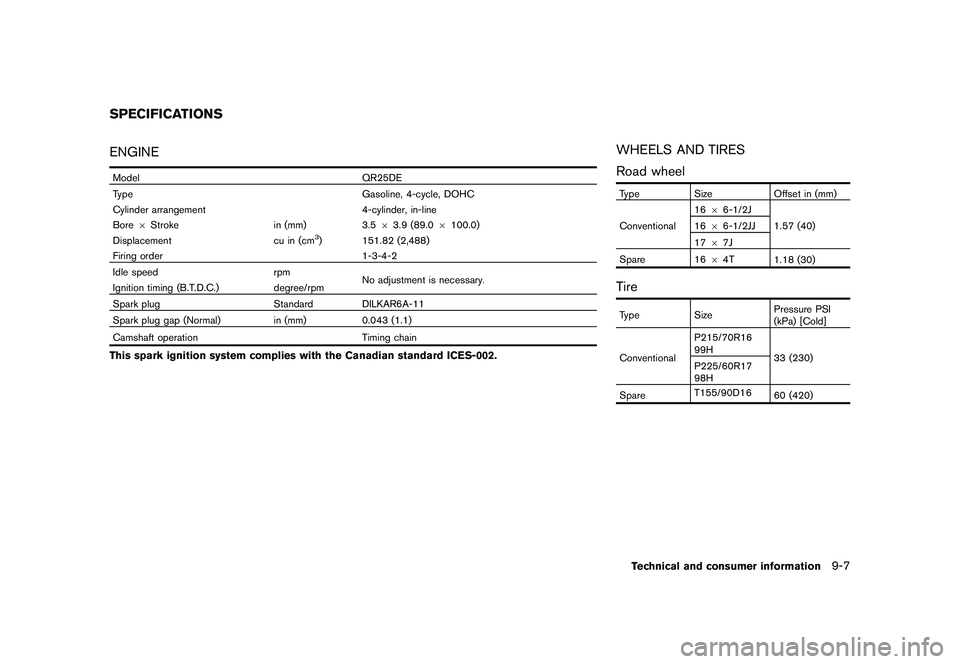
ENGINEModelQR25DE
Type Gasoline, 4-cycle, DOHC
Cylinder arrangement 4-cylinder, in-line
Bore 6Stroke in (mm)3.563.9 (89.0 6100.0)
Displacement cu in (cm
3) 151.82 (2,488)
Firing order 1-3-4-2
Idle speed rpm
No adjustment is necessary.
Ignition timing (B.T.D.C.) degree/rpm
Spark plug Standard DILKAR6A-11
Spark plug gap (Normal) in (mm)0.043 (1.1)
Camshaft operation Timing chain
This spark ignition system complies with the Canadian standard ICES-002.
WHEELS AND TIRES
Road wheelTypeSize Offset in (mm)
Conventional 16
66-1/2J
1.57 (40)
16 66-1/2JJ
17 67J
Spare 16 64T
1.18 (30)TireType Size Pressure PSI
(kPa) [Cold]
Conventional P215/70R16
99H
33 (230)
P225/60R17
98H
Spare T155/90D16
60 (420)
SPECIFICATIONS
Technical and consumer information
9-7
Page 325 of 328
Black plate (5,1)
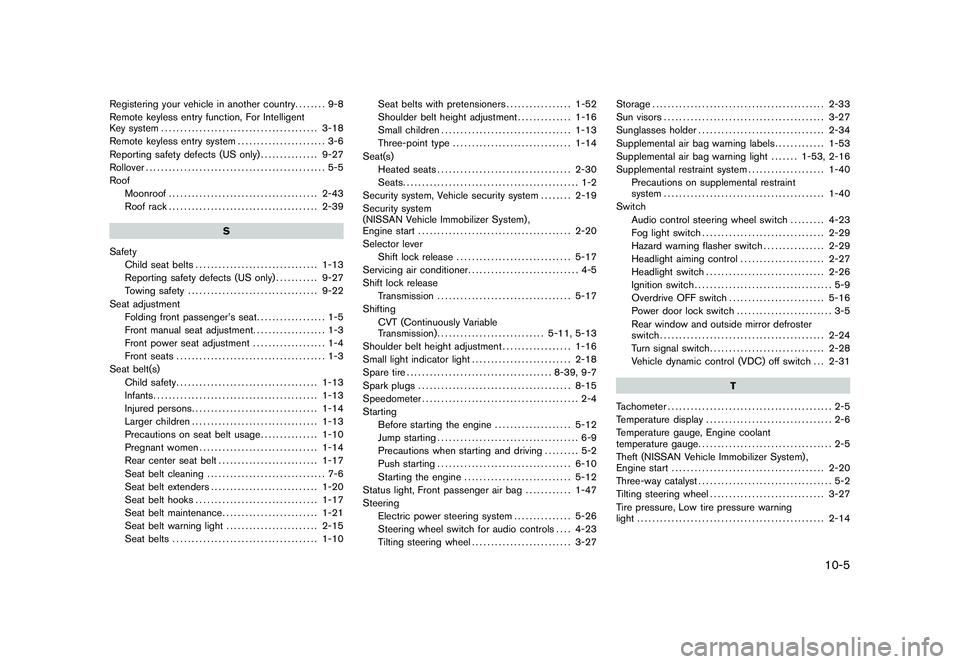
Registering your vehicle in another country........ 9-8
Remote keyless entry function, For Intelligent
Key system ......................................... 3-18
Remote keyless entry system ....................... 3-6
Reporting safety defects (US only) ............... 9-27
Rollover ............................................... 5-5
Roof Moonroof ....................................... 2-43
Roof rack ....................................... 2-39
S
Safety Child seat belts ................................ 1-13
Reporting safety defects (US only) ........... 9-27
Towing safety .................................. 9-22
Seat adjustment Folding front passenger’s seat .................. 1-5
Front manual seat adjustment. .................. 1-3
Front power seat adjustment ................... 1-4
Front seats ....................................... 1-3
Seat belt(s) Child safety ..................................... 1-13
Infants ........................................... 1-13
Injured persons ................................. 1-14
Larger children ................................. 1-13
Precautions on seat belt usage ............... 1-10
Pregnant women ............................... 1-14
Rear center seat belt .......................... 1-17
Seat belt cleaning ............................... 7-6
Seat belt extenders ............................ 1-20
Seat belt hooks ................................ 1-17
Seat belt maintenance ......................... 1-21
Seat belt warning light ........................ 2-15
Seat belts ...................................... 1-10 Seat belts with pretensioners
................. 1-52
Shoulder belt height adjustment .............. 1-16
Small children .................................. 1-13
Three-point type ............................... 1-14
Seat(s) Heated seats ................................... 2-30
Seats .............................................. 1-2
Security system, Vehicle security system ........ 2-19
Security system
(NISSAN Vehicle Immobilizer System) ,
Engine start ........................................ 2-20
Selector lever Shift lock release .............................. 5-17
Servicing air conditioner ............................. 4-5
Shift lock release Transmission ................................... 5-17
Shifting CVT (Continuously Variable
Transmission) ............................ 5-11, 5-13
Shoulder belt height adjustment .................. 1-16
Small light indicator light .......................... 2-18
Spare tire ...................................... 8-39, 9-7
Spark plugs ........................................ 8-15
Speedometer ......................................... 2-4
Starting Before starting the engine .................... 5-12
Jump starting ..................................... 6-9
Precautions when starting and driving ......... 5-2
Push starting ................................... 6-10
Starting the engine ............................ 5-12
Status light, Front passenger air bag ............ 1-47
Steering Electric power steering system ............... 5-26
Steering wheel switch for audio controls .... 4-23
Tilting steering wheel .......................... 3-27 Storage
............................................. 2-33
Sun visors .......................................... 3-27
Sunglasses holder ................................. 2-34
Supplemental air bag warning labels ............. 1-53
Supplemental air bag warning light ....... 1-53, 2-16
Supplemental restraint system .................... 1-40
Precautions on supplemental restraint
system .......................................... 1-40
Switch Audio control steering wheel switch ......... 4-23
Fog light switch ................................ 2-29
Hazard warning flasher switch ................ 2-29
Headlight aiming control ...................... 2-27
Headlight switch ............................... 2-26
Ignition switch .................................... 5-9
Overdrive OFF switch ......................... 5-16
Power door lock switch ......................... 3-5
Rear window and outside mirror defroster
switch ........................................... 2-24
Turn signal switch .............................. 2-28
Vehicle dynamic control (VDC) off switch . . . 2-31
T
Tachometer ........................................... 2-5
Temperature display ................................. 2-6
Temperature gauge, Engine coolant
temperature gauge ................................... 2-5
Theft (NISSAN Vehicle Immobilizer System) ,
Engine start ........................................ 2-20
Three-way catalyst ................................... 5-2
Tilting steering wheel .............................. 3-27
Tire pressure, Low tire pressure warning
light ................................................. 2-14
10-5
Model "S35-D" EDITED: 2009/ 9/ 4