turn NISSAN ROGUE 2012 1.G Towing Guide
[x] Cancel search | Manufacturer: NISSAN, Model Year: 2012, Model line: ROGUE, Model: NISSAN ROGUE 2012 1.GPages: 27, PDF Size: 2.93 MB
Page 3 of 27
2012 NISSAN Towing Guide 2 It is also a good idea to discuss your towing requirements with either your NISSAN dealer or a
professional supplier of towing equipment before you equip your NISSAN vehicle for towing.
Finally, there are state and local laws on towing that you should review to ensure compliance
with all regulations.
Special Note: Do not use your new vehicle to tow a trailer or haul a heavy load for
the first 500 miles (800 km). Your engine, axle or other parts could be damaged.
For the first 500 miles that you tow a trailer, do not drive over 50 mph and do not
make starts at full throttle. This helps your engine and other parts of your vehicle
wear in at heavier loads.
TOWING
EQUIPMENT
RENTING
The first thing to keep in mind when renting a trailer is to rent only from professional
companies that specialize in towing and towing equipment. More than likely, specialized
companies hire professional staff that can assist you in selecting and installing the proper
towing equipment for your NISSAN vehicle.
When renting, make sure you have your vehicle owner’s manual on hand so that you can
reference the towing capacities for your specific vehicle. Never rent a trailer that exceeds
these capacities, and make sure that any related towing equipment you rent will be sufficient
for the loaded trailer.
While you are there, ask questions. How much does the empty trailer weigh? How much
weight will the trailer hold? What is the trailer’s tongue load? With what type of brakes is it
equipped (if any)? All of these factors have an effect on whether your NISSAN vehicle is
capable of safely pulling that type of trailer or piece of equipment.
Make certain that the trailer stoplights, taillights, turn signals, and brakes (if equipped) are
connected and are operating correctly, and that all safety equipment is properly installed.
Check the safety chains/cables, tie-downs, etc.
For safer operation, carefully inspect the condition of the trailer and towing equipment.
Specifically, check to make sure the tires are not worn excessively and are properly inflated.
Make sure there are not any broken welds, missing bolts, and that the hitch components are
not damaged.
Towing safety should be a high priority when choosing and renting towing equipment,
including hitches. NEVER RENT A CLAMP-ON-TYPE HITCH. Your vehicle’s bumpers are
not designed for using this type of hitch. Using it will damage your vehicle and could even
result in the trailer separating from the towing vehicle; this can cause death or serious injury.
To avoid this, use only a permanent-type hitch.
Page 8 of 27
2012 NISSAN Towing Guide 7 Like ball mounts, hitch balls are available in a number of weight capacities and sizes. Always
make sure the hitch ball selected has the proper shank diameter and weight rating for the ball
mount as well as the coupler on your trailer. Using a 1
7/8” hitch ball in a 2” coupler, for example,
could result in the trailer separating from the tow vehicle.
The diameter of the hitch ball shank must be matched to the ball mount hole diameter. The
shank should be no more than
1/16” smaller than the hole.
To keep the hitch ball in top condition, a simple maintenance routine is recommended.
Coating it with light grease will minimize wear of both the coupler and hitch ball. Also, by
removing the hitch ball when not towing, or by protecting it with a special cover, you will help
prevent rust from forming on it.
TRAILER TONGUE
The tongue is the part of the trailer that extends forward to meet the tow vehicle, and it also
carries the coupler assembly. Knowledge of the trailer minimum and maximum tongue load
(conventional trailers) and king pin load (5th wheel and gooseneck trailers) is critical as it can
have a significant effect on the handling of the tow vehicle. Refer to your vehicle owner’s
manual to view the maximum conventional trailer tongue load listed for your vehicle, and
always maintain between 10-15% of the trailer weight or within the total trailer load
specification recommended by the trailer manufacturer.
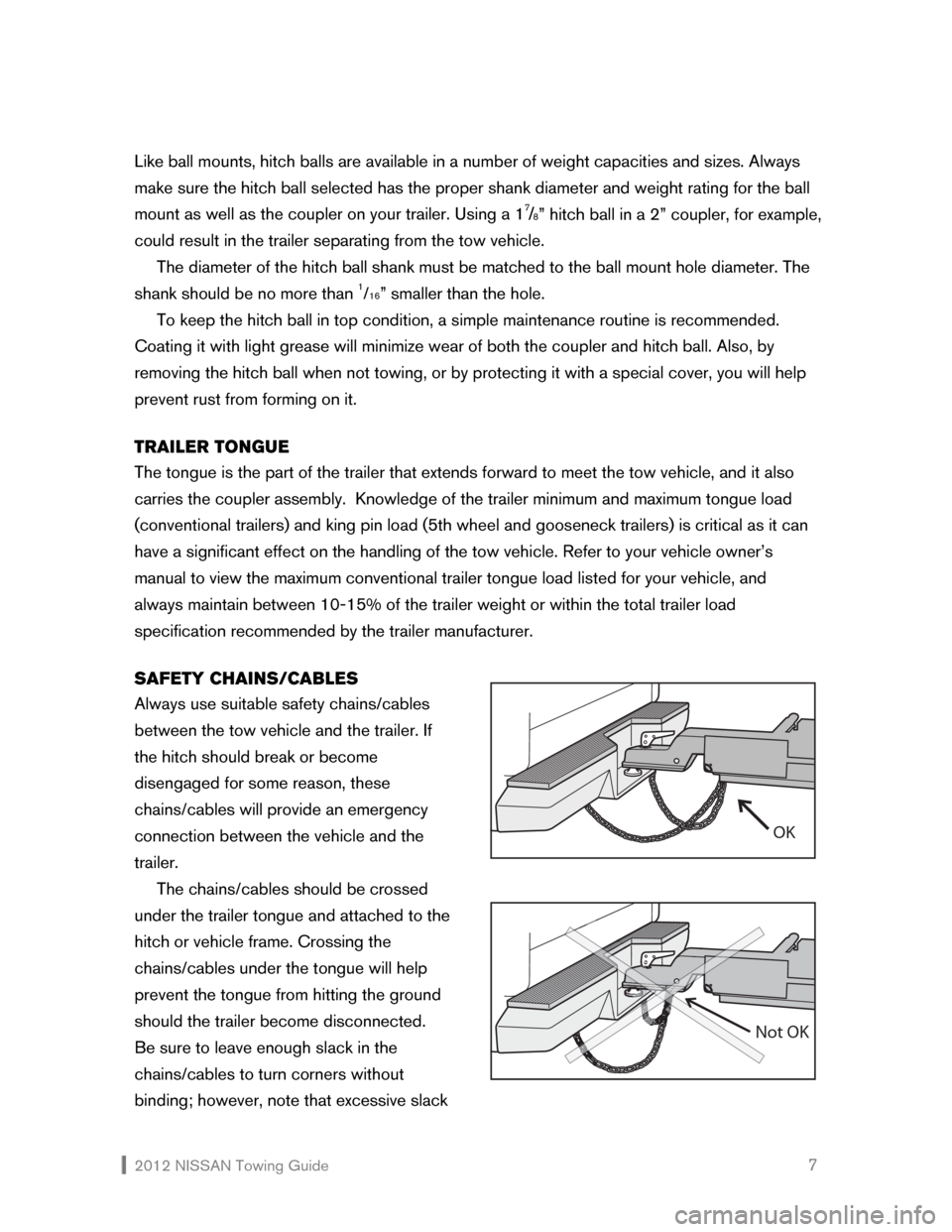
SAFETY CHAINS/CABLES
Always use suitable safety chains/cables
between the tow vehicle and the trailer. If
the hitch should break or become
disengaged for some reason, these
chains/cables will provide an emergency
connection between the vehicle and the
trailer.
The chains/cables should be crossed
under the trailer tongue and attached to the
hitch or vehicle frame. Crossing the
chains/cables under the tongue will help
prevent the tongue from hitting the ground
should the trailer become disconnected.
Be sure to leave enough slack in the
chains/cables to turn corners without
binding; however, note that excessive slack
Not OK
OK
Page 9 of 27
2012 NISSAN Towing Guide 8 will allow the chains/cables to drag on the ground.
Do not use S-hooks for attaching, as they may become un-hooked and are illegal in many
states. To avoid damage to the bumper and chains/cables when making a sharp turn, do not
attach the chains/cables too close to the coupler. Consult your trailer manufacturer for the
proper location of the chain/cable attachment to the trailer.
REAR VIEW MIRRORS
In many cases, a trailer can block your rear vision when you are using only the standard
NISSAN rear view mirrors. These mirrors were not designed for towing. “Extended” mirrors
specifically designed for trailer towing should be used when your rearward vision is
obstructed. Before using these mirrors, make certain that they comply with state and local
regulations. Telescoping Tow Mirrors are available as an accessory for certain Nissan vehicles.
Contact your NISSAN dealer for details.
BREAKAWAY SWITCH
On a trailer with electric brakes, a breakaway switch can automatically activate the trailer
brake system if the trailer becomes separated from the tow vehicle. Should the trailer become
detached, a breakaway switch may help prevent the trailer from wandering into another lane.
A breakaway switch relies on the power of a trailer battery, so make sure it is not
discharged. Never use the breakaway switch to “park” the trailer on a grade. The battery
would eventually discharge and release the brake, allowing the trailer to roll. Be sure to leave
enough slack in the tether on the breakaway switch to turn corners without binding. If you do
not, the electric trailer brakes will lock-up and not release. See your trailer manufacturer for
proper installation of a breakaway switch that is compatible with your trailer braking system.
TRAILER LIGHTS
Trailer lights should comply with all applicable federal, state, and local regulations, and should
be in proper working order at all times. A trailer’s taillights, stoplights, and turn signal lights
must be wired into the tow vehicle’s electrical system.*
Most trailers operate on a four-wire system in which the stoplights and turn signal lights
utilize the same wire. Most all NISSAN vehicles have separate wires for the stoplights and turn
signal lights, therefore a device called a “converter” is needed.** Specifically, a “powered
* Vehicles equipped with LED taillights require that wiring be connected at a specific location. For
assistance in hooking up trailer lights, contact your NISSAN dealer or a professional supplier of
towing
equipment.
** Armada, Frontier, Pathfinder, and Titan vehicles are pre-wired for trailer lighting and do not require a
converter.
Page 10 of 27
2012 NISSAN Towing Guide 9 converter” must be used, as a converter of this type creates only minimal additional electrical
demand (draw) on the vehicle lighting circuits, which helps to ensure protection for the
vehicle’s sensitive electronics.
Always check for correct operation of the taillights, stoplights, and turn signal lights every
time you connect a trailer for towing. Never replace vehicle fuses with fuses of a higher
amperage rating than the original.
NOTE – Improper or poor quality trailer harness wiring may affect your vehicle’s electrical
system. Use only a NISSAN approved wiring harness, or, consult your dealer or a professional
supplier of towing equipment for compatible equipment.
BRAKES
As with hitches, several types of braking systems are available. Most states require a separate
braking system on trailers with a loaded weight above a specific amount, therefore you should
check to ensure you comply with all regulations. Have a professional supplier of towing
equipment demonstrate proper brake function testing.
NOTE – Never connect a hydraulic trailer brake system directly to the vehicle hydraulic
brake system.
Surge Brakes – The surge brake actuator is mounted on the trailer tongue with a hydraulic
line running to each trailer wheel. Surge brakes are activated by the trailer pushing against the
hitch ball when the tow vehicle is braking. Hydraulic surge brakes are common on rental
trailers and some boat trailers. In this type of system, there is no hydraulic or electric
connection for brake operation between the tow vehicle and the trailer.
Electric Trailer Brakes – Electric braking systems are activated by an electronic signal sent
from a trailer brake controller (special brake-sensing module). If electric trailer brakes are used,
NISSAN recommends all-electronic actuation because with this system it will not be
necessary to tap into the tow vehicle’s hydraulic system. For adjustment specifications, refer
to the brake controller manual for the controller being installed.
For your convenience, Armada, Frontier, Pathfinder, Titan, and NV vehicles are pre-wired to
accommodate most popular electric trailer brake controllers. A wiring harness* is either
included with your vehicle or available from your NISSAN dealer. This harness provides
electric trailer brake controller input and output connections to the vehicle wiring. See a
professional supplier of towing equipment for electric trailer brake controller availability.
* Contact a NISSAN dealer or a professional supplier of towing equipment for information on trailers
equipped with electric brakes and for Genuine NISSAN jumper harness availability for your specific
vehicle.
Page 18 of 27
2012 NISSAN Towing Guide 17 VEHICLE MODIFICATIONS
Vehicle modifications — beyond those required for proper hitch installation, wiring hook-up, or
adding extended mirrors — are not recommended for any NISSAN vehicle being used for
towing purposes. Changes to the drivetrain, suspension, exhaust systems, frame
structure/unibody, or other vehicle components are not necessary for towing within the limits
described in this guide. These changes may diminish the reliability and longevity of your
vehicle and possibly void warranty coverage.
TOOL KIT
When towing, bring tools including, flares, a flashlight, emergency reflectors, jumper cables,
extra fuses, extra radiator coolant, oil, and easily replaced spare parts such as taillight bulbs.
You should also carry spare tires for your tow vehicle and trailer, as well as a jack suitable for
use on the trailer. Be aware that not all automotive jacks can be used safely on a trailer.
BEFORE STARTING OUT
Before starting out on a trip, make one last inspection of the tow vehicle and the trailer. Are
the tire pressures correct? Are the safety chains/cables securely in place? Is the cargo tied
down securely? Do all the lights work? Is the coupler properly attached over the hitch ball and
secured using a locking pin? Is the breakaway switch hooked up and functioning properly?
Are vehicle and electric trailer brakes working properly?
Make a checklist of key items to be inspected. When towing, vehicle engine oil,
transmission oil, and coolant should always be checked before starting out. Finding a potential
problem while in your driveway is better than discovering it miles from home.
TOWING
TIPS
If you have never towed a trailer before, be aware that it does take getting used to. To begin
with, towing noticeably affects your vehicle’s performance:
Š It will not accelerate as quickly — an important point to keep in mind when merging onto a
highway.
Š It will not stop as quickly. Leave more room than usual between you and the traffic ahead,
and brake sooner when coming to a stop.
Š Abrupt maneuvering can unbalance the load and reduce the handling and stability of your
tow vehicle. Plan ahead and make lane changes and turns smoothly.
Page 19 of 27
2012 NISSAN Towing Guide 18 If possible, before you actually hit the open road, practice towing in a large uncrowded area
such as a stadium or shopping center parking lot. Become especially familiar with backing up
a trailer — the maneuver many people find most difficult.
BRAKE SOONER
The combination of your tow vehicle and trailer obviously requires a greater distance to stop.
A good rule of thumb to remember is that for each 10 mph of speed, allow yourself one tow
vehicle and trailer length of distance between the front of your vehicle and the vehicle ahead.
When braking, use firm but gradual pressure on the pedal rather than panic braking.
Applying the brakes abruptly or with too much force can cause the trailer to skid or jackknife
at its point of attachment with the vehicle. This, in turn, can throw the tow vehicle out of
control. If equipped with an electric trailer brake controller, follow the recommended
operational instructions.
PASS CAREFULLY
As mentioned in the introduction to this section, because of the added weight of the trailer,
acceleration capability is reduced and you will require a longer distance to pass another
vehicle. Be certain you have sufficient time and space to pass safely. Never attempt to pass
on hills or when going around curves.
CORNER MORE SLOWLY
Know your vehicle and trailer capabilities. Entering a sharp corner too quickly or abruptly can
“crack the whip,” whereby the trailer can actually pull the tow vehicle off the road. Therefore,
when approaching a relatively sharp corner, begin braking sooner than you would when not
towing. Do your braking in a straight line prior to the corner, and turn smoothly into it. In
addition, remember to make a wider turn than normal to ensure that the trailer safely clears the
inside of the turn.
When towing a 5th wheel or gooseneck trailer, do not make sharp turns while driving or
backing as the trailer may contact the vehicle and cause damage to both the trailer and
vehicle. A special extended 5th wheel pin box or sliding hitch may be required to provide
additional trailer-to-truck clearance for tight maneuvering.
BACK UP WITH CAUTION
Backing up with a trailer is a difficult maneuver. The best way to steer is by placing one hand
at the bottom of the steering wheel to direct the trailer. The trailer will go in the same direction
Page 20 of 27
2012 NISSAN Towing Guide 19 your hand moves. If you want to turn the trailer to the left, you will turn the steering wheel to
the left. To turn the trailer to the right, move the wheel to the right. All movements of the wheel
should be done in small increments. Of course, backing up should be done only at very slow
speeds. For large trailers that obstruct your rearward vision, have someone outside the vehicle
act as a “spotter” to guide you along.
PARK SMART
A tow vehicle and trailer can be an unwieldy combination in a small area, so always try to park
where you will have a relatively easy time maneuvering. Once parked, always block the wheels
on both the tow vehicle and the trailer.
Parking on a slope is not recommended. If, however, you must park on a slope and your
vehicle is equipped with an automatic transmission, there are some precautions you should
take:
Š Have someone block the wheels once the tow vehicle and trailer are in position and being
held by the vehicle’s brake.
Š Next, apply the parking brake and only then move the gear lever into PARK. If you move the
lever into PARK before blocking the wheels and applying the parking brake, it may be
difficult later to shift out of PARK. Transmission damage may also occur.
HIGH-ALTITUDE PERFORMANCE
An engine will lose about 4% of its performance for every 1,000 feet above sea level that you
travel. If you will be towing in high altitudes, it is a good idea to allow more time than usual due
to the engine’s reduced performance.
TOW MODE (IF EQUIPPED)
Tow Mode is recommended when towing a heavy trailer or hauling a heavy load, in stop-and-
go traffic, rolling terrain, or a busy parking lot. Driving the vehicle in Tow Mode may affect fuel
economy and transmission/engine driving characteristics. See your vehicle owner’s manual for
additional information about Tow Mode.
HILLS – UPGRADES
As the incline increases, your vehicle — if equipped with an automatic transmission — is
designed to automatically select the correct gear for the best towing comfort and
performance. To maintain speed or avoid up and down shifts, manually shift to a lower gear as
needed.
Page 21 of 27
2012 NISSAN Towing Guide 20 The added weight of a trailer places an increased load on the engine and cooling system, so
monitor your coolant temperature gauge and automatic transmission fluid temperature gauge
(if equipped) carefully. At the first sign of overheating, pull to the side of the road. See IF
YOUR ENGINE OVERHEATS later in this section for more information.
HILLS – DOWNGRADES
While going downhill, the weight of the trailer pushing on the tow vehicle may decrease
overall stability. Therefore, to maintain adequate control, reduce your speed and shift to a
lower gear. If your vehicle is equipped with Tow Mode, see your vehicle owner’s manual for
information about the use of this function.
Avoid long or repeated use of the brakes when descending a hill, as this reduces their
effectiveness and could cause overheating. Shifting to a lower gear instead provides “engine
braking” and reduces the need to brake as frequently.
AUTOMATIC CRUISE CONTROL
Do not use cruise control while towing a trailer.
IF YOUR ENGINE OVERHEATS
A moderate increase in engine operating temperature is normal when towing a trailer. If,
however, the coolant temperature gauge reading is abnormally high, or if you are experiencing
a significant loss of power, or if you hear unusual engine noises,* the engine may be
overheating and you should immediately take the following steps:
1. Pull your vehicle safely over to the side of the road, out of traffic. Apply the parking brake
and move the gearshift lever to NEUTRAL (manual) or PARK (automatic). DO NOT STOP
THE ENGINE.
2. Turn off the air conditioning and, after opening all the windows, turn the heater on to
maximum hot and the fan to its highest speed. The heater core in your vehicle is just like a
miniature engine radiator and will provide an extra cooling surface to help reduce engine
temperature.
3. If the temperature does not drop or continues to increase, stop the engine immediately.
4. Being cautious of traffic, step out of the vehicle and, from a safe distance, look for steam
underneath the engine. If you see steam or leaking coolant, stand clear to avoid being
burned and shut off your engine immediately and allow it to cool. If there is no steam, open
* See your vehicle owner’s manual for additional indications that your vehicle may be overheating.
Page 22 of 27
2012 NISSAN Towing Guide 21
the hood. Never remove the radiator cap when the radiator is hot. If the cap is removed
under these conditions, hot water/coolant under high pressure may spurt out, possibly
causing serious injury.
5. As soon as the engine has cooled to its normal operating temperature, visually inspect the
drive belts for damage or looseness. A loose belt reduces water pump efficiency. Be
careful to keep your hands, hair, jewelry, and clothing clear of the running drive belt and
other moving parts when inspecting the engine and radiator. Also check to see if the
cooling fan is running, and inspect the water pump, radiator, and radiator hoses for leaks.
Keep in mind, too, that if your vehicle is equipped with an electric fan motor, it may start
without warning any time the coolant temperature is high. If you find leaking coolant, a
loose or missing drive belt, or an inoperable fan, turn off the engine immediately.
6. If no leaks are apparent and all other components appear to be operating properly with
the engine cooled to its normal operating temperature, check the coolant level in the
reservoir tank with the engine running. Add coolant to the reservoir tank if needed. At this
point, if repairs are required, go to the nearest NISSAN dealer. See the IN CASE OF
EMERGENCY section of your vehicle owner’s manual for additional information on
overheating.
NOTES – All NISSAN vehicles have an engine protection mode, which helps reduce the
chance of engine damage if the engine coolant reaches a specified temperature. See your
vehicle owner’s manual for details.
1 Maximum Trailer Weight values are calculated assuming a base vehicle with driver and any
options required to achieve the rating. Additional passengers, cargo and/or optional
equipment will add weight to the vehicle and reduce your vehicle’s maximum towing
capacity and trailer tongue load.
2 Use of a weight-distributing hitch system is recommended when towing over 5,000 lbs.
3 The Maximum Trailer Weight and Gross Combined Weight ratings for 5th wheel and
gooseneck trailer towing are the same as specified for conventional trailer towing.
4 Most states require a separate braking system on trailers with a loaded weight above a
specific amount. Check local ordinances. 7-pin connector trailer wire harnesses are
required for use with trailer brakes (available separately).