roof NISSAN ROGUE 2014 2.G Owners Manual
[x] Cancel search | Manufacturer: NISSAN, Model Year: 2014, Model line: ROGUE, Model: NISSAN ROGUE 2014 2.GPages: 442, PDF Size: 5.19 MB
Page 5 of 442
DRIVING SAFETY PRECAUTIONS
Your NISSAN is designed for both normal and
off-road use. However, avoid driving in deep wa-
ter or mud as your NISSAN is mainly designed for
leisure use, unlike a conventional off-road ve-
hicle.
Remember that two-wheel drive models are less
capable than all-wheel drive models for rough
road driving and extrication when stuck in deep
snow or mud, or the like.
Please observe the following precautions:
WARNING
●Spinning the front wheels on slippery
surface may cause the AWD warning
message to display and the AWD sys-
tem to automatically switch from the
AWD to the 2WD mode. This could re-
duce the traction. Be especially careful
when towing a trailer. (AWD models)
●Drive carefully when off the road and
avoid dangerous areas. Every person
who drives or rides in this vehicle
should be seated with their seat belt
fastened. This will keep you and your
passengers in position when driving
over rough terrain.●Do not drive across steep slopes. In-
stead drive either straight up or straight
down the slopes. Off-road vehicles can
tip over sideways much more easily
than they can forward or backward.
●Many hills are too steep for any vehicle.
If you drive up them, you may stall. If
you drive down them, you may not be
able to control your speed. If you drive
across them, you may roll over.
●Do not shift gears while driving on
downhill grades as this could cause
loss of control of the vehicle.
●Stay alert when driving to the top of a
hill. At the top there could be a drop-off
or other hazard that could cause an
accident.
●If your engine stalls or you cannot make
it to the top of a steep hill, never at-
tempt to turn around. Your vehicle could
tip or roll over. Always back straight
down in R (Reverse) gear and apply
brakes to control your speed.
●Heavy braking going down a hill could
cause your brakes to overheat and fade,
resulting in loss of control and an acci-
dent. Apply brakes lightly and use a low
gear to control your speed.●Unsecured cargo can be thrown around
when driving over rough terrain. Prop-
erly secure all cargo so it will not be
thrown forward and cause injury to you
or your passengers.
●To avoid raising the center of gravity
excessively, do not exceed the rated
capacity of the roof rack (if so equipped)
and evenly distribute the load.
●Secure heavy loads in the cargo area as
far forward and as low as possible. Do
not equip the vehicle with tires larger
than specified in this manual. This could
cause your vehicle to roll over.
●Do not grip the inside or spokes of the
steering wheel when driving off-road.
The steering wheel could move sud-
denly and injure your hands. Instead
drive with your fingers and thumbs on
the outside of the rim.
●Before operating the vehicle, ensure
that the driver and all passengers have
their seat belts fastened.
●Always drive with the floor mats in place
as the floor may become hot.
Page 19 of 442
1. Supplemental front-impact air bags(P. 1-41)
2. Occupant classification sensor
(weight sensor) (P. 1-56)
3. Seat belts (P. 1-13)
4. Head restraints/headrests (P. 1-6)
5. Roof-mounted curtain side-impact and
rollover supplemental air bag (P. 1-41)
6. 2nd row center position top tether strap
(located on ceiling) (P. 1-26 )
7. Folding 3rd row bench (if so equipped)
(P. 1-12)
8. 2nd row outboard seat top tether strap
anchor (located on bottom of seatback)
(P. 1-37)
9. LATCH (Lower Anchors and Tethers for
CHildren) (P. 1-24)
10. Folding 2nd row bench (P. 1-5)
11. Front seat-mounted side-impact
supplemental air bag (P. 1-41)
12. Seat belt with pretensioner (P. 1-55)
13. Seats (front row) (P. 1-2)
See the page number indicated in paren-
theses for operating details.
LII2185
AIR BAGS, SEAT BELTS AND CHILD
RESTRAINTS
0-2Illustrated table of contents
Page 22 of 442
1. Glove box(P. 2-47)
2. Map lights (P. 2-56)
3. Console box (P. 2-44)
4. Power panoramic moonroof(if so equipped) (P. 2-53)
5. Luggage hooks (P. 2-48)
6. Center armrest (2nd row) (P. 1-12)
7. Seats (P. 1-2)
8. Cup holders (P. 2-45)
9. Sun visors (P. 3-30)
See the page number indicated in paren-
theses for operating details.
LII2187
PASSENGER COMPARTMENT
Illustrated table of contents0-5
Page 53 of 442
When installing a child restraint, carefully read
and follow the instructions in this manual and
those supplied with the child restraint.
Top tether anchor
WARNING
●Do not allow cargo to contact the top
tether strap when it is attached to the
top tether anchor. Properly secure the
cargo so it does not contact the top
tether strap. Cargo that is not properly
secured or cargo that contacts the top
tether strap may damage it during a
collision. A child could be seriously in-
jured or killed in a collision if the top
tether strap is damaged.
● Child restraint anchorages are de-
signed to withstand only those loads
imposed by correctly fitted child re-
straints. Under no circumstances are
they to be used to attach adult seat
belts, or other items or equipment to
the vehicle. Doing so could damage the
child restraint anchorages. The child re-
straint will not be properly installed us-
ing the damaged anchorages, and a
child could be seriously injured or killed
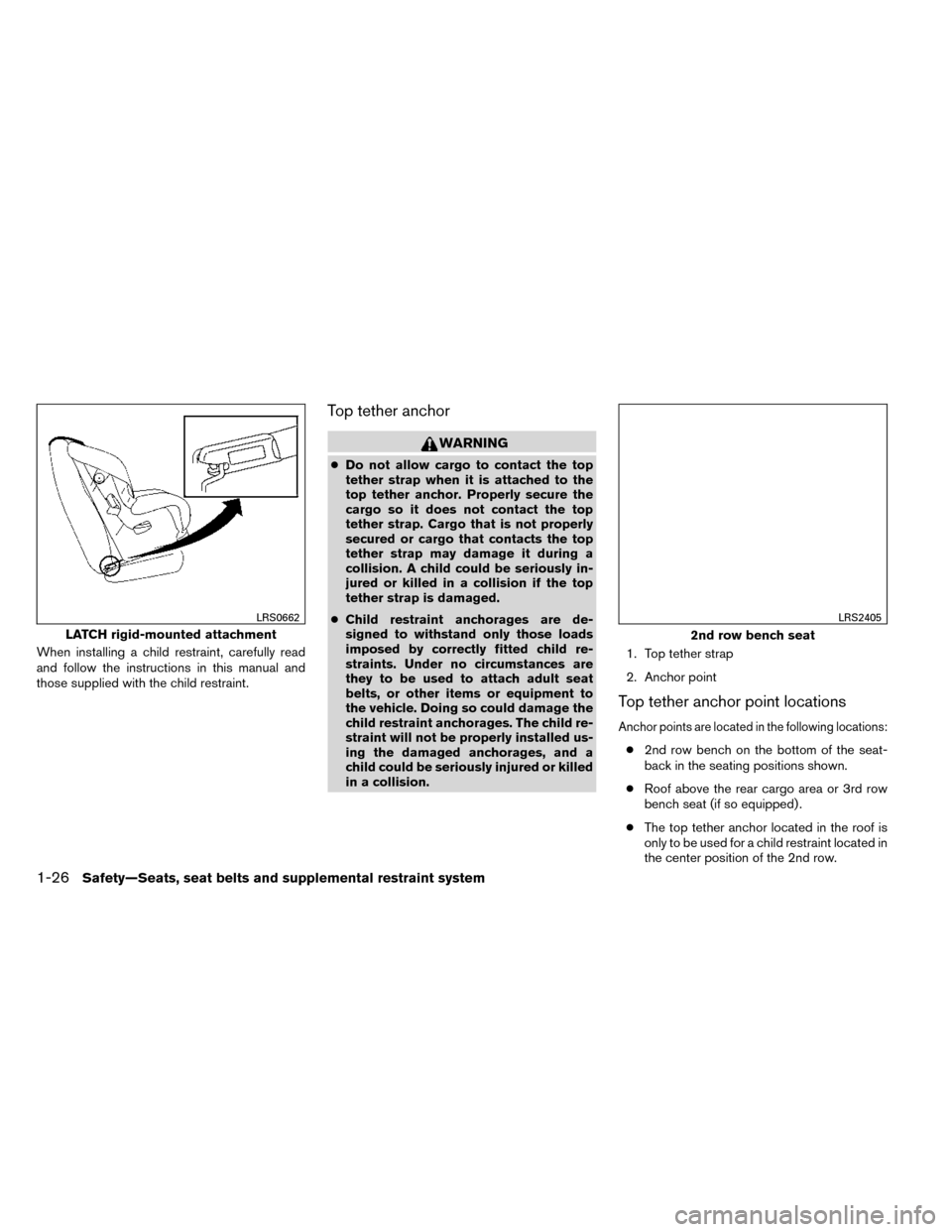
in a collision. 1. Top tether strap
2. Anchor point
Top tether anchor point locations
Anchor points are located in the following locations:
●
2nd row bench on the bottom of the seat-
back in the seating positions shown.
● Roof above the rear cargo area or 3rd row
bench seat (if so equipped) .
● The top tether anchor located in the roof is
only to be used for a child restraint located in
the center position of the 2nd row.
LATCH rigid-mounted attachment
LRS0662
2nd row bench seat
LRS2405
1-26Safety—Seats, seat belts and supplemental restraint system
Page 68 of 442
If the seating position does not have an
adjustable head restraint/headrest and it is
interfering with the proper booster seat fit,
try another seating position or a different
booster seat.
4. Position the lap portion of the seat belt low and snug on the child’s hips. Be sure to
follow the booster seat manufacturer’s in-
structions for adjusting the seat belt routing.
5. Pull the shoulder belt portion of the seat belt toward the retractor to take up extra slack.
Be sure the shoulder belt is positioned
across the top, middle portion of the child’s
shoulder. Be sure to follow the booster seat
manufacturer’s instructions for adjusting the
seat belt routing.
6. Follow the warnings, cautions and instruc- tions for properly fastening a seat belt
shown in “Three-point type seat belt with
retractor” in this section. 7. If the booster seat is installed in the front
passenger seat, place the ignition switch in
the ON position. The front passenger air bag
status light
may or may not illuminate,
depending on the size of the child and the
type of booster seat being used. For addi-
tional information, refer to “Front passenger
air bag and status light” in this section.
PRECAUTIONS ON SRS
This SRS section contains important information
concerning the following systems:
● Driver and passenger supplemental front-
impact air bag (NISSAN Advanced Air Bag
System)
● Front seat-mounted side-impact supple-
mental air bag
● Roof-mounted curtain side-impact and roll-
over supplemental air bag
● Seat belt with pretensioner
Supplemental front-impact air bag system:
The NISSAN Advanced Air Bag System can help
cushion the impact force to the head and chest of
the driver and front passenger in certain frontal
collisions.
Front seat-mounted side-impact supple-
mental air bag system: This system can help
cushion the impact force to the chest area of the
driver and front passenger in certain side-impact
collisions. The side air bags are designed to
inflate on the side where the vehicle is impacted.
Roof-mounted curtain side-impact and
rollover supplemental air bag system: This
system can help cushion the impact force to the
head of occupants in the outboard seating posi-
tions in certain side-impact or rollover collisions.
LRS0865
SUPPLEMENTAL RESTRAINT
SYSTEM (SRS)
Safety—Seats, seat belts and supplemental restraint system1-41
Page 73 of 442
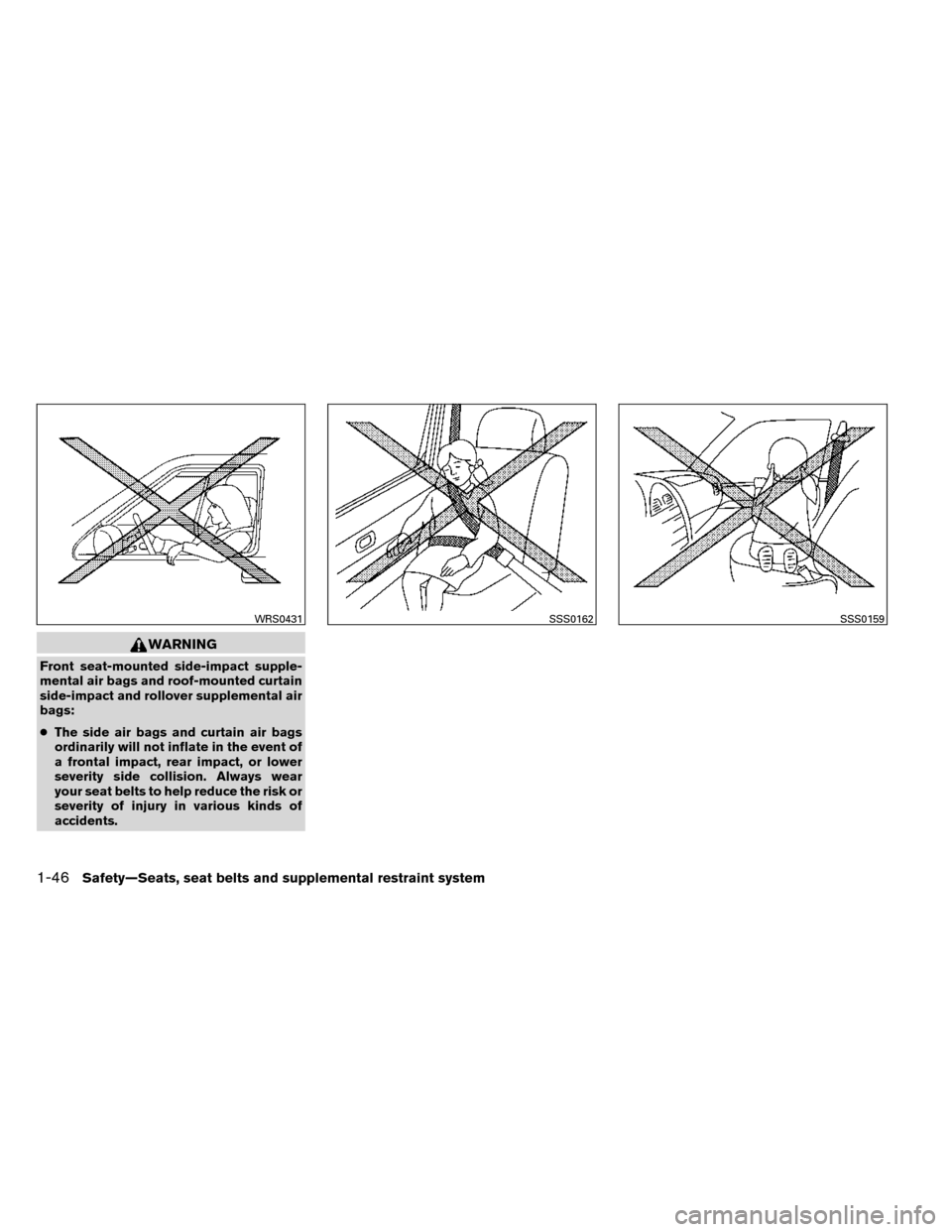
WARNING
Front seat-mounted side-impact supple-
mental air bags and roof-mounted curtain
side-impact and rollover supplemental air
bags:
●The side air bags and curtain air bags
ordinarily will not inflate in the event of
a frontal impact, rear impact, or lower
severity side collision. Always wear
your seat belts to help reduce the risk or
severity of injury in various kinds of
accidents.
WRS0431SSS0162SSS0159
1-46Safety—Seats, seat belts and supplemental restraint system
Page 74 of 442
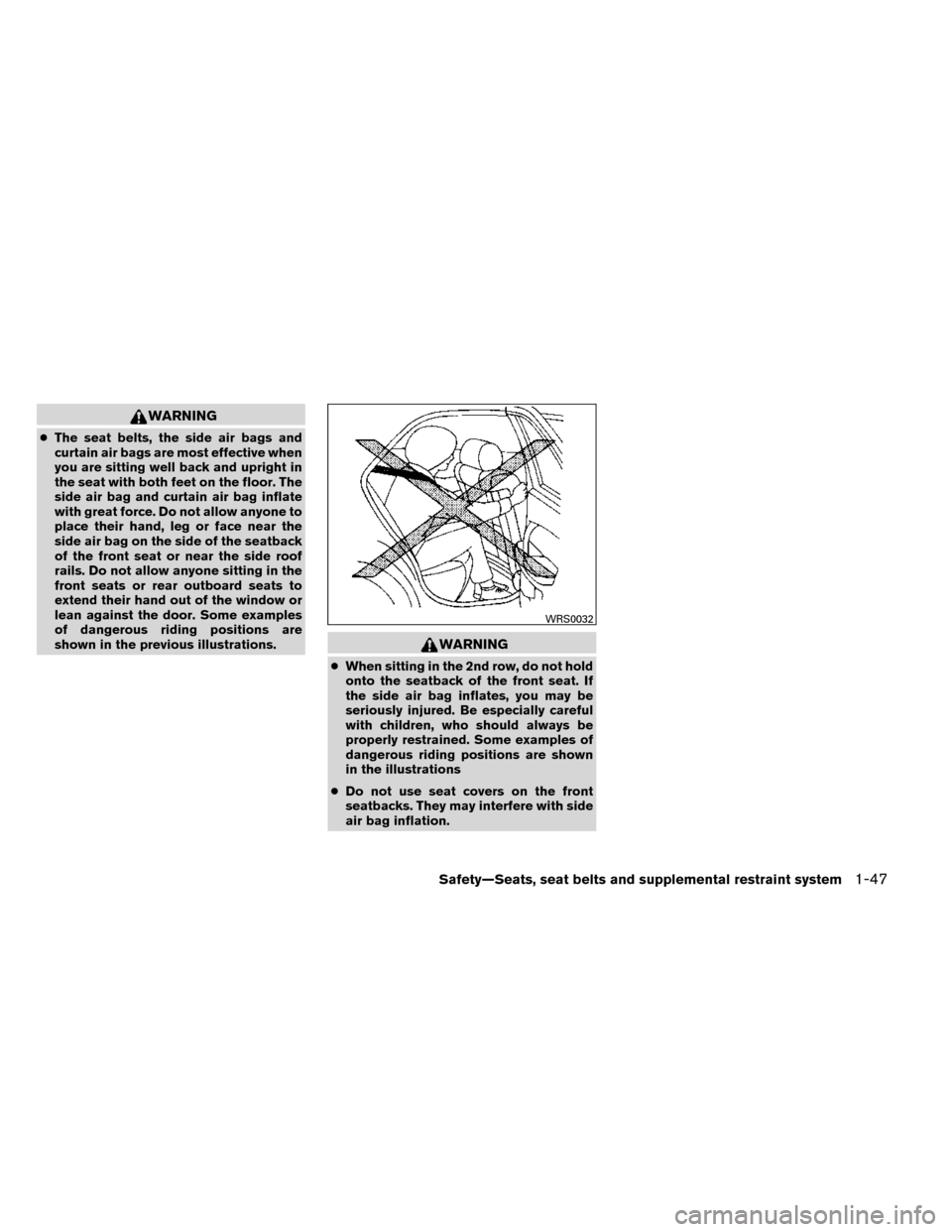
WARNING
●The seat belts, the side air bags and
curtain air bags are most effective when
you are sitting well back and upright in
the seat with both feet on the floor. The
side air bag and curtain air bag inflate
with great force. Do not allow anyone to
place their hand, leg or face near the
side air bag on the side of the seatback
of the front seat or near the side roof
rails. Do not allow anyone sitting in the
front seats or rear outboard seats to
extend their hand out of the window or
lean against the door. Some examples
of dangerous riding positions are
shown in the previous illustrations.
WARNING
● When sitting in the 2nd row, do not hold
onto the seatback of the front seat. If
the side air bag inflates, you may be
seriously injured. Be especially careful
with children, who should always be
properly restrained. Some examples of
dangerous riding positions are shown
in the illustrations
● Do not use seat covers on the front
seatbacks. They may interfere with side
air bag inflation.
WRS0032
Safety—Seats, seat belts and supplemental restraint system1-47
Page 75 of 442
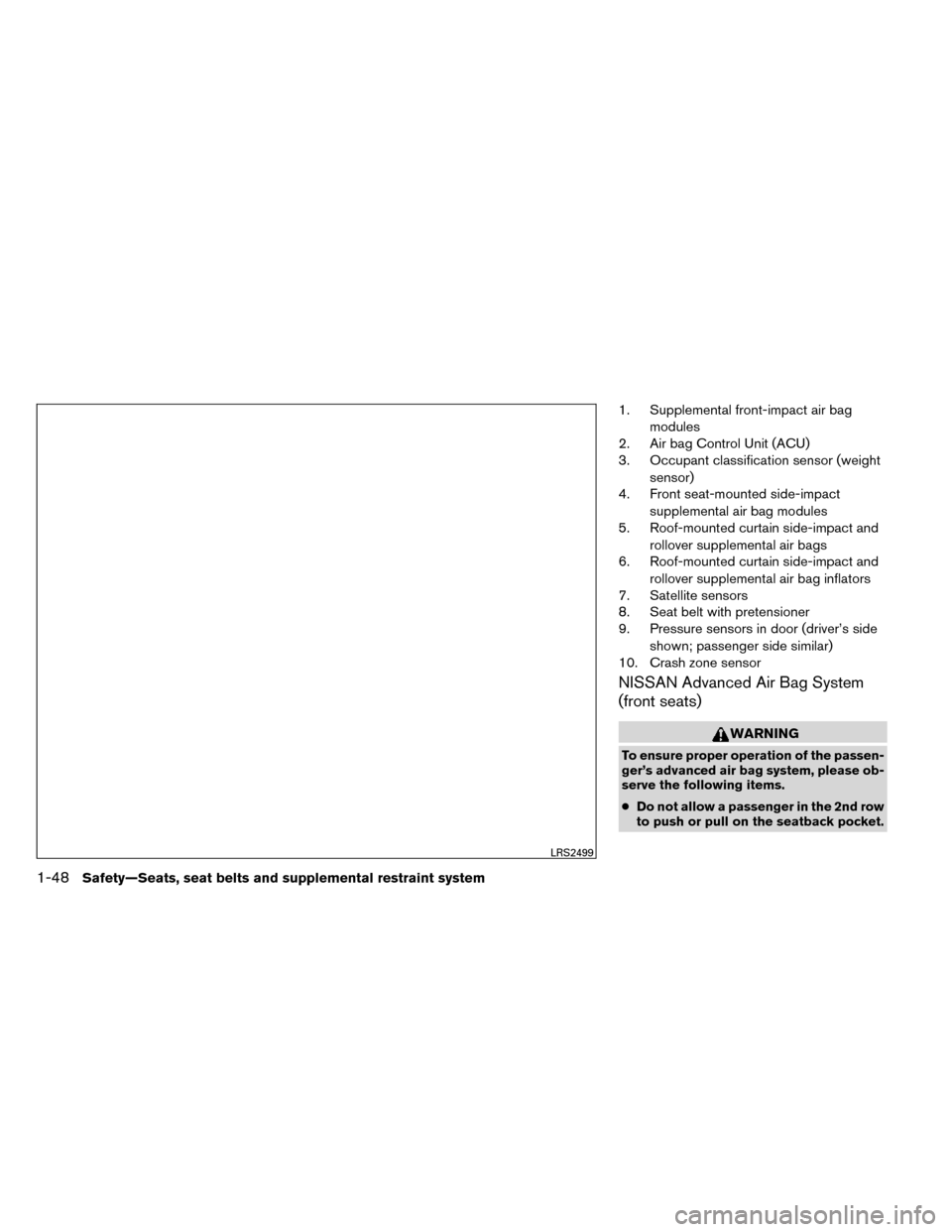
1. Supplemental front-impact air bagmodules
2. Air bag Control Unit (ACU)
3. Occupant classification sensor (weight
sensor)
4. Front seat-mounted side-impact
supplemental air bag modules
5. Roof-mounted curtain side-impact and
rollover supplemental air bags
6. Roof-mounted curtain side-impact and
rollover supplemental air bag inflators
7. Satellite sensors
8. Seat belt with pretensioner
9. Pressure sensors in door (driver’s side
shown; passenger side similar)
10. Crash zone sensor
NISSAN Advanced Air Bag System
(front seats)
WARNING
To ensure proper operation of the passen-
ger’s advanced air bag system, please ob-
serve the following items.
● Do not allow a passenger in the 2nd row
to push or pull on the seatback pocket.
LRS2499
1-48Safety—Seats, seat belts and supplemental restraint system
Page 80 of 442
●Modifying or tampering with the front
passenger seat may result in serious
personal injury. For example, do not
change the front seats by placing mate-
rial on the seat cushion or by installing
additional trim material, such as seat
covers, on the seat that are not specifi-
cally designed to assure proper air bag
operation. Additionally, do not stow any
objects under the front passenger seat
or the seat cushion and seatback. Such
objects may interfere with the proper
operation of the occupant classification
sensor (weight sensor) .
● No unauthorized changes should be
made to any components or wiring of
the seat belt system. This may affect the
front air bag system. Tampering with
the seat belt system may result in seri-
ous personal injury. ●
Work on and around the front air bag
system should be done by a NISSAN
dealer. Installation of electrical equip-
ment should also be done by a NISSAN
dealer. The Supplemental Restraint
System (SRS) wiring harnesses* should
not be modified or disconnected. Unau-
thorized electrical test equipment and
probing devices should not be used on
the air bag system.
● A cracked windshield should be re-
placed immediately by a qualified repair
facility. A cracked windshield could af-
fect the function of the supplemental air
bag system.
*The SRS wiring harness connectors are
yellow and orange for easy identification.
When selling your vehicle, we request that you
inform the buyer about the front air bag system
and guide the buyer to the appropriate sections
in this Owner’s Manual.
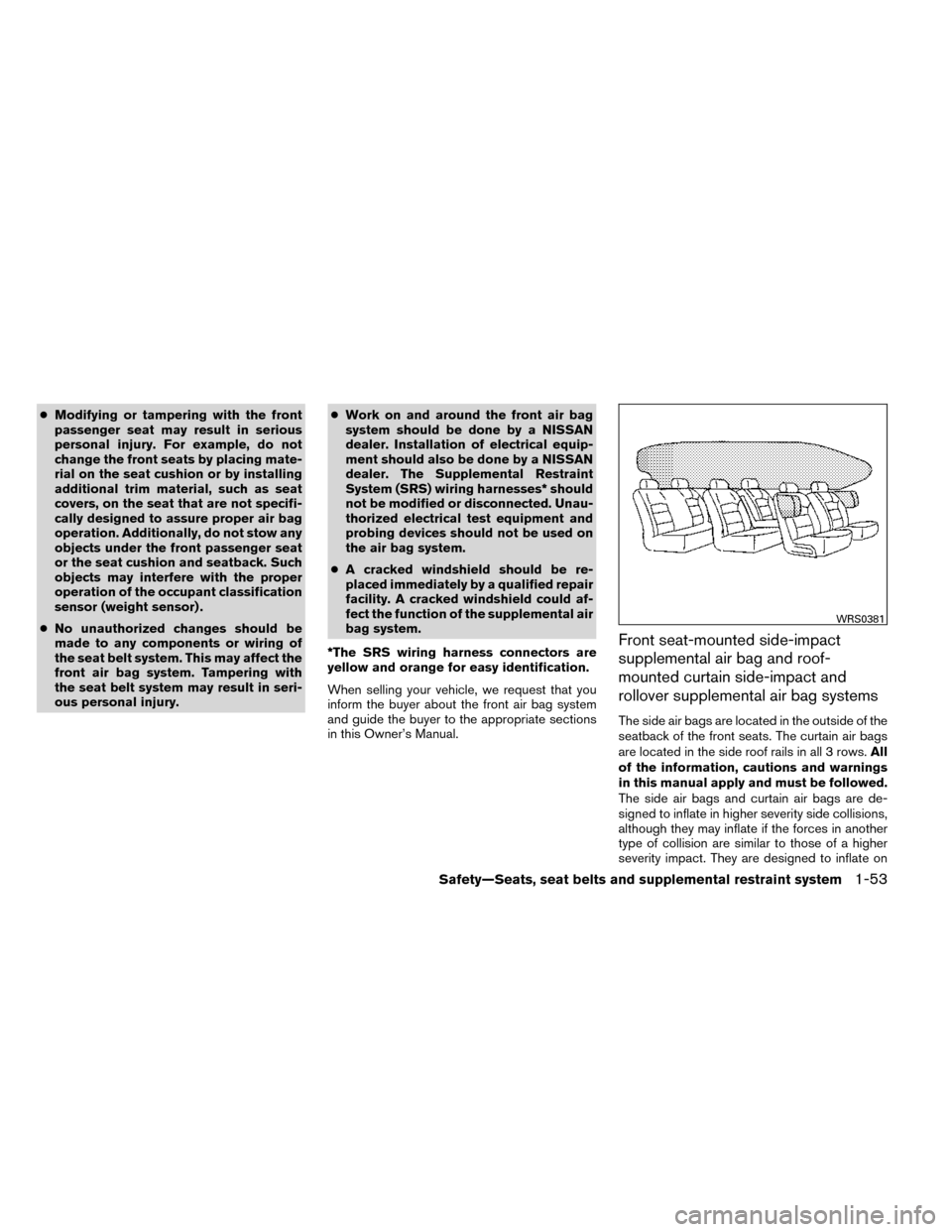
Front seat-mounted side-impact
supplemental air bag and roof-
mounted curtain side-impact and
rollover supplemental air bag systems
The side air bags are located in the outside of the
seatback of the front seats. The curtain air bags
are located in the side roof rails in all 3 rows. All
of the information, cautions and warnings
in this manual apply and must be followed.
The side air bags and curtain air bags are de-
signed to inflate in higher severity side collisions,
although they may inflate if the forces in another
type of collision are similar to those of a higher
severity impact. They are designed to inflate on
WRS0381
Safety—Seats, seat belts and supplemental restraint system1-53
Page 81 of 442
the side where the vehicle is impacted. They may
not inflate in certain side collisions.
Curtain air bags are also designed to inflate in
certain types of rollover collisions or near roll-
overs. As a result, certain vehicle movements (for
example, during severe off roading) may cause
the curtain air bags to inflate.
Vehicle damage (or lack of it) is not always an
indication of proper side air bag and curtain air
bag operation.
When the side air bags and curtain air bags
inflate, a fairly loud noise may be heard, followed
by release of smoke. This smoke is not harmful
and does not indicate a fire. Care should be taken
not to inhale it, as it may cause irritation and
choking. Those with a history of a breathing con-
dition should get fresh air promptly.
Side air bags, along with the use of seat belts,
help to cushion the impact force on the chest of
the front occupants. Curtain air bags help to
cushion the impact force to the head of occu-
pants in the front and rear outboard seating po-
sitions in all rows. They can help save lives and
reduce serious injuries. However, an inflating
side air bag or curtain air bag may cause abra-
sions or other injuries. Side air bags and curtain
air bags do not provide restraint to the lower
body.The seat belts should be correctly worn and the
driver and passenger seated upright as far as
practical away from the side air bag. Rear seat
passengers should be seated as far away as
practical from the door finishers and side roof
rails. The side air bags and curtain air bags inflate
quickly in order to help protect the occupants.
Because of this, the force of the side air bags and
curtain air bags inflating can increase the risk of
injury if the occupant is too close to, or is against,
these air bag modules during inflation. The side
air bag will deflate quickly after the collision is
over.
The curtain air bag will remain inflated for a short
time.
The side air bags and curtain air bags op-
erate only when the ignition switch is
placed in the ON position.
After placing the ignition switch in the ON
position, the supplemental air bag warning
light illuminates. The supplemental air bag
warning light will turn off after about 7 sec-
onds if the system is operational.WARNING
●
Do not place any objects near the seat-
back of the front seats. Also, do not
place any objects (an umbrella, bag,
etc.) between the front door finisher
and the front seat. Such objects may
become dangerous projectiles and
cause injury if a side air bag inflates.
● Right after inflation, several side air bag
and curtain air bag system components
will be hot. Do not touch them; you may
severely burn yourself.
● No unauthorized changes should be
made to any components or wiring of
the side air bag and curtain air bag
systems. This is to prevent damage to or
accidental inflation of the side air bag
and curtain air bag systems.
● Do not make unauthorized changes to
your vehicle’s electrical system, sus-
pension system or side panel. This
could affect proper operation of the cur-
tain air bag systems.
1-54Safety—Seats, seat belts and supplemental restraint system