service NISSAN ROGUE 2015 Owner´s Manual
[x] Cancel search | Manufacturer: NISSAN, Model Year: 2015, Model line: ROGUE, Model: NISSAN ROGUE 2015Pages: 440, PDF Size: 4.71 MB
Page 402 of 440
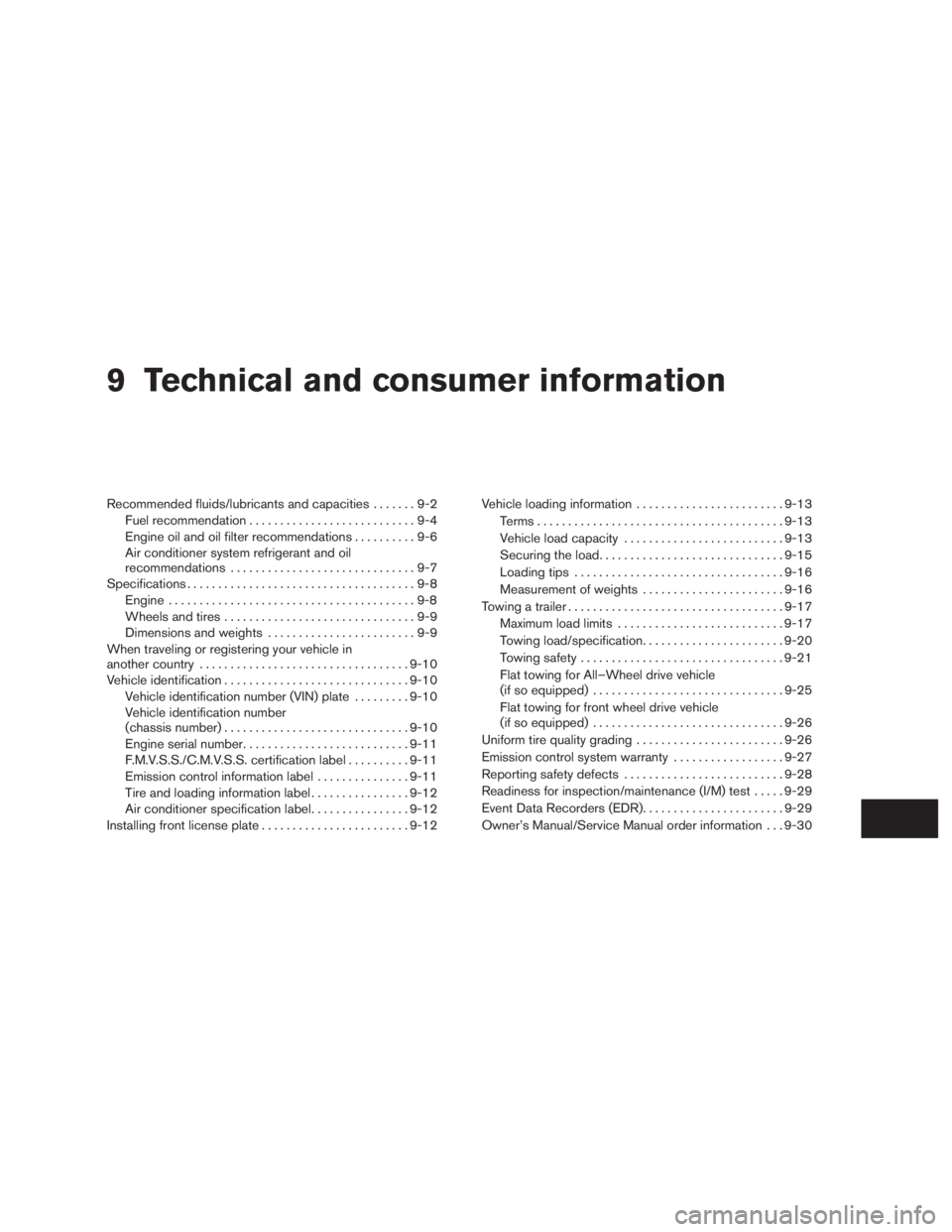
9 Technical and consumer information
Recommended fluids/lubricants and capacities.......9-2
Fuel recommendation ...........................9-4
Engine oil and oil filter recommendations ..........9-6
Air conditioner system refrigerant and oil
recommendations ..............................9-7
Specifications .....................................9-8
Engine ........................................9-8
Wheels and tires ...............................9-9
Dimensions and weights ........................9-9
When traveling or registering your vehicle in
another country .................................. 9-10
Vehicle identification .............................. 9-10
Vehicle identification number (VIN) plate .........9-10
Vehicle identification number
(chassis number) .............................. 9-10
Engine serial number ........................... 9-11
F.M.V.S.S./C.M.V.S.S. certification label ..........9-11
Emission control information label ...............9-11
Tire and loading information label ................9-12
Air conditioner specification label ................9-12
Installing front license plate ........................9-12Vehicle loading information
........................9-13
Terms ........................................ 9-13
Vehicle load capacity .......................... 9-13
Securing the load .............................. 9-15
Loading tips .................................. 9-16
Measurement of weights .......................9-16
Towing a trailer ................................... 9-17
Maximum load limits ........................... 9-17
Towing load/specification .......................9-20
Towing safety ................................. 9-21
Flat towing for All–Wheel drive vehicle
(if so equipped) ............................... 9-25
Flat towing for front wheel drive vehicle
(if so equipped) ............................... 9-26
Uniform tire quality grading ........................9-26
Emission control system warranty ..................9-27
Reporting safety defects .......................... 9-28
Readiness for inspection/maintenance (I/M) test .....9-29
Event Data Recorders (EDR) .......................9-29
Owner’s
Manual/Service Manual order information . . . 9-30
Page 404 of 440
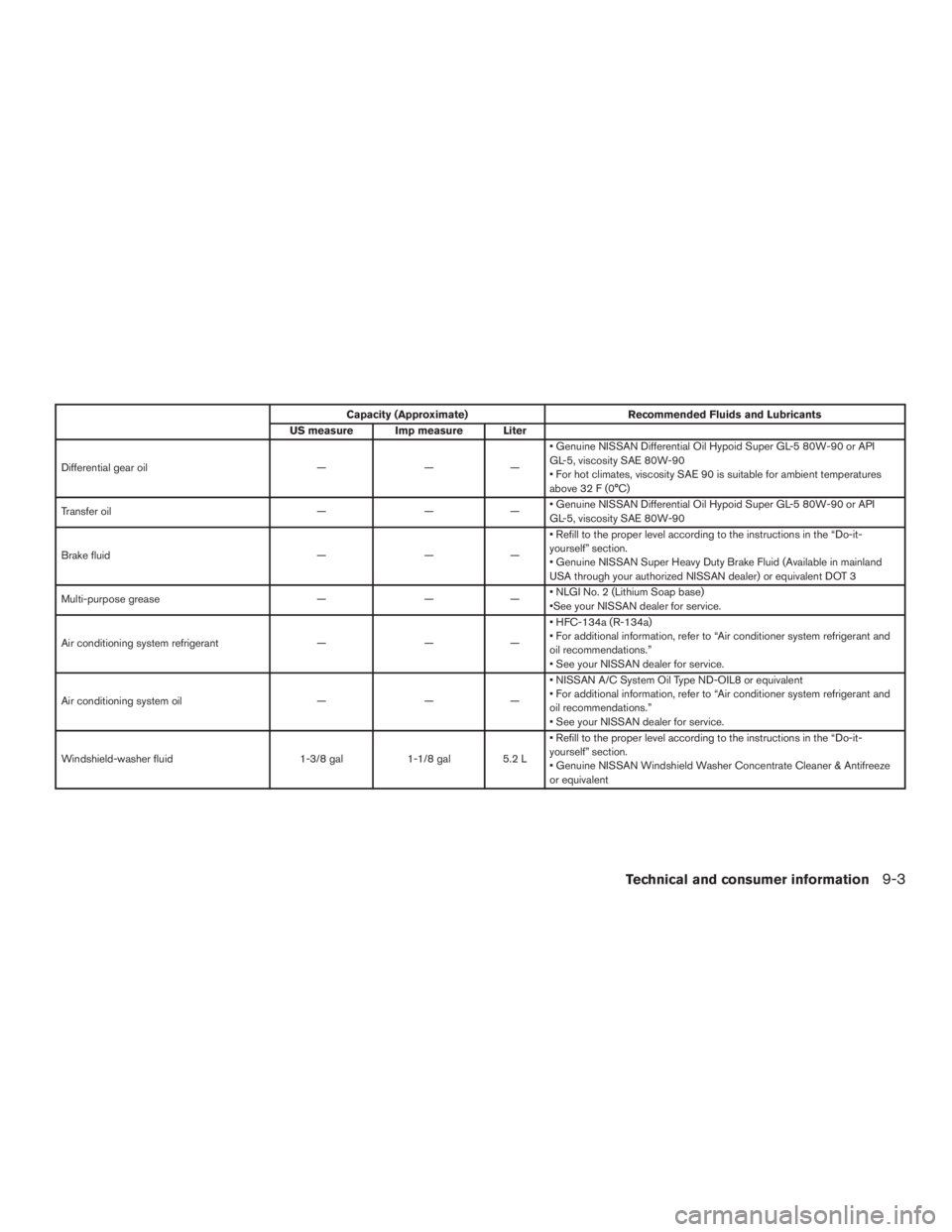
Capacity (Approximate)Recommended Fluids and Lubricants
US measure Imp measure Liter
Differential gear oil ———• Genuine NISSAN Differential Oil Hypoid Super GL-5 80W-90 or API
GL-5, viscosity SAE 80W-90
• For hot climates, viscosity SAE 90 is suitable for ambient temperatures
above 32 F (0°C)
Transfer oil ———• Genuine NISSAN Differential Oil Hypoid Super GL-5 80W-90 or API
GL-5, viscosity SAE 80W-90
Brake fluid ———• Refill to the proper level according to the instructions in the “Do-it-
yourself” section.
• Genuine NISSAN Super Heavy Duty Brake Fluid (Available in mainland
USA through your authorized NISSAN dealer) or equivalent DOT 3
Multi-purpose grease ———• NLGI No. 2 (Lithium Soap base)
•See your NISSAN dealer for service.
Air conditioning system refrigerant ———• HFC-134a (R-134a)
• For additional information, refer to “Air conditioner system refrigerant and
oil recommendations.”
• See your NISSAN dealer for service.
Air conditioning system oil ———• NISSAN A/C System Oil Type ND-OIL8 or equivalent
• For additional information, refer to “Air conditioner system refrigerant and
oil recommendations.”
• See your NISSAN dealer for service.
Windshield-washer fluid 1-3/8 gal1-1/8 gal 5.2 L • Refill to the proper level according to the instructions in the “Do-it-
yourself” section.
• Genuine NISSAN Windshield Washer Concentrate Cleaner & Antifreeze
or equivalent
Technical and consumer information9-3
Page 405 of 440
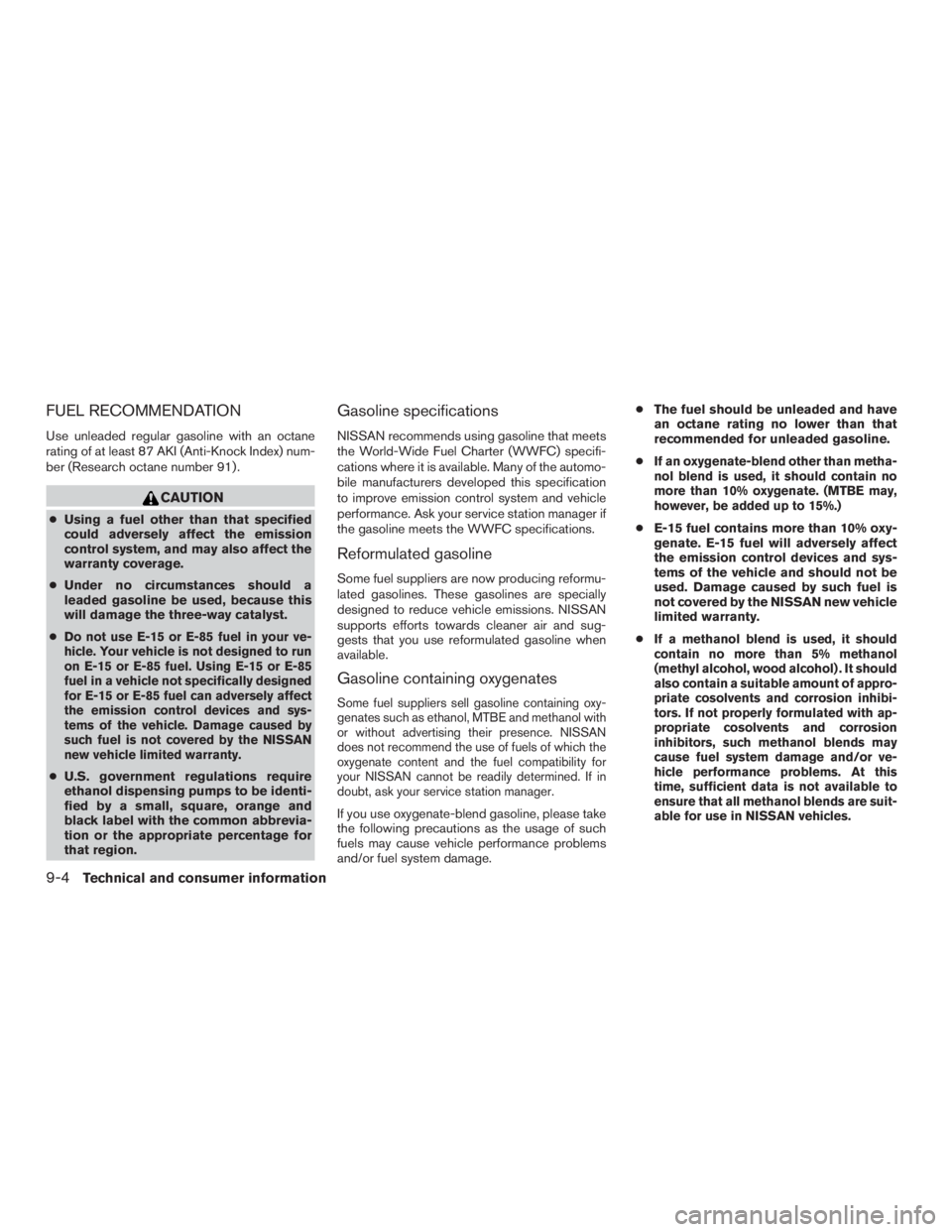
FUEL RECOMMENDATION
Use unleaded regular gasoline with an octane
rating of at least 87 AKI (Anti-Knock Index) num-
ber (Research octane number 91) .
CAUTION
●Using a fuel other than that specified
could adversely affect the emission
control system, and may also affect the
warranty coverage.
● Under no circumstances should a
leaded gasoline be used, because this
will damage the three-way catalyst.
●
Do not use E-15 or E-85 fuel in your ve-
hicle. Your vehicle is not designed to run
on E-15 or E-85 fuel. Using E-15 or E-85
fuel in a vehicle not specifically designed
for E-15 or E-85 fuel can adversely affect
the emission control devices and sys-
tems of the vehicle. Damage caused by
such fuel is not covered by the NISSAN
new vehicle limited warranty.
● U.S. government regulations require
ethanol dispensing pumps to be identi-
fied by a small, square, orange and
black label with the common abbrevia-
tion or the appropriate percentage for
that region.
Gasoline specifications
NISSAN recommends using gasoline that meets
the World-Wide Fuel Charter (WWFC) specifi-
cations where it is available. Many of the automo-
bile manufacturers developed this specification
to improve emission control system and vehicle
performance. Ask your service station manager if
the gasoline meets the WWFC specifications.
Reformulated gasoline
Some fuel suppliers are now producing reformu-
lated gasolines. These gasolines are specially
designed to reduce vehicle emissions. NISSAN
supports efforts towards cleaner air and sug-
gests that you use reformulated gasoline when
available.
Gasoline containing oxygenates
Some fuel suppliers sell gasoline containing oxy-
genates such as ethanol, MTBE and methanol with
or without advertising their presence. NISSAN
does not recommend the use of fuels of which the
oxygenate content and the fuel compatibility for
your NISSAN cannot be readily determined. If in
doubt, ask your service station manager.
If you use oxygenate-blend gasoline, please take
the following precautions as the usage of such
fuels may cause vehicle performance problems
and/or fuel system damage. ●
The fuel should be unleaded and have
an octane rating no lower than that
recommended for unleaded gasoline.
●
If an oxygenate-blend other than metha-
nol blend is used, it should contain no
more than 10% oxygenate. (MTBE may,
however, be added up to 15%.)
● E-15 fuel contains more than 10% oxy-
genate. E-15 fuel will adversely affect
the emission control devices and sys-
tems of the vehicle and should not be
used. Damage caused by such fuel is
not covered by the NISSAN new vehicle
limited warranty.
●
If a methanol blend is used, it should
contain no more than 5% methanol
(methyl alcohol, wood alcohol) . It should
also contain a suitable amount of appro-
priate cosolvents and corrosion inhibi-
tors. If not properly formulated with ap-
propriate cosolvents and corrosion
inhibitors, such methanol blends may
cause fuel system damage and/or ve-
hicle performance problems. At this
time, sufficient data is not available to
ensure that all methanol blends are suit-
able for use in NISSAN vehicles.
9-4Technical and consumer information
Page 408 of 440
Your engine was filled with a high-quality engine
oil when it was built. You do not have to change
the oil before the first recommended change
interval. Oil and filter change intervals depend
upon how you use your vehicle.
Operation under the following conditions may
require more frequent oil and filter changes:● repeated short distance driving at cold out-
side temperatures
● driving in dusty conditions
● extensive idling
● towing a trailer
● stop and go commuting
For additional information, refer to the “NISSAN
Service and Maintenance Guide” for the mainte-
nance schedule.
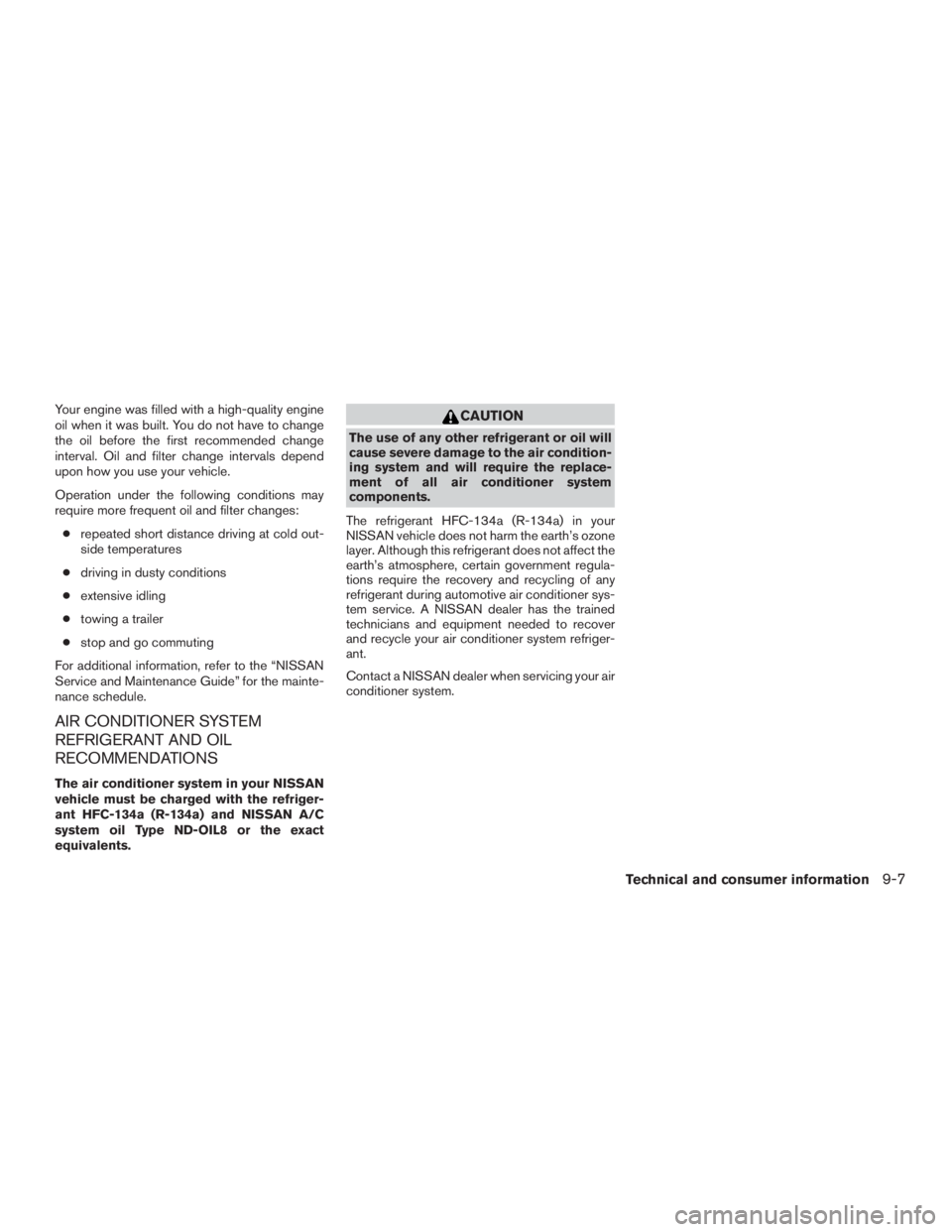
AIR CONDITIONER SYSTEM
REFRIGERANT AND OIL
RECOMMENDATIONS
The air conditioner system in your NISSAN
vehicle must be charged with the refriger-
ant HFC-134a (R-134a) and NISSAN A/C
system oil Type ND-OIL8 or the exact
equivalents.
CAUTION
The use of any other refrigerant or oil will
cause severe damage to the air condition-
ing system and will require the replace-
ment of all air conditioner system
components.
The refrigerant HFC-134a (R-134a) in your
NISSAN vehicle does not harm the earth’s ozone
layer. Although this refrigerant does not affect the
earth’s atmosphere, certain government regula-
tions require the recovery and recycling of any
refrigerant during automotive air conditioner sys-
tem service. A NISSAN dealer has the trained
technicians and equipment needed to recover
and recycle your air conditioner system refriger-
ant.
Contact a NISSAN dealer when servicing your air
conditioner system.
Technical and consumer information9-7
Page 426 of 440
●Have your vehicle serviced more often than
at intervals specified in the recommended
Maintenance Schedule in the “NISSAN Ser-
vice and Maintenance Guide”.
● When making a turn, your trailer wheels will
be closer to the inside of the turn than your
vehicle wheels. To compensate for this,
make a larger than normal turning radius
during the turn.
● Crosswinds and rough roads will adversely
affect vehicle/trailer handling, possibly caus-
ing vehicle sway. When being passed by
larger vehicles, be prepared for possible
changes in crosswinds that could affect ve-
hicle handling.
Do the following if the trailer begins to sway: 1. Take your foot off the accelerator pedal to allow the vehicle to coast and steer as
straight ahead as the road conditions allow.
This combination will help stabilize the ve-
hicle
– Do not correct trailer sway by steering or applying the brakes.
2. When the trailer sway stops, gently apply the brakes and pull to the side of the road in a
safe area. 3. Try to rearrange the trailer load so it is bal-
anced as described in this section.
● Be careful when passing other vehicles.
Passing while towing a trailer requires con-
siderably more distance than normal pass-
ing. Remember, the length of the trailer must
also pass the other vehicle before you can
safely change lanes.
● Downshift the transmission to a lower gear
for engine braking when driving down steep
or long hills. This will help slow the vehicle
without applying the brakes.
● Avoid holding the brake pedal down too long
or too frequently. This could cause the
brakes to overheat, resulting in reduced
braking efficiency.
● Increase your following distance to allow for
greater stopping distances while towing a
trailer. Anticipate stops and brake gradually.
● NISSAN recommends that the cruise con-
trol not be used while towing a trailer.
● Some states or provinces have specific
regulations and speed limits for vehicles that
are towing trailers. Obey the local speed
limits. ●
Check your hitch, trailer wiring harness con-
nections, and trailer wheel lug nuts after
50 miles (80 km) of travel and at every break.
● When launching a boat, don’t allow the wa-
ter level to go over the exhaust tail pipe or
rear bumper.
● Make sure you disconnect the trailer lights
before backing the trailer into the water or
the trailer lights may burn out.
When towing a trailer, final drive gear oil
should be replaced and transmission
oil/fluid should be changed more fre-
quently. For additional information, refer to
the “Maintenance and do-it-yourself” sec-
tion of this manual.
FLAT TOWING FOR ALL–WHEEL
DRIVE VEHICLE (if so equipped)
Towing your vehicle with all four wheels on the
ground is sometimes called flat towing. This
method is sometimes used when towing a vehicle
behind a recreational vehicle, such as a motor
home.
Technical and consumer information9-25
Page 427 of 440
CAUTION
●Failure to follow these guidelines can
result in severe transmission damage.
● Never flat tow your All-wheel drive
(AWD) vehicle.
● DO NOT tow your All-wheel drive (AWD)
vehicle with any wheels on the ground.
Doing so may cause serious and expen-
sive damage to the powertrain.
● For emergency towing procedures refer
to “Towing recommended by NISSAN”
in the “In case of emergency” section of
this manual.
FLAT TOWING FOR FRONT WHEEL
DRIVE VEHICLE (if so equipped)
Towing your vehicle with all four wheels on the
ground is sometimes called flat towing. This
method is sometimes used when towing a vehicle
behind a recreational vehicle, such as a motor
home.
CAUTION
● Failure to follow these guidelines can
result in severe transmission damage.
● Whenever flat towing your vehicle, al-
ways tow forward, never backward.
● Never tow your front wheel drive vehicle
with the front tires on the ground. Doing
so may cause serious and expensive
damage to the powertrain.
● DO NOT tow your front wheel drive con-
tinuously variable transmission vehicle
with all four wheels on the ground (flat
towing) . Doing so WILL DAMAGE inter-
nal transmission parts due to lack of
transmission lubrication.
● For emergency towing procedures refer
to “Towing recommended by NISSAN”
in the “In case of emergency” section of
this manual.
Continuously Variable Transmission
To tow a vehicle equipped with a continuously
variable transmission, an appropriate vehicle
dolly MUST be placed under the towed vehicle’s
drive wheels. Alwaysfollow the dolly manufac-
turer’s recommendations when using their prod-
uct. DOT (Department of Transportation) Quality
Grades: All passenger car tires must conform to
federal safety requirements in addition to these
grades.
Quality grades can be found where applicable on
the tire sidewall between tread shoulder and
maximum section width. For example:
Treadwear 200 Traction AA Temperature A
Treadwear
The treadwear grade is a comparative rating
based on the wear rate of the tire when tested
under controlled conditions on a specified gov-
ernment test course. For example, a tire graded
150 would wear one and one-half (1 1/2) times
as well on the government course as a tire graded
100. The relative performance of tires depends
upon the actual conditions of their use, however,
and may depart significantly from the norm due to
variations in driving habits, service practices and
differences in road characteristics and climate.
Traction AA, A, B and C
The traction grades, from highest to lowest, are
AA, A, B, and C. Those grades represent the
tire’s ability to stop on wet pavement as mea-
sured under controlled conditions on specified
government test surfaces of asphalt and con-
crete. A tire marked C may have poor traction
performance.
UNIFORM TIRE QUALITY GRADING
9-26Technical and consumer information
Page 431 of 440
the type of personally identifying data routinely
acquired during a crash investigation.
To read data recorded by an EDR, special equip-
ment is required and access to the vehicle or the
EDR is needed. In addition to the vehicle manu-
facturer and NISSAN dealer, other parties, such
as law enforcement, that have the special equip-
ment, can read the information if they have ac-
cess to the vehicle or the EDR. EDR data will only
be accessed with the consent of the vehicle
owner or lessee or as otherwise required or per-
mitted by law.Genuine NISSAN Service Manuals for this model
year and prior can be purchased. A Genuine
NISSAN Service Manual is the best source of
service and repair information for your vehicle.
This manual is the same one used by the factory-
trained technicians working at NISSAN dealer-
ships. Genuine NISSAN Owner’s Manuals can
also be purchased.
For USA
For current pricing and availability of Genuine
NISSAN Service Manuals, contact:
www.nissan-techinfo.com
For current pricing and availability of Genuine
NISSAN Owner’s Manuals, contact:
1-800-247-5321
For Canada
To purchase a copy of a Genuine NISSAN Ser-
vice Manual or Owner’s Manual, for this model
year and prior, please contact your nearest
NISSAN dealer. For the phone number and loca-
tion of a NISSAN dealer in your area, call the
NISSAN Information Center at 1-800-387-0122
and a bilingual NISSAN representative will assist
you.
OWNER’S MANUAL/SERVICE
MANUAL ORDER INFORMATION
9-30Technical and consumer information
Page 432 of 440
10 Index
2nd row bench seat adjustment.........1-6
A
Aiming control, headlights ...........2-36
Air bag (See supplemental restraint
system) .....................1-46
Air bag system Front (See supplemental front impact
air bag system) ...............1-53
Airbagwarninglabels.............1-63
Airbagwarninglight...........1-63,2-12
Air bag warning light, supplemental . .1-63, 2-12
Air cleaner housing filter ............8-17
Air conditioner Air conditioner operation ..........4-28
Air conditioner service ...........4-36
Air conditioner specification label .....9-12
Air conditioner system refrigerant and
oil recommendations .............9-7
Heater and air conditioner
controls................4-25,4-34
Servicing air conditioner ..........4-36
Airflowcharts..................4-29
Alarm system
(See vehicle security system) .........2-29
Anchor point locations .............1-29
Antenna .....................4-74
Antifreeze ....................5-51
Anti-lock brake warning light ..........2-8
Anti-lock Braking System (ABS) ........5-42
Apps .......................4-74 Armrests .....................1-8
AroundView®Monitor.............4-14
Audible reminders
...............2-15
Audio system ..................4-36
AMradioreception.............4-37
Bluetooth®audio..........4-70,4-71
Bluetooth® streaming audio ....4-70,4-71
Compact disc (CD) player . .4-46, 4-51, 4-58
FM/AM/SAT radio with compact disc (CD)
player .............4-44,4-48,4-53
FMradioreception.............4-36
iPod® Player .............4-64,4-67
iPod® player operation .......4-64,4-67
Radio ....................4-36
USB interface ............4-60,4-62
USB (Universal Serial Bus) Connection
Port..................4-60,4-62
Autolight switch .................2-35
Automatic Automatic power window switch .....2-53
Automatic door locks ..............3-7
AUXjack ....................4-60
B
Battery ..................5-51,8-14
Chargewarninglight.............2-9
Battery replacement Keyfob ...................8-24
NISSAN Intelligent Key® ......8-25,8-26
Before starting the engine ...........5-15
Belt (See drive belt) ..............8-16 Block heater
Engine ....................5-53
Bluetooth® audio ............4-70,4-71
Bluetooth® hands-free phone
system..................4-76,4-88
Bluetooth® streaming audio with Navigation
System .....................4-71
Boosterseats..................1-42
Brake Anti-lock Braking System (ABS) ......5-42
Brakelight(Seestoplight).........8-29
Brake system ................5-42
Brakewarninglight..............2-8
Brakewearindicators........2-15,8-21
Parking brake operation ..........5-21
Self-adjusting brakes ............8-21
Brakes ......................8-21
Brake system ..................5-42
Break-inschedule ...............5-35
Brightness/contrast button ...........4-9
Brightness control Instrument panel ..............2-37
Bulb check/instrument panel ..........2-8
Bulbreplacement................8-29
C
Capacities and recommended
fuel/lubricants ...................9-2
C
argolight ...................2-57
Cargo (See vehicle loading information) . . .9-13
Car phone or CB radio .............4-75
Page 436 of 440
O
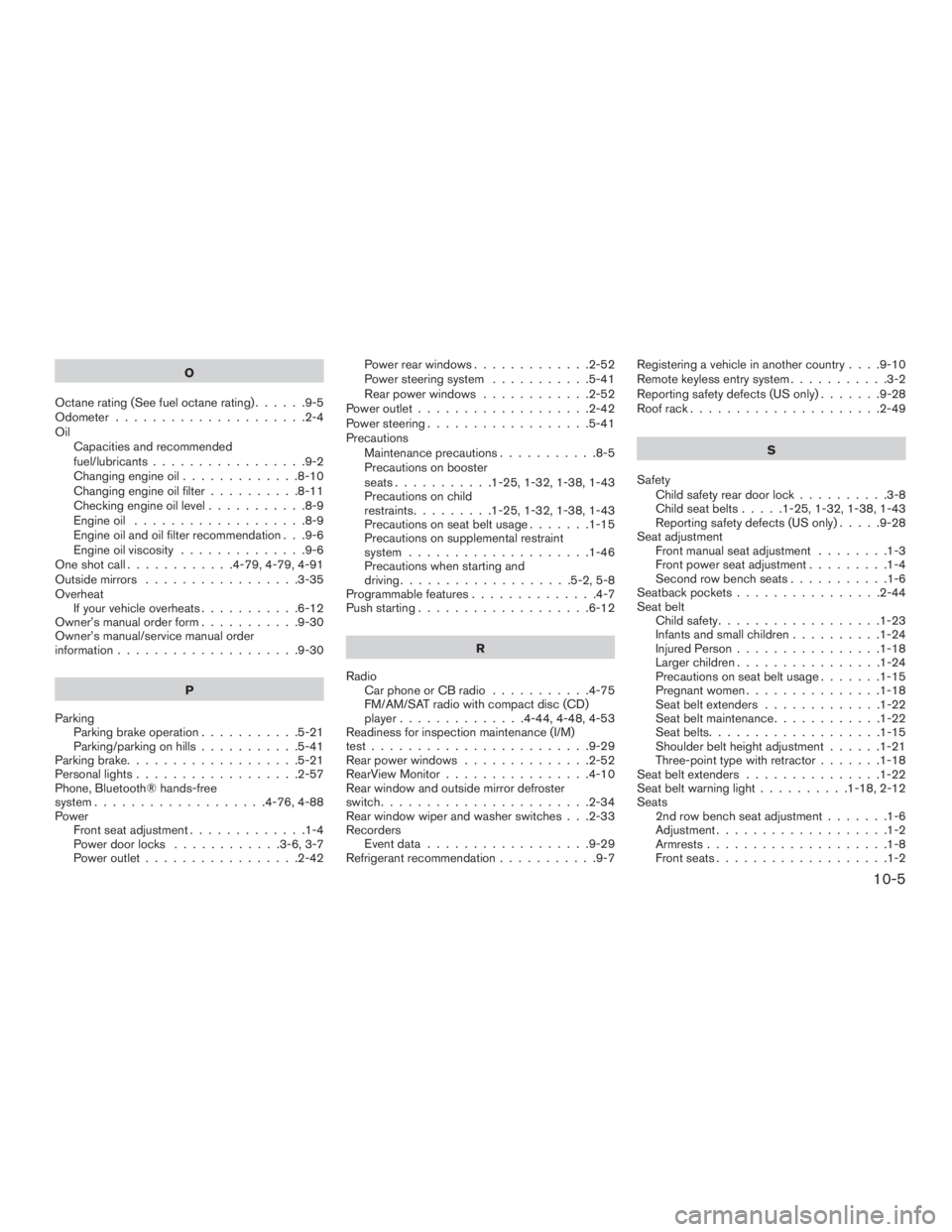
Octanerating(Seefueloctanerating)......9-5
Odometer .....................2-4
Oil Capacities and recommended
fuel/lubricants .................9-2
Changing engine oil .............8-10
Changing engine oil filter ..........8-11
Checking engine oil level ...........8-9
Engine oil ...................8-9
Engine oil and oil filter recommendation . . .9-6
Engine oil viscosity ..............9-6
Oneshotcall............4-79,4-79,4-91
Outside mirrors .................3-35
Overheat Ifyourvehicleoverheats...........6-12
Owner’s manual order form ...........9-30
Owner’s manual/service manual order
information ....................9-30
P
Parking Parking brake operation ...........5-21
Parking/parking on hills ...........5-41
Parking brake ...................5-21
Personallights..................2-57
Phone, Bluetooth® hands-free
system ...................4-76,4-88
Power Front seat adjustment .............1-4
Power door locks ............3-6,3-7
Power outlet .................2-42 Power rear windows
.............2-52
Power steering system ...........5-41
Rear power windows ............2-52
Power outlet ...................2-42
Power steering ..................5-41
Precautions Maintenance precautions ...........8-5
Precautions on booster
seats...........1-25,1-32,1-38,1-43
Precautions on child
restraints .........1-25,1-32,1-38,1-43
Precautions on seat belt usage .......1-15
Precautions on supplemental restraint
system ....................1-46
Precautions when starting and
driving ...................5-2,5-8
Programmablefeatures..............4-7
Push starting ...................6-12
R
Radio Car phone or CB radio ...........4-75
FM/AM/SAT radio with compact disc (CD)
player ..............4-44,4-48,4-53
Readiness for inspection maintenance (I/M)
test........................9-29
Rear power windows ..............2-52
RearView Monitor ................4-10
Rear window and outside mirror defroster
switch .......................2-34
Rear window wiper and washer switches . . .2-33
Recorders Eventdata..................9-29
Refrigerant recommendation ...........9-7Registering a vehicle in another country
....9-10
Remote keyless entry system ...........3-2
Reporting safety defects (US only) .......9-28
Roof rack .....................2-49
S
Safety Child safety rear door lock ..........3-8
Child seat belts .....1-25,1-32,1-38,1-43
Reporting safety defects (US only) .....9-28
Seat adjustment Front manual seat adjustment ........1-3
Front power seat adjustment .........
1-4
Secondrowbenchseats...........1-6
Seatbackpockets................2-44
Seat belt Child safety ..................1-23
Infants and small children ..........1-24
Injured Person ................1-18
Largerchildren................1-24
Precautions on seat belt usage .......1-15
Pregnant women ...............1-18
Seatbeltextenders .............1-22
Seatbeltmaintenance............1-22
Seatbelts...................1-15
Shoulder belt height adjustment ......1-21
Three-point type with retractor .......1-18
Seat belt extenders ...............1-22
Seatbeltwarninglight..........1-18,2-12
Seats 2nd row bench seat adjustment .......1-6
Adjustment ...................1-2
Armrests....................1-8
Frontseats...................1-2
10-5
Page 437 of 440
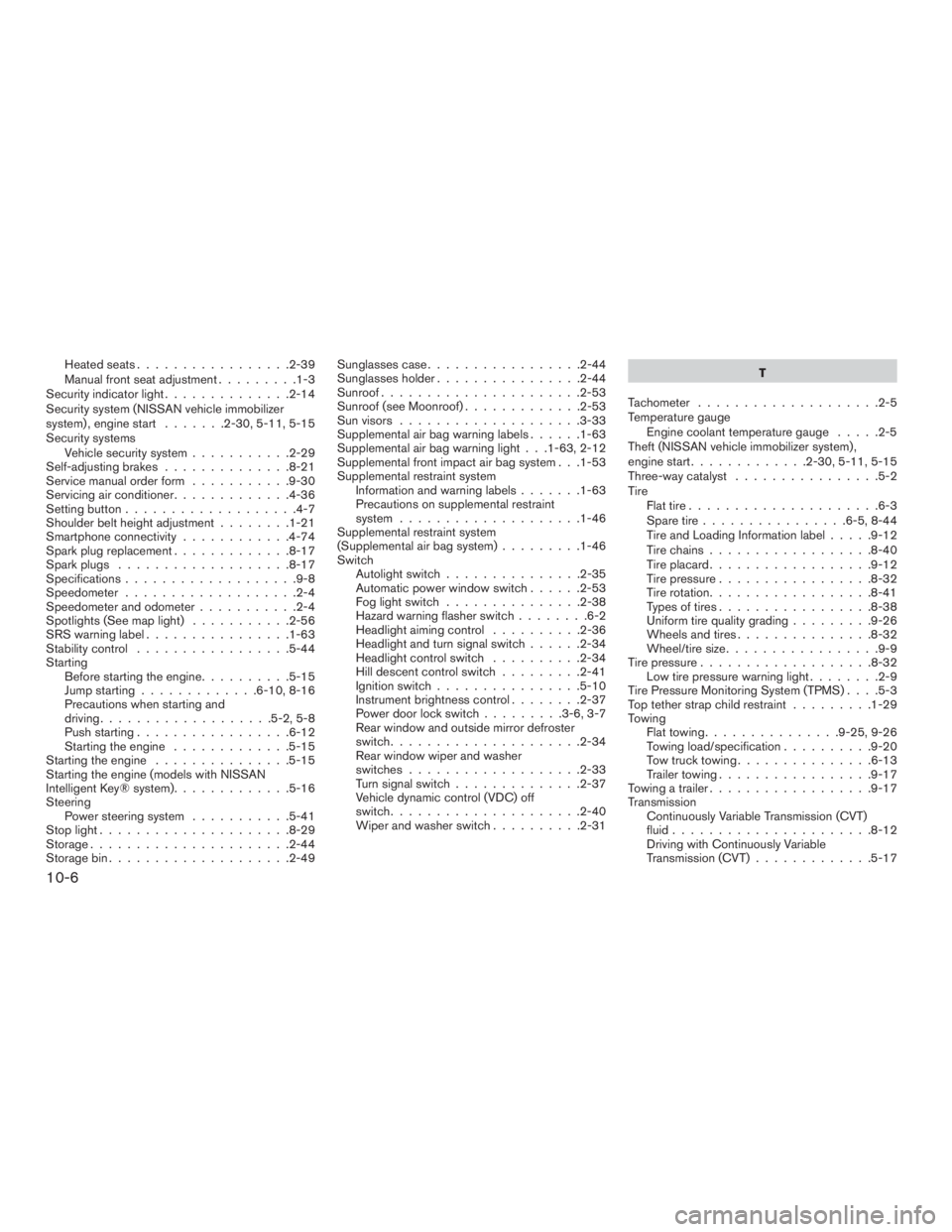
Heatedseats.................2-39
Manual front seat adjustment.........1-3
Security indicator light ..............2-14
Security system (NISSAN vehicle immobilizer
system) , engine start .......2-30,5-11,5-15
Security systems Vehicle security system ...........2-29
Self-adjusting brakes ..............8-21
Service manual order form ...........9-30
Servicing air conditioner .............4-36
Setting button ...................4-7
Shoulder belt height adjustment ........1-21
Smartphone connectivity ............4-74
Spark plug replacement .............8-17
Spark plugs ...................8-17
Specifications ...................9-8
Speedometer ...................2-4
Speedometer and odometer ...........2-4
Spotlights(Seemaplight) ...........2-56
SRS warning label ................1-63
Stability control .................5-44
Starting Before starting the engine ..........5-15
Jump starting .............6-10,8-16
Precautions when starting and
driving ...................5-2,5-8
Push starting .................6-12
Starting the engine .............5-15
Starting the engine ...............5-15
Starting the engine (models with NISSAN
Intelligent Key® system) .............5-16
Steering Power steering system ...........5-41
Stoplight.....................8-29
Storage......................2-44
Storagebin....................2-49 Sunglassescase.................2-44
Sunglassesholder................2-44
Sunroof......................2-53
Sunroof(seeMoonroof).............2-53
Sun visors
....................3-33
Supplemental air bag warning labels ......1-63
Supplemental air bag warning light . . .1-63, 2-12
Supplemental front impact air bag system . . .1-53
Supplemental restraint system Information and warning labels .......1-63
Precautions on supplemental restraint
system ....................1-46
Supplemental restraint system
(Supplemental air bag system) .........1-46
Switch Autolightswitch...............2-35
Automatic power window switch ......2-53
Foglightswitch ...............2-38
Hazard warning flasher switch ........6-2
Headlightaimingcontrol ..........2-36
Headlight and turn signal switch ......2-34
Headlight control switch ..........2-34
Hill descent control switch .........2-41
Ignition switch ................5-10
Instrument brightness control ........2-37
Power door lock switch .........3-6,3-7
Rear window and outside mirror defroster
switch.....................2-34
Rear window wiper and washer
switches...................2-33
Turn signal switch ..............2-37
Vehicle dynamic control (VDC) off
switch.....................2-40
Wiperandwasherswitch..........2-31 T
Tachometer ....................2-5
Temperature gauge Engine coolant temperature gauge .....2-5
Theft (NISSAN vehicle immobilizer system) ,
engine start .............2-30,5-11,5-15
Three-way catalyst ................5-2
Tire Flat tire .....................6-3
Spare tire ................
6-5,8-44
Tire and Loading Information label .....9-12
Tire chains ..................8-40
Tire placard ..................9-12
Tire pressure .................8-32
Tire rotation..................8-41
Types of tires .................8-38
Uniform tire quality grading .........9-26
Wheels and tires ...............8-32
Wheel/tire size .................9-9
Tirepressure...................8-32 Low tire pressure warning light ........2-9
Tire Pressure Monitoring System (TPMS) ....5-3
Top tether strap child restraint .........1-29
Towing Flattowing...............9-25,9-26
Towing load/specification ..........9-20
Towtrucktowing...............6-13
Trailer towing .................9-17
Towing a trailer ..................9-17
Transmission Continuously Variable Transmission (CVT)
fluid......................8-12
Driving with Continuously Variable
Transmission (CVT) .............5-17
10-6