steering NISSAN ROGUE 2015 Owner´s Manual
[x] Cancel search | Manufacturer: NISSAN, Model Year: 2015, Model line: ROGUE, Model: NISSAN ROGUE 2015Pages: 440, PDF Size: 4.71 MB
Page 348 of 440
3. Get out of the vehicle. Look and listen forsteam or coolant escaping from the radiator
before opening the hood. If steam or coolant
is escaping, turn off the engine. Do not open
the hood further until no steam or coolant
can be seen.
4. Open the engine hood.
WARNING
If steam or water is coming from the en-
gine, stand clear to prevent getting
burned.
5. Visually check drive belts for damage or looseness. Also check if the cooling fan is
running. The radiator hoses and radiator
should not leak water. If coolant is leaking,
the water pump belt is missing or loose, or
the cooling fan does not run, stop the en-
gine.
WARNING
Be careful not to allow your hands, hair,
jewelry or clothing to come into contact
with, or get caught in, engine belts or the
engine cooling fan. The engine cooling fan
can start at any time. 6. After the engine cools down, check the cool-
ant level in the engine coolant reservoir tank
with the engine running. Add coolant to the
engine coolant reservoir tank if necessary.
Have your vehicle repaired at a NISSAN
dealer. When towing your vehicle, all jurisdictional and
local regulations for towing must be followed.
Incorrect towing equipment could damage your
vehicle. Towing instructions are available from a
NISSAN dealer. Local service operators are gen-
erally familiar with the applicable laws and proce-
dures for towing. To assure proper towing and to
prevent accidental damage to your vehicle,
NISSAN recommends having a service operator
tow your vehicle. It is advisable to have the ser-
vice operator carefully read the following precau-
tions:
WARNING
●
Never ride in a vehicle that is being
towed.
● Never get under your vehicle after it has
been lifted by a tow truck.
CAUTION
● When towing, make sure that the trans-
mission, axles, steering system and
powertrain are in working condition. If
any of these conditions apply, dollies or
a flatbed tow truck must be used.
● Always attach safety chains before
towing.
TOWING YOUR VEHICLE
In case of emergency6-13
Page 350 of 440
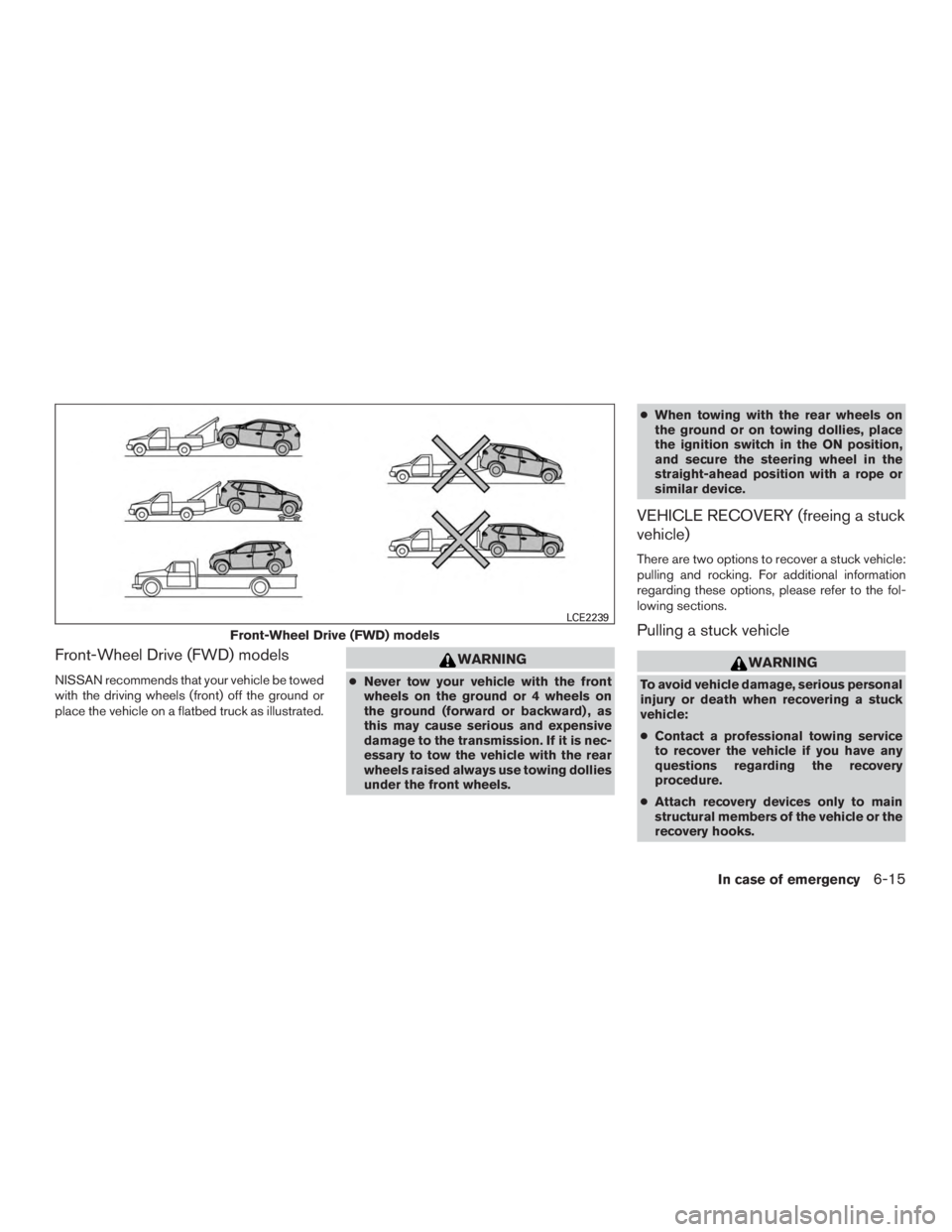
Front-Wheel Drive (FWD) models
NISSAN recommends that your vehicle be towed
with the driving wheels (front) off the ground or
place the vehicle on a flatbed truck as illustrated.
WARNING
●Never tow your vehicle with the front
wheels on the ground or 4 wheels on
the ground (forward or backward) , as
this may cause serious and expensive
damage to the transmission. If it is nec-
essary to tow the vehicle with the rear
wheels raised always use towing dollies
under the front wheels. ●
When towing with the rear wheels on
the ground or on towing dollies, place
the ignition switch in the ON position,
and secure the steering wheel in the
straight-ahead position with a rope or
similar device.
VEHICLE RECOVERY (freeing a stuck
vehicle)
There are two options to recover a stuck vehicle:
pulling and rocking. For additional information
regarding these options, please refer to the fol-
lowing sections.
Pulling a stuck vehicle
WARNING
To avoid vehicle damage, serious personal
injury or death when recovering a stuck
vehicle:
● Contact a professional towing service
to recover the vehicle if you have any
questions regarding the recovery
procedure.
● Attach recovery devices only to main
structural members of the vehicle or the
recovery hooks.
Front-Wheel Drive (FWD) models
LCE2239
In case of emergency6-15
Page 351 of 440
●Do not use the vehicle tie-downs to tow
or free a stuck vehicle.
● Only use devices specifically designed
for vehicle recovery and follow the
manufacturer’s instructions.
● Always pull the recovery device straight
out from the front of the vehicle. Never
pull at an angle.
● Route recovery devices so they do not
touch any part of the vehicle except the
attachment point.
If your vehicle is stuck in sand, snow, mud, etc.,
use a tow strap or other device designed specifi-
cally for vehicle recovery. Always follow the
manufacturer’s instructions for the recovery de-
vice.
NOTE:
Do not use the tie-down hooks for towing
or vehicle recovery.Rocking a stuck vehicle
WARNING
● Stand clear of a stuck vehicle.
● Do not spin your tires at high speed.
This could cause them to explode and
result in serious injury. Parts of your
vehicle could also overheat and be
damaged.
If your vehicle is stuck in sand, snow, mud, etc.,
use the following procedure: 1. Turn off the Vehicle Dynamic Control (VDC) system.
2. Make sure the area in front and behind the vehicle is clear of obstructions.
3. Turn the steering wheel right and left to clear an area around the front tires.
4. Slowly rock the vehicle forward and back- ward.
● Shift back and forth between R (Reverse)
and D (Drive) .
● Apply the accelerator as little as possible
to maintain the rocking motion. ●
Release the accelerator pedal before
shifting between R and D.
● Do not spin the tires above 35 mph
(55 km/h).
5. If the vehicle cannot be freed after a few tries, contact a professional towing service
to remove the vehicle.
6-16In case of emergency
Page 360 of 440
When driving in areas using road salt or other
corrosive materials, check lubrication frequently.
Lights*Clean the headlights on a regular basis.
Make sure that the headlights, stop lights, tail
lights, turn signal lights, and other lights are all
operating properly and installed securely. Also
check headlight aim.
Road wheel nuts (lug nuts)* When checking
the tires, make sure no wheel nuts are missing,
and check for any loose wheel nuts. Tighten if
necessary.
Tire rotation* Tires should be rotated every
5,000 miles (8,000 km).
Tires* Check the pressure with a gauge often
and always prior to long distance trips. If neces-
sary, adjust the pressure in all tires, including the
spare, to the pressure specified. Check carefully
for damage, cuts or excessive wear.
Tire Pressure Monitoring System (TPMS)
transmitter components Replace the TPMS
transmitter grommet seal, valve core and cap
when the tires are replaced due to wear or age.
Wheel alignment and balance If the vehicle
should pull to either side while driving on a
straight and level road, or if you detect uneven or
abnormal tire wear, there may be a need for wheel alignment. If the steering wheel or seat vibrates at
normal highway speeds, wheel balancing may be
needed.
● For additional information regarding tires,
refer to “Important Tire Safety Information”
(US) or “Tire Safety Information” (Canada) in
the Warranty Information Booklet.
Windshield Clean the windshield on a regular
basis. Check the windshield at least every six
months for cracks or other damage. Have a dam-
aged windshield repaired by a qualified repair
facility.
Windshield wiper blades* Check for cracks or
wear if they do not wipe properly.
Inside the vehicle
The maintenance items listed here should be
checked on a regular basis, such as when per-
forming periodic maintenance, cleaning the ve-
hicle, etc.
Additional information on the following
items with an “*” is found in this section.
Accelerator pedal Check the pedal for smooth
operation and make sure the pedal does not bind
or require uneven effort. Keep the floor mat away
from the pedal.
Brake pedal Check the pedal for smooth opera-
tion. If the brake pedal suddenly goes down fur- ther than normal, the pedal feels spongy or the
vehicle seems to take longer to stop, see a
NISSAN dealer immediately. Keep the floor mat
away from the pedal.
Brakes
Check that the brakes do not pull the
vehicle to one side when applied.
Continuously Variable Transmission (CVT)
P (Park) position mechanism On a fairly
steep hill check that your vehicle is held securely
with the shift lever in the P (Park) position without
applying any brakes.
Parking brake Check the parking brake opera-
tion regularly. The vehicle should be securely held
on a fairly steep hill with only the parking brake
applied. If the parking brake needs adjustment,
see a NISSAN dealer.
Seats Check seat position controls such as seat
adjusters, seatback recliner, etc. to ensure they
operate smoothly and all latches lock securely in
every position. Check that the head
restraints/headrests move up and down
smoothly and the locks (if so equipped) hold
securely in all latched positions.
Seat belts Check that all parts of the seat belt
system (for example, buckles, anchors, adjusters
and retractors) operate properly and smoothly,
and are installed securely. Check the belt web-
bing for cuts, fraying, wear or damage.
Maintenance and do-it-yourself8-3
Page 361 of 440
Steering wheelCheck for changes in the steer-
ing system, such as excessive freeplay, hard
steering or strange noises.
Warning lights and chimes Make sure all
warning lights and chimes are operating properly.
Windshield wiper and washer* Check that
the wipers and washer operate properly and that
the wipers do not streak.
Windshield defroster Check that the air
comes out of the defroster outlets properly and in
sufficient quantity when operating the heater or
air conditioner.
Under the hood and vehicle
The maintenance items listed here should be
checked periodically (for example, each time you
check the engine oil or refuel) .
Battery* Check the fluid level in each cell. It
should be between the MAX and MIN lines. Ve-
hicles operated in high temperatures or under
severe conditions require frequent checks of the
battery fluid level. NOTE:
Care should be taken to avoid situations
that can lead to potential battery discharge
and potential no-start conditions such as:
1. Installation or extended use of electronic ac-
cessories that consume battery power when the
engine is not running (Phone chargers, GPS,
DVD players, etc.)
2. Vehicle is not driven regularly and/or only
driven short distances. In these cases, the battery
may need to be charged to maintain battery
health.
Brake fluid level*
Make sure that the brake fluid
level is between the MIN and MAX lines on the
reservoir.
Engine coolant level* Check the coolant level
when the engine is cold.
Engine drive belts* Make sure the drive belts
are not frayed, worn, cracked or oily.
Engine oil level* Check the level after parking
the vehicle on a level surface with the engine off.
Wait more than 10 minutes for the oil to drain
back into the oil pan.
Exhaust system Make sure there are no loose
supports, cracks or holes. If the sound of the
exhaust seems unusual or there is a smell of
exhaust fumes, immediately have the exhaust system inspected by a NISSAN dealer. For addi-
tional information, refer to Exhaust Gas (carbon
monoxide) warning in the “Starting and driving”
section of this manual.
Fluid leaks
Check under the vehicle for fuel, oil,
water or other fluid leaks after the vehicle has
been parked for a while. Water dripping from the
air conditioner after use is normal. If you should
notice any leaks or if gasoline fumes are evident,
check for the cause and have it corrected imme-
diately.
Radiator and hoses Check the front of the
radiator and clean off any dirt, insects, leaves,
etc., that may have accumulated. Make sure the
hoses have no cracks, deformation, rot or loose
connections.
Underbody The underbody is frequently ex-
posed to corrosive substances such as those
used on icy roads or to control dust. It is very
important to remove these substances from the
underbody, otherwise rust may form on the floor
pan, frame, fuel lines and exhaust system. At the
end of winter, the underbody should be thor-
oughly flushed with plain water, in those areas
where mud and dirt may have accumulated. For
additional information, refer to “Appearance and
care” section of this manual.
Windshield-washer fluid* Check that there is
adequate fluid in the reservoir.
8-4Maintenance and do-it-yourself
Page 418 of 440
WARNING
Overloading or improper loading of a
trailer and its cargo can adversely affect
vehicle handling, braking and perfor-
mance and may lead to accidents.
CAUTION
●Do not tow a trailer or haul a heavy load
for the first 500 miles (805 km) . Your
engine, axle or other parts could be
damaged.
● For the first 500 miles (805 km) that you
tow a trailer, do not drive over 50 mph
(80 km/h) and do not make starts at full
throttle. This helps the engine and other
parts of your vehicle wear in at the
heavier loads.
Your new vehicle was designed to be used pri-
marily to carry passengers and cargo. Remember
that towing a trailer places additional loads on
your vehicle’s engine, drive train, steering, brak-
ing and other systems.
A NISSAN Towing Guide (U.S. only) is available
on the website at www.nissanusa.com. This
guide includes information on trailer towing ca-
pability and the special equipment required for
proper towing.
MAXIMUM LOAD LIMITS
Maximum trailer loads
Never allow the total trailer load to exceed the
value specified in the “Towing
Load/Specification” chart found in this section.
The total trailer load equals trailer weight plus its
cargo weight.
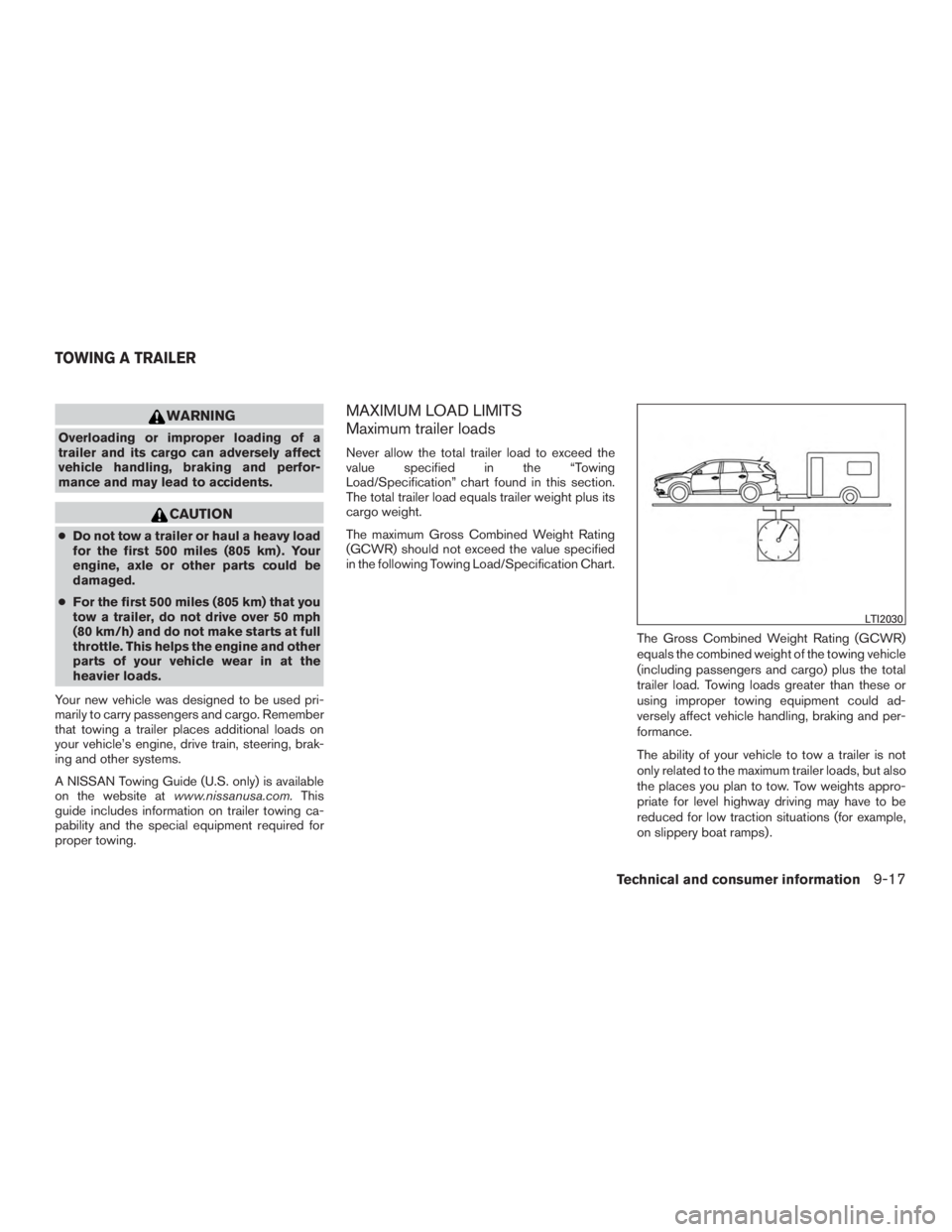
The maximum Gross Combined Weight Rating
(GCWR) should not exceed the value specified
in the following Towing Load/Specification Chart.
The Gross Combined Weight Rating (GCWR)
equals the combined weight of the towing vehicle
(including passengers and cargo) plus the total
trailer load. Towing loads greater than these or
using improper towing equipment could ad-
versely affect vehicle handling, braking and per-
formance.
The ability of your vehicle to tow a trailer is not
only related to the maximum trailer loads, but also
the places you plan to tow. Tow weights appro-
priate for level highway driving may have to be
reduced for low traction situations (for example,
on slippery boat ramps) .
LTI2030
TOWING A TRAILER
Technical and consumer information9-17
Page 425 of 440
●Determine the overall height of the vehicle
and trailer so the required clearance is
known.
Trailer towing tips
In order to gain skill and an understanding of the
vehicle’s behavior, you should practice turning,
stopping and backing up in an area which is free
from traffic. Steering stability and braking perfor-
mance will be somewhat different than under
normal driving conditions.
● Always secure items in the trailer to prevent
load shift while driving.
● Lock the trailer hitch coupler with a pin or
lock to prevent the coupler from inadver-
tently becoming unlatched.
● Avoid abrupt starts, acceleration or stops.
● Avoid sharp turns or lane changes.
● Always drive your vehicle at a moderate
speed.
● When backing up, hold the bottom of the
steering wheel with one hand. Move your
hand in the direction in which you want the
trailer to go. Make small corrections and
back up slowly. If possible, have someone
guide you when you are backing up. Always block the wheels on both vehicle and
trailer when parking. Parking on a slope is not
recommended; however, if you must do so:
CAUTION
If you move the shift lever to the P (Park)
position before blocking the wheels and
applying the parking brake, transmission
damage could occur.
1. Apply and hold the brake pedal.
2. Have someone place blocks on the downhill side of the vehicle and trailer wheels.
3. After the wheel blocks are in place, slowly release the brake pedal until the blocks ab-
sorb the vehicle load.
4. Apply the parking brake.
5. Shift the transmission into P (Park) .
6. Turn off the engine.
To drive away: 1. Start the vehicle.
2. Apply and hold the brake pedal.
3. Shift the transmission into gear.
4. Release the parking brake. 5. Drive slowly until the vehicle and trailer are
clear from the blocks.
6. Apply and hold the brake pedal.
7. Have someone retrieve and store the blocks. ● While going downhill, the weight of the
trailer pushing on the tow vehicle may de-
crease overall stability. Therefore, to main-
tain adequate control, reduce your speed
and shift to a lower gear. Avoid long or
repeated use of the brakes when descend-
ing a hill, as this reduces their effectiveness
and could cause overheating. Shifting to a
lower gear instead provides “engine brak-
ing” and reduces the need to brake as fre-
quently.
● If the engine coolant temperature rises to a
high temperature, refer to “If your vehicle
overheats” in the “In case of emergency”
section of this owner’s manual.
● Trailer towing requires more fuel than normal
circumstances.
● Avoid towing a trailer for your vehicle’s first
500 miles (805 km) .
● For the first 500 miles (805 km) that you do
tow, do not drive over 50 MPH (80 km/h).
9-24Technical and consumer information
Page 426 of 440
●Have your vehicle serviced more often than
at intervals specified in the recommended
Maintenance Schedule in the “NISSAN Ser-
vice and Maintenance Guide”.
● When making a turn, your trailer wheels will
be closer to the inside of the turn than your
vehicle wheels. To compensate for this,
make a larger than normal turning radius
during the turn.
● Crosswinds and rough roads will adversely
affect vehicle/trailer handling, possibly caus-
ing vehicle sway. When being passed by
larger vehicles, be prepared for possible
changes in crosswinds that could affect ve-
hicle handling.
Do the following if the trailer begins to sway: 1. Take your foot off the accelerator pedal to allow the vehicle to coast and steer as
straight ahead as the road conditions allow.
This combination will help stabilize the ve-
hicle
– Do not correct trailer sway by steering or applying the brakes.
2. When the trailer sway stops, gently apply the brakes and pull to the side of the road in a
safe area. 3. Try to rearrange the trailer load so it is bal-
anced as described in this section.
● Be careful when passing other vehicles.
Passing while towing a trailer requires con-
siderably more distance than normal pass-
ing. Remember, the length of the trailer must
also pass the other vehicle before you can
safely change lanes.
● Downshift the transmission to a lower gear
for engine braking when driving down steep
or long hills. This will help slow the vehicle
without applying the brakes.
● Avoid holding the brake pedal down too long
or too frequently. This could cause the
brakes to overheat, resulting in reduced
braking efficiency.
● Increase your following distance to allow for
greater stopping distances while towing a
trailer. Anticipate stops and brake gradually.
● NISSAN recommends that the cruise con-
trol not be used while towing a trailer.
● Some states or provinces have specific
regulations and speed limits for vehicles that
are towing trailers. Obey the local speed
limits. ●
Check your hitch, trailer wiring harness con-
nections, and trailer wheel lug nuts after
50 miles (80 km) of travel and at every break.
● When launching a boat, don’t allow the wa-
ter level to go over the exhaust tail pipe or
rear bumper.
● Make sure you disconnect the trailer lights
before backing the trailer into the water or
the trailer lights may burn out.
When towing a trailer, final drive gear oil
should be replaced and transmission
oil/fluid should be changed more fre-
quently. For additional information, refer to
the “Maintenance and do-it-yourself” sec-
tion of this manual.
FLAT TOWING FOR ALL–WHEEL
DRIVE VEHICLE (if so equipped)
Towing your vehicle with all four wheels on the
ground is sometimes called flat towing. This
method is sometimes used when towing a vehicle
behind a recreational vehicle, such as a motor
home.
Technical and consumer information9-25
Page 436 of 440
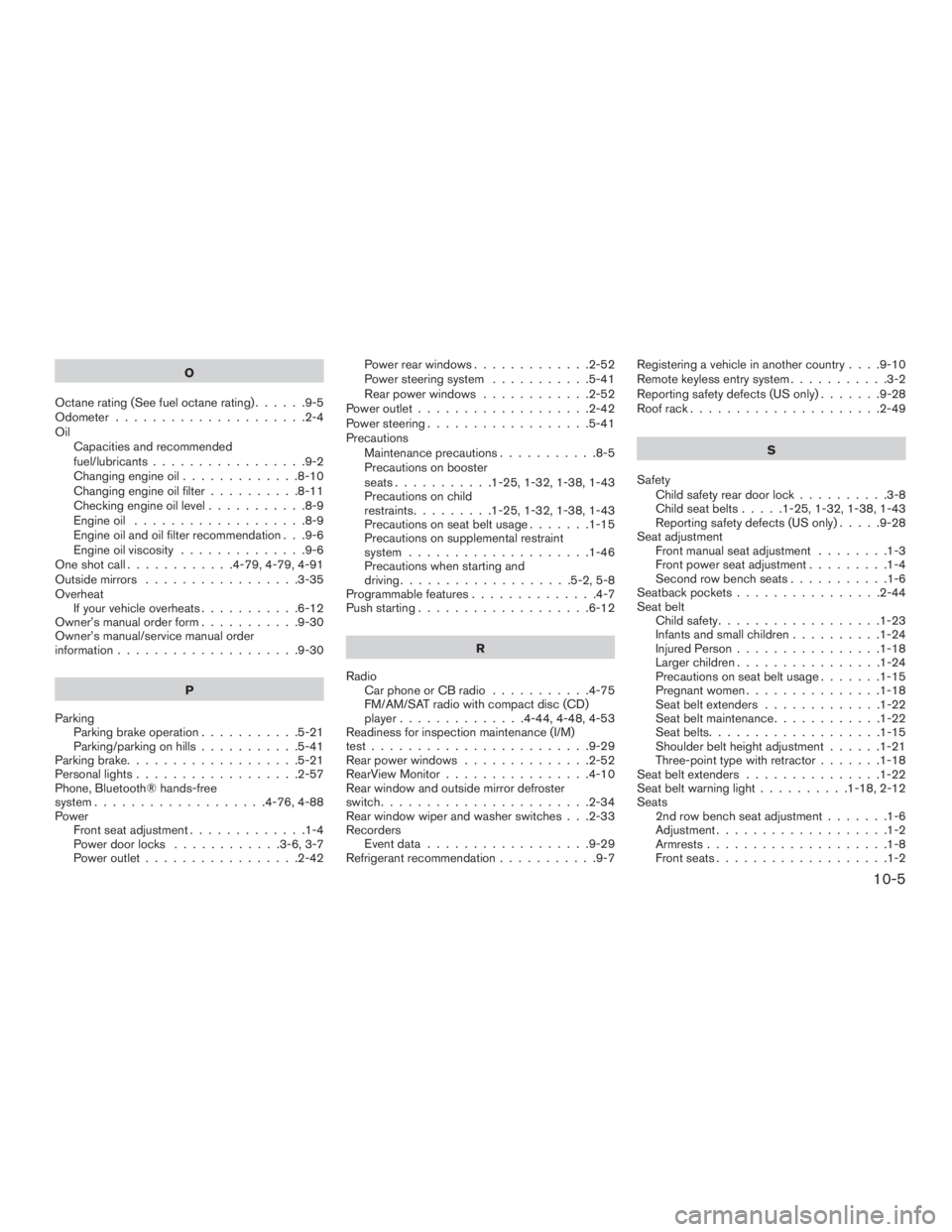
O
Octanerating(Seefueloctanerating)......9-5
Odometer .....................2-4
Oil Capacities and recommended
fuel/lubricants .................9-2
Changing engine oil .............8-10
Changing engine oil filter ..........8-11
Checking engine oil level ...........8-9
Engine oil ...................8-9
Engine oil and oil filter recommendation . . .9-6
Engine oil viscosity ..............9-6
Oneshotcall............4-79,4-79,4-91
Outside mirrors .................3-35
Overheat Ifyourvehicleoverheats...........6-12
Owner’s manual order form ...........9-30
Owner’s manual/service manual order
information ....................9-30
P
Parking Parking brake operation ...........5-21
Parking/parking on hills ...........5-41
Parking brake ...................5-21
Personallights..................2-57
Phone, Bluetooth® hands-free
system ...................4-76,4-88
Power Front seat adjustment .............1-4
Power door locks ............3-6,3-7
Power outlet .................2-42 Power rear windows
.............2-52
Power steering system ...........5-41
Rear power windows ............2-52
Power outlet ...................2-42
Power steering ..................5-41
Precautions Maintenance precautions ...........8-5
Precautions on booster
seats...........1-25,1-32,1-38,1-43
Precautions on child
restraints .........1-25,1-32,1-38,1-43
Precautions on seat belt usage .......1-15
Precautions on supplemental restraint
system ....................1-46
Precautions when starting and
driving ...................5-2,5-8
Programmablefeatures..............4-7
Push starting ...................6-12
R
Radio Car phone or CB radio ...........4-75
FM/AM/SAT radio with compact disc (CD)
player ..............4-44,4-48,4-53
Readiness for inspection maintenance (I/M)
test........................9-29
Rear power windows ..............2-52
RearView Monitor ................4-10
Rear window and outside mirror defroster
switch .......................2-34
Rear window wiper and washer switches . . .2-33
Recorders Eventdata..................9-29
Refrigerant recommendation ...........9-7Registering a vehicle in another country
....9-10
Remote keyless entry system ...........3-2
Reporting safety defects (US only) .......9-28
Roof rack .....................2-49
S
Safety Child safety rear door lock ..........3-8
Child seat belts .....1-25,1-32,1-38,1-43
Reporting safety defects (US only) .....9-28
Seat adjustment Front manual seat adjustment ........1-3
Front power seat adjustment .........
1-4
Secondrowbenchseats...........1-6
Seatbackpockets................2-44
Seat belt Child safety ..................1-23
Infants and small children ..........1-24
Injured Person ................1-18
Largerchildren................1-24
Precautions on seat belt usage .......1-15
Pregnant women ...............1-18
Seatbeltextenders .............1-22
Seatbeltmaintenance............1-22
Seatbelts...................1-15
Shoulder belt height adjustment ......1-21
Three-point type with retractor .......1-18
Seat belt extenders ...............1-22
Seatbeltwarninglight..........1-18,2-12
Seats 2nd row bench seat adjustment .......1-6
Adjustment ...................1-2
Armrests....................1-8
Frontseats...................1-2
10-5
Page 437 of 440
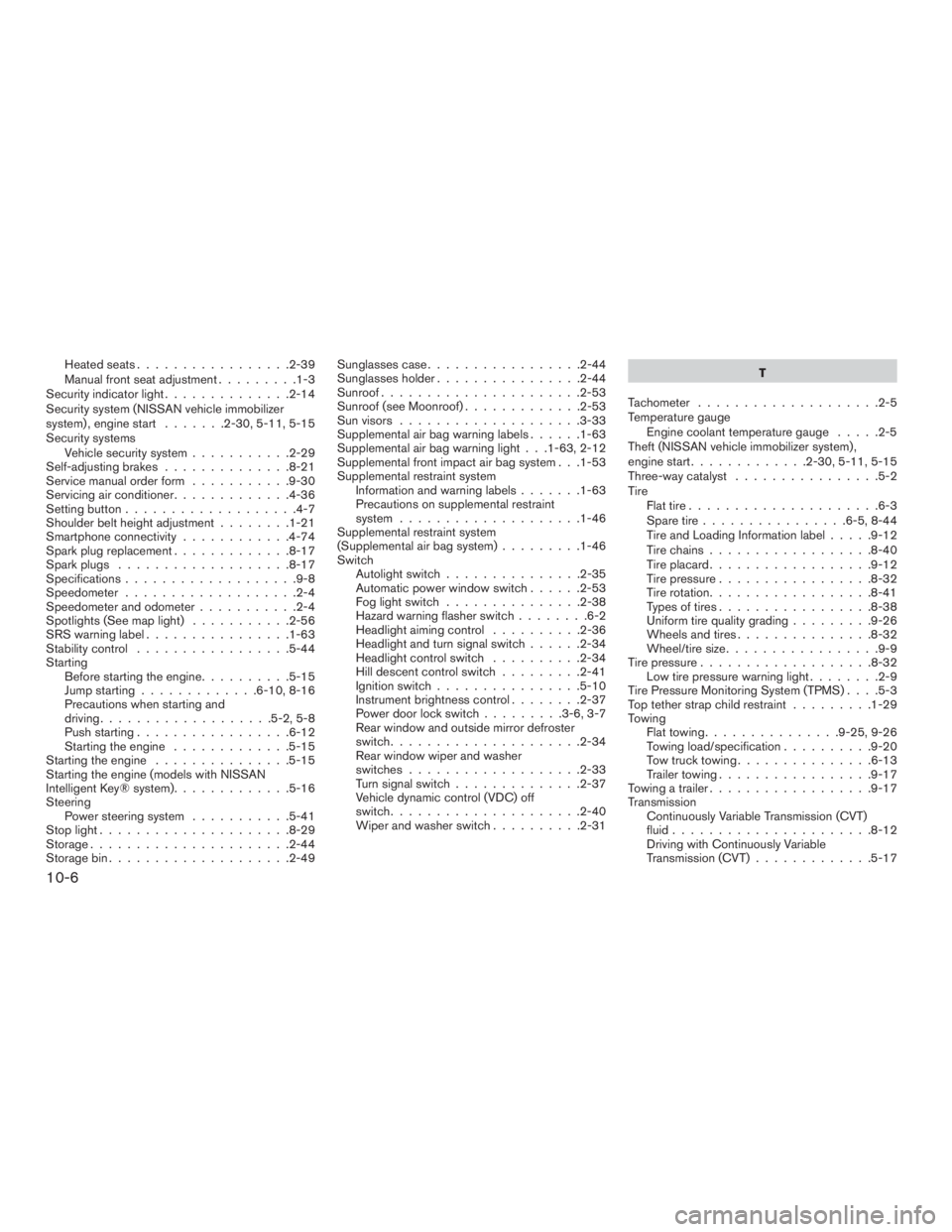
Heatedseats.................2-39
Manual front seat adjustment.........1-3
Security indicator light ..............2-14
Security system (NISSAN vehicle immobilizer
system) , engine start .......2-30,5-11,5-15
Security systems Vehicle security system ...........2-29
Self-adjusting brakes ..............8-21
Service manual order form ...........9-30
Servicing air conditioner .............4-36
Setting button ...................4-7
Shoulder belt height adjustment ........1-21
Smartphone connectivity ............4-74
Spark plug replacement .............8-17
Spark plugs ...................8-17
Specifications ...................9-8
Speedometer ...................2-4
Speedometer and odometer ...........2-4
Spotlights(Seemaplight) ...........2-56
SRS warning label ................1-63
Stability control .................5-44
Starting Before starting the engine ..........5-15
Jump starting .............6-10,8-16
Precautions when starting and
driving ...................5-2,5-8
Push starting .................6-12
Starting the engine .............5-15
Starting the engine ...............5-15
Starting the engine (models with NISSAN
Intelligent Key® system) .............5-16
Steering Power steering system ...........5-41
Stoplight.....................8-29
Storage......................2-44
Storagebin....................2-49 Sunglassescase.................2-44
Sunglassesholder................2-44
Sunroof......................2-53
Sunroof(seeMoonroof).............2-53
Sun visors
....................3-33
Supplemental air bag warning labels ......1-63
Supplemental air bag warning light . . .1-63, 2-12
Supplemental front impact air bag system . . .1-53
Supplemental restraint system Information and warning labels .......1-63
Precautions on supplemental restraint
system ....................1-46
Supplemental restraint system
(Supplemental air bag system) .........1-46
Switch Autolightswitch...............2-35
Automatic power window switch ......2-53
Foglightswitch ...............2-38
Hazard warning flasher switch ........6-2
Headlightaimingcontrol ..........2-36
Headlight and turn signal switch ......2-34
Headlight control switch ..........2-34
Hill descent control switch .........2-41
Ignition switch ................5-10
Instrument brightness control ........2-37
Power door lock switch .........3-6,3-7
Rear window and outside mirror defroster
switch.....................2-34
Rear window wiper and washer
switches...................2-33
Turn signal switch ..............2-37
Vehicle dynamic control (VDC) off
switch.....................2-40
Wiperandwasherswitch..........2-31 T
Tachometer ....................2-5
Temperature gauge Engine coolant temperature gauge .....2-5
Theft (NISSAN vehicle immobilizer system) ,
engine start .............2-30,5-11,5-15
Three-way catalyst ................5-2
Tire Flat tire .....................6-3
Spare tire ................
6-5,8-44
Tire and Loading Information label .....9-12
Tire chains ..................8-40
Tire placard ..................9-12
Tire pressure .................8-32
Tire rotation..................8-41
Types of tires .................8-38
Uniform tire quality grading .........9-26
Wheels and tires ...............8-32
Wheel/tire size .................9-9
Tirepressure...................8-32 Low tire pressure warning light ........2-9
Tire Pressure Monitoring System (TPMS) ....5-3
Top tether strap child restraint .........1-29
Towing Flattowing...............9-25,9-26
Towing load/specification ..........9-20
Towtrucktowing...............6-13
Trailer towing .................9-17
Towing a trailer ..................9-17
Transmission Continuously Variable Transmission (CVT)
fluid......................8-12
Driving with Continuously Variable
Transmission (CVT) .............5-17
10-6