flat NISSAN ROGUE 2016 2.G Repair Manual
[x] Cancel search | Manufacturer: NISSAN, Model Year: 2016, Model line: ROGUE, Model: NISSAN ROGUE 2016 2.GPages: 478, PDF Size: 5.94 MB
Page 446 of 478
Tire pressures
●When towing a trailer, inflate the ve-
hicle tires to the recommended cold
tire pressure indicated on the Tire
and Loading Information label.
● Trailer tire condition, size, load rating
and proper inflation pressure should
be in accordance with the trailer and
tire manufacturer’s specifications.
Safety chains
Always use suitable safety chains between your
vehicle and the trailer. The safety chains should
be crossed and should be attached to the hitch,
not to the vehicle bumper or axle. The safety
chains can be attached to the bumper if the hitch
ball is mounted to the bumper. Be sure to leave
enough slack in the chains to permit turning
corners.
Trailer lights
CAUTION
When splicing into the vehicle electrical
system, a commercially available power-
type module/converter must be used to
provide power for all trailer lighting. This
unit uses the vehicle battery as a direct
power source for all trailer lights while
using the vehicle tail light, stoplight and
turn signal circuits as a signal source. The
module/converter must draw no more that
15 milliamps from the stop and tail lamp
circuits. Using a module/converter that
exceeds these power requirements may
damage the vehicle’s electrical system.
See a reputable trailer retailer to obtain
the proper equipment and to have it
installed.
Trailer lights should comply with federal and/or
local regulations. For assistance in hooking up
trailer lights, contact a NISSAN dealer or repu-
table trailer retailer. Vehicles equipped with the
optional trailer tow package are equipped with a
7-pin trailer harness connector. If your trailer is
equipped with a flat 4-pin connector, an adapter
will be needed to connect the trailer lights to the
vehicle. Adapters are available at auto parts
stores and hitch retailers.
Pre-towing tips
● Be certain your vehicle maintains a level
position when a loaded and/or unloaded
trailer is hitched. Do not drive the vehicle if it
has an abnormal nose-up or nose-down
condition; check for improper tongue load,
overload, worn suspension or other possible
causes of either condition.
● Always secure items in the trailer to prevent
load shift while driving.
●
Keep the cargo load as low as possible in the
trailer to keep the trailer center of gravity low.
● Load the trailer so approximately 60% of the
trailer load is in the front half and 40% is in
the back half. Also make sure the load is
balanced side to side.
● Check your hitch, trailer tire pressure, ve-
hicle tire pressure, trailer light operation, and
trailer wheel lug nuts every time you attach a
trailer to the vehicle.
● Be certain your rearview mirrors conform to
all federal, state or local regulations. If not,
install any mirrors required for towing before
driving the vehicle.
●
Determine the overall height of the vehicle and
trailer so the required clearance is known.
Technical and consumer information9-23
Page 448 of 478
●When making a turn, your trailer wheels will
be closer to the inside of the turn than your
vehicle wheels. To compensate for this,
make a larger than normal turning radius
during the turn.
● Crosswinds and rough roads will adversely
affect vehicle/trailer handling, possibly caus-
ing vehicle sway. When being passed by
larger vehicles, be prepared for possible
changes in crosswinds that could affect ve-
hicle handling.
Do the following if the trailer begins to sway: 1. Take your foot off the accelerator pedal to allow the vehicle to coast and steer as
straight ahead as the road conditions allow.
This combination will help stabilize the ve-
hicle
– Do not correct trailer sway by steering or applying the brakes.
2. When the trailer sway stops, gently apply the brakes and pull to the side of the road in a
safe area.
3. Try to rearrange the trailer load so it is bal- anced as described in this section. ●
Be careful when passing other vehicles.
Passing while towing a trailer requires con-
siderably more distance than normal pass-
ing. Remember, the length of the trailer must
also pass the other vehicle before you can
safely change lanes.
● Downshift the transmission to a lower gear
for engine braking when driving down steep
or long hills. This will help slow the vehicle
without applying the brakes.
● Avoid holding the brake pedal down too long
or too frequently. This could cause the
brakes to overheat, resulting in reduced
braking efficiency.
● Increase your following distance to allow for
greater stopping distances while towing a
trailer. Anticipate stops and brake gradually.
● NISSAN recommends that the cruise con-
trol not be used while towing a trailer.
● Some states or provinces have specific
regulations and speed limits for vehicles that
are towing trailers. Obey the local speed
limits. ●
Check your hitch, trailer wiring harness con-
nections, and trailer wheel lug nuts after
50 miles (80 km) of travel and at every break.
● When launching a boat, don’t allow the wa-
ter level to go over the exhaust tail pipe or
rear bumper.
● Make sure you disconnect the trailer lights
before backing the trailer into the water or
the trailer lights may burn out.
When towing a trailer, final drive gear oil
should be replaced and transmission
oil/fluid should be changed more fre-
quently. For additional information, refer to
the “Maintenance and do-it-yourself” sec-
tion of this manual.
FLAT TOWING FOR ALL–WHEEL
DRIVE VEHICLE (if so equipped)
Towing your vehicle with all four wheels on the
ground is sometimes called flat towing. This
method is sometimes used when towing a vehicle
behind a recreational vehicle, such as a motor
home.
Technical and consumer information9-25
Page 449 of 478
CAUTION
●Failure to follow these guidelines can
result in severe transmission damage.
● Never flat tow your All-wheel drive
(AWD) vehicle.
● DO NOT tow your All-wheel drive (AWD)
vehicle with any wheels on the ground.
Doing so may cause serious and expen-
sive damage to the powertrain.
● For emergency towing procedures refer
to “Towing recommended by NISSAN”
in the “In case of emergency” section of
this manual.
FLAT TOWING FOR FRONT WHEEL
DRIVE VEHICLE (if so equipped)
Towing your vehicle with all four wheels on the
ground is sometimes called flat towing. This
method is sometimes used when towing a vehicle
behind a recreational vehicle, such as a motor
home.
CAUTION
● Failure to follow these guidelines can
result in severe transmission damage.
● Whenever flat towing your vehicle, al-
ways tow forward, never backward.
● Never tow your front wheel drive vehicle
with the front tires on the ground. Doing
so may cause serious and expensive
damage to the powertrain.
● DO NOT tow your front wheel drive con-
tinuously variable transmission vehicle
with all four wheels on the ground (flat
towing) . Doing so WILL DAMAGE inter-
nal transmission parts due to lack of
transmission lubrication.
● For emergency towing procedures refer
to “Towing recommended by NISSAN”
in the “In case of emergency” section of
this manual.
Continuously Variable Transmission
To tow a vehicle equipped with a continuously
variable transmission, an appropriate vehicle
dolly MUST be placed under the towed vehicle’s
drive wheels. Alwaysfollow the dolly manufac-
turer’s recommendations when using their prod-
uct. DOT (Department of Transportation) Quality
Grades: All passenger car tires must conform to
federal safety requirements in addition to these
grades.
Quality grades can be found where applicable on
the tire sidewall between tread shoulder and
maximum section width. For example:
Treadwear 200 Traction AA Temperature A
Treadwear
The treadwear grade is a comparative rating
based on the wear rate of the tire when tested
under controlled conditions on a specified gov-
ernment test course. For example, a tire graded
150 would wear one and one-half (1 1/2) times
as well on the government course as a tire graded
100. The relative performance of tires depends
upon the actual conditions of their use, however,
and may depart significantly from the norm due to
variations in driving habits, service practices and
differences in road characteristics and climate.
Traction AA, A, B and C
The traction grades, from highest to lowest, are
AA, A, B, and C. Those grades represent the
tire’s ability to stop on wet pavement as mea-
sured under controlled conditions on specified
government test surfaces of asphalt and con-
crete. A tire marked C may have poor traction
performance.
UNIFORM TIRE QUALITY GRADING
9-26Technical and consumer information
Page 450 of 478
WARNING
The traction grade assigned to this tire is
based on straight-ahead braking traction
tests, and does not include acceleration,
cornering, hydroplaning, or peak traction
characteristics.
Temperature A, B and C
The temperature grades are A (the highest) , B,
and C, representing the tire’s resistance to the
generation of heat, and its ability to dissipate heat
when tested under controlled conditions on a
specified indoor laboratory test wheel. Sustained
high temperature can cause the material of the
tire to degenerate and reduce tire life, and exces-
sive temperature can lead to sudden tire failure.
The grade C corresponds to a level of perfor-
mance which all passenger car tires must meet
under the Federal Motor Safety Standard No.
109. Grades B and A represent higher levels of
performance on the laboratory test wheel than
the minimum required by law.
WARNING
The temperature grade for this tire is es-
tablished for a tire that is properly inflated
and not overloaded. Excessive speed,
under-inflation, or excessive loading, ei-
ther separately or in combination, can
cause heat build-up and possible tire
failure. Your NISSAN vehicle is covered by the following
emission warranties:
For USA
1. Emission Defects Warranty
2. Emissions Performance Warranty
Details of this warranty may be found with other
vehicle warranties in your Warranty Information
Booklet which comes with your NISSAN vehicle.
If you did not receive a Warranty Information
Booklet, or it is lost, you may obtain a replace-
ment by writing to: ● Nissan North America, Inc.
Consumer Affairs Department
P.O. Box 685003
Franklin, TN 37068-5003
For Canada
Emission Control System Warranty
Details of this warranty may be found with other
vehicle warranties in your Warranty Information
Booklet which comes with your NISSAN vehicle.
If you did not receive a Warranty Information
Booklet, or it is lost, you may obtain a replace-
ment by writing to: ● Nissan Canada Inc.
5290 Orbitor Drive
Mississauga, Ontario, L4W 4Z5
EMISSION CONTROL SYSTEM
WARRANTY
Technical and consumer information9-27
Page 456 of 478
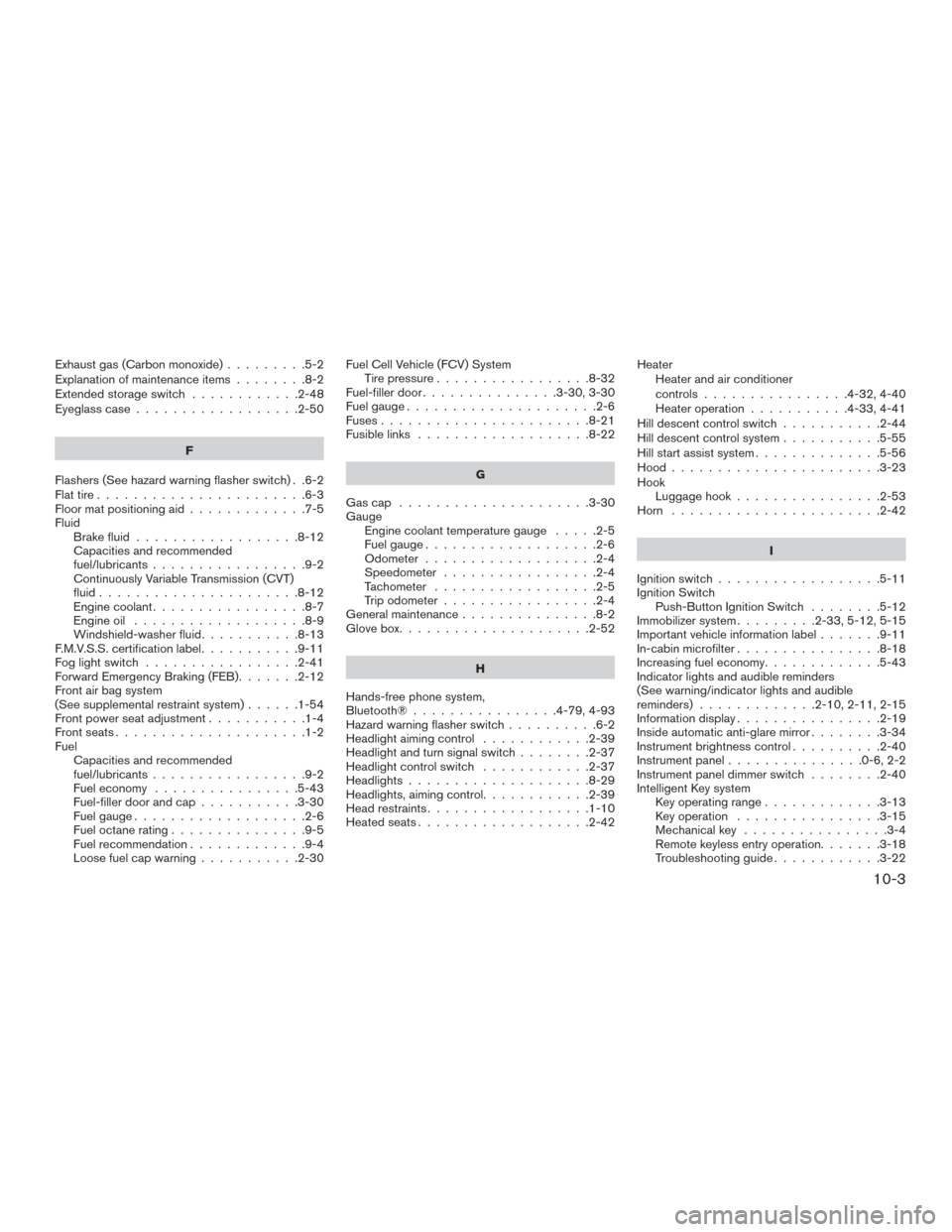
Exhaust gas (Carbon monoxide).........5-2
Explanation of maintenance items ........8-2
Extendedstorageswitch ............2-48
Eyeglass case ..................2-50
F
Flashers (See hazard warning flasher switch) . .6-2
Flat tire .......................6-3
Floor mat positioning aid .............7-5
Fluid Brake fluid ..................8-12
Capacities and recommended
fuel/lubricants .................9-2
Continuously Variable Transmission (CVT)
fluid......................8-12
Engine coolant .................8-7
Engine oil ...................8-9
Windshield-washerfluid...........8-13
F.M.V.S.S. certification label ...........9-11
Foglightswitch .................2-41
Forward Emergency Braking (FEB) .......2-12
Front air bag system
(See supplemental restraint system) ......1-54
Front power seat adjustment ...........1-4
Frontseats.....................1-2
Fuel Capacities and recommended
fuel/lubricants .................9-2
Fuel economy ................5-43
Fuel-filler door and cap ...........3-30
Fuel gauge ...................2-6
Fuel octane rating ...............9-5
Fuel recommendation .............9-4
Loose fuel cap warning ...........2-30 Fuel Cell Vehicle (FCV) System
Tirepressure.................8-32
Fuel-filler door ...............3-30,3-30
Fuelgauge.....................2-6
Fuses.......................8-21
Fusiblelinks ...................8-22
G
Gascap .....................3-30
Gauge Engine coolant temperature gauge .....2-5
Fuel gauge ...................2-6
Odometer ...................2-4
Speedometer .................2-4
Tachometer ..................2-5
Trip odometer .................2-4
General maintenance ...............8-2
Glovebox.....................2-52
H
Hands-free phone system,
Bluetooth®................4-79,4-93
Hazard warning flasher switch ..........6-2
Headlight aiming control ............2-39
Headlight and turn signal switch ........2-37
Headlight control switch ............2-37
Headlights ....................8-29
Headlights, aiming control ............2-39
Head restraints ..................1-10
Heated seats ...................2-42 Heater
Heater and air conditioner
controls ................4-32,4-40
Heater operation ...........4-33,4-41
Hill descent control switch ...........2-44
Hill descent control system ...........5-55
Hill start assist system ..............5-56
Hood.......................3-23
Hook Luggage hook ................2-53
Horn .......................2-42
I
Ignition
switch ..................5-11
Ignition Switch Push-Button Ignition Switch ........5-12
Immobilizer system .........2-33,5-12,5-15
Important vehicle information label .......9-11
In-cabin microfilter ................8-18
Increasing fuel economy .............5-43
Indicator lights and audible reminders
(See warning/indicator lights and audible
reminders).............2-10,2-11,2-15
Information display ................2-19
Inside automatic anti-glare mirror ........3-34
Instrument brightness control ..........2-40
Instrumentpanel...............0-6,2-2
Instrument panel dimmer switch ........2-40
Intelligent Key system Key operating range .............3-13
Key operation ................3-15
Mechanical key ................3-4
Remote keyless entry operation.......3-18
Troubleshooting guide ............3-22
10-3
Page 459 of 478
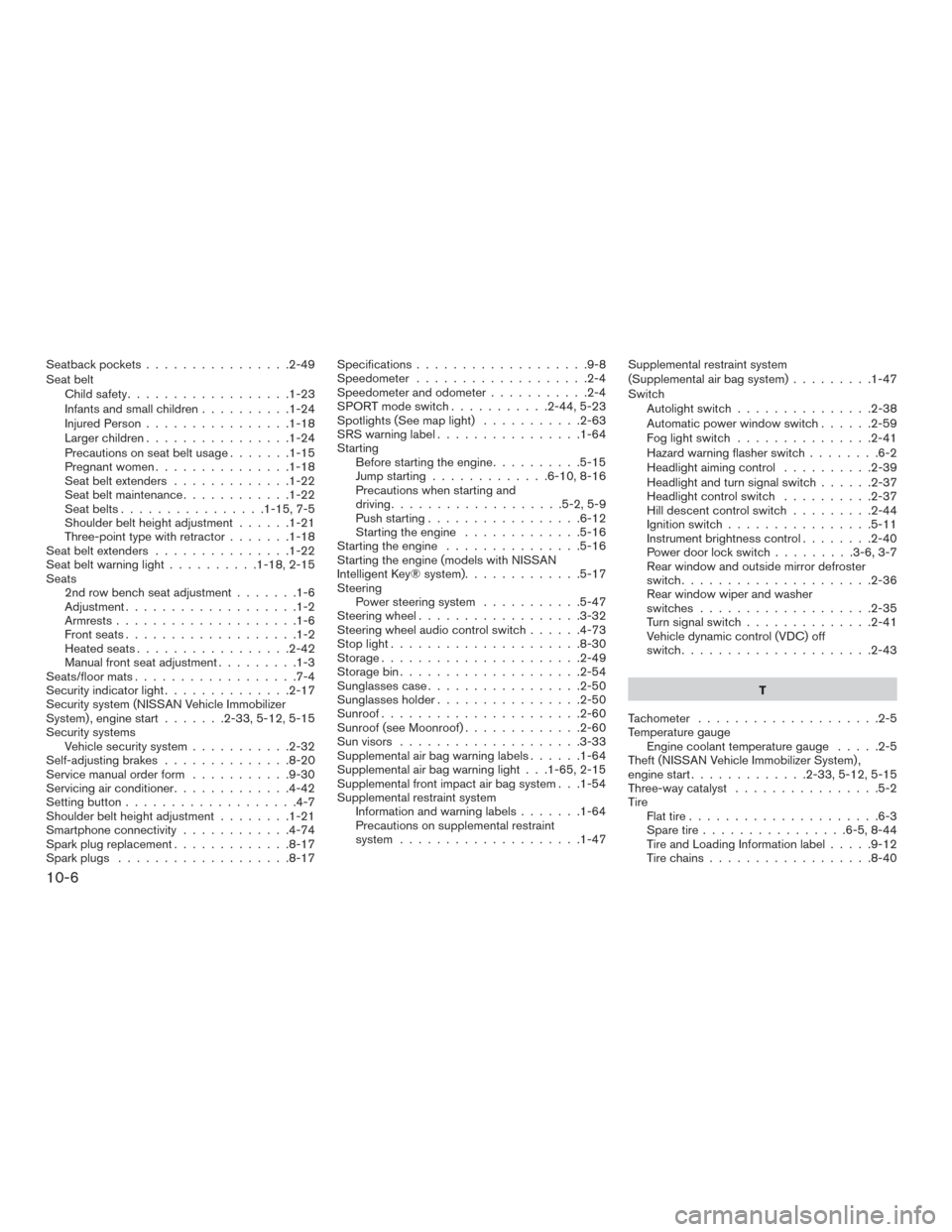
Seatback pockets................2-49
Seat belt Childsafety..................1-23
Infantsandsmallchildren..........1-24
Injured Person ................1-18
Largerchildren................1-24
Precautionsonseatbeltusage.......1-15
Pregnant women ...............1-18
Seat belt extenders .............1-22
Seat belt maintenance ............1-22
Seat belts ................1-15,7-5
Shoulder belt height adjustment ......1-21
Three-point type with retractor .......1-18
Seat belt extenders ...............1-22
Seatbeltwarninglight..........1-18,2-15
Seats 2nd row bench seat adjustment .......1-6
Adjustment ...................1-2
Armrests....................1-6
Frontseats...................1-2
Heatedseats.................2-42
Manual front seat adjustment .........1-3
Seats/floor mats ..................7-4
Security indicator light ..............2-17
Security system (NISSAN Vehicle Immobilizer
System) , engine start .......2-33,5-12,5-15
Security systems Vehicle security system ...........2-32
Self-adjusting brakes ..............8-20
Service manual order form ...........9-30
Servicing air conditioner .............4-42
Setting button ...................4-7
Shoulder belt height adjustment ........1-21
Smartphone connectivity ............4-74
Spark plug replacement .............8-17
Spark plugs ...................8-17 Specifications
...................9-8
Speedometer ...................2-4
Speedometer and odometer ...........2-4
SPORT mode switch ...........2-44,5-23
Spotlights(Seemaplight) ...........2-63
SRSwarninglabel................1-64
Starting Before starting the engine ..........5-15
Jump starting .............6-10,8-16
Precautions when starting and
driving ...................5-2,5-9
Push starting .................6-12
Starting the engine .............5-16
Starting the engine ...............5-16
Starting the engine (models with NISSAN
Intelligent Key® system) .............5-17
Steering Power steering system ...........5-47
Steeringwheel..................3-32
Steering wheel audio control switch ......4-73
Stoplight.....................8-30
Storage......................2-49
Storagebin....................2-54
Sunglassescase.................2-50
Sunglassesholder................2-50
Sunroof......................2-60
Sunroof(seeMoonroof).............2-60
Sun visors ....................3-33
Supplemental air bag warning labels ......1-64
Supplemental air bag warning light . . .1-65, 2-15
Supplemental front impact air bag system . . .1-54
Supplemental restraint system Information and warning labels .......1-64
Precautions on supplemental restraint
system ....................1-47 Supplemental restraint system
(Supplemental air bag system)
.........1-47
Switch Autolightswitch...............2-38
Automatic power window switch ......2-59
Fog light switch ...............2-41
Hazard warning flasher switch ........6-2
Headlightaimingcontrol ..........2-39
Headlightandturnsignalswitch......2-37
Headlight control switch ..........2-37
H
illdescentcontrolswitch.........2-44
Ignition switch ................5-11
Instrument brightness control ........2-40
Power door lock switch .........3-6,3-7
Rear window and outside mirror defroster
switch .....................2-36
Rear window wiper and washer
switches ...................2-35
Turnsignalswitch..............2-41
Vehicle dynamic control (VDC) off
switch .....................2-43
T
Tachometer ....................2-5
Temperature gauge Engine coolant temperature gauge .....2-5
Theft (NISSAN Vehicle Immobilizer System) ,
engine start .............2-33,5-12,5-15
Three-way catalyst ................5-2
Tire Flat tire .....................6-3
Spare tire ................6-5,8-44
Tire and Loading Information label .....9-12
Tire chains ..................8-40
10-6
Page 460 of 478
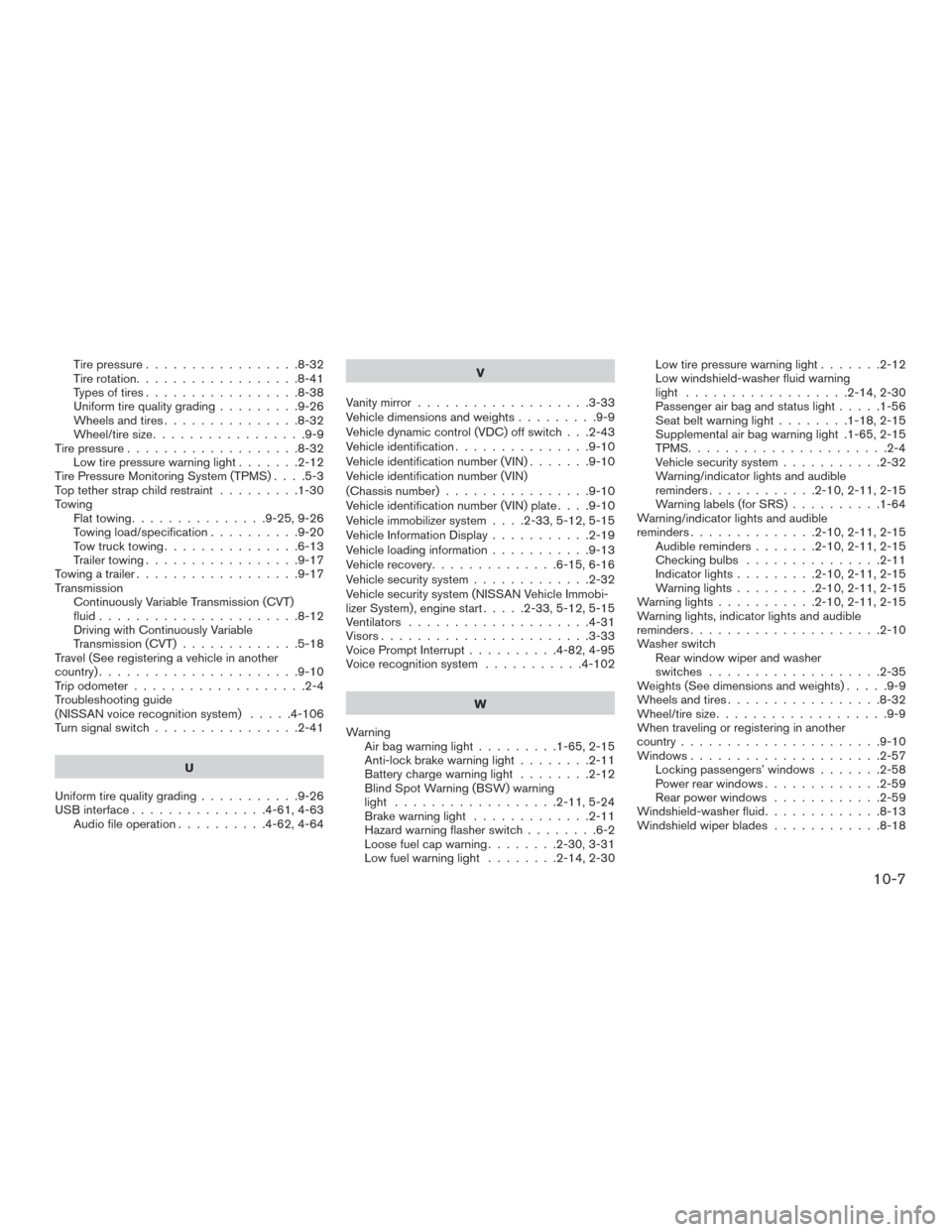
Tirepressure.................8-32
Tire rotation..................8-41
Types of tires.................8-38
Uniform tire quality grading .........9-26
Wheels and tires ...............8-32
Wheel/tire size .................9-9
Tirepressure...................8-32 Low tire pressure warning light .......2-12
Tire Pressure Monitoring System (TPMS) ....5-3
Top tether strap child restraint .........1-30
Towing Flattowing...............9-25,9-26
Towing load/specification ..........9-20
Towtrucktowing...............6-13
Trailer towing .................9-17
Towing a trailer ..................9-17
Transmission Continuously Variable Transmission (CVT)
fluid......................8-12
Driving with Continuously Variable
Transmission (CVT) .............5-18
Travel (See registering a vehicle in another
country) ......................9-10
Trip odometer ...................2-4
Troubleshooting guide
(NISSAN voice recognition system) .....4-106
Turn signal switch ................2-41
U
Uniform tire quality grading ...........9-26
USB interface ...............4-61,4-63
Audio file operation ..........4-62,4-64 V
Vanity mirror ...................3-33
Vehicle dimensions and weights .........9-9
Vehicle dynamic control (VDC) off switch . . .2-43
Vehicle identification ...............9-10
Vehicle identification number (VIN) .......9-10
Vehicle identification number (VIN)
(Chassis number) ................9-10
Vehicle identification number (VIN) plate ....9-10
Vehicle immobilizer system ....2-33,5-12,5-15
Vehicle Information Display ...........2-19
Vehicle loading information ...........9-13
Vehicle recovery ..............6-15,6-16
Vehicle security system .............2-32
Vehicle security system (NISSAN Vehicle Immobi-
lizer System) , engine start .....2-33,5-12,5-15
Ventilators ....................4-31
Visors.......................3-33
Voice Prompt Interrupt ..........4-82,4-95
Voice recognition system ...........4-102
W
Warning Airbagwarninglight.........1-65,2-15
Anti-lock brake warning light ........2-11
Battery charge warning light ........2-12
Blind Spot Warning (BSW) warning
light ..................2-11,5-24
Brake warning light .............2-11
Hazard warning flasher switch ........6-2
Loose fuel cap warning ........2-30,3-31
Lowfuelwarninglight ........2-14,2-30 Low tire pressure warning light
.......2-12
Low windshield-washer fluid warning
light ..................2-14,2-30
Passenger air bag and status light .....1-56
Seat belt warning light ........1-18,2-15
Supplemental air bag warning light .1-65, 2-15
TPMS ......................2-4
Vehicle security system ...........2-32
Warning/indicator lights and audible
reminders ............2-10,2-11,2-15
Warning labels (for SRS) ..........1-64
W
arning/indicator lights and audible
reminders..............2-10,2-11,2-15 Audiblereminders.......2-10,2-11,2-15
Checkingbulbs ...............2-11
Indicatorlights.........2-10,2-11,2-15
Warning lights .........2-10,2-11,2-15
Warning lights ...........2-10,2-11,2-15
Warning lights, indicator lights and audible
reminders.....................2-10
Washer switch Rear window wiper and washer
switches...................2-35
Weights (See dimensions and weights) .....9-9
Wheels and tires .................8-32
Wheel/tire size ...................9-9
When traveling or registering in another
country ......................9-10
Windows .....................2-57
Locking passengers’ windows .......2-58
Power rear windows .............2-59
Rear power windows ............2-59
Windshield-washerfluid.............8-13
Windshieldwiperblades............8-18
10-7
Page 465 of 478
PRECAUTIONS ON SRS
This SRS section contains important information
concerning the following systems:
●Driver and front passenger supplemental
front-impact air bag (NISSAN Advanced Air
Bag System)
●Front seat-mounted side-impact supple-
mental air bag
●Roof-mounted curtain side-impact and roll-
over supplemental air bag
●Seat belt with pretensioner(s) (front seats)
Supplemental front-impact air bag system
The NISSAN Advanced Air Bag System can help
cushion the impact force to the head and chest of
the driver and front passenger in certain frontal
collisions.
Front seat-mounted side-impact supple-
mental air bag system
This system can help cushion the impact force to
the chest area of the driver and front passenger in
certain side-impact collisions. The side air bags
are designed to inflate on the side where the
vehicle is impacted.Roof-mounted curtain side-impact and
rollover supplemental air bag system
This system can help cushion the impact force to
the head of occupants in front and rear outboard
seating positions in certain side-impact colli-
sions. The curtain air bags are designed to inflate
on the side where the vehicle is impacted. In a
rollover, the curtain air bags are designed to
inflate and remain inflated for a short time.
The SRS is designed tosupplementthe crash
protection provided by the driver and front pas-
senger seat belts and isnot a substitutefor
them. Seat belts should always be correctly worn
and the occupant seated a suitable distance
away from the steering wheel, instrument panel
and door finishers. For additional information
about instructions and precautions on seat belt
usage, refer to “Seat belts” in this section.
The supplemental air bags operate only
when the ignition switch is placed in the ON
position.
After placing the ignition switch in the ON
position, the supplemental air bag warning
light illuminates. The supplemental air bag
warning light will turn off after about 7 sec-
onds if the system is operational.
SUPPLEMENTAL RESTRAINT
SYSTEM (SRS)
Page 466 of 478
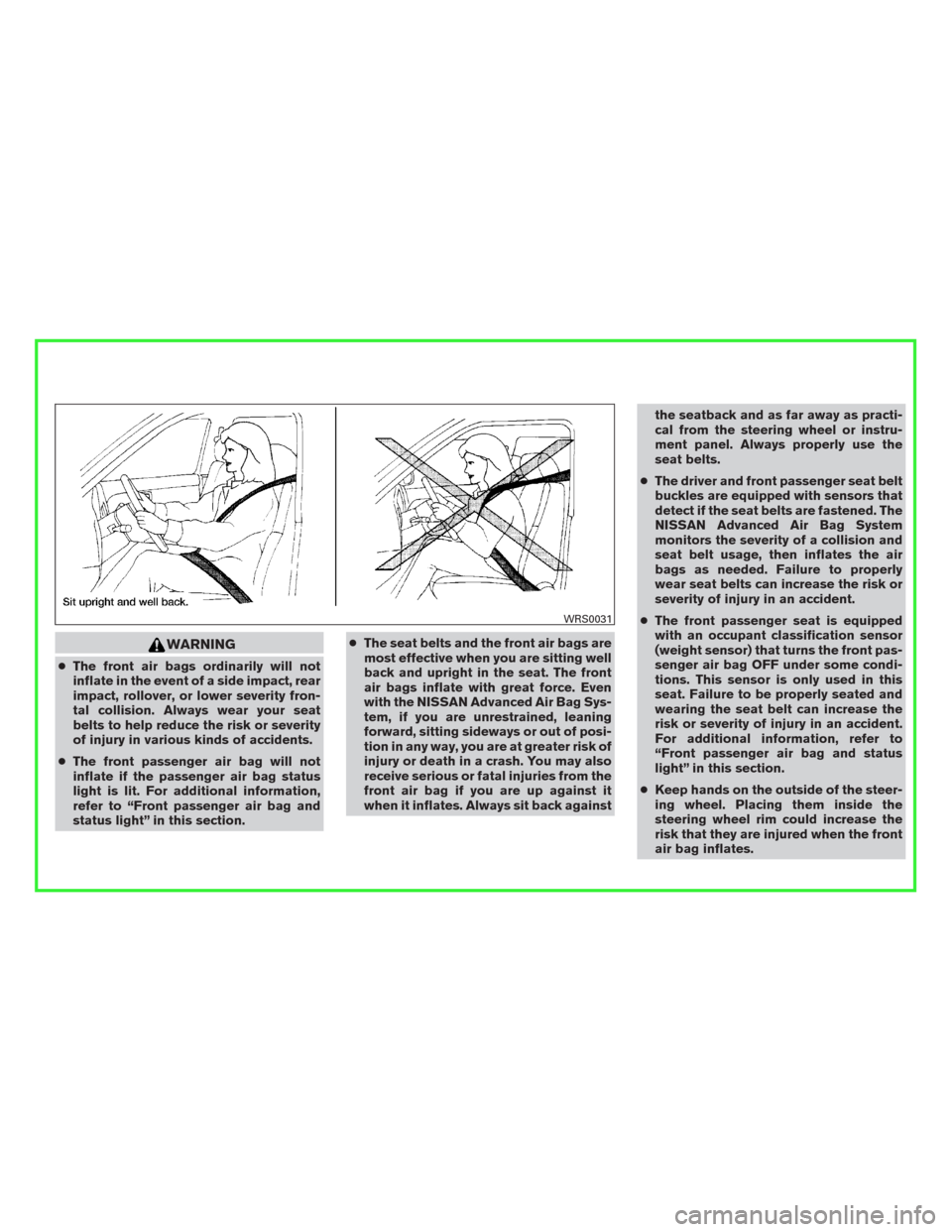
WARNING
●The front air bags ordinarily will not
inflate in the event of a side impact, rear
impact, rollover, or lower severity fron-
tal collision. Always wear your seat
belts to help reduce the risk or severity
of injury in various kinds of accidents.
●The front passenger air bag will not
inflate if the passenger air bag status
light is lit. For additional information,
refer to “Front passenger air bag and
status light” in this section.●The seat belts and the front air bags are
most effective when you are sitting well
back and upright in the seat. The front
air bags inflate with great force. Even
with the NISSAN Advanced Air Bag Sys-
tem, if you are unrestrained, leaning
forward, sitting sideways or out of posi-
tion in any way, you are at greater risk of
injury or death in a crash. You may also
receive serious or fatal injuries from the
front air bag if you are up against it
when it inflates. Always sit back againstthe seatback and as far away as practi-
cal from the steering wheel or instru-
ment panel. Always properly use the
seat belts.
●The driver and front passenger seat belt
buckles are equipped with sensors that
detect if the seat belts are fastened. The
NISSAN Advanced Air Bag System
monitors the severity of a collision and
seat belt usage, then inflates the air
bags as needed. Failure to properly
wear seat belts can increase the risk or
severity of injury in an accident.
●The front passenger seat is equipped
with an occupant classification sensor
(weight sensor) that turns the front pas-
senger air bag OFF under some condi-
tions. This sensor is only used in this
seat. Failure to be properly seated and
wearing the seat belt can increase the
risk or severity of injury in an accident.
For additional information, refer to
“Front passenger air bag and status
light” in this section.
●Keep hands on the outside of the steer-
ing wheel. Placing them inside the
steering wheel rim could increase the
risk that they are injured when the front
air bag inflates.
WRS0031
Page 468 of 478
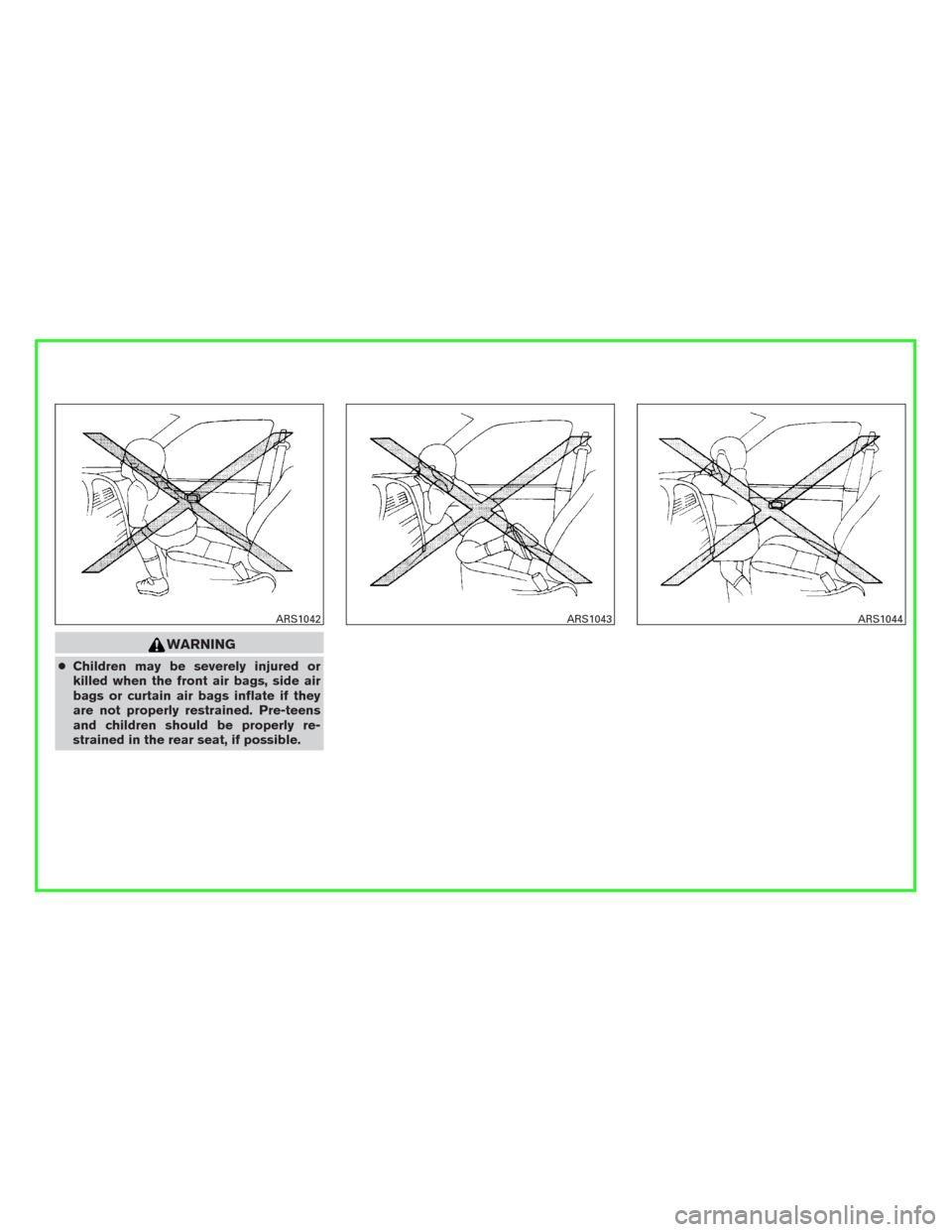
WARNING
●Children may be severely injured or
killed when the front air bags, side air
bags or curtain air bags inflate if they
are not properly restrained. Pre-teens
and children should be properly re-
strained in the rear seat, if possible.
ARS1042ARS1043ARS1044