height NISSAN ROGUE 2016 Owner´s Manual
[x] Cancel search | Manufacturer: NISSAN, Model Year: 2016, Model line: ROGUE, Model: NISSAN ROGUE 2016Pages: 478, PDF Size: 5.94 MB
Page 419 of 478
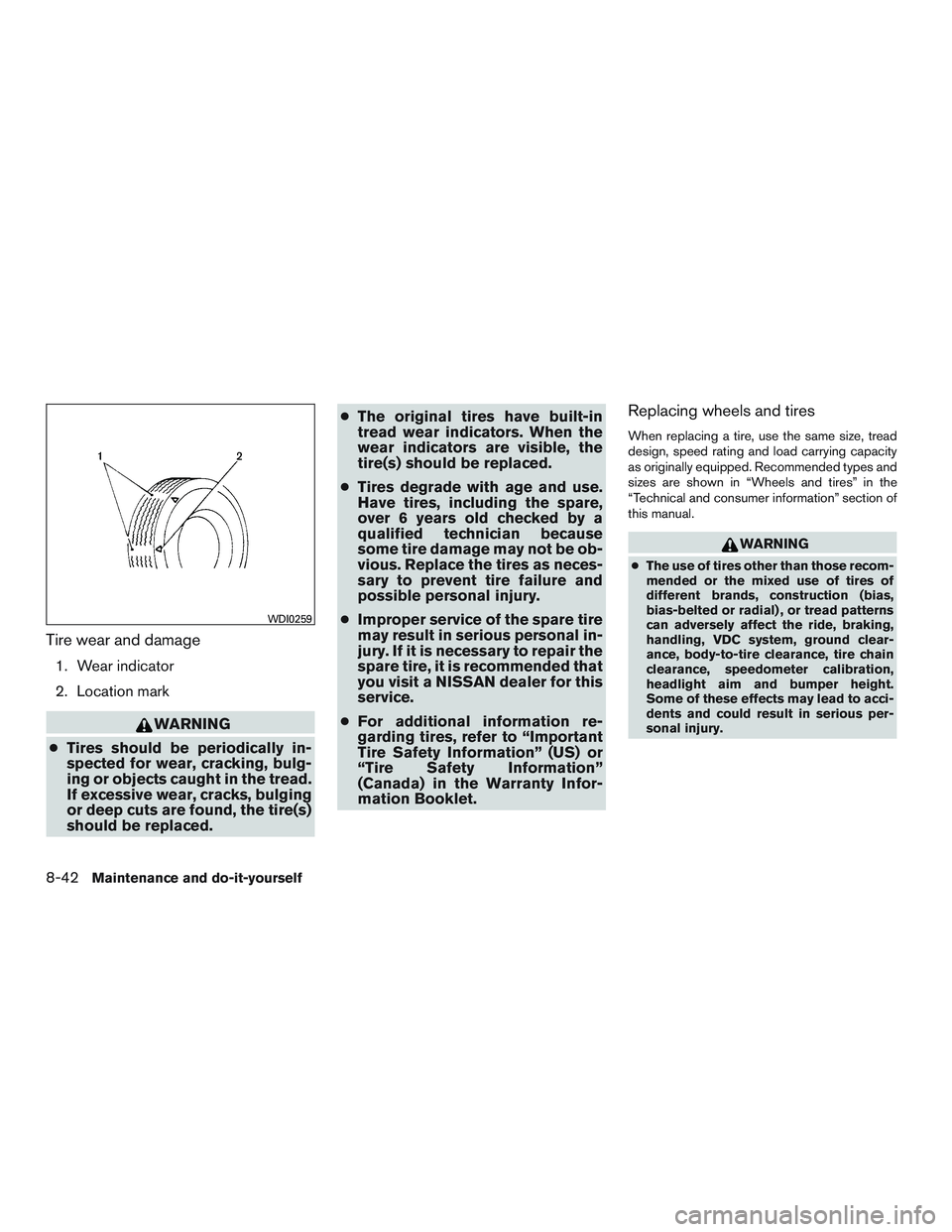
Tire wear and damage
1. Wear indicator
2. Location mark
WARNING
● Tires should be periodically in-
spected for wear, cracking, bulg-
ing or objects caught in the tread.
If excessive wear, cracks, bulging
or deep cuts are found, the tire(s)
should be replaced. ●
The original tires have built-in
tread wear indicators. When the
wear indicators are visible, the
tire(s) should be replaced.
● Tires degrade with age and use.
Have tires, including the spare,
over 6 years old checked by a
qualified technician because
some tire damage may not be ob-
vious. Replace the tires as neces-
sary to prevent tire failure and
possible personal injury.
● Improper service of the spare tire
may result in serious personal in-
jury. If it is necessary to repair the
spare tire, it is recommended that
you visit a NISSAN dealer for this
service.
● For additional information re-
garding tires, refer to “Important
Tire Safety Information” (US) or
“Tire Safety Information”
(Canada) in the Warranty Infor-
mation Booklet.
Replacing wheels and tires
When replacing a tire, use the same size, tread
design, speed rating and load carrying capacity
as originally equipped. Recommended types and
sizes are shown in “Wheels and tires” in the
“Technical and consumer information” section of
this manual.
WARNING
● The use of tires other than those recom-
mended or the mixed use of tires of
different brands, construction (bias,
bias-belted or radial) , or tread patterns
can adversely affect the ride, braking,
handling, VDC system, ground clear-
ance, body-to-tire clearance, tire chain
clearance, speedometer calibration,
headlight aim and bumper height.
Some of these effects may lead to acci-
dents and could result in serious per-
sonal injury.
WDI0259
8-42Maintenance and do-it-yourself
Page 432 of 478
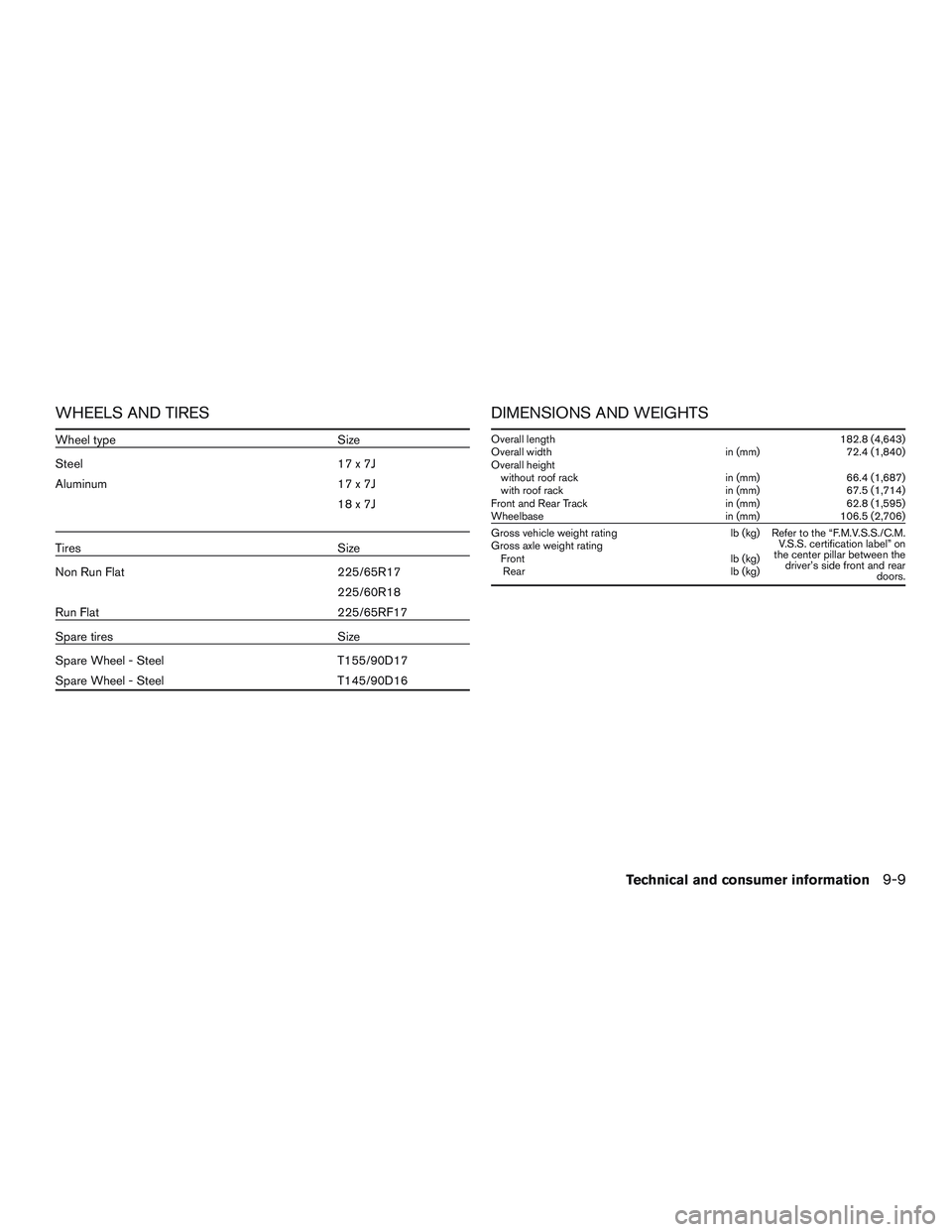
WHEELS AND TIRES
Wheel typeSize
Steel 17 x 7J
Aluminum 17 x 7J
18x7J
Tires Size
Non Run Flat 225/65R17
225/60R18
Run Flat 225/65RF17
Spare tires Size
Spare Wheel - Steel T155/90D17
Spare Wheel - Steel T145/90D16
DIMENSIONS AND WEIGHTS
Overall length 182.8 (4,643)
Overall width in (mm)72.4 (1,840)
Overall height without roof rack in (mm)66.4 (1,687)
with roof rack in (mm)67.5 (1,714)
Front and Rear Track in (mm)62.8 (1,595)
Wheelbase in (mm)106.5 (2,706)
Gross vehicle weight rating lb (kg) Refer to the “F.M.V.S.S./C.M.
V.S.S. certification label” on
the center pillar between the driver’s side front and rear doors.
Gross axle weight rating
Front lb (kg)
Rear lb (kg)
Technical and consumer information9-9
Page 445 of 478
Ball mount
The hitch ball is attached to the ball mount and
the ball mount is inserted into the hitch receiver.
Choose a proper class ball mount based on the
trailer weight. Additionally, the ball mount should
be chosen to keep the trailer tongue level with the
ground.
Weight carrying hitches
A weight carrying or “dead weight” ball mount is
one that is designed to carry the whole amount of
tongue weight and gross weight directly on the
ball mount and on the receiver.
Weight distribution hitch
This type of hitch is also called a “load-leveling” or
“equalizing” hitch. A set of bars attach to the ball
mount and to the trailer to distribute the tongue
weight (hitch weight) of your trailer. Many ve-
hicles can’t carry the full tongue weight of a given
trailer, and need some of the tongue weight
transferred through the frame and pushing down
on the front wheels. This gives stability to the tow
vehicle.
A weight-distributing hitch system (Class IV) is
recommended if you plan to tow trailers with a
maximum weight over 5,000 lbs (2,268 kg).
Check with the trailer and towing equipmentmanufacturers to determine if they recommend
the use of a weight-distributing hitch system.
NOTE:
A weight-distributing hitch system may af-
fect the operation of trailer surge brakes. If
you are considering use of a weight-
distributing hitch system with a surge
brake-equipped trailer, check with the
surge brake, hitch or trailer manufacturer
to determine if and how this can be done.
Follow the instructions provided by the manufac-
turer for installing and using the weight-
distributing hitch system.
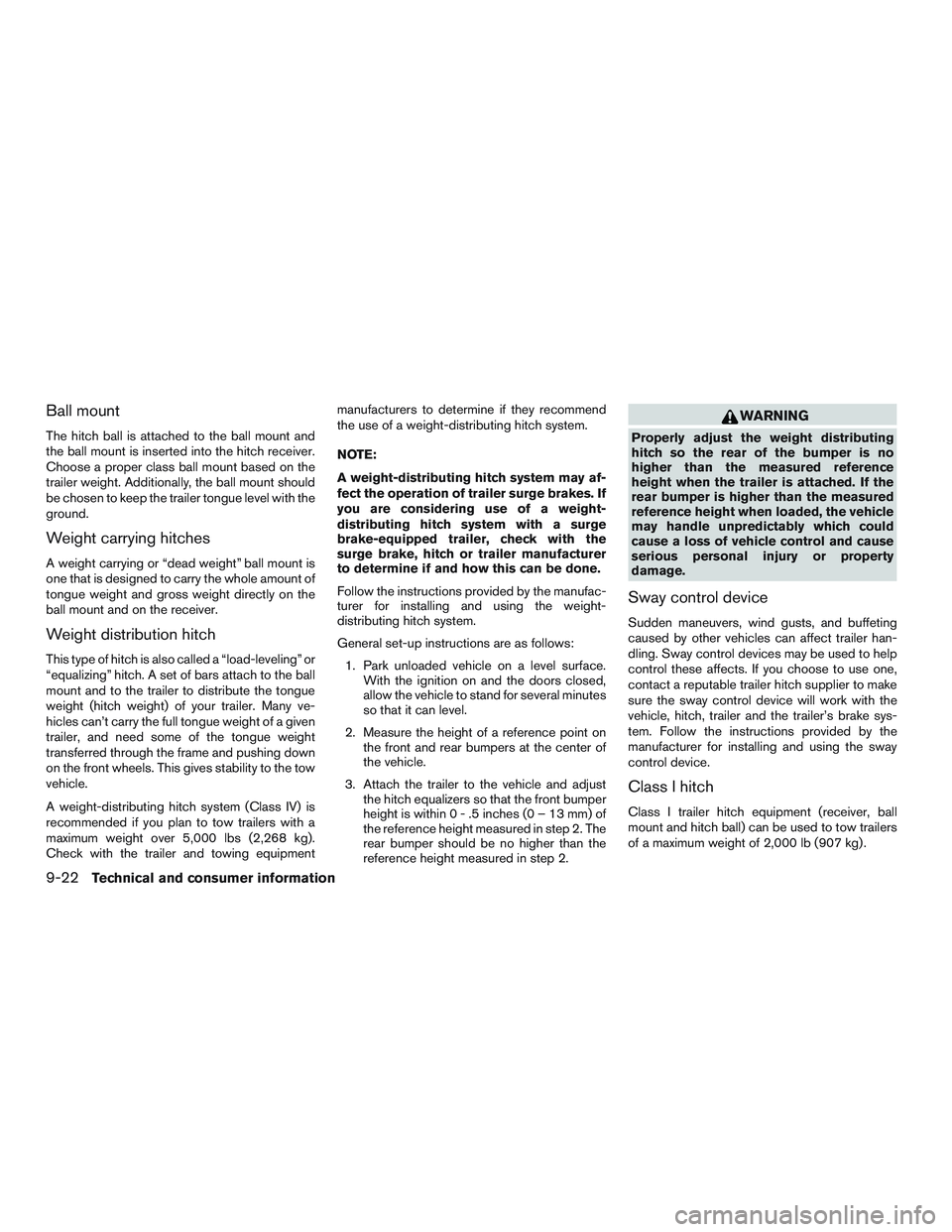
General set-up instructions are as follows:
1. Park unloaded vehicle on a level surface. With the ignition on and the doors closed,
allow the vehicle to stand for several minutes
so that it can level.
2. Measure the height of a reference point on the front and rear bumpers at the center of
the vehicle.
3. Attach the trailer to the vehicle and adjust the hitch equalizers so that the front bumper
height is within0-.5inches (0 – 13 mm) of
the reference height measured in step 2. The
rear bumper should be no higher than the
reference height measured in step 2.
WARNING
Properly adjust the weight distributing
hitch so the rear of the bumper is no
higher than the measured reference
height when the trailer is attached. If the
rear bumper is higher than the measured
reference height when loaded, the vehicle
may handle unpredictably which could
cause a loss of vehicle control and cause
serious personal injury or property
damage.
Sway control device
Sudden maneuvers, wind gusts, and buffeting
caused by other vehicles can affect trailer han-
dling. Sway control devices may be used to help
control these affects. If you choose to use one,
contact a reputable trailer hitch supplier to make
sure the sway control device will work with the
vehicle, hitch, trailer and the trailer’s brake sys-
tem. Follow the instructions provided by the
manufacturer for installing and using the sway
control device.
Class I hitch
Class I trailer hitch equipment (receiver, ball
mount and hitch ball) can be used to tow trailers
of a maximum weight of 2,000 lb (907 kg) .
9-22Technical and consumer information
Page 446 of 478
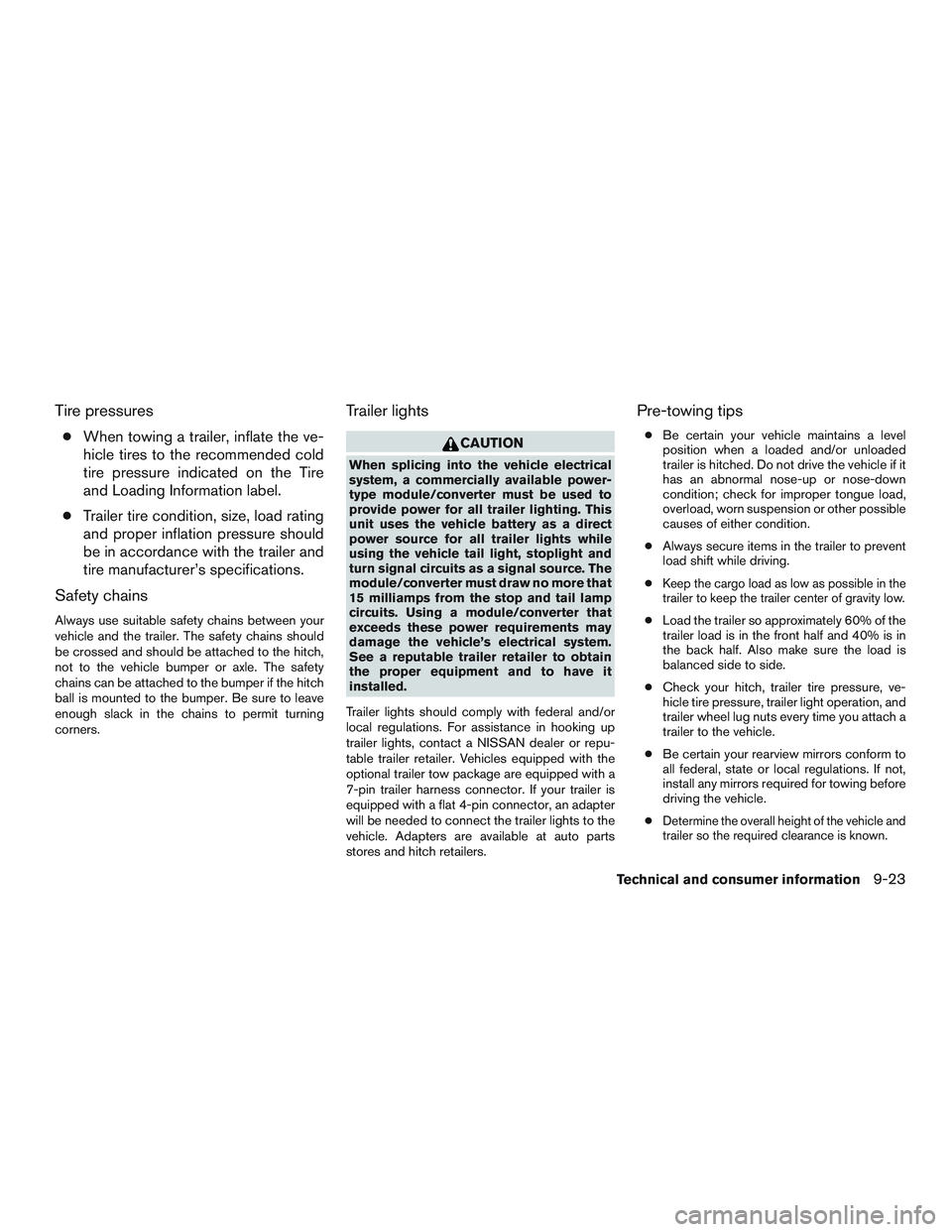
Tire pressures
●When towing a trailer, inflate the ve-
hicle tires to the recommended cold
tire pressure indicated on the Tire
and Loading Information label.
● Trailer tire condition, size, load rating
and proper inflation pressure should
be in accordance with the trailer and
tire manufacturer’s specifications.
Safety chains
Always use suitable safety chains between your
vehicle and the trailer. The safety chains should
be crossed and should be attached to the hitch,
not to the vehicle bumper or axle. The safety
chains can be attached to the bumper if the hitch
ball is mounted to the bumper. Be sure to leave
enough slack in the chains to permit turning
corners.
Trailer lights
CAUTION
When splicing into the vehicle electrical
system, a commercially available power-
type module/converter must be used to
provide power for all trailer lighting. This
unit uses the vehicle battery as a direct
power source for all trailer lights while
using the vehicle tail light, stoplight and
turn signal circuits as a signal source. The
module/converter must draw no more that
15 milliamps from the stop and tail lamp
circuits. Using a module/converter that
exceeds these power requirements may
damage the vehicle’s electrical system.
See a reputable trailer retailer to obtain
the proper equipment and to have it
installed.
Trailer lights should comply with federal and/or
local regulations. For assistance in hooking up
trailer lights, contact a NISSAN dealer or repu-
table trailer retailer. Vehicles equipped with the
optional trailer tow package are equipped with a
7-pin trailer harness connector. If your trailer is
equipped with a flat 4-pin connector, an adapter
will be needed to connect the trailer lights to the
vehicle. Adapters are available at auto parts
stores and hitch retailers.
Pre-towing tips
● Be certain your vehicle maintains a level
position when a loaded and/or unloaded
trailer is hitched. Do not drive the vehicle if it
has an abnormal nose-up or nose-down
condition; check for improper tongue load,
overload, worn suspension or other possible
causes of either condition.
● Always secure items in the trailer to prevent
load shift while driving.
●
Keep the cargo load as low as possible in the
trailer to keep the trailer center of gravity low.
● Load the trailer so approximately 60% of the
trailer load is in the front half and 40% is in
the back half. Also make sure the load is
balanced side to side.
● Check your hitch, trailer tire pressure, ve-
hicle tire pressure, trailer light operation, and
trailer wheel lug nuts every time you attach a
trailer to the vehicle.
● Be certain your rearview mirrors conform to
all federal, state or local regulations. If not,
install any mirrors required for towing before
driving the vehicle.
●
Determine the overall height of the vehicle and
trailer so the required clearance is known.
Technical and consumer information9-23
Page 459 of 478
Seatback pockets................2-49
Seat belt Childsafety..................1-23
Infantsandsmallchildren..........1-24
Injured Person ................1-18
Largerchildren................1-24
Precautionsonseatbeltusage.......1-15
Pregnant women ...............1-18
Seat belt extenders .............1-22
Seat belt maintenance ............1-22
Seat belts ................1-15,7-5
Shoulder belt height adjustment ......1-21
Three-point type with retractor .......1-18
Seat belt extenders ...............1-22
Seatbeltwarninglight..........1-18,2-15
Seats 2nd row bench seat adjustment .......1-6
Adjustment ...................1-2
Armrests....................1-6
Frontseats...................1-2
Heatedseats.................2-42
Manual front seat adjustment .........1-3
Seats/floor mats ..................7-4
Security indicator light ..............2-17
Security system (NISSAN Vehicle Immobilizer
System) , engine start .......2-33,5-12,5-15
Security systems Vehicle security system ...........2-32
Self-adjusting brakes ..............8-20
Service manual order form ...........9-30
Servicing air conditioner .............4-42
Setting button ...................4-7
Shoulder belt height adjustment ........1-21
Smartphone connectivity ............4-74
Spark plug replacement .............8-17
Spark plugs ...................8-17 Specifications
...................9-8
Speedometer ...................2-4
Speedometer and odometer ...........2-4
SPORT mode switch ...........2-44,5-23
Spotlights(Seemaplight) ...........2-63
SRSwarninglabel................1-64
Starting Before starting the engine ..........5-15
Jump starting .............6-10,8-16
Precautions when starting and
driving ...................5-2,5-9
Push starting .................6-12
Starting the engine .............5-16
Starting the engine ...............5-16
Starting the engine (models with NISSAN
Intelligent Key® system) .............5-17
Steering Power steering system ...........5-47
Steeringwheel..................3-32
Steering wheel audio control switch ......4-73
Stoplight.....................8-30
Storage......................2-49
Storagebin....................2-54
Sunglassescase.................2-50
Sunglassesholder................2-50
Sunroof......................2-60
Sunroof(seeMoonroof).............2-60
Sun visors ....................3-33
Supplemental air bag warning labels ......1-64
Supplemental air bag warning light . . .1-65, 2-15
Supplemental front impact air bag system . . .1-54
Supplemental restraint system Information and warning labels .......1-64
Precautions on supplemental restraint
system ....................1-47 Supplemental restraint system
(Supplemental air bag system)
.........1-47
Switch Autolightswitch...............2-38
Automatic power window switch ......2-59
Fog light switch ...............2-41
Hazard warning flasher switch ........6-2
Headlightaimingcontrol ..........2-39
Headlightandturnsignalswitch......2-37
Headlight control switch ..........2-37
H
illdescentcontrolswitch.........2-44
Ignition switch ................5-11
Instrument brightness control ........2-40
Power door lock switch .........3-6,3-7
Rear window and outside mirror defroster
switch .....................2-36
Rear window wiper and washer
switches ...................2-35
Turnsignalswitch..............2-41
Vehicle dynamic control (VDC) off
switch .....................2-43
T
Tachometer ....................2-5
Temperature gauge Engine coolant temperature gauge .....2-5
Theft (NISSAN Vehicle Immobilizer System) ,
engine start .............2-33,5-12,5-15
Three-way catalyst ................5-2
Tire Flat tire .....................6-3
Spare tire ................6-5,8-44
Tire and Loading Information label .....9-12
Tire chains ..................8-40
10-6