steering wheel NISSAN ROGUE 2016 Owner´s Manual
[x] Cancel search | Manufacturer: NISSAN, Model Year: 2016, Model line: ROGUE, Model: NISSAN ROGUE 2016Pages: 478, PDF Size: 5.94 MB
Page 381 of 478
Steering wheelCheck for changes in the steer-
ing system, such as excessive freeplay, hard
steering or strange noises.
Warning lights and chimes Make sure all
warning lights and chimes are operating properly.
Windshield wiper and washer* Check that
the wipers and washer operate properly and that
the wipers do not streak.
Windshield defroster Check that the air
comes out of the defroster outlets properly and in
sufficient quantity when operating the heater or
air conditioner.
Under the hood and vehicle
The maintenance items listed here should be
checked periodically (for example, each time you
check the engine oil or refuel) .
Battery* (for serviceable batteries) Check
the fluid level in each cell. It should be between
the MAX and MIN lines. Vehicles operated in high
temperatures or under severe conditions require
frequent checks of the battery fluid level.
(for non-serviceable batteries) If low battery
fluid is suspected, see a NISSAN dealer. NOTE:
Care should be taken to avoid situations
that can lead to potential battery discharge
and potential no-start conditions such as:
1. Installation or extended use of electronic ac-
cessories that consume battery power when the
engine is not running (Phone chargers, GPS,
DVD players, etc.)
2. Vehicle is not driven regularly and/or only driven
short distances. In these cases, the battery may
need to be charged to maintain battery health.
Brake fluid level*
Make sure that the brake fluid
level is between the MIN and MAX lines on the
reservoir.
Engine coolant level* Check the coolant level
when the engine is cold.
Engine drive belts* Make sure the drive belts
are not frayed, worn, cracked or oily.
Engine oil level* Check the level after parking
the vehicle on a level surface with the engine off.
Wait more than 10 minutes for the oil to drain
back into the oil pan.
Exhaust system Make sure there are no loose
supports, cracks or holes. If the sound of the
exhaust seems unusual or there is a smell of
exhaust fumes, immediately have the exhaust
system inspected. It is recommended you visit a NISSAN dealer for this service. For additional
information, refer to “Exhaust Gas (carbon mon-
oxide)” in the “Starting and driving” section of this
manual.
Fluid leaks
Check under the vehicle for fuel, oil,
water or other fluid leaks after the vehicle has
been parked for a while. Water dripping from the
air conditioner after use is normal. If you should
notice any leaks or if gasoline fumes are evident,
check for the cause and have it corrected imme-
diately.
Radiator and hoses Check the front of the
radiator and clean off any dirt, insects, leaves,
etc., that may have accumulated. Make sure the
hoses have no cracks, deformation, rot or loose
connections.
Underbody The underbody is frequently ex-
posed to corrosive substances such as those
used on icy roads or to control dust. It is very
important to remove these substances from the
underbody, otherwise rust may form on the floor
pan, frame, fuel lines and exhaust system. At the
end of winter, the underbody should be thor-
oughly flushed with plain water, in those areas
where mud and dirt may have accumulated. For
additional information, refer to “Appearance and
care” section of this manual.
Windshield-washer fluid* Check that there is
adequate fluid in the reservoir.
8-4Maintenance and do-it-yourself
Page 447 of 478
Trailer towing tips
In order to gain skill and an understanding of the
vehicle’s behavior, you should practice turning,
stopping and backing up in an area which is free
from traffic. Steering stability and braking perfor-
mance will be somewhat different than under
normal driving conditions.● Always secure items in the trailer to prevent
load shift while driving.
● Lock the trailer hitch coupler with a pin or
lock to prevent the coupler from inadver-
tently becoming unlatched.
● Avoid abrupt starts, acceleration or stops.
● Avoid sharp turns or lane changes.
● Always drive your vehicle at a moderate
speed.
● When backing up, hold the bottom of the
steering wheel with one hand. Move your
hand in the direction in which you want the
trailer to go. Make small corrections and
back up slowly. If possible, have someone
guide you when you are backing up.
Always block the wheels on both vehicle and
trailer when parking. Parking on a slope is not
recommended; however, if you must do so:
CAUTION
If you move the shift lever to the P (Park)
position before blocking the wheels and
applying the parking brake, transmission
damage could occur.
1. Apply and hold the brake pedal.
2. Have someone place blocks on the downhill side of the vehicle and trailer wheels.
3. After the wheel blocks are in place, slowly release the brake pedal until the blocks ab-
sorb the vehicle load.
4. Apply the parking brake.
5. Shift the transmission into P (Park) .
6. Turn off the engine.
To drive away: 1. Start the vehicle.
2. Apply and hold the brake pedal.
3. Shift the transmission into gear.
4. Release the parking brake.
5. Drive slowly until the vehicle and trailer are clear from the blocks.
6. Apply and hold the brake pedal.
7. Have someone retrieve and store the blocks. ●
While going downhill, the weight of the
trailer pushing on the tow vehicle may de-
crease overall stability. Therefore, to main-
tain adequate control, reduce your speed
and shift to a lower gear. Avoid long or
repeated use of the brakes when descend-
ing a hill, as this reduces their effectiveness
and could cause overheating. Shifting to a
lower gear instead provides “engine brak-
ing” and reduces the need to brake as fre-
quently.
● If the engine coolant temperature rises to a
high temperature, refer to “If your vehicle
overheats” in the “In case of emergency”
section of this owner’s manual.
● Trailer towing requires more fuel than normal
circumstances.
● Avoid towing a trailer for your vehicle’s first
500 miles (805 km) .
● For the first 500 miles (805 km) that you do
tow, do not drive over 50 mph (80 km/h).
● Have your vehicle serviced more often than
at intervals specified in the recommended
Maintenance Schedule in the “NISSAN Ser-
vice and Maintenance Guide”.
9-24Technical and consumer information
Page 448 of 478
●When making a turn, your trailer wheels will
be closer to the inside of the turn than your
vehicle wheels. To compensate for this,
make a larger than normal turning radius
during the turn.
● Crosswinds and rough roads will adversely
affect vehicle/trailer handling, possibly caus-
ing vehicle sway. When being passed by
larger vehicles, be prepared for possible
changes in crosswinds that could affect ve-
hicle handling.
Do the following if the trailer begins to sway: 1. Take your foot off the accelerator pedal to allow the vehicle to coast and steer as
straight ahead as the road conditions allow.
This combination will help stabilize the ve-
hicle
– Do not correct trailer sway by steering or applying the brakes.
2. When the trailer sway stops, gently apply the brakes and pull to the side of the road in a
safe area.
3. Try to rearrange the trailer load so it is bal- anced as described in this section. ●
Be careful when passing other vehicles.
Passing while towing a trailer requires con-
siderably more distance than normal pass-
ing. Remember, the length of the trailer must
also pass the other vehicle before you can
safely change lanes.
● Downshift the transmission to a lower gear
for engine braking when driving down steep
or long hills. This will help slow the vehicle
without applying the brakes.
● Avoid holding the brake pedal down too long
or too frequently. This could cause the
brakes to overheat, resulting in reduced
braking efficiency.
● Increase your following distance to allow for
greater stopping distances while towing a
trailer. Anticipate stops and brake gradually.
● NISSAN recommends that the cruise con-
trol not be used while towing a trailer.
● Some states or provinces have specific
regulations and speed limits for vehicles that
are towing trailers. Obey the local speed
limits. ●
Check your hitch, trailer wiring harness con-
nections, and trailer wheel lug nuts after
50 miles (80 km) of travel and at every break.
● When launching a boat, don’t allow the wa-
ter level to go over the exhaust tail pipe or
rear bumper.
● Make sure you disconnect the trailer lights
before backing the trailer into the water or
the trailer lights may burn out.
When towing a trailer, final drive gear oil
should be replaced and transmission
oil/fluid should be changed more fre-
quently. For additional information, refer to
the “Maintenance and do-it-yourself” sec-
tion of this manual.
FLAT TOWING FOR ALL–WHEEL
DRIVE VEHICLE (if so equipped)
Towing your vehicle with all four wheels on the
ground is sometimes called flat towing. This
method is sometimes used when towing a vehicle
behind a recreational vehicle, such as a motor
home.
Technical and consumer information9-25
Page 454 of 478
10 Index
2nd row bench seat adjustment.........1-6
A
Aiming control, headlights ...........2-39
Air bag (See supplemental restraint
system) .....................1-47
Air bag system Front (See supplemental front impact
air bag system) ...............1-54
Airbagwarninglabels.............1-64
Airbagwarninglight...........1-65,2-15
Air bag warning light, supplemental . .1-65, 2-15
Air cleaner housing filter ............8-17
Air conditioner Air conditioner operation ..........4-34
Air conditioner specification label .....9-12
Air conditioner system refrigerant and
oil recommendations .............9-7
Air conditioner system refrigerant
recommendations ..............9-7
Heater and air conditioner
controls................4-32,4-40
Servicing air conditioner ..........4-42
Airflowcharts..................4-36
Alarm system
(See vehicle security system) .........2-32
All-Wheel Drive .................5-43
Anchor point locations .............1-30
Antenna .....................4-74
Antifreeze ....................5-57
Anti-lock brake warning light ..........2-11Anti-lock Braking System (ABS)
........5-48
Apps .......................4-74
Armrests .....................1-6
AroundView®Monitor.............4-16
Audible reminders ...............2-18
Audio system ..................4-42
AMradioreception.............4-43
Bluetooth®audio..........4-70,4-71
Bluetooth® streaming audio ....4-70,4-71
Compact disc (CD) player .....4-53,4-60
FM/AM/SAT radio with compact disc (CD)
player.................4-50,4-55
FMradioreception.............4-42
iPod® Player .............4-65,4-67
iPod® player operation .......4-65,4-67
Radio ....................4-42
Steering wheel audio control switch . . .4-73
USB interface ............4-61,4-63
USB (Universal Serial Bus) Connection
Port..................4-61,4-63
Autolight switch .................2-38
Automatic Automatic power window switch .....2-59
Automatic anti-glare inside mirror .......3-34
Automatic door locks ..............3-7
AUXjack ....................4-61
AWD.......................5-43
B
Battery ..................5-57,8-14
Chargewarninglight............2-12 Battery replacement
..............8-24
Keyfob ...................8-24
NISSAN Intelligent Key® ......8-26,8-27
Before starting the engine ...........5-15
Belt (See drive belt) ..............8-16
Blind Spot Warning (BSW) warning
system..................2-11,5-24
Block heater Engine ....................5-58
Bluetooth® audio ............4-70,4-71
Bluetooth® hands-free phone
system..................4-79,4-93
Bluetooth® streaming audio with Navigation
System .....................4-71
Boosterseats..................1-43
Brake Anti-lock Braking System (ABS) ......5-48
Brake fluid ..................8-12
Brakelight(Seestoplight).........8-30
Brake system ................5-48
Brakewarninglight.............2-11
Brakewearindicators........2-18,8-20
Parking brake operation ..........5-22
Self-adjusting brakes ............8-20
Brake fluid ....................8-12
Brakes ......................8-20
Brake system ..................5-48
Break-inschedule ...............5-41
Brightness/contrast button ...........4-9
Brightness control Instrument panel ..............
2-40
Bulb check/instrument panel ..........2-11
Bulbreplacement................8-30
Page 455 of 478
C
Capacities and recommended fuel/lubricants . .9-2
Cargoareastoragebin.............2-54
Cargocover...................2-55
Cargolight....................2-64
Cargo(Seevehicleloadinginformation)....9-13
Car phone or CB radio .............4-79
CD care and cleaning ..............4-72
CD player (See audio system) ......4-53,4-60
Checkingbulbs .................2-11
Check tire pressure ...............2-30
Child restraints .......1-23,1-24,1-25,1-27
LATCH (Lower Anchors and Tethers for
CHildren) System ..............1-27
Precautions on child
restraints.........1-25,1-32,1-39,1-44
Top tether strap anchor point locations . .1-30
Child restraint with top tether strap .......1-30
Child safety rear door lock ............3-7
Chimes, audible reminders ...........2-18
Cleaningexteriorandinterior........7-2,7-4
Clock setting
(models with Navigation System) ........4-7
Clock setting
(models without Navigation System) ......4-51
C.M.V.S.S. certification label ..........9-11
Cold weather driving ...............5-57
Compact disc (CD) player ........4-53,4-60
Connect phone .................4-75
Consolebox...................2-53
Consolelight...................2-63
Continuously Variable Transmission (CVT) . . .5-18 Continuously Variable Transmission (CVT)
fluid ......................8-12 Driving with Continuously Variable
Transmission (CVT)
.............5-18
Control panel buttons ...............4-4
Brightness/contrast button ..........4-9
Enterbutton..................4-4
Setting button .................4-7
Controls Audio controls (steering wheel) .......4-73
Heater and air conditioner
controls................4-32,4-40
Coolant Capacities and recommended
fuel/lubricants .................9-2
Changingenginecoolant...........8-8
Checking engine coolant level ........8-8
Engine coolant temperature gauge .....2-5
Corrosion protection ...............7-5
Cruisecontrol..................5-33
Cupholders...................2-50
D
Daytime running light system (Canada only) . .2-40
Defroster switch Rear window and outside mirror defroster
switch.....................2-36
Dimensionsandweights.............9-9
Dimmer switch for instrument panel ......2-40
Display......................2-19
Display controls (see control panel buttons) . .4-4
Door locks .....................3-6
Doors ........................3-5
Drive belt .....................8-16
Driving Cold weather driving .............5-57 Driving with Continuously Variable
Transmission (CVT)
.............5-18
Precautions when starting and
driving ...................5-2,5-9
Driving the vehicle ................5-18
E
ECO mode switch ................5-23
Economy-fuel..................5-43
Emergency engine shutoff ............5-14
Emission control information label .......9-11
Emission control system warranty .......9-27
Engine Before starting the engine ..........5-15
Blockheater.................5-58
Capacities and recommended
fuel/lubricants.................9-2
Changing engine coolant ...........8-8
Changingengineoil.............8-10
Changing engine oil filter ..........8-11
Checking engine coolant level ........8-8
Checking
engine oil level ...........8-9
Engine compartment check locations ....8-6
Engine coolant temperature gauge .....2-5
Engine cooling system ............8-7
Engineoil ...................8-9
Engine oil and oil filter recommendation . . .9-6
Engine oil viscosity ..............9-7
Engine serial number ............9-11
Engine specifications .............9-8
Starting the engine .............5-16
Engine coolant temperature gauge .......2-5
Enter button ....................4-4
Event Data recorders ..............9-29
10-2
Page 458 of 478
Mobileapps ...................4-74
Moonroof.....................2-60
Moving Object Detection (MOD) ........4-27
N
NissanConnect
SM................4-74
NissanConnectSMServices...........4-75
NISSAN Intelligent Key® .........3-3,3-12
NISSAN Vehicle Immobilizer
System ...............2-33,5-12,5-15
NISSAN voice recognition system ......4-102
O
Octanerating(Seefueloctanerating)......9-5
Odometer .....................2-4
Oil Capacities and recommended
fuel/lubricants .................9-2
Changing engine oil .............8-10
Changing engine oil filter ..........8-11
Checking engine oil level ...........8-9
Engine oil ...................8-9
Engine oil and oil filter recommendation . . .9-6
Engine oil viscosity ..............9-7
Oneshotcall............4-82,4-82,4-95
Outside mirrors .................3-35
Overheat Ifyourvehicleoverheats...........6-12
Owner’s manual order form ...........9-30
Owner’s manual/service manual order
information ....................9-30 P
Parking Parking brake operation ...........5-22
Parking/parking on hills ...........5-47
Parking brake ...................5-22
Personallights..................2-64
Phone, Bluetooth® hands-free
system ...................4-79,4-93
Power Front seat adjustment .............1-4
Power door locks ............3-6,3-7
Power outlet .................2-46
Power rear windows .............2-59
Power steering system ...........5-47
Rear power windows ............2-59
Power outlet ...................2-46
Power steering ..................5-47
Precautions Maintenance precautions ...........8-5
On-pavement and off-road driving
precautions ..................5-7
Precautions on booster
seats...........1-25,1-32,1-39,1-44
Precautions on child
restraints .........1-25,1-32,1-39,1-44
Precautions on seat belt usage .......1-15
Precautions on supplemental restraint
system ....................1-47
Precautions when starting and
driving ...................5-2,5-9
Programmablefeatures..............4-7
Push starting ...................6-12 R
Radio CarphoneorCBradio ...........4-79
FM/AM/SAT radio with compact disc (CD)
player .................4-50,4-55
Steering wheel audio control switch . . . .4-73
Readiness for inspection maintenance (I/M)
test ........................9-29
Rear power windows ..............2-59
Rearview mirror .................3-34
RearView Monitor ................4-10
Rear window and outside mirror defroster
switch.......................2-36
Rear window wiper and washer switches . . .2-35
Recommended Fluids ...............9-2
Recorders EventData..................9-29
Refrigerant recommendation ...........9-7
Registering a vehicle in another country ....9-10
Remote keyless entry system .....3-2,3-8,3-9
Reporting
safety defects (US only) .......9-28
Roof rack .....................2-56
S
Safety Child safety rear door lock ..........3-7
Child seat belts .....1-25,1-32,1-39,1-44
Reporting safety defects (US only) .....9-28
Seat adjustment Front manual seat adjustment ........1-3
Front power seat adjustment .........1-4
Secondrowbenchseats...........1-6
10-5
Page 459 of 478
Seatback pockets................2-49
Seat belt Childsafety..................1-23
Infantsandsmallchildren..........1-24
Injured Person ................1-18
Largerchildren................1-24
Precautionsonseatbeltusage.......1-15
Pregnant women ...............1-18
Seat belt extenders .............1-22
Seat belt maintenance ............1-22
Seat belts ................1-15,7-5
Shoulder belt height adjustment ......1-21
Three-point type with retractor .......1-18
Seat belt extenders ...............1-22
Seatbeltwarninglight..........1-18,2-15
Seats 2nd row bench seat adjustment .......1-6
Adjustment ...................1-2
Armrests....................1-6
Frontseats...................1-2
Heatedseats.................2-42
Manual front seat adjustment .........1-3
Seats/floor mats ..................7-4
Security indicator light ..............2-17
Security system (NISSAN Vehicle Immobilizer
System) , engine start .......2-33,5-12,5-15
Security systems Vehicle security system ...........2-32
Self-adjusting brakes ..............8-20
Service manual order form ...........9-30
Servicing air conditioner .............4-42
Setting button ...................4-7
Shoulder belt height adjustment ........1-21
Smartphone connectivity ............4-74
Spark plug replacement .............8-17
Spark plugs ...................8-17 Specifications
...................9-8
Speedometer ...................2-4
Speedometer and odometer ...........2-4
SPORT mode switch ...........2-44,5-23
Spotlights(Seemaplight) ...........2-63
SRSwarninglabel................1-64
Starting Before starting the engine ..........5-15
Jump starting .............6-10,8-16
Precautions when starting and
driving ...................5-2,5-9
Push starting .................6-12
Starting the engine .............5-16
Starting the engine ...............5-16
Starting the engine (models with NISSAN
Intelligent Key® system) .............5-17
Steering Power steering system ...........5-47
Steeringwheel..................3-32
Steering wheel audio control switch ......4-73
Stoplight.....................8-30
Storage......................2-49
Storagebin....................2-54
Sunglassescase.................2-50
Sunglassesholder................2-50
Sunroof......................2-60
Sunroof(seeMoonroof).............2-60
Sun visors ....................3-33
Supplemental air bag warning labels ......1-64
Supplemental air bag warning light . . .1-65, 2-15
Supplemental front impact air bag system . . .1-54
Supplemental restraint system Information and warning labels .......1-64
Precautions on supplemental restraint
system ....................1-47 Supplemental restraint system
(Supplemental air bag system)
.........1-47
Switch Autolightswitch...............2-38
Automatic power window switch ......2-59
Fog light switch ...............2-41
Hazard warning flasher switch ........6-2
Headlightaimingcontrol ..........2-39
Headlightandturnsignalswitch......2-37
Headlight control switch ..........2-37
H
illdescentcontrolswitch.........2-44
Ignition switch ................5-11
Instrument brightness control ........2-40
Power door lock switch .........3-6,3-7
Rear window and outside mirror defroster
switch .....................2-36
Rear window wiper and washer
switches ...................2-35
Turnsignalswitch..............2-41
Vehicle dynamic control (VDC) off
switch .....................2-43
T
Tachometer ....................2-5
Temperature gauge Engine coolant temperature gauge .....2-5
Theft (NISSAN Vehicle Immobilizer System) ,
engine start .............2-33,5-12,5-15
Three-way catalyst ................5-2
Tire Flat tire .....................6-3
Spare tire ................6-5,8-44
Tire and Loading Information label .....9-12
Tire chains ..................8-40
10-6
Page 465 of 478
PRECAUTIONS ON SRS
This SRS section contains important information
concerning the following systems:
●Driver and front passenger supplemental
front-impact air bag (NISSAN Advanced Air
Bag System)
●Front seat-mounted side-impact supple-
mental air bag
●Roof-mounted curtain side-impact and roll-
over supplemental air bag
●Seat belt with pretensioner(s) (front seats)
Supplemental front-impact air bag system
The NISSAN Advanced Air Bag System can help
cushion the impact force to the head and chest of
the driver and front passenger in certain frontal
collisions.
Front seat-mounted side-impact supple-
mental air bag system
This system can help cushion the impact force to
the chest area of the driver and front passenger in
certain side-impact collisions. The side air bags
are designed to inflate on the side where the
vehicle is impacted.Roof-mounted curtain side-impact and
rollover supplemental air bag system
This system can help cushion the impact force to
the head of occupants in front and rear outboard
seating positions in certain side-impact colli-
sions. The curtain air bags are designed to inflate
on the side where the vehicle is impacted. In a
rollover, the curtain air bags are designed to
inflate and remain inflated for a short time.
The SRS is designed tosupplementthe crash
protection provided by the driver and front pas-
senger seat belts and isnot a substitutefor
them. Seat belts should always be correctly worn
and the occupant seated a suitable distance
away from the steering wheel, instrument panel
and door finishers. For additional information
about instructions and precautions on seat belt
usage, refer to “Seat belts” in this section.
The supplemental air bags operate only
when the ignition switch is placed in the ON
position.
After placing the ignition switch in the ON
position, the supplemental air bag warning
light illuminates. The supplemental air bag
warning light will turn off after about 7 sec-
onds if the system is operational.
SUPPLEMENTAL RESTRAINT
SYSTEM (SRS)
Page 466 of 478
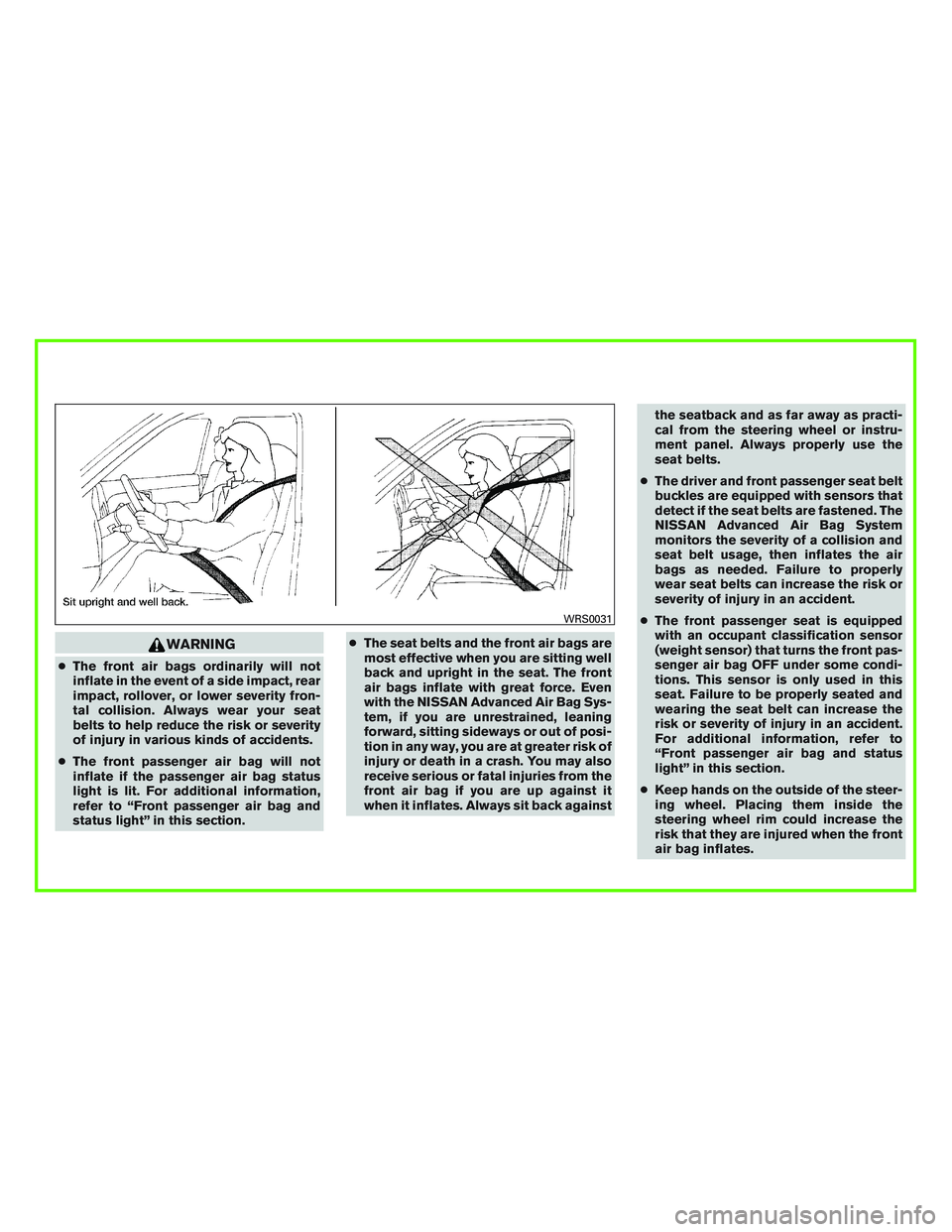
WARNING
●The front air bags ordinarily will not
inflate in the event of a side impact, rear
impact, rollover, or lower severity fron-
tal collision. Always wear your seat
belts to help reduce the risk or severity
of injury in various kinds of accidents.
●The front passenger air bag will not
inflate if the passenger air bag status
light is lit. For additional information,
refer to “Front passenger air bag and
status light” in this section.●The seat belts and the front air bags are
most effective when you are sitting well
back and upright in the seat. The front
air bags inflate with great force. Even
with the NISSAN Advanced Air Bag Sys-
tem, if you are unrestrained, leaning
forward, sitting sideways or out of posi-
tion in any way, you are at greater risk of
injury or death in a crash. You may also
receive serious or fatal injuries from the
front air bag if you are up against it
when it inflates. Always sit back againstthe seatback and as far away as practi-
cal from the steering wheel or instru-
ment panel. Always properly use the
seat belts.
●The driver and front passenger seat belt
buckles are equipped with sensors that
detect if the seat belts are fastened. The
NISSAN Advanced Air Bag System
monitors the severity of a collision and
seat belt usage, then inflates the air
bags as needed. Failure to properly
wear seat belts can increase the risk or
severity of injury in an accident.
●The front passenger seat is equipped
with an occupant classification sensor
(weight sensor) that turns the front pas-
senger air bag OFF under some condi-
tions. This sensor is only used in this
seat. Failure to be properly seated and
wearing the seat belt can increase the
risk or severity of injury in an accident.
For additional information, refer to
“Front passenger air bag and status
light” in this section.
●Keep hands on the outside of the steer-
ing wheel. Placing them inside the
steering wheel rim could increase the
risk that they are injured when the front
air bag inflates.
WRS0031
Page 472 of 478
The driver supplemental front-impact air bag is
located in the center of the steering wheel. The
front passenger supplemental front-impact air
bag is mounted in the dashboard above the glove
box. The front air bags are designed to inflate in
higher severity frontal collisions, although they
may inflate if the forces in another type of collision
are similar to those of a higher severity frontal
impact. They may not inflate in certain frontal
collisions. Vehicle damage (or lack of it) is not
always an indication of proper front air bag sys-
tem operation.
The NISSAN Advanced Air Bag System monitors
information from the crash zone sensor, the Air
bag Control Unit (ACU) , seat belt buckle sensors
and occupation classification sensor (weight
sensor) . Inflator operation is based on the sever-
ity of a collision and seat belt usage for the driver.
For the front passenger, the occupant classifica-
tion sensor is also monitored. Based on informa-
tion from the sensor, only one front air bag may
inflate in a crash, depending on the crash severity
and whether the front occupants are belted or
unbelted. Additionally, the front passenger air
bag may be automatically turned off under some
conditions, depending on the weight detected on
the front passenger seat and how the seat belt is
used. If the front passenger air bag is OFF, the
front passenger air bag status light will be illumi-
nated. For additional information, refer to “Frontpassenger air bag and status light” in this section.
One front air bag inflating does not indicate im-
proper performance of the system.
If you have any questions about your air bag
system, it is recommended that you visit a
NISSAN dealer to obtain information about the
system. If you are considering modification of
your vehicle due to a disability, you may also
contact NISSAN. Contact information is con-
tained in the front of this Owner’s Manual.
When a front air bag inflates, a fairly loud noise
may be heard, followed by the release of smoke.
This smoke is not harmful and does not indicate a
fire. Care should be taken to not inhale it, as it may
cause irritation and choking. Those with a history
of a breathing condition should get fresh air
promptly.
Front air bags, along with the use of seat belts,
help to cushion the impact force on the face and
chest of the front occupants. They can help save
lives and reduce serious injuries. However, an
inflating front air bag may cause facial abrasions
or other injuries. Front air bags do not provide
restraint to the lower body.
Even with NISSAN Advanced Air Bags, seat
belts should be correctly worn and the driver and
front passenger seated upright as far as practical
away from the steering wheel or instrument
panel. The front air bags inflate quickly in order tohelp protect the front occupants. Because of this,
the force of the front air bag inflating can increase
the risk of injury if the occupant is too close to, or
is against, the front air bag module during infla-
tion.
The front air bags deflate quickly after a collision.
The front air bags operate only when the
ignition switch is in the ON position.
After placing the ignition switch in the ON
position, the supplemental air bag warning
light illuminates. The supplemental air bag
warning light will turn off after about 7 sec-
onds if the system is operational.