service NISSAN ROGUE 2016 Owner´s Manual
[x] Cancel search | Manufacturer: NISSAN, Model Year: 2016, Model line: ROGUE, Model: NISSAN ROGUE 2016Pages: 478, PDF Size: 5.94 MB
Page 449 of 478
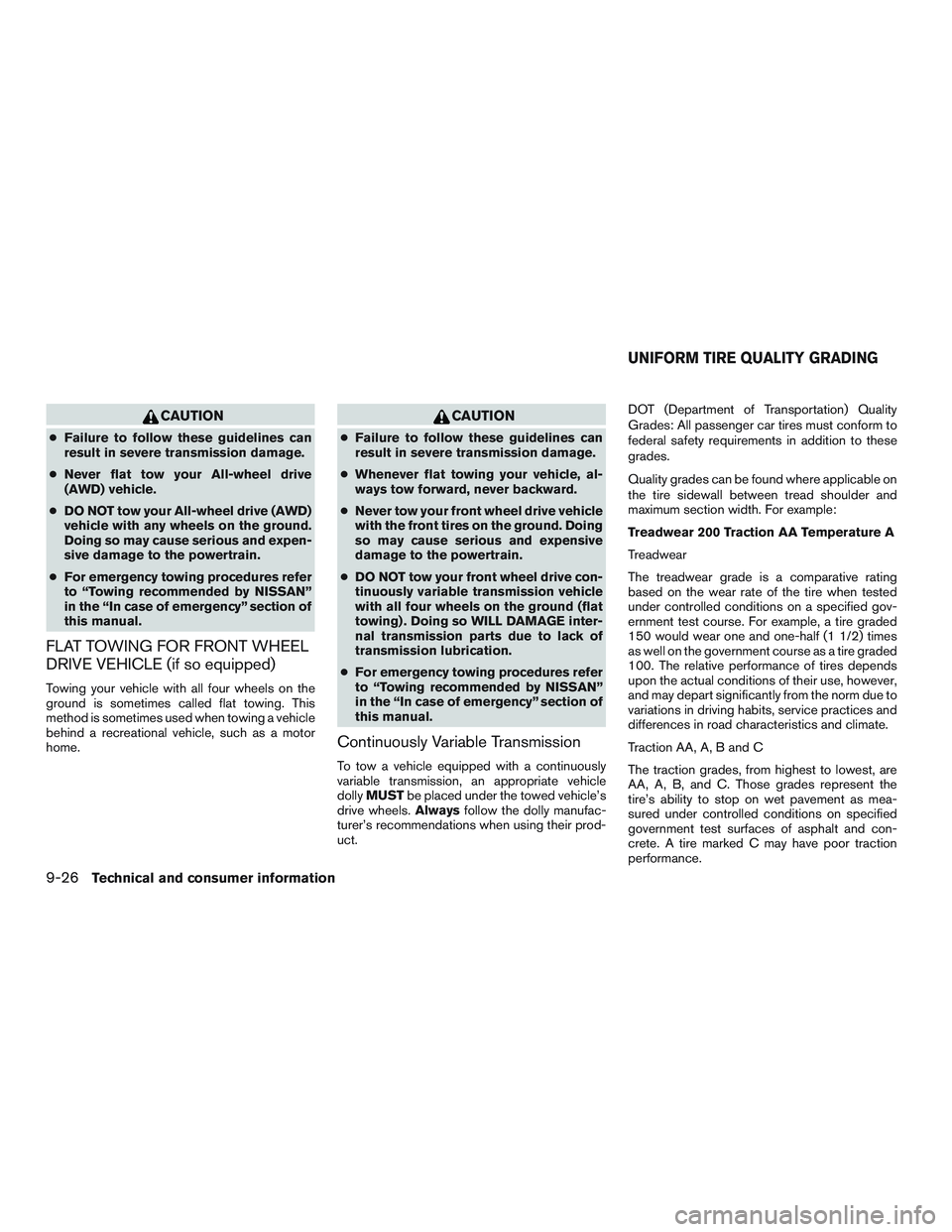
CAUTION
●Failure to follow these guidelines can
result in severe transmission damage.
● Never flat tow your All-wheel drive
(AWD) vehicle.
● DO NOT tow your All-wheel drive (AWD)
vehicle with any wheels on the ground.
Doing so may cause serious and expen-
sive damage to the powertrain.
● For emergency towing procedures refer
to “Towing recommended by NISSAN”
in the “In case of emergency” section of
this manual.
FLAT TOWING FOR FRONT WHEEL
DRIVE VEHICLE (if so equipped)
Towing your vehicle with all four wheels on the
ground is sometimes called flat towing. This
method is sometimes used when towing a vehicle
behind a recreational vehicle, such as a motor
home.
CAUTION
● Failure to follow these guidelines can
result in severe transmission damage.
● Whenever flat towing your vehicle, al-
ways tow forward, never backward.
● Never tow your front wheel drive vehicle
with the front tires on the ground. Doing
so may cause serious and expensive
damage to the powertrain.
● DO NOT tow your front wheel drive con-
tinuously variable transmission vehicle
with all four wheels on the ground (flat
towing) . Doing so WILL DAMAGE inter-
nal transmission parts due to lack of
transmission lubrication.
● For emergency towing procedures refer
to “Towing recommended by NISSAN”
in the “In case of emergency” section of
this manual.
Continuously Variable Transmission
To tow a vehicle equipped with a continuously
variable transmission, an appropriate vehicle
dolly MUST be placed under the towed vehicle’s
drive wheels. Alwaysfollow the dolly manufac-
turer’s recommendations when using their prod-
uct. DOT (Department of Transportation) Quality
Grades: All passenger car tires must conform to
federal safety requirements in addition to these
grades.
Quality grades can be found where applicable on
the tire sidewall between tread shoulder and
maximum section width. For example:
Treadwear 200 Traction AA Temperature A
Treadwear
The treadwear grade is a comparative rating
based on the wear rate of the tire when tested
under controlled conditions on a specified gov-
ernment test course. For example, a tire graded
150 would wear one and one-half (1 1/2) times
as well on the government course as a tire graded
100. The relative performance of tires depends
upon the actual conditions of their use, however,
and may depart significantly from the norm due to
variations in driving habits, service practices and
differences in road characteristics and climate.
Traction AA, A, B and C
The traction grades, from highest to lowest, are
AA, A, B, and C. Those grades represent the
tire’s ability to stop on wet pavement as mea-
sured under controlled conditions on specified
government test surfaces of asphalt and con-
crete. A tire marked C may have poor traction
performance.
UNIFORM TIRE QUALITY GRADING
9-26Technical and consumer information
Page 453 of 478
the type of personally identifying data routinely
acquired during a crash investigation.
To read data recorded by an EDR, special equip-
ment is required and access to the vehicle or the
EDR is needed. In addition to the vehicle manu-
facturer and NISSAN dealer, other parties, such
as law enforcement, that have the special equip-
ment, can read the information if they have ac-
cess to the vehicle or the EDR. EDR data will only
be accessed with the consent of the vehicle
owner or lessee or as otherwise required or per-
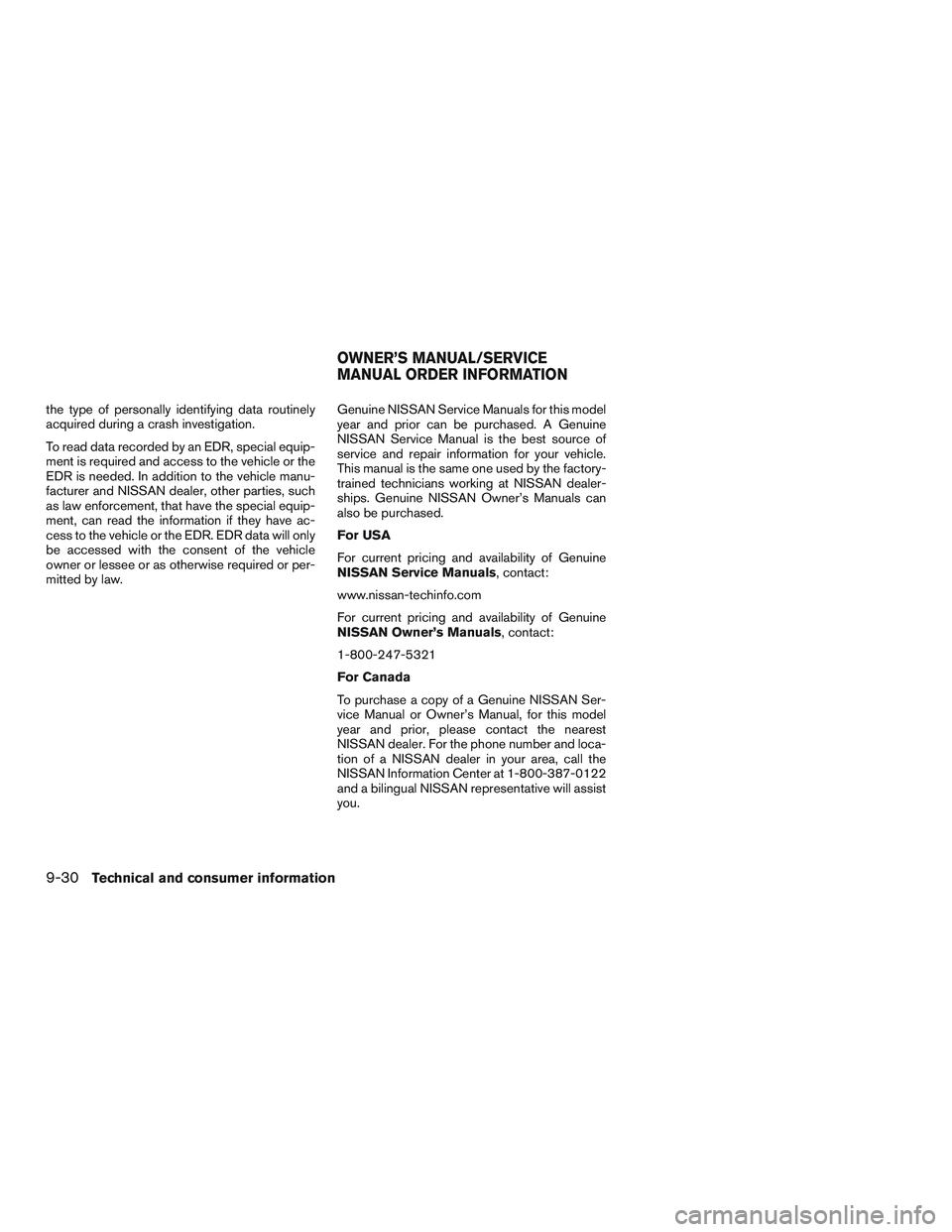
mitted by law.Genuine NISSAN Service Manuals for this model
year and prior can be purchased. A Genuine
NISSAN Service Manual is the best source of
service and repair information for your vehicle.
This manual is the same one used by the factory-
trained technicians working at NISSAN dealer-
ships. Genuine NISSAN Owner’s Manuals can
also be purchased.
For USA
For current pricing and availability of Genuine
NISSAN Service Manuals, contact:
www.nissan-techinfo.com
For current pricing and availability of Genuine
NISSAN Owner’s Manuals, contact:
1-800-247-5321
For Canada
To purchase a copy of a Genuine NISSAN Ser-
vice Manual or Owner’s Manual, for this model
year and prior, please contact the nearest
NISSAN dealer. For the phone number and loca-
tion of a NISSAN dealer in your area, call the
NISSAN Information Center at 1-800-387-0122
and a bilingual NISSAN representative will assist
you.
OWNER’S MANUAL/SERVICE
MANUAL ORDER INFORMATION
9-30Technical and consumer information
Page 458 of 478
Mobileapps ...................4-74
Moonroof.....................2-60
Moving Object Detection (MOD) ........4-27
N
NissanConnect
SM................4-74
NissanConnectSMServices...........4-75
NISSAN Intelligent Key® .........3-3,3-12
NISSAN Vehicle Immobilizer
System ...............2-33,5-12,5-15
NISSAN voice recognition system ......4-102
O
Octanerating(Seefueloctanerating)......9-5
Odometer .....................2-4
Oil Capacities and recommended
fuel/lubricants .................9-2
Changing engine oil .............8-10
Changing engine oil filter ..........8-11
Checking engine oil level ...........8-9
Engine oil ...................8-9
Engine oil and oil filter recommendation . . .9-6
Engine oil viscosity ..............9-7
Oneshotcall............4-82,4-82,4-95
Outside mirrors .................3-35
Overheat Ifyourvehicleoverheats...........6-12
Owner’s manual order form ...........9-30
Owner’s manual/service manual order
information ....................9-30 P
Parking Parking brake operation ...........5-22
Parking/parking on hills ...........5-47
Parking brake ...................5-22
Personallights..................2-64
Phone, Bluetooth® hands-free
system ...................4-79,4-93
Power Front seat adjustment .............1-4
Power door locks ............3-6,3-7
Power outlet .................2-46
Power rear windows .............2-59
Power steering system ...........5-47
Rear power windows ............2-59
Power outlet ...................2-46
Power steering ..................5-47
Precautions Maintenance precautions ...........8-5
On-pavement and off-road driving
precautions ..................5-7
Precautions on booster
seats...........1-25,1-32,1-39,1-44
Precautions on child
restraints .........1-25,1-32,1-39,1-44
Precautions on seat belt usage .......1-15
Precautions on supplemental restraint
system ....................1-47
Precautions when starting and
driving ...................5-2,5-9
Programmablefeatures..............4-7
Push starting ...................6-12 R
Radio CarphoneorCBradio ...........4-79
FM/AM/SAT radio with compact disc (CD)
player .................4-50,4-55
Steering wheel audio control switch . . . .4-73
Readiness for inspection maintenance (I/M)
test ........................9-29
Rear power windows ..............2-59
Rearview mirror .................3-34
RearView Monitor ................4-10
Rear window and outside mirror defroster
switch.......................2-36
Rear window wiper and washer switches . . .2-35
Recommended Fluids ...............9-2
Recorders EventData..................9-29
Refrigerant recommendation ...........9-7
Registering a vehicle in another country ....9-10
Remote keyless entry system .....3-2,3-8,3-9
Reporting
safety defects (US only) .......9-28
Roof rack .....................2-56
S
Safety Child safety rear door lock ..........3-7
Child seat belts .....1-25,1-32,1-39,1-44
Reporting safety defects (US only) .....9-28
Seat adjustment Front manual seat adjustment ........1-3
Front power seat adjustment .........1-4
Secondrowbenchseats...........1-6
10-5
Page 459 of 478
Seatback pockets................2-49
Seat belt Childsafety..................1-23
Infantsandsmallchildren..........1-24
Injured Person ................1-18
Largerchildren................1-24
Precautionsonseatbeltusage.......1-15
Pregnant women ...............1-18
Seat belt extenders .............1-22
Seat belt maintenance ............1-22
Seat belts ................1-15,7-5
Shoulder belt height adjustment ......1-21
Three-point type with retractor .......1-18
Seat belt extenders ...............1-22
Seatbeltwarninglight..........1-18,2-15
Seats 2nd row bench seat adjustment .......1-6
Adjustment ...................1-2
Armrests....................1-6
Frontseats...................1-2
Heatedseats.................2-42
Manual front seat adjustment .........1-3
Seats/floor mats ..................7-4
Security indicator light ..............2-17
Security system (NISSAN Vehicle Immobilizer
System) , engine start .......2-33,5-12,5-15
Security systems Vehicle security system ...........2-32
Self-adjusting brakes ..............8-20
Service manual order form ...........9-30
Servicing air conditioner .............4-42
Setting button ...................4-7
Shoulder belt height adjustment ........1-21
Smartphone connectivity ............4-74
Spark plug replacement .............8-17
Spark plugs ...................8-17 Specifications
...................9-8
Speedometer ...................2-4
Speedometer and odometer ...........2-4
SPORT mode switch ...........2-44,5-23
Spotlights(Seemaplight) ...........2-63
SRSwarninglabel................1-64
Starting Before starting the engine ..........5-15
Jump starting .............6-10,8-16
Precautions when starting and
driving ...................5-2,5-9
Push starting .................6-12
Starting the engine .............5-16
Starting the engine ...............5-16
Starting the engine (models with NISSAN
Intelligent Key® system) .............5-17
Steering Power steering system ...........5-47
Steeringwheel..................3-32
Steering wheel audio control switch ......4-73
Stoplight.....................8-30
Storage......................2-49
Storagebin....................2-54
Sunglassescase.................2-50
Sunglassesholder................2-50
Sunroof......................2-60
Sunroof(seeMoonroof).............2-60
Sun visors ....................3-33
Supplemental air bag warning labels ......1-64
Supplemental air bag warning light . . .1-65, 2-15
Supplemental front impact air bag system . . .1-54
Supplemental restraint system Information and warning labels .......1-64
Precautions on supplemental restraint
system ....................1-47 Supplemental restraint system
(Supplemental air bag system)
.........1-47
Switch Autolightswitch...............2-38
Automatic power window switch ......2-59
Fog light switch ...............2-41
Hazard warning flasher switch ........6-2
Headlightaimingcontrol ..........2-39
Headlightandturnsignalswitch......2-37
Headlight control switch ..........2-37
H
illdescentcontrolswitch.........2-44
Ignition switch ................5-11
Instrument brightness control ........2-40
Power door lock switch .........3-6,3-7
Rear window and outside mirror defroster
switch .....................2-36
Rear window wiper and washer
switches ...................2-35
Turnsignalswitch..............2-41
Vehicle dynamic control (VDC) off
switch .....................2-43
T
Tachometer ....................2-5
Temperature gauge Engine coolant temperature gauge .....2-5
Theft (NISSAN Vehicle Immobilizer System) ,
engine start .............2-33,5-12,5-15
Three-way catalyst ................5-2
Tire Flat tire .....................6-3
Spare tire ................6-5,8-44
Tire and Loading Information label .....9-12
Tire chains ..................8-40
10-6
Page 471 of 478
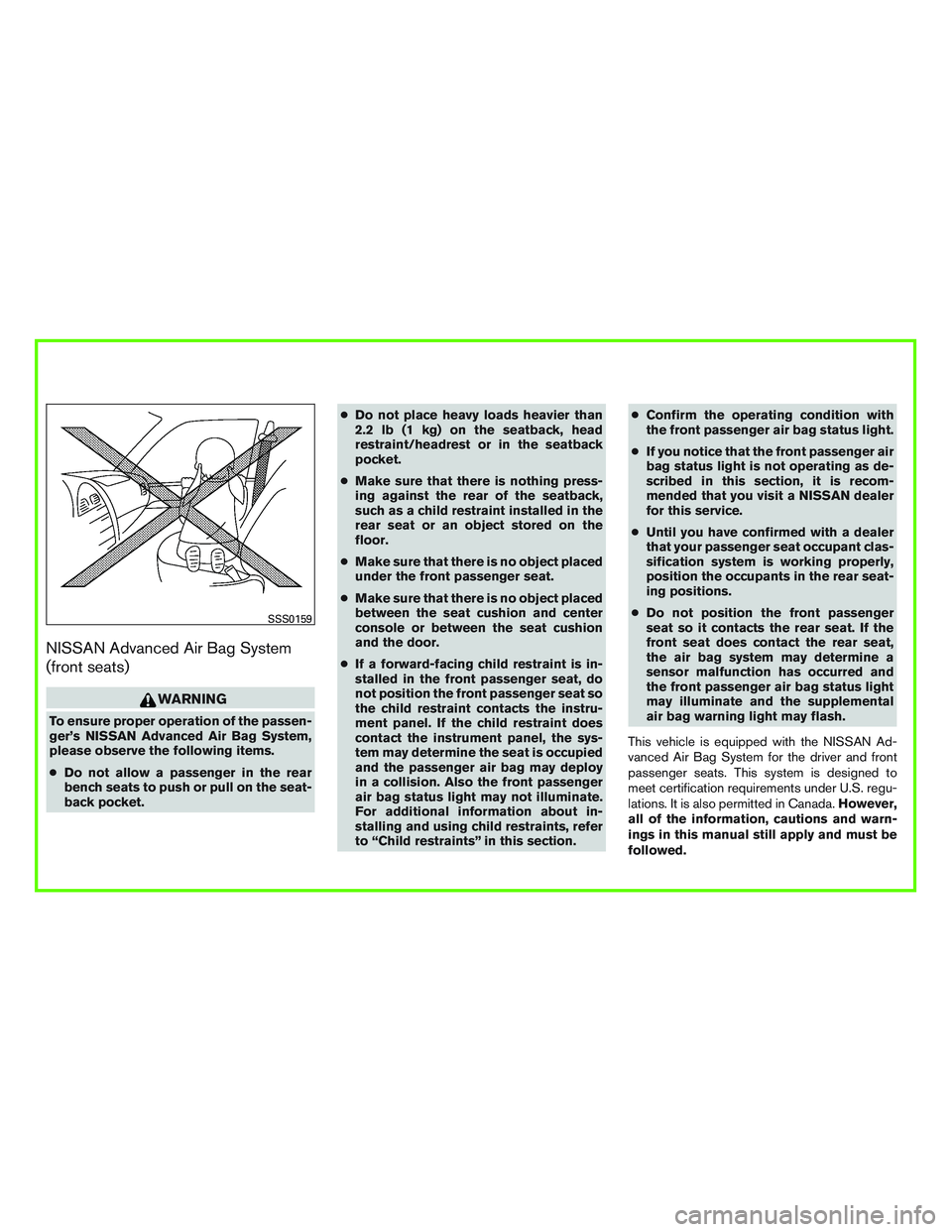
NISSAN Advanced Air Bag System
(front seats)
WARNING
To ensure proper operation of the passen-
ger’s NISSAN Advanced Air Bag System,
please observe the following items.
●Do not allow a passenger in the rear
bench seats to push or pull on the seat-
back pocket.●Do not place heavy loads heavier than
2.2 lb (1 kg) on the seatback, head
restraint/headrest or in the seatback
pocket.
●Make sure that there is nothing press-
ing against the rear of the seatback,
such as a child restraint installed in the
rear seat or an object stored on the
floor.
●Make sure that there is no object placed
under the front passenger seat.
●Make sure that there is no object placed
between the seat cushion and center
console or between the seat cushion
and the door.
●If a forward-facing child restraint is in-
stalled in the front passenger seat, do
not position the front passenger seat so
the child restraint contacts the instru-
ment panel. If the child restraint does
contact the instrument panel, the sys-
tem may determine the seat is occupied
and the passenger air bag may deploy
in a collision. Also the front passenger
air bag status light may not illuminate.
For additional information about in-
stalling and using child restraints, refer
to “Child restraints” in this section.●Confirm the operating condition with
the front passenger air bag status light.
●If you notice that the front passenger air
bag status light is not operating as de-
scribed in this section, it is recom-
mended that you visit a NISSAN dealer
for this service.
●Until you have confirmed with a dealer
that your passenger seat occupant clas-
sification system is working properly,
position the occupants in the rear seat-
ing positions.
●Do not position the front passenger
seat so it contacts the rear seat. If the
front seat does contact the rear seat,
the air bag system may determine a
sensor malfunction has occurred and
the front passenger air bag status light
may illuminate and the supplemental
air bag warning light may flash.
This vehicle is equipped with the NISSAN Ad-
vanced Air Bag System for the driver and front
passenger seats. This system is designed to
meet certification requirements under U.S. regu-
lations. It is also permitted in Canada.However,
all of the information, cautions and warn-
ings in this manual still apply and must be
followed.
SSS0159
Page 475 of 478
belt is not being used properly. Make sure that
the child restraint is installed properly, the seat
belt is used properly and the occupant is posi-
tioned properly. If the air bag status light is still not
illuminated, reposition the occupant or child re-
straint in a rear seat.
If the front passenger air bag status light will not
illuminate even though you believe that the child
restraint, the seat belts and the occupant are
properly positioned, it is recommended that you
take your vehicle to a NISSAN dealer. A NISSAN
dealer can check system status by using a spe-
cial tool. However, until you have confirmed with
a dealer that your air bag is working properly,
reposition the occupant or child restraint in a rear
seat.
The NISSAN Advanced Air Bag System and front
passenger air bag status light will take a few
seconds to register a change in the front passen-
ger seat status. For example, if a large adult who
is sitting in the front passenger seat exits the
vehicle, the front passenger air bag status light
will go from OFF to ON for a few seconds and
then to OFF. This is normal system operation and
does not indicate a malfunction.If a malfunction occurs in the front passenger air
bag system, the supplemental air bag warning
light
, located in the meter and gauges area
of the instrument panel, will be illuminated (blink-
ing or steadily lit) . Have the system checked. It is
recommended that you visit a NISSAN dealer for
this service.
Normal operation
In order for the occupant classification sensor
system to classify the front passenger based on
weight, please follow the precautions and steps
outlined below:
Precautions
●Make sure that there are no objects weigh-
ing over 2.2 lbs (1 kg) hanging on the seat or
placed in the seatback pocket.
●Make sure that a child restraint or other
object is not pressing against the rear of the
seatback.
●Make sure that a rear passenger is not push-
ing or pulling on the back of the front pas-
senger seat.
●Make sure that the front passenger seat or
seatback is not forced back against an ob-
ject on the seat or floor behind it.
●Make sure that there is no object placed
under the front passenger seat.Steps
1. Adjust the seat as outlined in the “Seats”
section of this manual. Sit upright, leaning
against the seatback, and centered on the
seat cushion with your feet comfortably ex-
tended to the floor.
2. Make sure there are no objects on your lap.
3. Fasten the seat belt as outlined in the “Seat
belts” section of this manual. Front passen-
ger seat belt buckle status is monitored by
the occupant classification system, and is
used as an input to determine occupancy
status. So, it is highly recommended that the
front passenger fasten their seat belt.
4. Remain in this position for 30 seconds al-
lowing the system to classify the front pas-
senger before the vehicle is put into motion.
5. Ensure proper classification by checking the
front passenger air bag status light.
Page 476 of 478
NOTE:
This vehicle’s occupant classification sen-
sor system generally keeps the classifica-
tion locked during driving, so it is important
that you confirm that the front passenger is
properly classified prior to driving. How-
ever, the occupant classification sensor
may recalculate the weight of the occupant
under some conditions (both while driving
and when stopped) , so front passenger
seat occupants should continue to remain
seated as outlined above.
Troubleshooting
If you think the front passenger air bag status light
is incorrect:
1. If the light is ON with an adult occupying the
front passenger seat:
●Occupant is a small adult — the air bag light
is functioning as intended. The front passen-
ger air bag is suppressed.
However, if the occupant is not a small adult, then
this may be due to the following conditions that
may be interfering with the weight sensors:
●Occupant is not sitting upright, leaning
against the seatback, and centered on the
seat cushion with his/her feet comfortably
extended to the floor.●A child restraint or other object pressing
against the rear of the seatback.
●A rear passenger pushing or pulling on the
back of the front passenger seat.
●Forcing the front seat or seatback against an
object on the seat or floor behind it.
●An object placed under the front passenger
seat.
●An object placed between the seat cushion
and center console or between the seat
cushion and the door.
If the vehicle is moving, please come to a stop
when it is safe to do so. Check and correct any of
the above conditions. Restart the vehicle and
wait 1 minute.
NOTE:
A system check will be performed during
which the front passenger air bag status
light will remain lit for about 7 seconds
initially.
If the light is still ON after this, the person should
be advised not to ride in the front passenger seat
and the vehicle should be checked as soon as
possible. It is recommended that you visit a
NISSAN dealer for this service.2. If the light is OFF with a small adult, child or
child restraint occupying the front passen-
ger seat.
This may be due to the following conditions
that may be interfering with the weight sen-
sors:
●Small adult or child is not sitting upright,
leaning against the seatback, and centered
on the seat cushion with his/her feet com-
fortably extended to the floor.
●The child restraint is not properly installed,
as outlined in the “Child restraints” section of
this manual.
●An object weighing over 2.2 lbs (1 kg) hang-
ing on the seat or placed in the seatback
pocket.
●A child restraint or other object pressing
against the rear of the seatback.
●A rear passenger pushing or pulling on the
back of the front passenger seat.
●Forcing the front seat or seatback against an
object on the seat or floor behind it.
●An object placed under the front passenger
seat.
●An object placed between the seat cushion
and center console.
Page 477 of 478
If the vehicle is moving, please come to a stop
when it is safe to do so. Check and correct any of
the above conditions. Restart the vehicle and
wait 1 minute.
NOTE:
A system check will be performed during
which the front passenger air bag status
light will remain lit for about 7 seconds
initially.
If the light is still OFF after this, the small adult,
child or child restraint should be repositioned in
the rear seat and the vehicle should be checked
as soon as possible. It is recommended that you
visit a NISSAN dealer for this service.
3. If the light is OFF with no front passenger
and no objects on the front passenger seat,
the vehicle should be checked. It is recom-
mended that you visit a NISSAN dealer as
soon as possible.Other supplemental front-impact air bag
precautions
WARNING
●Do not place any objects on the steering
wheel pad or on the instrument panel.
Also, do not place any objects between
any occupant and the steering wheel or
instrument panel. Such objects may be-
come dangerous projectiles and cause
injury if the front air bags inflate.
●Immediately after inflation, several
front air bag system components will be
hot. Do not touch them; you may se-
verely burn yourself.
●No unauthorized changes should be
made to any components or wiring of
the supplemental air bag system. This is
to prevent accidental inflation of the
supplemental air bag or damage to the
supplemental air bag system.
●Do not make unauthorized changes to
your vehicle’s electrical system, sus-
pension system or front end structure.
This could affect proper operation of
the front air bag system.●Tampering with the front air bag system
may result in serious personal injury.
Tampering includes changes to the
steering wheel and the instrument
panel assembly by placing material
over the steering wheel pad and above
the instrument panel or by installing
additional trim material around the air
bag system.
●Removing or modifying the front pas-
senger seat may affect the function of
the air bag system and result in serious
personal injury.
●Modifying or tampering with the front
passenger seat may result in serious
personal injury. For example, do not
change the front seats by placing mate-
rial on the seat cushion or by installing
additional trim material, such as seat
covers, on the seat that are not specifi-
cally designed to assure proper air bag
operation. Additionally, do not stow any
objects under the front passenger seat
or the seat cushion and seatback. Such
objects may interfere with the proper
operation of the occupant classification
sensor (weight sensor) .