tire size NISSAN ROGUE 2018 Owner´s Manual
[x] Cancel search | Manufacturer: NISSAN, Model Year: 2018, Model line: ROGUE, Model: NISSAN ROGUE 2018Pages: 547, PDF Size: 6.42 MB
Page 480 of 547
∙ Always use tires of the same type,size, brand, construction and tread
pattern on all four wheels. Failure to
do so may result in a circumference
difference between tires on the front
and rear axles which can cause the
Vehicle Dynamic Control (VDC) system
to malfunction resulting in personal
injury or death, excessive tire wear
and may damage the transmission,
transfer case and differential gears.
All-Wheel Drive (AWD) models
CAUTION
∙ ONLY use spare tires specified for the AWD model.
If excessive tire wear is found, it is recom-
mended that all four tires be replaced with
tires of the same size, brand, construction
and tread pattern. The tire pressure and
wheel alignment should also be checked
and corrected as necessary. It is recom-
mended that you visit a NISSAN dealer for
this service.
All season tires
NISSAN specifies All Season tires on some
models to provide good performance all
year, including snowy and icy road condi- tions. All Season tires are identified by ALL
SEASON and/or M&S on the tire sidewall.
Snow tires have better snow traction than
All Season tires and may be more appropri-
ate in some areas.
Summer tires
NISSAN specifies summer tires on some
models to provide superior performance
on dry roads. Summer tire performance is
substantially reduced in snow and ice.
Summer tires do not have the tire traction
rating “M&S” on the tire sidewall.
If you plan to operate your vehicle in snowy
or icy conditions, NISSAN recommends the
use of SNOW tires or ALL SEASON tires on all
four wheels.
Snow tires
If snow tires are needed, it is necessary to
select tires equivalent in size and load rat-
ing to the original equipment tires. If you do
not, it can adversely affect the safety and
handling of your vehicle.
Generally, snow tires have lower speed rat-
ings than factory equipped tires and may
not match the potential maximum vehicle
speed. Never exceed the maximum speed
rating of the tire.If you install snow tires, they must be the
same size, brand, construction and tread
pattern on all four wheels.
For additional traction on icy roads, stud-
ded tires may be used. However, some U.S.
states and Canadian provinces prohibit
their use. Check local, state and provincial
laws before installing studded tires. Skid
and traction capabilities of studded snow
tires on wet or dry surfaces may be poorer
than that of non-studded snow tires.
Run–Flat Tires (if so equipped)
Your vehicle is equipped with run-flat tires
and is not equipped with a spare tire, or a
jack and tool kit. The jack and tool kit may
be purchased at the dealer. Please consult
a NISSAN dealer for additional information.
You can continue driving to a safe location
even if the run-flat tires are punctured. Al-
ways use run-flat tires of the specified size
on all four wheels. Mixing tire sizes or con-
struction may reduce vehicle handling sta-
bility. If necessary, it is recommended that
you visit a NISSAN dealer for this service.
Frequently check the tire pressure and ad-
just pressure of each tire properly. The tire
pressure can be also checked in the vehicle
information display.
8-38Do-it-yourself
Page 482 of 547
∙ Do not enter an automated car washwith a punctured run-flat tire.
∙ Have the punctured tire inspected by a NISSAN dealer or other authorized
repair shop. Replace the tire as soon
as possible if the tire is seriously
damaged.
∙ Always use tires of the same type, size, brand, construction (bias, bias-
belted or radial), and tread pattern on
all four wheels. Failure to do so may
result in a circumference difference
between tires on the front and rear
axles which will cause excessive tire
wear and may damage the transmis-
sion, transfer case and differential
gears (AWD models).
∙ ONLY use spare tires specified for the AWD model.
∙ If excessive tire wear is found, it is rec- ommended that all four tires be re-
placed with tires of the same size,
brand, construction and tread pat-
tern. The tire pressure and wheel
alignment should also be checked
and corrected as necessary. It is rec-
ommended that you visit a NISSAN
dealer for this service.TIRE CHAINS
Use of tire chains may be prohibited ac-
cording to location. Check the local laws
before installing tire chains. When installing
tire chains, make sure they are the proper
size for the tires on your vehicle and are
installed according to the chain manufac-
turer’s suggestions. Use only SAE class “S”
chains. Class “S” chains are used on ve-
hicles with restricted tire to vehicle clear-
ance. Vehicles that can use Class “S” chains
are designed to meet the minimum clear-
ances between the tire and the closest ve-
hicle suspension or body component re-
quired to accommodate the use of a
winter traction device (tire chains or
cables). The minimum clearances are de-
termined using the factory equipped tire
size. Other types may damage your vehicle.
Use chain tensioners when recommended
by the tire chain manufacturer to ensure a
tight fit. Loose end links of the tire chain
must be secured or removed to prevent
the possibility of whipping action damage
to the fenders or underbody. If possible,
avoid fully loading your vehicle when using
tire chains. In addition, drive at a reduced
speed. Otherwise, your vehicle may be
damaged and/or vehicle handling and
performance may be adversely affected. Do not use tire chains on dry roads. Driving
with chains in such conditions can cause
damage to the various mechanisms of the
vehicle due to some overstress.
8-40Do-it-yourself
Page 484 of 547
∙ The original tires have built-intread wear indicators. When the
wear indicators are visible, the
tire(s) should be replaced.
∙ Tires degrade with age and use. Have tires, including the spare,
over 6 years old checked by a
qualified technician because
some tire damage may not be
obvious. Replace the tires as
necessary to prevent tire failure
and possible personal injury.
∙ Improper service of the spare tire may result in serious per-
sonal injury. If it is necessary to
repair the spare tire, it is recom-
mended that you visit a NISSAN
dealer for this service.
∙ For additional information re- garding tires, refer to “Impor-
tant Tire Safety Information”
(US) or “Tire Safety Information”
(Canada) in the Warranty Infor-
mation Booklet.
Replacing wheels and tires
When replacing a tire, use the same size,
tread design, speed rating and load carry- ing capacity as originally equipped. Rec-
ommended types and sizes are shown in
“Wheels and tires” in the “Technical and con-
sumer information” section of this manual.
WARNING
∙ The use of tires other than those rec-
ommended or the mixed use of tires
of different brands, construction
(bias, bias-belted or radial), or tread
patterns can adversely affect the ride,
braking, handling, Vehicle Dynamic
Control (VDC) system, ground clear-
ance, body-to-tire clearance, tire
chain clearance, speedometer cali-
bration, headlight aim and bumper
height. Some of these effects may
lead to accidents and could result in
serious personal injury.
∙ For 2WD models, if your vehicle was originally equipped with four tires
that were the same size and you are
only replacing two of the four tires,
install the new tires on the rear axle.
Placing new tires on the front axle
may cause loss of vehicle control in
some driving conditions and cause an
accident and personal injury ∙ If the wheels are changed for any rea-
son, always replace with wheels
which have the same off-set dimen-
sion. Wheels of a different off-set
could cause premature tire wear, de-
grade vehicle handling characteris-
tics, affect the VDC system and/or in-
terference with the brake discs. Such
interference can lead to decreased
braking efficiency and/or early brake
pad/shoe wear. For additional infor-
mation on wheel off-set dimensions,
refer to “Wheels and tires” in the
“Technical and consumer informa-
tion” section of this manual.
∙ When replacing a wheel without the TPMS, such as the spare tire, the TPMS
will not function and the low tire pres-
sure warning light will flash for ap-
proximately 1 minute. The light will re-
main on af ter 1 minute. Have your
tires replaced and/or TPMS system
reset as soon as possible. It is recom-
mended that you visit a NISSAN dealer
for this service.
∙ Replacing tires with those not origi- nally specified by NISSAN could affect
the proper operation of the TPMS.
8-42Do-it-yourself
Page 485 of 547
∙ The TPMS sensor may be damaged ifit is not handled correctly. Be careful
when handling the TPMS sensor.
∙ When replacing the TPMS sensor, the ID registration may be required. It is
recommended that you visit a NISSAN
dealer for ID registration.
∙ Do not use a valve stem cap that is not specified by NISSAN. The valve stem
cap may become stuck.
∙ Be sure that the valve stem caps are correctly fitted. Otherwise the valve
may be clogged up with dirt and
cause a malfunction or loss of
pressure.
∙ Do not install a damaged or deformed wheel or tire even if it has been re-
paired. Such wheels or tires could
have structural damage and could fail
without warning.
∙ The use of retread tires is not recommended.
∙ For additional information regarding tires, refer to “Important Tire Safety
Information” (US) or “Tire Safety Infor-
mation” (Canada) in the Warranty In-
formation Booklet.CAUTION
Always use tires of the same type, size,
brand, construction (bias, bias-belted
or radial), and tread pattern on all four
wheels. Failure to do so may result in a
circumference difference between tires
on the front and rear axles which will
cause excessive tire wear and may
damage the transmission, transfer case
and differential gears (AWD models).
If excessive tire wear is found, it is recom-
mended that all four tires be replaced with
tires of the same size, brand, construction
and tread pattern. The tire pressure and
wheel alignment should also be checked
and corrected as necessary. It is recom-
mended that you visit a NISSAN dealer for
this service.
Wheel balance
Unbalanced wheels may affect vehicle
handling and tire life. Even with regular use,
wheels can get out of balance. Therefore,
they should be balanced as required.
Wheel balance service should be per-
formed with the wheels off the vehicle.
Spin balancing the wheels on the vehicle
could lead to mechanical damage. ∙
For additional information regarding
tires, refer to “Important Tire Safety
Information” (US) or “Tire Safety In-
formation” (Canada) in the Warranty
Information Booklet.
Care of wheels
∙ Wash the wheels when washing the ve- hicle to maintain their appearance.
∙ Clean the inner side of the wheels when the wheel is changed or the underside
of the vehicle is washed.
∙ Do not use abrasive cleaners when washing the wheels.
∙ Inspect wheel rims regularly for dents or corrosion. Such damage may cause
loss of pressure or poor seal at the tire
bead.
∙ NISSAN recommends waxing the road wheels to protect against road salt in
areas where it is used during winter.
Spare tire (TEMPORARY USE ONLY
spare tire) (if so equipped)
When replacing a wheel without the TPMS
such as the spare tire, the TPMS will not
function.
Do-it-yourself8-43
Page 511 of 547
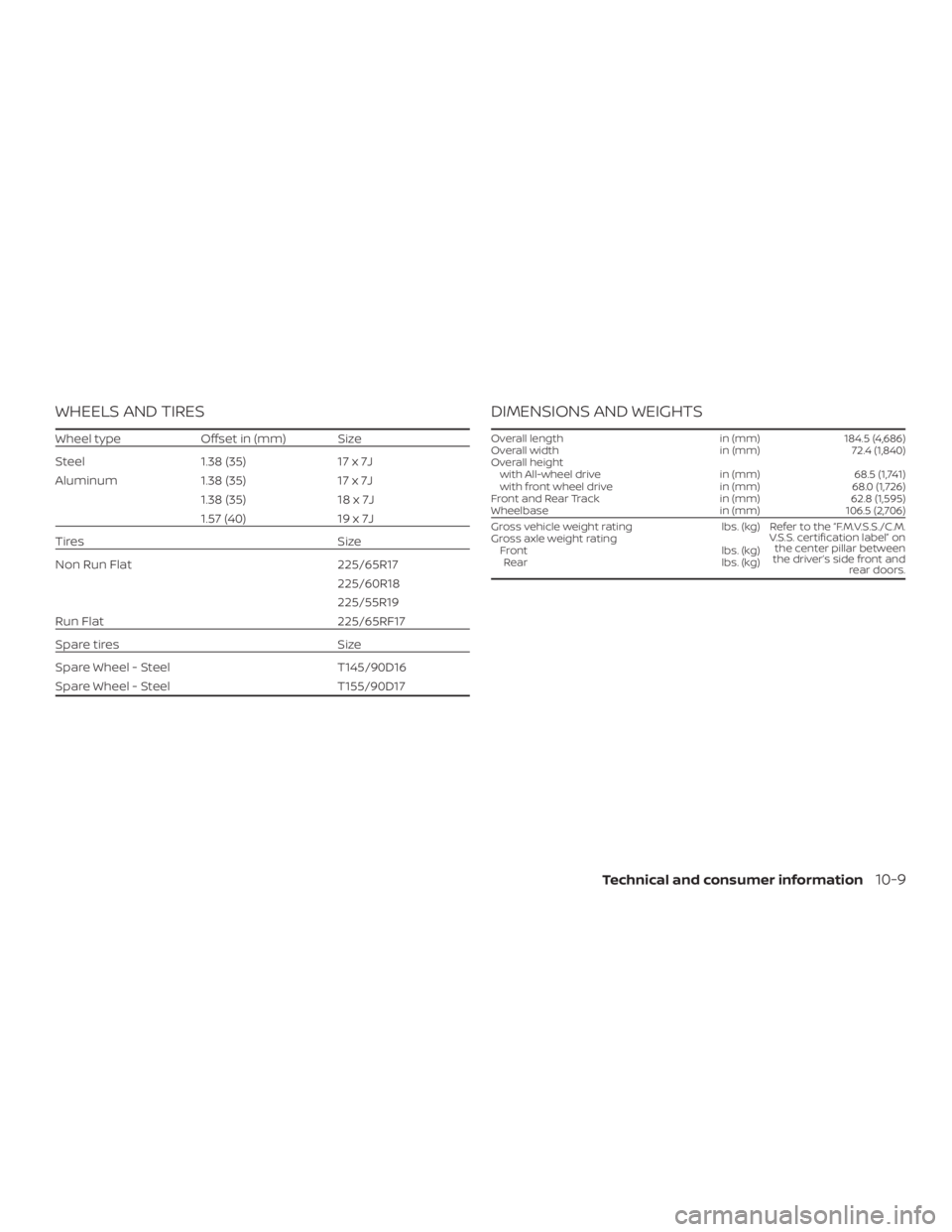
WHEELS AND TIRES
Wheel typeOffset in (mm) Size
Steel 1.38 (35)17 x 7J
Aluminum 1.38 (35)17 x 7J
1.38(35) 18x7J
1.57(40) 19x7J
Tires Size
Non Run Flat 225/65R17
225/60R18
225/55R19
Run Flat 225/65RF17
Spare tires Size
Spare Wheel - Steel T145/90D16
Spare Wheel - Steel T155/90D17
DIMENSIONS AND WEIGHTS
Overall lengthin (mm)184.5 (4,686)
Overall width in (mm)72.4 (1,840)
Overall height with All-wheel drive in (mm)68.5 (1,741)
with front wheel drive in (mm)68.0 (1,726)
Front and Rear Track in (mm)62.8 (1,595)
Wheelbase in (mm)106.5 (2,706)
Gross vehicle weight rating lbs. (kg) Refer to the “F.M.V.S.S./C.M.
V.S.S. certification label” onthe center pillar between
the driver’s side front and rear doors.
Gross axle weight rating
Front lbs. (kg)
Rear lbs. (kg)
Technical and consumer information10-9
Page 525 of 547
3. Attach the trailer to the vehicle and ad-just the hitch equalizers so that the
front bumper height is within 0 -
.5 inches (0 – 13 mm) of the reference
height measured in step 2. The rear
bumper should be no higher than the
reference height measured in step 2.
WARNING
Properly adjust the weight distributing
hitch so the rear of the bumper is no
higher than the measured reference
height when the trailer is attached. If
the rear bumper is higher than the mea-
sured reference height when loaded,
the vehicle may handle unpredictably
which could cause a loss of vehicle con-
trol and cause serious personal injury or
property damage.
Sway control device
Sudden maneuvers, wind gusts, and buf-
feting caused by other vehicles can affect
trailer handling. Sway control devices may
be used to help control these affects. If you
choose to use one, contact a reputable
trailer hitch supplier to make sure the sway
control device will work with the vehicle,
hitch, trailer and the trailer’s brake system. Follow the instructions provided by the
manufacturer for installing and using the
sway control device.
Class I hitch
Class I trailer hitch equipment (receiver, ball
mount and hitch ball) can be used to tow
trailers of a maximum weight of 2,000 lbs.
(907 kg).
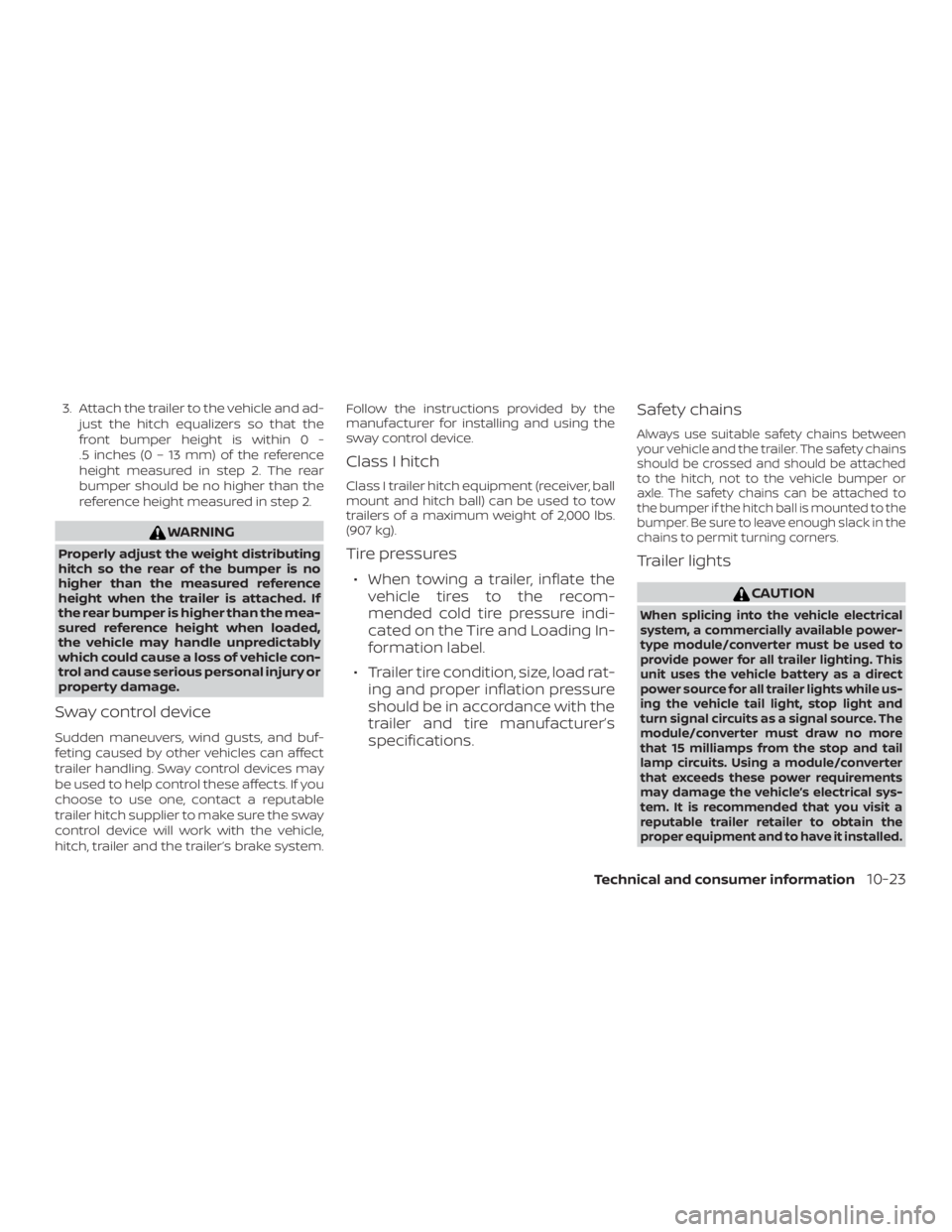
Tire pressures
∙ When towing a trailer, inflate the
vehicle tires to the recom-
mended cold tire pressure indi-
cated on the Tire and Loading In-
formation label.
∙ Trailer tire condition, size, load rat- ing and proper inflation pressure
should be in accordance with the
trailer and tire manufacturer’s
specifications.
Safety chains
Always use suitable safety chains between
your vehicle and the trailer. The safety chains
should be crossed and should be attached
to the hitch, not to the vehicle bumper or
axle. The safety chains can be attached to
the bumper if the hitch ball is mounted to the
bumper. Be sure to leave enough slack in the
chains to permit turning corners.
Trailer lights
CAUTION
When splicing into the vehicle electrical
system, a commercially available power-
type module/converter must be used to
provide power for all trailer lighting. This
unit uses the vehicle battery as a direct
power source for all trailer lights while us-
ing the vehicle tail light, stop light and
turn signal circuits as a signal source. The
module/converter must draw no more
that 15 milliamps from the stop and tail
lamp circuits. Using a module/converter
that exceeds these power requirements
may damage the vehicle’s electrical sys-
tem. It is recommended that you visit a
reputable trailer retailer to obtain the
proper equipment and to have it installed.
Technical and consumer information10-23
Page 541 of 547
T
Tachometer ...................2-6
Temperature gauge Engine coolant temperature gauge . .2-6
Thef t (NISSAN Vehicle Immobilizer System),
engine start ............2-40,5-14,5-18
Three-waycatalyst...............5-5
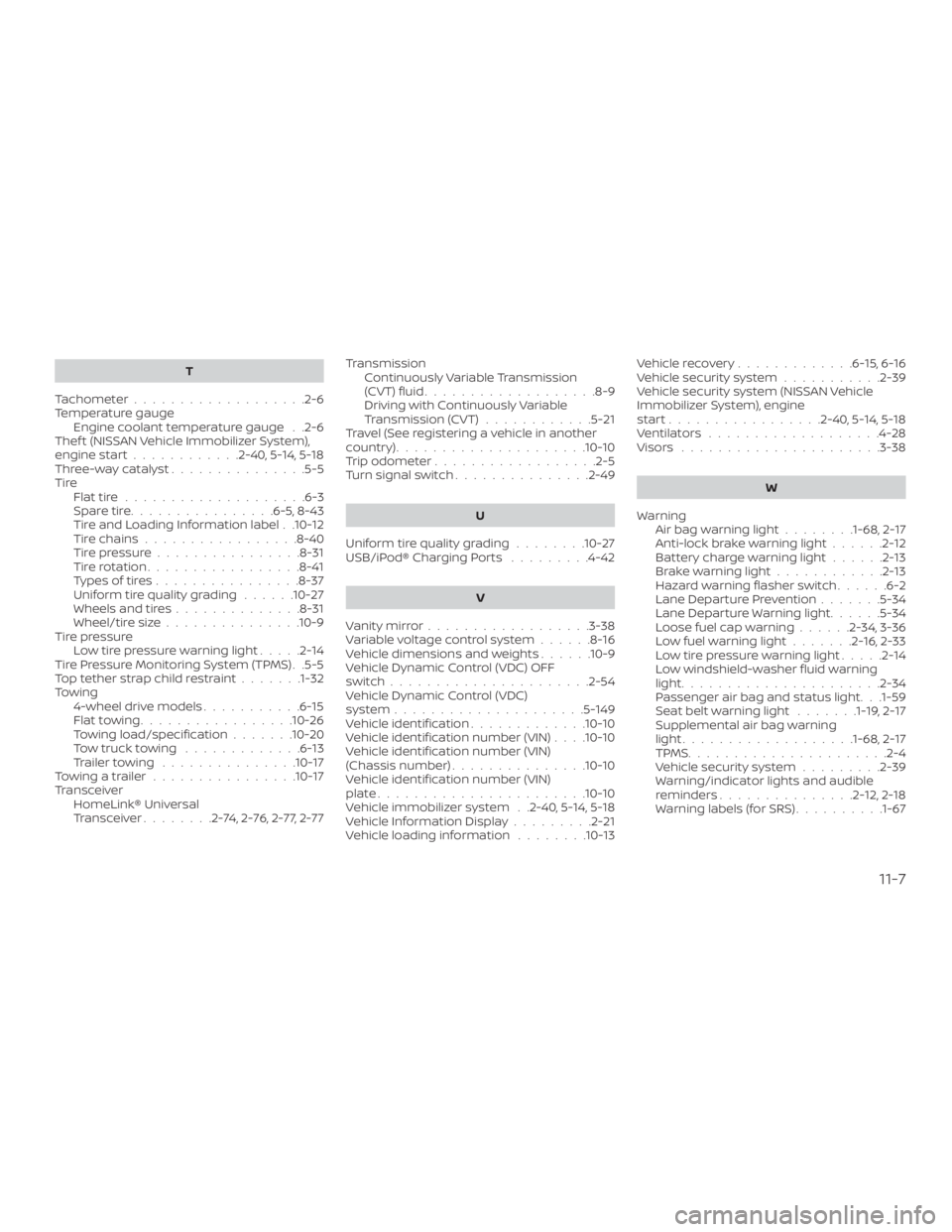
Tire Flattire....................6-3
Spare tire ................6-5,8-43
Tire and Loading Information label . .10-12
Tire chains .................8-40
Tire pressure ................8-31
Tirerotation.................8-41
Types of tires ................8-37
Uniform tire quality grading ......10-27
Wheels and tires ..............8-31
Wheel/tire size ...............10-9
Tire pressure Low tire pressure warning light .....2-14
Tire Pressure Monitoring System (TPMS) . .5-5
Toptetherstrapchildrestraint.......1-32
Towing 4-wheel drive models ...........6-15
Flattowing.................10-26
Towing load/specification .......10-20
Towtrucktowing .............6-13
Trailertowing ...............10-17
Towingatrailer................10-17
Transceiver HomeLink® Universal
Transceiver ........2-74,2-76,2-77,2-77 Transmission
Continuously Variable Transmission
(CVT) fluid ...................8-9
Driving with Continuously Variable
Transmission (CVT) ............5-21
Travel (See registering a vehicle in another
country) .....................10-10
Trip odometer ..................2-5
Turn signal switch ...............2-49
U
Uniform tire quality grading ........10-27
USB/iPod® Charging Ports .........4-42
V
Vanitymirror..................3-38
Variable voltage control system ......8-16
Vehicle dimensions and weights ......10-9
Vehicle Dynamic Control (VDC) OFF
switch......................2-54
Vehicle Dynamic Control (VDC)
system .....................5-149
Vehicle identification .............10-10
Vehicle identification number (VIN) . . . .10-10
Vehicle identification number (VIN)
(Chassis number) ...............10-10
Vehicle identification number (VIN)
plate.......................10-10
Vehicle immobilizer system . .2-40, 5-14, 5-18
VehicleInformationDisplay.........2-21
Vehicle loading information ........10-13Vehiclerecovery.............6-15,
6-16
Vehicle security system ...........2-39
Vehicle security system (NISSAN Vehicle
Immobilizer System), engine
start.................2-40,5-14,5-18
Ventilators ...................4-28
Visors ......................3-38
W
Warning Airbagwarninglight........1-68, 2-17
Anti-lock brake warning light ......2-12
Battery charge warning light ......2-13
Brakewarninglight............2-13
Hazard warning flasher switch ......6-2
Lane Departure Prevention .......5-34
Lane Departure Warning light ......5-34
Loose fuel cap warning ......2-34,3-36
Lowfuelwarninglight.......2-16,2-33
Lowtirepressurewarninglight.....2-14
Low windshield-washer fluid warning
light......................2-34
Passenger air bag and status light. . .1-59
Seatbeltwarninglight .......1-19, 2-17
Supplemental air bag warning
light...................1-68, 2-17
TPMS......................2-4
Vehicle security system .........2-39
Warning/indicator lights and audible
reminders ...............2-12,2-18
Warning labels (for SRS) ..........1-67
11-7
Page 542 of 547
Warning/indicator lights and audible
reminders.................2-12,2-18
Audible reminders ..........2-12,2-18
Checking bulbs ...............2-12
Indicatorlights............2-12,2-18
Warninglights............2-12,2-18
Warninglights..............2-12,2-18
Warning lights, indicator lights and audible
reminders ....................2-11
Washer switch Rear window wiper and washer
switches ...................2-43
Weights (See dimensions and weights) . .10-9
Wheels and tires ................8-31
Wheel/tire size .................10-9
When traveling or registering in another
country .....................10-10
Windows ....................2-66 Locking passengers' windows .....2-67
Powerrearwindows...........2-67
Powerwindows..............2-66
Rearpowerwindows...........2-67
Windshield-washer fluid ...........8-10
Windshield wiper blades ...........8-19
Wiper Rear window wiper and washer
switches ...................2-43
Wiper blades ................8-19
Wiper and washer switch ..........2-42
11-8