brakes NISSAN ROGUE 2018 Owner´s Manual
[x] Cancel search | Manufacturer: NISSAN, Model Year: 2018, Model line: ROGUE, Model: NISSAN ROGUE 2018Pages: 547, PDF Size: 6.42 MB
Page 527 of 547
1. Apply and hold the brake pedal.
2. Have someone place blocks on thedownhill side of the vehicle and trailer
wheels.
3. Af ter the wheel blocks are in place, slowly release the brake pedal until the
blocks absorb the vehicle load.
4. Apply the parking brake.
5. Shif t the transmission into P (Park).
6. Turn off the engine.
To drive away: 1. Start the vehicle.
2. Apply and hold the brake pedal.
3. Shif t the transmission into gear.
4. Release the parking brake.
5. Drive slowly until the vehicle and trailer are clear from the blocks.
6. Apply and hold the brake pedal.
7. Have someone retrieve and store the blocks. ∙ While going downhill, the weight of the
trailer pushing on the tow vehicle may
decrease overall stability. Therefore, to
maintain adequate control, reduce your
speed and shif t to a lower gear. Avoid
long or repeated use of the brakes
when descending a hill, as this reduces
their effectiveness and could cause
overheating. Shif ting to a lower gear in-
stead provides “engine braking” and re-
duces the need to brake as frequently.
∙ If the engine coolant temperature rises to a high temperature, refer to “If your
vehicle overheats” in the “In case of
emergency” section of this owner’s
manual.
∙ Trailer towing requires more fuel than normal circumstances.
∙ Avoid towing a trailer for your vehicle’s first 500 miles (805 km).
∙ For the first 500 miles (805 km) that you do tow, do not drive over 50 mph
(80 km/h).
∙ Have your vehicle serviced more of ten than at intervals specified. For addi-
tional information, refer to "Mainte-
nance schedules" in the "Maintenance
and schedules" section of this manual.. ∙ When making a turn, your trailer wheels
will be closer to the inside of the turn
than your vehicle wheels. To compen-
sate for this, make a larger than normal
turning radius during the turn.
∙ Crosswinds and rough roads will ad- versely affect vehicle/trailer handling,
possibly causing vehicle sway. When
being passed by larger vehicles, be pre-
pared for possible changes in cross-
winds that could affect vehicle han-
dling.
Do the following if the trailer begins to
sway: 1. Take your foot off the accelerator pedal to allow the vehicle to coast and steer
as straight ahead as the road condi-
tions allow. This combination will help
stabilize the vehicle
– Do not correct trailer sway by steer- ing or applying the brakes.
2. When the trailer sway stops, gently ap- ply the brakes and pull to the side of the
road in a safe area.
3. Try to rearrange the trailer load so it is balanced as described in this section.
Technical and consumer information10-25
Page 528 of 547
∙ Be careful when passing other vehicles.Passing while towing a trailer requires
considerably more distance than nor-
mal passing. Remember, the length of
the trailer must also pass the other ve-
hicle before you can safely change
lanes.
∙ Downshif t the transmission to a lower gear for engine braking when driving
down steep or long hills. This will help
slow the vehicle without applying the
brakes.
∙ Avoid holding the brake pedal down too long or too frequently. This could cause
the brakes to overheat, resulting in re-
duced braking efficiency.
∙ Increase your following distance to al- low for greater stopping distances
while towing a trailer. Anticipate stops
and brake gradually.
∙ NISSAN recommends that the cruise control not be used while towing a
trailer.
∙ Some states or provinces have specific regulations and speed limits for ve-
hicles that are towing trailers. Obey the
local speed limits. ∙ Check your hitch, trailer wiring harness
connections, and trailer wheel lug nuts
af ter 50 miles (80 km) of travel and at
every break.
∙ When launching a boat, don’t allow the water level to go over the exhaust tail
pipe or rear bumper.
∙ Make sure you disconnect the trailer lights before backing the trailer into the
water or the trailer lights may burn out.
When towing a trailer, final drive gear oil
should be replaced and transmission
oil/fluid should be changed more fre-
quently. For additional information, refer
to the “Do-it-yourself ” section of this
manual.
FLAT TOWING FOR ALL–WHEEL
DRIVE VEHICLE (if so equipped)
Towing your vehicle with all four wheels on
the ground is sometimes called flat towing.
This method is sometimes used when
towing a vehicle behind a recreational ve-
hicle, such as a motor home.
CAUTION
∙ Failure to follow these guidelines can result in severe transmission damage.
∙ Never flat tow your All-Wheel Drive (AWD) vehicle.
∙ DO NOT tow your All-Wheel Drive (AWD) vehicle with any wheels on the
ground. Doing so may cause serious
and expensive damage to the
powertrain.
∙ For emergency towing procedures re- fer to “Towing recommended by
NISSAN” in the “In case of emergency ”
section of this manual.
FLAT TOWING FOR FRONT WHEEL
DRIVE VEHICLE (if so equipped)
Towing your vehicle with all four wheels on
the ground is sometimes called flat towing.
This method is sometimes used when
towing a vehicle behind a recreational ve-
hicle, such as a motor home.
10-26Technical and consumer information
Page 533 of 547
name, gender, age and crash location) are
recorded. However, other parties, such as
law enforcement, could combine the EDR
data with the type of personally identif ying
data routinely acquired during a crash in-
vestigation.
To read data recorded by an EDR, special
equipment is required and access to the
vehicle or the EDR is needed. In addition to
the vehicle manufacturer and NISSAN
dealer, other parties, such as law enforce-
ment, that have the special equipment, can
read the information if they have access to
the vehicle or the EDR. EDR data will only be
accessed with the consent of the vehicle
owner or lessee or as otherwise required or
permitted by law.
ADDITIONAL DATA RECORDING (on
vehicles equipped with optional
ProPILOT Assist)
If your vehicle is equipped with the optional
ProPILOT Assist, it will also be equipped
with supplemental data recording function
intended to assist in understanding how
ProPILOT Assist performs in certain non-
trival crash or near-crash scenarios. Spe-
cifically, supplemental recording is de-
signed to capture the following:∙ Driver operational status of the accel-
erator, brakes, steering, etc.
∙ Detection status of a vehicle ahead and lane markers
∙ Vehicle information including distance to vehicle ahead and lateral position
∙ Information on the operation of the ProPILOT Assist and other crash avoid-
ance features
∙ ProPILOT Assist malfunction diagnosis information
∙ External images from the multi-sensing front camera (Available only when the
SRS air bag or IEB system is activated)
The ProPILOT Assist does not record con-
versations, sounds or images of the inside
of the vehicle.
To read this supplemental data, special
equipment is required and access to the
vehicle or the recording unit is needed. This
supplemental data will only be accessed
with the consent of the vehicle owner or
lessee or as otherwise required or permit-
ted by law. If downloaded, NISSAN and third
parties entrusted by NISSAN may use the
data recorded for the purpose of improv-
ing NISSAN’s vehicle safety performance. NISSAN and third parties entrusted by
NISSAN will not disclose/provide the re-
corded data to a third party except:
- With the consent of the vehicle owner or
with the consent of the lessee
- In response to an official request from law
enforcement, court order, governmental
agency, or other legally enforceable re-
quest
- For research purposes af ter the data is
modified such that it is no longer tied to a
specific vehicle or vehicle owner (anony-
mized)
Technical and consumer information10-31
Page 535 of 547
11 Index
2nd row bench seat adjustment......1-6
A
ActiveRideControl(ARC) .........5-154
Air bag (See supplemental restraint
system) .................... .1-50
Air bag system Front (See supplemental front impact air
bagsystem)................1-57
Air bag warning labels ............1-67
Airbagwarninglight..........1-68, 2-17
Air bag warning light,
supplemental ..............1-68, 2-17
Air cleaner housing filter ..........8-18
Air conditioner Air conditioner operation ....4-32,4-38
Air conditioner specification label . .10-12
Air conditioner system refrigerant and oil
recommendations ............10-7
Air conditioner system refrigerant
recommendations ............10-7
Heater and air conditioner
controls...............4-29,4-38
Servicing air conditioner ........4-41
Air flow charts .................4-33
Alarm system
(See vehicle security system) .......2-39
All-Wheel Drive .............5-142,6-14
Anchor point locations ............1-33
Antenna ....................4-42 Antifreeze
...................5-156
Anti-lock brake warning light ........2-12
Anti-lock Braking System (ABS) .....5-148
Armrests.................... .1-7
Audible reminders ..............2-20
Autolightswitch ...............2-45
Automatic Automatic drive positioner . . .3-43, 3-44
Automatic power window switch. . .2-68
Automatic anti-glare inside
mirror...................3-39,3-41
Automatic door locks .............3-7
Automatic drive positioner .....3-43,3-44
Automatic Emergency Braking
(AEB) ...................2-12,5-123
Automatic Emergency Braking (AEB) with
Pedestrian Detection ............5-131
AWD...................5-142,6-14
B
Battery .................5-156,8-12 Charge warning light ...........2-13
Battery replacement ............8-24
Keyfob...................8-24
NISSAN Intelligent Key® ......8-24,8-26
Before starting the engine .........5-18
Belt(Seedrivebelt)..............8-16
Blind Spot Warning (BSW) ..........5-45
Booster seats .................1-46 Brake
Anti-lock Braking System (ABS) . . .5-148
Brakefluid.................8-10
Brakelight(Seestoplight).......8-29
Brakesystem...............5-147
Brakewarninglight............2-13
Brakewearindicators.......2-20,8-21
Parking brake operation ........5-27
Self-adjustingbrakes ..........8-21
Brakeassist .................5-149
Brakefluid...................8-10
Brakes......................8-21
Brakesystem.................5-147
Break-in schedule ..............5-140
Brightness control Instrument panel .............2-49
Bulb check/instrument panel .......2-12
Bulb replacement ..............8-29
C
Capacities and recommended fuel/
lubricants....................10-2
Cargoareastoragebin...........2-62
Cargocover................. .2-64
Cargolight...................2-73
Cargo
(See vehicle loading information) .....10-13
Car phone or CB radio ...........4-42
Chassis control ...............
5-152
Checking bulbs ................2-12
Check tire pressure .............2-34
Page 540 of 547
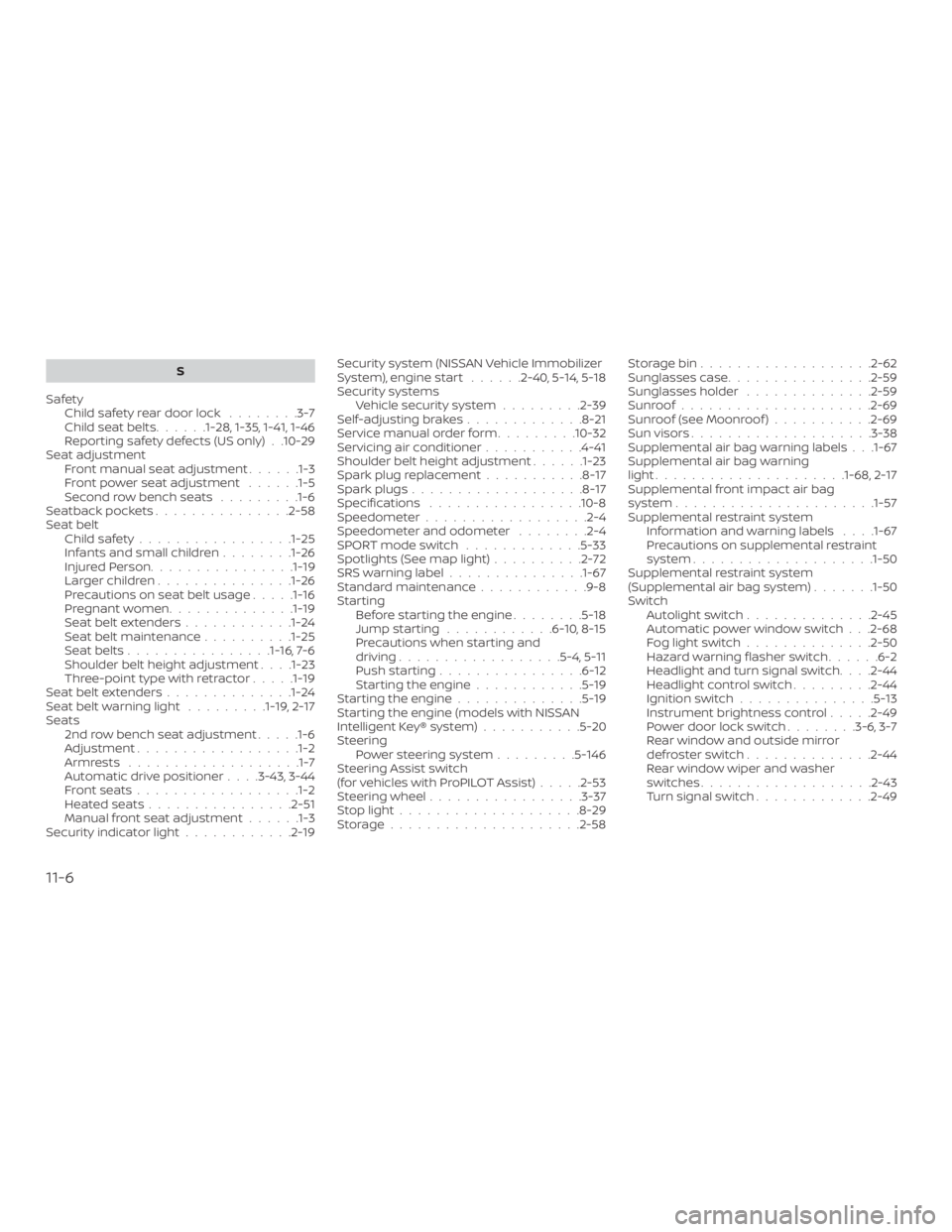
S
Safety Child safety rear door lock ........3-7
Childseatbelts......1-28, 1-35, 1-41, 1-46
Reporting safety defects (US only) . .10-29
Seat adjustment Front manual seat adjustment ......1-3
Front power seat adjustment ......1-5
Second row bench seats .........1-6
Seatback pockets ...............2-58
Seat belt Childsafety.................1-25
Infants and small children ........1-26
InjuredPerson............... .1-19
Largerchildren.............. .1-26
Precautions on seat belt usage .....1-16
Pregnant women ..............1-19
Seat belt extenders ............1-24
Seat belt maintenance ..........1-25
Seatbelts................1-16, 7-6
Shoulder belt height adjustment . . . .1-23
Three-pointtypewithretractor.....1-19
Seat belt extenders ..............1-24
Seatbeltwarninglight .........1-19, 2-17
Seats 2nd row bench seat adjustment .....1-6
Adjustment ..................1-2
Armrests .................. .1-7
Automatic drive positioner ....3-43,3-44
Frontseats..................1-2
Heatedseats................2-51
Manual front seat adjustment ......1-3
Security indicator light ............2-19 Security system (NISSAN Vehicle Immobilizer
System), engine start
......2-40,5-14,5-18
Security systems Vehicle security system .........2-39
Self-adjustingbrakes.............8-21
Service manual order form .........10-32
Servicing air conditioner ...........4-41
Shoulder belt height adjustment ......1-23
Spark plug replacement ...........8-17
Spark plugs ...................8-17
Specifications .................10-8
Speedometer ..................2-4
Speedometer and odometer ........2-4
SPORT mode switch .............5-33
Spotlights(Seemaplight)..........2-72
SRS warning label ...............1-67
Standard maintenance ............9-8
Starting Before starting the engine ........
5-18
Jumpstarting............6-10,8-15
Precautions when starting and
driving..................5-4,5-11
Push starting ................6-12
Starting the engine ............5-19
Starting the engine ..............5-19
Starting the engine (models with NISSAN
Intelligent Key® system) ...........5-20
Steering Powersteeringsystem.........5-146
Steering Assist switch
(forvehicleswithProPILOTAssist).....2-53
Steering wheel .................3-37
Stoplight....................8-29
Storage.....................2-58 Storagebin...................2-62
Sunglasses case
................2-59
Sunglasses holder ..............2-59
Sunroof .....................2-69
Sunroof (see Moonroof ) ...........2-69
Sunvisors................... .3-38
Supplemental air bag warning labels . . .1-67
Supplemental air bag warning
light.................... .1-68, 2-17
Supplemental front impact air bag
system..................... .1-57
Supplemental restraint system Information and warning labels . . . .1-67
Precautions on supplemental restraint
system ....................1-50
Supplemental restraint system
(Supplemental air bag system) .......1-50
Switch Autolightswitch..............2-45
Automatic power window switch . . .2-68
Foglightswitch..............2-50
Hazard warning flasher switch ......6-2
Headlight and turn signal switch ....2-44
Headlightcontrolswitch.........2-44
Ignition switch ...............5-13
Instrument brightness control .....2-49
Power door lock switch ........3-6,3-7
Rear window and outside mirror
defrosterswitch..............2-44
Rear window wiper and washer
switches ...................2-43
Turn signal switch .............2-49
11-6