EMISSION NISSAN ROGUE 2019 Owner´s Manual
[x] Cancel search | Manufacturer: NISSAN, Model Year: 2019, Model line: ROGUE, Model: NISSAN ROGUE 2019Pages: 564, PDF Size: 6.97 MB
Page 504 of 564
Some day-to-day and regular mainte-
nance is essential to maintain your vehicle
good mechanical condition, as well as its
emissions and engine performance.
It is the owner’s responsibility to make sure
that the scheduled maintenance, as well as
general maintenance, is performed.
As the vehicle owner, you are the only one
who can ensure that your vehicle receives
proper maintenance. You are a vital link in
the maintenance chain.
GENERAL MAINTENANCE
General maintenance includes those items
which should be checked during normal
day-to-day operation. They are essential
for proper vehicle operation. It is your re-
sponsibility to perform these procedures
regularly as prescribed.
Performing general maintenance checks
requires minimal mechanical skill and only
a few general automotive tools.
These checks or inspections can be done
by yourself, a qualified technician or, if you
prefer, a NISSAN dealer.
SCHEDULED MAINTENANCE
The maintenance items listed in this sec-
tion are required to be serviced at regular
intervals. However under severe driving
conditions, additional or more frequent
maintenance will be required.
WHERE TO GO FOR SERVICE
If maintenance service is required or your
vehicle appears to malfunction, have the
systems checked and serviced. It is recom-
mended that you visit a NISSAN dealer for
this service.
NISSAN technicians are well-trained spe-
cialists and are kept up-to-date with the
latest service information through techni-
cal bulletins, service tips and training pro-
grams. They are completely qualified to
work on NISSAN vehiclesbeforework be-
gins.
If your vehicle is involved in a collision, it is
recommended that you ask your NISSAN
dealer where the nearest NISSAN Certified
Collision Center is located, or go to
http://collision.nissanusa.com. You can be confident that a NISSAN deal-
er’s service department can perform the
service needed to meet the maintenance
requirements on your vehicle.
MAINTENANCE REQUIREMENTS
9-2Maintenance and schedules
Page 508 of 564
The following descriptions are provided to
give you a better understanding of the
scheduled maintenance items that should
be regularly checked or replaced. The
maintenance schedule indicates at which
mileage/time intervals each item requires
service.
In addition to scheduled maintenance,
your vehicle requires that some items be
checked during normal day-to-day opera-
tion. For additional information, refer to
“General maintenance” in this section.
Items marked with“*”are recommended
by NISSAN for reliable vehicle operation.
You are not required to perform mainte-
nance on these items in order to maintain
the warranties which come with your
NISSAN. Other maintenance items and in-
tervals are required.
When applicable, additional information
can be found in the “Do-it-yourself ” section
of this manual. NOTE:
NISSAN does not advocate the use of
non-OEM approved af termarket flush-
ing systems and strongly advises
against performing these services on a
NISSAN product. Many of the af termar-
ket flushing systems use non-OEM ap-
proved chemicals or solvents, the use of
which has not been validated by NISSAN.
For recommended fuel, lubricants, fluids,
grease, and refrigerant, refer to “Recom-
mended fluids/lubricants and capaci-
ties” in the “Technical and consumer in-
formation” section of this manual.
EMISSION CONTROL SYSTEM
MAINTENANCE:
Drive belt*:
Check engine drive belt for
wear, fraying or cracking and for proper
tension. Replace any damaged drive belt.
Engine air filter: Replace at specified inter-
vals. When driving for prolonged periods in
dusty conditions, check/replace the filter
more frequently. Engine coolant*:
Replace coolant at the
specified interval. When adding or replac-
ing coolant, be sure to use only Genuine
NISSAN Long Life Antifreeze/Coolant (blue)
or equivalent with the proper mixture. (For
additional information on the proper mix-
ture for your area, refer to “Engine cooling
system” in the “Do-it-yourself ” section of
this manual.)
NOTE:
Mixing any other type of coolant or the
use of non-distilled water may reduce
the recommended service interval of the
coolant.
Engine oil and oil filter: Replace engine oil
and oil filter at the specified intervals. For
recommended oil grade and viscosity refer
to “Recommended fluids/lubricants and
capacities” in the “Technical and consumer
information” section of this manual.
Engine valve clearance*: Inspect only if
valve noise increase. Adjust valve clearance
if necessary.
Evaporative emissions control vapor
lines*: Check vapor lines for leaks or loose-
ness. Tighten connections or replace parts
as necessary.
EXPLANATION OF SCHEDULED
MAINTENANCE ITEMS
9-6Maintenance and schedules
Page 511 of 564

The following tables show the standard
maintenance schedule. Depending upon
weather and atmospheric conditions,
varying road surfaces, individual driving
habits and vehicle usage, additional or
more frequent maintenance may be re-
quired.Af ter 120,000 miles
(192,000 km)/144 months, continue
maintenance at the same mileage/time
interval.
EMISSION CONTROL SYSTEM MAINTENANCE
Abbreviations: I = Inspect and correct or replace as necessary, R = Replace
MAINTENANCE OPERATION
Perform at number of miles, kilometers or months, whichever comes first. miles x 1,000
(km x 1,000) Months MAINTENANCE INTERVAL
5
(8) 6 10
(16) 12 15
(24) 18 20
(32) 24 25
(40) 30 30
(48) 36 35
(56) 42 40
(64) 48 45
(72) 54 50
(80) 60 55
(88) 66 60
(96) 72
Drive belt See NOTE (1) I*I*I*
Air cleaner filter See NOTE (2) RR
EVAP vapor lines I*I*I*
Fuel lines I*I*I*
Fuel filter See NOTE (3)
Engine coolant* See NOTE (4)(5)
Engine oil RRRRRRRRRRRR
Engine oil filter RRRRRRRRRRRR
Spark plugs See NOTE (6)Replace every 105,000 miles (168,000 km)
Intake and exhaust valve clearances* See NOTE (7)
STANDARD MAINTENANCE
Maintenance and schedules9-9
Page 512 of 564

MAINTENANCE OPERATION
Perform at number of miles, kilometers or months, whichever comes first. miles x 1,000
(km x 1,000) Months MAINTENANCE INTERVAL
65
(104) 78 70
(112) 84 75
(120) 90 80
(128) 96 85
(136) 102 90
(144) 108 95
(152) 114 100
(160) 120 105
(168) 126 110
(176) 132 115
(184) 138 120
(192) 144
Drive belt See NOTE (1)I*I*I*I*I*I*
Air cleaner filter See NOTE (2) RR
EVAP vapor lines I*I*I*
Fuel lines I*I*I*
Fuel filter See NOTE (3)
Engine coolant* See NOTE (4)(5)
Engine oil RRRRRRRRRRRR
Engine oil filter RRRRRRRRRRRR
Spark plugs See NOTE (6)Replace every 105,000 miles (168,000 km)
Intake and exhaust valve clearances* See NOTE (7)
NOTE:
(1) Af ter 40,000 miles (64,000 km) or 48 months, inspect every 10,000 miles (16,000 km) or 12 months. Replace the drive belt if
found damaged.
(2) If operating mainly in dusty conditions, more frequent maintenance may be required.
(3) Periodic maintenance is not required.
(4) First replacement interval is 105,000 miles (168,000 km) or 84 months. Af ter first replacement, replace every 75,000 miles
(120,000 km) or 60 months.
(5) Use only Genuine NISSAN Long Life Antifreeze/Coolant (blue) or equivalent with proper mixture ratio of 50% antifreeze and 50%
demineralized or distilled water. Mixing any other type of coolant or the use of non-distilled water may reduce the life expectancy
of the factory fill coolant.
(6) Replace spark plug when the plug gap exceeds 0.055 in (1.4 mm) even if within specified periodic replacement mileage.
(7) Periodic maintenance is not required. However, if valve noise increased, inspect valve clearance.
* Maintenance items and intervals with “*” are recommended by NISSAN for reliable vehicle operation. The owner need not perform
such maintenance in order to maintain the emission warranty or manufacturer recall liability. Other maintenance items and
intervals are required.
9-10Maintenance and schedules
Page 520 of 564
10 Technical and consumer information
Recommended fluids/lubricants and
capacities...................................... 10-2
Fuel recommendation ....................... 10-3
Engine oil and oil filter
recommendations .......................... 10-6
Air conditioner system refrigerant and
oil recommendations ....................... 10-7
Specifications .................................. 10-8
Engine ...................................... 10-8
Wheels and tires ............................. 10-9
Dimensions and weights ....................10-9
When traveling or registering in another
country ........................................ 10-10
Vehicle identification .......................... 10-10
Vehicle Identification Number (VIN)
plate ....................................... 10-10
Vehicle identification number
(chassis number) ........................... 10-10
Engine serial number ........................ 10-11
F.M.V.S.S./C.M.V.S.S. certification label .........10-11
Emission control information label ..........10-11
Tire and Loading Information label .........10-12 Air conditioner specification label
...........10-12
Installing front license plate ....................10-12
Vehicle loading information ...................10-13
Terms ...................................... 10-13
Vehicle load capacity ....................... 10-14
Securing the load ........................... 10-15
Loading tips ................................ 10-16
Measurement of weights ...................10-16
Towing a trailer ................................ 10-17
Maximum load limits ....................... 10-17
Towing load/specification ..................10-20
Towing safety .............................. 10-21
Flat towing for all–wheel drive vehicle
(if so equipped) ............................. 10-26
Flat towing for front wheel drive vehicle
(if so equipped) ............................. 10-26
Uniform tire quality grading ....................10-27
Emission control system warranty .............10-28
R
eporting safety defects ......................10-29
Readiness for Inspection/Maintenance (I/M)
test ............................................ 10-30
Page 523 of 564
Fluid typeCapacity (approximate) Recommended Fluids/Lubricants
Metric
Measure US
Measure Imperial
Measure
Air conditioning system refrigerant ———• HFC-134a (R-134a)
• For additional information, refer to “Air conditioner system re-
frigerant and oil recommendations” in this section.
Air conditioning system oil ———• NISSAN A/C System Oil Type ND-OIL8 or exact equivalents
• For additional information, refer to “Air conditioner system re-
frigerant and oil recommendations” in this section.
Windshield-washer fluid 5 L 1-3/8 gal 1-1/8 gal• Genuine NISSAN Windshield Washer Concentrate Cleaner & An-
tifreeze or equivalent
FUEL RECOMMENDATION
Use unleaded regular gasoline with an oc-
tane rating of at least 87 AKI (Anti-Knock
Index) number (Research octane number
91).
CAUTION
∙ Only vehicles with the E-85 filler door
label can operate on E-85. Fuel system
or other damage can occur if E-85 is
used in vehicles that are not designed
to run on E-85.
∙ Using a fuel other than that specified could adversely affect the emission
control system, and may also affect
the warranty coverage. ∙ Under no circumstances should a
leaded gasoline be used, because this
will damage the three-way catalyst.
∙ Do not use a fuel containing more than 15% ethanol in your vehicle. Your
vehicle is not designed to run on a fuel
containing more than 15% ethanol.
Using a fuel containing more than 15%
ethanol in a vehicle not specifically
designed for a fuel containing more
than 15% ethanol can adversely affect
the emission control devices and sys-
tems of the vehicle. Damage caused
by such fuel is not covered by the
NISSAN New Vehicle Limited Warranty. ∙ Do not use fuel that contains the oc-
tane booster methylcyclopentadienyl
manganese tricarbonyl (MMT). Using
fuel containing MMT may adversely
affect vehicle performance and ve-
hicle emissions. Not all fuel dispens-
ers are labeled to indicate MMT con-
tent, so you may have to consult your
gasoline retailer for more details.
Note that Federal and California laws
prohibit the use of MMT in reformu-
lated gasoline.
∙ U.S. government regulations require ethanol dispensing pumps to be iden-
tified by a small, square, orange and
black label with the common abbre-
viation or the appropriate percentage
for that region.
Technical and consumer information10-3
Page 524 of 564
Gasoline specifications
NISSAN recommends using gasoline that
meets the World-Wide Fuel Charter (WWFC)
specifications where it is available. Many of
the automobile manufacturers developed
this specification to improve emission con-
trol system and vehicle performance. Ask
your service station manager if the gaso-
line meets the WWFC specifications.
Reformulated gasoline
Some fuel suppliers are now producing re-
formulated gasolines. These gasolines are
specially designed to reduce vehicle emis-
sions. NISSAN supports efforts towards
cleaner air and suggests that you use re-
formulated gasoline when available.
Gasoline containing oxygenates
Some fuel suppliers sell gasoline contain-
ing oxygenates such as ethanol, Methyl
Tert-butyl Ether (MTBE) and methanol with
or without advertising their presence.
NISSAN does not recommend the use of
fuels of which the oxygenate content and
the fuel compatibility for your NISSAN can-
not be readily determined. If in doubt, ask
your service station manager.If you use oxygenate-blend gasoline,
please take the following precautions as
the usage of such fuels may cause vehicle
performance problems and/or fuel system
damage.
∙ The fuel should be unleaded and have
an octane rating no lower than that
recommended for unleaded gasoline.
∙ If an oxygenate-blend other than
methanol blend is used, it should
contain no more than 15% oxygenate.
∙ If a methanol blend is used, it should
contain no more than 5% methanol
(methyl alcohol, wood alcohol). It
should also contain a suitable
amount of appropriate cosolvents
and corrosion inhibitors. If not prop-
erly formulated with appropriate co-
solvents and corrosion inhibitors,
such methanol blends may cause fuel
system damage and/or vehicle per-
formance problems. At this time, suf-
ficient data is not available to ensure
that all methanol blends are suitable
for use in NISSAN vehicles.
If any driveability problems such as engine
stalling and difficult hot-starting are expe-
rienced af ter using oxygenate-blend fuels, immediately change to a non-oxygenate
fuel or a fuel with a low blend of MTBE.
Take care not to spill gasoline during re-
fueling. Gasoline containing oxygenates
can cause paint damage.
E–15 fuel
E-15 fuel is a mixture of approximately 15%
fuel ethanol and 85% unleaded gasoline.
E-15 can only be used in vehicles designed
to run on E-15 fuel. U.S. government regula-
tions require fuel ethanol dispensing
pumps to be identified with small, square,
orange and black label with the common
abbreviation or the appropriate percent-
age for that region.
E–85 fuel
E-85 fuel is a mixture of approximately 85%
fuel ethanol and 15% unleaded gasoline.
E-85 can only be used in a Flexible Fuel
Vehicle (FFV). Do not use E-85 in your ve-
hicle. U.S. government regulations require
fuel ethanol dispensing pumps to be iden-
tified by a small, square, orange and black
label with the common abbreviation or the
appropriate percentage for that region.
10-4Technical and consumer information
Page 525 of 564
Fuel containing MMT
MMT, or methylcyclopentadienyl manga-
nese tricarbonyl, is an octane boosting ad-
ditive. NISSAN does not recommend the
use of fuel containing MMT. Such fuel may
adversely affect vehicle performance, in-
cluding the emissions control system. Note
that while some fuel pumps label MMT
content, not all do, so you may have to
consult your gasoline retailer for more de-
tails.
Af termarket fuel additives
NISSAN does not recommend the use of
any af termarket fuel additives (for ex-
ample, fuel injector cleaner, octane
booster, intake valve deposit removers,
etc.) which are sold commercially. Many of
these additives intended for gum, varnish
or deposit removal may contain active sol-
vents or similar ingredients that can be
harmful to the fuel system and engine.
Octane rating tips
Using unleaded gasoline with an octane
rating lower than recommended can
cause persistent, heavy “spark knock.”
(“Spark knock” is a metallic rapping
noise.) If severe, this can lead to engine
damage. If you detect a persistent heavy
spark knock even when using gasoline
of the stated octane rating, or if you hear
steady spark knock while holding a
steady speed on level roads, it is recom-
mended that you have a NISSAN dealer
correct the condition. Failure to correct
the condition is misuse of the vehicle, for
which NISSAN is not responsible.
Incorrect ignition timing may result in
spark knock, af ter-run and/or overheating,
which may cause excessive fuel consump-
tion or engine damage. If any of the above
symptoms are encountered, have your ve-
hicle checked. It is recommended that you
visit a NISSAN dealer for servicing.However, now and then you may notice
light spark knock for a short time while
accelerating or driving up hills. This is not
a cause for concern, because you get the
greatest fuel benefit when there is light
spark knock for a short time under heavy
engine load.
Technical and consumer information10-5
Page 530 of 564
When planning to drive your NISSAN ve-
hicle in another country,you should first
find out if the fuel available is suitable for
your vehicle's engine.
Using fuel with an octane rating that is too
low may cause engine damage. All gaso-
line vehicles must be operated with un-
leaded gasoline. Therefore, avoid taking
your vehicle to areas where appropriate
fuel is not available.
When transferring the registration of
your vehicle to another country, state,
province or district, it may be necessary
to modif y the vehicle to meet local laws
and regulations.
The laws and regulations for motor vehicle
emission control and safety standards
vary according to the country, state, prov-
ince or district; therefore, vehicle specifica-
tions may differ.
When any vehicle is to be taken into an-
other country, state, province or district
and registered, its modifications, trans-
portation and registration are the re-
sponsibility of the user. NISSAN is not re-
sponsible for any inconvenience that
may result.
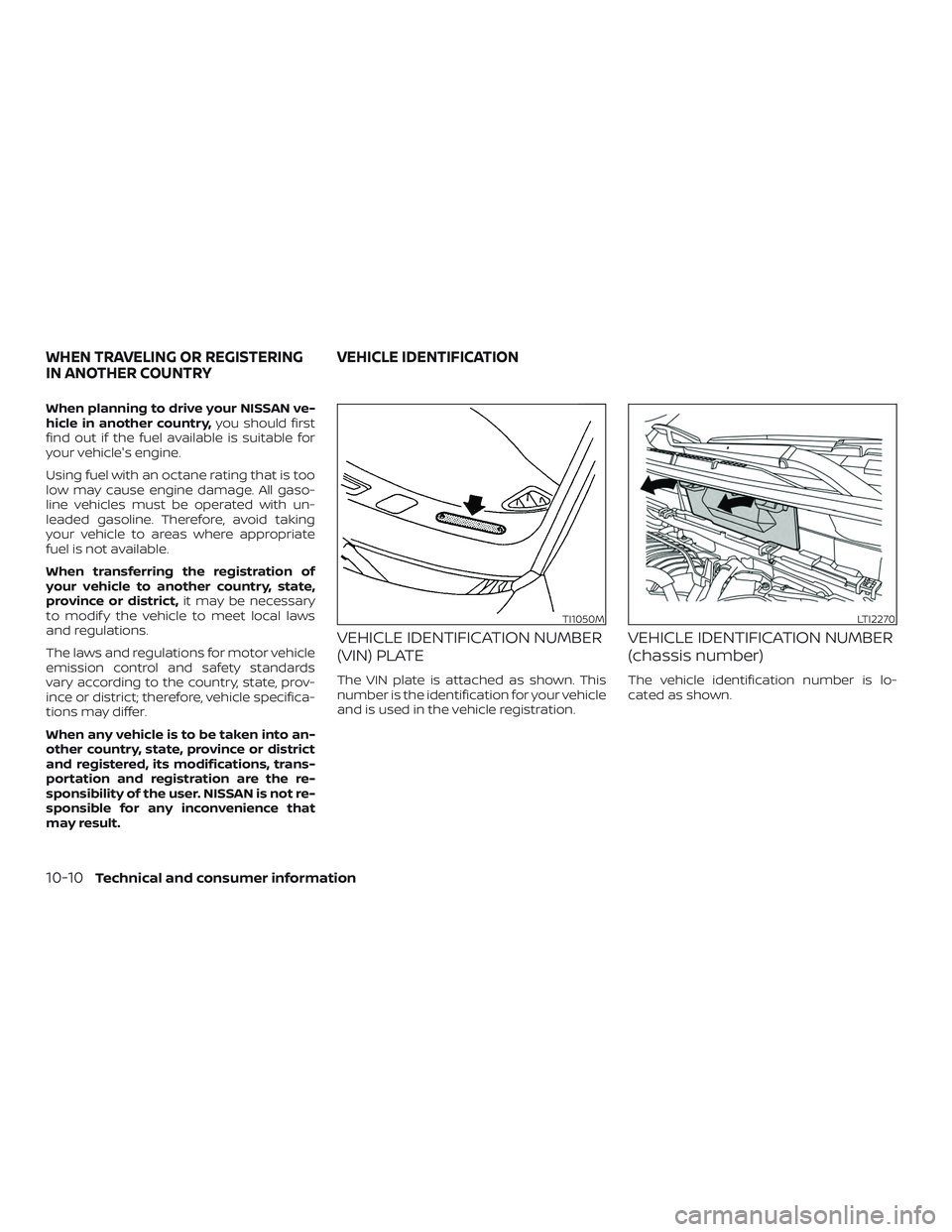
VEHICLE IDENTIFICATION NUMBER
(VIN) PLATE
The VIN plate is attached as shown. This
number is the identification for your vehicle
and is used in the vehicle registration.
VEHICLE IDENTIFICATION NUMBER
(chassis number)
The vehicle identification number is lo-
cated as shown.
TI1050MLTI2270
WHEN TRAVELING OR REGISTERING
IN ANOTHER COUNTRY VEHICLE IDENTIFICATION
10-10Technical and consumer information
Page 531 of 564
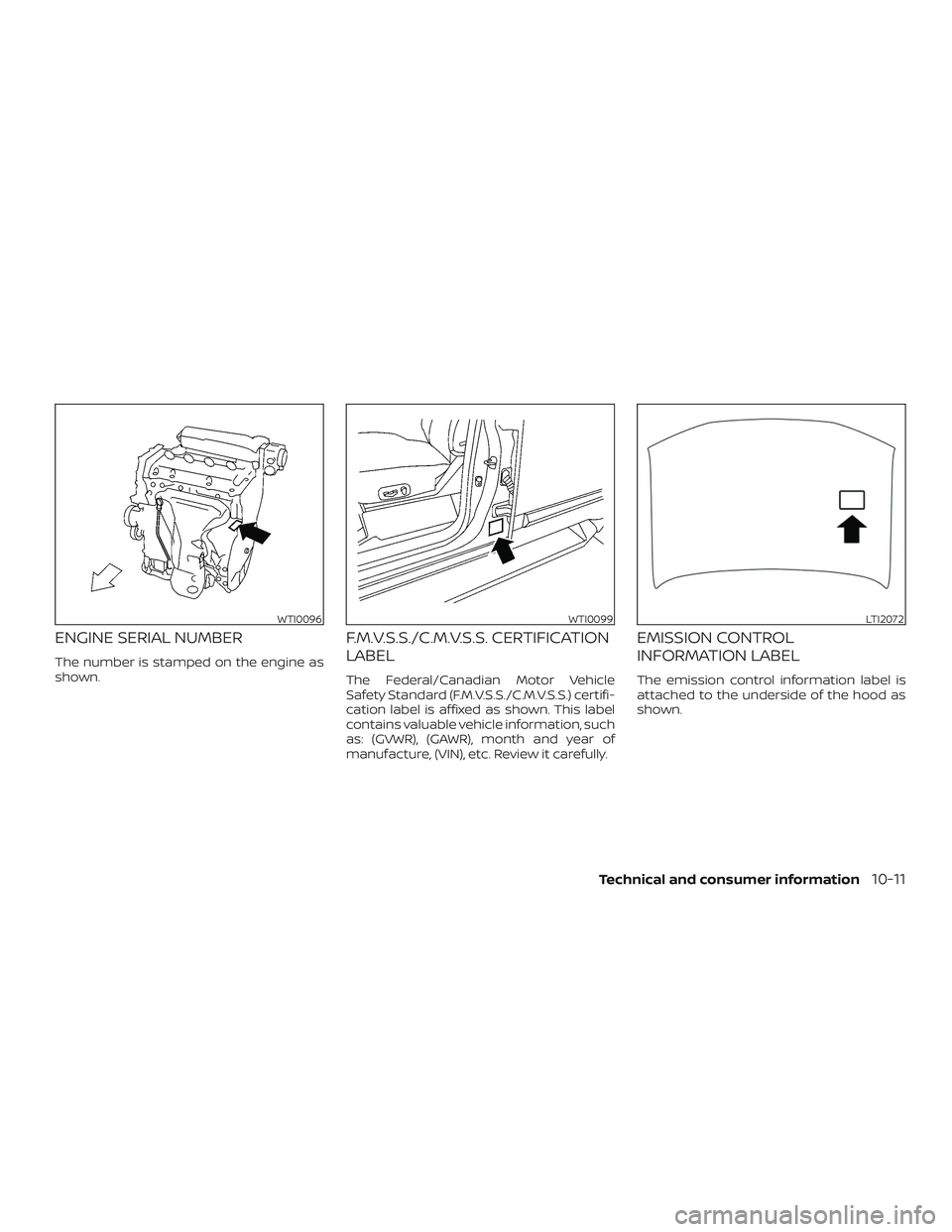
ENGINE SERIAL NUMBER
The number is stamped on the engine as
shown.
F.M.V.S.S./C.M.V.S.S. CERTIFICATION
LABEL
The Federal/Canadian Motor Vehicle
Safety Standard (F.M.V.S.S./C.M.V.S.S.) certifi-
cation label is affixed as shown. This label
contains valuable vehicle information, such
as: (GVWR), (GAWR), month and year of
manufacture, (VIN), etc. Review it carefully.
EMISSION CONTROL
INFORMATION LABEL
The emission control information label is
attached to the underside of the hood as
shown.
WTI0096WTI0099LTI2072
Technical and consumer information10-11