check NISSAN ROGUE 2019 Owner´s Manual
[x] Cancel search | Manufacturer: NISSAN, Model Year: 2019, Model line: ROGUE, Model: NISSAN ROGUE 2019Pages: 564, PDF Size: 6.97 MB
Page 535 of 564
Steps for determining correct
load limit
1. Locate the statement “The com-bined weight of occupants and
cargo should never exceed XXX
lbs. or XXX kg” on your vehicle’s
Tire and Loading Information la-
bel.
2. Determine the combined weight of the driver and passengers
that will be riding in your vehicle.
3. Subtract the combined weight of the driver and passengers
from XXX lbs. or XXX kg.
4. The resulting figure equals the available amount of cargo and
luggage load capacity. For ex-
ample, if the XXX amount equals
1,400 lbs. and there will be five
150 lbs. passengers in your ve-
hicle, the amount of available
cargo and luggage load capac-
ity is 650 lbs. (1,400-750 (5 X 150) =
650 lbs.) or (640-340 (5 X 70) =
300 kg.) 5. Determine the combined weight
of luggage and cargo being
loaded on the vehicle. That
weight may not safely exceed
the available cargo and luggage
load capacity calculated in
step 4.
6. If your vehicle will be towing a trailer, load from your trailer will
be transferred to your vehicle.
Consult this manual to deter-
mine how this reduces the avail-
able cargo and luggage load ca-
pacity of your vehicle.
Before driving a loaded vehicle, con-
firm that you do not exceed the
Gross Vehicle Weight Rating (GVWR)
or the Gross Axle Weight Rating
(GAWR) for your vehicle. For addi-
tional information, refer to “Measure-
ment of weights” in this section.
Also check tires for proper inflation
pressures. For additional informa-
tion, refer to the “Tire and Loading
Information label” in this section.
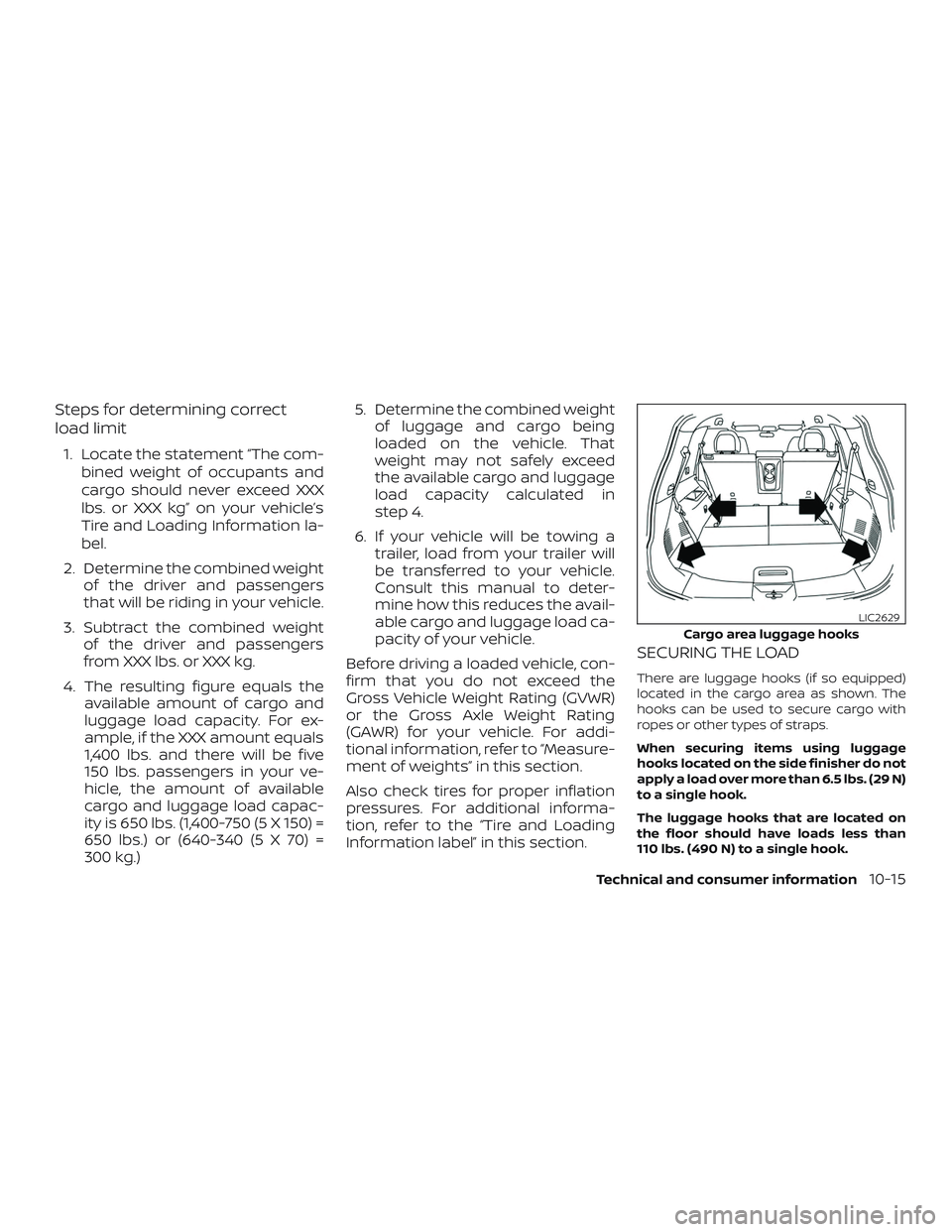
SECURING THE LOAD
There are luggage hooks (if so equipped)
located in the cargo area as shown. The
hooks can be used to secure cargo with
ropes or other types of straps.
When securing items using luggage
hooks located on the side finisher do not
apply a load over more than 6.5 lbs. (29 N)
to a single hook.
The luggage hooks that are located on
the floor should have loads less than
110 lbs. (490 N) to a single hook.
Cargo area luggage hooks
LIC2629
Technical and consumer information10-15
Page 541 of 564

TOWING LOAD/SPECIFICATION CHARTU.S. and Canada
Maximum Towing Capacity*1 1,100 lbs. (500 kg)
Maximum Tongue Load 110 lbs. (50 kg)
Maximum Gross Combined Weight Rating 5,291 lbs. (2,400 kg)
*1: The towing capacity values are calculated assuming a base vehicle with driver and any options re-
quired to achieve the rating. Additional passengers, cargo and/or optional equipment will add weight to
the vehicle and reduce your vehicle’s maximum towing capacity.TOWING SAFETY
Trailer hitch
Your vehicle may be equipped with an op-
tional trailer tow package. The trailer tow
package includes a receiver-type frame
mounted hitch. This hitch is rated for the
maximum towing capacity of this vehicle
when the proper towing equipment is
used. Choose a proper ball mount and
hitch ball that is rated for the trailer to be
towed. Genuine NISSAN ball mounts and
hitch balls are available from a NISSAN
dealer.
If your vehicle is not equipped with the op-
tional trailer tow package, check the tow-
ing capacity of your bumper hitch or
receiver-type frame mounted hitch.
Choose a proper hitch for your vehicle and
trailer. A Genuine NISSAN trailer hitch is
available from a NISSAN dealer. Make sure
the trailer hitch is securely attached to the
vehicle to help avoid personal injury or
property damage due to sway caused by
crosswinds, rough road surfaces or pass-
ing trucks.
Technical and consumer information10-21
Page 542 of 564
WARNING
Trailer hitch components have specific
weight ratings. Your vehicle may be ca-
pable of towing a trailer heavier than
the weight rating of the hitch compo-
nents. Never exceed the weight rating
of the hitch components. Doing so can
cause serious personal injury or prop-
erty damage.
Hitch ball
Choose a hitch ball of the proper size and
weight rating for your trailer:∙ The required hitch ball size is stamped on most trailer couplers. Most hitch
balls also have the size printed on the
top of the ball.
∙ Choose the proper class hitch ball based on the trailer weight.
∙ The diameter of the threaded shank of the hitch ball must be matched to the
ball mount hole diameter. The hitch ball
shank should be no more than 1/16”
smaller than the hole in the ball mount. ∙ The threaded shank of the hitch ball
must be long enough to be properly
secured to the ball mount. There should
be at least 2 threads showing beyond
the lock washer and nut.
Ball mount
The hitch ball is attached to the ball mount
and the ball mount is inserted into the
hitch receiver. Choose a proper class ball
mount based on the trailer weight. Addi-
tionally, the ball mount should be chosen to
keep the trailer tongue level with the
ground.
Weight carrying hitches
A weight carrying or “dead weight” ball
mount is one that is designed to carry the
whole amount of tongue weight and gross
weight directly on the ball mount and on
the receiver.
Weight distribution hitch
This type of hitch is also called a “load-
leveling” or “equalizing” hitch. A set of bars
attach to the ball mount and to the trailer
to distribute the tongue weight (hitch
weight) of your trailer. Many vehicles can’t
carry the full tongue weight of a given
trailer, and need some of the tongue weight transferred through the frame and
pushing down on the front wheels. This
gives stability to the tow vehicle.
A weight-distributing hitch system (Class
IV) is recommended if you plan to tow trail-
ers with a maximum weight over 5,000 lbs.
(2,268 kg). Check with the trailer and towing
equipment manufacturers to determine if
they recommend the use of a weight-
distributing hitch system.
NOTE:
A weight-distributing hitch system may
affect the operation of trailer surge
brakes. If you are considering use of a
weight-distributing hitch system with a
surge brake-equipped trailer, check with
the surge brake, hitch or trailer manufac-
turer to determine if and how this can be
done.
Follow the instructions provided by the
manufacturer for installing and using the
weight-distributing hitch system.
General set-up instructions are as follows:
1. Park unloaded vehicle on a level sur- face. With the ignition on and the doors
closed, allow the vehicle to stand for
several minutes so that it can level.
10-22Technical and consumer information
Page 544 of 564
Trailer lights should comply with federal
and/or local regulations. For assistance in
hooking up trailer lights, contact a NISSAN
dealer or reputable trailer retailer. Vehicles
equipped with the optional trailer tow
package are equipped with a 7-pin trailer
harness connector. If your trailer is
equipped with a flat 4-pin connector, an
adapter will be needed to connect the
trailer lights to the vehicle. Adapters are
available at auto parts stores and hitch re-
tailers.
Pre-towing tips
∙ Be certain your vehicle maintains a levelposition when a loaded and/or un-
loaded trailer is hitched. Do not drive the
vehicle if it has an abnormal nose-up or
nose-down condition; check for im-
proper tongue load, overload, worn sus-
pension or other possible causes of ei-
ther condition.
∙ Always secure items in the trailer to pre- vent load shif t while driving.
∙ Keep the cargo load as low as possible in the trailer to keep the trailer center of
gravity low. ∙ Load the trailer so approximately 60%
of the trailer load is in the front half and
40% is in the back half. Also make sure
the load is balanced side to side.
∙ Check your hitch, trailer tire pressure, vehicle tire pressure, trailer light opera-
tion, and trailer wheel lug nuts every
time you attach a trailer to the vehicle.
∙ Be certain your rearview mirrors con- form to all federal, state or local regula-
tions. If not, install any mirrors required
for towing before driving the vehicle.
∙ Determine the overall height of the ve- hicle and trailer so the required clear-
ance is known.
Trailer towing tips
In order to gain skill and an understanding
of the vehicle’s behavior, you should prac-
tice turning, stopping and backing up in an
area which is free from traffic. Steering sta-
bility and braking performance will be
somewhat different than under normal
driving conditions.
∙ Always secure items in the trailer to pre- vent load shif t while driving. ∙ Lock the trailer hitch coupler with a pin
or lock to prevent the coupler from in-
advertently becoming unlatched.
∙ Avoid abrupt starts, acceleration or stops.
∙ Avoid sharp turns or lane changes.
∙ Always drive your vehicle at a moderate speed.
∙ When backing up, hold the bottom of the steering wheel with one hand. Move
your hand in the direction in which you
want the trailer to go. Make small cor-
rections and back up slowly. If possible,
have someone guide you when you are
backing up.
Always block the wheels on both vehicle
and trailer when parking. Parking on a
slope is not recommended; however, if you
must do so:
CAUTION
If you move the shif t lever to the P (Park)
position before blocking the wheels
and applying the parking brake, trans-
mission damage could occur.
10-24Technical and consumer information
Page 546 of 564
∙ Be careful when passing other vehicles.Passing while towing a trailer requires
considerably more distance than nor-
mal passing. Remember, the length of
the trailer must also pass the other ve-
hicle before you can safely change
lanes.
∙ Downshif t the transmission to a lower gear for engine braking when driving
down steep or long hills. This will help
slow the vehicle without applying the
brakes.
∙ Avoid holding the brake pedal down too long or too frequently. This could cause
the brakes to overheat, resulting in re-
duced braking efficiency.
∙ Increase your following distance to al- low for greater stopping distances
while towing a trailer. Anticipate stops
and brake gradually.
∙ NISSAN recommends that the cruise control not be used while towing a
trailer.
∙ Some states or provinces have specific regulations and speed limits for ve-
hicles that are towing trailers. Obey the
local speed limits. ∙ Check your hitch, trailer wiring harness
connections, and trailer wheel lug nuts
af ter 50 miles (80 km) of travel and at
every break.
∙ When launching a boat, don’t allow the water level to go over the exhaust tail
pipe or rear bumper.
∙ Make sure you disconnect the trailer lights before backing the trailer into the
water or the trailer lights may burn out.
When towing a trailer, final drive gear oil
should be replaced and transmission
oil/fluid should be changed more fre-
quently. For additional information, refer
to the “Do-it-yourself ” section of this
manual.
FLAT TOWING FOR ALL–WHEEL
DRIVE VEHICLE (if so equipped)
Towing your vehicle with all four wheels on
the ground is sometimes called flat towing.
This method is sometimes used when
towing a vehicle behind a recreational ve-
hicle, such as a motor home.
CAUTION
∙ Failure to follow these guidelines can result in severe transmission damage. ∙ Never flat tow your All-Wheel Drive
(AWD) vehicle.
∙ DO NOT tow your All-Wheel Drive (AWD) vehicle with any wheels on the
ground. Doing so may cause serious
and expensive damage to the
powertrain.
∙ For emergency towing procedures re- fer to “Towing recommended by
NISSAN” in the “In case of emergency ”
section of this manual.
FLAT TOWING FOR FRONT WHEEL
DRIVE VEHICLE (if so equipped)
Towing your vehicle with all four wheels on
the ground is sometimes called flat towing.
This method is sometimes used when
towing a vehicle behind a recreational ve-
hicle, such as a motor home.
CAUTION
∙ Failure to follow these guidelines canresult in severe transmission damage.
∙ Whenever flat towing your vehicle, al- ways tow forward, never backward.
10-26Technical and consumer information
Page 550 of 564
WARNING
A vehicle equipped with All -Wheel Drive
(AWD) should never be tested using a
two wheel dynamometer (such as the
dynamometers used by some states for
emissions testing), or similar equip-
ment. Make sure you inform the test fa-
cility personnel that your vehicle is
equipped with AWD before it is placed
on a dynamometer. Using the wrong
test equipment may result in drivetrain
damage or unexpected vehicle move-
ment which could result in serious ve-
hicle damage or personal injury.
Due to legal requirements in some states
and Canadian Provinces, your vehicle may
be required to be in what is called the
“ready condition” for an
Inspection/Maintenance (I/M) test of the
emission control system.
The vehicle is set to the “ready condition”
when it is driven through certain driving
patterns. Usually, the ready condition can
be obtained by ordinary usage of the ve-
hicle. If a powertrain system component is re-
paired or the battery is disconnected, the
vehicle may be reset to a “not ready” condi-
tion. Before taking the I/M test, check the
vehicle’s inspection/maintenance test
readiness condition. Place the ignition
switch in the ON position without starting
the engine. If the Malfunction Indicator
Light (MIL) comes on steady for 20 seconds
and then blinks for 10 seconds , the I/M test
condition is “not ready”. If the MIL does not
blink af ter 20 seconds, the I/M test condi-
tion is “ready”. It is recommended that you
visit a NISSAN dealer to set the “ready con-
dition” or to prepare the vehicle for testing.
This vehicle is equipped with an Event Data
Recorder (EDR). The main purpose of an
EDR is to record, in certain crash or near
crash-like situations, such as an air bag
deployment or hitting a road obstacle, data
that will assist in understanding how a ve-
hicle’s systems performed. The EDR is de-
signed to record data related to vehicle dy-
namics and safety systems for a short
period of time, typically 30 seconds or less.
The EDR in this vehicle is designed to re-
cord such data as:
∙ How various systems in your vehicle were operating;
∙ Whether or not the driver and passen- ger safety belts were buckled/fastened;
∙ How far (if at all) the driver was depress- ing the accelerator and/or brake pedal;
and,
∙ How fast the vehicle was traveling.
∙ Sounds are not recorded.
READINESS FOR INSPECTION/
MAINTENANCE (I/M) TEST EVENT DATA RECORDERS (EDR)
10-30Technical and consumer information
Page 553 of 564
11 Index
2nd row bench seat adjustment......1-6
A
ActiveRideControl(ARC)..........5-161
Air bag (See supplemental restraint
system) .................... .1-46
Air bag system Front (See supplemental front impact
airbagsystem)..............1-53
Air bag warning labels ............1-64
Airbagwarninglight..........1-65, 2-17
Air bag warning light,
supplemental ..............1-65, 2-17
Air cleaner housing filter ..........8-18
Air conditioner Air conditioner operation ....4-32,4-38
Air conditioner specification label . .10-12
Air conditioner system refrigerant
and oil recommendations .......10-7
Air conditioner system refrigerant
recommendations ............10-7
Heater and air conditioner
controls...............4-29,4-38
Servicing air conditioner ........4-41
Air flow charts .................4-33
Alarm system
(See vehicle security system) .......2-42
All-Wheel Drive .............5-149,6-15
All-Wheel Drive (AWD) LOCK switch . . .5-150
Anchor point locations ...........1-29Antenna
....................4-42
Antifreeze ...................5-168
Anti-lock brake warning light ........2-12
Anti-lock Braking System (ABS) ......5-154
Armrests.................... .1-6
Audible reminders ..............2-21
Autolightswitch ...............2-49
Automatic Automatic drive positioner . . .3-44, 3-45
Automatic power window switch . . .2-72
Automatic anti-glare inside mirror ....3-41
Automaticbrakehold............5-31
Automatic door locks .............3-7
Automatic drive positioner .....3-44, 3-45
Automatic Emergency Braking
(AEB) ................2-12,2-17,5-124
Automatic Emergency Braking (AEB) with
Pedestrian Detection ............5-132
AWD...................5-149,6-15
B
Battery.................5-168,8-13 Charge warning light ...........2-13
Battery replacement ............8-25
Keyfob...................8-25
NISSAN Intelligent Key® ......8-25,8-27
Before starting the engine .........5-19
Belt(Seedrivebelt)..............8-17
Blind Spot Warning (BSW) ..........5-46
Booster seats .................1-42 Brake
Anti-lock Braking System (ABS) ....5-154
Brakefluid .................8-11
Brakelight(Seestoplight).......8-30
Brakesystem ..............5-154
Brakewarninglight............2-13
Brakewearindicators.......2-21,8-22
Parking brake operation ........5-28
Self-adjustingbrakes..........8-22
Brake Assist .................5 -155
Brakefluid ...................8-11
Brakes .....................8-22
Brakesystem ................5-154
Break-in schedule ..............5-147
Brightness control Instrument panel .............2-53
Bulb check/instrument panel .......2-12
Bulb replacement ..............8-30
C
Capacities and recommended fuel/
l
ubricants....................10-2
Cargocover..................2-68
Cargolight...................2-78
Cargo
(See vehicle loading information) .....10-13
Car phone or CB radio ...........4-42
Chassis control ...............5-159
Checking bulbs ................2-12
Check tire pressure .............2-36
Page 554 of 564
Childrestraints........1-21, 1-22, 1-24, 1-26LATCH (Lower Anchors and Tethers for
CHildren)System..............1-26
Precautions on child
restraints..........1-24, 1-31, 1-37, 1-42
Top tether strap anchor point
locations...................1-29
Child restraint with top tether strap . . . .1-28
Child safety rear door lock ..........3-7
Chimes, audible reminders .........2-21
Cleaningexteriorandinterior......7-2,7-4
C.M.V.S.S. certification label .........10-11
Coldweatherdriving ............5-168
Console box ..................2-64
Console light ..................2-76
Continuously Variable Transmission
(CVT) ....................5-14,5-21
Continuously Variable Transmission (CVT)
fluid......................8-10
Driving with Continuously Variable
Transmission (CVT) .........5-14,5-21
Controls Heater and air conditioner
controls................4-29,4-38
Coolant Capacities and recommended
fuel/lubricants...............10-2
Changing engine coolant .........8-5
Checking engine coolant level ......8-5
Engine coolant temperature gauge . .2-6
Corrosionprotection..............7-7
Cruisecontrol.................5-65
Cupholders ..................2-65 D
Defroster switch Rear window and outside mirror
defrosterswitch..............2-47
Dimensions and weights ...........10-9
Dimmer switch for instrument panel . . .2-53
Display......................2-22
Door locks ..................3-5,3-6
Drivebelt.....................8-17
Drive positioner, Automatic ......3-44,3-45
Driving Cold weather driving ..........5-168
Driving with Continuously Variable
Transmission (CVT) .........5-14,5-21
Precautions when starting and
driving..................5-4,5-11
Drivingthevehicle...............5-21
Dynamic driver assistance switch
(for vehicles without ProPILOT Assist) . . .2-57
E
E-call (SOS) Button ..............2-60
ECO mode switch ...............5-34
Economy - fuel ................5-148
Emergency engine shutoff ..........5-17
Emission control information label . . . .10-11
Emission control system warranty . . . .10-28
Engine Before starting the engine ........5-19
Capacities and recommended
fuel/lubricants...............10-2
Changing engine coolant .........8-5
Changing engine oil ............8-7 Changing engine oil filter
.........8-7
Checking engine coolant level ......8-5
Checking engine oil level .........8-6
Engine compartment check
locations...................8-3
Engine coolant temperature gauge . .2-6
Engine cooling system ..........8-4
Engine oil ...................8-6
Engine oil and oil filter
recommendation .............10-6
Engine oil viscosity .............10-6
Engine serial number ...........10-11
Engine specifications ...........10-8
Starting the engine ............5-19
Engine coolant temperature gauge ....2-6
EventDatarecorders.........10-30,10-31
Exhaust gas (Carbon monoxide) .......5-4
Explanation of maintenance items .....9-3
Explanation of scheduled maintenance
items .......................9-6
Extended storage switch ..........2-62
Eyeglasscase.................2-65
F
Flashers
(Seehazardwarningflasherswitch)....6-2
Flattire......................6-3
Floormatpositioningaid...........7-6
Fluid Brakefluid..................8-11
Capacities and recommended
fuel/lubricants...............10-2
Continuously Variable Transmission (CVT)
f
luid......................8-10
11-2
Page 556 of 564
K
Key.........................3-2
Key fob battery replacement ........8-25
Keyless entry With Intelligent Key system
(See Intelligent Key system) .......3-17
Without Intelligent Key system (See re-
mote keyless entry system) . .3-2, 3-8, 3-9
Keys NISSAN Intelligent Key® ........3-3,3-11
NISSAN Vehicle Immobilizer System
keys......................3-4
L
Label Tire and Loading Information label . .10-12
Labels Air conditioner specification label . . .10-12
C.M.V.S.S. certification label .......10-11
Emission control information label . .10-11
Engine serial number ...........10-11
F.M.V.S.S. certification label ........10-11
Tire and Loading Information label . .10-12
Vehicle identification number (VIN) . .10-10
Vehicle identification number (VIN)
plate.....................10-10
Warning labels (for SRS) .........1-64
Lane Departure Warning (LDW) .......5-35
LATCH (Lower Anchors and Tethers for
CHildren)System............... .1-26
LED Daytime Running Lights (DRL)
system ......................2-52 License plate
Installing the license plate .......10-12
Liftgate .....................3-28
Liftgaterelease ................3-33
Light Airbagwarninglight........1-65, 2-17
Brakelight(Seestoplight)........8-30
Bulb check/instrument panel ......2-12
Bulb replacement .............8-30
Charge warning light ...........2-13
Console light ................2-76
ExteriorandInteriorlights........8-30
Foglights..................8-29
Foglightswitch..............2-54
Headlight and turn signal switch ....2-48
Headlightcontrolswitch.........2-48
Headlights.................8-28
Interiorlight..............2-75,2-77
Lightbulbs.................8-28
Low tire pressure warning light .....2-14
Low windshield-washer fluid warning
light......................2-36
Passenger air bag and status light. . .1-56
Personal lights ...............2-77
Security indicator light ..........2-20
Spotlights(Seemaplight)........2-76
Warning/indicator lights and audible
reminders ...............2-12,2-18
Lights......................8-28 Maplights..................2-76
Lock Child safety rear door lock ........3-7
Door locks ................3-5,3-6
Liftgaterelease ..............3-33
Power door locks ............3-6,3-7
Loose fuel cap warning ........2-36,3-38 Lowfuelwarninglight.........2-16,2-36
Low tire pressure warning light
.......2-14
Low windshield-washer fluid warning
light........................2-36
Luggage hook .................2-68
Luggage rack (see roof rack) ........2-70
Luggage
(See vehicle loading information) .....10-13
M
Maintenance General maintenance ...........9-3
Insidethevehicle..............9-4
Maintenance precautions .........8-2
Outsidethevehicle.............9-3
Seat belt maintenance ..........1-21
Under the hood and vehicle .......9-4
Maintenance log ................9-14
Maintenance requirements ..........9-2
Maintenance schedules ............9-8
Maintenance under severe operation
conditions....................9-13
Malfunctionindicatorlight..........2-19
Manual front seat adjustment ........1-3
Maplights....................2-76
Memory Seat ............. .3-44, 3-45
Meter
s and gauges ...............2-4
Instrument brightness control .....2-53
Mirror Automatic anti-glare inside mirror . . .3-41
Outsidemirrors..............3-42
Rearview ..................3-40
Vanitymirror................3-40
Mirrors......................3-40
11-4
Page 557 of 564
Moonroof..................2-73,7-5
Moving Object Detection (MOD) ......4-23
N
NissanConnect® Owner's Manual ......4-2
NISSAN Intelligent Key® ..........3-3,3-11
NISSAN Intelligent Key® battery discharge
indicator.....................5-17
NISSAN Vehicle Immobilizer
System...............2-44,5-14,5-18
O
Octane rating (See fuel octane rating). . .10-5
Odometer ....................2-5
Oil Capacities and recommended
fuel/lubricants...............10-2
Changing engine oil ............8-7
Changing engine oil filter .........8-7
Checking engine oil level .........8-6
Engine oil ...................8-6
Engine oil and oil filter
recommendation .............10-6
Engine oil viscosity .............10-6
Outsidemirrors................3-42
Overhead sunglasses holder ........2-65
Overheat Ifyourvehicleoverheats.........6-13
Owner's manual order form ........10-32
Owner's manual/service manual order
information..................10-32 P
Parking Parking brake operation .........5-28
Parking/parkingonhills.........5-153
Parkingbrake...........2-14,2-18,5-28
Personal lights .................2-77
Power Front seat adjustment ...........1-4
Power door locks ............3-6,3-7
Poweroutlet................2-60
Powerrearwindows ...........2-72
Power steering system .........5-153
Powerwindows ..............2-71
Rearpowerwindows...........2-72
Poweroutlet..................2-60
Powersteering................5-153
Precautions Maintenance precautions .........8-2
On-pavement and off-road driving
precautions .................5-9
Precautions on booster
seats............1-24, 1-31, 1-37, 1-42
Precautions on child
restraints..........1-24, 1-31, 1-37, 1-42
Precautions on seat belt usage .....1-12
Precautions on supplemental restraint
system ................... .1-46
Precautions when starting and
driving..................5-4,5-11
ProPILOT Assist .................5-91
Push starting ..................6-13 R
Radio Car phone or CB radio ..........4-42
Readiness for inspection maintenance
(I/M) test ....................10-30
Rear Automatic Braking (RAB) .......5-141
RearCrossTrafficAlert(RCTA)........5-57
Rear Door Alert .............2-41,2-59
Rearpowerwindows.............2-72
Rear Sonar System (RSS) ..........5-163
Rearviewmirror................3-40
RearViewMonitor................4-3 Adjustingthescreen............4-8
Rear window and outside mirror defroster
switch......................2-47
Rear window wiper and washer
switches .....................2-46
Recommended Fluids ............10-2
Recorders EventData.............10-30,10-31
Refrigerant recommendation ........10-7
Registering a vehicle in another
country .....................10-10
Remote Engine Start ..........3-24,5-21
Remote keyless entry system . . .3-2, 3-8, 3-9
Reporting safety defects (US only) . . . .10-29
Roofrack................... .2-70
S
Safety Child
safety rear door lock ........3-7
Childseatbelts......1-24, 1-31, 1-37, 1-42
11-5