turn NISSAN ROGUE 2019 Owner´s Manual
[x] Cancel search | Manufacturer: NISSAN, Model Year: 2019, Model line: ROGUE, Model: NISSAN ROGUE 2019Pages: 564, PDF Size: 6.97 MB
Page 538 of 564
Temperature conditions can also affect
towing. For example, towing a heavy trailer
in high outside temperatures on graded
roads can affect engine performance and
cause overheating. The engine protection
mode, which helps reduce the chance of
engine damage, could activate and auto-
matically decrease engine power. Vehicle
speed may decrease under high load. Plan
your trip carefully to account for trailer and
vehicle load, weather and road conditions.
WARNING
Overheating can result in reduced en-
gine power and vehicle speed. The re-
duced speed may be lower than other
traffic, which could increase the chance
of a collision. Be especially careful when
driving. If the vehicle cannot maintain a
safe driving speed, pull to the side of the
road in a safe area. Allow the engine to
cool and return to normal operation. For
additional information, refer to “If your
vehicle overheats” in the “In case of
emergency ” section of this manual.
CAUTION
Vehicle damage resulting from im-
proper towing procedures is not cov-
ered by NISSAN warranties.
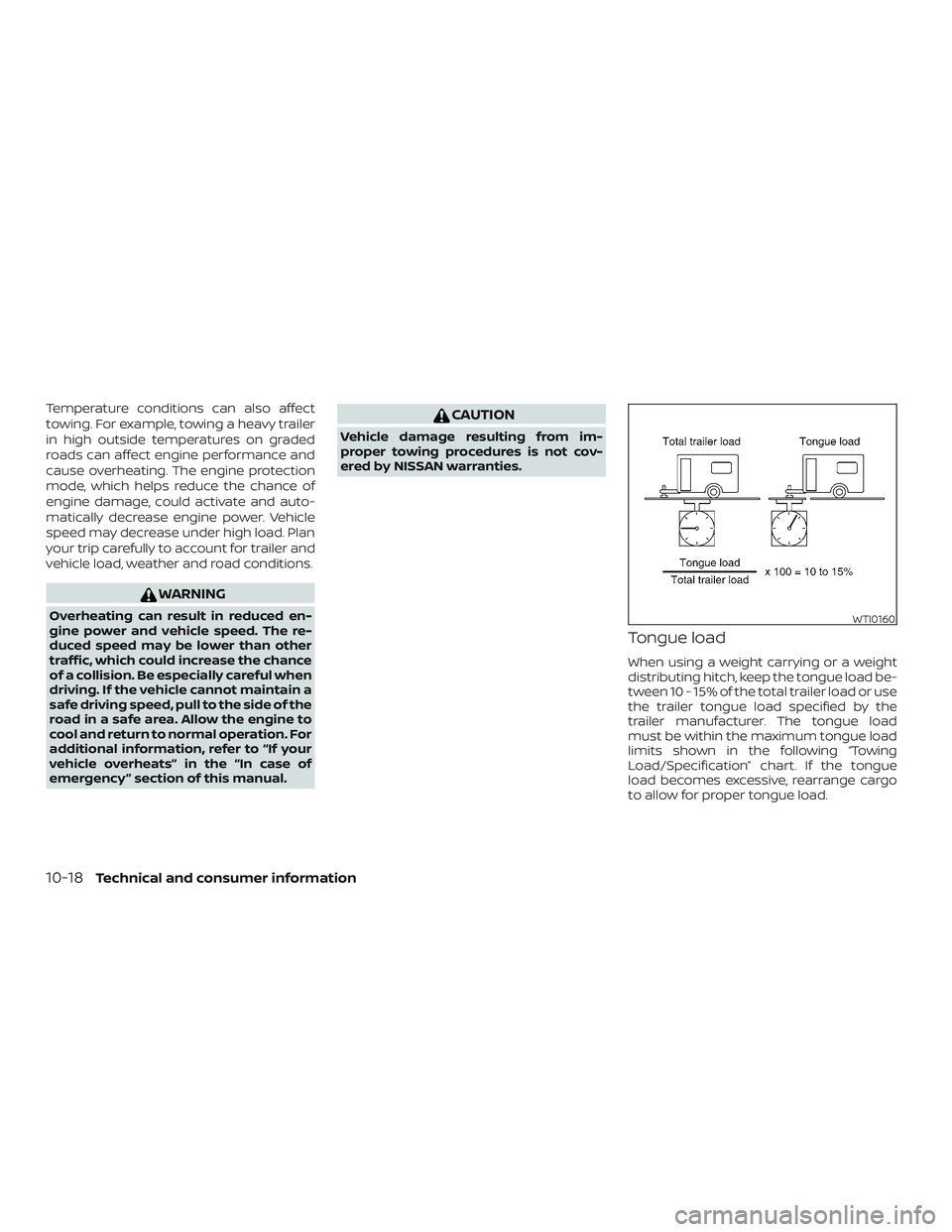
Tongue load
When using a weight carrying or a weight
distributing hitch, keep the tongue load be-
tween 10 - 15% of the total trailer load or use
the trailer tongue load specified by the
trailer manufacturer. The tongue load
must be within the maximum tongue load
limits shown in the following “Towing
Load/Specification” chart. If the tongue
load becomes excessive, rearrange cargo
to allow for proper tongue load.
WTI0160
10-18Technical and consumer information
Page 543 of 564
2. Measure the height of a reference pointon the front and rear bumpers at the
center of the vehicle.
3. Attach the trailer to the vehicle and ad- just the hitch equalizers so that the
front bumper height is within 0 -
.5 inches (0 – 13 mm) of the reference
height measured in step 2. The rear
bumper should be no higher than the
reference height measured in step 2.
WARNING
Properly adjust the weight distributing
hitch so the rear of the bumper is no
higher than the measured reference
height when the trailer is attached. If
the rear bumper is higher than the mea-
sured reference height when loaded,
the vehicle may handle unpredictably
which could cause a loss of vehicle con-
trol and cause serious personal injury or
property damage.
Sway control device
Sudden maneuvers, wind gusts, and buf-
feting caused by other vehicles can affect
trailer handling. Sway control devices may
be used to help control these affects. If you
choose to use one, contact a reputable
trailer hitch supplier to make sure the sway control device will work with the vehicle,
hitch, trailer and the trailer’s brake system.
Follow the instructions provided by the
manufacturer for installing and using the
sway control device.
Class I hitch
Class I trailer hitch equipment (receiver, ball
mount and hitch ball) can be used to tow
trailers of a maximum weight of 2,000 lbs.
(907 kg).
Tire pressures
∙ When towing a trailer, inflate the
vehicle tires to the recom-
mended cold tire pressure indi-
cated on the Tire and Loading In-
formation label.
∙ Trailer tire condition, size, load rat- ing and proper inflation pressure
should be in accordance with the
trailer and tire manufacturer’s
specifications.
Safety chains
Always use suitable safety chains between
your vehicle and the trailer. The safety chains
should be crossed and should be attached
to the hitch, not to the vehicle bumper or
axle. The safety chains can be attached to
the bumper if the hitch ball is mounted to the
bumper. Be sure to leave enough slack in the
chains to permit turning corners.
Trailer lights
CAUTION
When splicing into the vehicle electrical
system, a commercially available power-
type module/converter must be used to
provide power for all trailer lighting. This
unit uses the vehicle battery as a direct
power source for all trailer lights while us-
ing the vehicle tail light, stop light and
turn signal circuits as a signal source. The
module/converter must draw no more
that 15 milliamps from the stop and tail
lamp circuits. Using a module/converter
that exceeds these power requirements
may damage the vehicle’s electrical sys-
tem. It is recommended that you visit a
reputable trailer retailer to obtain the
proper equipment and to have it installed.
Technical and consumer information10-23
Page 544 of 564
Trailer lights should comply with federal
and/or local regulations. For assistance in
hooking up trailer lights, contact a NISSAN
dealer or reputable trailer retailer. Vehicles
equipped with the optional trailer tow
package are equipped with a 7-pin trailer
harness connector. If your trailer is
equipped with a flat 4-pin connector, an
adapter will be needed to connect the
trailer lights to the vehicle. Adapters are
available at auto parts stores and hitch re-
tailers.
Pre-towing tips
∙ Be certain your vehicle maintains a levelposition when a loaded and/or un-
loaded trailer is hitched. Do not drive the
vehicle if it has an abnormal nose-up or
nose-down condition; check for im-
proper tongue load, overload, worn sus-
pension or other possible causes of ei-
ther condition.
∙ Always secure items in the trailer to pre- vent load shif t while driving.
∙ Keep the cargo load as low as possible in the trailer to keep the trailer center of
gravity low. ∙ Load the trailer so approximately 60%
of the trailer load is in the front half and
40% is in the back half. Also make sure
the load is balanced side to side.
∙ Check your hitch, trailer tire pressure, vehicle tire pressure, trailer light opera-
tion, and trailer wheel lug nuts every
time you attach a trailer to the vehicle.
∙ Be certain your rearview mirrors con- form to all federal, state or local regula-
tions. If not, install any mirrors required
for towing before driving the vehicle.
∙ Determine the overall height of the ve- hicle and trailer so the required clear-
ance is known.
Trailer towing tips
In order to gain skill and an understanding
of the vehicle’s behavior, you should prac-
tice turning, stopping and backing up in an
area which is free from traffic. Steering sta-
bility and braking performance will be
somewhat different than under normal
driving conditions.
∙ Always secure items in the trailer to pre- vent load shif t while driving. ∙ Lock the trailer hitch coupler with a pin
or lock to prevent the coupler from in-
advertently becoming unlatched.
∙ Avoid abrupt starts, acceleration or stops.
∙ Avoid sharp turns or lane changes.
∙ Always drive your vehicle at a moderate speed.
∙ When backing up, hold the bottom of the steering wheel with one hand. Move
your hand in the direction in which you
want the trailer to go. Make small cor-
rections and back up slowly. If possible,
have someone guide you when you are
backing up.
Always block the wheels on both vehicle
and trailer when parking. Parking on a
slope is not recommended; however, if you
must do so:
CAUTION
If you move the shif t lever to the P (Park)
position before blocking the wheels
and applying the parking brake, trans-
mission damage could occur.
10-24Technical and consumer information
Page 545 of 564
1. Apply and hold the brake pedal.
2. Have someone place blocks on thedownhill side of the vehicle and trailer
wheels.
3. Af ter the wheel blocks are in place, slowly release the brake pedal until the
blocks absorb the vehicle load.
4. Apply the parking brake.
5. Shif t the transmission into P (Park).
6. Turn off the engine.
To drive away: 1. Start the vehicle.
2. Apply and hold the brake pedal.
3. Shif t the transmission into gear.
4. Release the parking brake.
5. Drive slowly until the vehicle and trailer are clear from the blocks.
6. Apply and hold the brake pedal.
7. Have someone retrieve and store the blocks. ∙ While going downhill, the weight of the
trailer pushing on the tow vehicle may
decrease overall stability. Therefore, to
maintain adequate control, reduce your
speed and shif t to a lower gear. Avoid
long or repeated use of the brakes
when descending a hill, as this reduces
their effectiveness and could cause
overheating. Shif ting to a lower gear in-
stead provides “engine braking” and re-
duces the need to brake as frequently.
∙ If the engine coolant temperature rises to a high temperature, refer to “If your
vehicle overheats” in the “In case of
emergency” section of this owner’s
manual.
∙ Trailer towing requires more fuel than normal circumstances.
∙ Avoid towing a trailer for your vehicle’s first 500 miles (805 km).
∙ For the first 500 miles (805 km) that you do tow, do not drive over 50 mph
(80 km/h).
∙ Have your vehicle serviced more of ten than at intervals specified. For addi-
tional information, refer to "Mainte-
nance schedules" in the "Maintenance
and schedules" section of this manual. ∙ When making a turn, your trailer wheels
will be closer to the inside of the turn
than your vehicle wheels. To compen-
sate for this, make a larger than normal
turning radius during the turn.
∙ Crosswinds and rough roads will ad- versely affect vehicle/trailer handling,
possibly causing vehicle sway. When
being passed by larger vehicles, be pre-
pared for possible changes in cross-
winds that could affect vehicle han-
dling.
Do the following if the trailer begins to
sway: 1. Take your foot off the accelerator pedal to allow the vehicle to coast and steer
as straight ahead as the road condi-
tions allow. This combination will help
stabilize the vehicle
– Do not correct trailer sway by steer- ing or applying the brakes.
2. When the trailer sway stops, gently ap- ply the brakes and pull to the side of the
road in a safe area.
3. Try to rearrange the trailer load so it is balanced as described in this section.
Technical and consumer information10-25
Page 555 of 564
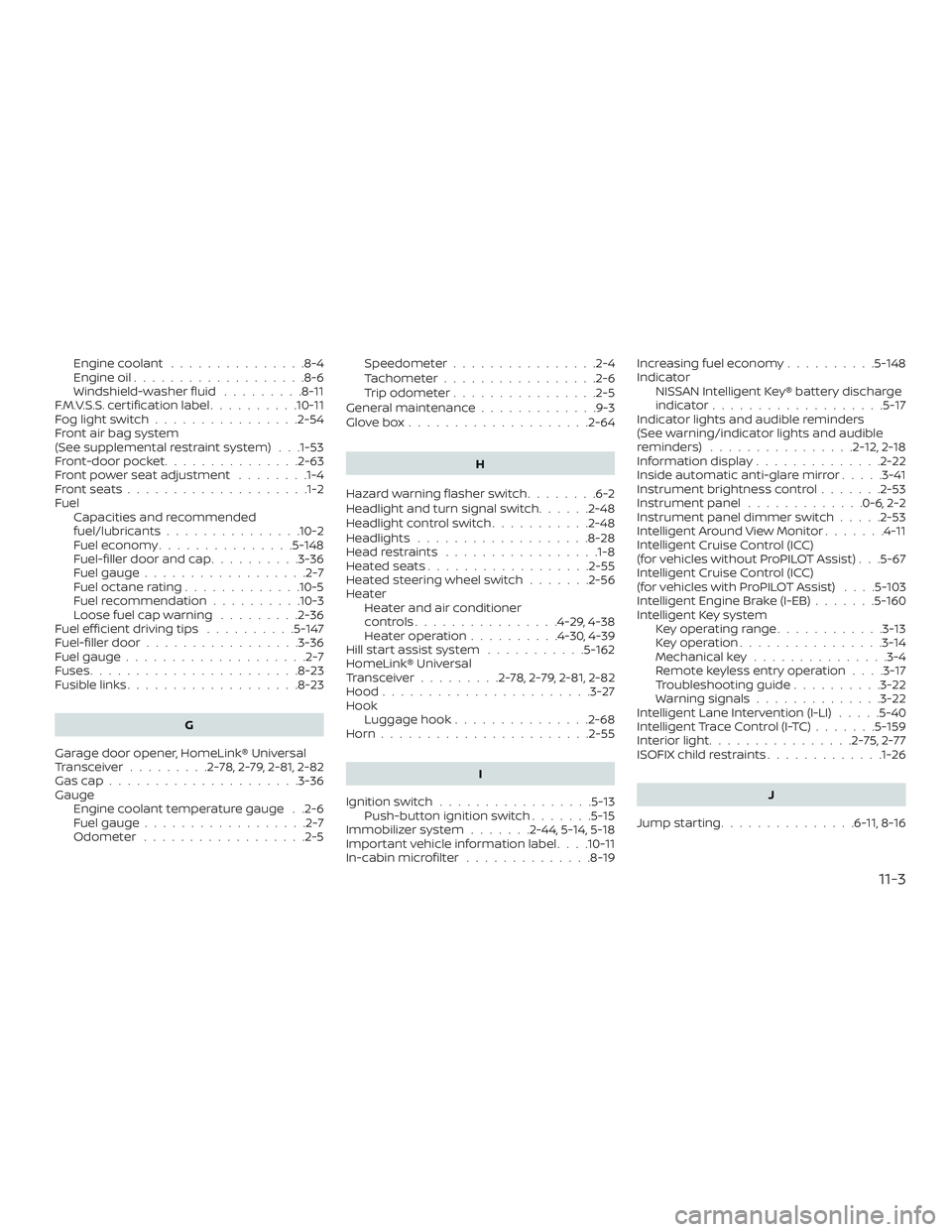
Engine coolant...............8-4
Engine oil ...................8-6
Windshield-washer fluid .........8-11
F.M.V.S.S. certification label ..........10-11
Foglightswitch................2-54
Front air bag system
(See supplemental restraint system) . . .1-53
Front-door pocket ...............2-63
Front power seat adjustment ........1-4
Frontseats................... .1-2
Fuel Capacities and recommended
fuel/lubricants...............10-2
Fuel economy ...............5-148
Fuel-filler door and cap ..........3-36
Fuel gauge ..................2-7
Fueloctanerating.............10-5
Fuel recommendation ..........10-3
Loose fuel cap warning .........2-36
Fuelefficientdrivingtips ..........5-147
Fuel-filler door .................3-36
Fuel gauge ....................2-7
Fuses .......................8-23
Fusiblelinks...................8-23
G
Garage door opener, HomeLink® Universal
Transceiver .........2-78,2-79,2-81,2-82
Gascap.....................3-36
Gauge Engine coolant temperature gauge . .2-6
Fuel gauge ..................2-7
Odometer ..................2-5 Speedometer
................2-4
Tachometer .................2-6
Trip odometer ................2-5
General maintenance .............9-3
Glovebox....................2-64
H
Hazard warning flasher switch ........6-2
Headlight and turn signal switch ......2-48
Headlightcontrolswitch...........2-48
Headlights...................8-28
Headrestraints .................1-8
Heatedseats..................2-55
Heated steering wheel switch .......2-56
Heater Heater and air conditioner
controls................4-29,4-38
Heater operation ..........4-30,4-39
Hill start assist system ...........5-162
HomeLink® Universal
Transceiver .........2-78,2-79,2-81,2-82
Hood .......................3-27
Hook Luggage hook ...............2-68
Horn.......................2-55
I
Ignition switch .................5-13
Push-button ignition switch .......5-15
Immobilizer system .......2-44,5-14,5-18
Important vehicle information label . . . .10-11
In-cabinmicrofilter ..............8-19 Increasing fuel economy
..........5-148
Indicator NISSAN Intelligent Key® battery discharge
indicator...................5-17
Indicator lights and audible reminders
(See warning/indicator lights and audible
reminders) ................2-12,2-18
Informationdisplay..............2-22
Inside automatic anti-glare mirror .....3-41
Instrument brightness control .......2-53
Instrument panel .............0-6,2-2
Instrument panel dimmer switch .....2-53
Intelligent Around View Monitor .......4-11
Intelligent
Cruise Control (ICC)
(for vehicles without ProPILOT Assist) . . .5-67
Intelligent Cruise Control (ICC)
(for vehicles with ProPILOT Assist) ....5-103
Intelligent Engine Brake (I-EB) .......5-160
Intelligent Key system Key operating range ............3-13
Key operation ................3-14
Mechanical key ...............3-4
Remote keyless entry operation ....3-17
Troubleshooting guide ..........3-22
Warning signals ..............3-22
Intelligent Lane Intervention (I-LI) .....5-40
Intelligent Trace Control (I-TC) .......5-159
Interiorlight................2-75,2-77
ISOFIX child restraints .............1-26
J
Jumpstarting...............6 -11, 8-16
11-3
Page 556 of 564
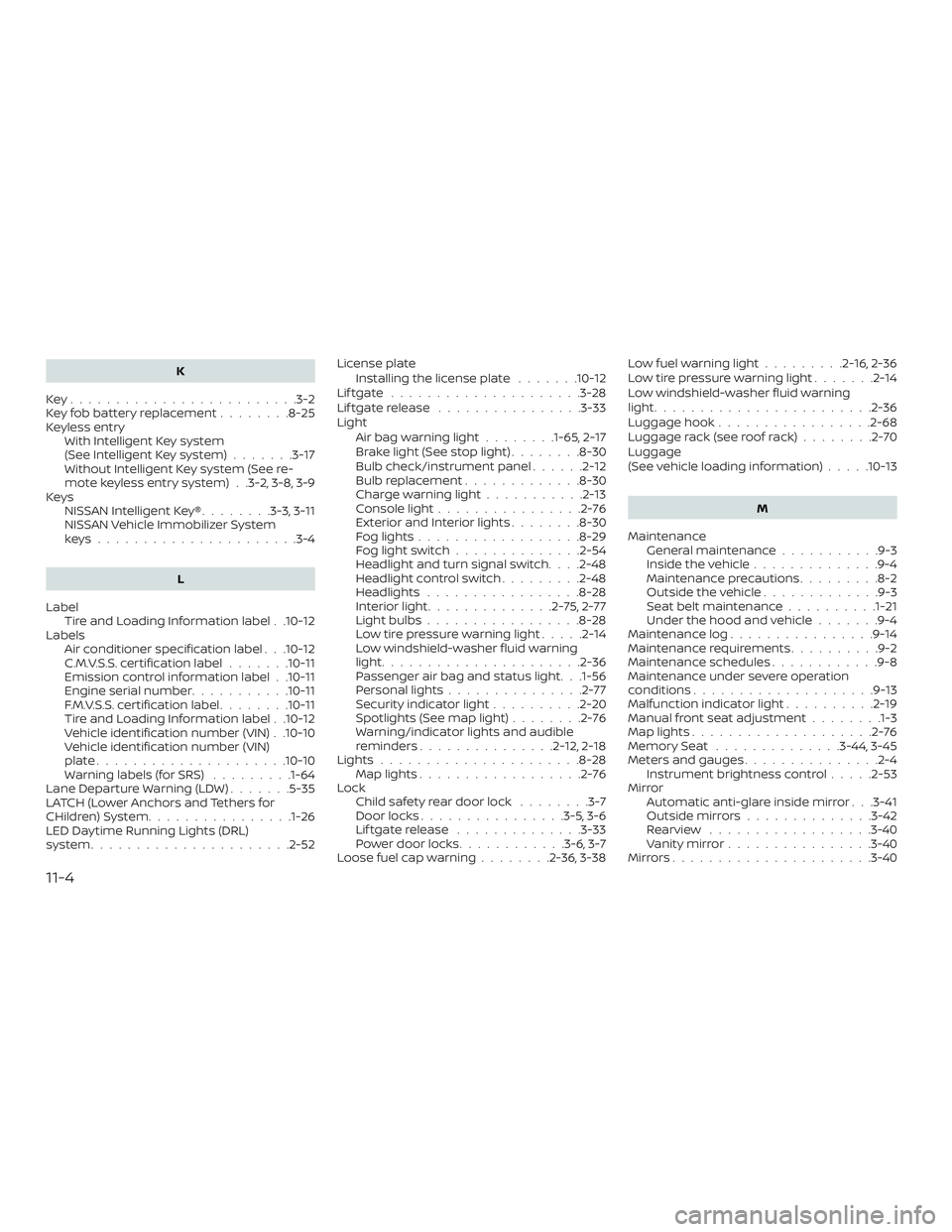
K
Key.........................3-2
Key fob battery replacement ........8-25
Keyless entry With Intelligent Key system
(See Intelligent Key system) .......3-17
Without Intelligent Key system (See re-
mote keyless entry system) . .3-2, 3-8, 3-9
Keys NISSAN Intelligent Key® ........3-3,3-11
NISSAN Vehicle Immobilizer System
keys......................3-4
L
Label Tire and Loading Information label . .10-12
Labels Air conditioner specification label . . .10-12
C.M.V.S.S. certification label .......10-11
Emission control information label . .10-11
Engine serial number ...........10-11
F.M.V.S.S. certification label ........10-11
Tire and Loading Information label . .10-12
Vehicle identification number (VIN) . .10-10
Vehicle identification number (VIN)
plate.....................10-10
Warning labels (for SRS) .........1-64
Lane Departure Warning (LDW) .......5-35
LATCH (Lower Anchors and Tethers for
CHildren)System............... .1-26
LED Daytime Running Lights (DRL)
system ......................2-52 License plate
Installing the license plate .......10-12
Liftgate .....................3-28
Liftgaterelease ................3-33
Light Airbagwarninglight........1-65, 2-17
Brakelight(Seestoplight)........8-30
Bulb check/instrument panel ......2-12
Bulb replacement .............8-30
Charge warning light ...........2-13
Console light ................2-76
ExteriorandInteriorlights........8-30
Foglights..................8-29
Foglightswitch..............2-54
Headlight and turn signal switch ....2-48
Headlightcontrolswitch.........2-48
Headlights.................8-28
Interiorlight..............2-75,2-77
Lightbulbs.................8-28
Low tire pressure warning light .....2-14
Low windshield-washer fluid warning
light......................2-36
Passenger air bag and status light. . .1-56
Personal lights ...............2-77
Security indicator light ..........2-20
Spotlights(Seemaplight)........2-76
Warning/indicator lights and audible
reminders ...............2-12,2-18
Lights......................8-28 Maplights..................2-76
Lock Child safety rear door lock ........3-7
Door locks ................3-5,3-6
Liftgaterelease ..............3-33
Power door locks ............3-6,3-7
Loose fuel cap warning ........2-36,3-38 Lowfuelwarninglight.........2-16,2-36
Low tire pressure warning light
.......2-14
Low windshield-washer fluid warning
light........................2-36
Luggage hook .................2-68
Luggage rack (see roof rack) ........2-70
Luggage
(See vehicle loading information) .....10-13
M
Maintenance General maintenance ...........9-3
Insidethevehicle..............9-4
Maintenance precautions .........8-2
Outsidethevehicle.............9-3
Seat belt maintenance ..........1-21
Under the hood and vehicle .......9-4
Maintenance log ................9-14
Maintenance requirements ..........9-2
Maintenance schedules ............9-8
Maintenance under severe operation
conditions....................9-13
Malfunctionindicatorlight..........2-19
Manual front seat adjustment ........1-3
Maplights....................2-76
Memory Seat ............. .3-44, 3-45
Meter
s and gauges ...............2-4
Instrument brightness control .....2-53
Mirror Automatic anti-glare inside mirror . . .3-41
Outsidemirrors..............3-42
Rearview ..................3-40
Vanitymirror................3-40
Mirrors......................3-40
11-4
Page 558 of 564

Reporting safety defects (US only) . .10-29
Seat adjustment Front manual seat adjustment ......1-3
Front power seat adjustment ......1-4
Second row bench seats .........1-6
Seatback pockets ...............2-63
Seat belt Childsafety ................ .1-21
Infants and small children ........1-22
InjuredPerson............... .1-15
Largerchildren.............. .1-22
Precautions on seat belt usage .....1-12
Pregnant women ..............1-15
Seat belt extenders ............1-20
Seat belt maintenance ..........1-21
Seatbelts................1-12, 7-6
Shoulder belt height adjustment . . . .1-19
Three-pointtypewithretractor.....1-15
Seat belt extenders ..............1-20
Seatbeltwarninglight .........1-15, 2-17
Seats 2nd row bench seat adjustment .....1-6
Adjustment ..................1-2
Armrests .................. .1-6
Automatic drive positioner ....3-44,3-45
Frontseats..................1-2
Heatedseats................2-55
Manual front seat adjustment ......1-3
Security indicator light ............2-20
Security system (NISSAN Vehicle Immobilizer
System), engine start ......2-44,5-14,5-18
Security systems Vehicle security system .........2-42
Self-adjustingbrakes.............8-22
Service manual order form .........10-32
Servicing air conditioner ...........4-41Shoulder belt height adjustment
......1-19
Sonar Rear system ................5-163
Spark plug replacement ...........8-18
Spark plugs ...................8-18
Specifications .................10-8
Speedometer ..................2-4
Speedometer and odometer ........2-4
SPORT mode switch .............5-34
Spotlights(Seemaplight)..........2-76
SRS warning label ...............1-64
Standard maintenance ............9-9
Starting Before starting the engine ........5-19
Jumpstarting.............6 -11, 8-16
Precautions when starting and
d
riving..................5-4,5-11
Push starting ................6-13
Starting the engine ............5-19
Starting the engine ..............5-19
Starting the engine (models with
NISSAN Intelligent Key® system) ......5-20
Steering Powersteeringsystem.........5-153
Steering Assist switch (for vehicles with
ProPILOT Assist) ................2-57
Steering wheel .................3-38
Stoplight....................8-30
Storage.....................2-63
Sunglasses case ................2-65
Sunglasses holder ..............2-65
Sunroof ...................2-73,7-5
Sunroof (see Moonroof ) ...........2-73
Sunvisors....................3-39
Supplemental air bag warning labels . . .1-64 Supplemental air bag warning
light.....................1-65, 2-17
Supplemental front impact air bag
system.....................
.1-53
Supplemental restraint system Information and warning labels . . . .1-64
Precautions on supplemental restraint
system ....................1-46
Supplemental restraint system
(Supplemental air bag system) .......1-46
Switch Autolightswitch..............2-49
Automatic power window switch . . .2-72
Foglightswitch..............2-54
Hazard warning flasher switch ......6-2
Headlight and turn signal switch . . . .2-48
Headlightcontrolswitch.........2-48
Ignition switch ...............5-13
Instrument brightness control .....2-53
Power door lock switch ........3-6,3-7
Rear window and outside mirror
defrosterswitch..............2-47
Rear window wiper and washer
switches ...................2-46
Turn signal switch .............2-53
T
Tachometer ...................2-6
Temperature gauge Engine coolant temperature gauge . .2-6
Thef t (NISSAN Vehicle Immobilizer System),
engine start ............2-44,5-14,5-18
Three-waycatalyst...............5-5
11-6
Page 559 of 564
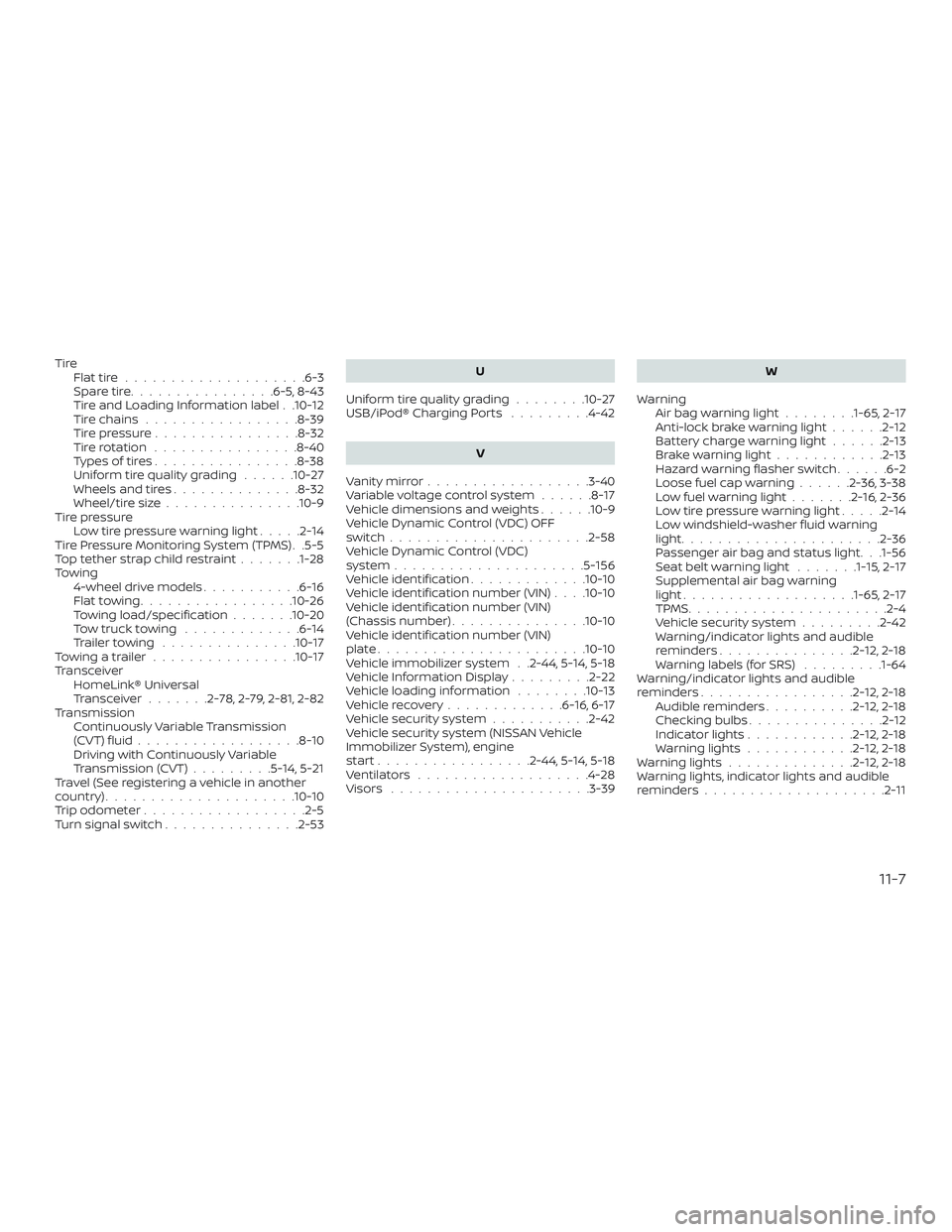
TireFlattire....................6-3
Spare tire ................6-5,8-43
Tire and Loading Information label . .10-12
Tire chains .................8-39
Tire pressure ................8-32
Tirerotation ................8-40
Types of tires ................8-38
Uniform tire quality grading ......10-27
Wheels and tires ..............8-32
Wheel/tire size ...............10-9
Tire pressure Low tire pressure warning light .....2-14
Tire Pressure Monitoring System (TPMS) . .5-5
Toptetherstrapchildrestraint.......1-28
Towing 4-wheel drive models ...........6-16
Flattowing.................10-26
Towing load/specification .......10-20
Towtrucktowing .............6-14
Trailertowing ...............10-17
Towingatrailer................10-17
Transceiver HomeLink® Universal
Transceiver .......2-78,2-79,2-81,2-82
Transmission Continuously Variable Transmission
(CVT) fluid ..................8-10
Driving with Continuously Variable
Transmission (CVT) .........5-14,5-21
Travel (See registering a vehicle in another
country) .....................10-10
Trip odometer ..................2-5
Turn signal switch ...............2-53 U
Uniform tire quality grading ........10-27
USB/iPod® Charging Ports .........4-42
V
Vanitymirror..................3-40
Variable voltage control system ......8-17
Vehicle dimensions and weights ......10-9
Vehicle Dynamic Control (VDC) OFF
switch......................2-58
Vehicle Dynamic Control (VDC)
system .....................5-156
Vehicle identification .............10-10
Vehicle identification number (VIN) . . . .10-10
Vehicle identification number (VIN)
(Chassis number) ...............10-10
Vehicle identification number (VIN)
plate.......................10-10
Vehicle immobilizer system . .2-44, 5-14, 5-18
VehicleInformationDisplay.........2-22
Vehicle loading information ........10-13
Vehiclerecovery.............6-16,6-17
Vehicle security system ...........2-42
Vehicle security system (NISSAN Vehicle
Immobilizer System), engine
start.................2-44,5-14,5-18
Ventilators ...................4-28
Visors ......................3-39 W
Warning Airbagwarninglight........1-65, 2-17
Anti-lock brake warning light ......2-12
Battery charge warning light ......2-13
Brakewarninglight............2-13
Hazard warning flasher switch ......6-2
Loose fuel cap warning ......2-36,3-38
Lowfuelwarninglight.......2-16,2-36
Lowtirepressurewarninglight.....2-14
Low windshield-washer fluid warning
light......................2-36
Passenger air bag and status light. . .1-56
Seatbeltwarninglight .......1-15, 2-17
Supplemental air bag warning
light...................1-65, 2-17
TPMS......................2-4
Vehicle security system .........2-42
Warning/indicator lights and audible
reminders ...............2-12,2-18
Warning labels (for SRS) .........1-64
Warning/indicator lights and audible
reminders .................2-12,2-18
Audible reminders ..........2-12,2-18
Checking bulbs ...............2-12
Indicatorlights............2-12,2-18
Warninglights............2-12,2-18
Warninglights..............2-12,2-18
Warning lights, indicator lights and audible
reminders ....................2-11
11-7