service indicator NISSAN ROGUE 2020 Owner´s Manual
[x] Cancel search | Manufacturer: NISSAN, Model Year: 2020, Model line: ROGUE, Model: NISSAN ROGUE 2020Pages: 567, PDF Size: 6.63 MB
Page 412 of 567
CAUTION
∙ If the warning light remains on af terthe above operation, have your ve-
hicle checked as soon as possible. It is
recommended that you visit a NISSAN
dealer for this service.
∙ If the warning light comes on while driving, there may be a malfunction in
the AWD system. Reduce the vehicle
speed and have your vehicle checked
as soon as possible. It is recom-
mended that you visit a NISSAN dealer
for this service.
∙ The powertrain may be damaged if you continue driving with the warning
light illuminated.
∙ Never drive on dry, hard surface roads in the LOCK mode, as this will overload
the powertrain and may cause a seri-
ous malfunction.
WARNING
∙ For AWD equipped vehicles, do not at-tempt to raise two wheels off the
ground and shif t the transmission to
any drive or reverse position with the
engine running. Doing so may result
in drivetrain damage or unexpected
vehicle movement which could result
in serious vehicle damage or personal
injury.
∙ Do not attempt to test an AWD equipped vehicle on a 2–wheel dyna-
mometer (such as the dynamometers
used by some states for emissions
testing) or similar equipment even if
the other two wheels are raised off the
ground. Make sure that you inform
the test facility personnel that your
vehicle is equipped with AWD before it
is placed on a dynamometer. Using
the wrong test equipment may result
in drivetrain damage or unexpected
vehicle movement which could result
in serious vehicle damage or personal
injury.
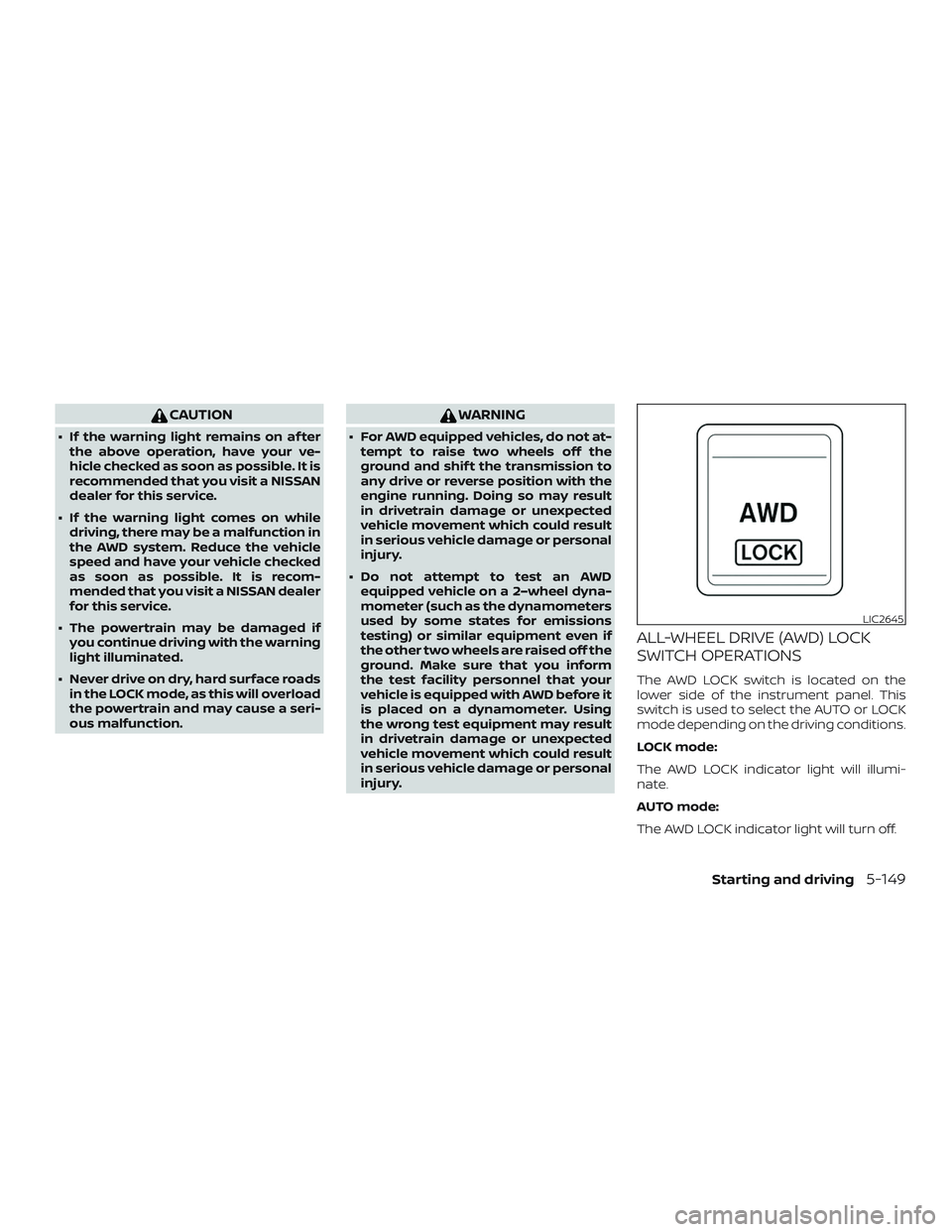
ALL-WHEEL DRIVE (AWD) LOCK
SWITCH OPERATIONS
The AWD LOCK switch is located on the
lower side of the instrument panel. This
switch is used to select the AUTO or LOCK
mode depending on the driving conditions.
LOCK mode:
The AWD LOCK indicator light will illumi-
nate.
AUTO mode:
The AWD LOCK indicator light will turn off.
LIC2645
Starting and driving5-149
Page 413 of 567
![NISSAN ROGUE 2020 Owner´s Manual AWD mode Wheels driven AWD LOCK indicator light Use conditionsAUTO Distribution of torque
to the front and rear
wheels changes
automatically, depend-
ing on road conditions
encountered [100:0]
←→](/img/5/40361/w960_40361-412.png "NISSAN ROGUE 2020 Owner´s Manual AWD mode Wheels driven AWD LOCK indicator light Use conditionsAUTO Distribution of torque
to the front and rear
wheels changes
automatically, depend-
ing on road conditions
encountered [100:0]
←→")
AWD mode Wheels driven AWD LOCK indicator light Use conditionsAUTO Distribution of torque
to the front and rear
wheels changes
automatically, depend-
ing on road conditions
encountered [100:0]
←→
[50:50]. This results
in improved driving
stability. *1 For driving on paved
or slippery roads.
LOCK AWD *2, *3
For driving on rough
roads.
*1 When the rotation difference between the front and rear wheels is large, the AWD mode
may change from AUTO to LOCK for a while; however, this is not a malfunction.
*2 The LOCK mode will change to AUTO mode automatically when the vehicle has been
driven at a high speed. The AWD LOCK indicator light turns off.
*3 LOCK mode will automatically be canceled when the ignition switch is placed in the OFF
position. ∙ The AWD torque distribution between
the front and rear wheels can be dis-
played in the video information display.
∙ If the AWD LOCK switch is operated while accelerating or decelerating, or if
the ignition switch is placed in the OFF
position, you may feel a jolt. This is nor-
mal.
∙ The oil temperature of the powertrain parts will increase if the vehicle is con-
tinuously operated under conditions
where the difference in rotation be-
tween the front and rear wheels is large
(wheel slip), such as when driving the
vehicle on rough roads or through sand
or mud or freeing a stuck vehicle. In
these cases, the master warning light
illuminates and the AWD mode
changes to 2–Wheel Drive to protect the
powertrain parts. Stop driving with the
engine idling and wait until the warning
light turns off and the AWD returns to
the AUTO mode. If the warning light re-
mains on, have your vehicle checked as
soon as possible. It is recommended
that you visit a NISSAN dealer for this
service.
5-150Starting and driving
Page 436 of 567

TIRE PRESSURE MONITORING
SYSTEM (TPMS)
This vehicle is equipped with the TPMS. It
monitors tire pressure of all tires except the
spare. When the low tire pressure warning
light is lit and the “Tire Pressure Low — Add
Air” warning appears in the vehicle infor-
mation display, one or more of your tires is
significantly under-inflated. If the vehicle is
being driven with low tire pressure, the
TPMS will activate and warn you of it by the
low tire pressure warning light. This system
will activate only when the vehicle is driven
at speeds above 16 mph (25 km/h). For ad-
ditional information, refer to “Warning
lights, indicator lights and audible remind-
ers” in the “Instruments and controls” sec-
tion, and “Tire Pressure Monitoring System
(TPMS)” in the “Starting and driving” section
of this manual.
WARNING
∙ Radio waves could adversely affectelectric medical equipment. Those
who use a pacemaker should contact
the electric medical equipment
manufacturer for the possible influ-
ences before use. ∙ If the low tire pressure warning light
illuminates while driving, avoid sud-
den steering maneuvers or abrupt
braking, reduce vehicle speed, pull off
the road to a safe location and stop
the vehicle as soon as possible. Driv-
ing with underinflated tires may per-
manently damage the tires and in-
crease the likelihood of tire failure.
Serious vehicle damage could occur
and may lead to an accident and could
result in serious personal injury.
Check the tire pressure for all four
tires. Adjust the tire pressure to the
recommended COLD tire pressure
shown on the Tire and Loading Infor-
mation label to turn the low tire pres-
sure warning light OFF. If the light still
illuminates while driving af ter adjust-
ing the tire pressure, a tire may be flat
or the TPMS may be malfunctioning. If
you have a flat tire, replace it with a
spare tire as soon as possible. If no tire
is flat and all tires are properly in-
flated, have the vehicle checked. It is
recommended that you visit a NISSAN
dealer for this service. ∙ When replacing a wheel without the
TPMS such as the spare tire, the TPMS
will not function and the low tire pres-
sure warning light will flash for ap-
proximately 1 minute. The light will re-
main on af ter 1 minute. Have your
tires replaced and/or TPMS system
reset as soon as possible. It is recom-
mended that you visit a NISSAN dealer
for these services.
∙ Replacing tires with those not origi- nally specified by NISSAN could affect
the proper operation of the TPMS.
∙ Do not inject any tire liquid or aerosol tire sealant into the tires, as this may
cause a malfunction of the tire pres-
sure sensors.
∙ If the light still comes on while driving af ter adjusting the tire pressure, a tire
may be flat or the TPMS may be mal-
functioning. If you have a flat tire, re-
place it with a spare tire as soon as
possible. If no tire is flat and all tires
are properly inflated, it is recom-
mended that you visit a NISSAN dealer
for this service.
FLAT TIRE
In case of emergency6-3
Page 481 of 567
Rear window wiper blade
If checking or replacement is required, it is
recommended that you visit a NISSAN
dealer for this service.If the brakes do not operate properly, have
the brakes checked. It is recommended
that you visit a NISSAN dealer for this ser-
vice.
Self-adjusting brakes
Your vehicle is equipped with self-adjusting
brakes.
The front and rear disc-type brakes self-
adjust every time the brake pedal is ap-
plied.
WARNING
Have your brake system checked if the
brake pedal height does not return to
normal. It is recommended that you
visit a NISSAN dealer for this service.
Brake pad wear indicators
The disc brake pads on your vehicle have
audible wear indicators. When a brake pad
requires replacement, a high pitched
scraping or screeching sound will be heard
when the vehicle is in motion. The noise will
be heard whether or not the brake pedal is
depressed. Have the brakes checked as
soon as possible if the wear indicator
sound is heard.Under some driving or climate conditions,
occasional brake squeak, squeal or other
noise may be heard. Occasional brake
noise during light to moderate stops is nor-
mal and does not affect the function or
performance of the brake system.
Proper brake inspection intervals should
be followed.
For additional information re-
garding brake inspections, refer to the ap-
propriate maintenance schedule informa-
tion in the "Maintenance and schedules"
section of this manual.
BRAKES
8-22Do-it-yourself
Page 500 of 567
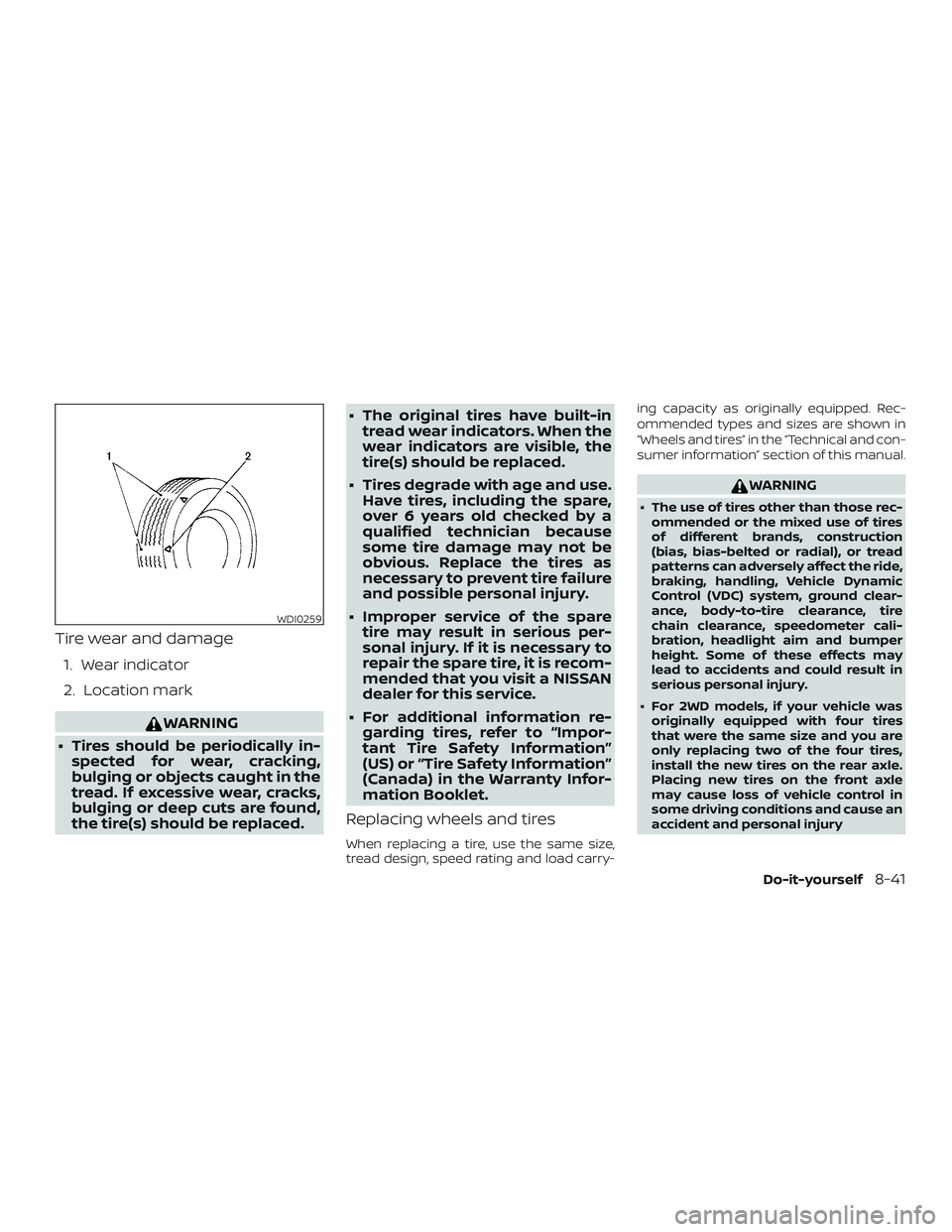
Tire wear and damage
1. Wear indicator
2. Location mark
WARNING
∙ Tires should be periodically in- spected for wear, cracking,
bulging or objects caught in the
tread. If excessive wear, cracks,
bulging or deep cuts are found,
the tire(s) should be replaced. ∙ The original tires have built-in
tread wear indicators. When the
wear indicators are visible, the
tire(s) should be replaced.
∙ Tires degrade with age and use. Have tires, including the spare,
over 6 years old checked by a
qualified technician because
some tire damage may not be
obvious. Replace the tires as
necessary to prevent tire failure
and possible personal injury.
∙ Improper service of the spare tire may result in serious per-
sonal injury. If it is necessary to
repair the spare tire, it is recom-
mended that you visit a NISSAN
dealer for this service.
∙ For additional information re- garding tires, refer to “Impor-
tant Tire Safety Information”
(US) or “Tire Safety Information”
(Canada) in the Warranty Infor-
mation Booklet.
Replacing wheels and tires
When replacing a tire, use the same size,
tread design, speed rating and load carry- ing capacity as originally equipped. Rec-
ommended types and sizes are shown in
“Wheels and tires” in the “Technical and con-
sumer information” section of this manual.
WARNING
∙ The use of tires other than those rec-
ommended or the mixed use of tires
of different brands, construction
(bias, bias-belted or radial), or tread
patterns can adversely affect the ride,
braking, handling, Vehicle Dynamic
Control (VDC) system, ground clear-
ance, body-to-tire clearance, tire
chain clearance, speedometer cali-
bration, headlight aim and bumper
height. Some of these effects may
lead to accidents and could result in
serious personal injury.
∙ For 2WD models, if your vehicle was originally equipped with four tires
that were the same size and you are
only replacing two of the four tires,
install the new tires on the rear axle.
Placing new tires on the front axle
may cause loss of vehicle control in
some driving conditions and cause an
accident and personal injury
WDI0259
Do-it-yourself8-41
Page 556 of 567
Moonroof..................2-73,7-5
Moving Object Detection (MOD) ......4-23
N
NissanConnect® Owner's Manual ......4-2
NISSAN Intelligent Key® .........3-3,3-10
NISSAN Intelligent Key® battery discharge
indicator.....................5-18
NISSAN Vehicle Immobilizer
System...............2-44,5-15,5-18
O
Octane rating (See fuel octane rating). . .10-5
Odometer ....................2-5
Oil Capacities and recommended
fuel/lubricants...............10-2
Changing engine oil ............8-7
Changing engine oil filter .........8-7
Checking engine oil level .........8-6
Engine oil ...................8-6
Engine oil and oil filter
recommendation .............10-6
Engine oil viscosity .............10-6
Outsidemirrors................3-40
Overhead sunglasses holder ........2-65
Overheat Ifyourvehicleoverheats.........6-13
Owner's manual order form ........10-32
Owner's manual/service manual order
information..................10-32 P
Parking Parking brake operation .........5-28
Parking/parkingonhills.........5-152
Parkingbrake...........2-13,2-18,5-28
Personal lights .................2-77
Power Power door locks ............3-6,3-7
Poweroutlet................2-60
Powerrearwindows ...........2-72
Power steering system .........5-152
Powerwindows ..............2-71
Rearpowerwindows...........2-72
Poweroutlet..................2-60
Powersteering................5-152
Precautions Maintenance precautions .........8-2
On-pavement and off-road driving
precautions .................5-9
Precautions on booster
seats............1-24, 1-31, 1-37, 1-42
Precautions on child
restraints..........1-24, 1-31, 1-37, 1-42
Precautions on seat belt usage .....1-12
Precautions on supplemental restraint
system ....................1-46
Precautions when starting and
driving..................5-4,5-11
ProPILOT Assist .................5-91
Push starting ..................6-13 R
Radio Car phone or CB radio ..........4-42
Readiness for inspection maintenance (I/M)
test.......................10-30
Rear Automatic Braking (RAB) .......5-141
RearCrossTrafficAlert(RCTA)........5-57
Rear Door Alert .............2-41,2-59
Rearpowerwindows.............2-72
Rear Sonar System (RSS) ..........5-162
Rearviewmirror................3-38
RearViewMonitor................4-3 Adjustingthescreen............4-8
Rear window and outside mirror defroster
switch......................2-47
Rear window wiper and washer
switches .....................2-46
Recommended Fluids ............10-2
Recorders EventData.............10-30,10-31
Refrigerant recommendation ........10-7
Registering a vehicle in another
country .....................10-10
Remote Engine Start ..........3-22,5-21
Remote keyless entry system . . .3-2, 3-8, 3-9
Reporting safety defects (US only) . . . .10-29
Roofrack....................2-70
S
Safety Child safety rear door lock ........3-7
C h
ildseatbelts......1-24, 1-31, 1-37, 1-42
Reporting safety defects (US only) . .10-29
11-5
Page 557 of 567
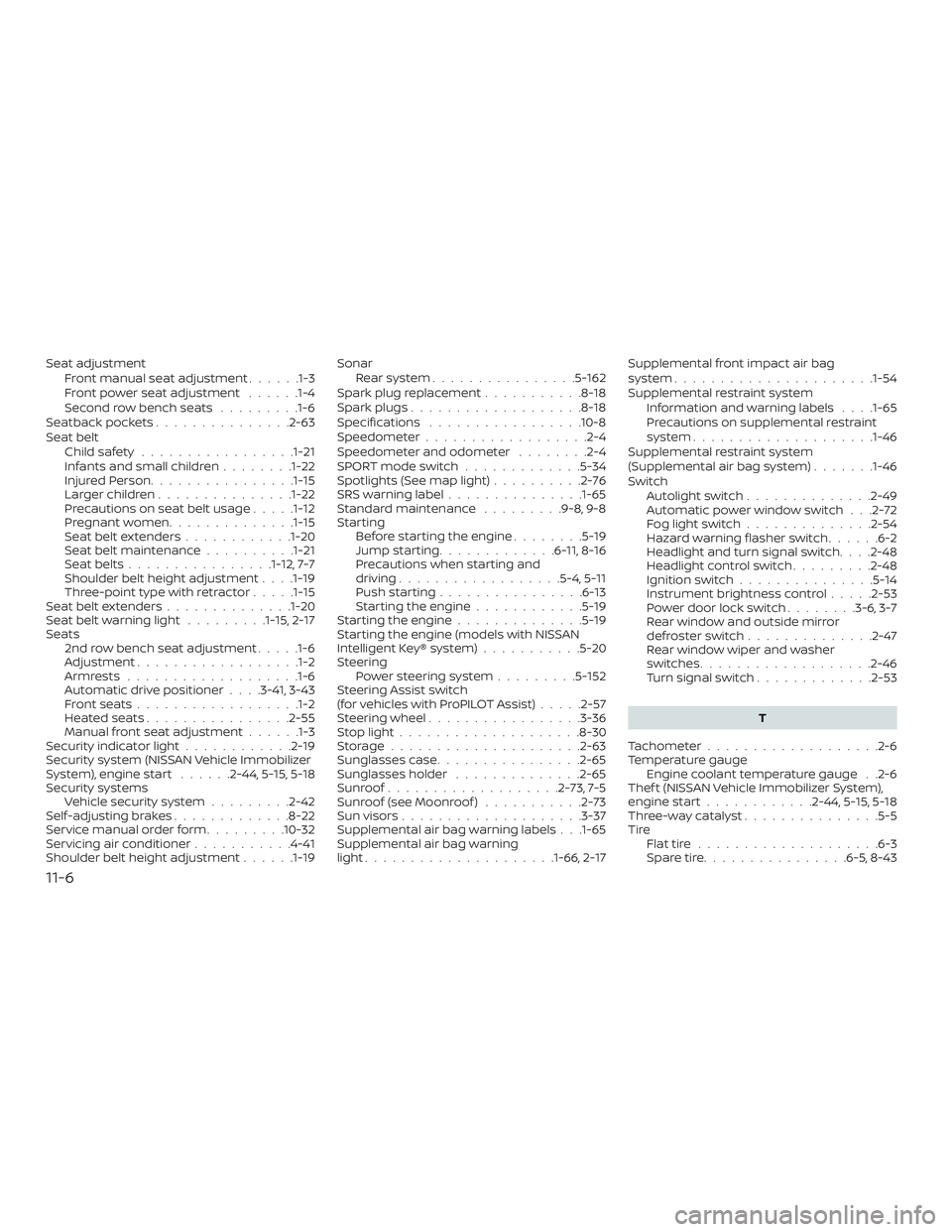
Seat adjustmentFront manual seat adjustment ......1-3
Front power seat adjustment ......1-4
Second row bench seats .........1-6
Seatback pockets ...............2-63
Seat belt Childsafety ................ .1-21
Infants and small children ........1-22
InjuredPerson............... .1-15
Largerchildren.............. .1-22
Precautions on seat belt usage .....1-12
Pregnant women ..............1-15
Seat belt extenders ............1-20
Seat belt maintenance ..........1-21
Seatbelts................1-12, 7-7
Shoulder belt height adjustment . . . .1-19
Three-pointtypewithretractor.....1-15
Seat belt extenders ..............1-20
Seatbeltwarninglight .........1-15, 2-17
Seats 2nd row bench seat adjustment .....1-6
Adjustment ..................1-2
Armrests .................. .1-6
Automatic drive positioner . . . .3-41, 3-43
Frontseats..................1-2
Heatedseats................2-55
Manual front seat adjustment ......1-3
Security indicator light ............2-19
Security system (NISSAN Vehicle Immobilizer
System), engine start ......2-44,5-15,5-18
Security systems Vehicle security system .........2-42
Self-adjustingbrakes.............8-22
Service manual order form .........10-32
Servicing air conditioner ...........4-41
Shoulder belt height adjustment ......1-19Sonar
Rear system ................5-162
Spark plug replacement ...........8-18
Spark plugs ...................8-18
Specifications .................10-8
Speedometer ..................2-4
Speedometer and odometer ........2-4
SPORT mode switch .............5-34
Spotlights(Seemaplight)..........2-76
SRS warning label ...............1-65
Standard maintenance .........9-8,9-8
Starting Before starting the engine ........5-19
Jumpstarting.............6 -11, 8-16
Precautions when starting and
driving..................5-4,5-11
Push star
ting................6-13
Starting the engine ............5-19
Starting the engine ..............5-19
Starting the engine (models with NISSAN
Intelligent Key® system) ...........5-20
Steering Powersteeringsystem.........5-152
Steering Assist switch
(forvehicleswithProPILOTAssist).....2-57
Steering wheel .................3-36
Stoplight....................8-30
Storage.....................2-63
Sunglasses case ................2-65
Sunglasses holder ..............2-65
Sunroof ...................2-73,7-5
Sunroof (see Moonroof ) ...........2-73
Sunvisors....................3-37
Supplemental air bag warning labels . . .1-65
Supplemental air bag warning
light.....................1-66, 2-17 Supplemental front impact air bag
system......................1-54
Supplemental restraint system
Information and warning labels . . . .1-65
Precautions on supplemental restraint
system ....................1-46
Supplemental restraint system
(Supplemental air bag system) .......1-46
Switch Autolightswitch..............2-49
Automatic power window switch . . .2-72
Foglightswitch..............2-54
Hazard warning flasher switch ......6-2
Headlight and turn signal switch . . . .2-48
Headlightcontrolswitch.........2-48
Ignition switch ...............5-14
Instrument brightness control .....2-53
Power door lock switch ........3-6,3-7
Rear window and outside mirror
defrosterswitch..............2-47
Rear window wiper and washer
switches ...................2-46
Turn signal switch .............2-53
T
Tachometer ...................2-6
Temperature gauge Engine coolant temperature gauge . .2-6
Thef t (NISSAN Vehicle Immobilizer System),
engine start ............2-44,5-15,5-18
Three-waycatalyst...............5-5
Tire Flattire....................6-3
Spare tire ................6-5,8-43
11-6