Gas NISSAN ROGUE 2021 Owner´s Manual
[x] Cancel search | Manufacturer: NISSAN, Model Year: 2021, Model line: ROGUE, Model: NISSAN ROGUE 2021Pages: 556, PDF Size: 2.7 MB
Page 456 of 556
8-2Do-it-yourself
When performing any inspection or main-
tenance work on your vehicle, always
take care to prevent serious accidental
injury to yourself or damage to the
vehicle. The following are general precau-
tions which should be closely observed.
WARNING
.Park the vehicle on a level sur-
face, apply the parking brake
securely and block the wheels to
prevent the vehicle from moving.
Push the park button to shift to
the P (Park) position.
. Be sure the ignition switch is in
the OFF position when perform-
ing any parts replacement or
repairs.
. If you must work with the engine
running, keep your hands, cloth-
ing, hair and tools away from
moving fans, belts and any other
moving parts.
. It is advisable to secure or re-
move any loose clothing and
remove any jewelry, such as
rings, watches, etc. before work-
ing on your vehicle. .
Always wear eye protection
whenever you work on your ve-
hicle.
. If you must run the engine in an
enclosed space such as a garage,
be sure there is proper ventilation
for exhaust gases to escape.
. Never get under the vehicle while
it is supported only by a jack. If it
is necessary to work under the
vehicle, support it with safety
stands.
. Because the fuel lines are under
high pressure even when the
engine is off, it is recommended
you visit a NISSAN dealer for
service of the fuel filter or fuel
lines.
. Keep smoking materials, flame
and sparks away from fuel and
the battery.
. On gasoline engine models with
the Multiport Fuel Injection (MFI)
system, the fuel filter and fuel
lines should be serviced because
the fuel lines are under high
pressure even when the engine
is turned off. It is recommended
that you visit a NISSAN dealer for
this service. .
Your vehicle is equipped with an
automatic engine cooling fan. It
may come on at any time without
warning, even if the ignition
switch is in the OFF position and
the engine is not running. To
avoid injury, always disconnect
the negative battery cable before
working near the fan.
CAUTION
.Do not work under the hood while
the engine is hot. Turn the engine
off and wait until it cools down.
. Avoid direct contact with used
engine oil and coolant. Impro-
perly disposed engine oil, and
engine coolant and/or other ve-
hicle fluids can damage the en-
vironment. Always conform to
local regulations for disposal of
vehicle fluid.
. Never leave the engine or the CVT
related component harnesses
disconnected while the ignition
switch is in the ON position.
. Never connect or disconnect the
battery or any transistorized
component while the ignition
MAINTENANCE PRECAUTIONS
Page 461 of 556
WAI0188X
WAI0189X
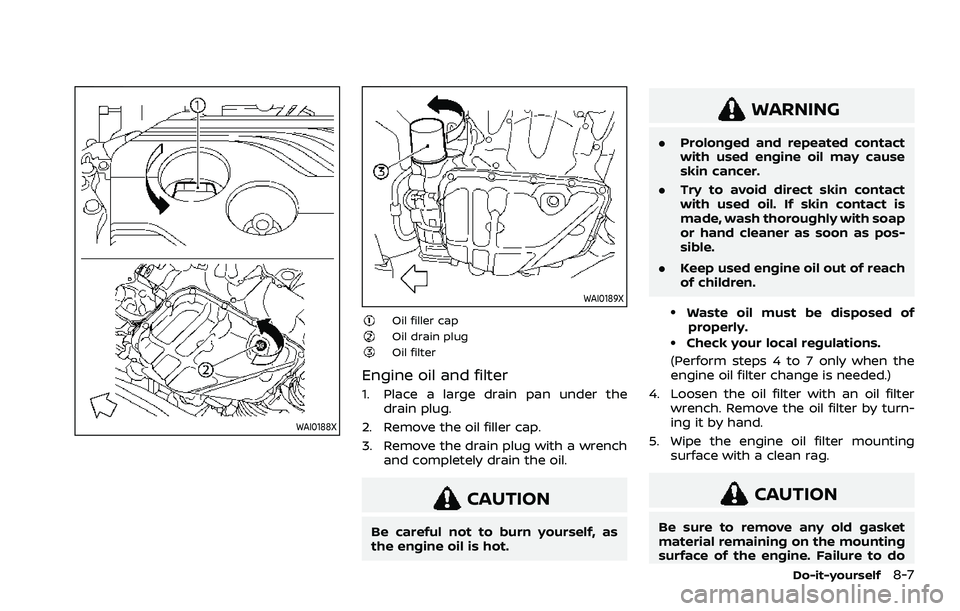
Oil filler capOil drain plugOil filter
Engine oil and filter
1. Place a large drain pan under thedrain plug.
2. Remove the oil filler cap.
3. Remove the drain plug with a wrench and completely drain the oil.
CAUTION
Be careful not to burn yourself, as
the engine oil is hot.
WARNING
.Prolonged and repeated contact
with used engine oil may cause
skin cancer.
. Try to avoid direct skin contact
with used oil. If skin contact is
made, wash thoroughly with soap
or hand cleaner as soon as pos-
sible.
. Keep used engine oil out of reach
of children.
.Waste oil must be disposed of
properly.
.Check your local regulations.
(Perform steps 4 to 7 only when the
engine oil filter change is needed.)
4. Loosen the oil filter with an oil filter wrench. Remove the oil filter by turn-
ing it by hand.
5. Wipe the engine oil filter mounting surface with a clean rag.
CAUTION
Be sure to remove any old gasket
material remaining on the mounting
surface of the engine. Failure to do
Do-it-yourself8-7
Page 462 of 556
8-8Do-it-yourself
so could lead to engine damage.
6. Coat the gasket on the new filter with clean engine oil.
7. Screw in the oil filter clockwise until a slight resistance is felt, then tighten
additionally more than 2/3 turn.
Oil filter tightening torque:11 to 15 ft-lb
(14.7 to 20.6 N·m)
8. Clean and re-install the drain plug with a new washer. Securely tighten
the drain plug with a wrench.
Drain plug tightening torque:
22 to 29 ft-lb
(29.4 to 39.2 N·m)
Do not use excessive force.
9. Refill the engine with the recom- mended oil through the oil filler open-
ing, and install the oil filler cap
securely.
See “Capacities and recommended
fluids/lubricants” (P.10-3) for drain
and refill capacity. The drain and refill
capacity depends on the oil tempera-
ture and drain time. Use these speci-
fications for reference only. Always
use the dipstick to determine the
proper amount of oil in the engine. 10. Start the engine and check for leak-
age around the drain plug and the oil
filter. Correct as required.
11. Turn the engine off and wait more than 10 minutes. Check the oil level
with the dipstick. Add engine oil if
necessary.
After the operation
1. Reinstall undercover in reverse orderof removal.
2. Lower the vehicle carefully to the ground.
3. Reset the Oil Control System (if so equipped) and oil and filter mainte-
nance reminder. (See “Maintenance”
(P.2-29).) When checking or replacement is re-
quired, we recommend a NISSAN dealer
for servicing.
CAUTION
.
NISSAN recommends using Gen-
uine NISSAN CVT Fluid NS-3 (or
equivalent) ONLY in NISSAN CVTs.
Do not mix with other fluids.
. Do not use Automatic transmis-
sion fluid (ATF) or Manual Trans-
mission fluid in a NISSAN CVT, as
it may damage the CVT. Damage
caused by the use of fluids other
than as recommended is not
covered by the NISSAN’s New
Vehicle Limited Warranty.
. Using fluids that are not equiva-
lent to Genuine NISSAN CVT Fluid
NS-3 may also damage the CVT.
Damage caused by the use of
fluids other than as recom-
mended is not covered under
the NISSAN’s New Vehicle Limited
Warranty.
CONTINUOUSLY VARIABLE
TRANSMISSION (CVT) FLUID
Page 466 of 556
8-12Do-it-yourself
.If the battery is labeled “do not open” it
is maintenance free and battery fluid
should not be checked. It is recom-
mended that you visit a NISSAN dealer
or a qualified specialist workshop to
confirm the battery’s performance.
. Keep the battery surface clean and
dry. Clean the battery with a solution
of baking soda and water.
. Make certain the terminal connec-
tions are clean and securely tightened.
. If the vehicle is not to be used for 30
days or longer, disconnect the nega-
tive 7battery terminal cable to pre-
vent discharging it.
NOTE:
Care should be taken to avoid situations
that can lead to potential battery dis-
charge and potential no-start condi-
tions such as:
1. Installation or extended use of elec-
tronic accessories that consume
battery power when the engine is
not running (Phone chargers, GPS,
DVD players, etc.).
2. Vehicle is not driven regularly and/
or only driven short distances.
In these cases, the battery may need to
be charged to maintain battery health.
WARNING
. Do not expose the battery to
flames or electrical sparks. Hy-
drogen gas generated by the
battery is explosive. Do not allow
battery fluid to contact your skin,
eyes, fabrics or painted surfaces.
After touching a battery or bat-
tery cap, do not touch or rub your
eyes. Thoroughly wash your
hands. If the acid contacts your
eyes, skin or clothing, immedi-
ately flush with water for at least
15 minutes and seek medical
attention.
. When working on or near a bat-
tery, always wear suitable eye
protection and remove all jew-
elry.
. Battery posts, terminals and re-
lated accessories contain lead
and lead compounds. Wash
hands after handling.
. Keep the battery out of the reach
of children.
. Do not tip the battery.
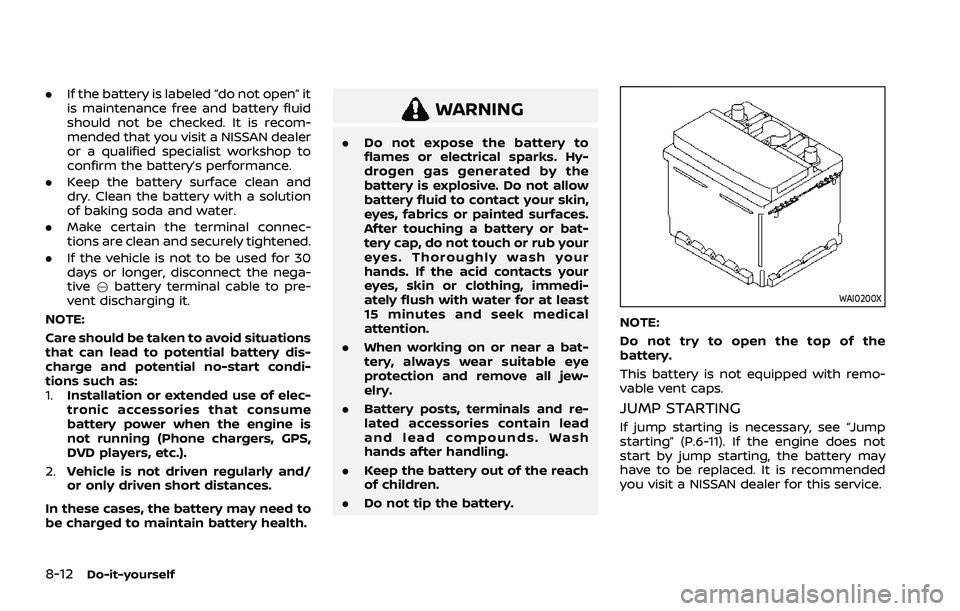
WAI0200X
NOTE:
Do not try to open the top of the
battery.
This battery is not equipped with remo-
vable vent caps.
JUMP STARTING
If jump starting is necessary, see “Jump
starting” (P.6-11). If the engine does not
start by jump starting, the battery may
have to be replaced. It is recommended
you visit a NISSAN dealer for this service.
Page 496 of 556
9-4Maintenance and schedules
Seats:Check seat position controls such
as seat adjusters, seatback recliners, etc.
to ensure they operate smoothly and that
all latches lock securely in every position.
Check that the head restraints/headrests
move up and down smoothly and that
the locks (if so equipped) hold securely in
all latched positions.
Steering wheel: Check for changes in the
steering conditions, such as excessive
free play, hard steering or strange noises.
Warning lights and chimes: Make sure
that all warning lights and chimes are
operating properly.
Windshield defroster: Check that the air
comes out of the defroster outlets prop-
erly and in sufficient quantity when oper-
ating the heater or air conditioner.
Windshield wiper and washer*: Check
that the wipers and washers operate
properly and that the wipers do not
streak.
Under the hood and vehicle
The maintenance items listed here should
be checked periodically (for example,
each time you check the engine oil or
refuel).
Battery*: This vehicle is equipped with a
sealed maintenance free battery. It is
recommended that you visit a NISSAN dealer for service.
NOTE:
Care should be taken to avoid situations
that can lead to potential battery dis-
charge and potential no-start condi-
tions such as:
1.
Installation or extended use of elec-
tronic accessories that consume
battery power when the engine is
not running (Phone chargers, GPS,
DVD players, etc.)
2. Vehicle is not driven regularly and/
or only driven short distances.
In these cases, the battery may need to
be charged to maintain battery health.
Brake fluid level*: Make sure that the
brake fluid level is between the MAX and
MIN lines on the reservoir.
Engine coolant level*: Check the coolant
level when the engine is cold.
Engine drive belt*: Make sure that the
drive belt is not frayed, worn, cracked or
oily.
Engine oil level*: Check the level after
parking the vehicle on a level surface and
turning off the engine. Wait more than 10
minutes for the oil to drain back into the
oil pan.
Exhaust system: Make sure there are no
loose supports, cracks or holes. If the sound of the exhaust seems unusual or
there is a smell of exhaust fumes, im-
mediately have the exhaust system in-
spected. It is recommended you visit a
NISSAN dealer for this service. (See “Pre-
cautions when starting and driving” (P.5-
5) for exhaust gas (carbon monoxide).)
Fluid leaks:
Check under the vehicle for
fuel, oil, water or other fluid leaks after the
vehicle has been parked for a while. Water
dripping from the air conditioner after use
is normal. If you should notice any leaks
or if gasoline fumes are evident, check for
the cause and have it corrected immedi-
ately.
Radiator and hoses: Check the front of
the radiator and clean off any dirt, insects,
leaves, etc., that may have accumulated.
Make sure the hoses have no cracks,
deformation, rot or loose connections.
Underbody: The underbody is frequently
exposed to corrosive substances such as
those used on icy roads or to control
dust. It is very important to remove these
substances, otherwise rust will form on
the floor pan, frame, fuel lines and around
the exhaust system. At the end of winter,
the underbody should be thoroughly
flushed with plain water, being careful to
clean those areas where mud and dirt
may accumulate. For additional informa-
tion, see “Cleaning exterior” (P.7-2).
Page 516 of 556

10-4Technical and consumer information
FUEL INFORMATION
Use unleaded regular gasoline with an
octane rating of at least 87 AKI (Anti-
Knock Index) number (Research octane
number 91).
CAUTION
.Using a fuel other than that spe-
cified could adversely affect the
emission control system, and
may also affect warranty cover-
age.
. Under no circumstances should a
leaded gasoline be used, because
this will damage the three-way
catalyst.
. Do not use a fuel containing more
than 15% ethanol in your vehicle.
Your vehicle is not designed to
run on a fuel containing more
than 15% ethanol. Using a fuel
containing more than 15% etha-
nol in a vehicle not specifically
designed for a fuel containing
more than 15% ethanol can ad-
versely affect the emission con-
trol devices and systems of the
vehicle. Damage caused by such
fuel is not covered by the NISSAN
new vehicle limited warranty. .
Do not use fuel that contains the
octane booster methylcyclopen-
tadienyl manganese tricarbonyl
(MMT). Using fuel containing
MMT may adversely affect vehicle
performance and vehicle emis-
sions. Not all fuel dispensers are
labeled to indicate MMT content,
so you may have to consult your
gasoline retailer for more details.
Note that Federal and California
laws prohibit the use of MMT in
reformulated gasoline.
. U.S. government regulations re-
quire ethanol dispensing pumps
to be identified by a small,
square, orange and black label
with the common abbreviation or
the appropriate percentage for
that region.
Gasoline specifications
NISSAN recommends using gasoline that
meets the World-Wide Fuel Charter
(WWFC) specifications where it is avail-
able. Many of the automobile manufac-
turers developed this specification to
improve emission control system and
vehicle performance. Ask your service
station manager if the gasoline meets
the WWFC specifications.
Reformulated gasoline
Some fuel suppliers are now producing
reformulated gasolines. These gasolines
are specially designed to reduce vehicle
emissions. NISSAN supports efforts to-
wards cleaner air and suggests that you
use reformulated gasoline when avail-
able.
Gasoline containing oxygenates
Some fuel suppliers sell gasoline contain-
ing oxygenates such as ethanol, MTBE
and methanol with or without advertising
their presence. NISSAN does not recom-
mend the use of fuels of which the
oxygenate content and the fuel compat-
ibility for your vehicle cannot be readily
determined. If in doubt, ask your service
station manager.
If you use oxygenate-blend gasoline,
please take the following precautions as
the usage of such fuels may cause vehicle
performance problems and/or fuel sys-
tem damage.
.The fuel should be unleaded and
have an octane rating no lower than
that recommended for unleaded
gasoline.
. If an oxygenate-blend, other than
methanol blend is used, it should
contain no more than 15% oxyge-
nate.
Page 517 of 556
.If a methanol blend is used, it should
contain no more than 5% methanol
(methyl alcohol, wood alcohol). It
should also contain a suitable
amount of appropriate cosolvents
and corrosion inhibitors. If not prop-
erly formulated with appropriate
cosolvents and corrosion inhibitors,
such methanol blends may cause
fuel system damage and/or vehicle
performance problems. At this time,
sufficient data is not available to
ensure that all methanol blends are
suitable for use in NISSAN vehicles.
If any driveability problems such as en-
gine stalling and difficult hot-starting are
experienced after using oxygenate-blend
fuels, immediately change to a non-oxy-
genate fuel or a fuel with a low blend of
MTBE.
Take care not to spill gasoline during
refueling. Gasoline containing oxyge-
nates can cause paint damage.
E-15 fuel
E-15 fuel is a mixture of approximately
15% fuel ethanol and 85% unleaded gaso-
line. E-15 can only be used in vehicles
designed to run on E- 15 fuel. U.S. govern-
ment regulations require fuel ethanol
dispensing pumps to be identified with
small, square, orange and black label with
the common abbreviation or the appro- priate percentage for that region.
E-85 fuel
E-85 fuel is a mixture of approximately
85% fuel ethanol and 15% unleaded gaso-
line. E-85 can only be used in a Flexible
Fuel Vehicle (FFV). Do not use E-85 fuel in
your vehicle. U.S. government regulations
require fuel ethanol dispensing pumps to
be identified by a small, square, orange
and black label with the common abbre-
viation or the appropriate percentage for
that region.
Fuel containing MMT
MMT, or methylcyclopentadienyl manga-
nese tricarbonyl, is an octane boosting
additive. NISSAN does not recommend
the use of fuel containing MMT. Such fuel
may adversely affect vehicle perfor-
mance, including the emissions control
system. Note that while some fuel pumps
label MMT content, not all do, so you may
have to consult your gasoline retailer for
more details.
Aftermarket fuel additives
NISSAN does not recommend the use of
any aftermarket fuel additives (for exam-
ple, fuel injector cleaner, octane booster,
intake valve deposit removers, etc.) which
are sold commercially. Many of these
additives intended for gum, varnish or
deposit removal may contain active sol-
vent or similar ingredients that can be
harmful to the fuel system and engine.
Octane rating tips
Using unleaded gasoline with an octane
rating lower than recommended can
cause persistent, heavy “spark knock”.
(Spark knock is a metallic rapping
noise.) If severe, this can lead to engine
damage. If you detect a persistent
heavy spark knock even when using
gasoline of the stated octane rating, or
if you hear steady spark knock while
holding a steady speed on level roads, it
is recommended you have a NISSAN
dealer correct the condition. Failure to
correct the condition is misuse of the
vehicle, for which NISSAN is not respon-
sible.
Incorrect ignition timing will result in
spark knock, after-run and/or overheat-
ing, which may cause excessive fuel
consumption or engine damage. If any
of the above symptoms are encountered,
have your vehicle checked. It is recom-
mended you visit a NISSAN dealer for
servicing.
However, now and then you may notice
light spark knock for a short time while
accelerating or driving up hills. This is
not a cause for concern, because you
Technical and consumer information10-5
Page 520 of 556

10-8Technical and consumer information
ENGINE
ModelPR25DD
Type Gasoline, 4-cycle, DOHC
Cylinder arrangement 4-cylinder, in-line
Bore × Stroke in (mm)3.504 × 3.937 (89.0 × 100.0)
Displacement cu in (cm
3)151.85 (2,488)
Firing order 1-3-4-2
Idle speed rpm
No adjustment is necessary.
Ignition timing (B.T.D.C.) degree/rpm
Spark plug StandardDXE22H11C
Spark plug gap (Normal) in (mm)0.043 (1.1)
Camshaft operation Timing chain
This spark ignition system complies with the Canadian standard ICES-002.
WHEELS AND TIRES
Road wheel
TypeSize Offset in
(mm)
Conven-
tional 17 × 7.5J 1.57 (40)
18 × 7.5J 1.57 (40)
19 × 7.5J 1.57 (40)
Spare 17 × 4T 1.18 (30)
Tire
Type
SizePressure PSI
(kPa) [Cold]
Con-
ven-
tional 235/65 R17Front: 36
(250)
Rear: 33 (230)
235/60 R18 Front: 33
(230)
Rear: 30 (210)
235/55 R19
Spare T155/80 D17
(2WD)
T165/90 D17
(AWD)
60 (420)
SPECIFICATIONS
Page 521 of 556
DIMENSIONS AND WEIGHTS
Overall length in(mm)182.9 (4,645)*1
183.5 (4,660)*2
Overall width in (mm)72.4 (1,840)
Overall height in (mm)67.9 (1,725)
Front tread in (mm)62.4 (1,585)
Rear tread in (mm)62.6 (1,590)
Wheelbase in (mm)106.5 (2,705)
Gross Vehicle
Weight Rating
(GVWR) lb (kg)
See the F.M.V.S.S. or
C.M.V.S.S. certifica-
tion label on the
driver’s side center
pillar.
Gross Axle
Weight Rating
(GAWR)
Front lb (kg)
Rear lb (kg)
*1: Without license plate
*2: With license plate
When planning to travel in another
country, you should first find out if the
fuel available is suitable for your vehicle’s
engine.
Using fuel with an octane rating that is
too low may cause engine damage. All
gasoline vehicles must be operated with
unleaded gasoline. Therefore, avoid tak-
ing your vehicle to areas where appro-
priate fuel is not available.
When transferring the registration of
your vehicle to another country, state,
province or district, it may be necessary
to modify the vehicle to meet local laws
and regulations.
The laws and regulations for motor
vehicle emission control and safety stan-
dards vary according to the country,
state, province or district; therefore, vehi-
cle specifications may differ.
When any vehicle is to be taken into
another country, state, province or dis-
trict and registered, its modifications,
transportation, and registration are the
responsibility of the user. NISSAN is not
responsible for any inconvenience that
may result.
JVT0352X
VEHICLE IDENTIFICATION NUMBER
(VIN) PLATE
The vehicle identification number plate is
attached as shown. This number is the
identification for your vehicle and is used
in the vehicle registration.
Technical and consumer information10-9
WHEN TRAVELING OR REGISTERING
IN ANOTHER COUNTRYVEHICLE IDENTIFICATION
Page 548 of 556

11-2
ChimesSeat belt warning light
and chime.................................................... 1-15, 2-16
Chimes, Audible reminders.................................. 2-22
Circuit breaker, Fusible link ................................. 8-18
Cleaning exterior and interior ................... 7-2, 7-4
Clock ........................................................................\
.............. 2-46
Coat hook........................................................................\
.. 2-77
Cockpit ........................................................................\
............. 2-3
Cold weather driving ............................................. 5-172
Connection to Roadside Assistance ................ 6-2
Console box ..................................................................... 2-75
Continuously Variable Transmission
(CVT) fluid........................................................................\
....... 8-8
Continuously Variable Transmission (CVT)
position indicator ........................................................ 2-11
Conventional (fixed speed) cruise control
mode (with ProPILOT Assist)........................... 5-118
Coolant Capacities and
recommended fluids/lubricants............... 10-3
Changing engine coolant ................................. 8-5
Checking engine coolant level...................... 8-5
Corrosion protection .................................................... 7-7
Cover, Cargo cover..................................................... 2-77
Cruise control Conventional (fixed speed) cruise
control mode ....................................................... 5-118
Cruise control (with ProPILOT Assist)
(See Conventional (fixed speed) cruise
control mode)...................................................... 5-118
Cruise control (without
ProPILOT Assist)..................................................... 5-82
Intelligent Cruise Control (ICC) .................. 5-97
Cup holders...................................................................... 2-71 CVT, Driving with CVT (Continuously
Variable Transmission)............................................ 5-19
D
Daytime Running Lights (DRL) system....... 2-61
Defroster switch, Rear window and
outside mirror defroster switch....................... 2-55
Dimensions and weights....................................... 10-9
Display
Head Up Display (HUD) ..................................... 2-47
Vehicle information display.......................... 2-22
Drive belt ........................................................................\
.... 8-13
Drive Computer............................................................. 2-44
Drive Mode Selector .................................................. 5-30
Driver and front passenger supplemental
knee air bag..................................................................... 1-61
Driver Assistance systems.................................... 5-34 Common troubleshooting guide ............. 5-39
Driving Cold weather driving ..................................... 5-172
Drive Mode Selector ........................................... 5-30
Driving with CVT (Continuously
Variable Transmission)..................................... 5-19
Intelligent 4x4 ..................................................... 5-151
On-pavement and off-road driving ....... 5-10
Precautions when starting
and driving.................................................................... 5-5
Safety precautions .............................................. 5-12
E
Easy-Fill Tire Alert system......................................... 5-9
ECO mode ........................................................................\
. 5-32
ECO mode system
ECO Drive Report.................................................. 2-11
Economy, Fuel............................................................. 5-150 Elapsed time.................................................................... 2-44
Electric power steering........................................ 5-154
Electric power steering warning light ........ 2-17
Electric shift control system
warning light ................................................................... 2-15
Emergency Call (SOS) button ............................ 2-70
Emission control information label............ 10-11
Emission control system warranty ............ 10-28
Engine
Before starting the engine............................ 5-17
Break-in schedule ............................................ 5-149
Capacities and
recommended fluids/lubricants............... 10-3
Changing engine coolant ................................. 8-5
Changing engine oil and filter ...................... 8-6
Checking engine coolant level...................... 8-5
Checking engine oil level................................... 8-5
Coolant temperature gauge .......................... 2-9
Emergency engine shut off.............. 5-16, 6-3
Engine compartment
check locations ......................................................... 8-3
Engine cooling system ........................................ 8-4
Engine oil.....................................................................\
... 8-5
Engine oil and oil
filter recommendation ..................................... 10-6
Engine oil viscosity .............................................. 10-7
Engine serial number .................................... 10-10
Engine specifications......................................... 10-8
Engine start operation indicator.............. 2-34
If your vehicle overheats ................................ 6-13
Remote engine start.......................................... 3-19
Starting the engine............................................. 5-17
Event Data Recorders (EDR)............................. 10-30
Exhaust gas (carbon monoxide) ......................... 5-5
Explanation of scheduled
maintenance items ........................................................ 9-5