tire type NISSAN ROGUE 2021 Owner´s Manual
[x] Cancel search | Manufacturer: NISSAN, Model Year: 2021, Model line: ROGUE, Model: NISSAN ROGUE 2021Pages: 556, PDF Size: 2.7 MB
Page 486 of 556
8-32Do-it-yourself
.For additional information re-
garding tires, refer to “Important
Tire Safety Information” (US) or
“Tire Safety Information” (Cana-
da) in the Warranty Information
Booklet.
. Always use tires of the same type,
size, brand, construction and
tread pattern on all four wheels.
Failure to do so may result in a
circumference difference be-
tween tires on the front and rear
axles which can cause the Vehicle
Dynamic Control (VDC) system to
malfunction resulting in personal
injury or death, excessive tire
wear and may damage the trans-
mission, transfer case and differ-
ential gears.
All season tires
NISSAN specifies all season tires on some
models to provide good performance all
year, including snowy and icy road con-
ditions. All Season tires are identified by
ALL SEASON and/or M&S (Mud and Snow)
on the tire sidewall. Snow tires have
better snow traction than All Season tires
and may be more appropriate in some
areas.
Summer tires
NISSAN specifies summer tires on some
models to provide superior performance
on dry roads. Summer tire performance is
substantially reduced in snow and ice.
Summer tires do not have the tire trac-
tion rating M&S on the tire sidewall.
If you plan to operate your vehicle in
snowy or icy conditions, NISSAN recom-
mends the use of SNOW tires or ALL
SEASON tires on all four wheels.
Snow tires
If snow tires are needed, it is necessary to
select tires equivalent in size and load
rating to the original equipment tires. If
you do not, it can adversely affect the
safety and handling of your vehicle.
Generally, snow tires will have lower
speed ratings than factory equipped tires
and may not match the potential max-
imum vehicle speed. Never exceed the
maximum speed rating of the tire.
If you install snow tires, they must be the
same size, brand, construction and tread
pattern on all four wheels.
For additional traction on icy roads,
studded tires may be used. However,
some U.S. states and Canadian provinces
prohibit their use. Check local, state and
provincial laws before installing studded tires. Skid and traction capabilities of
studded snow tires, on wet or dry sur-
faces, may be poorer than that of non-
studded snow tires.
TIRE CHAINS
WARNING
If tire chains are used with this
vehicle, they must allow sufficient
clearance between the tire and the
closest vehicle suspension or body
component. Failure to use the cor-
rect chains, or not properly installing
chains, can damage the brakes, sus-
pension or other vehicle parts and
cause a crash in which a person
could be seriously injured or killed.
NISSAN recommends using the fol-
lowing chains, or equivalent.
.
PEERLESS SUPER Z6 SZ-429
Use of tire chains may be prohibited
according to location. Check the local
laws before installing tire chains. When
installing tire chains, make sure they are
the proper size for the tires on your
vehicle and are installed according to
the chain manufacturer’s suggestions.
Use only SAE Class S chains. Class “S”
chains are used on vehicles with re-
Page 487 of 556
stricted tire to vehicle clearance. Vehicles
that can use Class “S” chains are designed
to meet the SAE standard minimum
clearances between the tire and the
closest vehicle suspension or body com-
ponent required to accommodate the
use of a winter traction device (tire chains
or cables). The minimum clearances are
determined using the factory equipped
tire size. Other types may damage your
vehicle. Use chain tensioners when re-
commended by the tire chain manufac-
turer to ensure a tight fit. Loose end links
of the tire chain must be secured or
removed to prevent the possibility of
whipping action damage to the fenders
or underbody. If possible, avoid fully load-
ing your vehicle when using tire chains. In
addition, drive at a reduced speed. Other-
wise, your vehicle may be damaged and/
or vehicle handling and performance may
be adversely affected.
Tire chains must be installed only on
the front wheels and not on the rear
wheels.
Never install tire chains on a TEMPORARY
USE ONLY spare tire.
Do not use tire chains on dry roads.
Driving with tire chains in such conditions
can cause damage to the various me-
chanisms of the vehicle due to some
overstress.
JVM0287X
CHANGING WHEELS AND TIRES
Tire rotation
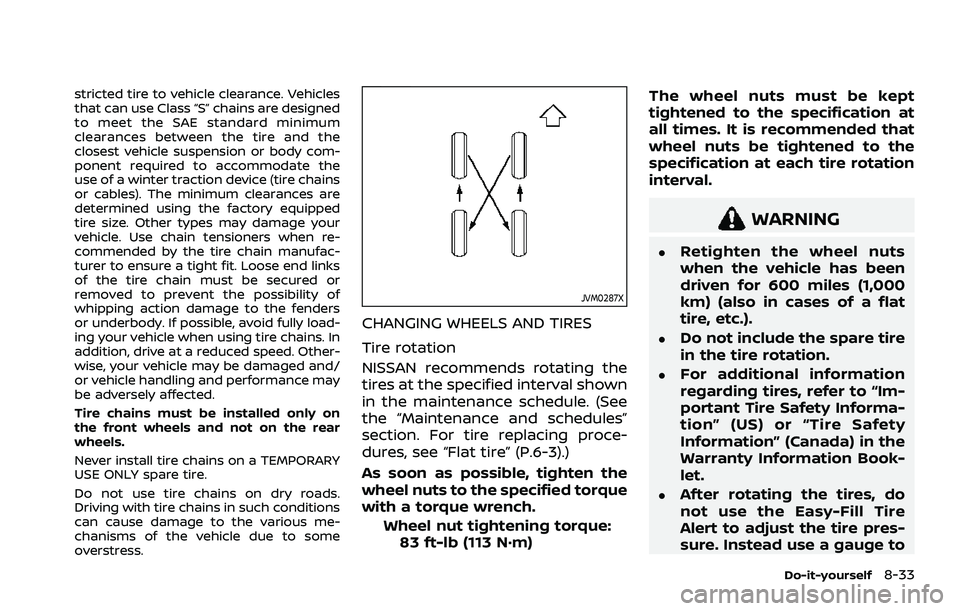
NISSAN recommends rotating the
tires at the specified interval shown
in the maintenance schedule. (See
the “Maintenance and schedules”
section. For tire replacing proce-
dures, see “Flat tire” (P.6-3).)
As soon as possible, tighten the
wheel nuts to the specified torque
with a torque wrench.Wheel nut tightening torque:83 ft-lb (113 N·m) The wheel nuts must be kept
tightened to the specification at
all times. It is recommended that
wheel nuts be tightened to the
specification at each tire rotation
interval.
WARNING
.Retighten the wheel nuts
when the vehicle has been
driven for 600 miles (1,000
km) (also in cases of a flat
tire, etc.).
.Do not include the spare tire
in the tire rotation.
.For additional information
regarding tires, refer to “Im-
portant Tire Safety Informa-
tion” (US) or “Tire Safety
Information” (Canada) in the
Warranty Information Book-
let.
.After rotating the tires, do
not use the Easy-Fill Tire
Alert to adjust the tire pres-
sure. Instead use a gauge to
Do-it-yourself8-33
Page 489 of 556
Warranty Information Book-
let.
Replacing wheels and tires
When replacing a tire, use the same size,
tread design, speed rating and load
carrying capacity as originally equipped.
(See “Specifications” (P.10-8) for recom-
mended types and sizes of tires and
wheels.)
WARNING
. The use of tires other than those
recommended or the mixed use
of tires of different brands, con-
struction (bias, bias-belted or ra-
dial), or tread patterns can
adversely affect the ride, braking,
handling, VDC system, ground
clearance, body-to-tire clearance,
tire chain clearance, speed-
ometer calibration, headlight
aim and bumper height. Some of
these effects may lead to acci-
dents and could result in serious
personal injury.
. For Two-Wheel Drive (2WD) mod-
els, if your vehicle was originally
equipped with 4 tires that were the same size and you are only
replacing 2 of the 4 tires, install
the new tires on the rear axle.
Placing new tires on the front
axle may cause loss of vehicle
control in some driving condi-
tions and cause an accident and
personal injury.
. If the wheels are changed for any
reason, always replace with
wheels which have the same off-
set dimension. Wheels of a differ-
ent off-set could cause prema-
ture tire wear, degrade vehicle
handling characteristics and/or
interference with the brake
discs/drums. Such interference
can lead to decreased braking
efficiency and/or early brake
pad/shoe wear. See “Wheels and
tires” (P.10-8) of this manual for
wheel off-set dimensions.
. Since the spare tire is not
equipped with the TPMS, when a
spare tire is mounted or a wheel
is replaced, the TPMS will not
function and the low tire pressure
warning light will flash for ap-
proximately 1 minute. The light
will remain on after 1 minute.
Have your tires replaced and/or
TPMS system reset as soon as possible. It is recommended you
visit a NISSAN dealer for these
services.
. Replacing tires with those not
originally specified by NISSAN
could affect the proper operation
of the TPMS.
. The TPMS sensor may be da-
maged if it is not handled cor-
rectly. Be careful when handling
the TPMS sensor.
. When replacing the TPMS sensor,
the ID registration may be re-
quired. It is recommended you
visit a NISSAN dealer for ID regis-
tration.
. Do not use a valve stem cap that
is not specified by NISSAN. The
valve stem cap may become
stuck.
. Be sure that the valve stem caps
are correctly fitted. Otherwise the
valve may be clogged up with dirt
and cause a malfunction or loss
of pressure.
. Do not install a damaged or
deformed wheel or tire even if it
has been repaired. Such wheels
or tires could have structural
damage and could fail without
warning.
Do-it-yourself8-35
Page 495 of 556
other corrosive materials, check lubrica-
tion frequently.
Lights*:Clean the headlights on a regular
basis. Make sure that the headlights, stop
lights, tail lights, turn signal lights, and
other lights are all operating properly and
installed securely. Also check headlight
aim.
Road wheel nuts (lug nuts)*: When
checking the tires, make sure no wheel
nuts are missing, and check for any loose
wheel nuts. Tighten if necessary.
Tire rotation*: Rotate tires at the speci-
fied interval shown in the maintenance
schedule.
Tires*: Check the pressure with a gauge
often and always prior to long distance
trips. If necessary, adjust the pressure in
all tires, including the spare (if so
equipped), to the pressure specified.
Check carefully for damage, cuts or
excessive wear.
Tire Pressure Monitoring System (TPMS)
transmitter components: Replace the
TPMS transmitter snap-in type, valve core
and cap when the tires are replaced due
to wear or age.
Wheel alignment and balance: If the
vehicle should pull to either side while
driving on a straight and level road, or if
you detect uneven or abnormal tire wear, there may be a need for wheel alignment.
If the steering wheel or seat vibrates at
normal highway speeds, wheel balancing
may be needed.
For additional information regarding tires,
refer to “Important Tire Safety Informa-
tion” (US) or “Tire Safety Information”
(Canada) in the NISSAN Warranty Infor-
mation Booklet.
Windshield:
Clean the windshield on a
regular basis. Check the windshield at
least every six months for cracks or other
damage. Have a damaged windshield
repaired by a qualified repair facility.
It is recommended that you have a
damaged windshield repaired by a
NISSAN dealer, or a NISSAN Certified
Collision Center. To locate a collision
center in your area, refer to http://colli-
sion.nissanusa.com.
Windshield wiper blades*: Check for
cracks or wear if they do not wipe
properly.
Inside the vehicle
The maintenance items listed here should
be checked on a regular basis, such as
when performing scheduled mainte-
nance, cleaning the vehicle, etc.
Accelerator pedal: Check the pedal for
smooth operation and make sure the pedal does not catch or require uneven
effort. Keep the floor mat away from the
pedal.
Brake pedal:
Check the pedal for smooth
operation. If the brake pedal suddenly
goes down further than normal, the pedal
feels spongy or the vehicle seems to take
longer to stop, have your vehicle checked
immediately. It is recommended you visit
a NISSAN dealer for this service. Keep the
floor mat away from the pedal.
Brakes: Check that the brakes do not pull
the vehicle to one side when applied.
Continuously Variable Transmission
(CVT) P (Park) mechanism: On a fairly
steep hill, check that the vehicle is held
securely with the shift lever in the P (Park)
position without applying any brakes.
Parking brake: Check the parking brake
operation regularly. The vehicle should be
securely held on a fairly steep hill with
only the parking brake applied. If the
parking brake needs adjusted, it is re-
commended you visit a NISSAN dealer for
this service.
Seat belts: Check that all parts of the seat
belt system (for example, buckles, an-
chors, adjusters and retractors) operate
properly and smoothly, and are installed
securely. Check the belt webbing for cuts,
fraying, wear or damage.
Maintenance and schedules9-3
Page 498 of 556
9-6Maintenance and schedules
Engine oil and oil filter:
Replace engine oil and oil filter at the
specified intervals. For recommended oil
grade and viscosity refer to “Capacities
and recommended fluids/lubricants”
(P.10-3).
Engine valve clearance*:
Inspect only if valve noise increases.
Adjust valve clearance if necessary.
Evaporative emissions control vapor
lines*:
Check vapor lines for leaks or looseness.
Tighten connections or replace parts as
necessary.
Fuel filter
Periodic maintenance is not required (in-
tank type filter).
Fuel lines*:
Check the fuel hoses, piping and connec-
tions for leaks, looseness, or deterioration.
Tighten connections or replace parts as
necessary.
Spark plugs:
Replace at specified intervals. Install new
plugs of the type as originally equipped.CHASSIS AND BODY MAINTENANCE
Brake lines and cables:
Visually inspect for proper installation.
Check for chafing, cracks, deterioration,
and signs of leaking. Replace any deterio-
rated or damaged parts immediately.
Brake pads and rotors:
Check for wear, deterioration and fluid
leaks. Replace any deteriorated or da-
maged parts immediately.
Exhaust system:
Visually inspect the exhaust pipes, muffler
and hangers for leaks, cracks, deteriora-
tion, and damage. Tighten connections or
replace parts as necessary.
In-cabin microfilter:
Replace at specified intervals. When driv-
ing for prolonged periods in dusty condi-
tions, replace the filter more frequently.
Propeller shaft(s):
Check for damage, looseness, and grease
leakage. (AWD)
Steering gear and linkage, axle and
suspension parts, drive shaft boots:
Check for damage, looseness, and leak-
age of oil or grease. Under severe driving
conditions, inspect more frequently.
Tire rotation:
Rotate tires at the specified interval.Transmission fluid/oil, differential oil
and transfer case oil:
Visually inspect for signs of leakage at
specified intervals.
If using a car-top carrier, or towing a
trailer, or using a camper, or driving on
rough or muddy roads:
.
Replace the differential oil and trans-
fer case oil every 20,000 miles (32,000
km) or 24 months.
. Replace the CVT fluid every 60,000
miles (96,000 km) or request the deal-
er to inspect the fluid deterioration
data using a CONSULT. If the dete-
rioration data is more than 210,000,
replace the CVT fluid.
Page 520 of 556

10-8Technical and consumer information
ENGINE
ModelPR25DD
Type Gasoline, 4-cycle, DOHC
Cylinder arrangement 4-cylinder, in-line
Bore × Stroke in (mm)3.504 × 3.937 (89.0 × 100.0)
Displacement cu in (cm
3)151.85 (2,488)
Firing order 1-3-4-2
Idle speed rpm
No adjustment is necessary.
Ignition timing (B.T.D.C.) degree/rpm
Spark plug StandardDXE22H11C
Spark plug gap (Normal) in (mm)0.043 (1.1)
Camshaft operation Timing chain
This spark ignition system complies with the Canadian standard ICES-002.
WHEELS AND TIRES
Road wheel
TypeSize Offset in
(mm)
Conven-
tional 17 × 7.5J 1.57 (40)
18 × 7.5J 1.57 (40)
19 × 7.5J 1.57 (40)
Spare 17 × 4T 1.18 (30)
Tire
Type
SizePressure PSI
(kPa) [Cold]
Con-
ven-
tional 235/65 R17Front: 36
(250)
Rear: 33 (230)
235/60 R18 Front: 33
(230)
Rear: 30 (210)
235/55 R19
Spare T155/80 D17
(2WD)
T165/90 D17
(AWD)
60 (420)
SPECIFICATIONS
Page 527 of 556
weight may not safely exceed
the available cargo and luggage
load capacity calculated in Step
4.
Before driving a loaded vehicle,
confirm that you do not exceed
the Gross Vehicle Weight Rating
(GVWR) or the Gross Axle Weight
Rating (GAWR) for your vehicle. (See
“Measurement of weights” (P.10-16).)
Also check tires for proper inflation
pressures. See the Tire and Loading
Information label.
WAC0534X
SECURING THE LOAD
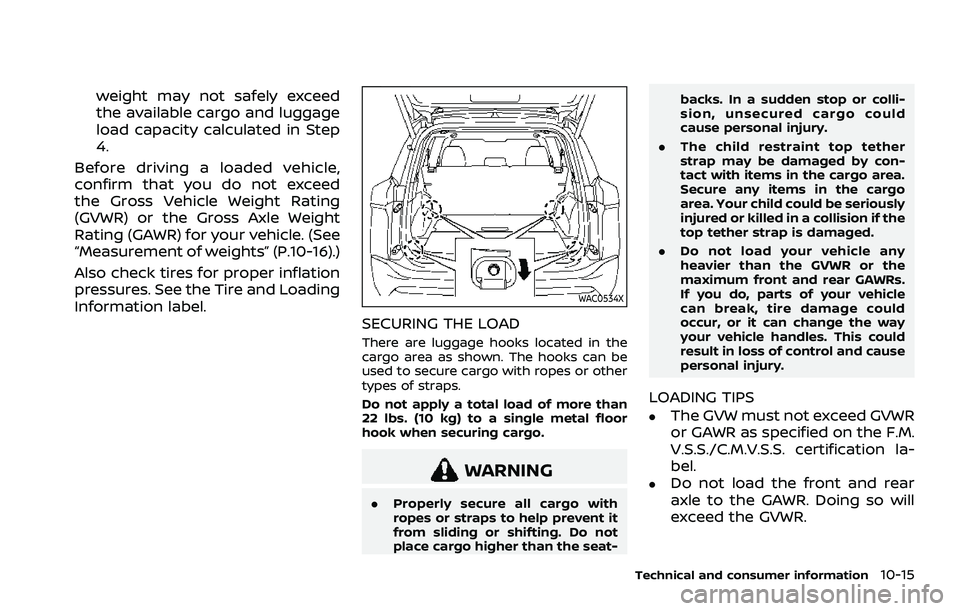
There are luggage hooks located in the
cargo area as shown. The hooks can be
used to secure cargo with ropes or other
types of straps.
Do not apply a total load of more than
22 lbs. (10 kg) to a single metal floor
hook when securing cargo.
WARNING
. Properly secure all cargo with
ropes or straps to help prevent it
from sliding or shifting. Do not
place cargo higher than the seat- backs. In a sudden stop or colli-
sion, unsecured cargo could
cause personal injury.
. The child restraint top tether
strap may be damaged by con-
tact with items in the cargo area.
Secure any items in the cargo
area. Your child could be seriously
injured or killed in a collision if the
top tether strap is damaged.
. Do not load your vehicle any
heavier than the GVWR or the
maximum front and rear GAWRs.
If you do, parts of your vehicle
can break, tire damage could
occur, or it can change the way
your vehicle handles. This could
result in loss of control and cause
personal injury.
LOADING TIPS
.The GVW must not exceed GVWR
or GAWR as specified on the F.M.
V.S.S./C.M.V.S.S. certification la-
bel.
.Do not load the front and rear
axle to the GAWR. Doing so will
exceed the GVWR.
Technical and consumer information10-15
Page 535 of 556

Sway control device
Sudden maneuvers, wind gusts and buf-
feting caused by other vehicles can affect
trailer handling. Sway control devices
may be used to help control these affects.
If you choose to use one, contact a
reputable trailer hitch supplier to make
sure the sway control device will work
with the vehicle, hitch, trailer and the
trailer’s brake system. Follow the instruc-
tions provided by the manufacturer for
installing and using the sway control
device.
Class I hitch
Class I trailer hitch equipment (receiver,
ball mount and hitch ball) can be used to
tow trailers of a maximum weight of
2,000 lb (907 kg).
Tire pressures
.When towing a trailer, inflate the
vehicle tires to the recom-
mended cold tire pressure indi-
cated on the Tire and Loading
Information label.
. Trailer tire condition, size, load
rating and proper inflation pres-
sure should be in accordance
with the trailer and tire manu-
facturers’ specifications. Safety chains
Always use a suitable chain between your
vehicle and the trailer. The safety chains
should be crossed and should be at-
tached to the hitch, not to the vehicle
bumper or axle. Be sure to leave enough
slack in the chains to permit turning
corners.
Trailer lights (if so equipped)
CAUTION
When splicing into the vehicle elec-
trical system, a commercially avail-
able power-type module/converter
must be used to provide power for
all trailer lighting. This unit uses the
vehicle battery as a direct power
source for all trailer lights while
using the vehicle tail light, stoplight
and turn signal circuits as a signal
source. The module/converter must
draw no more than 15 milliamps
from the stop and tail lamp circuits.
Using a module/converter that ex-
ceeds these power requirements
may damage the vehicle’s electrical
system. See a reputable trailer retai-
ler to obtain the proper equipment
and to have it installed. Trailer lights should comply with federal
and/or local regulations. For assistance in
hooking up trailer lights, contact a NISSAN
dealer or reputable trailer retailer.
Pre-towing tips
.
Be certain your vehicle maintains a
level position when a loaded or un-
loaded trailer is hitched. Do not drive
the vehicle if it has an abnormal nose-
up or nose-down condition; check for
improper tongue load, overload, worn
suspension or other possible causes
of either condition.
. Always secure items in the trailer to
prevent load shift while driving.
. Keep the cargo load as low as possible
in the trailer to keep the trailer center
of gravity low.
. Load the trailer so approximately 60%
of the trailer load is in the front half
and 40% is in the back half. Also make
sure the load is balanced side to side.
. Check your hitch, trailer tire pressure,
vehicle tire pressure, trailer light op-
eration, and trailer wheel lug nuts
every time you attach a trailer to the
vehicle.
. Be certain your rearview mirrors con-
form to all federal, state or local
regulations. If not, install any mirrors
required for towing before driving the
Technical and consumer information10-23
Page 552 of 556
11-6
ShiftingCVT (Continuously
Variable Transmission)..................................... 5-19
Shoulder belt height adjustment, For
front seats........................................................................\
. 1-18
Side Driving Aids........................................................... 5-34
SNOW mode..................................................................... 5-32
Soft bottle holders...................................................... 2-72
Sonar Rear Automatic Braking (RAB) ............... 5-143
Rear Sonar System (RSS)............................ 5-168
Sonar system....................................................... 5-162
SOS button (See Emergency Call
(SOS) button)................................................................... 2-70
Spare tire............................................................. 8-36, 10-8
Spark plugs....................................................................... 8-14
Speed Adjust by Route (ProPILOT Assist
with Navi-link).............................................................. 5-105
Speed and Average speed ................................... 2-44
Speed Limit Assist (ProPILOT Assist
with Navi-link).............................................................. 5-102
Speedometer ...................................................................... 2-8
SPORT mode ................................................................... 5-33
SRS Precautions on SRS ............................................ 1-46
Standard maintenance ............................................... 9-8
STANDARD mode......................................................... 5-32
Starting Before starting the engine............................ 5-17
Jump starting .......................................................... 6-11
Precautions when starting
and driving.................................................................... 5-5
Push starting............................................................ 6-13
Starting the engine............................................. 5-17
Status light, Front passenger air bag ......... 1-54
Steering Electric power steering................................ 5-154 Heated steering wheel ..................................... 2-63
Tilt/telescopic steering .................................... 3-31
Steering Assist ............................................................ 5-113
Steering Assist switch.............................................. 2-65
Storage ........................................................................\
........ 2-71
Sun visors ........................................................................\
.. 3-32
Sunglasses holder....................................................... 2-76
Sunshade (rear)............................................................. 3-32
Supplemental air bag warning labels ......... 1-66
Supplemental air bag
warning light .................................................... 1-66, 2-16
Supplemental Restraint System (SRS) ........ 1-46
switch Drive Mode Selector ........................................... 5-30
Emergency Call (SOS) button ..................... 2-70
Fog light switch ..................................................... 2-62
Hazard warning flasher switch .................... 6-2
Headlight switch ................................................... 2-55
Intelligent Auto Headlight switch ............ 2-56
Memory seat switch........................................... 3-36
Power door lock switch ..................................... 3-6
Rear window and outside mirror
defroster switch .................................................... 2-55
Steering Assist switch....................................... 2-65
Turn signal switch ............................................... 2-62
Wiper and washer switch .............................. 2-52
T
Tachometer........................................................................\
.. 2-9
Temperature gauge, Engine coolant
temperature gauge ....................................................... 2-9
Theft (NISSAN Vehicle Immobilizer
System), Engine start ............................................... 2-51
Three-way catalyst......................................................... 5-6
Tilt/telescopic steering ........................................... 3-31 Tire pressure, Low tire pressure
warning light ................................................................... 2-18
Tires
Easy-Fill Tire Alert system................................. 5-9
Flat tire........................................................................\
..... 6-3
Low tire pressure warning system ........... 5-6
Tire and Loading
information label................................ 8-27, 10-11
Tire chains.................................................................. 8-32
Tire dressing................................................................ 7-4
Tire pressure ............................................................ 8-25
Tire pressure monitoring
system (TPMS)................................................. 5-6, 6-3
Tire rotation.............................................................. 8-33
Types of tires ........................................................... 8-31
Uniform tire quality grading .................... 10-27
Wheel/tire size ........................................................ 10-8
Wheels and tires .................................................... 8-25
Towing Tow truck towing................................................. 6-15
Towing a trailer.................................................. 10-16
Towing safety...................................................... 10-21
TPMS, Tire pressure monitoring system....... 5-6 TPMS with Easy Fill Tire Alert......................... 5-9
TPMS, Tire pressure warning system .............. 6-3
Traffic Sign Recognition (TSR)........................... 5-43
Trailer towing .............................................................. 10-16
Transmission Continuously Variable Transmission
(CVT) fluid....................................................................... 8-8
Driving with CVT (Continuously
Variable Transmission)..................................... 5-19
Transmitter, With Intelligent Key system
(See Intelligent Key system) ................................ 3-15
Traveling or registering in
another country ........................................................... 10-9
Trip computer ................................................................ 2-44