main battery NISSAN ROGUE 2021 Owner´s Manual
[x] Cancel search | Manufacturer: NISSAN, Model Year: 2021, Model line: ROGUE, Model: NISSAN ROGUE 2021Pages: 556, PDF Size: 2.7 MB
Page 507 of 556
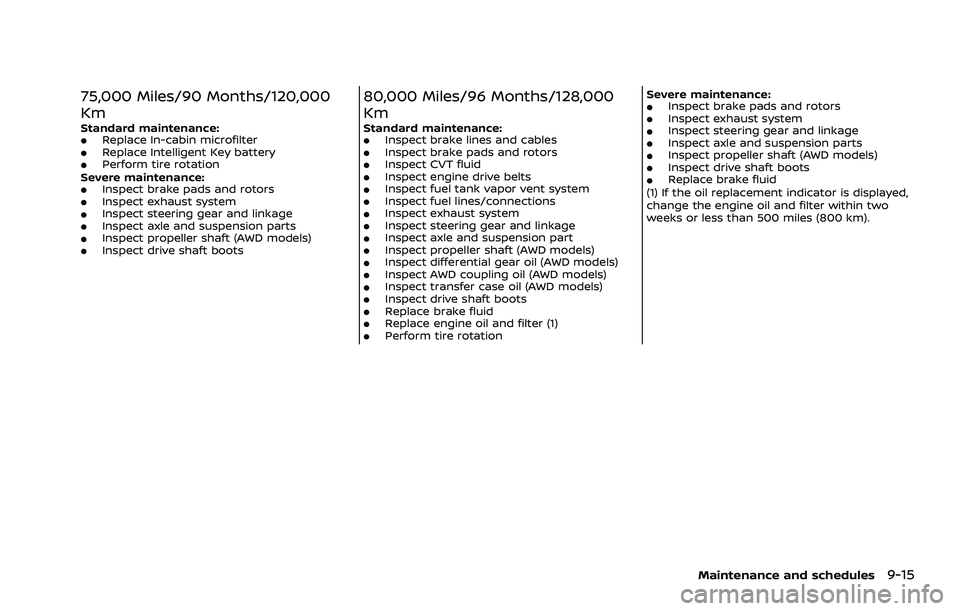
75,000 Miles/90 Months/120,000
Km
Standard maintenance:.Replace In-cabin microfilter.Replace Intelligent Key battery.Perform tire rotation
Severe maintenance:
.Inspect brake pads and rotors.Inspect exhaust system.Inspect steering gear and linkage.Inspect axle and suspension parts.Inspect propeller shaft (AWD models).Inspect drive shaft boots
80,000 Miles/96 Months/128,000
Km
Standard maintenance:.Inspect brake lines and cables.Inspect brake pads and rotors.Inspect CVT fluid.Inspect engine drive belts.Inspect fuel tank vapor vent system.Inspect fuel lines/connections.Inspect exhaust system.Inspect steering gear and linkage.Inspect axle and suspension part.Inspect propeller shaft (AWD models).Inspect differential gear oil (AWD models).Inspect AWD coupling oil (AWD models).Inspect transfer case oil (AWD models).Inspect drive shaft boots.Replace brake fluid.Replace engine oil and filter (1).Perform tire rotation Severe maintenance:
.Inspect brake pads and rotors.Inspect exhaust system.Inspect steering gear and linkage.Inspect axle and suspension parts.Inspect propeller shaft (AWD models).Inspect drive shaft boots.Replace brake fluid
(1) If the oil replacement indicator is displayed,
change the engine oil and filter within two
weeks or less than 500 miles (800 km).
Maintenance and schedules9-15
Page 508 of 556
9-16Maintenance and schedules
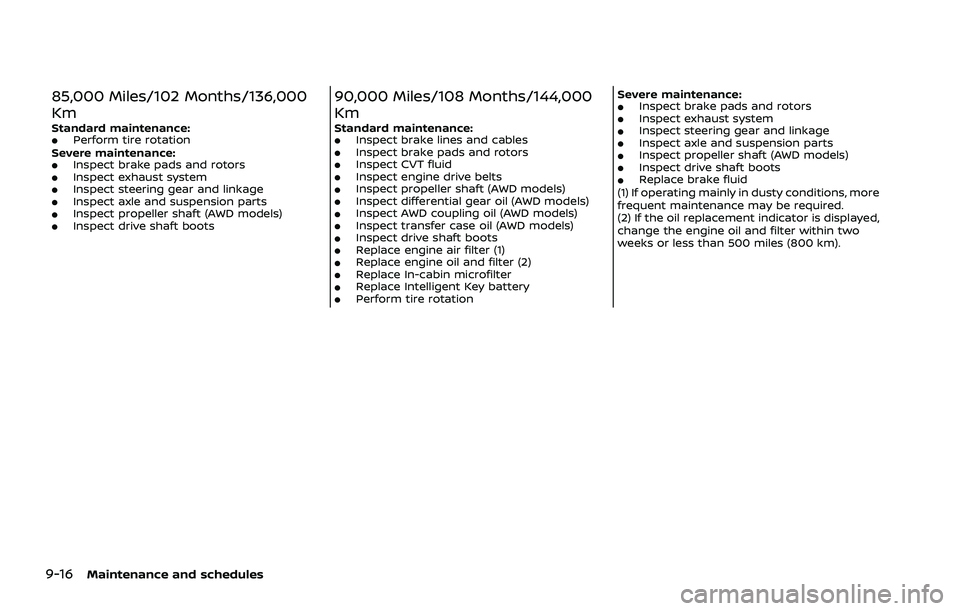
85,000 Miles/102 Months/136,000
Km
Standard maintenance:.Perform tire rotation
Severe maintenance:
.Inspect brake pads and rotors.Inspect exhaust system.Inspect steering gear and linkage.Inspect axle and suspension parts.Inspect propeller shaft (AWD models).Inspect drive shaft boots
90,000 Miles/108 Months/144,000
Km
Standard maintenance:.Inspect brake lines and cables.Inspect brake pads and rotors.Inspect CVT fluid.Inspect engine drive belts.Inspect propeller shaft (AWD models).Inspect differential gear oil (AWD models).Inspect AWD coupling oil (AWD models).Inspect transfer case oil (AWD models).Inspect drive shaft boots.Replace engine air filter (1).Replace engine oil and filter (2).Replace In-cabin microfilter.Replace Intelligent Key battery.Perform tire rotation Severe maintenance:
.Inspect brake pads and rotors.Inspect exhaust system.Inspect steering gear and linkage.Inspect axle and suspension parts.Inspect propeller shaft (AWD models).Inspect drive shaft boots.Replace brake fluid
(1) If operating mainly in dusty conditions, more
frequent maintenance may be required.
(2) If the oil replacement indicator is displayed,
change the engine oil and filter within two
weeks or less than 500 miles (800 km).
Page 510 of 556
9-18Maintenance and schedules
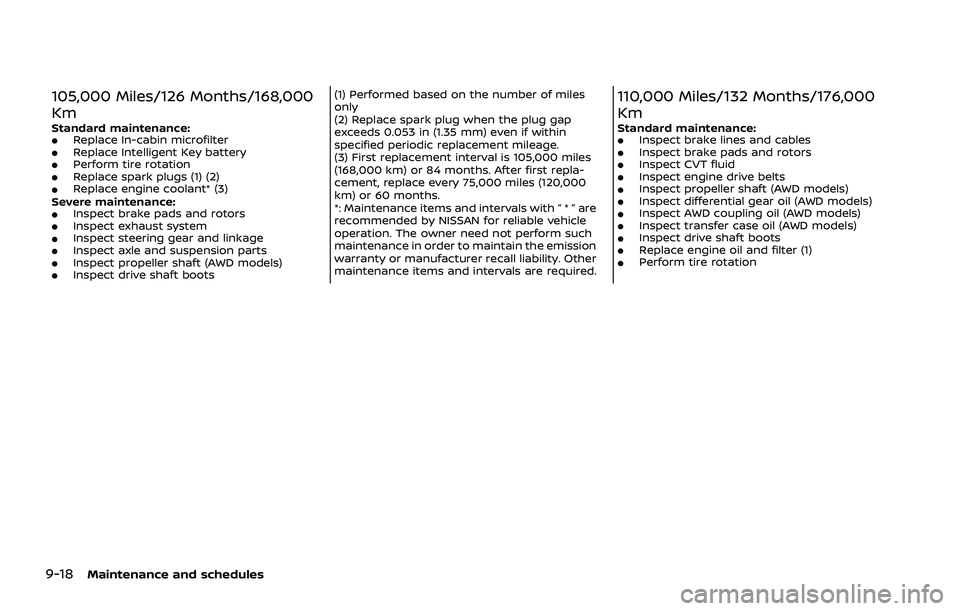
105,000 Miles/126 Months/168,000
Km
Standard maintenance:.Replace In-cabin microfilter.Replace Intelligent Key battery.Perform tire rotation.Replace spark plugs (1) (2).Replace engine coolant* (3)
Severe maintenance:
.Inspect brake pads and rotors.Inspect exhaust system.Inspect steering gear and linkage.Inspect axle and suspension parts.Inspect propeller shaft (AWD models).Inspect drive shaft boots (1) Performed based on the number of miles
only
(2) Replace spark plug when the plug gap
exceeds 0.053 in (1.35 mm) even if within
specified periodic replacement mileage.
(3) First replacement interval is 105,000 miles
(168,000 km) or 84 months. After first repla-
cement, replace every 75,000 miles (120,000
km) or 60 months.
*: Maintenance items and intervals with “ * ” are
recommended by NISSAN for reliable vehicle
operation. The owner need not perform such
maintenance in order to maintain the emission
warranty or manufacturer recall liability. Other
maintenance items and intervals are required.
110,000 Miles/132 Months/176,000
Km
Standard maintenance:.Inspect brake lines and cables.Inspect brake pads and rotors.Inspect CVT fluid.Inspect engine drive belts.Inspect propeller shaft (AWD models).Inspect differential gear oil (AWD models).Inspect AWD coupling oil (AWD models).Inspect transfer case oil (AWD models).Inspect drive shaft boots.Replace engine oil and filter (1).Perform tire rotation
Page 511 of 556
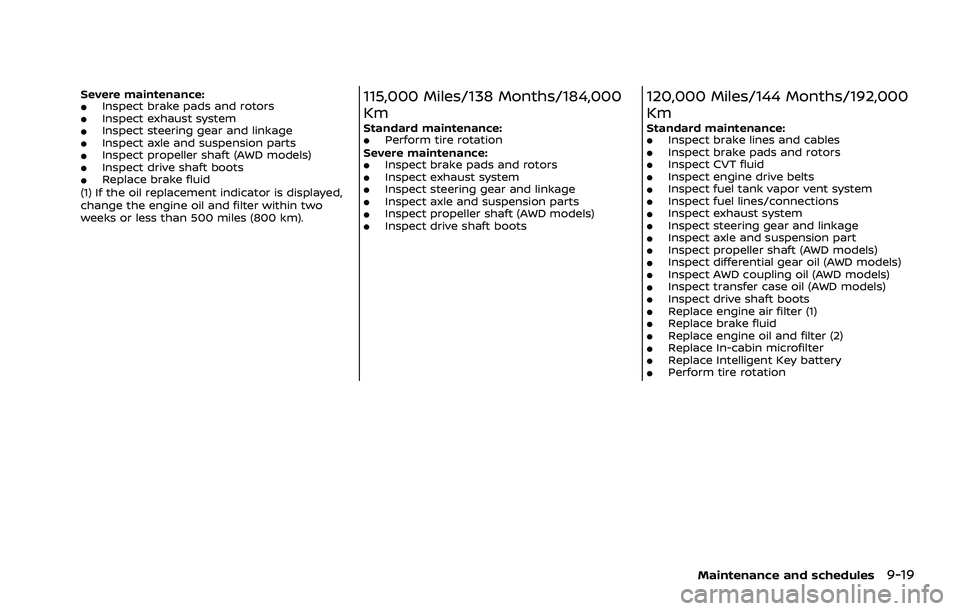
Severe maintenance:.Inspect brake pads and rotors.Inspect exhaust system.Inspect steering gear and linkage.Inspect axle and suspension parts.Inspect propeller shaft (AWD models).Inspect drive shaft boots.Replace brake fluid
(1) If the oil replacement indicator is displayed,
change the engine oil and filter within two
weeks or less than 500 miles (800 km).
115,000 Miles/138 Months/184,000
Km
Standard maintenance:.Perform tire rotation
Severe maintenance:
.Inspect brake pads and rotors.Inspect exhaust system.Inspect steering gear and linkage.Inspect axle and suspension parts.Inspect propeller shaft (AWD models).Inspect drive shaft boots
120,000 Miles/144 Months/192,000
Km
Standard maintenance:.Inspect brake lines and cables.Inspect brake pads and rotors.Inspect CVT fluid.Inspect engine drive belts.Inspect fuel tank vapor vent system.Inspect fuel lines/connections.Inspect exhaust system.Inspect steering gear and linkage.Inspect axle and suspension part.Inspect propeller shaft (AWD models).Inspect differential gear oil (AWD models).Inspect AWD coupling oil (AWD models).Inspect transfer case oil (AWD models).Inspect drive shaft boots.Replace engine air filter (1).Replace brake fluid.Replace engine oil and filter (2).Replace In-cabin microfilter.Replace Intelligent Key battery.Perform tire rotation
Maintenance and schedules9-19
Page 535 of 556

Sway control device
Sudden maneuvers, wind gusts and buf-
feting caused by other vehicles can affect
trailer handling. Sway control devices
may be used to help control these affects.
If you choose to use one, contact a
reputable trailer hitch supplier to make
sure the sway control device will work
with the vehicle, hitch, trailer and the
trailer’s brake system. Follow the instruc-
tions provided by the manufacturer for
installing and using the sway control
device.
Class I hitch
Class I trailer hitch equipment (receiver,
ball mount and hitch ball) can be used to
tow trailers of a maximum weight of
2,000 lb (907 kg).
Tire pressures
.When towing a trailer, inflate the
vehicle tires to the recom-
mended cold tire pressure indi-
cated on the Tire and Loading
Information label.
. Trailer tire condition, size, load
rating and proper inflation pres-
sure should be in accordance
with the trailer and tire manu-
facturers’ specifications. Safety chains
Always use a suitable chain between your
vehicle and the trailer. The safety chains
should be crossed and should be at-
tached to the hitch, not to the vehicle
bumper or axle. Be sure to leave enough
slack in the chains to permit turning
corners.
Trailer lights (if so equipped)
CAUTION
When splicing into the vehicle elec-
trical system, a commercially avail-
able power-type module/converter
must be used to provide power for
all trailer lighting. This unit uses the
vehicle battery as a direct power
source for all trailer lights while
using the vehicle tail light, stoplight
and turn signal circuits as a signal
source. The module/converter must
draw no more than 15 milliamps
from the stop and tail lamp circuits.
Using a module/converter that ex-
ceeds these power requirements
may damage the vehicle’s electrical
system. See a reputable trailer retai-
ler to obtain the proper equipment
and to have it installed. Trailer lights should comply with federal
and/or local regulations. For assistance in
hooking up trailer lights, contact a NISSAN
dealer or reputable trailer retailer.
Pre-towing tips
.
Be certain your vehicle maintains a
level position when a loaded or un-
loaded trailer is hitched. Do not drive
the vehicle if it has an abnormal nose-
up or nose-down condition; check for
improper tongue load, overload, worn
suspension or other possible causes
of either condition.
. Always secure items in the trailer to
prevent load shift while driving.
. Keep the cargo load as low as possible
in the trailer to keep the trailer center
of gravity low.
. Load the trailer so approximately 60%
of the trailer load is in the front half
and 40% is in the back half. Also make
sure the load is balanced side to side.
. Check your hitch, trailer tire pressure,
vehicle tire pressure, trailer light op-
eration, and trailer wheel lug nuts
every time you attach a trailer to the
vehicle.
. Be certain your rearview mirrors con-
form to all federal, state or local
regulations. If not, install any mirrors
required for towing before driving the
Technical and consumer information10-23
Page 541 of 556
You may notify NISSAN by contact-
ing our Consumer Affairs Depart-
ment, toll-free, at 1-800-NISSAN-1.
For Canada
If you believe that your vehicle has
a defect which could cause a crash
or could cause injury or death, you
should immediately inform Trans-
port Canada in addition to notifying
NISSAN.
If Transport Canada receives com-
plaints, it may open an investiga-
tion, and if it finds that a safety
defect exists in a group of vehicles,
it may request that NISSAN con-
duct a recall campaign. However,
Transport Canada cannot become
involved in individual problems be-
tween you, your dealer, or NISSAN.
You may contact Transport Cana-
da’s Defect Investigations and Re-
calls Division toll free at 1-800-333-
0510. You may also report safety
defects online at: https://
wwwapps.tc.gc.ca/Saf-Sec-Sur/7/
PCDB-BDPP/fc-cp.aspx?lang=eng
(English speakers) or https://wwwapps.tc.gc.ca/Saf-Sec-Sur/7/
PCDB-BDPP/fc-cp.aspx?lang=fra
(French speakers).
Additional information concerning
motor vehicle safety may be ob-
tained from Transport Canada’s
Road Safety Information Centre at
1-800-333-0371 or online at www.
tc.gc.ca/roadsafety (English speak-
ers) or www.tc.gc.ca/securiterou-
tiere (French speakers).
To notify NISSAN of any safety
concerns please contact our Con-
sumer Information Centre toll free
at 1-800-387-0122.
WARNING
A vehicle equipped with All-Wheel
Drive (AWD) should never be tested
using a two wheel dynamometer
(such as the dynamometers used by
some states for emissions testing),
or similar equipment. Make sure you
inform test facility personnel that
your vehicle is equipped with AWD
before it is placed on a dynam-
ometer. Using the wrong test equip-
ment may result in transmission
damage or unexpected vehicle
movement which could result in
serious vehicle damage or personal
injury.
Due to legal requirements in some states/
areas or provinces, your vehicle may be
required to be in what is called the “ready
condition” for an Inspection/Maintenance
(I/M) test of the emission control system.
The vehicle is set to the “ready condition”
when it is driven through certain driving
patterns. Usually, the “ready condition”
can be obtained by ordinary usage of
the vehicle.
If a powertrain system component is
repaired or the battery is disconnected,
the vehicle may be reset to a “not ready
Technical and consumer information10-29
READINESS FOR INSPECTION/
MAINTENANCE (I/M) TEST
Page 550 of 556
11-4
J
Jump starting ................................................................. 6-11
K
KeyIgnition switch positions ................................ 5-15
Keyless entry With Intelligent Key system (See
Intelligent Key system) ..................................... 3-15
Keys ........................................................................\
.................... 3-3 For Intelligent Key system................................ 3-7
L
LabelsAir bag warning labels ..................................... 1-66
Air conditioner specification label....... 10-11
Emission control information label .... 10-11
Engine serial number .................................... 10-10
F.M.V.S.S./C.M.V.S.S.
certification label .............................................. 10-10
Tire and Loading
information label................................ 8-27, 10-11
Vehicle identification number (VIN)........ 10-9
Lane Departure Warning (LDW) ........................ 5-46
LATCH system ................................................................ 1-25
License plate, Installing front
license plate.................................................................. 10-12
Liftgate........................................................................\
......... 3-23 Auto closure ............................................................. 3-28
Liftgate release lever ......................................... 3-28
Operating manual liftgate............................. 3-23
Operating power liftgate................................ 3-24
Light Air bag warning light......................................... 1-66 Bulb replacement ................................................. 8-22
Cargo light ................................................................. 2-87
Fog light switch ..................................................... 2-62
Headlight switch ................................................... 2-55
Headlights bulb replacement ..................... 8-23
Indicator lights........................................................ 2-17
Interior lights............................................................ 2-85
Map lights ................................................................... 2-86
Rear personal lights ........................................... 2-86
Room lights ............................................................... 2-86
Vanity mirror lights ............................................. 2-87
Warning lights, indicator lights and
audible reminders ................................................ 2-14
Lights, Exterior and interior
light replacement ........................................................ 8-23
Loading information (See vehicle
loading information) .............................................. 10-13
Lock Automatic door locks........................................... 3-7
Door locks...................................................................... 3-5
Power door lock ....................................................... 3-5
Low tire pressure warning (Tire
Pressure Low)................................................................. 2-35
Low tire pressure warning light ...................... 2-18
Low tire pressure warning system (See
Tire Pressure Monitoring System (TPMS)) ..... 5-6
Lower console tray .................................................... 2-76
Luggage hooks ............................................................. 2-78
M
Maintenance Battery........................................................................\
... 8-11
General maintenance........................................... 9-2
Maintenance precautions................................. 8-2
Maintenance requirements ............................. 9-2
Maintenance schedules...................................... 9-7 Seat belt maintenance..................................... 1-20
Standard maintenance ....................................... 9-8
Maintenance schedules.............................................. 9-7
Malfunction indicator light (MIL)...................... 2-19
Manual air conditioner and heater ............... 4-28
Manual front seat adjustment .............................. 1-4
Map lights ........................................................................\
.. 2-86
Master warning light.................................. 2-16, 2-20
Mechanical key (Intelligent Key system) ....... 3-4
Memory seat ................................................................... 3-36
Meters and gauges ........................................................ 2-5 Instrument brightness control .................. 2-11
Mirror Inside mirror ............................................................. 3-33
Outside mirrors ...................................................... 3-34
Vanity mirror ............................................................ 3-36
Moonroof........................................................................\
.... 2-83
Moving Object Detection (MOD) ...................... 4-22
N
Neutral hold mode ..................................................... 5-22
New vehicle break-in ............................................. 5-149
NISSAN Vehicle Immobilizer System ............ 2-51
O
Odometer........................................................................\
....... 2-8
OFF-ROAD mode.......................................................... 5-31
Off-road recovery ........................................................ 5-10
Oil
Capacities and
recommended fluids/lubricants............... 10-3
Changing engine oil and filter ...................... 8-6
Checking engine oil level................................... 8-5
Engine oil.....................................................................\
... 8-5
Engine oil viscosity .............................................. 10-7