tires NISSAN ROGUE 2021 Owner´s Manual
[x] Cancel search | Manufacturer: NISSAN, Model Year: 2021, Model line: ROGUE, Model: NISSAN ROGUE 2021Pages: 556, PDF Size: 2.7 MB
Page 520 of 556

10-8Technical and consumer information
ENGINE
ModelPR25DD
Type Gasoline, 4-cycle, DOHC
Cylinder arrangement 4-cylinder, in-line
Bore × Stroke in (mm)3.504 × 3.937 (89.0 × 100.0)
Displacement cu in (cm
3)151.85 (2,488)
Firing order 1-3-4-2
Idle speed rpm
No adjustment is necessary.
Ignition timing (B.T.D.C.) degree/rpm
Spark plug StandardDXE22H11C
Spark plug gap (Normal) in (mm)0.043 (1.1)
Camshaft operation Timing chain
This spark ignition system complies with the Canadian standard ICES-002.
WHEELS AND TIRES
Road wheel
TypeSize Offset in
(mm)
Conven-
tional 17 × 7.5J 1.57 (40)
18 × 7.5J 1.57 (40)
19 × 7.5J 1.57 (40)
Spare 17 × 4T 1.18 (30)
Tire
Type
SizePressure PSI
(kPa) [Cold]
Con-
ven-
tional 235/65 R17Front: 36
(250)
Rear: 33 (230)
235/60 R18 Front: 33
(230)
Rear: 30 (210)
235/55 R19
Spare T155/80 D17
(2WD)
T165/90 D17
(AWD)
60 (420)
SPECIFICATIONS
Page 527 of 556
weight may not safely exceed
the available cargo and luggage
load capacity calculated in Step
4.
Before driving a loaded vehicle,
confirm that you do not exceed
the Gross Vehicle Weight Rating
(GVWR) or the Gross Axle Weight
Rating (GAWR) for your vehicle. (See
“Measurement of weights” (P.10-16).)
Also check tires for proper inflation
pressures. See the Tire and Loading
Information label.
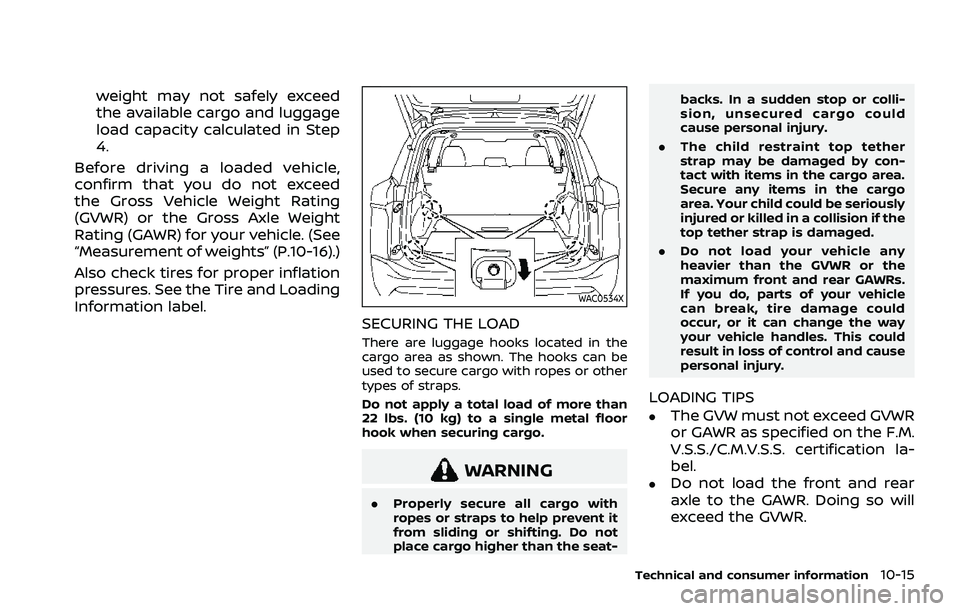
WAC0534X
SECURING THE LOAD
There are luggage hooks located in the
cargo area as shown. The hooks can be
used to secure cargo with ropes or other
types of straps.
Do not apply a total load of more than
22 lbs. (10 kg) to a single metal floor
hook when securing cargo.
WARNING
. Properly secure all cargo with
ropes or straps to help prevent it
from sliding or shifting. Do not
place cargo higher than the seat- backs. In a sudden stop or colli-
sion, unsecured cargo could
cause personal injury.
. The child restraint top tether
strap may be damaged by con-
tact with items in the cargo area.
Secure any items in the cargo
area. Your child could be seriously
injured or killed in a collision if the
top tether strap is damaged.
. Do not load your vehicle any
heavier than the GVWR or the
maximum front and rear GAWRs.
If you do, parts of your vehicle
can break, tire damage could
occur, or it can change the way
your vehicle handles. This could
result in loss of control and cause
personal injury.
LOADING TIPS
.The GVW must not exceed GVWR
or GAWR as specified on the F.M.
V.S.S./C.M.V.S.S. certification la-
bel.
.Do not load the front and rear
axle to the GAWR. Doing so will
exceed the GVWR.
Technical and consumer information10-15
Page 535 of 556

Sway control device
Sudden maneuvers, wind gusts and buf-
feting caused by other vehicles can affect
trailer handling. Sway control devices
may be used to help control these affects.
If you choose to use one, contact a
reputable trailer hitch supplier to make
sure the sway control device will work
with the vehicle, hitch, trailer and the
trailer’s brake system. Follow the instruc-
tions provided by the manufacturer for
installing and using the sway control
device.
Class I hitch
Class I trailer hitch equipment (receiver,
ball mount and hitch ball) can be used to
tow trailers of a maximum weight of
2,000 lb (907 kg).
Tire pressures
.When towing a trailer, inflate the
vehicle tires to the recom-
mended cold tire pressure indi-
cated on the Tire and Loading
Information label.
. Trailer tire condition, size, load
rating and proper inflation pres-
sure should be in accordance
with the trailer and tire manu-
facturers’ specifications. Safety chains
Always use a suitable chain between your
vehicle and the trailer. The safety chains
should be crossed and should be at-
tached to the hitch, not to the vehicle
bumper or axle. Be sure to leave enough
slack in the chains to permit turning
corners.
Trailer lights (if so equipped)
CAUTION
When splicing into the vehicle elec-
trical system, a commercially avail-
able power-type module/converter
must be used to provide power for
all trailer lighting. This unit uses the
vehicle battery as a direct power
source for all trailer lights while
using the vehicle tail light, stoplight
and turn signal circuits as a signal
source. The module/converter must
draw no more than 15 milliamps
from the stop and tail lamp circuits.
Using a module/converter that ex-
ceeds these power requirements
may damage the vehicle’s electrical
system. See a reputable trailer retai-
ler to obtain the proper equipment
and to have it installed. Trailer lights should comply with federal
and/or local regulations. For assistance in
hooking up trailer lights, contact a NISSAN
dealer or reputable trailer retailer.
Pre-towing tips
.
Be certain your vehicle maintains a
level position when a loaded or un-
loaded trailer is hitched. Do not drive
the vehicle if it has an abnormal nose-
up or nose-down condition; check for
improper tongue load, overload, worn
suspension or other possible causes
of either condition.
. Always secure items in the trailer to
prevent load shift while driving.
. Keep the cargo load as low as possible
in the trailer to keep the trailer center
of gravity low.
. Load the trailer so approximately 60%
of the trailer load is in the front half
and 40% is in the back half. Also make
sure the load is balanced side to side.
. Check your hitch, trailer tire pressure,
vehicle tire pressure, trailer light op-
eration, and trailer wheel lug nuts
every time you attach a trailer to the
vehicle.
. Be certain your rearview mirrors con-
form to all federal, state or local
regulations. If not, install any mirrors
required for towing before driving the
Technical and consumer information10-23
Page 538 of 556
10-26Technical and consumer information
the water or the trailer lights may
burn out.
When towing a trailer, the Continuously
Variable Transmission (CVT) fluid, trans-
fer fluid and differential gear oil should
be changed more frequently. For addi-
tional information, see the "9. Mainte-
nance and schedules" section.FLAT TOWING FOR ALL–WHEEL
DRIVE VEHICLE (if so equipped)
Towing your vehicle with all four wheels
on the ground is sometimes called flat
towing. This method is sometimes used
when towing a vehicle behind a recrea-
tional vehicle, such as a motor home.
CAUTION
. Failure to follow these guidelines
can result in severe transmission
damage.
. Never flat tow your All-Wheel
Drive (AWD) vehicle.
. DO NOT tow your All-Wheel Drive
(AWD) vehicle with any wheels on
the ground. Doing so may cause
serious and expensive damage to
the powertrain.
. For emergency towing proce-
dures refer to “Towing recom-
mended by NISSAN” (P.6-16).
FLAT TOWING FOR FRONT-WHEEL
DRIVE VEHICLE (if so equipped)
Towing your vehicle with all four wheels
on the ground is sometimes called flat
towing. This method is sometimes used
when towing a vehicle behind a recrea-
tional vehicle, such as a motor home.
CAUTION
.Failure to follow these guidelines
can result in severe transmission
damage.
. Whenever flat towing your vehi-
cle, always tow forward, never
backward.
. Never tow your front wheel drive
vehicle with the front tires on the
ground. Doing so may cause ser-
ious and expensive damage to
the powertrain.
. DO NOT tow your front wheel
drive Continuously Variable
Transmission (CVT) vehicle with
all four wheels on the ground (flat
towing). Doing so WILL DAMAGE
internal transmission parts due
to lack of transmission lubrica-
tion.
FLAT TOWING
Page 539 of 556
.For emergency towing proce-
dures refer to “Towing recom-
mended by NISSAN” in the “In
case of emergency” section of
this manual.
Continuously Variable Transmis-
sion (CVT)
To tow a vehicle equipped with a CVT, an
appropriate vehicle dolly MUSTbe placed
under the towed vehicle’s drive wheels.
Always follow the dolly manufacturer’s
recommendations when using their pro-
duct. DOT (Department Of Transportation)
Quality Grades: All passenger car tires
must conform to federal safety require-
ments in addition to these grades.
Quality grades can be found where ap-
plicable on the tire sidewall between
tread shoulder and maximum section
width. For example:
Treadwear 200 Traction AA Tempera-
ture A
TREADWEAR
The treadwear grade is a comparative
rating based on the wear rate of the tire
when tested under controlled conditions
on a specified government test course.
For example, a tire graded 150 would
wear one and one-half
(1 1/2) times as well on the government
course as a tire graded 100. The relative
performance of tires depends upon ac-
tual conditions of their use, however, and
may depart significantly from the norm
due to variations in driving habits, service
practices and differences in road charac-
teristics and climate.
TRACTION AA, A, B AND C
The traction grades, from highest to low-
est, are AA, A, B and C. Those grades
represent the tire’s ability to stop on wet
pavement as measured under controlled
conditions on specified government test
surfaces of asphalt and concrete. A tire
marked C may have poor traction perfor-
mance.
WARNING
The traction grade assigned to this
tire is based on straight-ahead brak-
ing traction tests, and does not
include acceleration, cornering, hy-
droplaning, or peak traction charac-
teristics.
TEMPERATURE A, B AND C
The temperature grades A (the highest),
B, and C, representing the tire’s resistance
to the generation of heat and its ability to
dissipate heat when tested under con-
trolled conditions on a specified indoor
laboratory test wheel. Sustained high
temperature can cause the material of
the tire to degenerate and reduce tire life,
and excessive temperature can lead to
sudden tire failure. The grade C corre-
sponds to a level of performance which
Technical and consumer information10-27
UNIFORM TIRE QUALITY GRADING
Page 540 of 556
10-28Technical and consumer information
all passenger car tires must meet under
the Federal Motor Vehicle Safety Stan-
dard No. 109. Grades B and A represent
higher levels of performance on the
laboratory test wheel than the minimum
required by law.
WARNING
The temperature grade for this tire is
established for a tire that is properly
inflated and not overloaded. Exces-
sive speed, under-inflation, or exces-
sive loading, either separately or in
combination, can cause heat build-
up and possible tire failure.Your vehicle is covered by the following
emission warranties.
For USA:
.
Emission Defects Warranty
. Emissions Performance Warranty
Details of these warranties may be found
with other vehicle warranties in your
Warranty Information Booklet which
comes with your vehicle. If you did not
receive a Warranty Information Booklet,
or it has become lost, you may obtain a
replacement by writing to:
. Nissan North America, Inc.
Consumer Affairs Department
P.O. Box 685003
Franklin, TN 37068-5003
For Canada:
Emission Control System Warranty
Details of this warranty may be found
with other vehicle warranties in your
Warranty Information Booklet which
comes with your vehicle. If you did not
receive a Warranty Information Booklet,
or it has become lost, you may obtain a
replacement by writing to:
. Nissan Canada Inc.
5290 Orbitor Drive
Mississauga, Ontario,
L4W 4Z5
For USA
If you believe that your vehicle has
a defect which could cause a crash
or could cause injury or death, you
should immediately inform the Na-
tional Highway Traffic Safety Ad-
ministration (NHTSA) in addition to
notifying NISSAN.
If NHTSA receives similar com-
plaints, it may open an investiga-
tion, and if it finds that a safety
defect exists in a group of vehicles,
it may order a recall and remedy
campaign. However, NHTSA cannot
become involved in individual pro-
blems between you, your dealer, or
NISSAN.
To contact NHTSA, you may call the
Vehicle Safety Hotline toll-free at 1-
888- 327-4236 (TTY: 1-800-424-
9153); go to http://www.safercar.
gov; or write to: Administrator,
NHTSA, 400 Seventh Street, SW.,
Washington, D.C. 20590. You can
also obtain other information
about motor vehicle safety from
http://www.safercar.gov.
EMISSION CONTROL SYSTEM WARRANTYREPORTING SAFETY DEFECTS
Page 552 of 556
11-6
ShiftingCVT (Continuously
Variable Transmission)..................................... 5-19
Shoulder belt height adjustment, For
front seats........................................................................\
. 1-18
Side Driving Aids........................................................... 5-34
SNOW mode..................................................................... 5-32
Soft bottle holders...................................................... 2-72
Sonar Rear Automatic Braking (RAB) ............... 5-143
Rear Sonar System (RSS)............................ 5-168
Sonar system....................................................... 5-162
SOS button (See Emergency Call
(SOS) button)................................................................... 2-70
Spare tire............................................................. 8-36, 10-8
Spark plugs....................................................................... 8-14
Speed Adjust by Route (ProPILOT Assist
with Navi-link).............................................................. 5-105
Speed and Average speed ................................... 2-44
Speed Limit Assist (ProPILOT Assist
with Navi-link).............................................................. 5-102
Speedometer ...................................................................... 2-8
SPORT mode ................................................................... 5-33
SRS Precautions on SRS ............................................ 1-46
Standard maintenance ............................................... 9-8
STANDARD mode......................................................... 5-32
Starting Before starting the engine............................ 5-17
Jump starting .......................................................... 6-11
Precautions when starting
and driving.................................................................... 5-5
Push starting............................................................ 6-13
Starting the engine............................................. 5-17
Status light, Front passenger air bag ......... 1-54
Steering Electric power steering................................ 5-154 Heated steering wheel ..................................... 2-63
Tilt/telescopic steering .................................... 3-31
Steering Assist ............................................................ 5-113
Steering Assist switch.............................................. 2-65
Storage ........................................................................\
........ 2-71
Sun visors ........................................................................\
.. 3-32
Sunglasses holder....................................................... 2-76
Sunshade (rear)............................................................. 3-32
Supplemental air bag warning labels ......... 1-66
Supplemental air bag
warning light .................................................... 1-66, 2-16
Supplemental Restraint System (SRS) ........ 1-46
switch Drive Mode Selector ........................................... 5-30
Emergency Call (SOS) button ..................... 2-70
Fog light switch ..................................................... 2-62
Hazard warning flasher switch .................... 6-2
Headlight switch ................................................... 2-55
Intelligent Auto Headlight switch ............ 2-56
Memory seat switch........................................... 3-36
Power door lock switch ..................................... 3-6
Rear window and outside mirror
defroster switch .................................................... 2-55
Steering Assist switch....................................... 2-65
Turn signal switch ............................................... 2-62
Wiper and washer switch .............................. 2-52
T
Tachometer........................................................................\
.. 2-9
Temperature gauge, Engine coolant
temperature gauge ....................................................... 2-9
Theft (NISSAN Vehicle Immobilizer
System), Engine start ............................................... 2-51
Three-way catalyst......................................................... 5-6
Tilt/telescopic steering ........................................... 3-31 Tire pressure, Low tire pressure
warning light ................................................................... 2-18
Tires
Easy-Fill Tire Alert system................................. 5-9
Flat tire........................................................................\
..... 6-3
Low tire pressure warning system ........... 5-6
Tire and Loading
information label................................ 8-27, 10-11
Tire chains.................................................................. 8-32
Tire dressing................................................................ 7-4
Tire pressure ............................................................ 8-25
Tire pressure monitoring
system (TPMS)................................................. 5-6, 6-3
Tire rotation.............................................................. 8-33
Types of tires ........................................................... 8-31
Uniform tire quality grading .................... 10-27
Wheel/tire size ........................................................ 10-8
Wheels and tires .................................................... 8-25
Towing Tow truck towing................................................. 6-15
Towing a trailer.................................................. 10-16
Towing safety...................................................... 10-21
TPMS, Tire pressure monitoring system....... 5-6 TPMS with Easy Fill Tire Alert......................... 5-9
TPMS, Tire pressure warning system .............. 6-3
Traffic Sign Recognition (TSR)........................... 5-43
Trailer towing .............................................................. 10-16
Transmission Continuously Variable Transmission
(CVT) fluid....................................................................... 8-8
Driving with CVT (Continuously
Variable Transmission)..................................... 5-19
Transmitter, With Intelligent Key system
(See Intelligent Key system) ................................ 3-15
Traveling or registering in
another country ........................................................... 10-9
Trip computer ................................................................ 2-44
Page 553 of 556
Trip odometer ................................................................ 2-44
Troubleshooting guideDriver Assistance systems............................. 5-39
Turn signal switch ...................................................... 2-62
U
Underbody cleaning ...................................................... 7-3
Uniform tire quality grading ............................ 10-27
USB (Universal Serial Bus)
charging connector................................................... 2-67
V
Vanity mirror ................................................................... 3-36
Vanity mirror lights .................................................... 2-87
Variable voltage control system ..................... 8-13
Vehicle Dimensions and weights................................ 10-9
Identification number (VIN)........................... 10-9
Loading information ...................................... 10-13
Recovery (freeing a stuck vehicle) .......... 6-17
Security system...................................................... 2-50
Vehicle Dynamic Control
(VDC) system ........................................................ 5-157
Vehicle information display................................. 2-22 Settings........................................................................\
. 2-24
Vehicle information display warnings
and indicators ......................................................... 2-34
Ventilators ........................................................................\
. 4-26
W
Warning Blind Spot Warning (BSW) .............................. 5-57
Driver Assistance systems
troubleshooting guide...................................... 5-39 Hazard warning flasher switch .................... 6-2
Intelligent Forward Collision
Warning (I-FCW).................................................. 5-132
Lane Departure Warning (LDW) ................. 5-46
Lights..................................................................\
............ 2-14
Low tire pressure warning............................ 2-35
Rear Door Alert....................................................... 2-65
Tire pressure monitoring
system (TPMS)................................................. 5-6, 6-3
Vehicle information display.......................... 2-22
Warning lights, indicator lights and
audible reminders ................................................ 2-13
Warning labels, Air bag warning labels...... 1-66
Warning light Air bag warning light.......................... 1-66, 2-16
Anti-lock Braking System (ABS)
warning light ............................................................ 2-17
Brake warning light ............................................ 2-14
Electric power steering
warning light ............................................................ 2-17
Electric shift control system
warning light ............................................................ 2-15
Electronic parking brake system
warning light ............................................................ 2-18
Low tire pressure warning light ............... 2-18
Seat belt warning light
and chime.................................................... 1-15, 2-16
Warranty, Emission control
system warranty ....................................................... 10-28
Washer switch Rear window wiper and
washer operation ................................................. 2-53
Wiper and washer switch .............................. 2-52
Washing........................................................................\
........... 7-2
Waxing ........................................................................\
.............. 7-3
Weights (See dimensions and weights)..... 10-9
Wheel/tire size ............................................................... 10-8 Wheels and tires ........................................................... 8-25
Care of wheels........................................................... 7-3
Cleaning aluminum alloy wheels ................ 7-3
Window washer fluid .................................................... 8-9
Window(s) Cleaning ........................................................................\
.. 7-3
Power windows ..................................................... 2-79
Wiper Rear window wiper blade.............................. 8-17
Wiper and washer switch .............................. 2-52
Wiper blades ............................................................. 8-16
Wiper and washer switch ..................................... 2-52
Wireless charger ........................................................... 2-68
11-7
Page 554 of 556
FUEL INFORMATION:
Use unleaded regular gasoline with an
octane rating of at least 87 AKI (Anti-
Knock Index) number (Research octane
number 91).
CAUTION
.Using a fuel other than that spe-
cified could adversely affect the
emission control system, and
may also affect warranty cover-
age.
. Under no circumstances should a
leaded gasoline be used, because
this will damage the three-way
catalyst.
. Do not use a fuel containing more
than 15% ethanol in your vehicle.
Your vehicle is not designed to
run on a fuel containing more
than 15% ethanol. Using a fuel
containing more than 15% etha-
nol in a vehicle not specifically
designed for a fuel containing
more than 15% ethanol can ad-
versely affect the emission con-
trol devices and systems of the
vehicle. Damage caused by such fuel is not covered by the NISSAN
new vehicle limited warranty.
. Do not use fuel that contains the
octane booster methylcyclopen-
tadienyl manganese tricarbonyl
(MMT). Using fuel containing
MMT may adversely affect vehicle
performance and vehicle emis-
sions. Not all fuel dispensers are
labeled to indicate MMT content,
so you may have to consult your
gasoline retailer for more details.
Note that Federal and California
laws prohibit the use of MMT in
reformulated gasoline.
. U.S. government regulations re-
quire ethanol dispensing pumps
to be identified by a small,
square, orange and black label
with the common abbreviation or
the appropriate percentage for
that region.
For additional information, see “Capaci-
ties and recommended fluids/lubricants”
(P.10-3).
ENGINE OIL RECOMMENDATION:
See “Capacities and recommended fluids/
lubricants” (P.10-3) for engine oil and oil
filter recommendation.
COLD TIRE PRESSURES:
For additional information, see “Tire and
Loading Information label” (P.10-11).
The label is typically located on the driver
side center pillar. For additional informa-
tion, see “Wheels and tires” (P.8-25).
NEW VEHICLE BREAK-IN PROCE-
DURES RECOMMENDATION:
During the first 1,200 miles (2,000 km) of
vehicle use, follow the recommendations
outlined in the “Break-in schedule” (P.5-
149) of this Owner’s Manual. Follow these
recommendations for the future reliability
and economy of your new vehicle.
GAS STATION INFORMATION